
 ≈ 66 min
The four previous chapters have done everything that has to be done before defining, and have not defined. They have read what was wanted on the first night, said what happens to whoever has a scene of the Nativity before them, gone layer by layer through the world that was born from it, and measured how much of that world the word manages to name in the two languages that have it. All that is missing is what anyone asks first: what this is, said in a sentence that can be repeated.
The order has not been a detour. A definition stated at the beginning is not proved afterwards: it is illustrated, and the subject is full of definitions born that way. This one comes at the end because each of its words has behind it a chapter that has established it, and the reader can go and check. It is the difference between a sentence that rests on whoever signs it and one that rests on what precedes it. This Manual has no academy or decree to back it, and does not need them: it has the record in plain view.
There is one more thing the previous chapter established that should be kept in mind from the first line, because it explains why this definition does not resemble those in circulation. The inherited definitions — those of the dictionaries, and the one in the document that declares nativity-scene art and practice heritage in Spain— define by the object: by the figures, the setting and the season. And they do so because the vocabulary in which they are written looks at the object: Krippenbau is «nativity-scene building», presepistica is «the art of building and setting up», pessebrisme is «art de construir» — the art of building—.1 Whoever defines from there is not mistaken; they say what their word lets them say. A definition by purpose has to break that habit knowingly, and say so.
The name, first
In Spanish, the definition begins by naming the practice, and it cannot write that first word without having chosen it. The previous chapter prepared the decision with a six-point case file and did not take it, because it is not a decision of method but one for the author.2 It is taken here, and taken with the case file in front of it.
The six points, in one sentence each, so that the reader does not have to go back. One: in the dictionary of the Spanish language, belenismo carries the label for Spain and pesebrismo carries none. Two: the other five languages of the Manual name the object after the manger, not after the town, and the Latin of the international federation goes the same way. Three: the sign the evangelist gives is the manger. Four: the Catalan word was born marked as belonging to one city and is today standard with no label at all — a century ago it travelled the road that the Spanish word still has ahead of it—. Five: the noise is shared out: belén carries the muddle in the base word, pesebrismo the sinecure in the derivative. Six: when, in Spanish, a name first had to be found for whoever does this, the root of the manger was chosen, and the one used today came later.
With that in front of it, the word with which this Manual names the practice in Spanish is belenismo. It is a decision of Emili Solé, taken on 16 September 2026, and the reasons that accompany it are those the case file allows to be given; none of them makes the other word wrong.
The first is Confucius's, with which the previous chapter opened: the name the practice needs in order to be seen is the one the practice uses. Today, in Spanish, the word in use is belenismo: it has been the dictionary's word since 2014 and that of the federation grouping the associations since 1963, and it is the word in the title of the open encyclopedia anyone consults and in the Real Decreto that declares it heritage.3 A manual that sets out to have the practice understood gains nothing by beginning with a change to the name by which those who practise it recognise it.
The second is that the noise, as the previous chapter showed, is symmetrical: neither house is clean. If noise does not decide, usage decides; and usage has been counted.
The third concerns the word itself. Belenismo is a word in -ismo, and such a word does a job that the word for the object cannot do — it disambiguates—: belén on its own is the town, the scene, a woman's name and a muddle; belenismo is a single thing. On this the two roots tie, and the tie leaves the decision where it was: in usage.
What the decision does not do, said so that it is not asked for what it does not promise. It does not erase pesebrismo: the dictionary's unlabelled word, the one that names Luke's sign and the one usage chose first, remains a word of this Manual, and its Spanish version uses it as what it is — the other word for the same practice, without hierarchy—, as the previous chapter already said when it declared the criterion with which the six versions are written.4 Nor does it decide anything for the four languages that have no word: a definition that does not legislate the usage of others cannot begin by legislating the name used by others. In French, English, German and Italian the definition is written without a subject — the world of an art, that of…—, and it is understood just the same; what word each of those languages adopts, if it adopts any, will be decided by its speakers, and the previous chapter noted that English is, of the four, the door most open to a loanword.5 This Manual does not propose the international word; it proposes the definition, which is what a word, when it comes, will have to name.
The definition
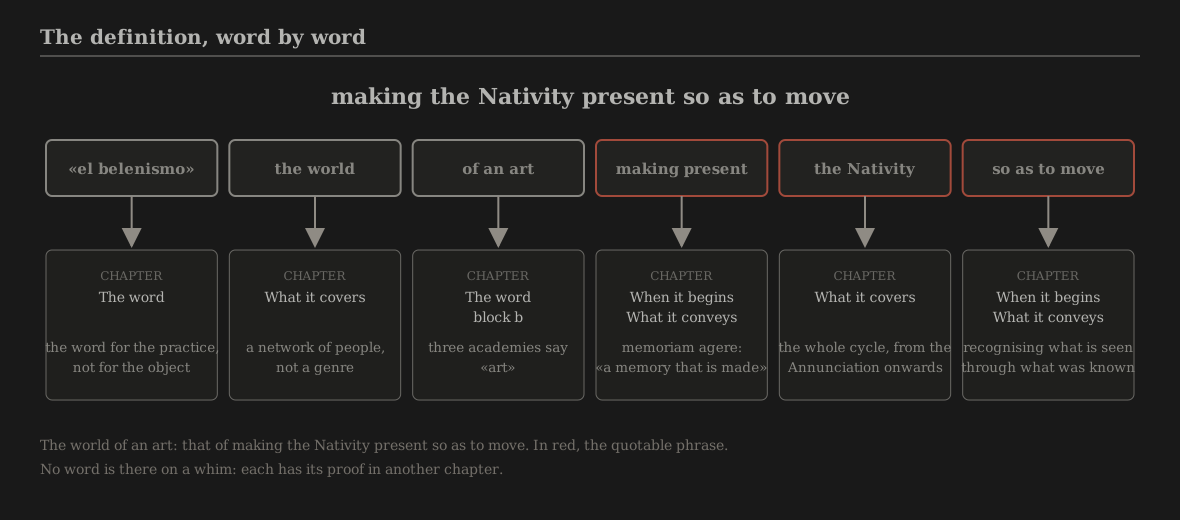
The world of an art: that of making the Nativity present so as to move. It comprises its works — in any mode: figures of any scale and material, people, paper, light, song, poetry —, those who make them and their crafts, how they are made, its history, its traditions and those who seek them out.
What can be quoted is the short phrase: making the Nativity present so as to move — in Spanish, six words: «hacer presente el Nacimiento para conmover»—. A definition displaces another when someone can say it by heart, and this phrase can be said by heart in all six languages of this Manual. What follows the colon is not the definition: it is its articulation, the inventory of what the sentence covers, and it is there so that nobody can say that the short phrase leaves out something the chapter on the world put in.
It is worth noting what kind of sentence this is, because it is neither a dictionary entry nor an administrative category. A dictionary identifies: it gives the genus and just enough for whoever comes across the word to know what is being spoken of, and it has already been said that this is not a defect but its job.6 A heritage dossier classifies: it puts the practice into a pigeonhole so that a law can be applied to it. This sentence does something else: it says from what understanding this Manual works, and says it in such a way that each word can be traced back to its proof. It is a criterion of practice. Whoever reads it will know what is meant here by nativity-scene art and practice and will be able to dispute it word by word, which is exactly what is wanted.
And an observation on its form, which is not accidental. The definition has a proximate genus and a specific difference, as logic has always required: the genus is art — or rather, the world of an art—, and the difference is the purpose, making the Nativity present so as to move. The inherited definitions put the difference in the object: in the figures, in the setting, in the date. This one puts it in what the thing is done for. The whole of the rest of this chapter is the proof that this choice is not a matter of taste but a necessity: that the difference by object fails in its own cases, and the difference by purpose gets them all right with fewer words.
Word by word
Each word of the sentence has a chapter behind it. They are taken in order, and for each one it is said what it establishes, where that is established and what it does not say.
The subject: «El belenismo es». The Spanish sentence opens with «El belenismo es» — belenismo is—, and the name has just been decided. What matters here is that the sentence defines the practice and not the object: it does not say «un belén es» — a nativity scene is—, it says «el belenismo es». The previous chapter proved that Spanish has had one word for the object and another for the practice for more than a century, and that defining the practice with the definition of the object is the original error of the Spanish dossier — defining music with the definition of the tango, as this Manual puts it—.7 The Spanish sentence begins with the word for the practice and does not let go of it. The English one, in a language that has no such word, begins directly with «The world», and makes the same choice: nowhere does it say «a nativity scene is».
«The world». Not a genre. The chapter on the world established this with Howard Becker's notion: an art world is the network of people whose cooperative activity produces the works for which that world is known, and it comprises all the people whose activities are necessary to that production, not only the artists.8 Landscape and portrait are classes of works; this has people inside it: whoever models, whoever reproduces, whoever paints, whoever dresses the figures, whoever composes at home, whoever collects, whoever studies, whoever popularises, whoever sells, whoever exhibits, whoever looks. And it has a calendar and customs: Christmas Eve, the associations, the exhibitions, the museum room. Defining nativity-scene art and practice as the world of an art — and not simply as the art— is what allows the short phrase to cover all that without listing it, and what gives material to the very block in which this chapter is read: if it were only the making of nativity scenes, there would be nothing about its world to fill a whole block.
«Of an art». It is the only thing that was won before starting, and it is not given away. Three academies — the Spanish, the Catalan and the Valencian— open their definitions with the same word, art («arte» in Spanish), and the previous chapter gathered them in a table.9 This Manual has also defended it on its own account, in the composition block: a nativity scene is made, one by one, of sculpture, painting, composition, scenography, lighting and art history, and what would need explaining is how a practice whose components are the fine arts could not be art.10 Here it is recapitulated and referred to. What the word art does not say — and it is worth saying now, because it comes back further down— is that every nativity scene is an accomplished work of art: it names a category, it does not guarantee the result.
«That of making… present». This is the verb, and it is the one that changes everything else. It comes from the first chapter of the series: Francis asked for memoriam agere, to celebrate the memory, with the verb with which the Latin of the Church says celebrate; and the second chapter found the exact turn of phrase in Spanish, in the liturgical sense of conmemoración — «memoria que se hace», a memory that is made— and in the difference between commemorating at a distance and commemorating by setting before oneself what is honoured.11 Making present is exactly that: not remembering, not representing from outside, but setting before. And it is a verb of creation, not of placement. The previous chapter explained why this Manual does not say, in Spanish, montar or poner — to set up, to put out—: because they name only the last operation and describe an ornament, and by describing it as an ornament they turn it into one.12 Making present names the whole operation — deciding what is made present, on what grounds, in what space, with what light, in what mode— and keeps inside it whoever models the original as much as whoever composes the scene at home.
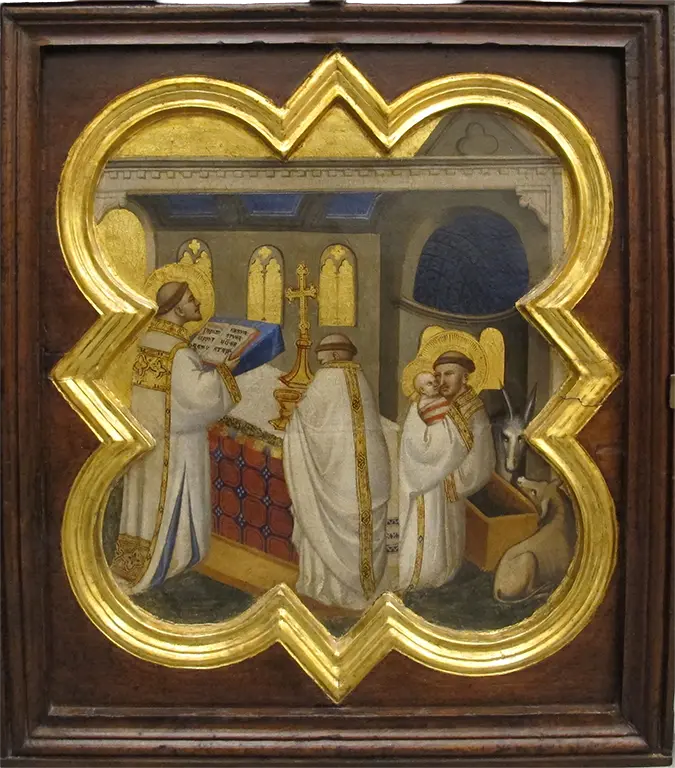

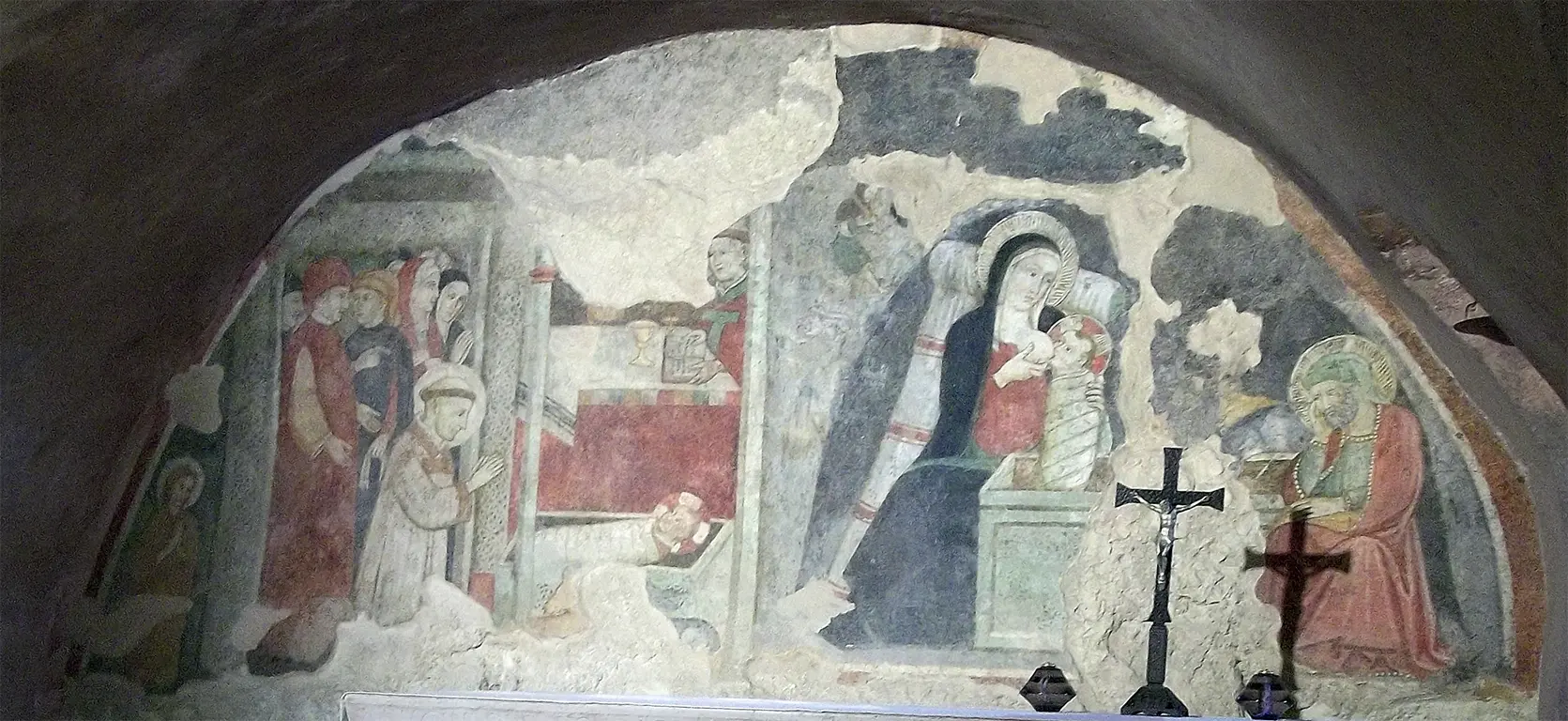

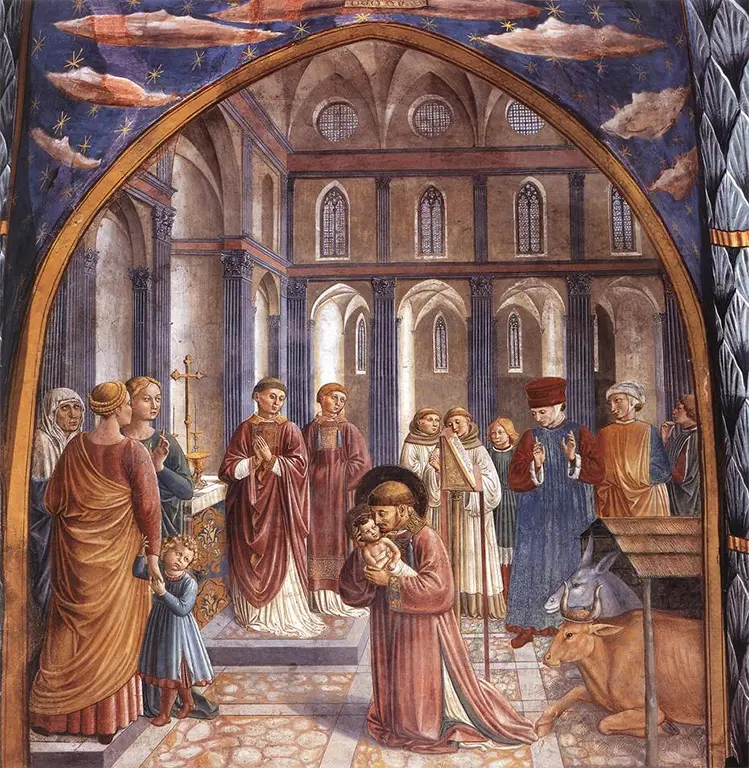

«The Nativity». With a capital letter, and it names the whole cycle. It is worth being exact, because this Manual's vocabulary distinguishes the Nativity of Jesus in the strict sense — the scene at the manger— from the Annunciation, the Adoration of the Shepherds, the Adoration of the Magi and the Presentation, and calls the Nativity cycle the set of scenes that groups them; the portal that orders them bears that name.13 The definition uses the word in that second sense, that of the cycle, and says so here so that nobody reads the short phrase as if it left out the Annunciation or the Flight into Egypt. The chapter on the world had already fixed this when describing the first level of the work: the representation of the Nativity «and of its whole cycle, from the Annunciation to the Presentation, and beyond, as far as the Child among the doctors».14 That is why a Magnificat — which is Mary's canticle in chapter 1 of Luke, within the cycle— fits in the sentence without forcing it. And that is why what does not belong to the cycle does not fit: this point comes back further down, where the chapter discusses what would refute the definition.
«So as to move». This is the specific difference, and it is the word with the most work behind it. It comes from the four-link chain that the first chapter read in Celano and Bonaventure — looking to the depths, being moved, awakening what had been forgotten and leaving it imprinted, understanding the poverty of that Child— and from the mechanism that the second chapter found at Emmaus: the disciples are not moved on seeing Jesus, they are moved on recognising him, and recognising is joining what is seen with what was already known.15 To move, then, does not mean here to produce just any emotion, nor to add one with signs: it is what happens when what is set before someone is recognised, and this Manual has already said that emotion is deduced from the argument, not added to it.16 The word is chosen, moreover, because it carries within it what Celano set out in three stations — the eyes of the body, the heart, the mind— without having to name them: in Spanish, conmover is to move with, to move at once what is felt and what is understood, and it travels to the six languages without a note — commoure, émouvoir, to move, rühren, commuovere—. In Spanish, «conmover» was preferred to «conmover el ánimo» — to move the spirit—, the spirit being Celano's word for the state of the people at Greccio — exsultantibus animis—, because conmover carries the spirit within it and the short phrase needs nothing more; ánimo, the spirit, is left for the text, where Celano puts it.17
And there is a consequence of this word which is the hardest to see and the one that matters most: it defines the purpose by its effect on whoever looks, not by what whoever makes does. The inherited definition looks at the work — figures, setting, date—; this one looks at whoever stands before it. And that is what makes it testable: it is tested by the effect it seeks, and that effect has a time of its own. The second chapter called it the third time — the time after, when what was seen or heard comes back without being present and the mind turns it over—, and it is the only one of the three that Francis wanted: not that the people should see a manger, but that the forgotten Child should remain impressus memoriae diligenti.18 That time is shared by the three modes of making present that the chapter on the world distinguished — in space, in time, in the word—: a scene, a piece of music and a poem differ in who sets the time before the work — the observer in the scene, the author in the music—, and do not differ at all in the time after.19 That is why the definition by purpose covers music without forcing Francis, who said eyes: music does not come in through his words, it comes in through what Celano and Bonaventure say happened, and that happens in the same way before a nativity scene as on hearing a canticle.
«It comprises its works — in any mode…—». What follows the colon is the inventory of the chapter on the world, and here it is only noted which word corresponds to which layer. Its works: on two levels, the representation of the Nativity in any technique, and the scene, which does not exist without figures.14 In any mode: figures of any scale and material, people, paper, light, song, poetry: the six modes, placed without hierarchy; all six are listed so that nobody reads «figures» where the sentence says «works».20 Those who make them and their crafts: the chain of people, and with it authorship — whoever models or carves the original makes sculpture, with authorship, whether aware of it or not— and the crafts that follow it: reproducing, polychroming, dressing, building the scenery, lighting.21 How they are made: technique, without which the concept stays a concept; it is the material of the composition block and of the chapters on the figure, and that is why this Manual teaches how to make.22 Its history: that of the object and that of the word, which has a date.23 Its traditions: Christmas Eve, the associations, the exhibition, the museum room.24 Those who seek them out: whoever looks, whoever collects, whoever studies, whoever exhibits — those who are inside the world without making a single figure, and without whom there would be nothing to make present to anyone—.21
What the definition leaves unsaid, on purpose
A definition is also judged by what it leaves unsaid, and this one leaves unsaid four things that the inherited ones assert. They are worth listing, because each silence is a decision.
It does not say with what. Neither figures, nor terracotta, nor setting. The chapter on the world established that the scene does not exist without figures, and that a figure is anything that takes the place of the character: a sculpture in any technique and material, a person, an animal, a figure painted on a flat sheet of paper, a commercial-brand figure.20 The definition inherits all of this when it says «in any mode», and so it does not need to name any material: the material decides nothing.
It does not say when or for how long. The inherited definition in the report says that the nativity scene «se arma para el tiempo de Navidad» — is set up for the Christmas season— and that these are «por lo general, de construcciones efímeras y estacionales» — as a rule, ephemeral and seasonal constructions—;25 this one says neither. Greccio lasted one night; Salzillo's nativity scene stays in its room all year round; a scene at home, as a rule, begins to be composed on 25 November and is taken down, where that is the custom, at Candlemas, on 2 February. This Manual has already dealt with why the ephemeral belongs to the nativity scene by necessity and not by essence, and refers to that here.26 How long a work lasts says nothing about what it is.
It does not say what size. From the size of a fingernail to life size; scale is a decision of composition, not a condition of belonging.
And it does not say that every nativity scene is a work of art. Here one has to be exact, because this is where a definition by purpose can be misread. To say that nativity-scene art and practice is the world of an art places the whole practice in the family of the arts: with an object, a purpose and different modes of achieving it, which is what theatre or music have. It does not raise each piece. A bad oratorio is still music; a badly composed nativity scene is still nativity-scene art, and bad nativity-scene art. This Manual has already placed the question of value where it belongs — in the concrete work, not in the category—: whoever composes can do so with judgement or without it, better or worse, and that is the only legitimate question.10 And this has to be read together with the distinction the chapter on the world drew between an author's figure and a commercial-brand figure: a nativity scene composed with Playmobil figures belongs to nativity-scene art and practice if it is made to be observed and to move; what the brand decides is who answers for the figure, not whether the scene belongs to the world.20 Category, not guarantee: the definition describes the language; the work proves its value.
What is left out, and where the limit lies
If the definition leaves nothing out by material, by date or by size, it must be said expressly what it does leave out, so that nobody believes it leaves out nothing. And it is best to begin with what does not decide the limit, because that is where it is usually placed: neither the technique of the work nor the profession of the person.
People. A profession neither brings anyone into this world nor takes anyone out of it. A lawyer or a surgeon does not enter nativity-scene art and practice by being a lawyer or a surgeon — in this world there are no laws other than those of intellectual property and those that concern art, and no role at all can be seen for the surgeon—; but if either of them makes figures or composes nativity scenes, they are nativity-scene makers: they do not live from it, and they practise it. The same holds, and with more reason, for the neighbouring professions: a sculptor is not a nativity-scene maker per se, but becomes one on producing a collection of nativity figures; a scenographer is not one until he or she has composed a nativity scene several years running. What brings someone into the world is practice, not title; and practice is what the definition names when it says «those who make them and their crafts». This is this Manual's criterion, stated from within the trade.
The work. This is where the difficulty lies, and it is resolved with a question that is rarely asked: why does one make a nativity scene, and not a landscape, a nude, a still life, a battle, a tango or a poem to a woman? The answer is what this Manual maintains, and it fits in two sentences. One makes a nativity scene because one wants to make the Nativity present: to commemorate the event and pay homage to the Child, on its date, for oneself and for one's own. A nativity scene is not made for what is seen, but for what is already known and one wants to pass through the heart once more.
The limit lies in the difference from the other genres, and it is worth measuring. Landscape, the nude, the still life or the battle are chosen as motifs: for their form, for their light, for what the artist wants to resolve in them; and the viewer needs to know nothing before arriving. The nativity scene is not a chosen motif: it is an event that is celebrated, with a date, and that the viewer already knows before arriving — the second chapter of this series established it: nobody comes to it blank—.27 The tango and the poem to a woman have their end in themselves, or in the woman; the nativity scene has its end outside itself: in the Nativity standing once again before whoever recognises it. That is why the Nativity is not the subject of the nativity scene in the sense in which a landscape is the subject of a painting: it is its reason. A nativity scene is made for the Nativity, not with the Nativity.
From this follows what is left out, and it follows without any need for examples of material: what is made for another reason is left out. A work that takes the Nativity as a motif for something else — a cause, a protest, a concept—, or that takes the title of nativity scene without the event, is not made for the Nativity; and the work itself shows it, because its title and its date can be changed without the work changing. This is not a judgement on its value — it may be an excellent work— nor on the beliefs of whoever made it: the second chapter said that one can make present what one does not believe, and here it is added that one cannot make present what has not been made. It is that its reason is another, and another reason belongs to another world.28 And for the same reason two things that honour the Nativity without making it present are left out: midnight Mass, which celebrates a sacrament and is not made to be observed — Greccio does not contradict this, it confirms it: there the scene was inside the Mass, and it is the scene, not the Mass, that Celano describes as the new thing—,29 and Christmas Eve dinner, whose table is laid in order to dine, and of which this Manual has already explained why it is not a nativity scene even though both have order.10 This also answers, in passing, the condition that the list of conditions called «setting the upper limit» — that the homage is prior to and greater than its plastic representation, and that without that limit the word has no frontiers—:30 the frontier exists, but it does not separate the plastic from the rest — song and poetry have been inside the world since the first night, which was sung—;20 it separates what is made for the Nativity from what is made for another reason. The condition is met, though not where it was looking for the limit, and the list of conditions records this further down.
It is worth saying what this limit does not do. It denies nobody the word: in anyone's speech many things are «a nativity scene», and this Manual does not legislate the usage of others. What the definition decides is not whether something is called a nativity scene, but whether it is made for the reason the definition names. The first question belongs to the language; the second, to this Manual.
What is not left out — and it has to be said, because an earlier draft of this series did leave it out— is the iconography of the Nativity. A Romanesque tympanum, an altarpiece, a fresco by Giotto or a canvas by La Tour are not a scene — they are not a place with figures inside it—, but they are the first level of the work that the chapter on the world established: the representation of the Nativity in any technique.14 They are inside the world and outside the scene. The report in the dossier distinguishes the nativity scene well from that iconography — by form and by function, it says—, and it is right that they are not the same thing; what this Manual adds is that sharing the world does not require sharing the mode.31
The five cases
A criterion is tested by applying it, and by applying it to cases that are not chosen because they suit it. The five that follow have already been presented in the chapter on the world, with their source panels; here they are not repeated but referred to, and put through both definitions. The inherited one is the operative definition in the dossier's report: «una representación tridimensional y escenográfica del nacimiento de Cristo, realizada con figuras móviles, en un escenario fijo, que se arma para el tiempo de Navidad» — a three-dimensional and scenographic representation of the birth of Christ, made with movable figures, on a fixed setting, which is set up for the Christmas season—.25 It requires three things: movable figures, a fixed setting, a season. Making the Nativity present so as to move requires two: a work that makes the Nativity present, and that it be made to move.
Greccio. A manger, hay, a live ox and ass, Mass celebrated over it, one night. No figures, no setting in the report's sense, no season. It meets none of the three inherited conditions, and the report itself acknowledges it: «aún mucho menos, que San Francisco montó un belén con figuras» — still less that Saint Francis set up a nativity scene with figures—.32 It meets both conditions of this one: there was a work made to be set before people — Francis asked for it and said what it was for— and it moved them: the people rejoiced «with new joys», the forgotten Child was awakened and imprinted on memory.33 The inherited definition leaves out what it itself calls the origin.
Salzillo's nativity scene. Modelled between 1776 and 1783, completed by 1800, figures about 30 centimetres tall, in its room at the Museo Salzillo all year round.34 Movable figures and a fixed setting, yes; a season, no: it is not something that «se arma para el tiempo de Navidad» — is set up for the Christmas season—, it is not one of the «construcciones efímeras y estacionales» — ephemeral and seasonal constructions—. It fails the third inherited condition, and the document that wrote that condition regards it as a summit. It meets both conditions of this one: nobody has stood before those figures to glance at them in passing.
The living nativity scene. People who embody the characters, real animals, a place in the village. The inherited definition expressly excludes it — «se decidió que en dicha propuesta no se incluyeran los Belenes vivientes» (it was decided that living nativity scenes would not be included in that proposal), with neither a subject nor a reason— and at the same time describes it as a nativity scene: «vivientes (con personas y animales reales) o inanimados» — living (with real people and animals) or inanimate—.35 It meets both conditions of this one, and of the five it is the mode that comes closest to Greccio.
The paper nativity scene. The one published by the international federation of the associations; that of 2026, with the regions of the Netherlands and their costumes, painted on flat sheets that are cut out and built up.36 If the figures are painted on the sheet and there is no loose piece — Unknown until the object itself is to hand—, they are not «figuras móviles» — movable figures—, and the nativity scene that the federation of the associations publishes does not meet the definition that the associations asked for. It meets both conditions of this one by a path that none of the others shows so clearly: it is made to be made, and whoever cuts out and builds an entire paper nativity scene has not seen it in passing.
A Magnificat. Mary's canticle, Lk 1,46-55, within the cycle; Bach set it to music and first performed it in Leipzig on 25 December 1723 with Christmas pieces interpolated.37 There are no figures, no setting, no season — the 1733 version was made to serve outside Christmas—: it meets none of the three inherited conditions. It meets both conditions of this one: it is a work that makes present a moment of the cycle, in time and not in space, and it is made to move; nobody hears a Magnificat in passing. It comes in through its purpose, not through Francis's words: that has already been said, and here it is only applied.
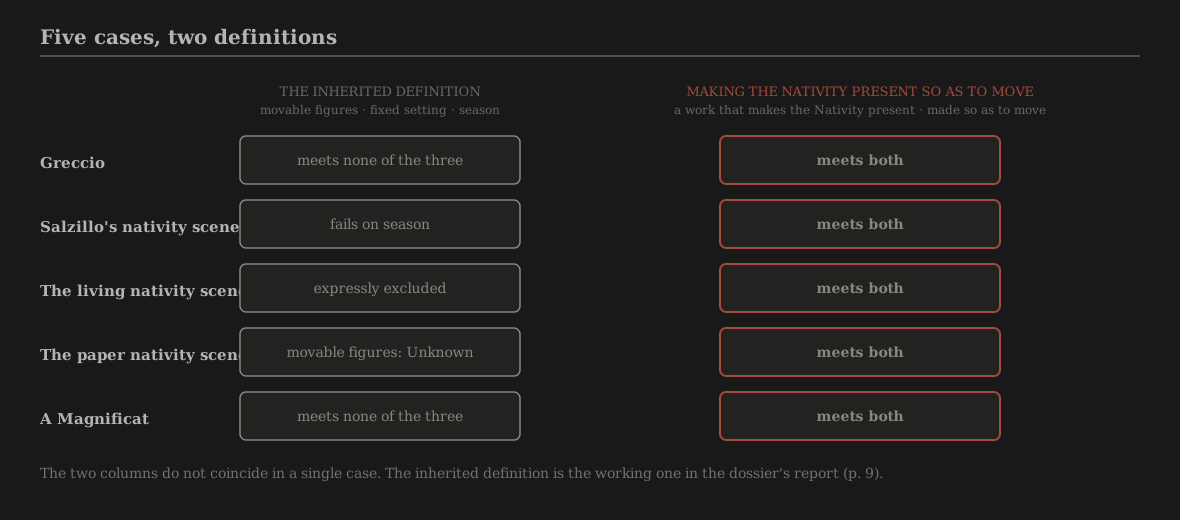
By the fifth case the reader does not need the criterion repeated: the reader has applied it four times. And it is worth noting what the grid does not say: it does not say that the inherited definition is absurd. It does what it set out to do, which was to describe the ordinary nativity scene with figures so as to fit it into an administrative pigeonhole; as an accounting tool it is better than this one, and as a concept it is worse, because it defines an object by its accidents and fails in its own cases. Putting it this way explains the error without making an adversary, and the chapter on the dossier examines it in full, page by page.38
The test of the two nativity scenes
This Manual reads every general statement about «the nativity scene» twice, once thinking of the popular one and once of the biblical one, and if it holds for only one of them it narrows the statement or splits it. Making the Nativity present so as to move is put through that test, and it holds for both nativity scenes in different ways; the difference is instructive.
The biblical nativity scene makes the Nativity present as it was: in its place and in its time, with the people who were there and the clothes that were worn there, and to do so it researches — this whole Manual, in its main series, is that research—. Whoever stands before it recognises the story, and the better researched the scene, the more the viewer has to connect it with and the more it gives back.
The popular nativity scene makes the Nativity present here: in the valley or the town of whoever makes it, with its people and their trades. The second chapter explained why it sometimes moves with fewer means — the recognition is double: the story and one's own land—, and the third measured how far that gesture is already present at Greccio: Celano says that «Greccio has become, as it were, a new Bethlehem», and that is transforming the place, which is half of the popular gesture; the other half — putting oneself inside— was added by practice centuries later.39 None of this is developed again here; it is recapitulated and referred to the chapter on the popular style, which is its home.
What the test brings to light is that the short phrase neither chooses between the two nativity scenes nor ranks them: both make present so as to move, and they differ in what they set before the viewer and in what the viewer recognises. A definition by object would have to decide whether the valley mill and the village night watchman are «figures of the birth of Christ»; a definition by purpose does not need to decide it, because what it asks is what they are there for, and they are there for the same thing.
The six languages
The definition has been drafted in the six languages of this Manual at once, not one after another, and with the rule that the list of conditions laid down: if a clause does not work in one language, the clause is wrong in all of them. None needs a note of equivalence; only one thing changes between them, and it is declared.
| Language | The definition |
|---|---|
| Spanish | El belenismo es el mundo de un arte: el de hacer presente el Nacimiento para conmover. Comprende sus obras — en cualquier modo: figuras de cualquier escala y material, personas, papel, luz, canto, poesía—, quienes las hacen y sus oficios, cómo se hacen, su historia, sus tradiciones y quienes las buscan. |
| Catalan | El pessebrisme és el món d'un art: el de fer present el Naixement per commoure. Comprèn les seves obres — en qualsevol mode: figures de qualsevol escala i material, persones, paper, llum, cant, poesia—, els qui les fan i els seus oficis, com es fan, la seva història, les seves tradicions i els qui les busquen. |
| French | Le monde d'un art : celui de rendre présente la Nativité pour émouvoir. Il comprend ses œuvres — sous n'importe quel mode : figures de toute échelle et de toute matière, personnes, papier, lumière, chant, poésie —, ceux qui les font et leurs métiers, la manière dont elles se font, son histoire, ses traditions et ceux qui les recherchent. |
| English | The world of an art: that of making the Nativity present so as to move. It comprises its works — in any mode: figures of any scale and material, people, paper, light, song, poetry —, those who make them and their crafts, how they are made, its history, its traditions and those who seek them out. |
| German | Die Welt einer Kunst: der Kunst, die Geburt Christi zu vergegenwärtigen, um zu rühren. Sie umfasst ihre Werke — in jeder Weise: Figuren jeder Größe und jeden Materials, Menschen, Papier, Licht, Gesang, Dichtung —, die, die sie schaffen, und ihre Berufe, wie sie entstehen, ihre Geschichte, ihre Überlieferungen und die, die sie suchen. |
| Italian | Il mondo di un'arte: quella di rendere presente la Natività per commuovere. Comprende le sue opere — in qualsiasi modo: figure di ogni scala e materiale, persone, carta, luce, canto, poesia —, chi le fa e i suoi mestieri, come si fanno, la sua storia, le sue tradizioni e chi le cerca. |
What changes: in the two languages that have a word, the definition begins with it; in the four that do not, it begins with «the world of an art» and the subject remains unnamed. This is a shortcoming not of the definition but of those languages, and the previous chapter explained why each of them has responded differently.5 It is understood just the same: the sentence says what the thing is, and the name, if it comes, will come to name what the sentence already says.
Two drafting observations, so that nobody has to discover them. The Spanish conmover travels with a verb of its own into all six — commoure, émouvoir, to move, rühren, commuovere—; in English, to move without an object is the ordinary usage of «a moving scene», and no object is added so as not to say more than the Spanish. And el Nacimiento is rendered by the word that in each language names the event — Naixement, Nativité, Nativity, Geburt Christi, Natività—: German is the only one that names who is born, because Geburt on its own does not say it; in the others the capital letter is enough, as in Spanish.
The list of conditions, one by one
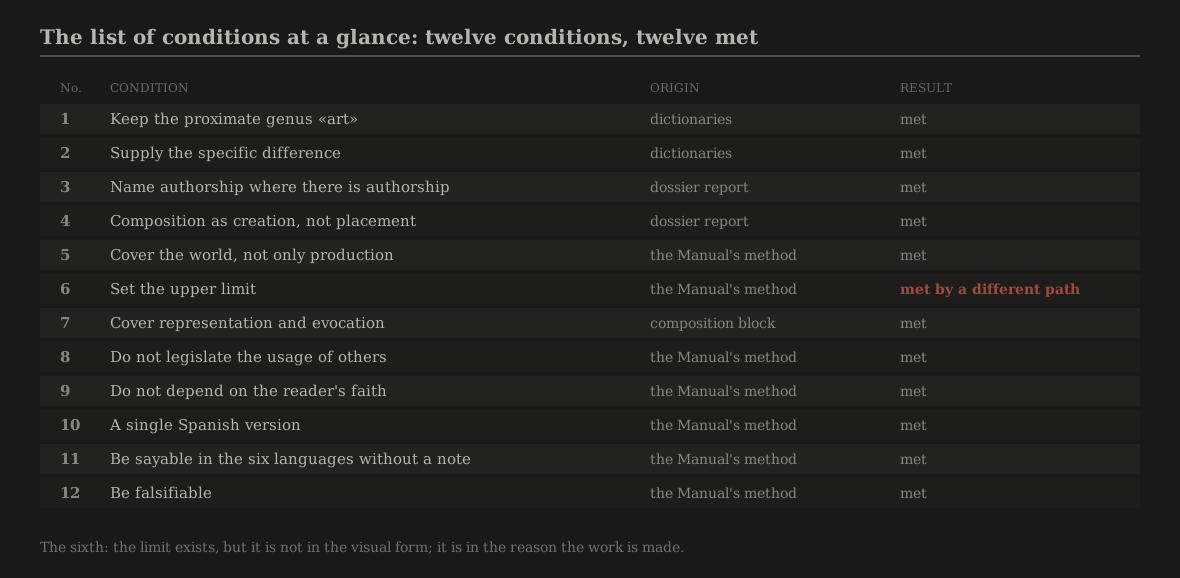
The previous chapter handed on to this one the list of conditions that a fair definition would have to meet, with a warning: that here it would also be said whether any of those conditions does not withstand examination.40 There are twelve, and none is a preference: each arises from a proven defect in an inherited definition, and cites its origin.41 Making the Nativity present so as to move is put through them one by one, with its result.
1. Keep the proximate genus «art». Origin: three academies in agreement. Met: the definition says «the world of an art», and what it adds to «art» — the world— does not replace it.
2. Supply the specific difference that the dictionary does not give. Origin: the examination of the short definitions, which identify and do not develop. Met: the difference is «making the Nativity present so as to move», and it is a difference by purpose, which none of the inherited definitions has.
3. Name authorship where there is authorship. Origin: the defect «fabricar las figuras del Belén a través de sus artesanos» — manufacturing the figures of the nativity scene through its craftsmen— in the dossier's report, which describes as manufacture what is sculpture with authorship.42 Met, and it is said how: the short phrase does not contain the word author, and does not need it: it says works, and a work has an author; it says art, and art is made with authorship; and the articulation says «those who make them and their crafts», in that order — first whoever makes, then the craft that reproduces—. Whoever models an original cannot be read in this definition as a manufacturer. The examination of that defect, page by page, belongs to the chapter on the dossier.
4. Name composition as creation, not as placement. Origin: the defect «armar o montar el Belén» — assembling or setting up the nativity scene— in the same report, and the section on verbs in the chapter on the word.12 Met through the verb: the definition says making present, which is an entire operation of creation, and not montar, poner or armar (to set up, to put out, to assemble), which name the last step.
5. Cover the world, not only production. Origin: nobody confuses cycling with the bicycle; and this whole block, which would have no material if nativity-scene art and practice were only the making of nativity scenes. Met through the opening words: «the world».
6. Set the upper limit. Origin: that the homage is greater than its representation. Met, and not where the condition supposed: the frontier is not in the plastic; it lies in the reason for which the work is made, and where that is has been said, in «What is left out».
7. Cover both representation and evocation. Origin: the criterion of composition of this Manual that a scene can represent the place or evoke it.43 Met: «making present» does not say how — a place built with figures inside it and a scene evoked with light both make present—, and «in any mode» confirms it.
8. Do not legislate the usage of others. Origin: the criterion in the block's index — the definition says from what understanding the Manual speaks, not which nativity scenes deserve the name—. Met, with the clarification made above: the definition denies nobody the word nativity scene; it decides whether a work is made for the reason the definition names, which is another question.
9. Do not depend on the reader's faith. Origin: the object is the same for whoever believes and for whoever does not. Met: «making the Nativity present» names a narrated event, and the second chapter said that understanding is not accepting — one can make present what one does not believe, and one cannot make present what one has not understood—.44 Believer and non-believer can affirm the same sentence.
10. A single Spanish version, with the variants declared. Origin: a decision of Emili Solé, already written into the chapter on the word.45 Met: there is one Spanish version, and pesebrismo is declared in it as the other word.
11. Be sayable in the six languages without a note of equivalence. Origin: a manual read in six. Met, with the table above and its single declared variation — the unnamed subject where there is no word—.
12. Be falsifiable. Origin: this Manual's rule of proof: a definition that no possible case could contradict defines nothing. Met, and the case is named. What would refute this definition is a work that practice unanimously regarded as nativity-scene art and that did not make the Nativity present, or that was not made to move. The first case exists and has to be faced squarely: the diorama of the Passion, made by the same people who make nativity scenes and with the same technique.46 The definition leaves it out by its subject matter: it does not make the Nativity present. If practice regards it as nativity-scene art — and not merely as the work of nativity-scene makers—, the clause «the Nativity» is refuted and would have to be widened or split. This Manual maintains that it does not: that a work by the same hand and with the same technique is scenographic sculpture, a sister of nativity-scene art and not nativity-scene art itself, in the same way that a painting of the Passion by Giotto is not a Nativity. But it maintains this for what it is — a reading by Emili Solé—, and leaves the case written down so that whoever disagrees knows exactly which word is in dispute. The second case — a work that everyone calls nativity-scene art and that is made neither for the Nativity nor to move— is the work that bears the title of nativity scene and can change its title and date without changing; the definition answers that its reason is another, and whoever maintains that the title is enough has their point of attack there.
Twelve conditions: twelve met; the sixth by a different path from the one it supposed. That is the result the list of conditions asked for, and the list was not a wish list: each condition was a proven defect in an inherited definition. A definition that meets them commits none of those defects, and that is all that can be asked of a definition: not that it be the last, but that it not repeat the errors of those that came before it, and that it say where it can be attacked.
Closing
The world of an art: that of making the Nativity present so as to move. Each word has its chapter, and none is there on a whim. World, because it has people inside it and is not a class of works. Art, because three academies say so and because its components are the fine arts. Making present, because it is what Francis asked for with a liturgical verb and what the Spanish dictionary calls a memory that is made. The Nativity, because it is the whole cycle and not only the scene at the manger. So as to move, because what happened at Greccio and what happens at Emmaus is not seeing but recognising, and what is recognised moves and stays.
The definition does not fight. It takes nothing away from whoever builds settings or whoever models figures, nor from the associations that asked for a declaration, nor from the document that granted it: it includes the scenographer as much as the sculptor, whoever plays a shepherd in a living nativity scene, whoever composes a carol, whoever cuts out a paper nativity scene and whoever arranges the figures on the moss one December afternoon. What it does is make the definitions that preceded it look small, because they defined an object by its accidents and failed in their own cases, while this one defines a practice by its purpose and gets them all right in one short phrase. And it moves one thing, which is the one that matters: where value comes from. Not from a decree recognising it, but from what the practice is.
What remains is not to define further: it is to put the definition to the test where it is decided today, without its having been read, what nativity-scene art and practice is. Against the institutions that say so — an open encyclopedia that almost nobody edits, a federation—; against the law that declares it heritage with a definition that leaves out Greccio, the living nativity scenes and Salzillo; and against the practice of whoever composes a scene and, in filling it with people, chooses whom to represent. That is what the next three chapters are, and the definition enters them already made.
References
The footnotes locate, and only locate. The entries that explain why each source is included, what it contributes and what it does not allow one to state are in the chapter of this series where each source first appears, and the reader is referred there; this chapter introduces no new source. The translations of the definition are the Manual's own.
Chapter on the word in this series, sections «How much each word names: the yardstick of operations» and «The bias of vocabulary», with the table of ten words and their sources: DIEC2, «Art de construir pessebres»; GDLI, «Arte di costruire e allestire presepi»; Krippenbau as an ordinary compound, with no entry of its own in the online Duden (duden.de, search «Krippenbau», consulted on 22-X-2026). ↩
Chapter on the word, section «The name», six points, and its conclusion: the decision «comes out of the next chapter, the one on the definition». ↩
Entry for belenismo in the DLE from the 23rd edition (2014): chapter on the word, section «When they entered the dictionary» and the corresponding note. Federación Española de Belenistas, 1963: same chapter, section «When the name of the trade changed». Spanish Wikipedia, article «Belenismo»: chapter «Who decides» in this series. Real Decreto 481/2022, de 14 de junio (BOE-A-2022-9969): chapter on the dossier. ↩
Chapter on the word, section «The name», last paragraph: the criterion for the six versions — «where a language already has or hints at a word of its own, the Manual uses it and explains it: belenismo and pesebrismo in Spanish, pessebrisme in Catalan, Krippenkunst in German, presepismo in Italian»—. ↩
Chapter on the word, section «Why each language has responded differently», paragraph on English: «it is not the most closed of the six languages: it is the door most open to a loanword». ↩ ↩
Chapter on the word, section «Why the definitions fall short — and why that is no reproach». ↩
Chapter on the word, section «Two different things». The formulation «defining music with the definition of the tango» is Emili Solé's (12-IX-2026) and is applied to the IPCE report, p. 4, which derives, «por tanto», the definition of nativity-scene art and practice from Amades's definition of the nativity scene; the examination of that page belongs to the chapter on the dossier. ↩
Howard S. Becker, Art Worlds, Berkeley and Los Angeles, University of California Press, 1982, p. x and p. 34; introduced and quoted in the chapter on the world, section «The people», with its limits and checked there against the 1982 copy. ↩
Chapter on the word, section «What the works that fix the language say», table of five works and six words: DLE («Arte de los belenes o afición a ellos»), DIEC2 («Art de construir pessebres»), DNV (betlemisme, «Art de construir betlems»). ↩
Chapter «Is nativity-scene making an art or just a Christmas tradition?» (Is nativity-scene making an art or just a Christmas tradition?): section «The main door» (the disciplines of which a nativity scene is made); section «What the table lacks» («they can do it with judgement or without it, better or worse — that is the only legitimate question—»); section «Closing» (the table is laid in order to dine; the nativity scene is composed to be looked at and understood). Here it is recapitulated and referred to. ↩ ↩ ↩
Memoriam agere: Celano, 84,8, first chapter of this series, section «What Francis said he wanted». Conmemoración, sense 2 in the DLE («memoria que se hace»), and the difference between honouring at a distance and setting before oneself what is honoured: second chapter, section «The words». ↩
Chapter on the word, section «Two different things»: «By naming only the end, the language describes an ornament. And by describing it as an ornament, it turns it into one». ↩ ↩
Terminology of the Manual fixed on 4-VII-2026: infancy cycle (from the betrothal to Jesus among the doctors) and Nativity core (from the Annunciation to the Presentation); portal «The Nativity cycle: scenes and characters»; narrative map in The scenes of the infancy cycle of Jesus. ↩
Chapter on the world, section «The work, on two levels». ↩ ↩ ↩
The four-link chain: first chapter, section «What happened», last paragraph. Emmaus, Lk 24,16.31-32 (RVA 1909): second chapter, section «The narrative asks for the same». ↩
Criterion fixed in this Manual on 12-VII-2026 for the scene pages; recapitulated in the second chapter, section «Understanding before making, on both sides». ↩
Celano, 85,2, exsultantibus animis, and 84,5, nobilitatem animi; ed. d'Alençon (Rome, 1906), p. 86, l. 24 (85,2) and l. 7 (84,5); first chapter, note 10. The decision «conmover» and not «conmover el ánimo»: Emili Solé, 16-IX-2026. Conmover: «Del lat. commovēre» (DLE, s. v. conmover, dle.rae.es, consulted on 22-X-2026); and the Latin com-mŏvĕo, «to put something in violent motion, to move» (Lewis and Short, A Latin Dictionary, s. v. commoveo, on Perseus, consulted on 22-X-2026). ↩
Celano, 86,8, impressus memoriae diligenti; first chapter, section «What happened» and note 11. The third time, with Augustine (Conf. X, 14, 21) and Wordsworth (preface of 1800): second chapter, section «From the eyes of the body to the eyes of the heart», last paragraph (amendment of 15-IX-2026). ↩
Chapter on the world, section «The modes, placed without hierarchy», paragraph «The third, which is the one that avoids saying too much», and the close of the section (space · time · word; «all three were there at Greccio»). From where a scene is looked at — one framing or infinitely many— is the subject of A question of framing, and is not touched on here. ↩
Chapter on the world, sections «The work, on two levels» (what can be a figure; author's figures and commercial-brand figures; automata) and «The modes, placed without hierarchy» (figures, people, paper, light, song, poetry; Celano 86,1 and 85,8-9 on the sung night). ↩ ↩ ↩ ↩
Chapter on the world, section «The people»: the whole chain, from whoever makes to whoever looks; block «Who is who in the nativity scene», for the examination of each role. ↩ ↩
Block «The art of composing nativity scenes» (scenography, composition, perspective, polychromy), and the chapters on the figure in the main series; criterion of the Manual of 19/21-VIII-2026: in artistic technique, teaching the procedure is unavoidable and necessary. ↩
Chapter on the word, section «The word has a history, and it can be dated» (1868-1907 in Catalan; 1864-1934 in Spanish). ↩
Chapter on the world, section «Activities and tradition». ↩
Instituto del Patrimonio Cultural de España, Informe técnico definitivo for the declaration of nativity-scene art and practice as a Manifestación Representativa del Patrimonio Cultural Inmaterial, March 2022, p. 9; introduced, quoted and checked against the source in the first chapter of this series, panel on the report and note 6. ↩ ↩
Chapter «Ephemeral by necessity, not by essence» (Ephemeral by necessity, not by essence). ↩
Second chapter of this series, opening («nobody comes to it blank») and section «Seeing and observing» (whoever stops before a work is the one who brings something to look with; the work does not change). ↩
The criterion for people — practice and not profession; the sculptor with a collection, the scenographer with several years running— and the answer to why a nativity scene is made are Emili Solé's (17-IX-2026), written here as the Manual's criterion. The chapter on the world (section «Activities and tradition», last paragraph) left the shop's Christmas village at the door of this chapter, saying that «whether it is a work or an ornament is for the definition to decide»: it is decided by this same yardstick — why it was composed, and that why is supplied by whoever composes it—, and not by the material, nor by whether someone stops or walks past, because the work does not change with whoever looks; whoever looks is what changes. It is answered in a note and not in the body by decision of Emili Solé (17-IX-2026): it is not a good example of what is left out. ↩
Celano, 85,4-5 and 85,11; first chapter, section «What there was at Greccio, and what there was not». What is maintained here about the liturgy — that it celebrates and does not make a scene present— is this Manual's reading, with no source that states it, and is to be read as such. ↩
First edition of the chapter on the word (August 2026), section «What a fair definition would have to meet», condition «Setting the upper limit»; and working document of 17-VIII-2026, unpublished, Phase 3, condition 6 («the Casals seed»). ↩
IPCE report, p. 9: it is necessary «diferenciar iconografía navideña del belén, puesto que, aunque comparten fondo, no así la forma ni la función»; and, among what is often confused with the nativity scene, «tímpanos de portadas de iglesias, relieves de retablos y lienzos del Nacimiento, cuando su finalidad es bien distinta». Checked against the PDF on 22-X-2026. ↩
IPCE report, p. 9; first chapter, note 6. ↩
Celano, 85,7 (ad novum mysterium novis gaudiis adlaetantur) and 86,8; first chapter, notes 10 and 11. ↩
Museo Salzillo, page «Belén de Salzillo», consulted on 13-IX-2026; introduced and quoted in the chapter on the world, section «Activities and tradition» and note 16 (that it is not taken down for Christmas is inferred from context; the expression «exposición permanente» does not appear on the page). ↩
IPCE report, pp. 5 and 40; chapter on the world, section «The modes», paragraph on people, and note 2. The Real Decreto 481/2022 does not contain the word «viviente». ↩
Poster and website of the UN-FŒ-PRÆ 2026; chapter on the world, section «The modes», paragraph on paper, and note 3 (Spanish and English wording checked on 13 and 16-IX-2026). ↩
J. S. Bach, Magnificat, BWV 243a (25-XII-1723) and BWV 243 (revision, performed on 2-VII-1733); chapter on the world, section «The modes», paragraph on written music, and note 7. The canticle: Lk 1,46-55. ↩
Chapter on the dossier in this series: it receives from this series the three cracks of Greccio (an origin without figures, p. 9; living nativity scenes described and excluded, pp. 5 and 40; a papal licence attributed to Celano, p. 9 note 1). The assessment «better as an administrative tool, worse as a concept» is Emili Solé's (12-IX-2026). ↩
Second chapter, section «The nativity scene as a mirror» (the double recognition); chapter on the world, section «The values it conveys», last paragraph (Celano 85,5, quasi nova Bethleem de Graecio facta est: the place, yes; the content, no; a sentence of Celano's, not of Francis's). Its home, if it holds: Popular, the other word. ↩
Chapter on the word, section «Why the definition is not here». ↩
Short version: first edition of the chapter on the word (August 2026), section «What a fair definition would have to meet» (seven conditions). Long version: working document «The definition as verdict», Phase 3 (twelve conditions) and Phase 5 (the jury's tests); unpublished, set out to Emili Solé on 17-VIII-2026. ↩
IPCE report, p. 4: «Por tanto, el Belenismo sería, por una parte, el arte de fabricar las figuras del Belén a través de sus artesanos, y por otra, el colectivo especializado en armar o montar el Belén»; checked against the PDF on 12-IX-2026. Real Decreto 481/2022, art. 2: «el arte de fabricar las figuras del Belén a través de sus artesanos», checked against the source on 16-VIII-2026. Full examination: chapter on the dossier. ↩
«That the nativity scene can represent or evoke»: a criterion of composition of this Manual, set down in the working document of 17-VIII-2026 (unpublished), Phase 1. In this series it is illustrated by the chapter on the world, section «The modes, placed without hierarchy», with the scenes «whose only material is a silhouette lit from behind». ↩
Second chapter, section «Understanding before making, on both sides»: the Buddha carved without knowing who he was; the devil, who can be made present without believing in him. ↩
Chapter on the word, section «One language, many territories»: «There will be a single Spanish version, with the variants named within it. Never two versions» (decision of Emili Solé, 16-VIII-2026). ↩
That the diorama of the Passion is made by those who make nativity scenes, and with the same technique, is an observation by Emili Solé from within the craft; here it serves only to name the case that would put the clause «the Nativity» to the test. ↩