
 ≈ 27 min

One last piece remains on the table, and it is the one the previous case left marked: a sentence. Josep Maria Garrut extended Amades’s definition with a concept that Amades endorsed — the nativity scene is destroyed after fulfilling its mission (The Amades case: the mystery of the omissions)1—. Like so many things on this path, the sentence described something true of its time; and like so many things on this path, inheritance turned it into something else: almost a commandment. The nativity scene, it is taken for granted, is ephemeral art — if it is art at all—: it is born in December and dies when the festival ends — by tradition, on Candlemas, 2 February; in practice, the vast majority are taken down in January with the rest of the Christmas decorations, and holding out until Candlemas is today the exception of a few homes and the odd church—, and that annual death would separate it from the works that last. Anyone who has followed the series will recognise the pattern: what is taken for granted is exactly what needs examining.
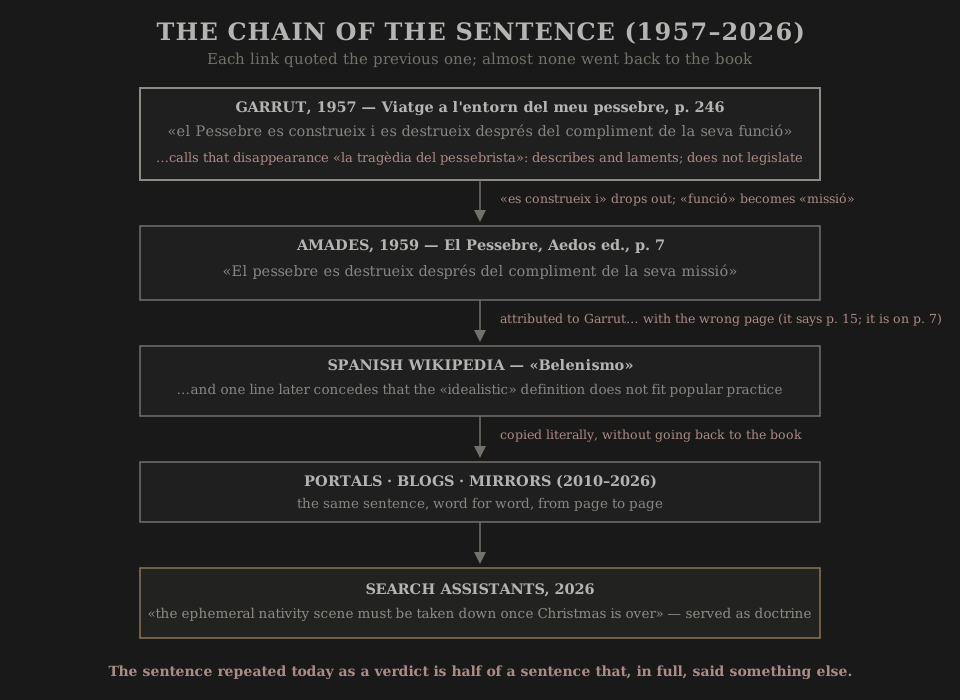
And it is not an archive sentence. Today it lives in the most frequently consulted summary — which attributes it to the historian Josep Maria Garrut as an addition to the definition approved in Rome—, and from there it has jumped, copied word for word, to portals, blogs and mirrors all over the internet; even search assistants now serve it up as doctrine: the nativity scene «debe desmontarse una vez pasa la Navidad» — must be taken down once Christmas is over—. It is the same chain of copying that the previous case documented with an English prohibition that never existed (The Amades case: the mystery of the omissions) — and with the same carelessness: the footnote that supports the sentence refers to a page of Amades’s book where the passage is not—.2 With an irony worth not losing: the very page that spreads the sentence acknowledges, one line later, that this «idealista» — idealistic— definition does not quite fit popular practice — the loudspeaker of the dogma confesses that reality does not obey it—.
This chapter examines the sentence, and with it closes the arc that began with a question of framing. At the end, the conclusions of the five chapters, together.
A distinction is needed: the three endings
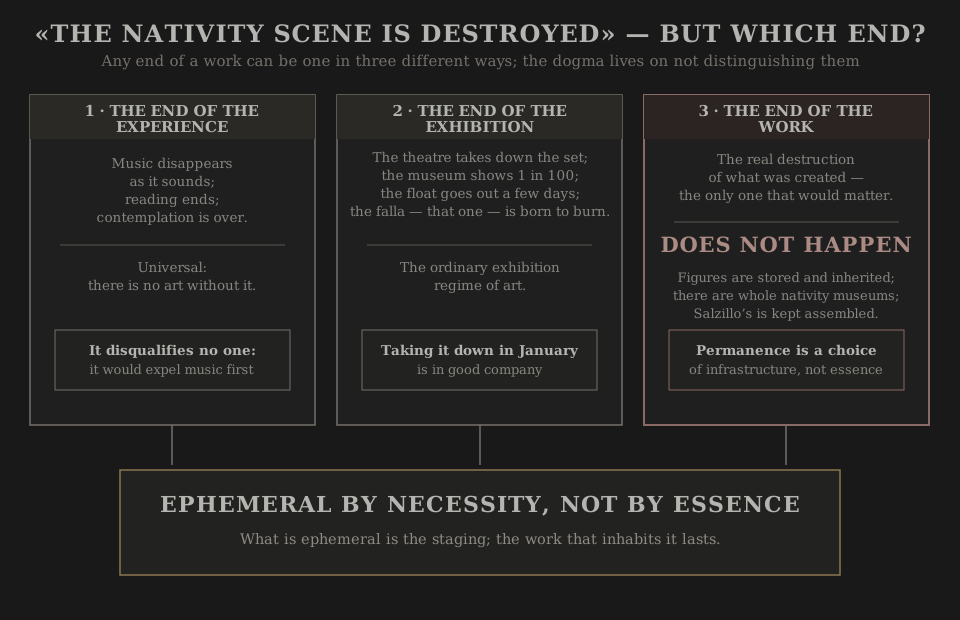
«The nativity scene is destroyed», «the nativity scene is ephemeral» — the sentences sound like a single thing, and they are three. Everything we call the end of a work can be so in three different ways, and the strength of the dogma comes precisely from not distinguishing them.
The end of the experience. Every artistic experience ends: music disappears as it sounds, reading ends and the book goes back on the shelf, the contemplation of a picture lasts as long as the visit. This end is universal — there is no art without it—, and that is why it cannot disqualify anyone: a criterion that demanded permanence of the experience would expel from art, before the nativity scene, the whole of music. Whoever wields this end against the nativity scene is wielding it, without knowing it, against all the arts at once.
The end of the exhibition. The nativity scene is taken down in January. True — and it is worth looking at the company it keeps—. The theatre performance ends and the set is taken down; the temporary exhibition closes and the works go back to their lenders; a museum’s holdings spend most of their life in storage — the British Museum, to give the institution’s own figure, holds at least eight million objects and displays some eighty thousand at a time: one in a hundred—3; processional sculpture goes out in procession a few days a year, and each piece spends the rest according to its fortune: some, on display all year round in their church or museum; others, stored in churches closed to the public until Holy Week; and one or another — like the Santa Cena of Tarragona, which because of its size is dismantled and kept in premises of its confraternity — exactly like a nativity scene: assembled, it can only be seen in its season4. And it occurs to nobody to reclassify a processional float because of that. Taking it down in January is not an anomaly of the nativity scene: it is the ordinary exhibition regime of a great deal of art. And even the extreme case confirms the rule from the other side. The falla carries its end written in its very name — falla comes from Catalan, and that from the Latin facŭla, 'torch'—, and dictionaries define it by its destiny: «conjunto de figuras de carácter burlesco que, dispuestas sobre un tablado, se queman públicamente en Valencia por las fiestas de San José» — a set of burlesque figures which, arranged on a platform, are publicly burned in Valencia for the feast of Saint Joseph— (DLE); «construcció de material combustible… que es crema» — a construction of combustible material… which is burned— (DIEC2)5. The falla is born to burn: the bonfire is its mission. The nativity scene is not: nobody creates it as a bonfire — nor as a Christmas Eve supper—; its mission is to commemorate the birth of Jesus, and destruction appears neither in its name nor in its definition. Whoever demands that the nativity scene die every year is treating it, without realising it, as if it were a falla: lending it an essence that belongs to another festival. And even so, even the Fallas — the art whose mission is to be burned — pardon every year a ninot that is saved from the fire and enters a museum6. If the art that is born for the bonfire keeps what it can, what shall we say of an art in which nothing burns?
The end of the work. This is the only one that would matter — the real destruction of what was created—, and it is exactly the one that does not happen. Whoever takes down a nativity scene destroys nothing: they wrap the figures, store the props, put away the buildings and the landscape. The figures are inherited, collected, restored and end up — the series has already seen it — in museums (Is nativity-scene making an art or just a Christmas tradition?). And not only in general museums: there are museums devoted specifically to the nativity scene — the Museo de Belenes in Mollina, the Belén del Príncipe that Patrimonio Nacional preserves and sets up again—: whole institutions dedicated to keeping what the dogma says is destroyed7. The nativity scene that Salzillo made for the Riquelme family is preserved, and preserved assembled, in his museum in Murcia8. And the nativity diorama has spent a century showing that even the composed tableau can be fixed: permanence is not an essence that the nativity scene has or lacks — it is a choice of infrastructure: space, showcase, box—. The only thing that ends in January is the scene composed on the table of a home; and a picture taken down from the wall is not a picture destroyed.
The acid test of the inherited sentence is to apply it outside the nativity scene. If «once the mission is fulfilled» one had to destroy, on 26 December one would have to take the Murillo down from the altarpiece that adorned the feast, dismantle the organ after the Christmas concert and pull down the cathedral at the end of Mass. Nobody proposes it, because the sentence, taken as law, does not survive its first application. And to anyone who replies that the nativity scene is not comparable because its mission is seasonal, the answer has already been given: the mission of the nativity scene — to commemorate the Nativity — is recurrent, not consumable; it comes back every year, as the Mass comes back to the altarpiece. What is seasonal is its exhibition, and that end has already been examined above, in the company of half of art. Taken as what it was — the description of a domestic custom: it is set up, contemplated, taken down—, it is true and even endearing. Another ethnographer’s description turned into a rule by inheritance: the reader of this series knows the mechanism only too well (Popular or artistic nativity scenes? The story of a half-finished reading, The Amades case: the mystery of the omissions).
And there is something better than interpreting the sentence: going back to the page where it was born, because the original does not say what the inheritance repeats. This is the whole proof, as Garrut left it written in 1957 (p. 246)1:
❝Però, a aquesta definició, cal afegir-hi quelcom que considerem bàsic: que el Pessebre es construeix i es destrueix després del compliment de la seva funció. Com el fabulista, podríem dir “espantosa brevedad”, però les construccions o escenes permanents que poden ésser Pessebres — Pessebre de vitrina o d'escaparata — són variants de la clàssica interpretació i no són específicament el que podríem dir-ne “Pessebre-Pessebre”. Són com substituts o similars, ara que aquestes accepcions, motivades per la carestia, s'han estès arreu. I aquí ve la tragèdia del pessebrista, admetent que el pessebrista pot ésser, i en algunes ocasions és, un artista, que en construir el seu Pessebre hi posa tota l'emoció i tota la voluntat i enginy que posseeix, i no pensa en aquests moments constructius en la desaparició de la seva obra destruïda per ell mateix poques setmanes després. Aquest potser és l'únic cas en les arts i és també una de les seves fesomies més pròpies. El creador de mons més o menys ingenus no els deixa per a la posteritat; aquest goig íntim dura pocs dies i potser fa que la consideració del pessebrisme es tingui, en els medis artístics, com una manifestació efímera.
In English (own translation):
❝But to this definition we must add something that we consider basic: that the Nativity scene is built and destroyed after the fulfilment of its function. Like the fabulist, we might say “espantosa brevedad” [dreadful brevity]; but the permanent constructions or scenes that can be Nativity scenes — the showcase or shop-window Nativity scene — are variants of the classic interpretation and are not specifically what we might call the “Pessebre-Pessebre” [the Nativity scene proper]. They are like substitutes or look-alikes, now that these senses, prompted by high costs, have spread everywhere. And here comes the tragedy of the nativity-scene maker, granting that the nativity-scene maker can be, and on some occasions is, an artist, who in building his Nativity scene puts into it all the emotion and all the will and ingenuity he possesses, and does not think, in those constructive moments, of the disappearance of his work, destroyed by himself a few weeks later. This is perhaps the only case in the arts, and it is also one of its most characteristic features. The creator of more or less naive worlds does not leave them for posterity; that intimate joy lasts a few days, and perhaps causes nativity-scene making to be regarded, in artistic circles, as an ephemeral manifestation.
Read what the inheritance let drop. First, the complete sentence says «is built and destroyed» — the whole cycle, not a sentence passed — and it says «function» (funció), not «mission» (missió): Amades, in taking it up, cut the «is built» and changed the word; posterity inherited the cut, and the encyclopaedia attributed it to Garrut with the wrong page. Second, Garrut himself admits permanent nativity scenes — showcase, shop window — as variants: the author of the supposed law of destruction recognised the exceptions in the same paragraph. And third, he calls the disappearance «the tragedy of the nativity-scene maker» — a nativity-scene maker who «can be, and on some occasions is, an artist»—, and observes that this very brief joy «perhaps causes» nativity-scene making to be regarded in artistic circles as an ephemeral manifestation: he described the prejudice and lamented it; he did not found it. The sentence repeated today as a verdict is half of a sentence that, in full, said something else.
The conclusion of the three distinctions fits the key the series has already put in place: the nativity scene is ephemeral by necessity, not by essence (Is nativity-scene making an art or just a Christmas tradition?). It is taken down because of space, because of the house, because of the season — not because its nature condemns it—; what is ephemeral is its staging, and the work that inhabits it lasts. There is, moreover, a small clue that gives the dogma away: the date of the supposed death is not even fixed — Candlemas by tradition, January by custom—, and essences do not negotiate their calendar; customs do. Whoever wishes to keep their tableau can: it is called a diorama, or it is called a museum. Whoever prefers the rite of setting it up and taking it down every year practises a beautiful custom — they are not carrying out a sentence—.
The conclusions of the arc
Five chapters, five inheritances examined. It is worth seeing them together once, because together they say more than added up.
Framing (A question of framing). The most decisive choice in a nativity scene is made before the first figure: where will it be looked at from? One framing or infinitely many — the diorama or the table that one walks around—: two ways, no ranking. The criterion distinguishes without ranking, and the old pigeonhole of «open and closed» with a judgement inside stayed where it should: described and superseded.
Composition (Is nativity-scene making an art or just a Christmas tradition?). Composing is creating: where there is room for error there is room for getting it right, and where there is room for getting it right there is someone deciding within a learned language. The disciplines of the nativity scene — sculpture, painting, composition, scenography, lighting — do not have to defend their artistic standing: they have centuries of theory and museum galleries. The question in the title of that chapter turned itself round: the strange thing would be for this not to be art.
The pigeonhole (Popular or artistic nativity scenes? The story of a half-finished reading). The division between «popular» and «artistic» nativity scenes was already in circulation in 1933, and the three books that discussed it in writing — Puig i Roig, Amades, Buendía — denied it the hierarchy; Amades himself left in writing that making a nativity scene, however humble, is quite an art. The pigeonhole was withdrawn without being replaced: for presentation there was already framing; for value, judgement work by work.
The Case (The Amades case: the mystery of the omissions). The most influential definition of the nativity scene was the honest map of an ethnographer’s interests, not the border of the discipline; its omissions — the diorama, plaster of Paris, the living nativity scene — were real, and the mechanism that made it law is the same one that sustained for fifteen years an invented death penalty in an encyclopaedia: inheritance without reading.
The ephemeral — this chapter—. Of the three endings, the nativity scene shares the first two with all the arts, and the third — the only one that would matter — does not happen. Annual destruction is not essence: it is calendar.
And now, the synthesis. The five objections that nativity-scene art and practice drags behind it — «it is nothing but tradition», «it is not real art», «yours is popular», «that is not a nativity scene», «anyway, it gets destroyed in January» — all come from the same workshop: honest descriptions from another time, inherited without reading until they became verdicts. Examined with the documents in front of us, none of them is left standing. What is left standing is something else: a practice that composes space, figure and light in order to narrate — a scenographic practice in its own right—, carried out every year by thousands of hands, from the living room at home to the exhibition hall. And the five conclusions remain like everything in this Manual: with their sources in view, open to a better document.
And that changes the task. While nativity-scene art and practice had to defend itself, these chapters were necessary; with what had to be proved now proved, defending itself is no longer the work. The work, from here on, is the craft: learning to decide the framing, to compose the tableau, to make space narrate and light tell. What comes next is devoted to that — to nativity-scene scenography in the proper sense —, with three declared guides that will be adapted to the nativity scene: Pamela Howard (What Is Scenography?), Félix Murcia (La escenografía en el cine: el arte de la apariencia) and Gustavo Mercado (The Filmmaker’s Eye). The series began by asking where a nativity scene is looked at from; it ends knowing what is looked at: a work. And with works there is only one thing to do: make them well.
References
The footnotes locate; these entries explain why each source is included and what it does not allow us to claim.
GARRUT, Josep Maria — the extension of the definition («the nativity scene is destroyed after fulfilling its mission»), endorsed by Amades. It is included as the text examined. It is quoted from Amades’s Catalan original (introduction, p. 7; scan of Emili Solé’s copy), which endorses it expressly; Amades’s own bibliography (entry 284bis) refers to GARRUT, Josep M.ª, Viatge a l'entorn del meu pessebre, Barcelona, Selecta (Biblioteca Selecta de Folklore), 1957 — Emili Solé’s copy—. The original passage (p. 246, «Final del viatge»): «que el Pessebre es construeix i es destrueix després del compliment de la seva funció» — with its context: the «tragèdia del pessebrista», the permanent showcase nativity scenes admitted as variants, and the regard for the ephemeral «en els medis artístics» described, not prescribed—. Cautions: the two versions (Garrut p. 246 / Amades p. 7) are not identical and the chapter says so; own translations from the Catalan. Central source.
MUSEO SALZILLO, Murcia — the Riquelme family nativity scene (Salzillo, 1776-1783, completed by Roque López in 1800), preserved and displayed assembled in the gallery the museum devotes to it. It is included as proof of the «end of the work» that does not happen. Cautions: the museum’s record does not give the number of pieces, and the chapter does not use it. Supporting source.
The ninot indultat / Museu Faller de València — the annual pardon by popular vote and its museum. It is included as an extreme case that confirms the rule (even the art conceived to burn keeps what it can). Documented with the Junta Central Fallera (fallas.com: the annual handovers of the ninots indultats to the Museu Faller; consulted on 23-X-2026). Supporting source.
BRITISH MUSEUM, official collection fact sheet (britishmuseum.org). — Institutional web resource. It is included for the two figures that portray the ordinary exhibition regime of art: at least eight million objects, some eighty thousand on display at a time. Consulted on 23-X-2026. Cautions: it is the figure of one particular institution — it is used as a major example, not as an average for the museum world—. Supporting source.
Nativity-scene museums (Museo de Belenes in Mollina; Belén del Príncipe, Patrimonio Nacional). — Institutions. They are included as direct proof of the «end of the work» that does not happen: whole museums devoted to preserving nativity scenes. Mollina, with its institutional website («Museo Internacional de Arte Belenista» — International Museum of Nativity-Scene Art—, more than a hundred nativity scenes and two thousand figures); the Belén del Príncipe, with the Patrimonio Nacional article («más de doscientas figuras» — more than two hundred figures—, set up «año tras año» — year after year—). Supporting source.
DLE and DIEC2, entries «falla». — Lexicographical sources. They are included because the falla carries its end in its name and in its definition (facŭla, 'torch'; «se queman públicamente» — are publicly burned—; «que es crema» — which is burned—): the exact contrast with the nativity scene, in whose name and definition there is no destruction at all. Consulted on 23-X-2026. Supporting source.
The following notes locate; they do not argue.
The sentence, in its Catalan original: «El pessebre es destrueix després del compliment de la seva missió» — Amades, El Pessebre, introduction, p. 7, where he adds: «Nosaltres estem plenament conformes amb aquesta ampliació» (scan of Emili Solé’s copy)—. Garrut’s source, identified by note 284bis of Amades’s own bibliography (p. 493): GARRUT, Josep M.ª, Viatge a l'entorn del meu pessebre, Barcelona, Editorial Selecta (Biblioteca Selecta de Folklore), 1957 — Emili Solé’s copy: p. 246, chapter «Final del viatge». The original wording: «Però, a aquesta definició, cal afegir-hi quelcom que considerem bàsic: que el Pessebre es construeix i es destrueix després del compliment de la seva funció» — note the two differences from the version Amades took up: «es construeix i» drops out and «funció» becomes «missió»—. Garrut’s own note 1 on that page cites: «Joan Amades, El Pessebre, Barcelona 1946, pàg. 7»—. ↩ ↩
Spanish Wikipedia, «Belenismo», revision 174757657 (8-VIII-2026), identical in this passage to 173802812 (5-VI-2026): the Rome 1955 definition («El Segundo Congreso belenista internacional, celebrado en Roma en 1955 por la UN-FOE-PRAE aprobó como la definición de belén la aportada por el folklorista catalán Joan Amades» — the second international nativity-scene congress, held in Rome in 1955 by the UN-FOE-PRAE, approved as the definition of the nativity scene the one put forward by the Catalan folklorist Joan Amades—) with the addition attributed to «el historiador Josep Maria Garrut» — the historian Josep Maria Garrut— and the concession «Veremos cómo esta definición "idealista" no acaba de ajustarse a la práctica popular» — we shall see how this "idealistic" definition does not quite fit popular practice—; its note [25] refers to «Amades, Joan, op. cit., p. 15» — the passage is on p. 7—. Word-for-word copies, consulted on 23-X-2026: padulcofrade.com (monograph «El belén», «Belenismo») and es-academic.com («Belén (escena del nacimiento de Jesús)»). The answer of Google’s search assistant, captured on 4-VIII-2026. ↩
British Museum, official collection fact sheet (britishmuseum.org, fact sheet): «The British Museum collection totals at least 8 million objects»; «Roughly 80,000 objects are on public display at the British Museum in Bloomsbury at any one time». Consulted on 23-X-2026. ↩
First-hand information from Emili Solé (4-VIII-2026), sculptor of processional groups for Holy Week in Tarragona: two of the floats are kept inside their church, closed to the public until Holy Week; that of the Santa Cena (confraternity dels Marejants), because of its size, is dismantled and kept in premises of the confraternity itself — assembled and ready to go out in procession, it can only be seen in Holy Week—. The regime varies from place to place (Salzillo’s nativity scene, displayed assembled all year round in its museum: note 5). ↩
DLE, «falla³»: «Del cat. falla, y este del lat. facŭla 'antorcha'» — from Catalan falla, and that from Latin facŭla, 'torch'—; «Conjunto de figuras de carácter burlesco que, dispuestas sobre un tablado, se queman públicamente en Valencia por las fiestas de San José» — a set of burlesque figures which, arranged on a platform, are publicly burned in Valencia for the feast of Saint Joseph—. DIEC2, «falla¹», sense 2: «Construcció de material combustible, constituïda per ninots i escenes satíriques, que es crema en moltes places de València i d'altres poblacions per la festa de Sant Josep». Consulted on 23-X-2026. ↩
The ninot indultat: Junta Central Fallera (fallas.com, «Ninots indultats»): since 1934, when Regino Mas proposed «L'Indult del Foc», «tots ells formen part del Museu Faller»; the website publishes the handover to the museum every year. Consulted on 23-X-2026. ↩
The Belén del Príncipe: Patrimonio Nacional, Ignacio Pérez Díaz, «El Belén del Príncipe, el desafío de recrear un mundo de detalles» (patrimonionacional.es): «alberga más de doscientas figuras» — it houses more than two hundred figures—, «se remonta a los tiempos de Carlos III» — it goes back to the times of Charles III—, and is set up «año tras año» — year after year—. The Museo de Belenes in Mollina (museodebelenes.com): «Museo Internacional de Arte Belenista» — International Museum of Nativity-Scene Art—, «más de 100 belenes artísticos» — more than 100 artistic nativity scenes—, «más de 2.000 figuras exclusivas» — more than 2,000 exclusive figures—, «más de 5.000 metros cuadrados» — more than 5,000 square metres—. Consulted on 23-X-2026. ↩
Museo Salzillo, Murcia, page «Belén de Salzillo» (museosalzillo.es/coleccion/belen-salzillo/): «El belén fue realizado por Francisco Salzillo entre 1776 y 1783 para el noble murciano Jesualdo Riquelme y Fontes […]. Quedaría concluido en 1800» — the nativity scene was made by Francisco Salzillo between 1776 and 1783 for the Murcian nobleman Jesualdo Riquelme y Fontes […]; it was finished in 1800—; the page presents it as «Sala del Belén de Salzillo» — Salzillo Nativity Scene Gallery— within the collection, open all year round (see also Is nativity-scene making an art or just a Christmas tradition?, note 10). ↩