
 ≈ 30 min

There is a sentence every nativity-scene maker has heard, and many have said: nativity scenes are divided into popular and artistic. It is written in exhibition programmes, repeated in the associations, taught to beginners. And it almost always carries a hierarchy inside it, even if unspoken: the «artistic» above and the «popular» below — the exhibition diorama in one pigeonhole; the nativity scene at home, in the other—.
This chapter puts to that sentence the question it almost never receives: where does it come from? Whoever traces an idea back to its source usually finds one of two things: an argument or a story. What there is here is a story — a discussion between specific books, by specific authors—, and it is worth telling it in full, because until now it has only ever been told by halves.
What has already been established
Two things were settled before arriving here, and this chapter rests on them. The first: composing is creating — the humblest nativity scene stands on the side of the painted picture, not on the side of the Christmas Eve table—, and the only legitimate judgement on it is the one made work by work: better or worse. The second: nativity scenes are distinguished by their framing — the single one of the nativity diorama, the infinite ones of the nativity scene that one walks around—, and that distinction does not order from better to worse: there is no better; there are two ways. On that ground the inherited classification can now be examined — the one the previous chapter left pointed out and promised—.
Sometimes mistaken ideas are not perpetuated because they are correct, but because nobody questions them: they are repeated over and over until they end up becoming an unquestionable truth. The way to question them is not to shout louder, but to go back to the documents. That is what this chapter does: it goes to the books, in order of date.
The first manuals
The first of the manuals this chapter examines is the Manual del Pessebrista by Fra Andreu de Palma de Mallorca (Barcelona, 1927)1, a Capuchin. In the pages quoted here, the nativity scene is an art — that is what he calls it—, and there are no pigeonholes of value in them.
The author of its foreword — Francesc de P. Badia, president of the «Associació de Pessebristes» — presented it as a work «devoted to an art that must find all its charm in the Franciscan simplicity and sincerity of its plastic form», in which «both the veteran nativity-scene maker and the layman in this art» will find «a host of most useful knowledge».2 In 1927, the president of the association calls this, quite simply, an art — the same for the veteran and for the layman: without castes—.
When the book classifies, it classifies something else: the light and the setting.
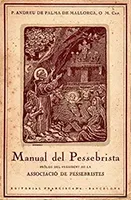
❝Biblical nativity scenes: They are so called when the setting of the plastic representation of the nativity scene is Bethlehem, the region of Judah… Palestine. The artist, according to the means and the space at his disposal, goes on reproducing with complete fidelity the holy places of the Holy Land, and others related to the Advent of Jesus Christ.
Extra-biblical nativity scenes: When the scene of the plastic representation relating to the Nativity is a topographical place quite different from those of Palestine, we are dealing with extra-biblical nativity scenes. The topography, then, may either be an imaginary panorama, not representative; or represent local places of the region, city or town to which the Christian home of the nativity-scene maker belongs (Catalonia, the province of Barcelona, the surroundings of the city). (Fra Andreu de Palma, p. 51; own translation)1
Where the scene takes place — the Judaea of the narrative or the landscape of the nativity-scene maker—: that is the division the book calls «a second justified classification» — the first, by light, separates midnight nativity scenes from those in full daylight—, and neither of the two carries a hierarchy inside it. No setting makes the nativity scene better or worse; the text calls whoever composes the biblical one an «artist», and the conception of nativity-scene makers an «artistic conception».
Six years later, another manual — La construcció dels pessebres, by Josep M.ª Puig i Roig (Barcelona, 1933) — devotes its chapter V to the «Classificació dels pessebres» and opens it with the craft’s distrust of taxonomies: classifying nativity scenes by styles or methods of construction is «very difficult, not to say impossible», because each nativity-scene maker follows rules of their own and there are almost as many forms as authors. The full quotation is in the chapter on framing (A question of framing)3. But what matters here is the sentence that follows:
❝In general, we see that there is an attempt to classify nativity scenes into two groups: «artistic» and «popular», a classification with which we personally cannot agree, since, on the one hand, we consider that every nativity-scene construction, whatever its character, is an artistic manifestation, more or less refined or rudimentary, which can fit into the many subdivisions of art, and many times we can find greater artistic refinement in a family nativity scene, one of those called «popular» or dining-room scenes, than in others pompously christened by their authors as artistic nativity scenes, and, on the other hand, we also consider that every nativity scene is always «popular», since it is a manifestation of popular art, inspired by affection for a cherished tradition of our own. (Puig i Roig, pp. 27-28; own translation)3
The pair this chapter is pursuing exists, then, in 1933, and not as a novelty: Puig i Roig takes it as general — «arreu», «en general»: everywhere, in general—, and records how «some» defined it. The «artistic» ones would be «those built according to all the laws of art, technique and perspective» (p. 28); the «popular» ones, «those built with elements of nature itself: moss, cork, clay, galzeran, etc.» (p. 31)3. Who formulated it first is not on record: Puig i Roig does not say, and this chapter has not found an earlier text that contains it.
It is worth noticing what he does with it. He rejects it as a hierarchy — every nativity scene is art, and every nativity scene is popular— and, even so, he accepts it as a tool: «having no pretensions as a critic, nor of lecturing anyone, we wish to accept, as a basis for these comments, the classification that has generally been made», because all or almost all the varieties fit into it, «even if only in a very imprecise way» (p. 28)3. Using it to order the discussion without granting it the power to order value: that is exactly the distinction this chapter defends, and it was written in 1933.
The balance of the first printed literature on nativity-scene making is, then, this: it classifies by light and by setting, it distrusts pigeonholes and it treats the nativity scene as art with no qualifiers. The «popular» versus «artistic» pair is already in circulation, and the first manual that names it denies it the hierarchy.
The book that described it
Thirteen years later, the pair reappears in El Pessebre by Joan Amades4. Amades (1890-1959) was a Barcelona folklorist with an immense body of work — he devoted his life to collecting and preserving Catalan popular culture—, and his book on the nativity scene is exactly that: an ethnographic monograph — the nativity scene as a living tradition: customs, uses, symbols—, not a treatise on scenography nor a history of art. The fact is not a reproach; it is the key to everything that follows.
In his introduction, Amades distinguishes two «aspects» of the nativity scene of his time:
❝The nativity scene can be considered under two aspects, apart from many other divisions that could be made of it: the artistic aspect and the popular aspect. […] By artistic nativity scene we understand that which is made by people skilled and knowledgeable in art, who take care to commission the figures and the iconographic elements that make up the whole from people who feel the emotion of art, and who put all their interest into fitting the nativity scene to the panoramic and pictorial reality and to the historical truth of the biblical scene, the subject of their production.
The popular nativity scene, generally the work of humble people led more by their sensitivity than by erudition and knowledge of the subject they have in hand, moves within a panoramic setting full of great local realism. […] We, as people attached to everything that embodies a sense of tradition, incline all our sympathy towards the humble nativity scene, anachronistic and contradictory in most of its aspects. (own translation)4
Read it slowly, because almost nothing of what is hung on this page today is in it. Amades describes: «can be considered», two «aspects», «apart from many other divisions that could be made» — it is the language of someone portraying a reality of his time, not that of someone laying down a rule—. His «artistic» does not name the person who knows how to model, but the one who can commission: knowledgeable people who entrust the figures to «people who feel the emotion of art» and pursue historical truth — he is portraying a patron, almost a social class, rather than a creator—. He does not even define the same thing as the 1933 classification: there the criterion was technique — the laws of art, perspective, materials—; here it is who commissions and what they pursue. And his declared heart lies at the other pole: the book’s sympathy goes to the humble nativity scene. Anyone who has heard «popular» used as a put-down would do well to reread Amades: from his pen it was praise.
The page nobody quotes
And if the introduction is misread, there is a chapter that is simply not read. In the same book, on reaching nativity-scene making as a phenomenon, Amades writes:
❝Making a nativity scene is quite an art, as small and as humble as you like, but an art after all, with its emotion and its sensitivity, the bases of every artistic work however slight it may be, without which art is not possible. And art is expansive, for, if it were not, it would no longer be art and would only seem to be. (El Pessebre, Aedos, 1959, ch. X, p. 413; own translation)5
And a few lines further down he calls those who practise it by their name: «the artists of the nativity scene have been called "pessebristes"» — nativity-scene makers. Artists — not craftsmen, not amateurs—.
There it is, from the author’s own hand, what this series has spent three chapters demonstrating by other routes: for Amades, every nativity scene — the smallest and humblest included — is art. The man to whom the division that demotes the domestic nativity scene is attributed left in writing exactly the opposite. The hierarchy is not dismantled by an argument of ours: it is dismantled by the letter of its supposed father.
How the hierarchy survived
How, then, did we arrive at the current pigeonhole, with its hierarchy inside? The hierarchy did not have to be manufactured afterwards: in 1933 it was already out on the street. Puig i Roig says who was putting it there — the authors who «pompously» christened their own nativity scenes as artistic — and he rejected it in writing. What the documents show from then on is something else: three books discussed the pair over twenty-four years, and none of them granted it the hierarchy.
The mechanism needs no malice: a division is quoted without its context; the quotation is repeated; the repetition is inherited; and after a few decades what circulates is the pigeonhole, not the discussion that came with it. Each link read the previous one, and almost none went back to the books. At the end of the process, two groups that a nativity-scene maker accepted «in a very imprecise way» and two «aspects» that an ethnographer noted with sympathy function as two classes with a hierarchy.
What can be documented is this: the pigeonhole that circulates today cites none of them. The most frequently consulted summary sorts nativity scenes into popular and artistic «según la técnica de confección del belén» — according to the technique used to make the nativity scene— — a criterion closer to that of 1933 than to that of Amades — and without a single note6.
The third discussion came from Madrid. Luis Buendía, author of a manual on building Nativity scenes published in 19577, knew the classifications in circulation and put them in their place with a clarity that still holds:
❝Es un error muy frecuente calificar exclusivamente de artísticos a los Nacimientos construidos en forma de dioramas […] Artístico es todo lo que es bello y ha sido bien realizado, cualquiera que sea su clase y categoría […] se consideran siempre dos clases de Nacimientos: el histórico o bíblico y el popular, y justamente uno y otro pueden ser, a la vez, artísticos. — It is a very common error to describe as artistic exclusively the Nativity scenes built in the form of dioramas […] Artistic is everything that is beautiful and has been well made, whatever its class and category […] two classes of Nativity scenes are always considered: the historical or biblical and the popular, and precisely the one and the other can be, at the same time, artistic— (Buendía, 1957, p. 49)7
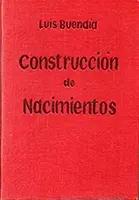
Two classes — the biblical and the popular — and the adjective «artistic» returned to its only legitimate use: the judgement on the finished work, not the label of a class. In 1957 what Puig i Roig had written in 1933 was being said for the second time. And yet the pigeonhole triumphed, and today it is still sorting nativity scenes.
What the pigeonhole looks at — and what art asks us to look at
It is worth now looking the pigeonhole in the face, because its defect does not lie in its origin — which we have already traced — but in its viewpoint: it classifies the work by the author’s record — who made it, what training they had, who commissioned it — and by the format in which it is presented. And that is a criterion no artistic discipline accepts for itself.
Photography shows it better than any other. Nobody sorts photographers into «popular» and «artistic» as two castes: there are successful and failed photographs, amateur and professional, and the discipline is a single one — the artistic is decided in each image, by its intention and its execution, not on the card of whoever presses the shutter—. The same happens with the nativity scene, and the series has already laid out the pieces: the exhibition diorama is one format — specialised, with resources of its own — and the nativity scene that one walks around is another (A question of framing); like any photograph, each of them can be artistic or not. Format does not guarantee art; nor does the record. Only the work answers.
One objection remains, and the reader of this series already has the means to resolve it: if art demands a language that is learned (Is nativity-scene making an art or just a Christmas tradition?), is the pigeonhole not right to separate the trained from the untrained? No, and because of one word: that chapter said «academically or self-taught». The language is also learned by looking, comparing and getting things wrong — that is how sensitivity and instinct are educated—; what the pigeonhole turns into a border between two classes is, in reality, the starting point of any learning. The mistake is not in demanding craft — this whole Manual demands it—: it is in passing the verdict before looking at the work.
And it would not be the first time a work changed pigeonhole. Before the painters of the Renaissance claimed that the artist was not a craftsman — when painting and sculpting were mechanical trades learned in the guild, not in the academy—, a good part of what fills museums today was considered craft: the masters of the Gothic, Greek pottery, altarpieces.8 The border between art and craft is not a fact of nature: it is a convention with a history — and whoever has seen it move knows that it can move again—.
A pigeonhole that is withdrawn
And what is put in its place? Nothing — and that is the best part—. Classifications are replaced when they were needed; this one was not needed at all. To talk about how a nativity scene is presented there is already a criterion that distinguishes without ordering: the number of framings (A question of framing). To talk about its value there is already the only judgement art admits: the work, one by one, better or worse (Is nativity-scene making an art or just a Christmas tradition?). And «popular» can go back to being what it was from Amades’s pen: the affectionate description of a way of doing things — not the basement of a hierarchy—.
Closing
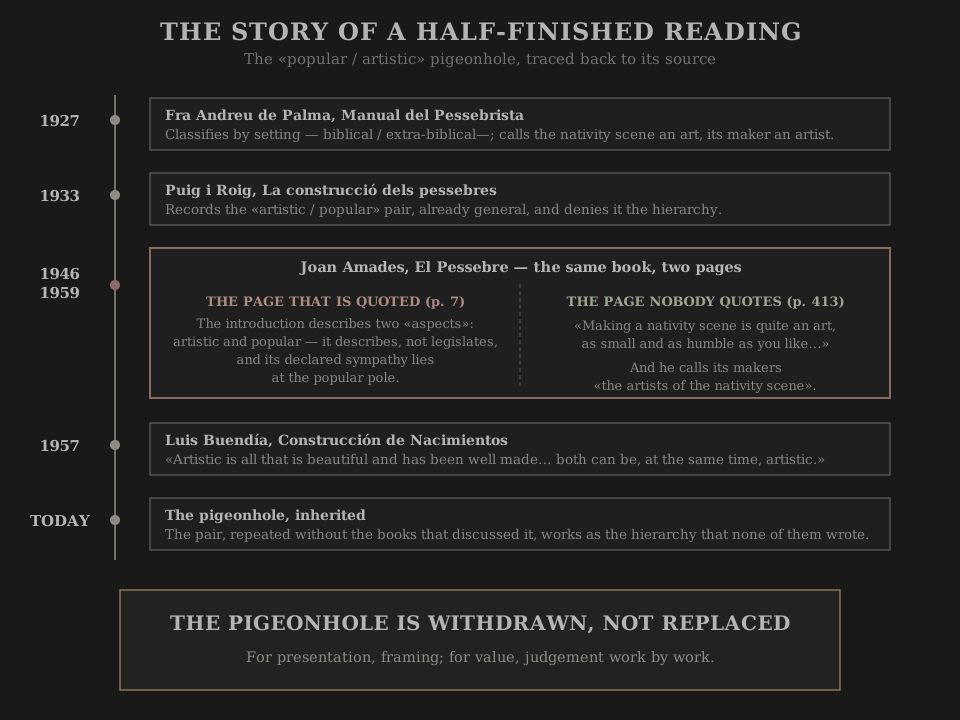
The pigeonhole asked to be traced back to its source, and the trail does not end in a book: it leads to a discussion. In 1933 the pair was already in circulation, and the first manual that names it rejects it as a hierarchy: every nativity scene is art, and every nativity scene is popular. Amades’s book describes it without a hierarchy, with its sympathy placed at the humble pole, and its own author left in writing that making a nativity scene, however small and humble, is quite an art. Buendía put the adjective back in its place in 1957. Who formulated it first is not on record; what is on record is that each time someone examined it in writing, the hierarchy did not survive the examination. And even so, repetition without context turned it into law. No verdict is needed: the whole story is enough — which is, precisely, the one that was not being told—.
Whoever composes their nativity scene this December — on the table at home or in the box of an exhibition — therefore has no pigeonhole to choose. They have something harder and more their own: composing well, which is the one thing no classification gives away.
And one loose thread remains, which the attentive reader will have seen go by: if Amades wrote this, why did his definition of the nativity scene — the one an international congress approved unanimously — leave out things that existed before his eyes? That is another case, with its own clues, and it deserves a chapter of its own: it is the next one.
References
The footnotes locate; these entries explain why each source is included, what it contributes and what it does not allow us to claim.
ANDREU DE PALMA DE MALLORCA, O.M.Cap. (1889-1963). Manual del Pessebrista. Barcelona, Editorial Franciscana, 1927. Foreword by Francesc de P. Badia, president of the «Associació de Pessebristes». — Technical manual; the first book devoted to building nativity scenes; history of Catalan nativity-scene making. It is included as a founding witness: it classifies by setting (biblical / extra-biblical) and calls the nativity scene an art and the nativity-scene maker an artist, without pigeonholes of value; Badia’s foreword confirms it from within the association itself. It is used as a direct historical source for the state of the question in 1927. Cautions: own translation from the Catalan, checked against the copy (pp. 7 and 51). Central source of the chapter.
PUIG I ROIG, Josep M.ª La construcció dels pessebres: recull d'orientacions pessebristes. Barcelona, Foment de Pietat (Publicacions de l'Associació de Pessebristes de Barcelona), 1933. Foreword by Joaquim Masdexexart; 146 p. — Technical manual. It is included for pp. 27-31: the craft’s distrust of taxonomies and the testimony that the «artistic / popular» pair was already in circulation in 1933, with its rejection as a hierarchy and its acceptance as a working basis. It is used as a direct historical source. Cautions: own translation, checked against the copy (pp. 27-28). Central source of the chapter.
AMADES, Joan. El Pessebre. First de luxe edition: Les Belles Edicions, Barcelona, Christmas 1946 according to the author himself (the Biblioteca de Catalunya catalogues it with a doubtful date, «1935?»); edition «considerably enlarged and brought up to date» (p. 7): Aedos, Barcelona, 1959, 508 p. — Ethnographic monograph; the work that in 1946 describes the «artistic / popular» pair without a hierarchy. It is included twice: for the introduction (the description of the two aspects, with the sympathy declared for the popular pole) and for chapter X of the Aedos edition (p. 413: «making a nativity scene is quite an art…», «the artists of the nativity scene»), the page that contradicts the hierarchy attributed to its author. It is used as a primary source, read in full and in its ethnographic framework — not as a treatise on scenography—. Cautions: the passages of the introduction, checked against the original (Aedos ed., pp. 7-8) and ch. X (p. 413), in Emili Solé’s copy; the presence of each passage in the 1946 edition has not been checked. Central source of the chapter.
BUENDÍA RUIZ, Luis (1895-1963). Construcción de nacimientos. Madrid, Ediciones Giner, 1957. Prologue by Fr José López de Toro; drawings by the author; 182 p. — Technical manual. It is included for p. 49: the early and explicit refutation of the division («artístico es todo lo que es bello y ha sido bien realizado, cualquiera que sea su clase y categoría» — artistic is everything that is beautiful and has been well made, whatever its class and category—), written two years after the Rome congress. It is used as a direct historical source and as a witness that the correct reading was possible in its time. Cautions: wording checked against the copy (p. 49). Central source of the chapter.
KRISTELLER, Paul Oskar. «The Modern System of the Arts: A Study in the History of Aesthetics». Journal of the History of Ideas, parts I-II, 1951-1952. — Classic academic article on the history of the system of the arts. It is included in support of a single fact: the medieval assignment of painting and sculpture to the mechanical trades and the later construction of the border between art and craft. It is used as an applicable technical study. Vol. 12, no. 4 (1951), pp. 496-527, and vol. 13, no. 1 (1952), pp. 17-46. Cautions: draw nothing from it but the fact cited. Supporting source.
The following notes locate; they do not argue.
Fra Andreu de Palma de Mallorca (1889-1963), Manual del Pessebrista, Barcelona, Editorial Franciscana, 1927, 86 p. (Biblioteca de Catalunya, copy from the Badia-Cardús collection). The division by land («una segona classificació justificada de pessebres»), p. 51; own translation from the Catalan, checked against Emili Solé’s copy. The original: «Pessebres bíblics. Així s'anomenen quan l'escenari de la representació plàstica del pessebre és Betlem, la regió de Judà... la Palestina. L'artista, segons els medis i l'espai de que disposa, va reproduint amb tota fidelitat els llocs sagrats de Terra Santa, i altres relacionats amb l'Adveniment de Jesucrist». ↩ ↩
Francesc de P. Badia, foreword to the Manual del Pessebrista, Barcelona, Editorial Franciscana, 1927, p. 7; own translation from the Catalan, checked against Emili Solé’s copy: «tant el pessebrista veterà com el profà en aquest art, hi trobaran una munió de coneixements utilíssims […] consagrada a un art que ha de trobar tot el seu encís en la franciscana simplicitat i sinceritat de la seva plàstica». The 1927 title page puts it thus: «Pròleg del president de l'«Associació de Pessebristes» D. Francesc de P. Badia». ↩
Puig i Roig, Josep M.ª, La construcció dels pessebres, Barcelona, Foment de Pietat, 1933, ch. V, «Classificació dels pessebres», pp. 27-31; own translation from the Catalan, checked against Emili Solé’s copy. The first sentence of the chapter, in A question of framing, note 2. The original of pp. 27-28: «En general, veiem que es pretén classificar els pessebres en dos grups: "artístics" i "populars", classificació amb la qual personalment no ens hi podem avenir, ja que, d'una part, considerem que tota construcció pessebrista, qualsevol que sigui el seu caire, és una manifestació artística, més o menys perfeccionada o rudimentària […]»; «Però, no tenint pretensions de crític, ni d'alliçonar ningú, volem acceptar, com a base per aquests comentaris, la classificació que en general s'ha fet […] encara que sols d'una manera molt imprecisa»; «els pessebres dits "artístics", que havem vist definits per alguns, que són els construïts segons totes les lleis de l'art, tècnica i perspectiva». P. 31: «Els pessebres de l'altre grup, o sigui els generalment coneguts com a "populars", i que alguns han definit ésser els construïts amb elements de la mateixa naturalesa: molsa, suro, greda, galzeran, etc.» ↩ ↩ ↩ ↩
Joan Amades, El Pessebre. First de luxe edition: Les Belles Edicions, Barcelona, Christmas 1946 according to Amades himself (Aedos ed., p. 7: «apareguda pel Nadal del 1946»; confirmed by Garrut, who cites it as «Barcelona 1946, pàg. 7» — the Biblioteca de Catalunya catalogues it as «Barcelona : Les Belles Edicions, 1935?», with a question mark—); edition «notablement augmentada i posada al dia» (p. 7): Aedos, Barcelona, 1959, 508 p. The passages of the introduction, checked against the Catalan original of that edition, pp. 7-8 (scan of Emili Solé’s copy). ↩ ↩
Amades, El Pessebre, Aedos, 1959, ch. X, «Pessebrisme», p. 413; own translation from the Catalan, checked against Emili Solé’s copy. The original: «Fer pessebre és tot un art, tan petit i tan humil com vulgueu, però un art al capdavall […]»; «Els artistes del pessebre han estat qualificats de "pessebristes"». ↩
Spanish Wikipedia, article «Belenismo», subsection «Modelos básicos»: «La segunda clasificación es según la técnica de confección del belén: Populares son los que se realizan utilizando técnicas sencillas de montaje […] Artísticos son los que el belenista realiza utilizando técnicas específicas y sofisticadas […] Casi todos los dioramas son de tipo artístico, mientras que los belenes abiertos son artísticos y populares de manera indiferente.» — The second classification is according to the technique used to make the nativity scene: popular ones are those made using simple setting-up techniques […] artistic ones are those the nativity-scene maker makes using specific and sophisticated techniques […] Almost all dioramas are of the artistic type, while open nativity scenes are artistic and popular indifferently—. Revision 174757657 (8-VIII-2026); the text entered the article in 2010 (revision 39750363), without any note. The history of the neighbouring passage, in A question of framing, note 1. ↩
Buendía, Luis, Construcción de nacimientos, Madrid, Ediciones Giner, 1957, ch. II, «La construcción del Nacimiento», 1, «Clases de Nacimientos», p. 49; wording checked against Emili Solé’s copy. ↩ ↩
The status of the trades — the medieval assignment of painting and sculpture to the mechanical arts and their Renaissance vindication—: Kristeller, P. O., «The Modern System of the Arts: A Study in the History of Aesthetics», Journal of the History of Ideas, vol. 12, no. 4 (October 1951), pp. 496-527, and vol. 13, no. 1 (January 1952), pp. 17-46. ↩