
 ≈ 20 min
The most decisive choice in a nativity scene is made before the first figure is placed. Almost nobody knows they are making it.
The decision taken without knowing it
If someone is asked to imagine a nativity scene, what comes to mind is almost always the same: terracotta figures on moss or sawdust, a piece of virgin cork bark serving as a cave, a few dry branches for trees, a strip of aluminium foil for a river. It is the most widespread image of the nativity scene — the one many families put together every Christmas on a table or a sideboard — and it is worth starting with it, because it is not «the» nativity scene: it is one of the two possible answers to a question that almost nobody asks.
The question is: where will this be looked at from? The table scene is looked at from wherever one likes — from the front on coming in, from the side from the sofa, from above if the viewer is standing and almost at the figures’ level if the viewer is a child—. But there is another way of creating a nativity scene, less familiar to the general public: a box that can only be looked into from its front, where the scene has been composed to be seen from that single place — as one looks at a painting, a photograph or a theatre stage—. Both are nativity scenes in their own right, and they answer the same question in opposite ways: the first replies «from wherever you like»; the second, «from here».
That answer — not the material, nor the size, nor the technique — is the most decisive choice in nativity-scene scenography: scenography, the composition of visual space in order to narrate, begins exactly there, and on it depend what is composed, how it is lit and what can be told. The decision is taken before the first figure is placed, and almost always without knowing that it is being taken: it is inherited with each household’s way of doing things. This chapter gives it a name, so that it can be taken consciously.
A note on words before going on: in Spanish, belén and pesebre coexist to name the whole — this block, whose Spanish title is «El arte de componer pesebres», uses both—; when this Manual needs precision, pesebre also names the manger of the Nativity, and the context resolves the ambiguity. In English, nativity scene names the whole and manger the trough.
Framing: the word and the gesture
Before painting from life, some painters make a gesture: they stretch out their arms and form a frame with their hands — they widen it or narrow it, bring it closer or move it away, until they find the right proportion—. That gesture has a name: it is framing — the prior delimitation of what will be seen and from where—. It is worth noticing what is strange about the gesture: there is no painting yet; there is a decision about the gaze. Framing comes before the work, and the whole work lives inside it.
Cinema and comics made that operation into a trade. When a story is drawn before it is filmed, a storyboard is made: the story told in panels, one per unit of action — who comes in, what happens, what is seen—. The panel lives on paper: it is the scene as thought, still without a body.
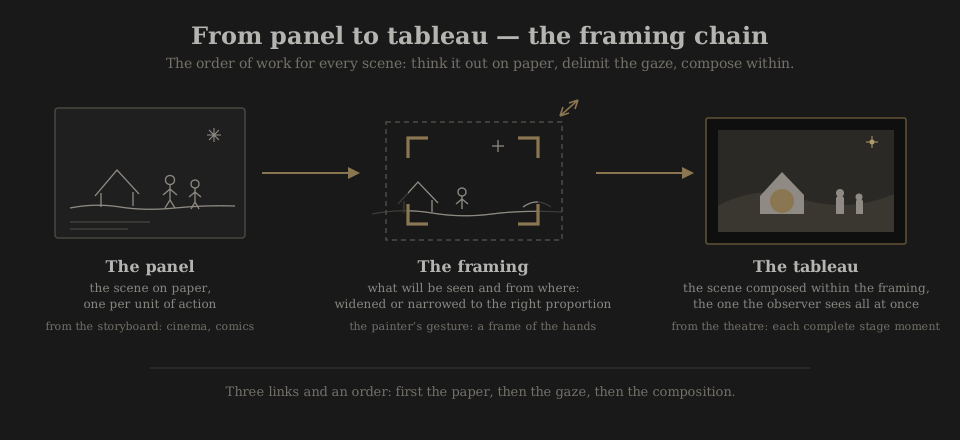
And when a panel passes from paper to scenography, the work begins with framing — what will be seen, from where — and ends in the tableau: in Spanish cuadro, a word inherited from the theatre, where it names «cada una de las partes breves en que se dividen algunas obras dramáticas o algunos actos de ellas» — each of the short parts into which some dramatic works, or some of their acts, are divided— (DLE, «cuadro», sense 15); here, the scene already composed, the one the observer sees all at once. The complete chain has three links and an order of work: the panel — the scene on paper—, the framing — the delimitation of the gaze—, the tableau — the scene composed within that delimitation—. This is how this Manual thinks of every scene that comes to be composed.
Two types of nativity scene
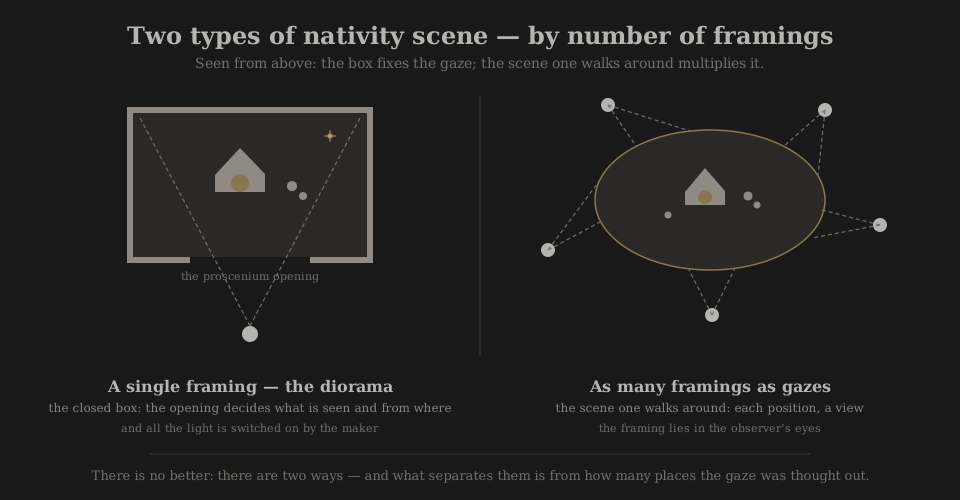
On that chain rests the most useful division this Manual knows: all nativity scenes fall into two types, according to the number of framings.
The first fixes a single framing. It is the nativity scene in a closed box — the diorama—, which can only be looked into from its front, through a proscenium opening (in Spanish embocadura): in the theatre, the «espacio del escenario que queda a la vista del espectador al levantar el telón» — the part of the stage left in view of the spectator when the curtain rises— (DLE, «embocadura», sense 7). Whoever composes it decides what is seen and from where — the framing is set by the maker of the scene, once and for everyone who looks—, and the box gives in return its structural advantage: total control of the light. No light enters but the light the maker switches on, and the lighting can then be composed as everything else is composed — directed, measured out, narrative—. The development of that control belongs to another chapter of this block; here the statement is enough, because it explains half the history of the diorama.
The second has as many framings as there are gazes. It is the nativity scene of homes and squares — the one on the table that people walk round—, composed to be walked around as one walks around a sculpture in the round, the «obra escultórica exenta, y por tanto visible por todo su contorno» — a free-standing sculptural work, and therefore visible all the way round— (DLE). It is worth putting it in positive terms, because language is misleading: this nativity scene does not lack framing — the framing lies in the observer’s eyes—. And it is worth specifying how, because here nobody makes the gesture of the frame: in the nativity scene that one walks around, the framing is given by the point of view — the place from which one looks, with its visual cone: the portion of the scene the eyes take in from there—. Whoever walks round it crouches down to the height of the figures, comes closer to a corner, chooses a front and changes it three steps later; and each movement, however slight, is already another framing — the framings of this nativity scene are not decided: they happen, and they are, in practice, infinite—. The whole is looked at as one looks at a landscape: on a visual stroll. Whoever composes it well can guide that stroll — with paths, lights, centres of attention—, but cannot fix it; that freedom of the viewer is not a defect of the type: it is its nature, and its appeal.
What each framing can tell
The number of framings might seem a fact of architecture; it is, above all, a narrative fact: the support decides how many tableaux fit, and how they are told.
The nativity scene with multiple framings can compose several tableaux on the same surface: the Nativity in its shelter, the annunciation on its hillside, the caravan of the Magi on its road, Herod’s palace on its hill — all at once, each in its place—. That way of narrating has a name and a tradition: it is continuous narration, that of the medieval paintings which bring together different moments of the same story on a single panel. It is a legitimate tradition that can be declared, and it has a limit worth keeping in view: the tableaux share space, not time — the annunciation and the adoration do not happen at the same moment, even though they live side by side on the same moss—, and the observer ought to be able to know that they are seeing different moments. When this is not declared, the cost exists, and the customary nativity scene pays it without knowing: the shepherds in perpetual adoration beside the manger, with the Magi already arrived next to them, merge into a single tableau scenes that the narrative keeps apart — that loss is measured on the page for that scene (Adoration of the shepherds)—.
The single-framing nativity scene can do none of that, and its limit is its strength: one tableau per box. The diorama forces a choice — out of the whole story, this, seen from here—, and that choice is half the craft. For it, the whole sequence exists in only one way: the series of correlated dioramas — the narrative exhibition: each diorama, a panel; the comic made into boxes—, where the visitor walks from box to box and the time of the story moves forward with them.
And there is a third mode, for a precise case: two scenes that share a framing — the same place, seen from the same spot, at two different moments—. In the cycle, the case is the annunciation to the shepherds: the angel before the band of shepherds and, «repentinamente» — suddenly— (Luke 2:13, in the 1909 Reina-Valera version), the heavenly multitude — the host of heaven — that proclaims the Gloria. Juxtaposition would put at the same time what the narrative keeps apart; the series would split into two boxes what happens in the same place. The solution is alternation: two states of the same tableau — at rest, the annunciation; activated, the Gloria—, with a device as humble as a push-button within the observer’s reach (Annunciation to the shepherds).
Three modes of narrating — juxtaposition, series, alternation—, and a single key that distributes them: the number of framings.
A criterion, not a classification
Readers who come from the literature of nativity-scene making — or from its most consulted summary — will have come across another division. It is given, for example, by Wikipedia, which classifies nativity scenes «según la presentación del montaje» — according to the presentation of the setting-up—:1
«Abiertos o panorámicos, que son los visibles al menos por tres de sus caras o lados, situados más bajos que el punto de vista del espectador, sin estar rematados por celaje alguno, ni techo ni armazón que lo cierre, sino, en todo caso, por un telón liso de fondo.» — Open or panoramic: those visible from at least three of their faces or sides, placed lower than the spectator’s point of view, not topped by any sky, nor by a roof or framework that closes them, but, at most, by a plain backdrop—.
«Cerrados los dotados de un cerramiento exterior (cajón, estructura metálica o de madera, cortinajes, etc.), que encierran el belén dejando como única vista un frente, a través de una embocadura, donde vemos todo como un paisaje cerrado provisto de perspectiva, como en un teatro, y cuyo realismo supera con mucho a los belenes abiertos. Se acostumbran a denominar dioramas artísticos.» — Closed: those provided with an outer enclosure (box, metal or wooden structure, drapes, etc.), which enclose the nativity scene leaving a front as the only view, through a proscenium opening, where we see everything as a closed landscape provided with perspective, as in a theatre, and whose realism far surpasses that of open nativity scenes. They are usually called artistic dioramas—.
The kinship with this Manual’s division is evident — the «cerrado» (closed) there is the single framing here—; the differences are what matter. The first: the criteria are of construction — how many faces can be seen, at what height the whole stands, what closes it, what tops it—: they describe the piece of furniture, not the gaze. And because they describe the furniture, they fail where the furniture varies. The height «más bajos que el punto de vista del espectador» — lower than the spectator’s point of view— depends on who is looking — the standing adult, the child, someone in a wheelchair — and on where the nativity scene is — on a platform, or at ground level in a square, with life-size figures looked at eye to eye—. And the «telón liso de fondo» — plain backdrop— is contradicted by ordinary practice, full of open nativity scenes with starry skies and painted landscapes.
The second difference weighs more: the definition of the closed nativity scene carries a judgement inside it — its realism «supera con mucho» — far surpasses— that of the open ones—. It is a classification that ranks while it describes: it sorts nativity scenes into pigeonholes and, in passing, orders the pigeonholes from better to worse. The division by framings needs none of that: it does not measure faces or heights — it asks from how many places the gaze has been thought out—, and it does not rank, because there is no better: there are two ways.
Distrust of taxonomies, moreover, is nothing new in this craft. A Catalan manual on building nativity scenes put it in writing as early as 1933 — La construcció dels pessebres, by Puig i Roig—:2
«We see how everywhere there is an attempt to classify nativity scenes into particular categories or groups, according to the different styles or to the methods of construction. We consider it very difficult, not to say impossible, to establish such classifications; for, since the building of nativity scenes cannot obey fixed rules, everyone makes their own and uses their own procedures, so that the forms these constructions take turn out to be almost as varied as the artist nativity-scene makers who create them are numerous.»
On the following page, the same author accepts the classification of his time «as a basis for these comments», «even if only in a very imprecise way»: he distrusts the pigeonhole, but he does not forbid it (as told in Popular or artistic nativity scenes? The story of a half-finished reading).
That is why this Manual does not offer another pigeonhole: it offers a criterion. Framing does not classify objects — it thinks through the relationship between the scene and the gaze—, and that is why it cuts across techniques, materials and formats: it holds for the table nativity scene and for the monumental one, for the box diorama and for the digital and immersive forms already on their way, where the question «where will it be looked at from?» will still be the first. What is essential is not how a nativity scene is built: it is how it has been thought that it will be seen.
The gaze and the applause
One objection remains, and it deserves an answer because it is heard: does the single framing not impose a gaze? Does it not take away from the observer the freedom to walk round, to choose, to discover? Painting gave the answer centuries ago. A picture is painted to be seen from the front, and nobody has ever felt that condition as a deprivation: the work does not cancel the interpretation of the one who looks — it invites it—. Nobody asks a painter to recompose the picture to suit each visitor, and not because of the painter’s authority, but because the composition is the work: what is looked at is, precisely, a gaze already thought out. It is not a matter of imposing a gaze, but of composing it.
The distinction does need refining, though, because the argument easily twists towards disdain — «the artist owes nothing to the public»—, and that is not the point. The observer matters, and a great deal: one composes for the gaze, not for the applause. The observer is the recipient of everything — every decision of the nativity-scene maker is taken for a pair of eyes—; what the observer is not is the judge of the design: the observer neither directs the composition nor corrects it. In the nativity scene with multiple framings, even the framing is the observer’s; in the single-framing one, what the observer receives is someone else’s gaze, already thought out for them — and receiving a thought-out gaze is one of the experiences that art knows how to give.
And the conclusion this chapter must leave settled, because the ones that follow rest on it: the value of a nativity scene is not decided by the form of its framing. Neither does the box make art on its own, nor does the open table prevent it: what decides is the composition and the craft of whoever creates it. The framing criterion distinguishes — that is what it is for—; it does not classify into closed categories and it does not rank. Of the two ways of looking at a nativity scene, this block will teach how to compose both.
References
Spanish Wikipedia, article «Belenismo», section «Características y clasificación», subsection «Modelos básicos», point «Según la presentación del montaje»; revision 173802812 (5-VI-2026), the one current on 27-VII-2026, identical in this passage to the present one (174757657, 8-VIII-2026). The passage entered the article on 8-I-2007 (revision 6385567) in an anonymous edit without any reference; the only note it carries today, «Amades, Joan, op. cit. pag. 185», was added by another user in 2010 at the end of the point «Cerrados», and refers to the 2009 edition. No earlier printed text with these words has been found. ↩
Puig i Roig, Josep M.ª, La construcció dels pessebres: recull d'orientacions pessebristes, Barcelona, Foment de Pietat (Publicacions de l'Associació de Pessebristes de Barcelona), 1933, ch. V, «Classificació dels pessebres», p. 27; own translation from the Catalan, checked against Emili Solé’s copy. The original: «Veiem com arreu es pretén classificar els pessebres en categories o grups determinats, atenent-se als diferents estils o a les modalitats de construcció. Entenem que és molt difícil, per no dir impossible, d'establir unes tals classificacions […]». ↩