
 ≈ 24 min

Nobody asks whether painting or sculpture is art. The question in the title is only raised about disciplines that are under suspicion, and that is why it is worth taking seriously: not in order to defend oneself against it, but to find out exactly what the nativity scene is accused of when the word is denied to it.
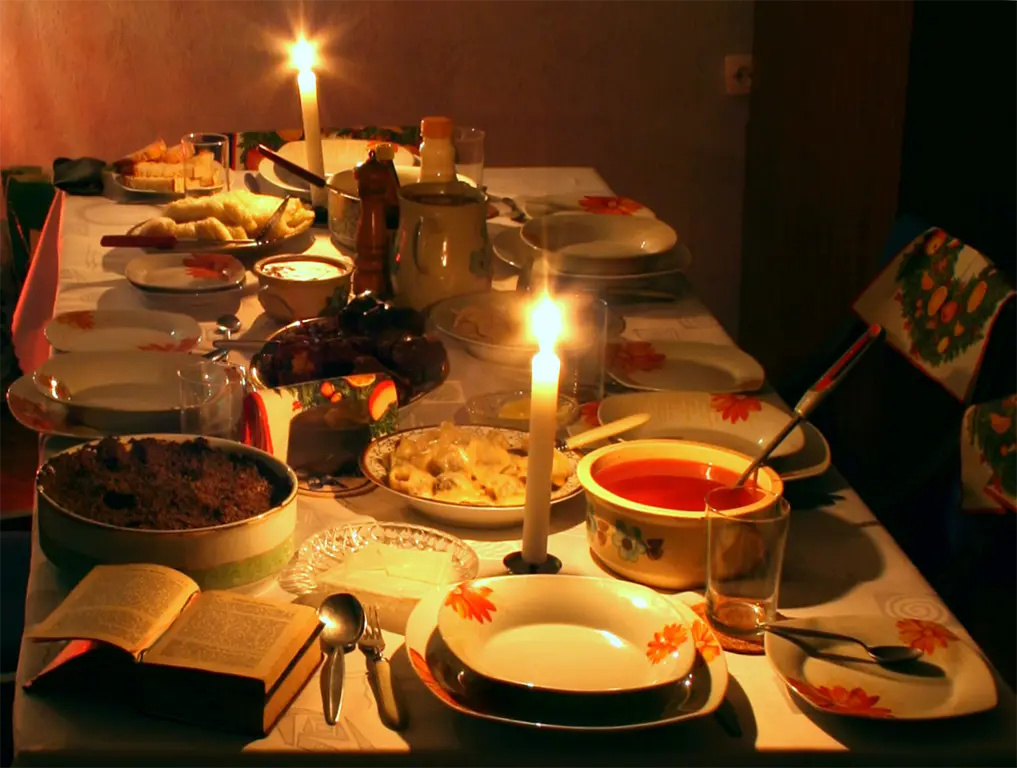
The accusation, though it is almost never spoken in full, is this: the nativity scene would be an arrangement, not a creation. The soup plate on the dinner plate, lined up in front of the chair; the knife and spoon on the right, the fork on the left. In the nativity scene, the Child lying in his manger, the Virgin on his right, Joseph on the left, the ox and the ass in their place, and everything lit by an angel as the table is lit by a candle. An inherited order, carried out every December and taken down in January. If that were all, the suspicion would be right: laying the table is not art, however well it is laid.
This chapter deals with the difference.
What the table does not have
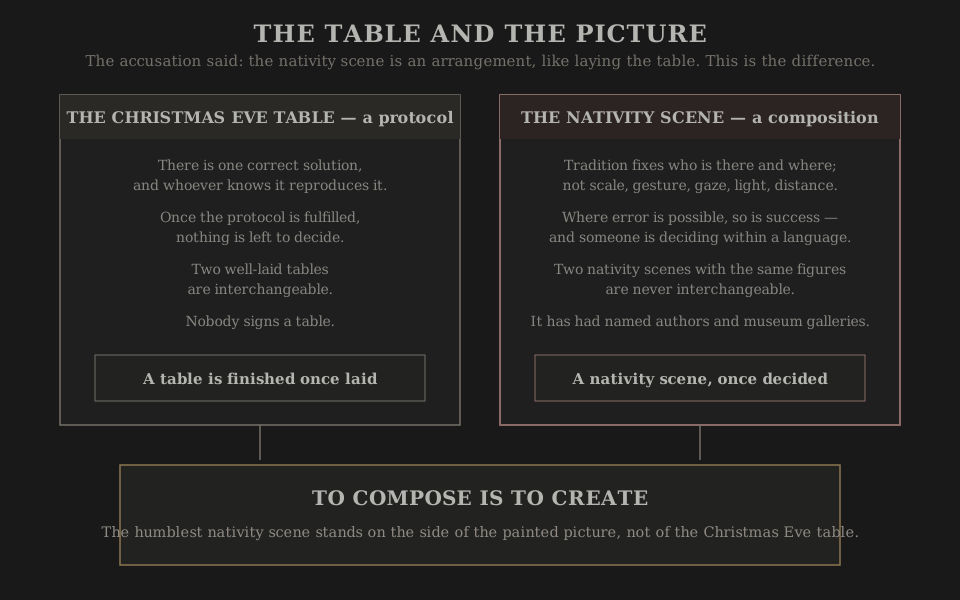
It is worth distinguishing between carrying out a protocol and solving a composition. The order of the table is closed: there is one correct solution, and whoever knows it reproduces it. Once the protocol has been fulfilled, nothing is left to decide; that is why two well-laid tables are interchangeable, and that is why nobody signs a table.
The order of the nativity scene only looks closed from a distance. Tradition fixes who is there and where, but it fixes almost nothing of what really builds the scene: at what scale, with what gesture, looking in which direction, lit from which side, at what distance one figure from another, what is seen first and what is discovered afterwards. Each of those decisions can be taken better or worse — and where there is room for error there is room for getting it right, and where there is room for getting it right there is someone deciding within a language they have had to learn — and with the sensitivity, the aptitude or the instinct that each person brings, which also decide; but neither do these come from nowhere: they are educated by looking, comparing and getting things wrong—. Two nativity scenes with the same figures are not interchangeable. That is the first difference from the table, and it is not a small one: it is exactly the difference between an order and a composition.
There is a domestic proof of that difference, within anyone’s reach: nobody empties the box of figures onto the moss and leaves things where they fall. As soon as someone starts to arrange them — this one here, that one further back, the angel on top—, they are already composing; and composing is creating. They may do it with judgement or without, better or worse — that is the only legitimate question—, but what they are doing is no longer carrying out a protocol: it is deciding a scene. The humblest nativity scene in the most absent-minded house stands on the side of the painted picture, not on the side of the Christmas Eve table.
A language that is learned
An idea is not yet a work. What turns an idea into a work is its materialisation through a technique, and technique is not improvised: it is acquired, academically or self-taught, but always with study, observation and references. Can there be poetry without mastery of the language? Can anyone play Bach’s Cello Suites without knowing the instrument? In any discipline, learning is what allows creativity to become form and not only intention.
This also holds against the myth of the spontaneous genius, that romantic figure who would create without training. Not even its favourite examples support it: Van Gogh, held to be self-taught, went through academic institutions and through Cormon’s studio in Paris, and studied colour theory and composition on his own with a discipline that his letters document1. Genius, when it exists, is a way of working, not an exemption from learning.
The extreme case is provided by a child. The self-portrait that Albrecht Dürer drew at the age of thirteen — in silverpoint, a technique that allows no correction — still astonishes; but it did not come from nowhere: he made it within the workshop of his father, a goldsmith, where that discipline of line was learned every day. Not even the prodigy skips the apprenticeship: he starts it earlier.2
The philosophy of art has returned again and again to these two features — the materialised form and the shared language. Aristotle, in the Poetics, observed that pleasure in a representation does not arise from the thing represented but from recognition: we understand that this is that, and that understanding is a delight proper to human beings3. Kant, in the Critique of Judgement, pointed out that before the work of art satisfaction is disinterested: we do not want to use what we look at, nor eat it, nor possess it; it is enough for us to contemplate it4. Neither of the two criteria excludes the nativity scene. Before a nativity scene nobody seeks usefulness — it is contemplated — and its whole working rests on recognition: we identify the scene, we understand that this is that, and from that understanding comes what we feel. The Christmas Eve table, on the other hand, is laid — it will be said — to celebrate Christmas; but celebrating does not oblige anyone to eat, so what the table does, strictly speaking, is serve a supper.
The main entrance
There is a check that comes before all theory, and it is done by listing: what is a nativity scene made of? Of sculpture — the figures: modelling, anatomy, gesture, scale—. Of painting — the polychromy of the figures, and the landscape and interiors of the scene—. Of composition — where the centre of the tableau lies, what tension orders it—. Of scenography — visual space built in order to narrate—. Of lighting — directed, measured out, narrative—. And, holding them all up, of art history — the iconography that each figure inherits, disputes or corrects—. None of these disciplines has to defend its artistic standing: they have centuries of theory, museum galleries and faculties. And around them work the fields of knowledge that are not arts but nourish whoever practises them: history, religion, ethnography, the study of folklore — the list is long, and this whole Manual is its proof—.
Once the material has been listed, the question in the title is turned round: what would need explaining is how a practice whose components are, one by one, the fine arts could not be art. Must an artistic expression come in through the service entrance when it could come in through the main one?
Place: Duchamp in reverse
In 1914 Marcel Duchamp took a mass-produced bottle rack and declared it a work5. The gesture, which founded the ready-made, showed something that nobody has been able to refute since: the place and the manner in which something is presented change what that something is. Any object, placed in the museum and upheld by a discourse, enters art.
What interests this chapter is reading the gesture in reverse. If the museum can turn an object into a work, the home can make a work look like an object. Historically, the nativity scene travelled the opposite road to the bottle rack: sculpture that, instead of entering the museum, entered homes, churches and streets — the places where art carries no credentials. Its supposedly minor standing does not come from what it is, but from where it has lived. And the proof is that when nativity figures enter a museum, the doubt disappears of its own accord: the collections of Neapolitan presepe at the Metropolitan in New York or at the Museo di San Martino in Naples are exhibited, catalogued and studied as sculpture without anyone in those galleries asking whether it is art6. The question in the title does not interrogate the work; it interrogates its postal address.
The subject never left art
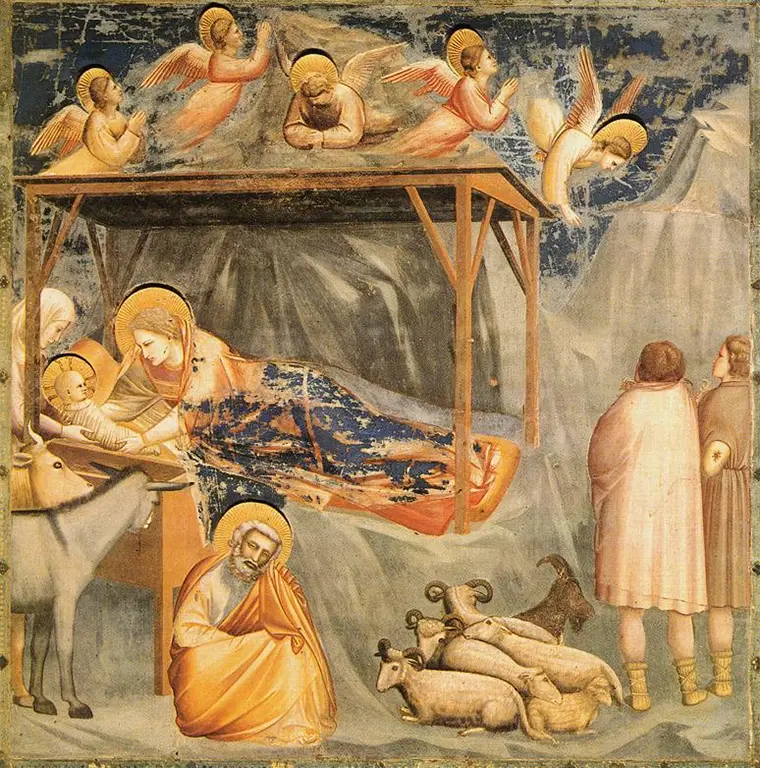
There is a second line of verification, older than Duchamp: looking at what artists on whom no suspicion weighs have done with this same subject. The Nativity is not a marginal matter that art has occasionally brushed against; it is one of the central scenes of the Western tradition. Giotto painted it around 1305 in the Scrovegni Chapel, in the cycle usually pointed to as the threshold of modern painting7. Georges de La Tour built, around 1644, an Adoration of the Shepherds that is, before being a pious scene, a problem of light solved: a single flame ordering volumes and distances8. Between the two, and after both, the list is the history of painting itself.
This does not show that every nativity scene is art — no subject guarantees anything. It shows something prior and necessary: that the subject of the nativity scene has always lived inside art, treated by its greatest names as a problem of composition, of light and of the human figure. Whoever composes a nativity scene today is not outside that tradition asking to be let in: they are inside it, and what can be demanded of them is to live up to it.
Those who did both
The most direct argument remains, and it is historical: the sculptors who worked at once for the church, for the future museum and for the nativity scene, without changing hands or standards.
In eighteenth-century Naples, the same workshops that produced monumental sculpture modelled presepe figures for the houses of the aristocracy. Giuseppe Sanmartino, author in 1753 of the Veiled Christ in the Sansevero Chapel — one of the technical summits of European sculpture —, is also credited with nativity figures: the Metropolitan in New York catalogues under his name an angel from the second half of the eighteenth century — polychromed terracotta head, body of wire wrapped in tow, fabrics — and attributes to him an Infant Jesus of the same period, both of which came with the Howard collection9. And the underlying fact is disputed by nobody: in that Naples, the nativity scene and major sculpture came from the same hands and the same century, and it occurred to nobody then that one of the two activities degraded the other.
In Spain, Francisco Salzillo (1707–1783) is the clear-cut case: the same sculptor whose processional work defines Holy Week in Murcia devoted his last years, from 1776 to 1783, to a monumental nativity scene — the one commissioned by the Murcian nobleman Jesualdo Riquelme, which his pupil Roque López completed in 180010 — that is preserved and studied today in a museum. In Catalonia, Ramon Amadeu (1745–1821) brought the naturalism of his religious sculpture to the nativity scene, and his figures are kept today in public collections as sculpture with an author — the Museu Nacional d'Art de Catalunya holds a head of a nativity figure by him—11; Damià Campeny (1771–1855) — professor of sculpture in Barcelona from 1815, sculptor of the chamber to Ferdinand VII, academician of merit of San Fernando — made nativity figures as a young man, according to the history of nativity-scene making in his native town, Mataró12; and Domènec Talarn (1812–1902) maintained that double condition up to the threshold of the twentieth century13.
This is not a roll of borrowed prestige. It is a historical fact with a logical consequence: if nativity-scene making were by nature foreign to art, these sculptors would have practised two different trades, one noble and the other domestic. That is not what the works show. They show a single way of modelling applied to different destinations. The hierarchy between those destinations was not set by them; we set it afterwards.
And the roll does not close in the past. Anyone who looks today at how the creators of figures present themselves to the public — in their workshops, on their websites, at the fairs of the trade — will find the same words again and again: escultor, escultora, artista — sculptor, in the masculine and the feminine, and artist—14. Those who make the figures go on naming themselves by their discipline; the exception is the opposite.
Where, then, does the suspicion come from
If the subject has belonged to art since Giotto, if the discipline has been practised by sculptors of the first rank and if its pieces enter museums without anyone protesting, where does the question in the title come from?
From three real circumstances that are worth naming without dramatising — and weighing one by one, because none of them can bear the weight it is made to carry.
The first is seasonality: the nativity scene is composed, contemplated and taken down, and it is hard to call a work something that does not last. But it is worth being precise about what does not last: the tableau — the composed scene—. The figures and the props are not destroyed: they are stored, inherited, collected and end up, as has been seen, in museums. The nativity scene is taken down out of necessity — space, materials—, not by essence; what is ephemeral is its staging, as a theatre performance is — an art whose standing nobody disputes because the performance ends—, and the work that inhabits it lasts, as a picture taken down from the wall lasts. What this argument has underneath — which is more than it seems — will have its own chapter in this block.
The second is universal practice and mass production: anyone composes a nativity scene every December, and alongside the authored figure there is the industrial figure. But anyone can also paint a picture, and today everyone takes photographs — and neither painting nor photography loses its standing as an art because of it—. Not every picture is kept nor is every photograph a work, and it occurs to nobody to reclassify the whole discipline on that account. The abundance of domestic practice does not lower the art that sustains it: it shows that art is alive. Distinguishing the authored figure from the industrial one is still necessary — not in order to despise either, but because confusing them prevents thinking—.
The third is an inherited classification — the one that separates the «popular» from the «artistic»—, repeated for decades as if nobody had revised it, and which deserves a chapter of its own: it is the next one.
And beneath all three runs the same inertia: going on pointing nativity-scene art and practice to the service entrance — that of folklore, that of the «Christmas tradition» of the title — when the main entrance, that of its own disciplines, has been open for centuries.
Closing
Let us go back to the Christmas Eve table, which was the accusation. The table is laid for supper; the nativity scene is composed to be looked at and understood. The table has one solution; the nativity scene has decisions — of scale, of gesture, of light, of distance — that can go wrong, and that is why they can succeed. The table recognises no author; the nativity scene has had authors with a name, a century and a museum gallery. Before the table, Kant’s criterion fails at the first word: there is interest, and it is that of sitting down. Before a nativity scene, we want nothing from it except to look at it.
The difference, then, does not lie in the order — both have one — but in what the order does: one serves a supper and the other builds a story. And perhaps the shortest proof of all is this: methods for laying the table exist by the dozen, and all of them are carried out in five steps, because a protocol leaves nothing to decide — laying the table well does not require a professorship—. For the other thing — for learning to compose, to look, to decide within a language — five steps are not enough: humanity has raised academies, schools and faculties of fine arts, and there are some in every Western country. A method of composition is not carried out: it is learned — and none of its pages spares a single decision to whoever composes—. A table is finished once it is laid; a nativity scene, once it is decided.
References
The following notes locate; they do not argue.
Van Gogh’s training: Académie Royale des Beaux-Arts in Brussels (critical edition of the letters, vangoghletters.org, letter 159, note 8); Antwerp academy, enrolment in January 1886 (KMSKA, Antwerp: «In January 1886, Vincent Van Gogh enrolled at the academy»); Fernand Cormon’s studio in Paris, in the months that followed his arrival at the beginning of March 1886 (vangoghletters.org, letter 569, note 14). Consulted on 23-X-2026. ↩
Albrecht Dürer, Self-Portrait at the Age of Thirteen (1484), silverpoint on prepared paper, Albertina, Vienna, inv. 4839 (Selbstbildnis als Dreizehnjähriger, «Silberstift auf grundiertem Papier»), with Dürer’s own inscription: «Dz hab ich aws eim spigell nach mir selbs kunterfet im 1484 iar do ich noch ein kint was». His father was a goldsmith and Dürer entered his workshop as an apprentice: Alfred Woltmann, «Dürer, Albrecht», Allgemeine Deutsche Biographie, vol. 5, 1877, p. 475 («ward dann Lehrling in der Goldschmiedswerkstatt seines Vaters»). Consulted on 23-X-2026. ↩
Aristotle, Poetics, IV, 1448b 4-19 — the pleasure of recognition in imitation—; the «this is that» (οὗτος ἐκεῖνος), at 1448b 17. Greek text read in the Perseus Digital Library on 23-X-2026. ↩
Kant, Critique of Judgement (1790), §§ 2–5, on disinterested satisfaction; Akademie-Ausgabe, vol. 5, pp. 204-210. The title of § 2: «Das Wohlgefallen, welches das Geschmacksurtheil bestimmt, ist ohne alles Interesse» (korpora.org, consulted on 23-X-2026). ↩
Marcel Duchamp, Bottle Rack (Porte-Bouteilles): the 1914 original is lost — thrown away by accident—; the 1960 version, which Duchamp signed at Robert Rauschenberg’s request, is in the Art Institute of Chicago, no. 2017.422. The museum’s record: «In 1914 Duchamp purchased this mass-produced bottle rack»; «Rauschenberg acquired Bottle Rack and asked Duchamp to sign it» (consulted on 23-X-2026). Duchamp died in 1968 and his work is not in the public domain: that is why the chapter mentions it without an image. ↩
Collections of Neapolitan presepe, checked (1-VIII-2026): The Metropolitan Museum of Art, New York — more than 140 figures from the Loretta Hines Howard bequest, 1964 (no. 64.164.*)—; Museo Nazionale di San Martino, Naples — nativity section with the Cuciniello presepe, which Michele Cuciniello donated to the State in 1879: «circa ottocento tra 'pastori', animali e accessori» (Ministero della Cultura, Art Bonus, «La sezione presepiale del Museo di San Martino», consulted on 23-X-2026). ↩
Giotto, Nativity, cycle of the Scrovegni Chapel, Padua, c. 1303–1305 (standard dating of the cycle). File fixed on Commons:
File:Giotto - Scrovegni - -17- - Nativity, Birth of Jesus.jpg(public domain). Reference monograph, as further reading. ↩Georges de La Tour, L'Adoration des bergers, around 1644, oil on canvas, 1.07 × 1.31 m, Musée du Louvre, inv. RF 2555, acquired in 1926 — formerly attributed to Honthorst— (Louvre record checked on 1-VIII-2026). ↩
Giuseppe Sanmartino (1720–1793), Cristo velato, 1753, Sansevero Chapel, Naples (checked on 1-VIII-2026). Nativity figures, The Metropolitan Museum of Art, Loretta Hines Howard bequest, 1964: Angel, no. 64.164.8a–c, catalogued as «Giuseppe Sanmartino (Italian, 1720–1793)», second half of the 18th century, «Polychromed terracotta head; wooden limbs and wings; body of wire wrapped in tow; various fabrics»; and Infant Jesus, no. 64.164.2a–c, «Attributed to Giuseppe Sanmartino», «Polychromed terracotta, charred wood and rope, silver-gilt halo». The angel’s record bases the authorship on «a tradition that seems to be supported by stylistic comparisons» (records consulted on 23-X-2026). ↩
Museo Salzillo, Murcia, page «Belén de Salzillo» (museosalzillo.es/coleccion/belen-salzillo/): «El belén fue realizado por Francisco Salzillo entre 1776 y 1783 para el noble murciano Jesualdo Riquelme y Fontes y completado por su discípulo Roque López y su taller. Quedaría concluido en 1800» — the nativity scene was made by Francisco Salzillo between 1776 and 1783 for the Murcian nobleman Jesualdo Riquelme y Fontes and completed by his pupil Roque López and his workshop; it was finished in 1800—; «Las figuras tienen un tamaño de unos treinta centímetros» — the figures are about thirty centimetres tall—. The record does not give the number of pieces. ↩
Ramon Amadeu (1745–1821). Museu Nacional d'Art de Catalunya, «Head of a Nativity figure», Ramon Amadeu, 1790-1815, inv. 122076-000 (museunacional.cat, consulted on 23-X-2026). ↩
Damià Campeny i Estrany (Mataró, 1771 – Barcelona, 1855). Real Academia de Bellas Artes de San Fernando, report E-636: «se le nombró académico de mérito (en la sección de escultura) el 9 de abril de 1820» — he was appointed academician of merit (in the sculpture section) on 9 April 1820—, and Ferdinand VII «le otorgó el título de escultor de cámara del rey» — granted him the title of sculptor of the king’s chamber—; Enciclopèdia Catalana, «Damià Campeny i Estany»: in 1815 he returned to Barcelona, «on fou nomenat professor d'escultura». The nativity figures of his youth: Albert Dresaire i Gaudí, «Notes sobre el pessebrisme a Mataró (1)», Sessions d'Estudis Mataronins (raco.cat). Consulted on 23-X-2026. ↩
Domènec Talarn i Ribot (1812–1902), sculptor and nativity-scene maker; the Museu Etnològic de Barcelona holds his nativity work: it lent his figures to the exhibition «Figures de pessebre, escultures de petit format. Domènec Talarn (1812-1902)», Sant Andreu de Llavaneres, 2013-2014 (Diputació de Barcelona, museums diary, consulted on 23-X-2026). ↩
Emili Solé’s own count of the official exhibitor posters of the X Feria Internacional de Belenismo (2025 edition, which is the cut-off date of the count), published in «¿Es confusión o un sinsentido en el foro de belenismo?» — Is it confusion or nonsense in the nativity-scene forum?— (emilisole.art, series «El belenismo y los escultores» — Nativity-scene art and sculptors—, 21-VII-2025): no figure maker presents themselves as «artesano» — craftsman—; the words chosen are escultor, escultora, artista, arte belenista. ↩