Procedure
The open workshop
How this site was made.
With names, roles and dates. What follows is not a statement of intent: it is a description of the work, and it can be checked.
Why this is being told
When someone comes across a long, well-finished piece of work today, they have reasonable grounds for wondering what it cost the person who signed it. The suspicion is not unfair: content produced in minutes, unchecked and undeclared, circulates every day, and a good deal of it is about exactly this — nativity scenes, traditions, the history of Christmas—, with errors of period and region that jump out at any reader who knows the craft.
So this site has two options. Say nothing and trust that the difference shows. Or explain how it was made, with names, roles and procedure, and let the reader judge with the evidence in front of them.
This is the second one.
The same text, four times
The Manual of Nativity-Scene Art and Practice did not begin in 2026. The oldest proof that can be fixed against someone else's archive dates from 23 February 2003: that day the Internet Archive captured www.emilisole.com, a bilingual site —Spanish and Catalan— with a sculpture gallery and a documents section. Its documentary index was captured 2 days later: characters, scenes of the Christ Child, scenes of Mary, objects; the diorama scenes separated by evangelist —Saint Luke, Saint Matthew—; a nativity-scene bibliography with catalogue records and ISBNs. That distribution is, 23 years earlier, the distribution of this Manual. And on the iconography page, captured in May, the Franciscan origin of the nativity scene was preceded by a «probably»: the caution now formalised as levels of evidence was already written by hand. The archive keeps that site with its content until January 2016.
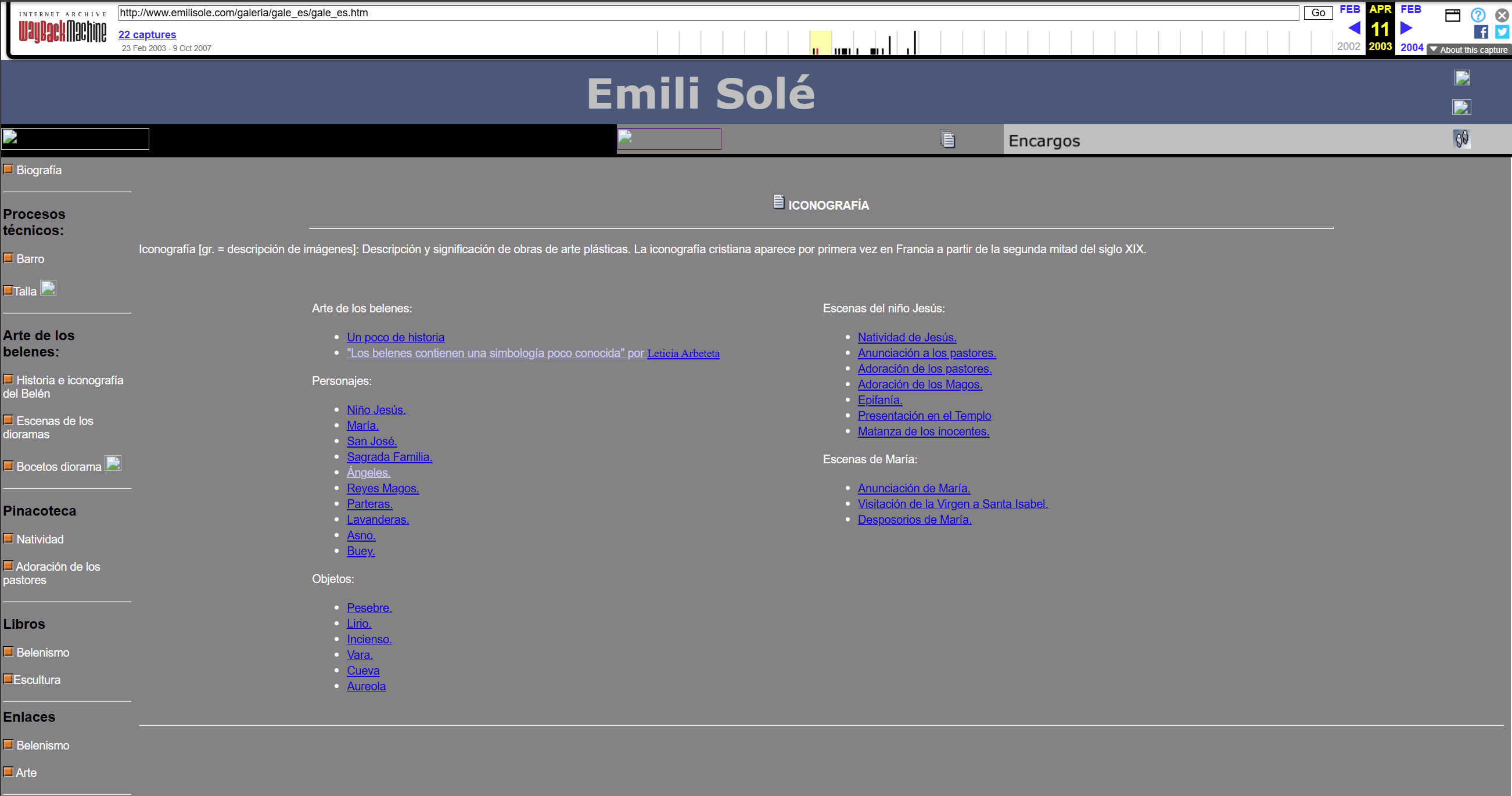
emilisole.com on 11 April 2003, with the site menu on the left. What the archive proves is that this page was published on that date; not when it was written. See the capture at the Internet Archive
What did not exist in 2003 was this text. The text has a history of its own, and it can be followed.
The drafts of the first entries are dated September 2015. On a blog called El belén artístico I had been writing about this for years, and the oldest entry whose date I can fix against someone else's archive is 1 January 2016: it deals with the diorama, the support and the proscenium opening. The Internet Archive has kept it since October 2017.
A visitor figure for that blog could be given here. It is not: the same service offers 2 — 1.68k in the dashboard list and 2.09k on the entry's own record—, and a figure that cannot agree with itself is not evidence. The rule that governs the rest of the site governs here too, where the number happens to favour me.
On 6 November 2019 I published a last entry there. It was titled «El blog está en revisión, lo siento» — the blog is under revision, sorry.
On 16 December 2019, 5 weeks later, I opened an account on the Wikimedia projects under my own name and began moving across what I had already written. The site chosen was Wikibooks, which is where books rather than articles are written, and the book was titled Belenismo. In March 2020 I created the definition, the external links, the chapter on models by making technique, the dioramas, the popular ones. The last edit is from 27 March 2020, at 09:22 in the morning. After that, nothing.
The morning before, between 07:25 and 07:39, I opened a page with the same table of contents in the Catalan free library, to take the book into the other language. I wrote the index and wrote nothing else: 1,443 bytes. The sections appear in red — page does not exist— and they are still the same 6 years later.
Then the text returned to a site of my own: the first edition of emilisole.art, which the archive captures with content from 4 October 2024. And finally this one, worked on in a local archive before publication.
A distinction is worth drawing, because «abandon» is not the right word: what was abandoned each time was the container, not the text. The text moved house. And because it moved whole, it can be followed.
On the blog, 1 January 2016:
«Para los belenistas es el soporte donde se realiza por regla general la escena del belén artístico. El tamaño del diorama es totalmente libre […] siempre es una caja con una embocadura por la que se mira la escena del belén.»
In another entry on the same blog:
«En todas las expresiones artísticas plásticas, hace falta un soporte para poder realizar y observar la obra. El pintor tiene el lienzo, la tabla y el muro […] los belenista de belenes artísticos tenemos generalmente una caja.»
On Wikibooks, 25 March 2020:
«Para los belenistas es el soporte en forma de caja donde se realizan en su interior una de las distintas escenas del belén, por regla general es el más utilizado.»
And in this Manual:
«In every plastic art the work needs a support […] The nativity scene needs one too, and there is no single one: depending on the intention and the type of framing it may be the floor itself, a shelf, a table, a frame, a raised structure, a box. […] The support cannot be removed; it can only be replaced. […] Without a support there is no nativity scene.»
There are 10 years between the first quotation and the last. In the first, the support of the nativity scene is a box. In the last, the box is one of the possible supports, and what is being asserted is no longer a habit observed in the craft but a condition the work cannot get around. The opening sentence is almost the same; what has changed place is what holds it up.
So neither the intention nor the index nor knowing what was to be discussed was missing: the 2020 table of contents resembles the present one more than I would like, and the 2003 index already distributed the same questions. What was missing was what does not fit into a March morning — finding the sources, collating them, accepting that half of what one takes for granted does not hold— and what was missing was a way of working that made that possible without giving up sculpture.
The revision I announced on 6 November 2019 is this. 6 years have passed.
Who does what
The author. Emili Solé. Decides what is researched and what is not. Finds and consults the sources that are not online. Contributes what no document contributes — the judgement of someone who has been solving these problems with his hands since 1984—. Reviews, corrects, rejects. And answers for everything published: the successes and the mistakes have a single signature.
Where these texts are read from. The texts of the Nativity cycle are read here as historical documents and not as doctrine: with the tools of philology and of the history of early Christianity — the scholarly tradition known in academic work as the quest for the historical Jesus—. In Spanish its reference is Antonio Piñero, a doctor of classical philology who was professor of Greek philology at the Complutense University of Madrid, «specialising in the language and literature of early Christianity», author of a Guía para entender el Nuevo Testamento (a guide to understanding the New Testament) and an Aproximación al Jesús histórico (an approach to the historical Jesus), and coordinator of the complete Spanish translation of all known gospel texts, canonical and apocryphal. He is cited for that reason: because his work makes it possible to carry out, rigorously and in Spanish, the operation this Manual needs on every page — telling apart what the canonical text says, what the apocrypha added, and what later tradition fixed—. That same scholarly tradition has its own names in each of the languages of this site, and the reader will recognise it in them. Whatever the author believes or does not believe is not an argument in any chapter, and no reader needs to share it in order to check what is asserted here.
The assistant. A language model, used as a working instrument and not as a source. It finds, contrasts, orders, drafts, translates, calculates and argues. Its main function, and the least obvious one, is to make possible a volume of collation that one person alone would not reach: comparing 6 dictionaries, following a word through 5 languages, going through an edit history, redoing a count. That is the real change it introduces; it does not write better than the author, and in fact what survives in the final text is usually what the author rewrote.
The sources. Digitised press archives, standard dictionaries, museum records, official gazettes, specialised bibliography, and the very sites the Manual examines. Everything asserted comes from there or is marked as pending.
And one rule that governs all three: artificial intelligence is not used as a documentary source. If a fact can only stand up because an assistant said so, that fact does not go in.
What was done with assistance and what was not
The distribution is not uniform, and to state it as a block would be false. There are 3 different regimes, and they are worth separating.
The popular collections —the Catalan popular figures and the Madrid Popular Nativity Scene— were researched earlier and researched alone. No assistance of any kind. Every figure begins with months of research, because you cannot model what you do not know; the modelling comes afterwards, and the public presentation —2023 and 2024— much later still. In the Madrid case it also began from nothing: the author is not from Madrid.
The Biblical Nativity is where assistance enters the research, and it enters through one door only: not by supplying data, but by collating what the author brought and arguing it through step by step. Locating an edition, comparing two versions of a passage, pointing out that a claim is wider than its proof. Constructive criticism at every step — not the answer.
The writing and the six languages are where the intervention is greatest, and there is no sense in disguising it. There the alternative was not to write the same thing without help: it was to hire a philologist for the writing and a translator for each language. That is 89 texts to be written 6 times: 534 pages. A free, self-funded cultural project does not carry that cost. That is what has been replaced, and that is the exact measure of what the instrument contributes.
With one difference that cannot be skipped, and that holds for all 3 regimes: a philologist and a translator answer for their work; an instrument answers for nothing. That is why everything that comes out of it goes through the procedure that follows, and why the signature belongs to whoever puts it there.
How the work is actually done
The procedure is always the same and there is nothing showy about it.
Gathering the material. The author decides what is researched, finds and consults the sources, and settles what has to be resolved. Nothing begins before this.
Draft. On that material, the assistant writes a proposal.
Presentation. It is shown to the author, with what holds it up and what it lacks.
Installation. Nothing goes into the site without an explicit instruction from the author. On installation the file's digital fingerprint is calculated against the disk and recorded, so that it can later be verified that the text is the one approved.
Rounds. Each chapter is corrected in successive rounds, and each round is noted in the file header with its date and its reason. That record is not bureaucracy: it is the only way to know, months later, why a sentence says what it says.
And a critique instructed to demolish. Before being accepted, a text is submitted to a reading designed to knock it down — not to validate it—. The hits that survive are corrected; those that do not are declared. The jury gets things wrong too, and that is why the final jury is the reader with the file in front of them.
What the instrument cannot do
This is worth stating precisely, because it is where the value of everything else is decided.
It cannot go and look. A press archive that has to be navigated, a page that will not let itself be consulted, a notebook that exists only on paper: a person does that, and without it there is neither Manual nor collections. The 2 newspaper copies that date the word pessebrisme were found by the author, one by one, in an archive the assistant cannot open.
It cannot decide what matters. Recognising that an unsourced line in a 1992 notebook is worth less than an 1868 copy is not a text operation: it is a judgement.
It has no craft. It does not know which pose holds for hours, which joint breaks when a figure is carried, or why a scene composed backwards produces a collision rather than a composition. Whoever has done it knows that.
And it answers for nothing. If something published here is wrong, there is no one to complain to but the author. That asymmetry is why the last word cannot belong to the instrument.
Real corrections
What follows are errors that came close to being published and were not. They come from both sides, because otherwise this would not be a description of the work but an advertisement.
A claim wider than its proof. While examining the open encyclopedias, the author formulated that no language speaks of the world that makes the nativity scene possible. The check found a counterexample — the German edition devotes sections to construction methods, materials and associations— and the claim was narrowed to where the evidence holds it: where the making appears, it appears as a section of the object, never as a subject of its own. The corrected version is harder to refute than the first.
A date taken as sound for 30 years. The Manual published, on the strength of a 1992 notebook, that a word appears in writing for the first time in 1805. On going to open that notebook it turned out the line carried neither note nor source. The fact was not refuted: it was replaced by 2 copies found in a press archive, with their date and their page. The earlier passage is marked as superseded.
A conclusion announced before the evidence. A chapter opened by explaining to the reader how to read what came next. The author rejected it for 2 reasons: the Manual does not teach reading, it sets out; and giving away the conclusion before having shown anything is exactly what the method itself forbids. The section was cut entirely.
3 workshop words slipped into the publishable text. «Cluster», «copy» and «machine» — the first a metaphor the reader has no reason to decipher, the second used with 2 different senses on the same page, the third without saying which machine was meant—. Out of that came a rule: if a sentence can only be understood by someone who has read the previous chapters or was present in the conversation that produced it, it is badly written.
An unchecked negative claim. The assistant wrote that no article on the Nativity scene refers to livestock, whereas those on the manger always end up at the Nativity. It sounded right and had not been checked in the 6 languages. It was withdrawn from the chapter and recorded as pending. A negative demands more apparatus than a positive.
And an imputation of intent, 2 times. Of a poorly documented article it was written that an omission «did not seem accidental»; of an official file, that there was manipulation. Both were rewritten with the fact alone. Not out of caution: because an intention leaves no verifiable trace, and asserting it forces the reader to argue with the writer instead of with the document.
The objection that counts
One objection remains, and it is the one that really counts: if an assistant can write all this, what merit is there in it?
The objection answers itself, and anyone can check it today.
These tools have been within everyone's reach for years. Type the word belenismo into any search engine and look at the first page of results. The definition that appears is the same as it was a decade ago. The same errors, the same confusion between the object and the practice, the same unchecked founding date repeated in 4 languages.
If asking a program were enough, that would already have been corrected. It has not. What was missing was never the capacity to write: it was someone to decide what to look at, to go and look at it, to refuse to accept what is not on record, and to answer for what is published.
An instrument does not do that. And that is why all of this carries a single name.
What the author signs for
He signs for the judgement, the selection, the fieldwork and the decisions. He also signs for whatever mistakes remain — and some will, because work on this scale cannot be free of them—.
The only thing this site asks in return is what the Manual asks in every chapter: that it not be believed because of who wrote it, but because the sources are there, with their dates, for anyone to go and look.