
 ≈ 31 min

The previous chapter left a loose thread, and it was this: the man who wrote that making a nativity scene, however small and humble, is quite an art, also signed the most influential definition of the nativity scene there is — the one an international congress approved unanimously—. And that definition, read under the magnifying glass, leaves out things that existed before his eyes.
It is worth saying from the outset what case this is, because there are two cases about the same book, and they are not alike. The case of the «popular/artistic» classification is already solved: there the problem was not Amades’s, but that of the inheritance — a pair that three books discussed and that circulates without any of them (Popular or artistic nativity scenes? The story of a half-finished reading)—. The present one is different: here the text is his, the absences are his, and the question is another: what did the definition leave out, and why? Not in order to judge the man — who will come out of this case better than he went in—, but to judge what posterity did with his text: turning the map of an ethnographer’s interests into the official border of a discipline.
The central piece: the definition
According to the definitive edition of his book, Amades understood by nativity scene:
❝By nativity scene we understand the plastic and objective representation of the birth of Jesus by means of the arrangement of a landscape seen panoramically, within which a variety of movable figures are placed, which can be moved and changed in position at the pleasure of whoever arranges the nativity scene. Any other figuration of the coming into the world of the Messiah, represented in painting, sculpture, stained glass, bas-relief or any other artistic manifestation that does not meet the conditions indicated, cannot for us be described as a nativity scene and, therefore, falls outside our interest and outside the subject of the present work. (own translation)1
And he added, on the same page, two facts that matter to this case: that at the second International Nativity-Scene Congress, held in Rome in 1955, this definition was unanimously approved — the statement is Amades’s own; of that congress we have found no documentation other than what he himself records2—, and that Josep Maria Garrut extended it with a concept that Amades endorsed: the nativity scene is destroyed after fulfilling its mission. That extension is a sentence loaded with consequences, and it deserves an examination that does not fit here: it is the next chapter.
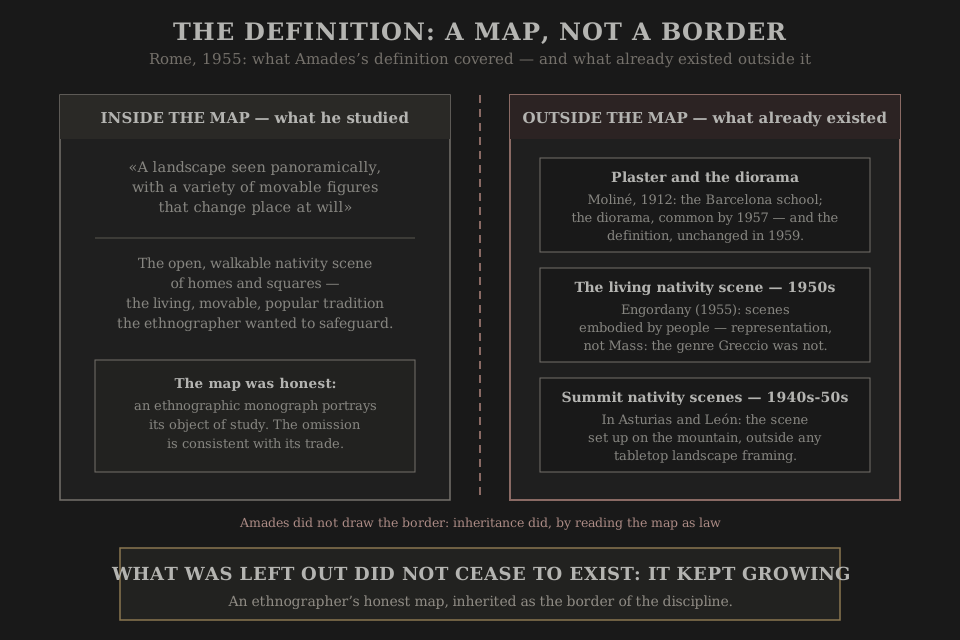
Read the definition slowly, because it is a precision instrument: landscape, seen panoramically, with movable figures that change place at will. Every word sets a limit. And what the words limit is not innocent: they define exactly the nativity scene that interested a folklorist — the one in homes, open, walkable, alive — and leave out, without naming it, everything else. The definition is not false: it is a faithful map of its object of study. The problem came later, when a scholar’s map was taken for the border of the territory.
This chapter examines three absences — three clues—, and then the mechanism that made them invisible.
Clue 1: the diorama that already existed
When the definition was published, the single-framing nativity scene was no novelty. In 1912, in Barcelona, Antoni Moliné had used sculptor’s plaster for the first time in building nativity scenes — the Gran Enciclopèdia Catalana records it: «l'ús del guix d'escultor, emprat per primer cop per Antoni Moliné el 1912» — the use of sculptor’s plaster, employed for the first time by Antoni Moliné in 1912—, a technique «coneguda amb el nom d'escola de Barcelona» — known by the name of the Barcelona school—3—. In 1933, a manual published by the Associació de Pessebristes de Barcelona already recorded the definition that «some» gave of «artistic» nativity scenes: «those built according to all the laws of art, technique and perspective»4. And in 1957 Luis Buendía took it as known, in Madrid, that «exclusivamente» — exclusively— «los Nacimientos construidos en forma de dioramas» — the Nativity scenes built in the form of dioramas— were called artistic5 — the closed nativity scene, the single framing of this series (A question of framing)—. Amades, however, did not touch the definition in the 1959 edition, the one he himself presents as «considerably enlarged and brought up to date»1: by 1959, that school had been working for almost half a century in his own city.
Could he not have known? There are three possible explanations, and they are worth weighing: ignorance — unlikely in a Barcelona ethnographer, faced with an innovation born in Barcelona—; lack of interest — plausible: the diorama belongs to schools and galleries, not to the people he studied—; the historian’s bias — looking at what the nativity scene had been, not at what it was starting to become—. And there is a fact that tips the balance, and it is Amades’s own: what does not fit his definition, he writes, «per nosaltres no pot ésser qualificada de pessebre i, per tant, cau fora del nostre interès i fora del tema del present treball» — cannot for us be described as a nativity scene and, therefore, falls outside our interest and outside the subject of the present work—1. Everything points to what has already been said: a deliberate exclusion, not an oversight. The «panoramic landscape» is not a slip in the definition: it is its axis. The diorama was left out on purpose, because it broke the panoramic view that Amades considered essential — according to the definition, it cannot even be called a nativity scene—.
And here comes the fairness this case owes him: El Pessebre is an ethnographic monograph, not a treatise on scenography. Its aim was to describe popular uses and symbols, not to catalogue technical innovations. That bias explains the omission without any need to attribute bad faith or ignorance: Amades did not «forget» the diorama; he considered it something different from the nativity scene he wanted to safeguard as a living, movable and popular tradition. The omission is consistent with his trade. What was inconsistent came later: that a definition made to delimit an ethnographic study should be used as if it legislated for the whole discipline.
Clue 2: the plaster already in use
The second absence is material. The manuals of the 1920s and 1930s build the nativity scene with elements of nature itself — moss, cork, clay, butcher’s broom— and, in 1933, already put plaster alongside cork and moss6; in 1912, the same Moliné had introduced plaster of Paris, a material of age-old antiquity in sculpture that in nativity-scene making gave its name to a school, that of Barcelona3. Amades does not mention it. It is the same omission as in Clue 1 seen from the workbench: whoever leaves out the format also leaves out its technique. To omit plaster of Paris is to omit one of the most significant changes in the history of nativity-scene construction.
Clue 3: the living nativity scene — and the ghost of Greccio
The third absence looks ahead. The pessebre vivent — the representation of the cycle with people: embodied scenes, a storyboard acted out — barely existed when Amades defined; it became established as a format in the second half of the twentieth century, and today it has its own federation in Catalonia, the Federació de Pessebres Vivents de Catalunya7.
Here the informed reader will raise an objection: what about Greccio? Did Saint Francis not make the first living nativity scene in 1223? It is worth looking at what the source says, because it says something else. According to Thomas of Celano, Francis wanted «de alguna manera ver con los ojos del cuerpo» — somehow to see with the eyes of the body— the Child of Bethlehem — «cómo fue acostado en un pesebre y cómo yacía sobre el heno entre el buey y el asno» — how he was laid in a manger and how he lay on the hay between the ox and the ass—8—: the manger was prepared, the hay was brought, the ox and the ass were led up, and Mass was celebrated over that manger. What happened at Greccio was not a story performed by actors: it was a devotional evocation around a Eucharist — real hay, real animals, and no neighbour playing Mary or Joseph—. The modern living nativity scene is something else: it is born as a representation — scenes, embodied characters, narrative—, not as a Mass. The distinction takes nothing away from Greccio; it gives each thing its exact name.
And in passing it sheds light on a mechanism this arc of chapters already knows: tradition attributes, and the attribution hardens into fact. Saint Francis is credited with «the first nativity scene» — it can already be seen that the matter calls for nuances—; Saint Joseph is credited with the trade of carpenter — the word in the corpus is broader, and his page tells the story (Joseph) — and he is the patron saint of carpenters. Attribution honours; the problem begins when it is cited as fact.
For that very reason, the facts of this clue are stated here at the exact size of their sources. And there is a documented case in Amades’s own world: the living nativity scene of Engordany (Andorra), which the Comú d'Escaldes-Engordany dates from 1955, recorded by Esteve Albert in El pessebre d'Engordany (1958), number 16 of the Biblioteca Folklòrica of Editorial Barcino — the natural collection for a Barcelona folklorist: it could hardly have escaped his notice—. Amades died on 17 January 1959, the year in which the Aedos edition appeared, and the definition was not updated9.
Can the omission be held against him? Not entirely, and the concession is a matter of fairness: in the 1940s the format was barely emerging, and nobody is required to prophesy. What can be pointed out is something else: that the definition left no room — neither for the living nativity scene, nor for the summit nativity scenes that mountaineers began to carry up the mountains of Asturias and León in the 1940s and 1950s10, nor for any future form—. A definition can be narrow by method; what it cannot be is narrow by method and govern as universal law. That is the whole case.
The mechanism in the open: the «Bethelem Ban»
And how does an author’s text, with an author’s limits, come to govern as law? By the same road by which the pigeonhole of the previous chapter arrived: it is cited without going back to the source, what is cited is copied, and the copy inherits the authority it never checked. This mechanism is worth seeing at work in an extreme case, because in extreme cases the gears can be seen. There is an unbeatable one, and it strikes right at the heart of nativity-scene art and practice.
For fifteen years there circulated on the internet — in the article «Belenismo» of the Spanish Wikipedia from 2010, and on the portals that copied it — the story of a supposed «Bethelem Ban» enacted in England in 1601: a decree that would have ordered nativity figures to be burned and those who kept them to be put to death. The two versions, side by side:
Spanish Wikipedia, «Belenismo», until 17 December 2025 — “Cuando Inglaterra adoptó el anglicanismo, las figuritas belenistas fueron quemadas, y debido al rechazo a los íconos, en 1601 se hizo un decreto, la Bethelem Ban, y quien no lo cumpliera sería condenado a muerte; en el siglo XIX, con la consolidación de la tolerancia religiosa, se levantó esa condena.” — When England adopted Anglicanism, the nativity figurines were burned, and because of the rejection of icons, in 1601 a decree was made, the Bethelem Ban, and whoever did not comply with it would be condemned to death; in the nineteenth century, with the consolidation of religious tolerance, that sentence was lifted—.11
catholic.net, «¿Qué es el belenismo?» — What is nativity-scene art?—, today, signed «Fuente: Wikipedia» — Source: Wikipedia— — “Cuando Inglaterra adoptó el anglicanismo, las figuritas belenistas fueron quemadas, y debido al rechazo a los íconos, en 1601 se hizo un decreto, la "Bethelem Ban", y quien no lo cumpliera sería condenado a muerte; en el siglo XIX con la consolidación de la tolerancia religiosa, se levantó esa condena.” — When England adopted Anglicanism, the nativity figurines were burned, and because of the rejection of icons, in 1601 a decree was made, the "Bethelem Ban", and whoever did not comply with it would be condemned to death; in the nineteenth century with the consolidation of religious tolerance, that sentence was lifted—.12
The burden of proof falls on whoever asserts, and whoever asserts the Ban provides none: there is no primary source, no decree, no trial. And where the evidence should be, there is its absence — which does weigh here, because it is the absence of the expected evidence—: the journals of the Parliament of 1601 (43 Eliz. I) deal with taxes, poverty and trade, without any religious decree at all about nativity scenes13. What did exist is in print, and it is something else: the Puritan Parliament made Christmas 1644 a day of fasting, abolished in 1647 the feast of the Nativity along with the other festivals, and in 1652 the House of Commons resolved that 25 December should not be observed. None of those texts condemns anyone to death, none is from 1601 and none speaks of figures14. The story is false; its severity — an invented death penalty — makes it, moreover, a serious manipulation. Wikipedia removed it on 17 December 2025, and whoever removed it left the reason in writing: the only source was an article in Spanish that cited none, and in English there was not a single reference to such a law. But the portal Wikipedia gave as its source goes on publishing it, and gives Wikipedia as its source: the copy citing the copy. And the copies of the copies are still on the internet.
That is the complete mechanism, seen large: a statement without a source, repeated until it looks like history. With Amades’s definition the same thing happened on a smaller scale and without any falsehood at the origin — the text was honest; what was dishonest was inheriting it without reading it—. The previous chapter gave the phenomenon a name; this one shows it at work.
Rome 1955: the salon of the rejected
The last piece remains: the unanimity. In 1955, in Rome, the second International Nativity-Scene Congress approved — as Amades himself records — his definition, unanimously2. How could so restrictive a formula be approved without a single vote against, when in Barcelona itself the plaster school had been working for more than forty years?
The history of art has an exact mirror for this. In 1863, the jury of the Paris Salon rejected so many works that the protests led the emperor to open a Salon des Refusés — the salon of the rejected—: there hung, among others, Manet, Whistler and Pissarro. The reception was one of mockery; today that salon is considered a threshold of modern painting15. The lesson is not that juries are foolish: it is that no jury’s consensus binds living practice — practice ends up correcting the jury—. The unanimity of 1955 was surely seeking a common basis, not a census of every sensibility; but the frame it set was narrow, and what was left outside — the diorama, the living nativity scene, the summits, everything that came afterwards — did not cease to exist for being left outside: it went on growing.
Each of us can ask which of today’s unanimities are calling for their own salon of the rejected. Emili Solé moved the 1955 definition to his salon of the obsolete some time ago. Readers who have followed the whole case will be able to decide whether it remains, or not, in the salon of 1955.
The case closes — and opens
Let us go over the pieces. The definition was the honest map of an ethnographer’s interests — panoramic view, movable figures, living tradition—. It deliberately left out the diorama and its technique; it could not foresee the living nativity scene or the summits, but it left no room for them either. A congress approved it; the inheritance turned it into a border; and the mechanism that kept it untouched for decades is the same one that sustained for fifteen years an invented death penalty in an encyclopaedia: nobody goes back to the sources. The Amades case closes where it should: with no culprit — a serious researcher is not to blame for the posthumous uses of his text — and with the real defendant identified: inheritance without reading.
But the attentive reader will have noticed that one piece from the first page is still on the table, unexamined. It is not something missing: it is something taken for granted. Amades endorsed Garrut’s extension — the nativity scene is destroyed after fulfilling its mission — and that sentence, repeated without context, has become almost a commandment: the nativity scene’s obligation to die every second of February. Is it true? Where does it come from? What exactly does someone destroy when they take it down? That examination — and the conclusions of this whole path of five chapters — deserves a chapter of its own: it is the next one, and with it the arc closes.
References
The footnotes locate; these entries explain why each source is included, what it contributes and what it does not allow us to claim.
AMADES, Joan. El Pessebre. First de luxe edition: Les Belles Edicions, Barcelona, Christmas 1946 according to the author himself (the Biblioteca de Catalunya catalogues it with a doubtful date, «1935?»); edition «considerably enlarged and brought up to date» (p. 7): Aedos, Barcelona, 1959, 508 p. — Ethnographic monograph; the source of the case. It is included for its definition of the nativity scene, for its report of the approval in Rome in 1955 and for Garrut’s extension, which it endorses. It is used as the primary source of the text examined; its ethnographic — not theoretical — character is part of the argument. Cautions: the definition and the report of Rome 1955, checked against the original (Aedos ed., p. 7; scan of Emili Solé’s copy); the date of the first edition, the one given by the author himself — the definition was published in the edition that appeared «pel Nadal del 1946»—; the approval of 1955 is the author’s assertion, with no independent minutes found. Central source.
GRAN ENCICLOPÈDIA CATALANA, entry «pessebrisme» (enciclopedia.cat). — Web resource (stable). It provides the fact about Moliné: «l'ús del guix d'escultor, emprat per primer cop per Antoni Moliné el 1912», a technique «coneguda amb el nom d'escola de Barcelona»; consulted on 23-X-2026. Cautions: a tertiary source with no visible apparatus; nothing is asked of it beyond that fact. Supporting source.
THOMAS OF CELANO. Vita prima S. Francisci, XXX, 84-86 (Fuentes Franciscanas 468-470). — Primary source (hagiography, 1228-1229). It is included for the description of the Greccio crib (1223): Francis’s wish to «ver con los ojos del cuerpo» — see with the eyes of the body— and the Mass celebrated over the manger — the documentary support for the distinction between devotional evocation and representation by scenes—. The Spanish wording is that of Pope Francis’s catechesis of 20-XII-2023 (vatican.va); the Latin, «corporeis oculis», in d'Alençon’s edition. Cautions: a hagiographical text — it reports the devotional event, it is not a notarial chronicle—. Central source of Clue 3.
ALBERT I CORP, Esteve. El pessebre d'Engordany (Valls d'Andorra). Barcelona, Editorial Barcino, 1958 (Biblioteca Folklòrica Barcino, 16). — A book bearing witness to the Andorran living nativity scene, which the Comú d'Escaldes-Engordany dates from 1955. It is included as the case of a living nativity scene documented in Amades’s immediate surroundings — Barcino’s folklore collection—. Cautions: the year 1955 comes from the fiftieth anniversary that the Comú celebrated in 2005, not from a record of the first performance. Supporting source.
FEDERACIÓ DE PESSEBRES VIVENTS DE CATALUNYA (pessebresvivents.cat). — Web resource (variable). It is included only as proof that the format has its own federation in Catalonia today; the federation does not publish a count of its living nativity scenes. Supporting source.
The «Bethelem Ban» set: Spanish Wikipedia, «Belenismo» (revisions 170996011, which contains the passage, and 171039419, which removes it) and catholic.net, «¿Qué es el belenismo?», which signs «Fuente: Wikipedia» — the two faces of a circular citation—; against them, the primary sources of British History Online: the Journals of Simonds D'Ewes for the Parliament of 1601, the Acts and Ordinances of the Interregnum (1644, 1647) and the Journal of the House of Commons, vol. 7 (1652). — They are included as the complete file on the myth: the sentence without a source, its reasoned removal and the texts where it ought to appear and does not. Cautions: the argument from silence is used only as the absence of the expected evidence, with the burden of proof on whoever asserts. Central set for the section on the mechanism.
DIÓCESIS DE JAÉN, «Belén de Cumbres» (diocesisdejaen.es, 21-XII-2020). — Institutional web resource. It provides the origin of the summit nativity scenes in Asturias and León in the 1940s and 1950s. Supporting source.
MANET / Salon des Refusés (1863). — Canonical episode in the history of art; it is included as a mirror of consensus corrected by living practice. Records of the Musée d'Orsay (Le Déjeuner sur l'herbe, RF 1668) and of the National Gallery of Art (Whistler, 1943.6.2). Supporting source.
The following notes locate; they do not argue.
Amades, El Pessebre, Aedos, Barcelona, 1959, p. 7 — the definition, checked against the Catalan original («…la representació plàstica i objectiva del naixement de Jesús mitjançant la disposició d'un país vist de manera panoràmica…»; scan of Emili Solé’s copy)—. The definition has existed since the 1946 edition: the passage itself declares it «publicada en l'obra El Pessebre, apareguda pel Nadal del 1946», and Garrut cites it as «Barcelona 1946, pàg. 7» (Viatge a l'entorn del meu pessebre, Selecta, 1957, p. 246). ↩ ↩ ↩
The unanimous approval, checked against the original (p. 7): «En el segon Congrés pessebrista internacional celebrat a Roma l'any 1955 va ésser unànimement aprovada aquesta definició nostra». The congress was that of the UN-FOE-PRAE, founded in Barcelona in 1952 with the first congress (Gran Enciclopèdia Catalana, «pessebrisme»: «Barcelona organitzà el Primer Congrés Pessebrista Internacional el 1952 i fou fundada la Universalis…»). Minutes or contemporary chronicles of the Rome congress, not found. ↩ ↩
Gran Enciclopèdia Catalana, «pessebrisme» (enciclopedia.cat), consulted on 23-X-2026: «Cal remarcar que una de les causes de la difusió del pessebrisme contemporani ha estat l'ús del guix d'escultor, emprat per primer cop per Antoni Moliné el 1912, tècnica emprada avui arreu i que és coneguda amb el nom d'escola de Barcelona». ↩ ↩
Puig i Roig, Josep M.ª, La construcció dels pessebres, Barcelona, Foment de Pietat (Publicacions de l'Associació de Pessebristes de Barcelona), 1933, p. 28: «el dels pessebres dits "artístics", que havem vist definits per alguns, que són els construïts segons totes les lleis de l'art, tècnica i perspectiva»; Emili Solé’s copy. ↩
Buendía Ruiz, Luis, Construcción de nacimientos, Madrid, Ediciones Giner, 1957, p. 49: «Es un error muy frecuente calificar exclusivamente de artísticos a los Nacimientos construidos en forma de dioramas» — it is a very common error to describe as artistic exclusively the Nativity scenes built in the form of dioramas—; Emili Solé’s copy. ↩
Puig i Roig, Josep M.ª, La construcció dels pessebres, Barcelona, Foment de Pietat, 1933, p. 30: «tant si són de suro i molsa, com de guix, com de paper, etc.»; p. 31: the nativity scenes «que alguns han definit ésser els construïts amb elements de la mateixa naturalesa: molsa, suro, greda, galzeran, etc.». Galzeran is butcher’s broom, Ruscus aculeatus (DIEC2, «galzeran»; DLE, «rusco»). Fra Andreu de Palma de Mallorca, Manual del Pessebrista, 1927, ch. XI, p. 54, quoting Joaquim Renart (Anant a visitar pessebres, 1926): «el suro és dòcil i fa oblidar les rígides lleis de l'arquitectura». Emili Solé’s copies. ↩
Federació de Pessebres Vivents de Catalunya (pessebresvivents.cat), consulted on 23-X-2026. ↩
Thomas of Celano, Vita prima, XXX, 84 (FF 468), quoted in Pope Francis’s catechesis of 20-XII-2023, «El belén de Greccio, escuela de sobriedad y de alegría» — The Greccio crib, school of sobriety and joy— (vatican.va, Spanish version, consulted on 23-X-2026). The Latin: «utcumque corporeis oculis pervidere» (d'Alençon ed., p. 86); see the chapter Making the memory present, note 7. ↩
Albert i Corp, Esteve, El pessebre d'Engordany (Valls d'Andorra), Barcelona, Editorial Barcino, 1958, 82 p. (Biblioteca Folklòrica Barcino, 16); Biblioteca de Catalunya, record 991056525019706706. The date of 1955: in 2005 the Comú d'Escaldes-Engordany published 50 anys del pessebre vivent a Engordany. Amades’s death: «Barcelona, 17 de gener de 1959» (Gran Enciclopèdia Catalana, «Joan Amades i Gelats»); the Aedos edition bears legal deposit B. 14161-1959. ↩
Diócesis de Jaén, «Belén de Cumbres» (diocesisdejaen.es, 21-XII-2020, consulted on 23-X-2026): «El montaje del Belén de Cumbres comenzó en Asturias y León en la década de los años cuarenta y cincuenta» — the setting-up of the summit nativity scene began in Asturias and León in the 1940s and 1950s—. ↩
Spanish Wikipedia, «Belenismo», revision 170996011 (15-XII-2025), the last one containing the passage; it supported it with a note to catholic.net, consulted on 23-XII-2023. It was removed by revision 171039419 (17-XII-2025), with this summary: «He quitado la información relativa a un Bethelem Ban en Inglaterra que aplicaba pena de muerte a quien pusiera un belén. La única fuente es un artículo en español que, a su vez, no cita fuentes. No he encontrado en inglés ni una sola referencia a esta ley, es información falsa.» — I have removed the information about a Bethelem Ban in England that applied the death penalty to anyone who set up a nativity scene. The only source is an article in Spanish which, in turn, cites no sources. I have not found a single reference to this law in English; it is false information—. The passage had entered the article on 25-XII-2010 (revision 42760799). ↩
catholic.net, «¿Qué es el belenismo?» (es.catholic.net/op/articulos/55144/que-es-el-belenismo.html), consulted on 23-X-2026; the page is signed «Por: Varios | Fuente: Wikipedia» — By: various | Source: Wikipedia— and gives no date. ↩
Simonds D'Ewes, The Journals of All the Parliaments during the Reign of Queen Elizabeth (1682), session from 27 October to 19 December 1601, in British History Online (british-history.ac.uk/no-series/jrnl-parliament-eliz1): the subsidy, the poor («a Committee was appointed to consider of the Statute for relief of the Poor», 5-XI) and monopolies. The House of Commons’ own journal does not survive for those years. The poor law is 43 Eliz. I c. 2 (legislation.gov.uk). ↩
C. H. Firth and R. S. Rait (eds.), Acts and Ordinances of the Interregnum, 1642-1660, London, 1911, in British History Online: ordinance of 19-XII-1644 on the fast of «the Feast of the Nativity of Christ» (p. 580) and «An Ordinance for Abolishing of Festivals», 8-VI-1647 (p. 954). Journal of the House of Commons, vol. 7, pp. 234-235, 24-XII-1652: «Resolved, That no Observation shall be had on the 25th Day of December, commonly called Christmas Day». Consulted on 23-X-2026. ↩
Musée d'Orsay, Le Déjeuner sur l'herbe, RF 1668: «Rejetée par le jury du Salon de 1863, cette oeuvre est exposée par Manet sous le titre Le Bain au “Salon des Refusés” accordé cette année là par Napoléon III. Elle en constitua la principale attraction, objet de moqueries et source de scandale». Whistler: National Gallery of Art, Washington, 1943.6.2 («Salon des Refusés… 1863, no. 596»). Pissarro: Kunstmuseum Basel, chronology of the exhibition Camille Pissarro. L'atelier de la modernité. The note in the Moniteur of 24-IV-1863 attributes the decision to the «nombreuses réclamations» of the artists. Consulted on 23-X-2026. ↩