
 ≈ 34 min

Everyone knows that the nativity scene began with Francis of Assisi, at Greccio, on Christmas Eve 1223. The associations know it, since they hold him as their patron; the Spanish heritage dossier knows it, since it gives him as the origin; anyone who has read two lines on the subject knows it. It is one of the few things in this trade on which nobody disagrees.
And yet almost nobody has asked the next question, which is the only one that matters: what he did it for. Not what he put there — that too is poorly known, as will be seen—, but what he hoped would happen in whoever saw it. Because if that night is the origin of what is done today, what Francis wanted to achieve is what is still being attempted today, whether people know it or not. And if they do not know it, a form is inherited without its motive.
This chapter will read the two texts that tell what happened at Greccio, written by people who knew Francis or knew those who had known him, and will look in them for one thing only: what was intended and what happened. It does not define the word «belenismo», the Spanish name for nativity-scene art and practice — that comes later in this series—, nor does it examine the dossier that defines it in law today — that has a chapter of its own—. It stops earlier, at the moment when there is still no word, no figure and no decree, and there is only a man who asks for a manger to be prepared for him with hay and two animals, and says why.
What there was at Greccio, and what there was not
Celano opens the chapter by saying what occupied Francis in those years, and it is worth starting there, because it explains everything that follows. His supreme intention was «to observe the holy Gospel in all things and through all things» and to follow the footsteps of Christ «with all the desire of the mind, with all the fervour of the heart» — toto desiderio mentis, toto cordis fervore—; and of the whole Gospel, two things «so occupied his memory that he hardly wished to think of anything else»: «the humility of the Incarnation and the charity of the Passion» — incarnationis humilitas et charitas passionis—.2 Greccio is not a pious whim of one Christmas Eve: it is one of those two things put into practice.
Some fifteen days before Christmas, Francis calls a man from that part of the country, John, «of good repute but of better life», and tells him what he wants. That sentence is read slowly in the next section. What matters now is what John prepared, because of that Celano gives a list, and it is short:
Et quidem praeparatur praesepium, apportatur foenum, bos et asinus adducuntur.3
And so the manger is prepared, the hay is brought, the ox and the ass are led in.
A manger, hay, a live ox and a live ass. And over the manger, the Mass: «the solemnities of the Mass are celebrated over the manger» — celebrantur missarum solemnia supra praesepe—.4 Francis, who was a deacon and not a priest, puts on the vestments of his order and «sings the holy Gospel in a sonorous voice», and then preaches to the people «on the birth of the poor King».5 That is all the text says there was.
And now what it does not say, which is the decisive part. There is no Mary. There is no Joseph. There are no shepherds. There is nobody playing anybody. There is no image of the Child. Nobody acts a part; nobody has modelled a figure. What there is are the material conditions of the Nativity — the manger, the hay, the two animals— and, within them, the liturgy of Christmas Eve, sung and preached. Greccio is not a living nativity scene in the sense in which the expression is used today, because there are no characters; and it is not a nativity scene of figures, because there are no figures. It is a Mass celebrated over a manger prepared on purpose so that the mystery being celebrated should be there before people's eyes.
It is not only the Manual that says this. It is said, in so many words, by the document that today defines nativity-scene art and practice in law in Spain.
On its page 9, the report describes the origin thus: in 1223, at Greccio, Francis «realizó en la misa de Nochebuena un drama paralitúrgico, en el que se escenificó de manera real el ambiente del nacimiento de Jesús» — performed at the Christmas Eve Mass a paraliturgical drama, in which the setting of the birth of Jesus was staged in a real way—. And it adds, to leave no room for doubt: «Conviene hacer notar que la presencia del Niño Jesús en el pesebre de Greccio no se corresponde, ni debe identificarse, con una imagen escultórica, como equivocadamente se piensa y viene repitiéndose. Y, aún mucho menos, que San Francisco montó un belén con figuras» — it should be noted that the presence of the Child Jesus in the manger at Greccio does not correspond to, nor should it be identified with, a sculpted image, as is mistakenly thought and keeps being repeated. And, still less, that Saint Francis set up a nativity scene with figures—.6
The reader should hold on to that sentence, because on the same page, a few lines earlier, the same report has defined what a nativity scene is: «una representación tridimensional y escenográfica del nacimiento de Cristo, realizada con figuras móviles, en un escenario fijo, que se arma para el tiempo de Navidad» — a three-dimensional and scenographic representation of the birth of Christ, made with movable figures, on a fixed set, which is put together for the Christmas season—; and it concludes: «Se trata, por lo general, de construcciones efímeras y estacionales» — they are, as a rule, ephemeral and seasonal constructions—.6 Nothing needs adding. The document defines the nativity scene by its figures, places its origin at Greccio and declares that at Greccio there were no figures. All three things, on one page. This chapter will not argue with the report — that is what its own chapter is for—; it will only do what the report did not do: ask, since there were no figures at the origin, what there was. And what there was, according to the only witness, was a purpose.
What Francis said he wanted
When Francis calls John, Celano puts into his mouth a single sentence of motive. It is the only one in the text in which Francis himself says why he does what he does, and it is this:
Volo enim illius pueri memoriam agere, qui in Bethleem natus est, et infantilium necessitatum eius incommoda, quomodo in praesepio reclinatus et quomodo, adstante bove atque asino, supra foenum positus exstitit, utcumque corporeis oculis pervidere.7
For I wish to celebrate the memory of that Child who was born in Bethlehem, and to see somehow, to the depths and with the eyes of the body, the hardships of his needs as an infant: how he was laid in a manger and how, with the ox and the ass beside him, he was placed upon the hay.
The translation reproduced in the IPCE report, the BAC one, reads: «Para hacer memoria con mayor naturalidad de aquel divino Niño y de las incomodidades que sufrió al ser reclinado en un pesebre y puesto sobre húmeda paja junto a un buey y un asno, quisiera hacerme de ello cargo de una manera palpable y como si lo presenciara con mis propios ojos» — in order to recall more naturally that divine Child and the discomforts he suffered when he was laid in a manger and placed on damp straw beside an ox and an ass, I would wish to grasp it in a palpable way and as if I were witnessing it with my own eyes—.6 It is a beautiful translation, and it is longer than the Latin: «palpable» is not in the text, nor is «húmeda», damp, nor «divino», divine. The three words on which the chapter hangs are translated afresh here, because in the version in circulation they become blurred.
The first is memoriam agere. It is not «to remember» or «to recall». Agere is the verb with which the Latin of the Church says celebrate — agere festum, to celebrate a feast; agere gratias, to give thanks—. Francis does not want to remember the Child: he wants to celebrate his memory as a rite is celebrated, by putting it into practice. The next chapter in this series shows that Spanish preserves that exact turn of phrase, word for word, in one of the senses recorded in its dictionary.
The second is incommoda. The discomforts, the hardships, the straits. What Francis wants to have before him is not a tender scene: it is the infantilium necessitatum incommoda, the hardships of a newborn's needs, and he lists them — a manger for a cradle, hay for a bed, two animals for company—. The subject of Greccio is the poverty in which that Child was born, which is, as Celano has said shortly before, the subject that occupied Francis's memory above any other.
The third is pervidere. Francis does not say videre, to see. He says per-videre: to see through, to see to the depths, to look in such a way as to pass through what is before one. And he says it with an honesty that should not be lost: utcumque, «somehow», «as best one can». He knows that a manger with hay and two animals is an approximation. But the gaze he asks for is the one that passes through, not the one that slides off; and he asks for it for the eyes of the body — corporeis oculis—, which are the only thing one can begin with.
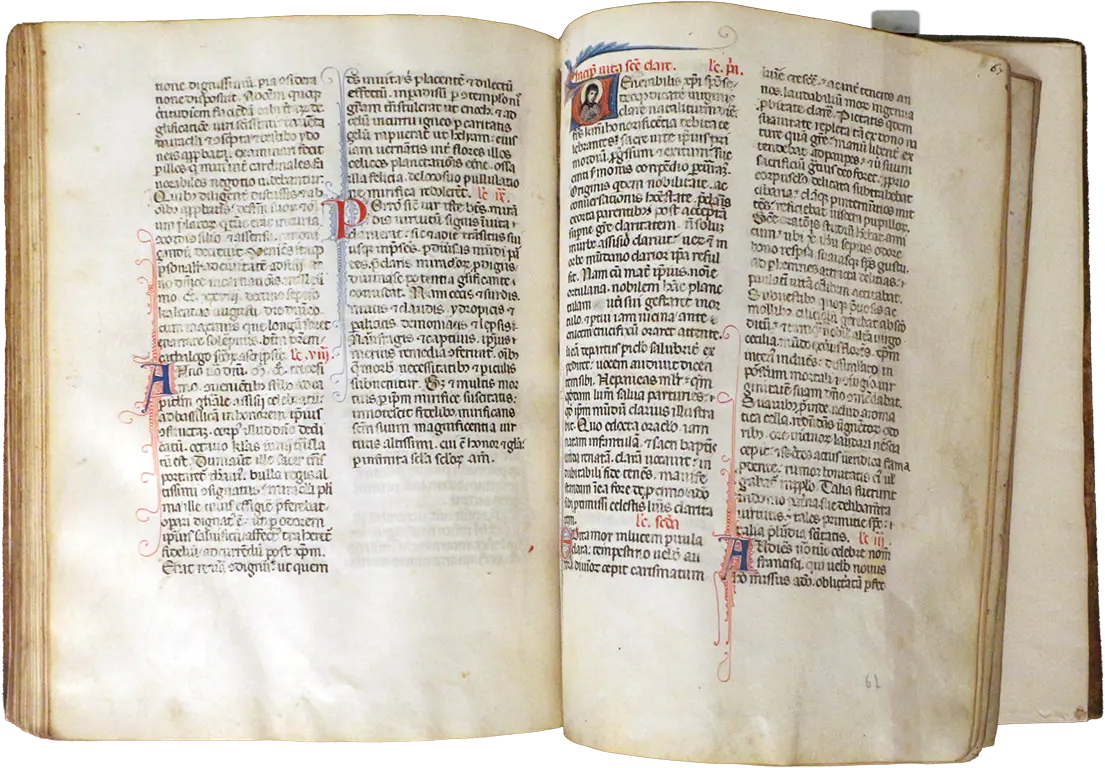
Something must be declared here about that word, because it affects what the reader ought to believe. Not all the manuscripts of Celano give it in the same form. The Barcelona codex on which the 1906 edition was based, and with it the critical edition and the text quoted by the Vatican, read pervidere; two manuscripts (those of Évreux and London) read plain videre, with no prefix; the Osek manuscript reads praevidere — and at least one modern transcription on the internet, previdere— and the Paris one, providere.8 The manuscript tradition, in other words, wavered between «to see» and «to see to the depths». The argument of this chapter does not rest on that prefix: it rests on what Celano says happened, which is read in the next section and has no variant. What separates seeing from seeing to the depths — and why that difference is the one that matters to whoever stands before a scene of the Nativity— is the subject of the next chapter; here it is enough to keep in mind that Francis asked for the second, and with the right verb.
So the sentence of motive says, without ornament: to celebrate the memory of the Child in such a way that the poverty of that Child is seen with the eyes of the body, to the depths, as best one can. It says what (the memory of the Child), it says of what (his poverty), and it says how (with the eyes, passing through). It does not say that he wants to build anything, or preserve anything, or exhibit anything. What follows is what Celano tells us happened.
What happened
Celano does not leave the question open. He describes the effect on Francis, he describes it on the people, and he also gives the message. They will be read in layers, because they are layers.
On Francis. «The saint of God stands before the manger, full of sighs, contrite with piety and overflowing with wonderful joy» — suspiriis plenus, pietate contritus et mirabili gaudio superfusus—.9 Three feelings in one sentence, and all three belong to someone who is inside what he has made, not to someone who has decorated it. And when he preaches, Celano tells it with a precision that belongs not to a record but to a portrait: whenever he wanted to name Jesus he called him «the Child of Bethlehem», and on saying «Bethlehem» he bleated like a sheep and licked his lips, «tasting and swallowing the sweetness of that word».5 Nobody writes like that about someone who has put up a decoration.
On the people. «The night is lit up like day, and it was delightful to men and beasts. The people arrive and, before the new mystery, rejoice with new joys. The forest resounds with voices and the rocks answer those who exult».10 In a 13th-century text that is the description of a whole crowd being moved, and it is worth noticing what it is done with: with light — candles and torches that the people had prepared «with exultant spirits», exsultantibus animis—, with voices, with the singing of the friars that lasts the whole night.10 Greccio was seen, but it was also heard: Francis sang the Gospel; the friars sang; the whole night «resounds with jubilation». Nobody sings so as not to be heard, and those who sang were there, in front of everyone, as much as the hay and the animals.
The message. Celano states it plainly, in the sentence that follows the one in which he says what was prepared: «There simplicity is honoured, poverty is exalted, humility is commended, and Greccio has become, as it were, a new Bethlehem» — honoratur ibi simplicitas, exaltatur paupertas, humilitas commendatur, et quasi nova Bethleem de Graecio facta est—.3 Greccio teaches something, and teaches it without a sermon: that God was born poor. It sets it before the eyes — hay, manger, two animals— so that whoever looks at it to the depths may understand it for themselves. And in passing it says what has been done with that place: Bethlehem has not been remembered; Greccio has been made Bethlehem.
And what Celano considers the true effect, which lies in his gloss on a vision. A good man saw in the manger «a little child lying lifeless», and saw the saint approach and wake him «as from the drowsiness of sleep». Celano does not leave it as a marvel; he interprets it:
Nec inconveniens visio ista, quum puer Iesus in multorum cordibus oblivioni fuerit datus, in quibus, ipsius gratia faciente, per servum suum sanctum Franciscum resuscitatus est et impressus memoriae diligenti.11
Nor was this vision unfitting, for the child Jesus had been given over to oblivion in the hearts of many, in whom, by the working of his grace, through his servant Saint Francis he was raised again and imprinted on an attentive memory.
It does not say «seen». It says awakened, raised again, and then imprinted on an attentive memory — impressus memoriae diligenti—. The aim of Greccio was not that people should see a manger; it was that something they had within them and had forgotten should come alive again, and should stay. This is the sentence on which the chapter rests, and it has no variant recorded in d'Alençon's critical apparatus.8
Forty years later, Bonaventure tells of the same night, more briefly, and states the purpose a second time and with another word. Francis «arranged to celebrate the memory of the birth of the child Jesus to awaken devotion» — memoriam nativitatis pueri Iesu ad devotionem excitandam … disponeret agere—.13 And he closes with the same verb: Francis's example is «an awakener of hearts grown numb in the faith of Christ» — excitativum est cordium in fide Christi torpentium—.14 Twice the same verb, excitare, to awaken; and both times what is awakened is the hearts, not the eyes. Celano said impressus memoriae; Bonaventure says excitare corda. They agree on the only thing this chapter needs: the means was sensory and the effect sought, inward.
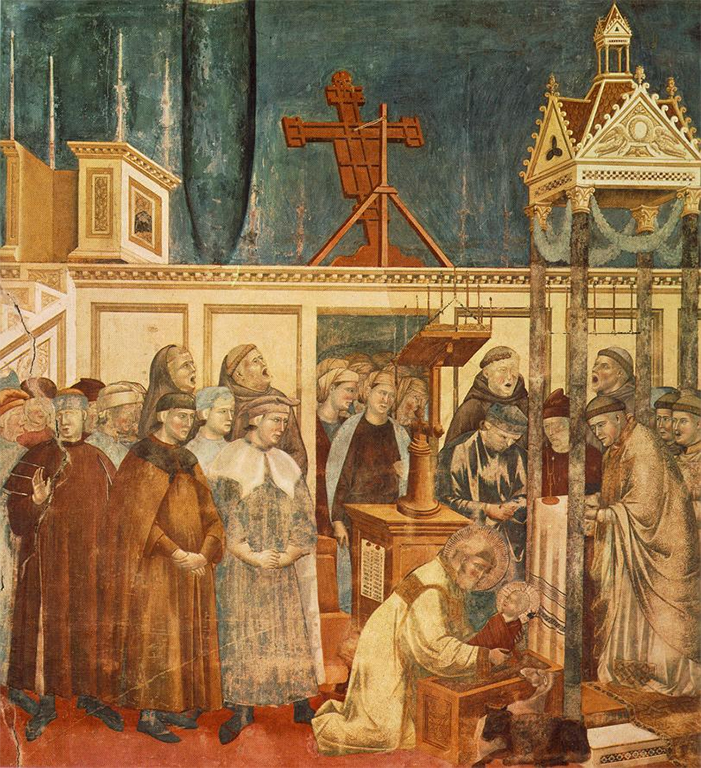
Bonaventure adds three things worth knowing, not because they change the argument but because they have changed the image people have of Greccio. The first: the tears. Where Celano put sighs, Bonaventure writes that Francis was «bathed in tears» — respersus lacrimis—.15 The second: the pope's licence, «so that this might not be put down to novelty» — ne vero hoc novitati posset adscribi, a Summo Pontifice petita et obtenta licentia—, which is not in Celano; Bonaventure does not name the pope, and the name of Honorius III that one reads everywhere is a deduction from the date.16 The third is the weightiest: the Child of the vision changes. In Celano the man who sees him has no name and the child is lifeless; in Bonaventure the visionary is «the lord John of Greccio», a knight who had given up arms for Christ, and the child is «most beautiful, asleep», and Francis wakes him «embracing him with both arms» — ambobus complexans brachiis—.17 That embrace is the one later painted in the basilica at Assisi, and from that fresco comes the idea, repeated for centuries, that at Greccio there was a figure of the Child which Francis took in his arms. The image is born in Bonaventure, almost forty years after the night; and neither in Bonaventure nor in Celano is there a figure: there is a vision, and an embrace within the vision.
With the two witnesses read, the question asked at the opening has a settled answer. Francis was not hoping for a mere sight, nor a mirror, nor an ornament. What he hoped for, in the words of those who told it, is a chain of four links, and all four are written down: looking to the depths → being moved → awakening what had been forgotten and leaving it imprinted → understanding the poverty of that Child. Senses, emotion, inner life, ethics. In that order, and each one the cause of the next.
Closing
Francis asked for a manger, hay and two animals, and said what for: to celebrate the memory of that Child and to see his poverty, to the depths, with the eyes of the body. That is what he named: the eyes. That is to say, the means. What he wanted to happen he did not name himself; it is told by those who were there, or by those who spoke with those who were there. In Francis, sighs, contrition, joy, and in the second witness, tears. In the people, a whole night that resounds. And beneath all that, what Celano and Bonaventure point to as what really happened, each with his own verb: the Child forgotten in people's hearts was awakened. The eyes of the body led to the hearts. That is the first stretch of the journey, and it is in both texts.
But Celano says one thing more, in the same sentence, and it is usually read straight past: that the Child was impressus memoriae diligenti, imprinted on an attentive memory. Not only awakened: retained. What the night set before the eyes and stirred in the hearts stayed somewhere it could be found again. And that place Celano had already named in the first sentence of the chapter, before telling anything, when he says what Francis's following of the Gospel was made of: toto desiderio mentis, toto cordis fervore, with all the desire of the mind and with all the fervour of the heart. The two together, before Greccio; the two together, after.
The journey has, then, three stations, and all three are written down. The eyes of the body: what Francis asked for. The hearts: what was awakened. The attentive memory — the mind—: where it stayed. What it is that stays, why it stays in some and not in others, and what there must be in the person looking for a scene of the Nativity to do this to them, is the question of the next chapter. Here only the starting point and the direction of the road have been established: it begins in the eyes and does not end in them.
Making the memory present with the eyes of the mind.
References
The footnotes locate, and only locate. The entries that explain why each source is included, what it contributes and what it does not allow us to state are in the body, in the panel that accompanies its first appearance. The translations from the Latin are the Manual's own.
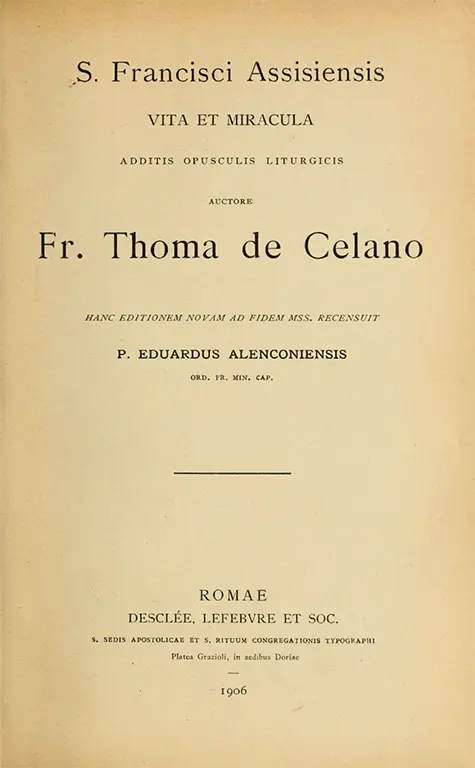
Thomas of Celano, Vita prima S. Francisci, chap. XXX, §§ 84-87. Latin text: S. Francisci Assisiensis vita et miracula additis opusculis liturgicis auctore Fr. Thoma de Celano, ed. P. Eduardus Alenconiensis, Rome, Desclée, 1906, pp. 85-88 (digitised copy in Internet Archive, item
sfrancisciassisi00thom). Base codex: Barcinonensis, Archivo de la Corona de Aragón, Ripoll collection, no. 41 (Prolegomena, p. XLVIII and chap. VI). Checked in full against this edition on 13-IX-2026. Fontes Franciscani, ed. E. Menestò and S. Brufani, Assisi, 1995, pp. 360-362, quoted through the apostolic letter Admirabile signum (Pope Francis, 1-XII-2019), Latin text at vatican.va; the Fontes Franciscani volume has not been consulted. ↩Celano, 84,1 and 84,3; d'Alençon, p. 85, ll. 14-23: «toto desiderio mentis, toto cordis fervore»; «Praecipue incarnationis humilitas et charitas passionis ita eius memoriam occupabant ut vix vellet aliud cogitare». ↩
Celano, 85,4-5; d'Alençon, p. 86, l. 28 - p. 87, l. 3: «Et quidem praeparatur praesepium, apportatur foenum, bos et asinus adducuntur. Honoratur ibi simplicitas, exaltatur paupertas, humilitas commendatur, et quasi nova Bethleem de Graecio facta est» (spelling Bethleem in d'Alençon; Bethlehem in the Fonte Colombo transcription). ↩ ↩
Celano, 85,11; d'Alençon, p. 87, ll. 10-12: «Celebrantur missarum solemnia supra praesepe, et nova fruitur consolatione sacerdos». ↩
Celano, 86,1-5; d'Alençon, p. 87, ll. 13-26: «Induitur sanctus Dei leviticis ornamentis, quia levita erat, et voce sonora sanctum evangelium cantat»; «Praedicat deinde populo circumstanti, et de nativitate pauperis regis»; «more balantis ovis Bethleem dicens»; «felici palato degustans et deglutiens dulcedinem verbi huius». ↩ ↩
Instituto del Patrimonio Cultural de España, Informe técnico definitivo for the declaration of nativity-scene art and practice as a Representative Manifestation of Intangible Cultural Heritage, March 2022, p. 9, checked against the PDF on 12-IX-2026: working definition of the nativity scene; «un drama paralitúrgico, en el que se escenificó de manera real el ambiente del nacimiento de Jesús»; «Conviene hacer notar que la presencia del Niño Jesús en el pesebre de Greccio no se corresponde, ni debe identificarse, con una imagen escultórica, como equivocadamente se piensa y viene repitiéndose. Y, aún mucho menos, que San Francisco montó un belén con figuras»; «Se trata, por lo general, de construcciones efímeras y estacionales». The Spanish quotation of Celano that the report reproduces comes, according to its note, from the 1956 BAC edition, pp. 339-342, not consulted: quoted through the report. ↩ ↩ ↩ ↩
Celano, 84,8; d'Alençon, p. 86, ll. 13-17: «Volo enim illius pueri memoriam agere, qui in Bethleem natus est, et infantilium necessitatum eius incommoda, quomodo in praesepio reclinatus et quomodo, adstante bove atque asino, supra foenum positus exstitit, utcumque corporeis oculis pervidere». Admirabile signum (2019), citing Fontes Franciscani, p. 360, gives the same text with the spellings praesaepio and fenum. ↩
Critical apparatus of d'Alençon, p. 86, l. 17: «E, L videre; Os praevidere; P providere»; sigla from the table of codices of the Legenda prima: E = Ebroicensis (Évreux), L = Londinensis, Os = Ossecenus (Osek), P = Parisiensis. The online transcription of the Casa Fonte Colombo (capuchinhosrs.org.br), consulted on 12-IX-2026, reads previdere. For 86,8, d'Alençon, p. 88, ll. 5-7, with no variant recorded in the apparatus. ↩ ↩
Celano, 85,10; d'Alençon, p. 87, ll. 8-10: «Stat sanctus Dei coram praesepio, suspiriis plenus, pietate contritus et mirabili gaudio superfusus». ↩
Celano, 85,2 and 85,6-9; d'Alençon, p. 86, ll. 22-26 and p. 87, ll. 3-8: «exsultantibus animis, cereos et faces praeparant ad illuminandam noctem»; «Illuminatur nox ut dies, et hominibus atque animalibus delitiosa exsistit. Adveniunt populi, et ad novum mysterium novis gaudiis adlaetantur. Personat sylva voces, et iubilantibus rupes respondent. Cantant fratres, Domino laudes debitas persolventes, et tota nox iubilatione resultat». ↩ ↩
Celano, 86,7-8; d'Alençon, p. 87, l. 28 - p. 88, l. 7: «Videbat enim in praesepio puerulum unum iacentem exanimem, ad quem videbat accedere sanctum Dei, et eumdem puerulum quasi a somni sopore suscitare. Nec inconveniens visio ista, quum puer Iesus in multorum cordibus oblivioni fuerit datus, in quibus, ipsius gratia faciente, per servum suum sanctum Franciscum resuscitatus est et impressus memoriae diligenti». ↩
Bonaventure, Legenda maior S. Francisci, chap. X, § 7. Latin text: PDF «1221-1274, Bonaventura, Legenda Major Sancti Francisci, LT» (Documenta Catholica Omnia), with no indication of the edition it comes from; sentence numbering matching that of Fontes Franciscani. Checked in full on 12-IX-2026. General chapter of Pisa, 1263: Benedict XVI, general audience of 3-III-2010 (vatican.va): «el capítulo general de los Frailes Menores de 1263, reunido en Pisa, reconoció en la biografía de san Buenaventura el retrato más fiel del fundador», and the Legenda «se convirtió en la biografía oficial del santo». General chapter of Paris, 1266: A. G. Little, «Definitiones capitulorum generalium Ordinis Fratrum Minorum 1260-1282», Archivum Franciscanum Historicum 7 (1914), pp. 676-682, «Diffinitiones facte in capitulo Parisiensi [1266]»: «precipit generale capitulum per obedientiam, quod omnes legende de beato Francisco olim facte deleantur, et ubi extra ordinem inveniri poterunt, ipsas fratres studeant amovere». ↩
Bonaventure, X,7,1: «Contigit autem anno tertio ante obitum suum, ut memoriam nativitatis pueri Iesu ad devotionem excitandam apud castrum Graecii disponeret agere, cum quanto maiore solemnitate valeret». ↩
Bonaventure, X,7,9: «Nam exemplum Francisci consideratum a mundo, excitativum est cordium in fide Christi torpentium». ↩
Bonaventure, X,7,4: «Stabat vir Dei coram praesepio pietate repletus, respersus lacrimis et gaudio superfusus». ↩
Bonaventure, X,7,2: «Ne vero hoc novitati posset adscribi, a Summo Pontifice petita et obtenta licentia, fecit praeparari praesepium, apportari foenum, bovem et asinum ad locum adduci». The IPCE report, p. 9, attributes the licence to Celano, referring to its note 1; it is not in Celano. ↩
Bonaventure, X,7,7: «dominus Ioannes de Graecio, se vidisse asseruit puerulum quemdam valde formosum in illo praesepio dormientem, quem beatus pater Franciscus, ambobus complexans brachiis, excitare videbatur a somno». In Celano the visionary is «a quodam viro virtutis», unnamed (86,6), and the John of 84,5 is the one who prepares the place: Bonaventure merges the two. ↩