
 ≈ 57 min

Someone wants to know what this is. They do not open a dictionary or look for a book: they type the word into a search engine. What they receive on that screen will be, for most people, the only answer they ever get round to reading.
So the question of who decides what nativity-scene art and practice is, if it is not only the academies, has a very concrete place in which to begin to be answered. Not in a treatise: on the first page of results.
What follows is what that screen showed on 19 August 2026. Any reader can repeat the test, and it is worth repeating: this chapter does not ask to be trusted.
And two warnings about scope, so that no reader feels faced with someone else's affair. This Manual is written in six languages: those used by the international nativity-scene federation — Spanish, English, French, German and Italian— and Catalan, which is added for two reasons and not out of preference: the word that names the practice was born in Catalan, and in Barcelona an association of nativity-scene makers was founded in 1863 that is still active.1 Everything that is checked here is checked in those six. And of the official dossiers that define this practice, one is examined in depth, the Spanish one: not because it is the only one or the most important, but because it is the one that can be examined with the document in front of us and its signatures in view. What travels from one country to another is not the document: it is the mechanism. Each reader has their own, and what is done here with one can be done by them with the one that concerns them.
What the screen returns
First, what is found
A search engine does not answer. It finds addresses where the word appears and puts them in order. The answer, if there is one, lies inside each of them — and whoever ends up at the top decides what most people read, because most people do not scroll down.
On 19 August 2026, leaving aside the advertisements and the block of videos inserted among the results, the first three sites placed by the ordinary search are these:
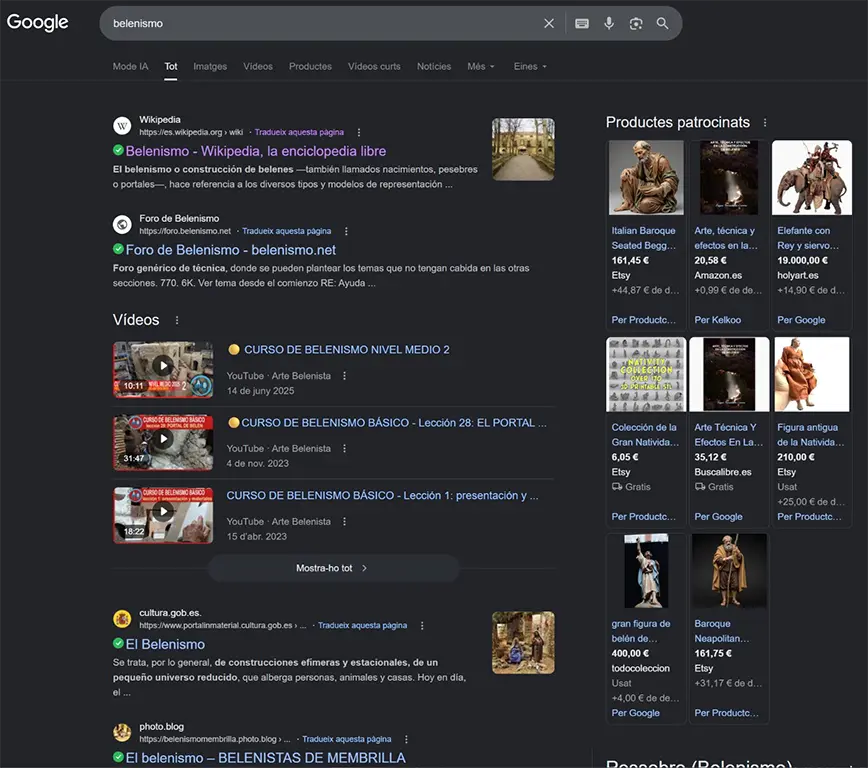
One. The open encyclopaedia. The snippet that can be seen without clicking through is the beginning of its first line, and it is cut off just here: «El belenismo o construcción de belenes —también llamados nacimientos, pesebres o portales—, hace referencia a los diversos tipos y modelos de representación…» — belenismo, or the building of nativity scenes (also called nacimientos, pesebres or portales), refers to the various types and models of representation…—
Two. A forum of nativity-scene makers. A forum is a place for conversation, not for doctrine: there is no reason why it should contain a definition, and if it does, the definition will be scattered across thousands of messages. It does not define, and this chapter does not ask it to. So only the one thing that matters here is noted: of the first three doors, the one that would lead to the practitioners themselves is not a door that answers the question.
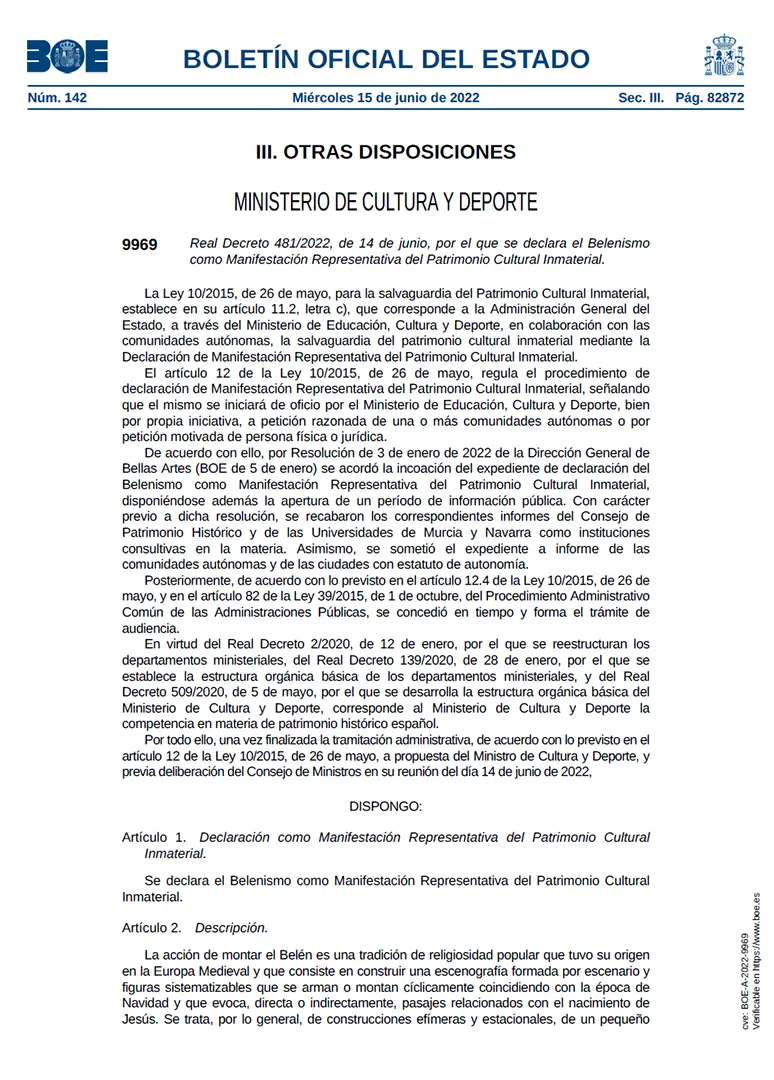
Three. The portal of the Ministry of Culture, with the page on the heritage recognition. Here there is a definition, and it is this: «El Belenismo comprende tanto al arte de fabricar las figuras del Belén a través de sus artesanos, como al colectivo especializado en armar o montar el Belén, empleando ciertos conocimientos y destrezas, en un proceso en el que se aplican técnicas y prácticas tradicionales y actuales, transmitiendo al espectador sensaciones emocionales y simbólicas.» — Belenismo comprises both the art of making the figures of the Belén through its craftsmen and the specialised group that sets up or assembles the Belén, employing certain knowledge and skills, in a process in which traditional and current techniques and practices are applied, conveying emotional and symbolic sensations to the viewer.—2
Of the three doors, then, two define and one does not. And the two that define are exactly the two that this Manual examines: the open encyclopaedia, here; the official dossier, in the next chapter (The dossier: «The Real Decreto 481/2022: the declaration that demotes what it declares»). There is no need to go looking for them: they are the ones the screen puts in front of us.
It is worth saying how all this is ranked, because it is not the way people usually assume. A search engine does not rank by accuracy: it places at the top whatever the work of search-engine optimisation has made match the searched word best. What comes first is not what defines best; it is what has best made itself found. And whoever searches reads what comes first.
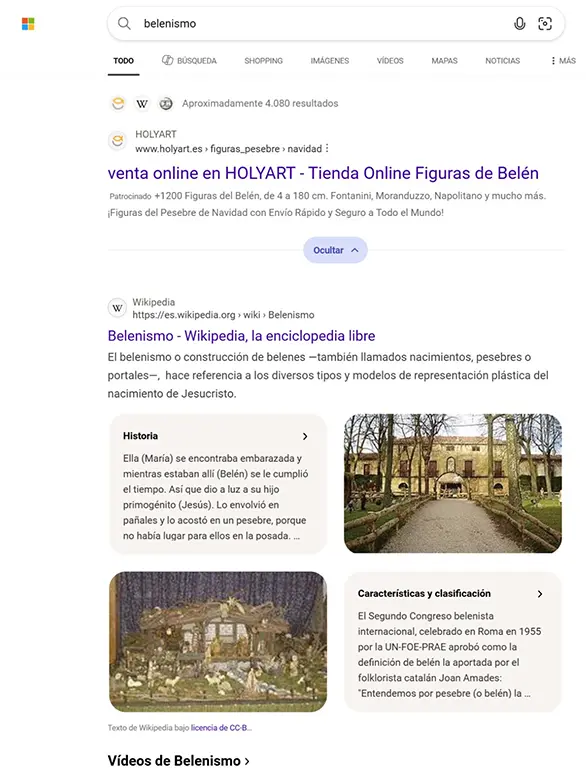
Changing search engine is enough to confirm it. In the second most widely used, on the same day and with the same word, the first thing on the page is not a definition: it is a figure shop, a paid advertisement. Then comes the encyclopaedia, from which that search engine also extracts two boxes — one with Luke's account and another that attributes to Joan Amades a definition of the nativity scene approved at the Second International Nativity-Scene Congress held in Rome in 1955—.3
Then, what is written
The same search offers another door, and more and more people go through it: asking an artificial-intelligence assistant to answer, instead of asking the search engine to find. Two queries with the same word on the same day, to two assistants in common use, give this.
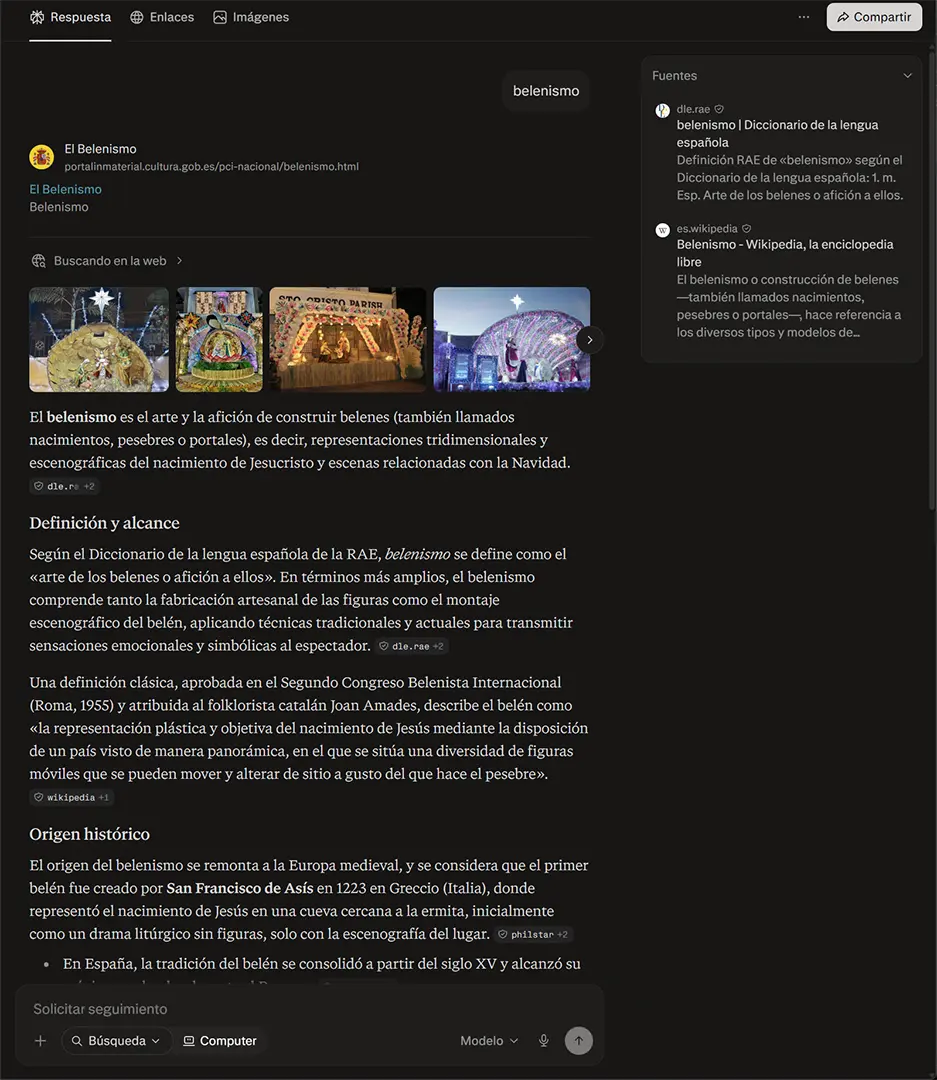
The first assistant answers: «El belenismo es el arte y la afición de construir belenes… es decir, representaciones tridimensionales y escenográficas del nacimiento de Jesucristo y escenas relacionadas con la Navidad.» — belenismo is the art and hobby of building nativity scenes… that is, three-dimensional, scenographic representations of the birth of Jesus Christ and scenes related to Christmas.— It adds the origin: Saint Francis, 1223, Greccio. And it adds a definition that the other does not bring, attributed to Joan Amades and approved — it says— at the Second International Nativity-Scene Congress in Rome, in 1955.4
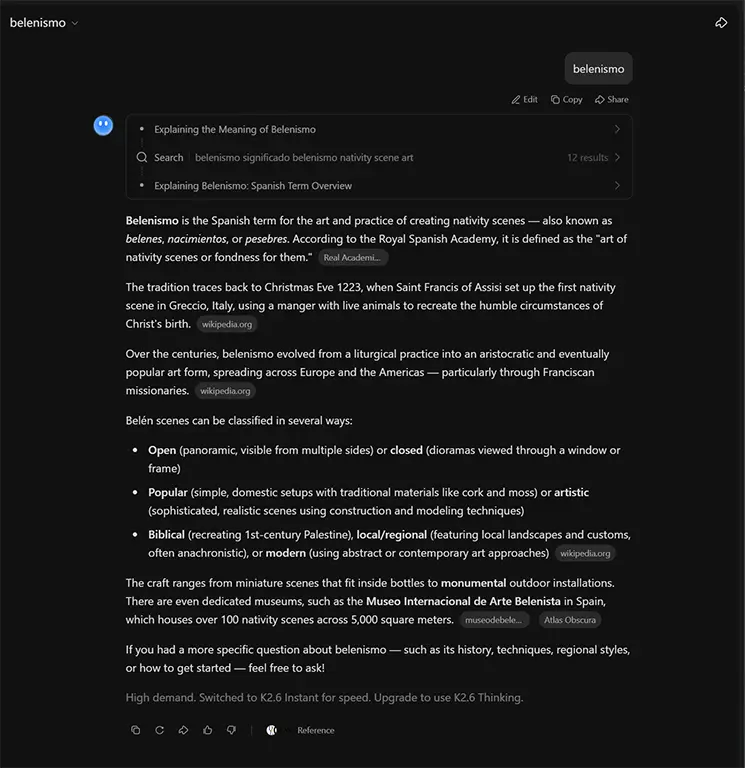
The second assistant answers in English, because it was asked in English: «Belenismo is the Spanish term for the art and practice of creating nativity scenes.» Origin: Christmas Eve 1223, Saint Francis, Greccio, with a manger and live animals. And it classifies: open or closed; popular or artistic; biblical, local or modern.5
Two answers that differ in form. And in substance, the same thing twice.
They agree on the date. 1223, Greccio, Saint Francis, the first representation. Neither of the two qualifies it, neither cites a study, neither says that this account is disputed. The Manual examines it in its proper place and with its sources (The Amades case: the mystery of the omissions); here only a fact of circulation is recorded: it is the piece of information that travels furthest of all those said about this practice.
They agree in defining by the product. «Construir belenes» — building nativity scenes—, «representaciones tridimensionales» — three-dimensional representations—, «creating nativity scenes». What is named is what is left once the work is done.
And they agree on something more discreet: neither of the two contradicts the other. Whoever consults both will believe they have cross-checked.
Where all this comes from
There is no need to investigate it: the two answers declare it. Both cite the same open encyclopaedia.
And this did not begin with the assistants. Before they existed, the same text was already circulating, copied by people. One case that has been checked against the source: a widely read Catholic portal publishes a «¿Qué es el belenismo?» — What is belenismo?— whose definition and approach coincide almost word for word with those of the encyclopaedia, with the same omissions and the same conceptual errors.6 It is not plagiarism, and it would not matter if it were: what matters is that an outlet with authority of its own lends that authority to a text it did not check.
They are two different chains, and they end up in the same place. One is driven by people who copy; the other, by programs that rewrite. The result is that the first page of results does not offer several answers: it offers one answer, repeated. Whoever consults it believes they have cross-checked because they have seen five links. They have seen five copies.
The mechanism has to be named with care, because it is easy to overstate it. A piece of information that is repeated often enough stops having anyone who doubts it: not because nobody can check it, but because checking takes effort and the repetition already does the work of proof. There comes a moment when calling it into question looks like the extraordinary claim.
Three clarifications, and all three matter.
The first: hardly ever does anyone need to have lied. The chapter on the word showed this with a case. A booklet published in 1992 gave a date for the first written appearance of a word. The date was reasonable, and it stood there with no note and no indication of where it came from. For more than thirty years nobody went to open that booklet to check it, and the date was repeated until it seemed established. Nobody lied: it was enough that nobody looked.
The second: but not everything is explained by carelessness. There are claims that cannot have been born of a check that was never made, because there was nothing to check: what they recount never happened. There, it is no longer enough to say that nobody looked; somebody had to write them. The case that follows is one of these, and it deserves to be seen in full, because it shows the mechanism better than any explanation.
And the third: irrefutable proof is not needed to dismantle a piece of information. Demanding it would mean falling into the trap — forcing whoever doubts to prove a negative—. It is enough to show that the claim never had any proof. That is why, here, an unproven piece of information is not refuted: it is replaced. Only in some cases can something stronger be done: show, in addition, that the event did not happen.
The case of the law that never existed
This case is not about a definition but about a historical fact, and even so it is the one that serves best here, for two reasons: it shows the chain of copies with the two texts side by side, and it shows that the chain can be broken.
For years, the encyclopaedia article contained this passage: «Cuando Inglaterra adoptó el anglicanismo, las figuritas belenistas fueron quemadas, y debido al rechazo a los íconos, en 1601 se hizo un decreto, la Bethelem Ban, y quien no lo cumpliera sería condenado a muerte; en el siglo XIX, con la consolidación de la tolerancia religiosa, se levantó esa condena.» — when England adopted Anglicanism, the nativity-scene figurines were burned, and because of the rejection of icons, in 1601 a decree was made, the Bethelem Ban, and whoever did not comply would be condemned to death; in the 19th century, with the consolidation of religious tolerance, that sentence was lifted.—
Its only reference pointed to a Catholic portal for the general public — the same one from the chain of copies—. And there the text is the same: same words, same order; only one comma is missing, the one the encyclopaedia added after the portal copied it. It does not resemble it: it is the same text.7
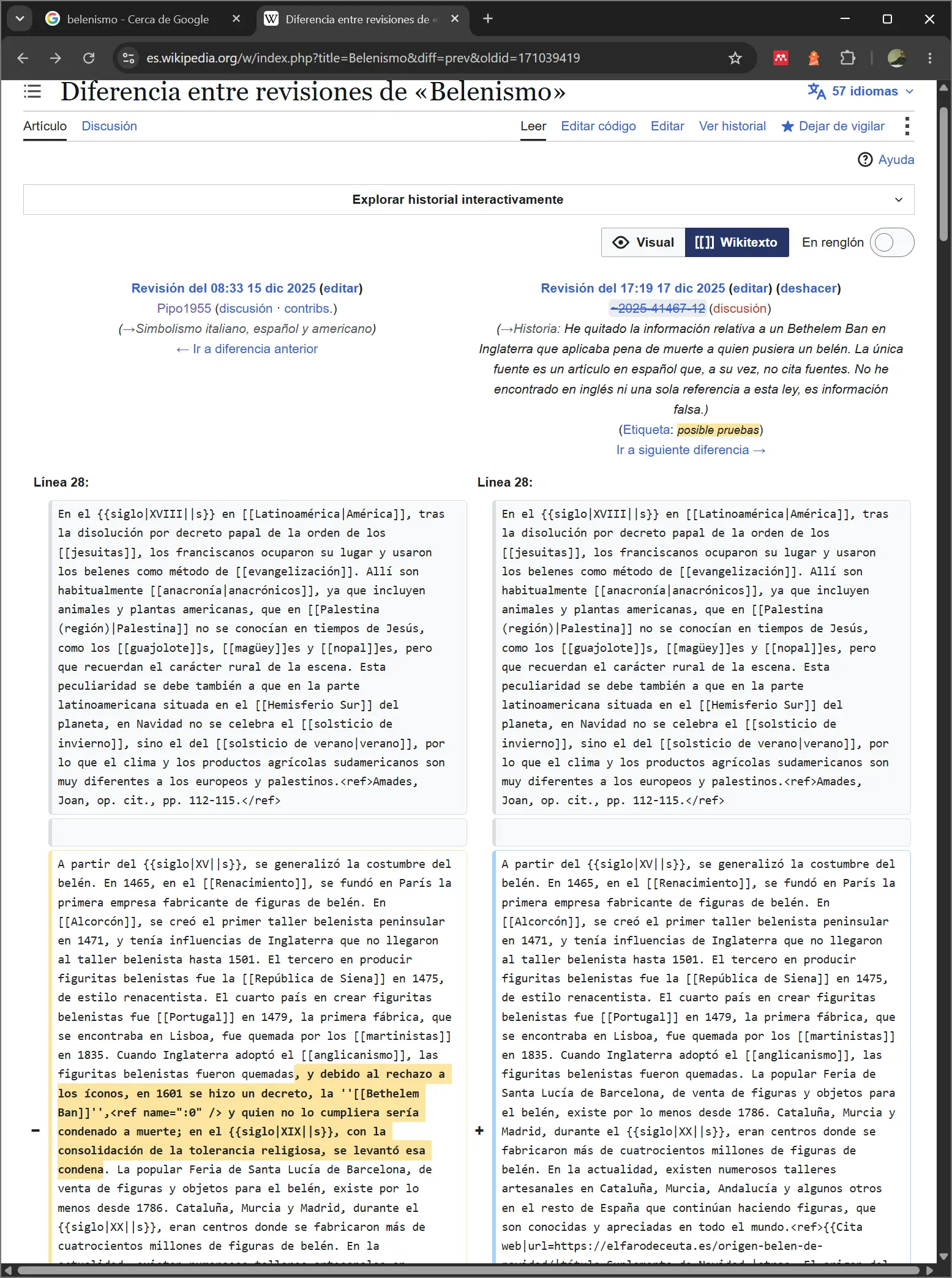
<ref name=":0" />— inside the code itself: the paragraph rested on a single source, and that source was the portal. es.wikipedia.org/w/index.php?title=Belenismo&diff=prev&oldid=171039419.The direction of the copying is worth looking at, because the portal itself declares it. Its page says, beneath the title: «Por: Varios · Fuente: Wikipedia» — By: Various · Source: Wikipedia—. And the fifteen notes with which it is supported are not its own: they are the encyclopaedia's — Amades with his page numbers, Garrut, Rebé Landa, Caballé and Clos—, copied with their entire apparatus. None of them points to anything of its own; one points to itself and another is an orphaned parenthesis. So the encyclopaedia cited, as the only source for that passage, a site that declares itself a copy of the encyclopaedia. It is not a chain: it is a circle, and both ends are signed.8
And it can be dated from the inside. The portal's first note refers to the Academy's dictionary in its twenty-second edition, that of 2001; that same note, in the encyclopaedia, now refers to the twenty-third. Where the portal has fifteen notes, the encyclopaedia has forty-two. What the portal serves is not the article: it is an old version of the article, from between 2012 and 2017, frozen.
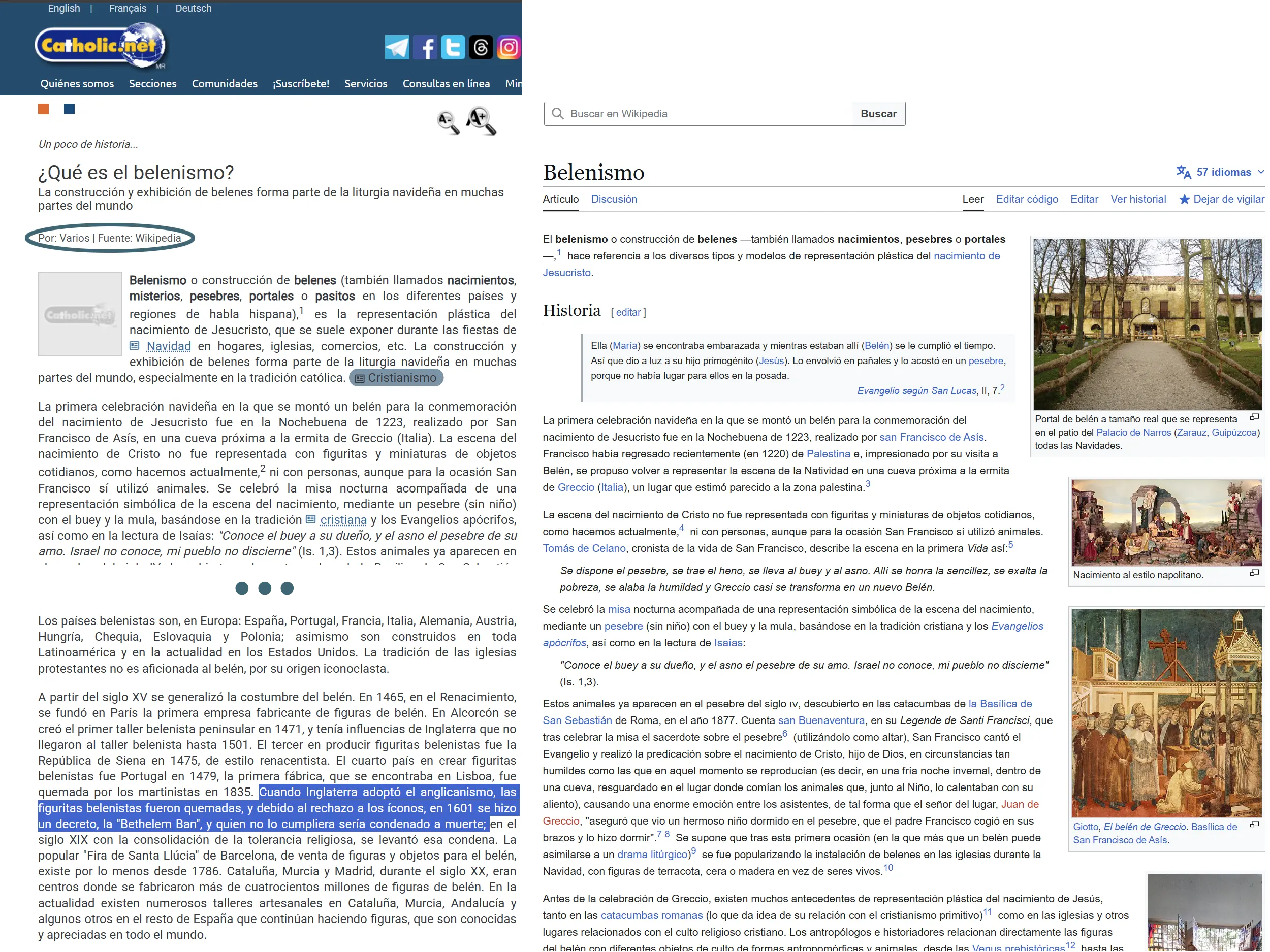
oldid=174757657—, whose history section has grown and is no longer the one the portal reproduces. The encyclopaedia cited the portal in its note 10; the portal declares the encyclopaedia as its source. The removal of the passage is recorded in the history (next image). Composite by Emili Solé, 21-VIII-2026.Note what is being claimed. A law with a proper name in English. An exact year. And a death penalty for having a nativity scene at home. This is not a soft piece of information: it is the gravest thing that can be attributed to a State and to a religious confession. And it is not recorded in any of the three places where it would have to be — not in the parliamentary records of that session, not in the specialist literature on the English Reformation, not in the known chronology of iconoclasm and of the Puritan bans on Christmas, which belong to another century and carried fines, not the scaffold—. The Manual dismantles it, with its sources, in the place where it belongs.
Something else matters here: why a piece of information like this travels better than a true one. Because it makes an impression. A law that orders death for setting up a nativity scene is remembered, repeated and shared; a workshop date is not. Repetition does not reward what is true: it rewards what is satisfying to tell.
And the case has an ending. On 17 December 2025 it was removed from the article by a temporary account — of the kind the encyclopaedia assigns to whoever edits without registering—, with this summary: «He quitado la información relativa a un Bethelem Ban en Inglaterra que aplicaba pena de muerte a quien pusiera un belén. La única fuente es un artículo en español que, a su vez, no cita fuentes. No he encontrado en inglés ni una sola referencia a esta ley, es información falsa.» — I have removed the information about a Bethelem Ban in England that applied the death penalty to anyone who set up a nativity scene. The only source is an article in Spanish that does not itself cite any sources. I have not found a single reference to this law in English; it is false information.—9
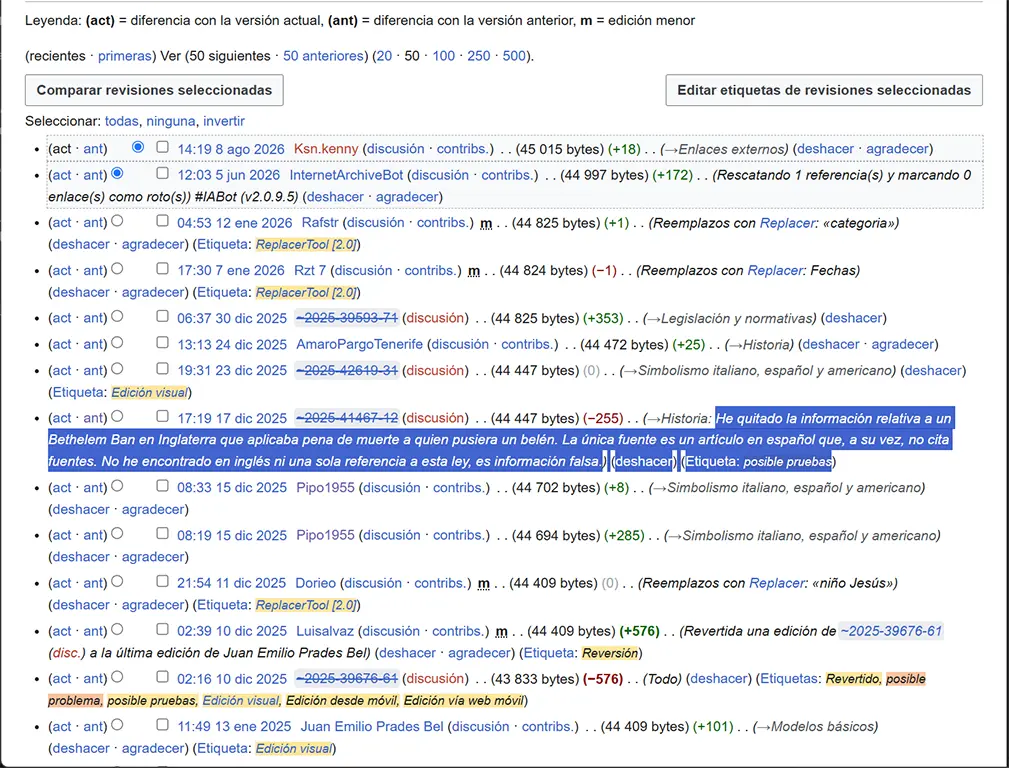
Two hundred and fifty-five bytes fewer, and one hoax out. Out of the encyclopaedia, that is: on the portal that the encyclopaedia cited it is still there, word for word, and nobody there has gone to check anything. The correction travels worse than the error, and for a simple reason: it is applied where someone looks, not where the text had been copied.
The sequence should be put in order, and kept to what is on record. The passage had been in the article for years, with a reference that did not support it, and nobody had questioned it. On 17 December 2025, someone without a registered account removed it, and the summary with which they did so describes the check that anyone could have made earlier: that the only source was a text in Spanish which in turn cited none, and that in English not a single reference to that law could be found.
This Manual claims nothing from that removal. It did not bring it about, as far as anyone knows, nor could it prove it if it thought so. What interests it lies earlier: the information held out for years because nobody went to look, and it fell on the day someone looked.
What is indeed demonstrated is how it fell: someone went to look whether it was on record. And for that one does not need to be a historian or set foot in an archive: it is enough to check whether the source being cited cites any source in turn. That is within anyone's reach, and it is the only thing that works.
What the source everyone cites says
The entry takes as its title the name of the practice. Its first line, on 19 August 2026, reads: «El belenismo o construcción de belenes —también llamados nacimientos, pesebres o portales—, hace referencia a los diversos tipos y modelos de representación plástica del nacimiento de Jesucristo.» — belenismo, or the building of nativity scenes (also called nacimientos, pesebres or portales), refers to the various types and models of plastic representation of the birth of Jesus Christ.—10
The flaw is not in any piece of information. It comes earlier.
The title names a practice and the first line delivers types and models of an object. What is defined is not what is done, but what is left once it has been done. And once that path is taken, an article can be correct from beginning to end and never describe what its title announced. That is what happens in what follows, as far as this review reaches: models, materials, styles and local traditions of the nativity scene.
From this it is clear why the search engine and the two assistants answer as they do. They did not invent it: they inherited it.
And what it does not say in any language
Now the part that readers can check in their own language, without leaving it.
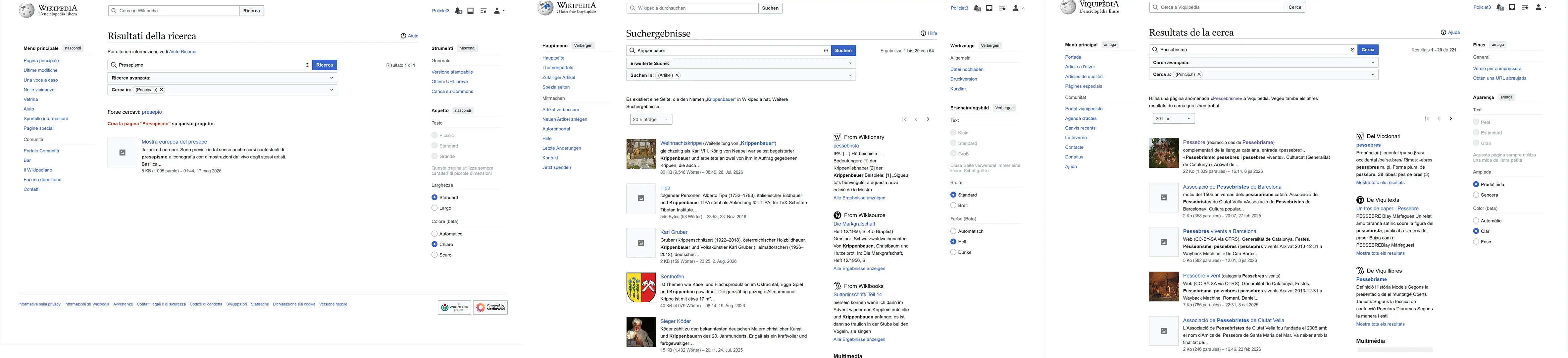
Let an Italian search for presepismo: it does not exist. The encyclopaedia offers to create the page. The word appears only once in the whole Italian edition, and incidentally, inside the announcement of some courses at an exhibition.
Let a German search for Krippenbau: there is no article. Let them search for Krippenbauer, the person who makes the Krippe: they are taken to Weihnachtskrippe, to the object.
Let a Catalan search for pessebrisme: they are taken to pessebre, to the object.
French and English speak of the scene — crèche de Noël, Nativity scene—, and have no other word to search for.
And Spanish, which does have the word and does have the article, has already been seen to do what it does with it.
Repeat the opening test in any of those languages — typing the equivalent into a search engine— and the result is consistent with the above: one finds the object, one finds the scene, one finds shops, courses and photographs. What one does not find is a word that names the whole body of those who take part in this, because that word is not available to be searched for.
The check can be taken one step further, towards the sister projects, where the question is no longer having an article but having a book. In the Catalan library there is a page entitled Pessebrisme, and it is not a manual: it is its table of contents — definition, history, models, composition, figures, settings, painting, lighting, special effects, bibliography—. The linked sections appear in red, which in these houses means a page that does not exist; the rest never even got as far as being linked. The whole book weighs one thousand four hundred and forty-three bytes and nobody has touched it since 26 March 2020. I opened it myself that day, with an account in my name earlier than the one I now use on the encyclopaedia, and I got no further than the contents page; the reason why is set out elsewhere.
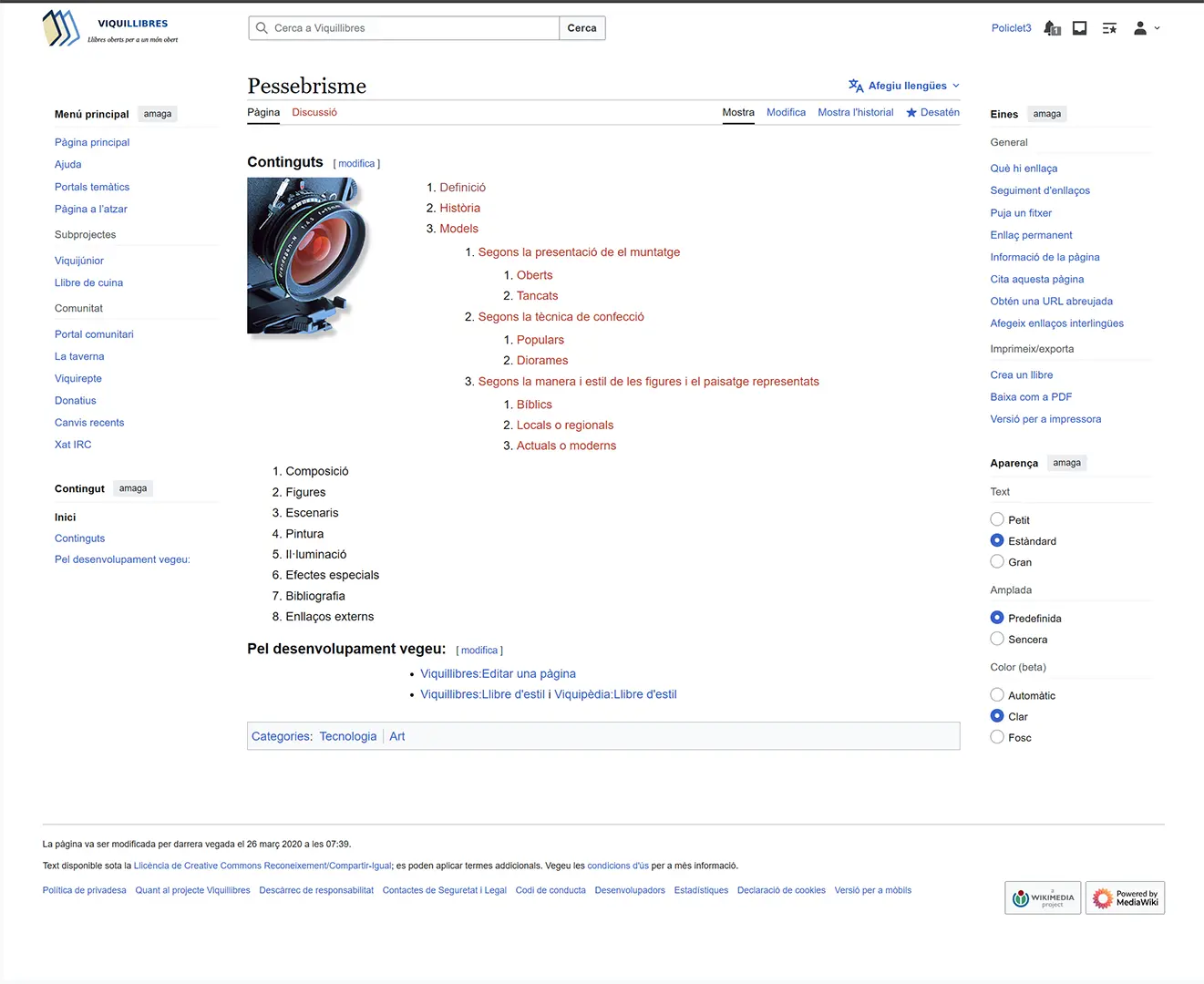
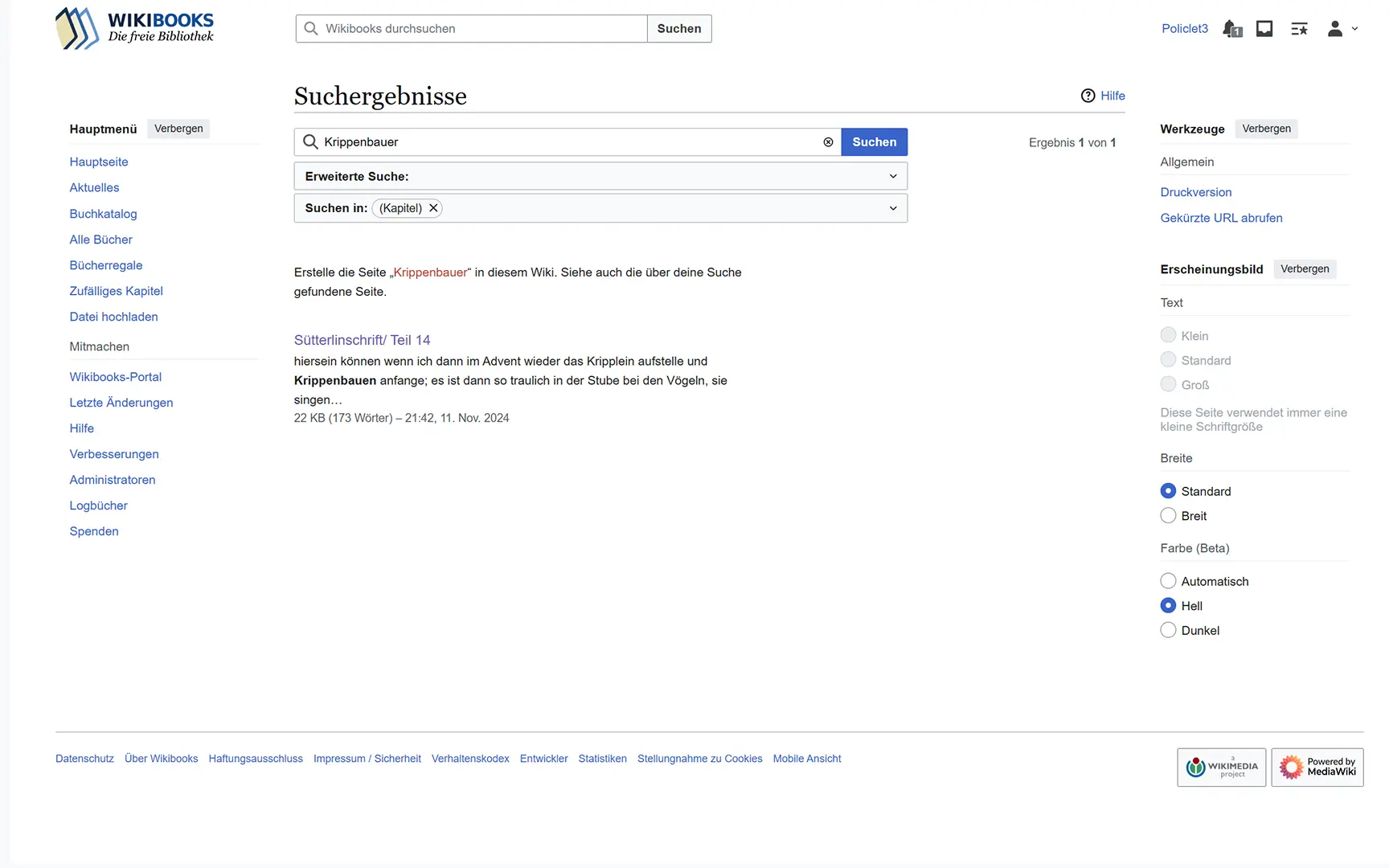
oldid=64653—: a table of contents whose sections were never written — they appear in red, which in that house means a page that does not exist— and a second list that never even got as far as being linked. At the foot, the date: «La pàgina va ser modificada per darrera vegada el 26 març 2020 a les 07:39» — the page was last modified on 26 March 2020 at 07:39—. Consulted 21-VIII-2026.In the German library, Krippenbauer returns a single result, and it is not about the trade: it is a handwriting exercise that transcribes a postcard in which someone says that in Advent they are setting up the nativity scene again.
One more piece of information remains, and it is the one that settles the matter. These articles are classified: each one belongs to a concept that it shares with its equivalents in other languages, and that classification is not written by an editor — it is deposited when the articles are linked—. There is one group for the stable feeding trough, where Galician, Catalan, Basque, Hebrew, Japanese and Chinese sit. There is another for the scene of the Nativity, which brings together fifty-eight languages: the Spanish one and fifty-seven others. And the Spanish article — the only one of these six languages whose title is the name of the practice— sits in the second group, alongside those that describe the scene; its own footer declares it, and the link to the image files names it unambiguously.11 Outside these six languages the check has not been made one by one, and so nothing is claimed about them here. What can be said is that neither of the two groups examined — that of the trough and that of the scene— corresponds to the practice.
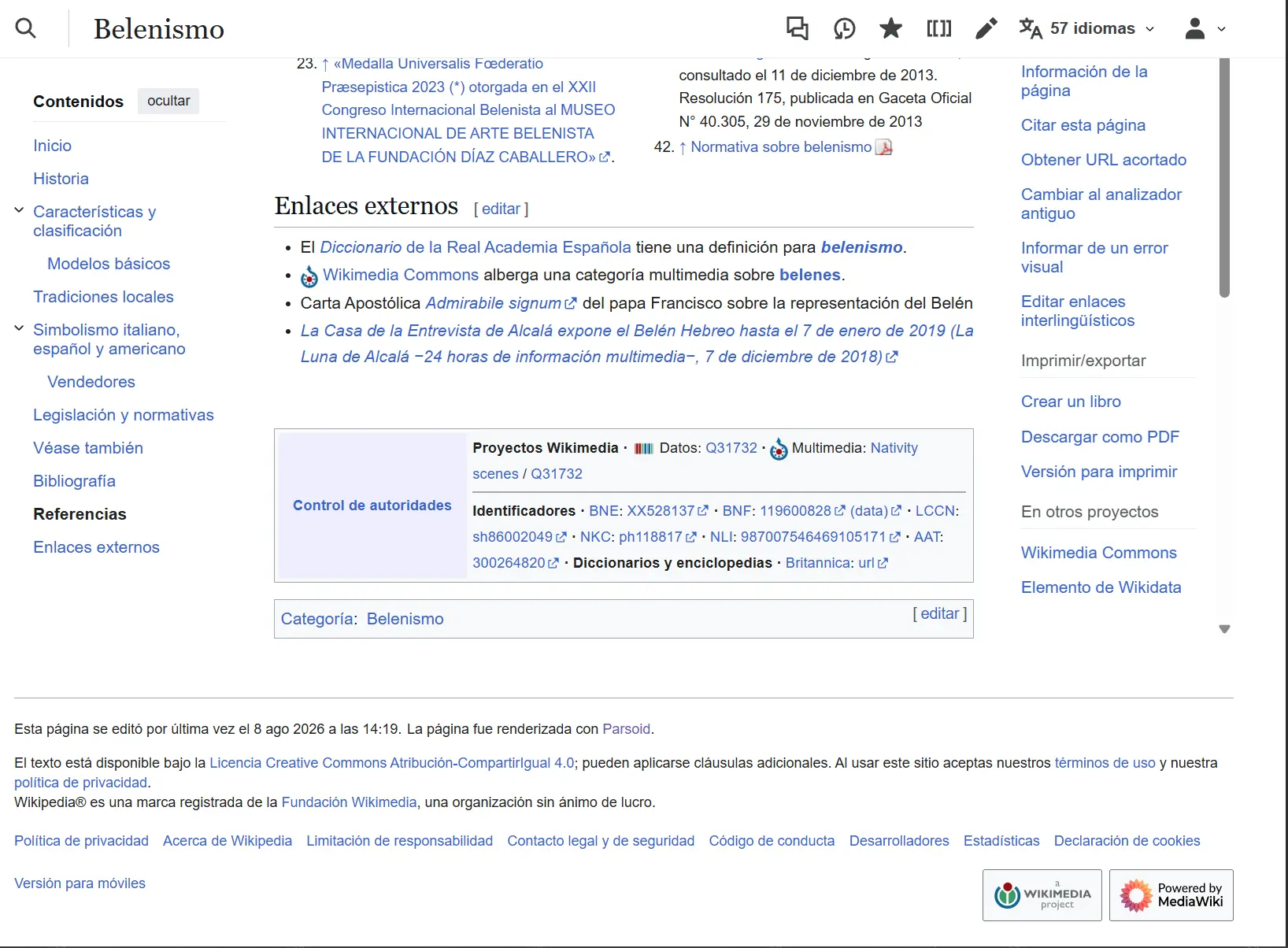
So it is not that the practice has little presence. It is that, as a separate concept, it is not there in any of the languages in which this Manual is written.
It is worth measuring what this proves and what it does not. It does not prove that nobody talks about the making: the German encyclopaedia devotes sections to methods of construction, to materials and to the existing associations. It proves where that material lives: as a section of the object, never as a subject in its own right. The redirect from Krippenbauer says it better than any reading — the person who makes the Krippe has no entry: they have an arrow pointing to the thing—.
And it connects with what the chapter on the word dated. Between the first located record of pessebre as an object, in 1868, and the first of pessebrisme as a practice named and defended, in 1907, thirty-nine years pass. The thing is named when it is a custom; the practice, when someone decides to defend it. A century later, outside Spanish and Catalan, that decision has not been taken in any language.
Who signs this
At this point Emili Solé should step out from behind the text.
The two proposals of August 2025 were signed by me, under the username Policlet3. And this chapter — and a good part of this Manual— spring from the same source: from finding, query after query, that much of what is published about nativity-scene art and practice is mistaken, poorly documented, confuses the object with the practice or has lost sight of what it represents. I do not say this as a suspicion; it is what has been demonstrated in the preceding pages, and anyone can repeat the check.
In the face of that there are two paths. To keep quiet, and let the practice go on being described this way. Or to show another view, with the arguments and the sources in front of us, and subject to the same method that is demanded here of the others. This Manual is the second path, and it does not aspire to replace one authority with another: it aspires to have the discussion held with the documents on the table.
Since the chapter examines other people's work, it is right to show my own.
The Manual is published openly and without commercial purpose. Behind it there are no commissions or sales that depend on what is stated here: «No se realizan encargos personalizados ni modificaciones de obras existentes. Excepcionalmente, podrán estudiarse consultas sobre la disponibilidad de las piezas expuestas, incluyendo la posibilidad de venta o reproducción.» — no personalised commissions or modifications of existing works are undertaken. Exceptionally, enquiries about the availability of the pieces on display may be considered, including the possibility of sale or reproduction.—
I do not correct the article, and not for the sake of convenience. I could go in and rewrite it; I do not, because in this matter I am an interested party — I work in the sector the entry deals with— and an encyclopaedia is not the place for each person to fix the page that concerns them. What I can do is what I am doing: leave the checks in view, with their sources and their dates, for whoever wishes to use them. With the case of the English law, that was enough.
I have once edited an article in which I am named. In November 2025, in the Catalan-language encyclopaedia, I replaced the word that described me as a craftsman with the one that corresponds to the trade. It is recorded in the history with its summary and with my signature.12 I say so because whoever reviews other people's hands has to show their own.
And in 2025 I proposed a definition. It is in the second of those threads, it is public and it predates this work. It is neither withdrawn nor disguised: it enters the summary of inherited definitions as one more, and goes through the same list of conditions as the rest. If it does not meet them, that will be said.
The errors, and their correction
This review is carried out with the right that the encyclopaedia itself grants to anyone, and with an obligation that this right imposes: pointing out the error is not enough; the solution has to be given. What follows carries both. And it does not seek to discredit the encyclopaedia or those who contribute to it: a better article benefits everyone, starting with whoever receives these answers today without knowing where they come from.
And it should be said before anything else that none of these errors is being pointed out here for the first time. They have been pointed out, with date and signature, on the talk page of the article itself, which is public and permanent.13 So what this chapter can document is not only what the article says, but what has happened since it was said to be wrong.
The chronology is this, and each date can be checked in three minutes:
2008. Someone writing without a registered account notes on that same page, on 22 December, that the encyclopaedia's article on Saint Francis of Assisi says that he did not invent the nativity scene.
2014. The word belenismo enters the Academy's dictionary, in its 23rd edition, together with pesebrismo.
2016. On 8 October, another user writes on that page that there is «un grave error» — a serious error—: the word is in the Academy's dictionary, and leaves the link.
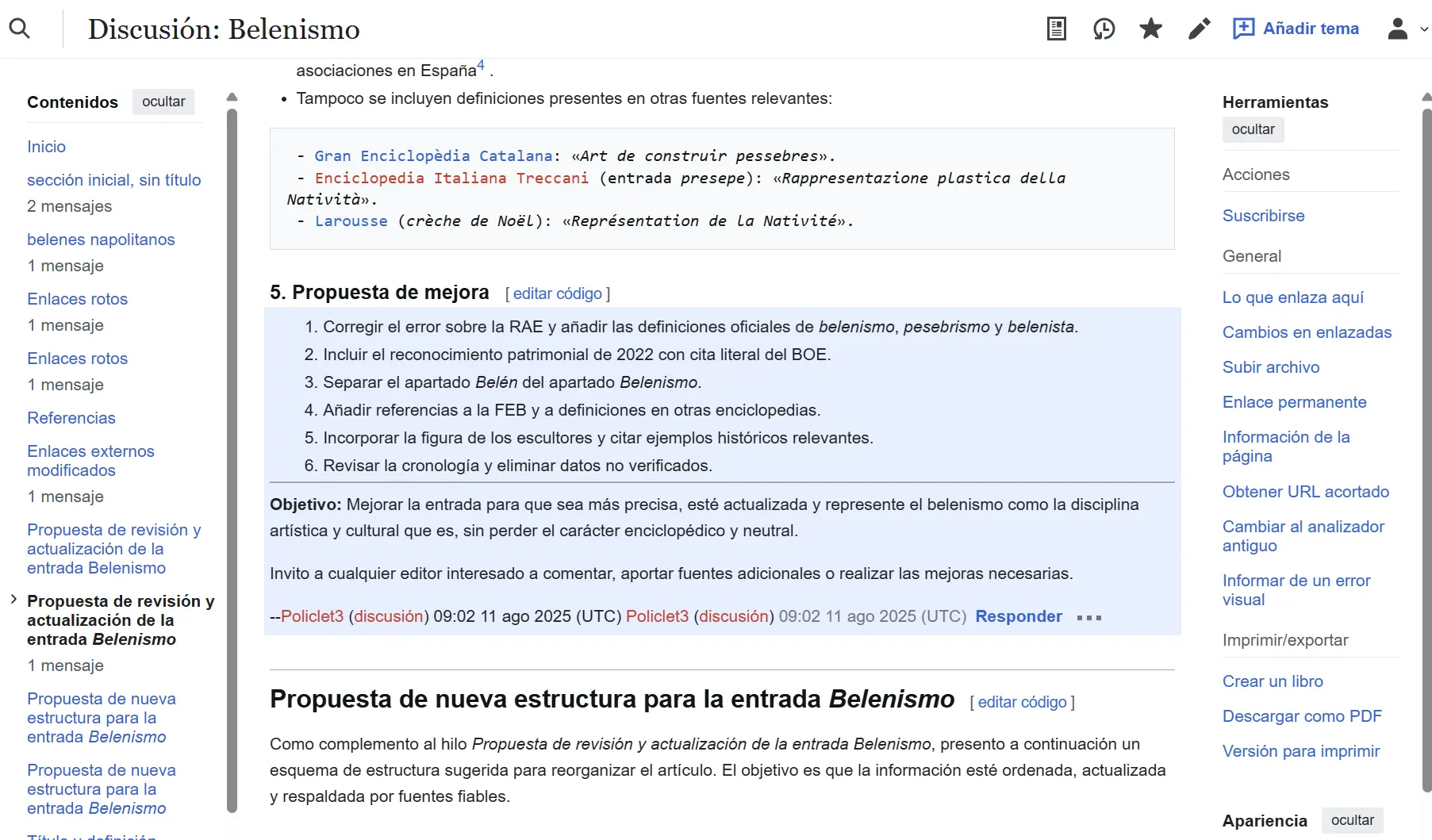
11 August 2025, at 09:02 and at 10:16. I post two signed proposals on that talk page. The first lists the errors and ends with six specific corrections: correct the information about the Academy and add the definitions of belenismo, pesebrismo and belenista; include the heritage recognition of 2022 with a verbatim quotation; separate the section on the object from the section on the practice; add the federation and the definitions of other encyclopaedias; incorporate the figure of the sculptors; and revise the chronology, removing unverified information. The second provides a complete outline for reorganising the article. I close by inviting any editor to comment, contribute sources or make the improvements.13
Nobody replied. The page itself declares it in its heading: one message, one user.
December 2025. The article is edited several times. In the history section the law of 1601 comes out (on the 17th) and the wording is retouched (on the 24th); in the legislation section a new paragraph goes in (on the 30th).
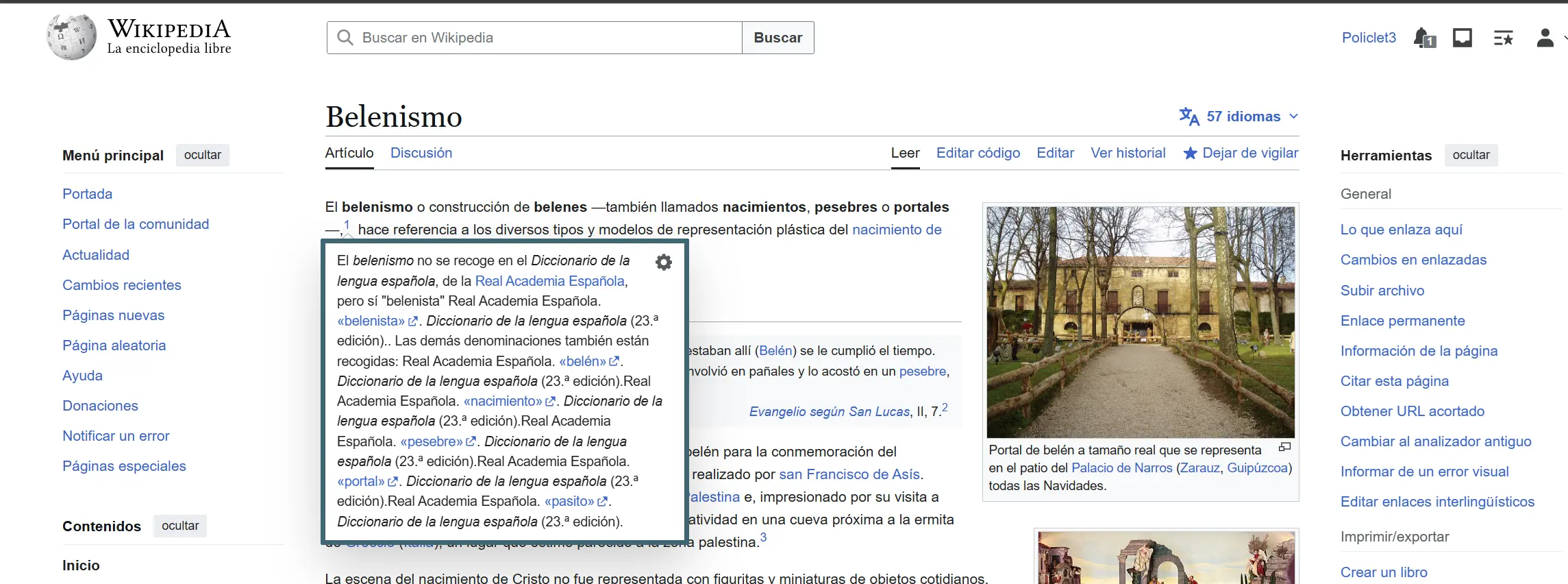
19 August 2026. The article still says: «El belenismo no se recoge en el Diccionario de la lengua española, de la Real Academia Española, pero sí "belenista".» — belenismo is not included in the Diccionario de la lengua española of the Real Academia Española, but “belenista” is.—14
It will be said, and rightly, that this passage may have been written before 2014, when it was still true. That is very probably what happened, and nobody is reproached for having written it then. What is documented here is something else: that it is still written twelve years after it stopped being true, and almost ten years after it was pointed out, with the correction alongside, on the talk page of the article itself — in October 2016, and again in August 2025—.
There is something more, and it is from this very August. On 8 August 2026, eleven days before this consultation, another editor added to the article's external links the template that refers to the Academy's dictionary, so that at the foot of the entry one can read: «El Diccionario de la Real Academia Española tiene una definición para belenismo» — the Diccionario de la Real Academia Española has a definition for belenismo—. The body still says that it does not. The correction came in through the links and never reached the sentence that needed it: the article contradicts itself within the same page, and the reader who arrives has no way of knowing which of the two things to believe.15
There is no need to characterise this: it needs to be dated.
The fact that can be checked in the source the article itself cites. It states that belenismo does not appear in the Academy's dictionary, and refers to belenista. It has appeared there since 2014, together with pesebrismo. Correction: cite both words with their definition and their labels — the chapter on the word has them checked against the source—. Still uncorrected.
The heritage declaration and the federation. The Federación Española de Belenistas, founded in 1963, does not appear. The 2022 declaration as a representative manifestation of the intangible cultural heritage does not appear, even though the article does have a section on legislation — edited in December 2025— devoted to the regulations on gathering moss. Correction: incorporate both with their official reference. The text of the declaration is examined separately (The dossier: «The Real Decreto 481/2022: the declaration that demotes what it declares»), because it deserves more than a mention. Still uncorrected.
The sculptors. The article does not name a single one. It speaks of craftsmen and of nativity-scene makers, and there is not one proper name of an author in the whole entry. Correction: incorporate the figure of the sculptor and cite the verifiable historical examples. Still uncorrected.
Judgement without attribution. The article introduced value judgements in the encyclopaedic voice, without citing anyone. Correction: attribute or remove. It falsifies no fact; it changes who is speaking, which is worse.
The typology without a criterion. Popular, artistic, biblical, regional, modern — mixing presentation, technique, style and function without declaring what the classification is based on—. Correction: declare the criterion for each axis, or present the diversity without ordering it. And it is worth seeing how far the matter reaches: that same typology is the one that the English-language assistant serves today to an English-speaking reader as if it were established knowledge. A classification without a criterion does not stay put: it gets translated.
The chronology. From the 14th century to the 18th and back to the 15th, with no transition. Correction: put it in order.
Facts without support. A first figure-making firm in Paris in 1465; a first workshop in the Iberian Peninsula at Alcorcón in 1471; figures in Siena in 1475; a factory in Lisbon in 1479, burned down in 1835; English influences in 1501. Correction: locate the source of each, or remove them. They are not declared false — they are declared unproven, which is what can be asserted and is enough—. The one from 1601 has already been seen above, and it is the only one on the list that has left the article.
And the fact that holds up all the others. The article states today: «La primera celebración navideña en la que se montó un belén para la conmemoración del nacimiento de Jesucristo fue en la Nochebuena de 1223, realizado por san Francisco de Asís.» — the first Christmas celebration at which a nativity scene was set up to commemorate the birth of Jesus Christ was on Christmas Eve 1223, made by Saint Francis of Assisi.— Without qualification, without discussion and without a study behind it. It is the sentence that the two answers return, each in its own way and each in its own language. And it is the same one that someone called into question on the talk page in 2008. Correction: the Manual deals with it, with its sources, in its proper place (The Amades case: the mystery of the omissions); here it is enough for whoever reads it to know that it has been flagged for almost eighteen years.
And the second entry, the one on the object, which reaches the same place by another route. In relating the account, it states that the manger was in a stable or a porch.16 In the account there is no stable, no porch, no lean-to: Luke says that they laid him in a manger because there was no room for them in the katályma, and of the place he says nothing more. The stable and the porch are a later tradition — very ancient, deep-rooted and worthy of study, and the Manual studies it where it belongs (block «In search of the biblical nativity scene»)—, but a tradition. Correction: separate what the text says from what tradition added, which is what the article does well a few lines earlier, when it glosses the inn as a guest house.
Nobody invented that stable. They took it as read. It is what any reader does who has been formed by the image and not by the text, and that is why it is so hard to detect from inside.
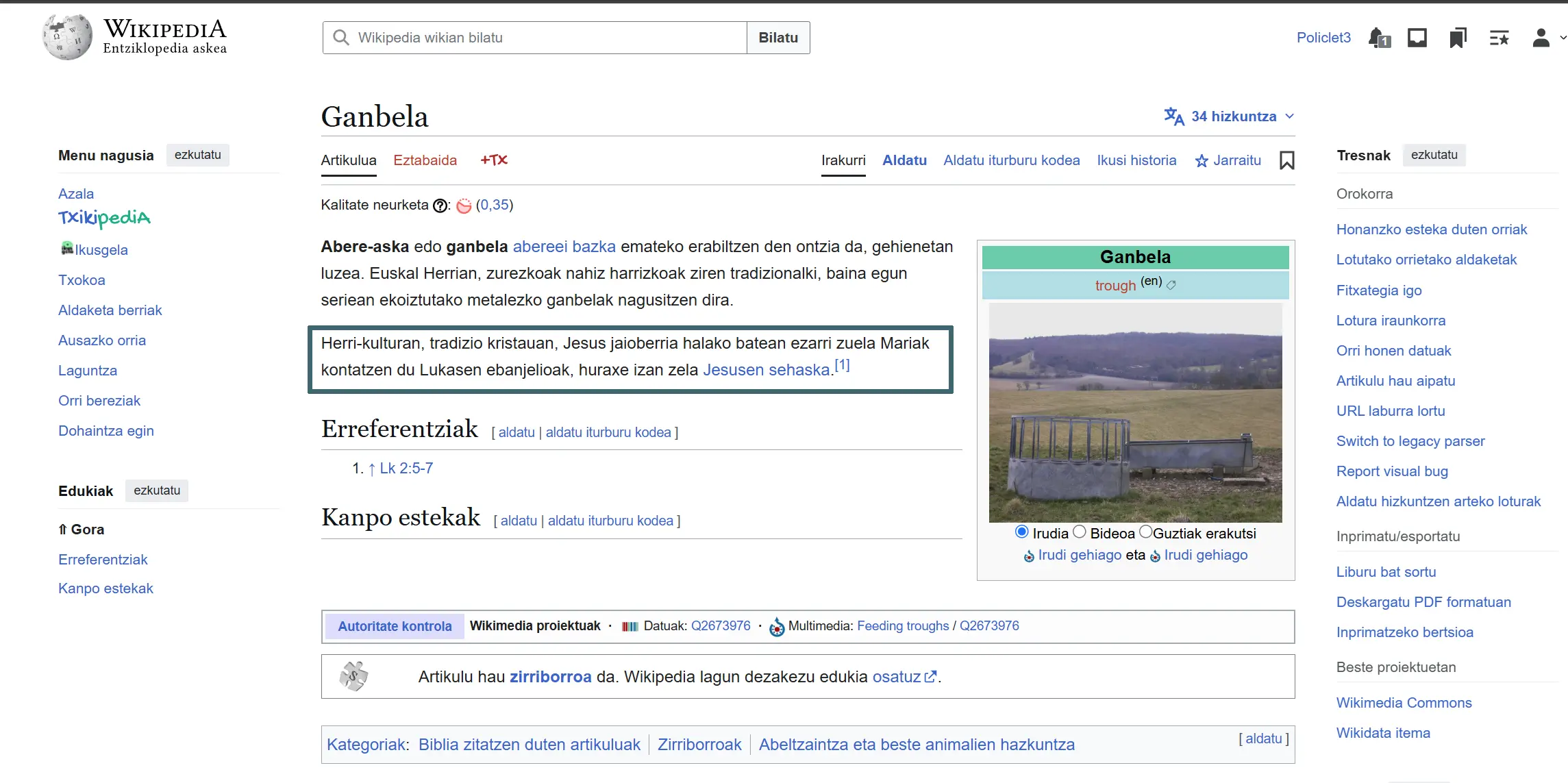
There remains, to finish, the proof that none of this is inevitable. The Basque article on the trough has four lines and a low-quality tag. In those four lines it names the object, attributes the tradition to tradition and cites Luke without adding a stable to him.17 Length measures nothing. What is inherited is not the size: it is the frame.
The others who define
The academies and the encyclopaedia do not exhaust the list. Whoever declares something heritage and chooses the words with which to declare it also defines, and so do the federations and associations when they say what they represent.
The dossier examined in depth is the Spanish one, and its chapter is the next (The dossier: «The Real Decreto 481/2022: the declaration that demotes what it declares»). The reason for examining that one and not another was given at the beginning: it is the one that can be read in full, with its signatures in view.
What the list of conditions takes from this
The chapter on the definition put its own through a list of twelve conditions, each born of a flaw proven in an inherited definition. The flaws that this chapter has documented in what circulates today add four, and it is worth writing them down here, where their proof is.
It must distinguish the practice from its product. This is the original flaw of everything that circulates: the nativity scene is defined and the result is called «belenismo». A definition that does not separate the two is already written against its own name.
It must stand without a borrowed founding date. The definition disseminated today comes hooked to a year, 1223, which none of the sources that repeat it has checked. A definition that needs an origin to explain itself depends on that origin holding up.
It must be verifiable element by element. This is not a demand of style: it is the only thing that prevents it from circulating without anyone being able to follow its trail, as the existing one has circulated.
And it must be able to name the practice in languages that do not have the word. The list of conditions in the chapter on the definition asked, in its eleventh condition, that it be said in all six without a note of equivalence. This is harder: four of those six do not have the word, and their readers receive the content anyway, translated by an assistant. A definition that only works where the noun exists leaves out most of those who are going to read it.
The definition of this Manual — making the Nativity present so as to move— withstands these four as well. It defines the practice and not the object: it does not say «un belén es» — a nativity scene is—, it says «el belenismo es» — belenismo is—. It carries no date: from Greccio it takes not the year but what the two witnesses say was intended. It can be followed word by word, because each word refers to the chapter that proves it. And in the four languages that do not have the word, it begins with «the world of an art» and leaves the subject unnamed, without losing anything of what it says.18
References
The Manual's criterion for languages. Federation: Universalis Fœderatio Præsepistica (Un. Fœ. Præ.), which in Spanish presents itself as the Federación Internacional de Amigos del Pesebre; its website (
unfoeprae.org) is published in five languages — Spanish, English, French, German and Italian—, according to the language selector on its own home page (consulted 19-VIII-2026, screenshot in the Manual's archive). Catalan is added by this Manual. Association: Associació de Pessebristes de Barcelona, whose home page opens with the founding date the association gives itself: «1863 · Venim d'un passat ple de futur» — 1863 · We come from a past full of future— (pessebristesdebarcelona.cat, consulted 22-X-2026). The press reports on its early years are in the chapter on the word, where they belong, together with the four copies that were located when checking them (The word: «Belenismo, in two languages», section «The Spanish series: 1864, 1867, 1877, 1934»). ↩Ministerio de Cultura, Portal del Patrimonio Cultural Inmaterial, page «El Belenismo» (
portalinmaterial.cultura.gob.es/pci-nacional/belenismo.html), consulted 19-VIII-2026. The definition comes from the declaration dossier and is examined in the chapter on the dossier. Snippet visible on the results page: «Se trata, por lo general, de construcciones efímeras y estacionales, de un pequeño universo reducido, que alberga personas, animales y casas». ↩Second general-purpose search engine, query «belenismo», 19-VIII-2026 (screenshot by Emili Solé). First item on the page: advertisement for a figure shop, marked as sponsored. Next, the open encyclopaedia's entry, with two boxes extracted from it and declared as such at the foot («Texto de Wikipedia bajo licencia CC-BY-SA»): «Historia», which cites Lk 2 in the version with the inn; and «Características y clasificación», which gives the definition of the nativity scene attributed to Joan Amades and approved by the Un.Foe.Prae at the Second International Nativity-Scene Congress (Rome, 1955). This locates where that quotation comes from — the assistant in note 4 took it from the article, not from anywhere else—. In the article, that definition rests on a single note, «Amades, Joan, op. cit., p. 15», which refers to Amades's El Pessebre; that is why here it is not used as an inherited definition. ↩
Artificial-intelligence assistant, query «belenismo», 19-VIII-2026 (screenshot by Emili Solé). Declared sources: the Academy's dictionary and the open encyclopaedia, among others. The definition attributed to Joan Amades and approved at the Second International Nativity-Scene Congress (Rome, 1955) comes from the encyclopaedia article (note 3), which supports it with a single reference to Amades; it is not used in this chapter. ↩ ↩
Artificial-intelligence assistant, query «belenismo» in English, 19-VIII-2026 (screenshot by Emili Solé). Declared source for the origin and for the typology: the open encyclopaedia. Recorded and not used: the figure it gives for the Museo Internacional de Arte Belenista. ↩
Catholic portal for the general public, «¿Qué es el belenismo?»: address, date of consultation and declared source, in note 8; the two texts, side by side, in the composite of 21 August 2026 reproduced further below. ↩
Verbatim comparison of the two texts, made for this Manual: Catholic portal for the general public, «¿Qué es el belenismo?», and the open encyclopaedia, «Belenismo», history section, in the version prior to 17-XII-2025. The article's reference pointed to that portal. The two pages were consulted on 21-VIII-2026 and again on 22-X-2026. The passage entered the encyclopaedia on 25-XII-2010 (
oldid=42760799), with a «cita requerida» tag; on 23-XII-2023 the portal was given as its reference (oldid=156197611). The portal declares «Fuente: Wikipedia» and reproduces a version of the article from between December 2012 and December 2017 (note 8). The encyclopaedia published first, and the portal copied it. ↩Catholic portal for the general public, «¿Qué es el belenismo?» (
es.catholic.net/op/articulos/55144/qu-es-el-belenismo.html), consulted 21-VIII-2026. The article's page declares «Por: Varios» and «Fuente: Wikipedia», under the section «Un poco de historia…». Its fifteen footnotes reproduce the encyclopaedia's apparatus; the first refers to the Academy's dictionary in its 22nd edition (2001), whereas the equivalent note in the live article refers to the 23rd. The reciprocal reference is note 10 of the article «Belenismo»: «¿Qué es el belenismo?». Catholic.net. Consultado el 23 de diciembre de 2023 — with no archive link in the article—. Copy of the portal in the Internet Archive from the same day:web.archive.org/web/20231223071835/http://es.catholic.net/op/articulos/55144/que-es-el-belenismo.html. The portal's text matches that of the article as it stood between 17-XII-2012 (oldid=62269896, when the sentence «se suele exponer durante las fiestas de Navidad en hogares, iglesias, comercios, etc.» goes in) and 6-XII-2017 (oldid=103975003, when the first line loses «misterios» and «pasitos»); in that interval the article still said «Fira de Santa Llúcia» and «pag 50-53», like the portal, and had no comma after «siglo XIX» in the passage on 1601. ↩The open encyclopaedia, Spanish edition, «Belenismo», history: edit of 17-XII-2025 at 17:19, −255 bytes, history section, with the summary quoted; the revision carries the automatic tag «posible pruebas». It is signed by a temporary account,
~2025-41467-12. Difference viewable ates.wikipedia.org/w/index.php?title=Belenismo&diff=prev&oldid=171039419(checked on 21-VIII-2026): on the left the revision of 15-XII-2025, by Pipo1955, which still contains the passage; on the right that of the 17th, which removes it. The removed wikitext contains the call<ref name=":0" />, the paragraph's only reference. Recorded in the workshop and not published: the identity of the editors involved and the conduct incidents recorded on their user pages. The fact is the removal and its date, not who made it. ↩The open encyclopaedia, Spanish edition, «Belenismo», first paragraph, consulted 19-VIII-2026. Permanent version:
oldid=174757657, checked on 21-VIII-2026. The most recent edit to the article is of 8-VIII-2026 at 14:19, earlier than all the consultations in this chapter: thatoldidtherefore fixes all the screenshots of the Spanish article — the first line, the article's footer and the inventory—. ↩Footer of the same article, with the concept identifier and the link to the media category, which names it as a Nativity scene (screenshot by Emili Solé, 19-VIII-2026). The Spanish article «Belenismo» belongs to the concept Q31732, which links to fifty-seven other editions — the figure the article declares in its heading—; among them are «Pessebre» (Catalan), «Presepe» (Italian), «Weihnachtskrippe» (German), «Crèche de Noël» (French) and «Nativity scene» (English). The Catalan and German editions declare that same identifier on their own pages, and in both the word for the practice is a redirect: Pessebrisme leads to «Pessebre» and Krippenbauer to «Weihnachtskrippe». The Spanish article «Pesebre», the one on the trough, belongs to the concept Q2673976, which links to thirty-four other editions, among them «Menjadora» (Catalan), «Presebe» (Galician), «Ganbela» (Basque) and the Hebrew, Japanese and Chinese editions. Consulted on 22-X-2026. ↩
The open encyclopaedia, Catalan edition, «Processó del Sant Enterrament de Tarragona», history: edit by Policlet3, 08:57 (UTC) on 30-XI-2025, +15 bytes, with the summary «Canvio «artesà» per «escultor» per descriure correctament l'autor Emili Solé.» — I am changing “artesà” [craftsman] to “escultor” [sculptor] to describe the author Emili Solé correctly—. The edit stands: the article says today «obra de l'escultor Emili Solé» — the work of the sculptor Emili Solé— when describing the two pieces attributed to him. The same account records four contributions of 20-III-2024 on the talk page of «Pessebre popular», with the new section «Propostes per a la Clarificació i Millora de l'Entrada» — Proposals for the Clarification and Improvement of the Entry—. None received a reply: the history of that talk page has only those four revisions, all by Policlet3, between 05:32 and 05:48 (UTC); permanent version,
oldid=33279757(Catalan edition), checked on 22-X-2026. Permanent version of the article:oldid=37902281(Catalan edition), checked on 21-VIII-2026. ↩Talk page of the article:
es.wikipedia.org/wiki/Discusión:Belenismo. Threads cited: the unsigned note recalling that the article on Saint Francis of Assisi says that he did not invent the nativity scene, added on 22-XII-2008 at 17:24 (UTC) from the IP address 69.79.164.215 (oldid=22767907); the section «Referencias», added unsigned by BelenistaVG on 8-X-2016 at 07:22 (UTC) (oldid=94180754); and the two signed Policlet3 on 11-VIII-2025, at 09:02 and at 10:16 (UTC) — «Propuesta de revisión y actualización de la entrada Belenismo», whose section 5 contains the six corrections, and «Propuesta de nueva estructura para la entrada Belenismo»—, which are by Emili Solé. Permanent link to the comment, by its timestamp:#c-Policlet3-20250811090200-5._Propuesta_de_mejora. Both threads appear with the indication «1 mensaje · 1 usuario en la discusión»: they received no reply. Checked again on 21-VIII-2026, one year later: they are still unanswered, and the account that signed them has received no notification arising from them. Permanent version of the talk page:oldid=168928252, consulted again on 21-VIII-2026. ↩ ↩The open encyclopaedia, Spanish edition, «Belenismo», direct consultation of 19-VIII-2026 to verify the inventory point by point. The following are confirmed in the live version: the passage on the Academy's dictionary; the absence of the Federación Española de Belenistas; the absence of the 2022 heritage declaration; the absence of any sculptor's name; and the passage on 1223. Permanent version:
oldid=174757657. ↩The open encyclopaedia, Spanish edition, «Belenismo», edit of 8-VIII-2026 at 14:19, by Ksn.kenny, +18 bytes, external links section: adds the template
{{RAE|belenismo}}. It is the most recent edit to the article and the one that fixes its current version,oldid=174757657; the difference can be viewed ates.wikipedia.org/w/index.php?title=Belenismo&diff=prev&oldid=174757657(checked on 21-VIII-2026). Between 17-XII-2025 and that date, the article received only spelling and template corrections, a retouching of the wording in the history section (24-XII-2025), the paragraph on the Pesebre Venezolano (30-XII-2025) and the rescue of a reference by InternetArchiveBot on 5-VI-2026 — which affected the citation of elmanifiesto.com, not that of the Catholic portal—. ↩The open encyclopaedia, Spanish edition, «Pesebre» (screenshot by Emili Solé, 17-VIII-2026). Permanent version:
oldid=171588105, checked on 21-VIII-2026. Wording, in the section «Natividad»: «En el relato bíblico, el pesebre estaba en un establo o portal que funcionaba como un alpendre (del latín «appendix»), un lugar rústico y cubierto donde se resguardaban los animales o los enseres». A few lines earlier: «lo acostó en un pesebre, porque no había lugar para ellos en la posada (casa de huéspedes)». That version, of 18-I-2026, is still the current one on 22-X-2026. ↩The open encyclopaedia, Basque edition, «Ganbela» (screenshot by Emili Solé, 17-VIII-2026); it cites Lk 2:5-7. Permanent version:
oldid=10579851(Basque edition), checked on 21-VIII-2026. ↩Chapter on the definition, sections «Word by word» («the sentence defines the practice and not the object»), «The definition» («each word can be traced back to its proof») and «The six languages» («in the four that do not have it, it begins with “the world of an art” and the subject remains unnamed»). ↩