
 ≈ 35 min

Whoever builds a scene of the Nativity asks, sooner or later, all the questions of the trade: which scene, what scale, what light, what materials, how many figures. There is one that is not usually asked, and it comes before all the others: who is being represented.
It seems an idle question, because it seems answered in advance. The nativity scene represents the birth of Jesus, and anyone knows that. But the birth of Jesus takes up only a small fraction of the scene: the Holy Family, some shepherds, some Magi, an angel. Everything else — the street, the market, the houses, the people at work while all this is happening— is not in the narrative. And yet it is in the nativity scene, and it usually takes up most of it.
That part is not given. Someone decided it. And since there is no text that prescribes it, whoever decides it does so with what they have: with a people. Their own, or someone else's, or one that never existed.
This chapter does not tell the history of the nativity scene — it has been written in many places and repeating it would add nothing— nor does it go into how a scene is composed, which is the business of the block on scenography. It deals with one thing only: making visible a choice that is almost always made without knowing that it is being made, and showing that there is no way of not making it.
It should also be pointed out that the answer forces apart two questions that usually go together and are not the same. One is who has a place in the scene, and it is answered with the Gospels. The other is why a people represents itself, and that one is answered neither by the Gospels nor from within nativity-scene art and practice: it has its own chapter and its own evidence elsewhere (Popular, the other word).
The figures the Gospel does not name
Of the four Gospels, two tell of the birth, and they do not tell the same thing. Luke brings the census, the journey, the manger, the shepherds and the angel; Matthew, the star, the Magi, Herod and the flight. Where they differ there is no way of reconciling them, and the Manual has already explained why that is not a defect of the narrative but a working condition for whoever represents it (Understanding the script: shaping with the words of the narrative).
What matters here is simpler: how many characters they name. They are few. Mary, Joseph, the Child, some shepherds with neither number nor name, an angel and a heavenly host, some Magi with neither number nor name, Herod, the priests and scribes whom Herod questions, and two names that only date the census, Augustus and Quirinius. Together, the two birth narratives do not fill two pages.
Around that, the nativity scene places a whole population. And that population is prescribed nowhere. There is no text that says how many they are, what trade they follow, how they are dressed, whether there is a market, whether there is a tavern, whether there is a river. The silence is total, and it is a silence from the source: the two narratives do not describe a setting, they tell what happens.
And precisely because there is no text, there is room — and a place has to be decided—. The gap can only be filled with people from somewhere, and where those people come from is the first decision of whoever builds the scene. Two answers are possible, and a third way of not answering that this chapter examines further on. One is one's own place, and then the scene is filled with the people one has in front of one: hence the Neapolitan nativity scene has tavern-keepers and the Tyrolean one woodcutters, not as regional ornament but because there was nothing else to fill it with. The other is the place of the narrative, which nobody chooses because it is given — Nazareth, Bethlehem, Jerusalem and the roads between them—, and then the gap is filled with the people of that place and that time, who have to be sought wherever they are documented. What changes between the two is not the demand: it is where what needs to be known is kept.
What the Gospel does not name, a place supplies; which place it is, is the choice this chapter is about.
That is the part of the scene that changes from one country to another. The part that tells the story changes little — a Joseph is a Joseph—; the part that accompanies it changes entirely, because the people who lend it change. It is the part of the nativity scene where one can see where its maker comes from — or how far they have gone to search—. And it is also the first part to be left without a model when that people ceases to exist.
To whom the news is addressed
There is a place in the narrative itself where the question of this chapter appears already formulated, and it is worth looking at slowly because it is usually read straight through.
On the night of the announcement, the angel tells the shepherds that he brings «nuevas de gran gozo, que será para todo el pueblo» — news of great joy, which shall be for all the people—.1 The scene has its own page in this Manual, with its full text and its analysis (The Annunciation to the shepherds); what was said there is only recalled here: that the news is declared for all the people and is given to those who in that people do not count — a crew on watch, at night, far from the Temple and with no authority to bear witness to anything—. The disproportion between what is announced and who hears it is the finding of that page, and it is developed there. Who those people were, and why their condition is not a charming detail, is studied in the chapter on the human world of the cycle (Jesus in his time).
What does belong here is an examination of the word. In the original Greek, the formula is παντὶ τῷ λαῷ: singular, with the article.2 And twenty-one verses later, in the same chapter, Luke uses the two forms that were missing. In Simeon's mouth, salvation is prepared «before the face of all peoples» — πάντων τῶν λαῶν, plural—, and it is «a light for revelation to the Gentiles» and «the glory of your people Israel» — ἐθνῶν as against λαοῦ σου Ἰσραήλ—.3
That is to say: Luke had the plural available to say «all peoples», and he uses it when he means it. In the announcement to the shepherds he does not use it. That this singular designates the people of Israel is a reading internal to the chapter itself — the same text names that people shortly afterwards, and distinguishes it from the Gentiles—; anyone can check it by looking at those three verses. Inferred from context.
From which something follows that does not require believing anything else: the narrative begins by addressing a particular people, by its name. The opening to everyone does come, but it comes later, in the mouth of another character and with another word.
This is not a philological curiosity. It is the very structure that every popular nativity scene will later repeat with its own people. When a people places itself in the scene it is neither enlarging the narrative nor diverting it: it is doing with its own people what the narrative did with its.
And here the limit, stated before anyone confuses it: this explains why a people has a place in the scene; it does not explain why a people represents itself precisely when its way of life is disappearing. That is another matter, it has other evidence — from sociology, anthropology and psychology— and it has its own chapter (Popular, the other word). What the Gospel allows, loss sets in motion.
How the people entered the scene
That the gap existed does not mean that it was filled at once, or anywhere. It took centuries, and it has dates. Everything that follows in this section rests on archival documents — contracts, inventories, museum records— and is given as Proven within the scope of each source; where it moves from there to a reading of this Manual's own, that is said.
It is best to begin with what does not begin here. The small-format figure was not invented by the nativity scene: it is one of the oldest things humanity has made. The so-called Venus of Willendorf, carved in fine limestone and found in 1908 in Lower Austria, is about 29,500 years old.4 Between it and the first nativity scene there is a good deal more distance than between the first nativity scene and ourselves, and everything else fits in between: the Egyptian ushebtis, the Iberian votive offerings, the warriors of Xi'an, the Greek and Roman terracottas.
Nor did the nativity scene invent its procedures. In the last quarter of the 4th century BC, Greek workshops were producing terracotta figures in two-part moulds — one for the front and another for the back—, and the device with which they enlarged their repertoire without modelling again is described: «By varying the direction of the head and the position of the arms, a single type of figure could be given many slightly different poses».5 That is serial production from a modelled original, and it is exactly what the Neapolitan pastorari will do with their matrices two thousand years later.
Not even the dressed, jointed figure is Neapolitan. In 1889, while the foundations of the Palace of Justice in Rome were being dug, the sarcophagus of a young woman, Crepereia Tryphaena, came to light intact, and inside it, among her grave goods, was an ivory doll «with jointed limbs», accompanied by small toilet articles; it dates from the middle of the 2nd century.6 The wooden mannequin that in seventeenth-century Naples will make it possible to dress and move the shepherds does not invent the procedure: it brings it to this trade fifteen centuries later.
Nor is it new to represent ordinary people in small figures. Most Tanagras — named after the site in Boeotia where they were found in their thousands— represent women and girls of their own time, dressed in the fashion of their own time, and the repertoire includes characters believed to come from the comedy of Menander.5 Ordinary people, not gods.
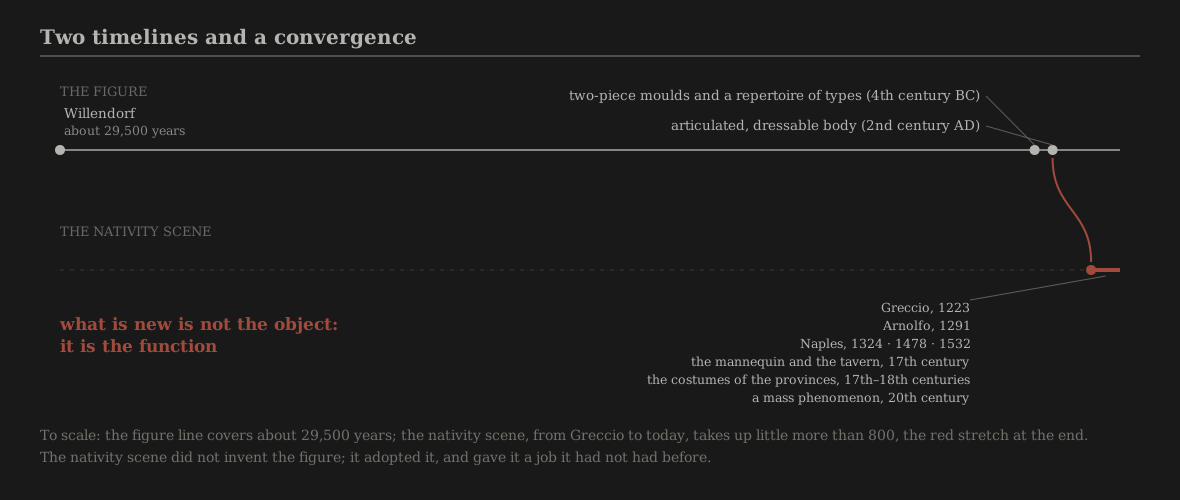
So the question narrows, and in narrowing it is answered. What is new is not the object, nor the technique, nor the subject. What is new is the function: that the figure should hold a place within a scene that represents one particular birth and that, in holding it, should also represent the people of whoever sets it there. The nativity scene did not invent the figure; it adopted it, and in adopting it gave it a job it had not had before.
In the nativity scene, moreover, the scene came before its figures. When Francis of Assisi gathered the people of Greccio, in 1223, there were no figures: there was a manger, straw, a live ox and ass, and people. The sculpted image came later, and the earliest that survives is not from the south of Italy but from Rome: in 1291 Pope Nicholas IV commissioned from Arnolfo di Cambio a group in Carrara marble for the basilica of Santa Maria Maggiore — Saint Joseph, the ox, the ass, one kneeling Magus and two standing; the Virgin and Child that accompany it today are a later replacement—. The basilica, which holds and displays it, presents it as the first nativity scene known to art history.7 It was an image for devotion, made for a chapel. The scene did not yet have a people inside it.
The people enter in Naples. The dates of this course of events are gathered in a study from the Università di Torino by Stefano De Caro, who works from notarial contracts, inventories and the press of the period; it enters this chapter as the documentary reconstruction of one case, not as a general history of the nativity scene, and everything that follows comes from it unless otherwise stated.8 The first mention of a nativity scene in the Neapolitan area dates from 1324, and from the first half of that century comes the record of a representation of the Nativity at Santa Chiara. The custom of building them spread in the second half of the 15th century, in Aragonese Naples. From 1478 comes the best-documented commission of those years: Jacovello Pepe — aromatario, supplier of spices and drugs, to Ferrante of Aragon— asked the sculptor Pietro Alamanno and his son Giovanni for forty-two figures of almost life size, and wanted them for his chapel in a church. And in 1532 a contract drawn up before a notary describes in detail a nativity scene with painted terracotta shepherds from the workshop of Domenico Impicciati, made for a nobleman of Sorrento: it might be, the study says with that caution, the first certain record of a nativity scene intended for a house and not for a church.
The 17th century is the one that decides the form, and this should be borne in mind because it is usually credited to the next. The jointed wooden mannequin spreads — a body that can be dressed and moved—, and with it the figure stops being a block carved in one piece and becomes something that is assembled: head, limbs, clothing. The tavern appears, and with it the first character who tells nothing of the narrative: the one who eats, the one who drinks, the one who serves. And the whole ensemble changes place and owner. In its becoming «a narration by the sum of scenes», the study says, in its progressive enrichment with wholly secular elements, «by now far removed from the mystery of the Nativity», the Neapolitan nativity scene became less and less a church object and more and more a palace furnishing.9
And with the mannequin comes what matters to this chapter. «As early as the second half of the 1600s, with the creation and spread of the wooden mannequin —writes De Caro—, the shepherds began to be dressed in the popular and peasant costumes of the various provinces of the Kingdom of Naples, a custom that in the 18th century gradually spread and grew richer with ever new types.»10 It is worth noticing which costumes he means: not those of the city of Naples, but those of the areas of Campania, Abruzzo, Apulia, Basilicata and Calabria. The people who enter the nativity scene are those of the whole kingdom, province by province.
The 18th century carries it to its end and adds money. The nativity scene becomes, in the words of the art historian Raffaello Causa, a «fashionable game of the court, the aristocracy and the wealthy bourgeoisie»,11 with the palace displays at its head; a whole city sets about making figures — the figurari, whose names have for the most part been lost, and with them sculptors of the first rank—. And clothing stops being improvised. In 1773 Pietro Fabris published a collection of prints of the costumes and trades of the kingdom; in the early 1780s Ferdinand IV sent the painters Alessandro D'Anna and Saverio Gatta, and later Antonio Berotti and Stefano Santucci, to the provinces to portray the dress of their inhabitants — so as to come to know, the study says, the subjects of the distant provinces «while at the same time giving equal dignity to all the populations portrayed in their national costumes»—. From those prints come the models that dress the shepherds. And the shepherds that Ferdinand sent as a gift to his brother, the King of Spain, had a slip of paper sewn inside their clothes giving the area of origin of each costume.12
One more detail, which tells a sculptor a great deal: what was reproduced was not working clothes but festive dress, that of men and women of the provinces and the countryside «gallantly dressed».12 Two hundred years before anyone studied it, the nativity scene was already doing what a people does when it wants to show itself: bringing out the clothes kept for the special day. Why it is always those clothes and not others is explained, with its sources, in the chapter on the popular style (Popular, the other word).
And an honesty that the same source imposes. Those shepherds looked closely at the poor, but they did not speak up for them: their figures are «devoid of any social denunciation of the peasant condition of the Neapolitan people» and seem to reflect «the desire for escape and divertissement of the aristocracy and the bourgeoisie»; there is in them, De Caro writes, a «taste for poverty».13 The courtly nativity scene of the 18th century puts the people into the scene, yes, but seen from above and on the commission of those who do not belong to it. That a people should represent itself, rather than be represented by others, comes later in Naples: the same source places it in the 20th century, when the nativity scene becomes a mass phenomenon and the tradition survives thanks to humble terracotta figures, in «the choral representation inspired by the life of the people through its everyday gestures».14 That is what happened in Naples, and it cannot simply be extended to the other traditions: the santons of Provence were born in private homes and not in palaces, and the Tiroler Krippe was developed by a nativity-scene builder, not by a court. Each tradition has its own division between whoever commissions and whoever is represented; the two just named are documented, with their dates and their sources, in the chapter on the popular style (Popular, the other word).
The two things, then, should not be merged. That the people are in the scene does not yet mean that the scene is theirs. Between the Neapolitan shepherd commissioned by a prince and the figure a people makes of itself there is a difference that is not one of style but of ownership, and knowing which of the two one has in front of one requires looking at who paid, who modelled, and for whom.
And each place did the same with its own
From Naples it passed to other places, and in each one it was filled with the people of the place: the santons of Provence, the Alpine Tiroler Krippe, the Catalan pessebre with its peasant-farmer figures, the Madrid nativity scene with the types and trades of the 19th-century city, the szopka that represents Kraków itself.
That course, with what each tradition names and with what words do in each language, is studied and checked against its sources in its own chapter, and it is not repeated here (Popular, the other word). It is enough to keep in mind the form they share: a people places itself around the Nativity, with its clothes, its houses and its trades. What changes from one tradition to another is not whether there is a people; it is which people.
What follows for whoever composes a scene
Up to this point, a description. Now the consequence, which is what the reader takes to the workbench.
Before peopling a scene one has to decide which people is being represented, and one answers for that decision with an archive. There is no third way that spares the formality: whoever does not make the decision consciously makes it all the same, inherited.
If the people chosen is the people of the narrative — the Judaea of the first third of the 1st century—, the archive is that of biblical research: the texts, archaeology, dress, the material world. This is what occupies the whole block of this Manual devoted to the biblical nativity scene, and there is no shortcut: what is not known before modelling will not be in the figure afterwards.
If the people chosen is one's own — a valley, a district, a city, a period—, the archive is local and lies elsewhere: newspaper archives, ethnographic museums, documentary photography, local history groups, and the last people who saw the trade being practised. It demands the same, and to the same degree; only the place where it is kept changes.
And there is a third practice, which should be named without adjectives: dressing the scene in an inherited image that corresponds to no documented people, taken from painting, illustration, cinema or workshop repetition. It is also a choice, and whoever makes it also answers for it. The Manual has already given its view on this practice, and it did so with a distinction that is only recalled here: it belongs to a stage of the nativity-scene tradition — with its moment, its possible beauty and its valuable works—, and a stage is not a defect; what it cannot do is pass itself off as a historical authenticity that has not been verified. Whoever does not promise reconstruction has nothing to revise; whoever does promise it answers to the evidence, not out of fashion or progress, but because in promising it they submitted to it. The full study, with its sources, is in its own chapter (What makes a biblical nativity scene authentic?).
And from the two things this chapter has been establishing a third follows, which should be stated in its barest form because it admits no argument of taste:
If every nativity scene represents a people, a nativity scene whose people never existed represents no one.
This is not a judgement on the quality of any work, nor a reproach to anyone: it is what follows from the definition this chapter works with. Which nativity scenes are in that position, and to what extent, is not decided by this page; it is decided, work by work, by whoever sets out to check where their forms come from.
None of this is a sorting into categories or a hierarchy. The pigeonhole that ranked nativity scenes from best to worst was dismantled where it belonged (Popular or artistic nativity scenes? The story of a half-finished reading), and this chapter does not bring it back through another door: it does not say which nativity scene is worth more; it says what each one is representing and with what it answers for it.
Closing
Every nativity scene pays a double tribute: to the Nativity and to a people. The first everyone knows; the second is almost never said, and yet it takes up most of the scene.
The formulation is this Manual's own and is declared as such: it is not a conclusion of the sources cited, which speak of identity, memory and documentation, but the way in which what they say is ordered here.
And from it follows the question with which any scene should begin, long before the first figure: whom am I representing, and with what do I answer for its being them?
References
The footnotes locate, and only locate. The entries that explain why each source enters, what it contributes and what it does not allow one to state are in the body of the text, in the panel that accompanies its first appearance.
Luke 2:10, RVA 1909. The complete pericope (Luke 2:8-14) and its checking are in The Annunciation to the shepherds, note 1: Luke 2 checked against Wikisource on 7-VII-2026 and 2:8-14 rechecked against it on 16-VII-2026. ↩
Luke 2:10, SBLGNT: «καὶ εἶπεν αὐτοῖς ὁ ἄγγελος· Μὴ φοβεῖσθε, ἰδοὺ γὰρ εὐαγγελίζομαι ὑμῖν χαρὰν μεγάλην ἥτις ἔσται παντὶ τῷ λαῷ». Consulted on BibleGateway on 9-IX-2026. ↩
Luke 2:31-32, SBLGNT: «ὃ ἡτοίμασας κατὰ πρόσωπον πάντων τῶν λαῶν, φῶς εἰς ἀποκάλυψιν ἐθνῶν καὶ δόξαν λαοῦ σου Ἰσραήλ». Consulted on BibleGateway on 9-IX-2026. The English translation of the phrases is the Manual's own and is given in the body. ↩
Naturhistorisches Museum Wien, record of the Venus of Willendorf: 29,500 years, carved in fine limestone (feinem Kalkstein geschnitzt), found in 1908 at Willendorf in der Wachau, Lower Austria. Consulted on 9-IX-2026. The height of the piece is not given in that record and is not given here. ↩
The Metropolitan Museum of Art, Department of Greek and Roman Art, «Tanagra Figurines», Heilbrunn Timeline of Art History, 1-X-2004: «Tanagras, from the site in Boeotia where great numbers of them were found»; «By the last quarter of the fourth century B.C.»; «were formed in concave terracotta molds»; «Tanagra figurines, however, were made in two-part molds—one for the front and one for the back»; «By varying the direction of the head and the position of the arms, a single type of figure could be given many slightly different poses»; «The majority of Tanagra figurines depict fashionable women or girls»; and the characters «who are believed to have had their origins in the New Comedy of Menander». Consulted on 9-IX-2026. ↩ ↩
Musei Capitolini — Centrale Montemartini, Rome, record of the grave goods of Crepereia Tryphaena, inv. AC 469: «raffinatissima bambola d'avorio con arti snodabili», accompanied by «piccoli oggetti da toeletta»; ivory; middle of the 2nd century AD; sarcophagus found intact in 1889 in the Prati district, during the excavations for the construction of the Palazzo di Giustizia. The translations are the Manual's own. Consulted on 9-IX-2026. The dimensions of the piece are not given in the record. ↩
Basilica of Santa Maria Maggiore, record «Presepe di Arnolfo di Cambio» (
basilicasantamariamaggiore.va): commissioned by Nicholas IV, 1291, Carrara marble; surviving figures and later replacement of the Virgin and Child; «costituisce il primo presepe conosciuto dalla storia dell'arte». Consulted on 8-IX-2026. ↩De Caro, op. cit., section 1, «I primi presepi della tradizione napoletana: dal Trecento al Cinquecento»: mention of 1324 and the sacra rappresentazione at Santa Chiara; spread of the custom «a partire dalla seconda metà del Quattrocento che nella Napoli aragonese»; commission from Jacovello Pepe to Pietro and Giovanni Alamanno, 1478, «un presepe composto da ben quarantadue figure di altezza quasi pari al vero»; contract of 1532, terracotta shepherds by Domenico Impicciati for Matteo Mastrogiudice, of which the study writes that «potrebbe trattarsi della prima attestazione certa di un presepe destinato ad una casa nobiliare e non ad una chiesa». Checked against the original PDF on 9-IX-2026. ↩
De Caro, op. cit., section 2, «Il Seicento»: «Nel suo divenire una "narrazione per somma di scene", nel suo progressivo arricchirsi di elementi del tutto laici, ormai ben lontani dal mistero della Natività […] il presepe napoletano, nel corso della seconda metà del Seicento ed in particolar modo sul finire del secolo, divenne sempre meno oggetto da chiesa e sempre più arredo di palazzo». The translation is the Manual's own. The same section documents the spread of jointed wooden mannequins and the arrival of the tavern. ↩
De Caro, op. cit., section 4.4.1, «Le vestiture»: «Già dalla seconda metà del Seicento con la creazione e la diffusione del manichino ligneo i pastori […] iniziarono ad essere vestiti con i costumi popolari e contadineschi delle diverse province del Regno di Napoli, un uso che nel XVIII secolo andò via via diffondendosi ed arricchendosi di tipi sempre nuovi». The translation is the Manual's own. In the same section, the places of origin: Campania, Abruzzo, Apulia, Basilicata and Calabria. ↩
Raffaello Causa, «giuoco alla moda della corte, dell'aristocrazia e dei borghesi ricchi», quoted through «Profano e popolare: il presepe napoletano del Settecento», Programma Barocco, Fondazione 1563. Consulted on 8-IX-2026. Causa's original not consulted. ↩
De Caro, op. cit., section 4.4.1: Pietro Fabris, Raccolta di vari vestimenti ed arti del regno, 1773, dedicated to William Hamilton; the painters sent by Ferdinand IV to the provinces in the early 1780s, with the aim of «approfondire […] la conoscenza dei sudditi sparsi in province lontane e arretrate conferendo al tempo stesso pari dignità a tutte le popolazioni ritratte nei loro costumi nazionali»; the shepherds sent to Spain with «cartigli» giving the area of origin sewn inside the costumes; and the costumes reproduced as «gli abiti della festa, ovvero gli abiti di uomini e donne delle province e del contado "galantemente vestiti"». The translations are the Manual's own. ↩ ↩
De Caro, op. cit., section 4.2, «I pastori»: representations «prive di ogni denuncia sociale della condizione contadina del popolo napoletano», which «sembrano riflettere […] il desiderio di evasione e di divertissement dell'aristocrazia e della borghesia»; «un "gusto per la povertà"». The translations are the Manual's own. ↩
De Caro, op. cit., section 3.5, «Il Novecento e l'età contemporanea»: the nativity scene as a mass phenomenon, the tradition kept alive «grazie alle umili figure di terracotta», and «la rappresentazione corale ispirata alla vita del popolo attraverso i suoi gesti quotidiani». The translations are the Manual's own. ↩