
 ≈ 47 min

A nativity scene is not improvised: it is composed.
It is not copied: it is interpreted.
Between tradition and truth
At Christmas we see very different nativity scenes: family, popular, monumental, regional, artistic or devotional. Some transfer the birth of Jesus to the world of whoever creates them; others try to come closer to the world in which the narrative sets that birth.
That is why, having opened the question of the biblical nativity scene, it is worth taking one step further:
what do we mean here by authenticity when we speak of a biblical nativity scene?
It is not a matter of seeking an impossible purity or of imagining that everything can be resolved with absolute exactness. Nor is it a matter of scorning the artistic tradition which, for centuries, has given visible form to the birth of Jesus with real power.
But it is one thing to recognise the value of that tradition, and quite another to confuse it automatically with the historical world in which the narrative is set.
To speak of authenticity here does not mean aspiring to a closed archaeological reconstruction. It means trying to ensure that the scene arises from a more conscious understanding: of the narrative being represented, of the world in which that narrative takes place and of the visual decisions that give the scene its form.
A biblical nativity scene is not more authentic because it looks older, more oriental or stranger to our eyes. It is authentic when its forms, its characters, its spaces and its atmosphere respond to a deeper question: what story am I telling, and from what world do I want to make it visible?
Note on the images in the Manual The images included in this Manual come, wherever possible, from works in the public domain, open museum collections or historical archives. I have not chosen them in order to single out particular contemporary works or makers, but to study how certain images of the birth of Jesus have been formed, transmitted and repeated over time. For that reason, I have decided not to use particular present-day figures or nativity scenes as examples for critical analysis. The point is not to say that a particular work «is wrong», but to understand where the visual forms that nativity-scene art has inherited come from, and how they have become what we recognise today as «this comes from here». What matters in this Manual is to study the sources, not the consequences: the paintings, sculptures, engravings, illustrations, visual documents and artistic traditions that, for centuries, have nourished our way of imagining the biblical world.
Authenticity does not depend on appearance alone
A biblical nativity scene is not defined by giving the figures an oriental air, or by adding a few ancient elements to an already familiar scene.
There may be «orientalising» robes, stone walls, palm trees or some architecture of remote appearance, and it may still be an image more inherited than thought through.
Authenticity does not depend only on outward appearance. It depends on the internal coherence of the representation: what story is being told, in what world it is set, and what relationship the narrative, the context and the form bear to one another.
It makes a difference whether one imagines a house, a grotto, a courtyard, a stable, a lamp, a fabric, a vessel, a manger or a road. Each object introduces an idea of the world represented. Each visual decision brings the scene closer to, or takes it further from, the cultural, material and human reality in which we want to set it.
That is why a biblical nativity scene does not begin when the scene «looks ancient», but when it begins to be built with greater awareness of the world to which it refers.
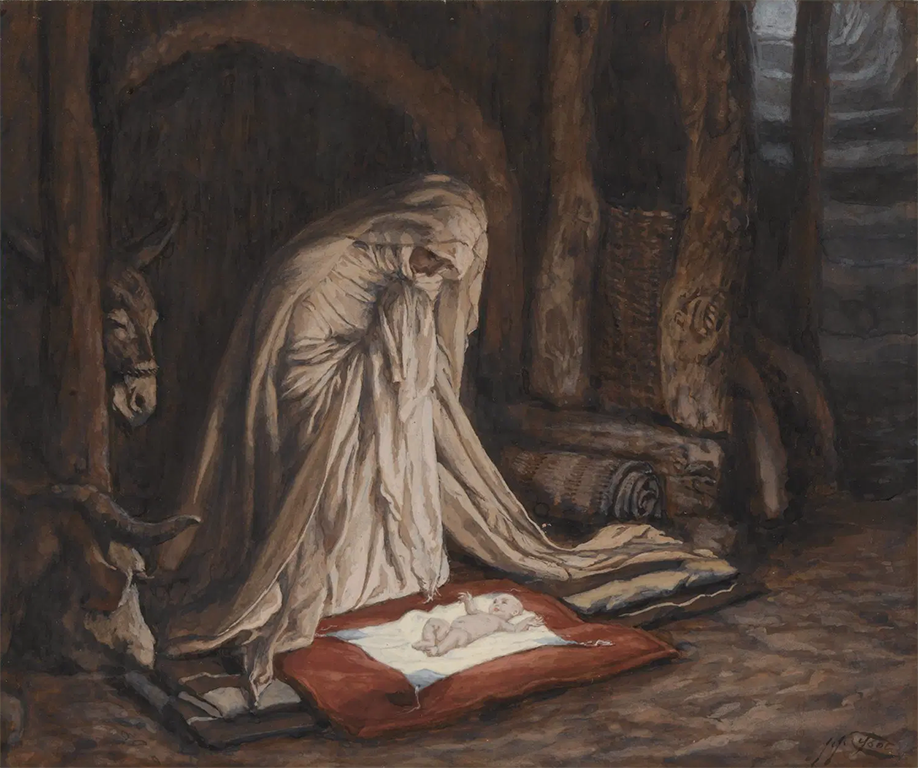
What we mean here by a biblical nativity scene
In this Manual, a biblical nativity scene is an artistic representation of the birth of Jesus set, as far as possible, in first-century Judaea.
That means trying to place the scene in its land, its culture, its way of life and its religious horizon, without merely repeating inherited visual formulas. It is not a matter of dressing the nativity scene in a vaguely oriental air or turning it into an exotic stage set. It is a matter of approaching with greater attention the real world in which the narrative places Mary, Joseph, the shepherds and the birth of Jesus itself.
The expression biblical nativity scene does not mean that everything can be known with certainty. Many things can only be reconstructed reasonably, by comparing data, sources and contexts. But it does mean that the scene is not built from just any image accumulated by custom, but from a will to understand.
A biblical nativity scene does not replace tradition with archaeology. Nor does it turn artistic creation into a documentary scale model. What it does is ask tradition for a more attentive reading, and imagination for a truer basis.
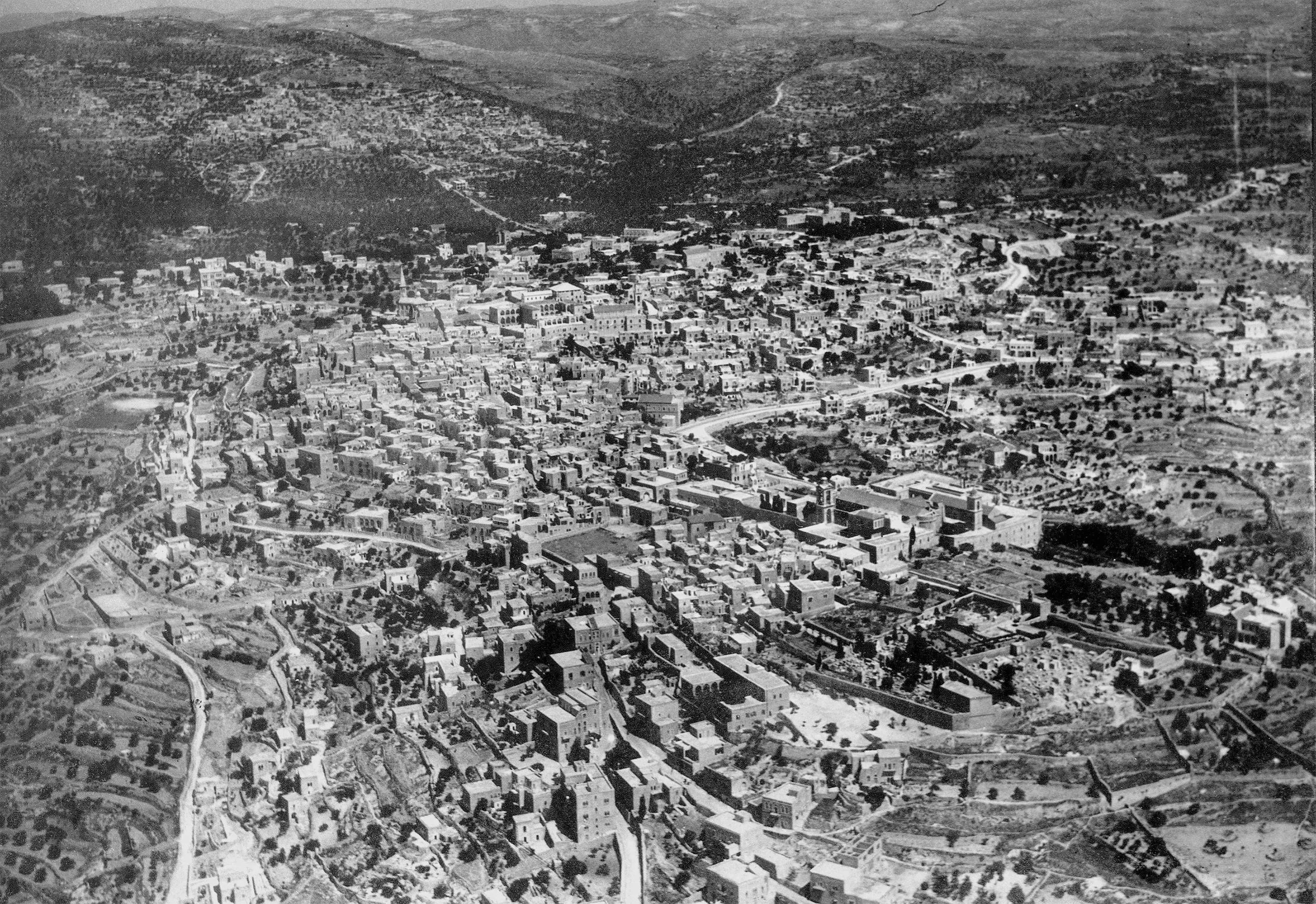
Photograph by Zoltan Kluger. Flat roofs, cubic volumes, pale stone and a town adapted to terraced hills. The image cannot be used to reconstruct the Bethlehem of the first century, but it can be used to question a convention: where is the round dome that so many “Hebrew”-style nativity scenes have turned into an automatic sign of the biblical? It does not appear as a dominant feature because it comes from another imaginary: an orientalised architecture of Arab and Ottoman roots, filtered through nineteenth-century European orientalism and later fixed by cinema, devotional illustration and repetition within the nativity-scene tradition. More than 6 centuries lie between the time of Jesus and that world. 2
The narrative and the world: two axes best not confused
The authenticity of a biblical nativity scene rests on two axes that are best not mixed.
One is the narrative: what the Gospels of Matthew and Luke narrate, suggest or leave unsaid about the birth of Jesus. That axis has its own chapter further on, where the Gospel text is treated as what it is for the nativity-scene maker: a script that must be read with attention.
The other is the world in which that narrative is set: first-century Judaea, with its historical framework, its material culture and the concrete men and women who inhabited it.
Both axes are necessary
If we attend only to the narrative, we may be left with a devotional scene without a world. If we attend only to the historical context, we may build a correct setting but one without a narrative soul. The biblical nativity scene needs both: a recognisable story and a believable world in which that story can take shape.
This Chapter 2 deals above all with the second axis: the world that makes the scene possible.
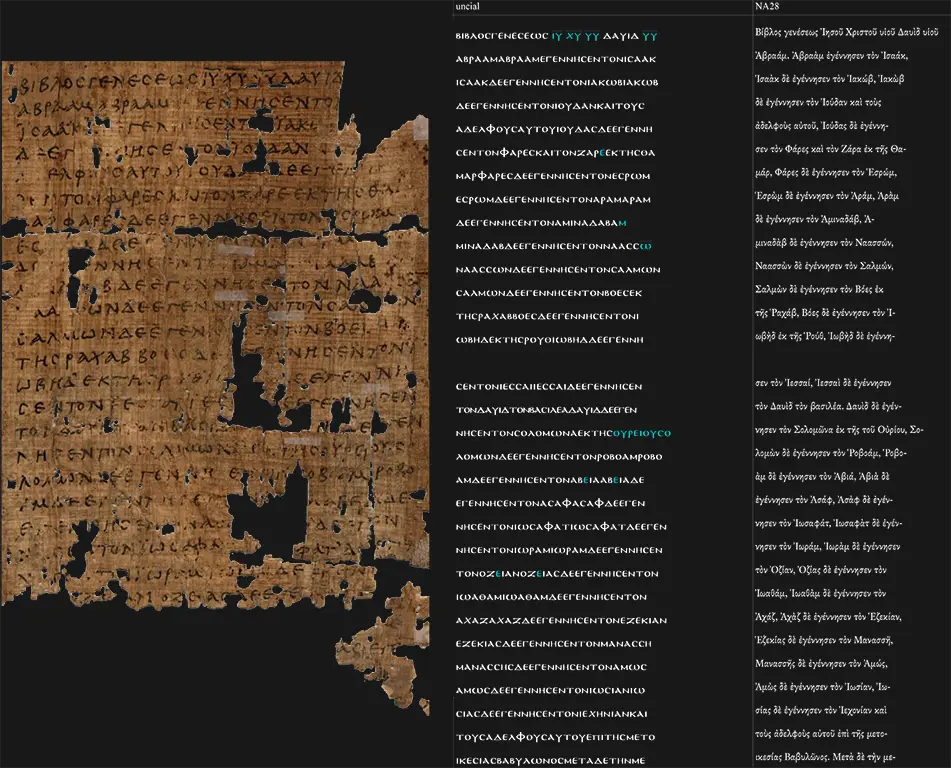
The beginning of the Nativity narrative in its oldest surviving material form: Egyptian papyrus, continuous script without word separation. The nativity-scene maker needs this axis: to know precisely what the text narrates, what it suggests and what it leaves unsaid. 3
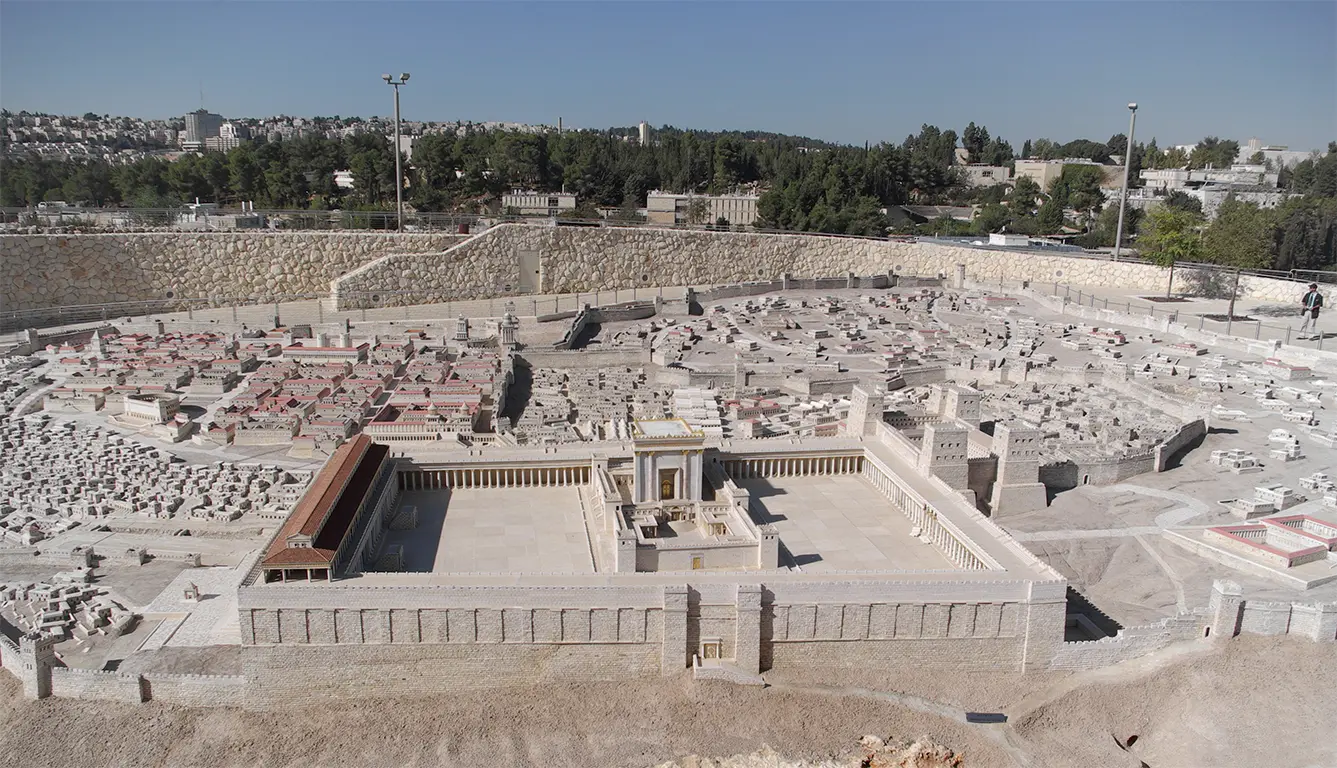
The material world in which the narrative is set: Judaea under Roman rule, with its architecture, its topography and its daily life. Without this axis, the scene may be left without a world. 4
Explanatory note
Before entering into these levels, it is worth remembering something simple: artists do not represent only what they see; they also represent from what they think they know.
If an artist imagines Bethlehem as a land that is always hot, the figures, their robes, the light and the atmosphere will arise from that idea. If the artist understands that Bethlehem and Jerusalem can be cold and rainy in winter, the scene will call for other decisions.
That is why authenticity also begins with revising the prior images from which we create. This question will be developed in more detail in the coming chapters, when we speak of references, visual memory and imagination.
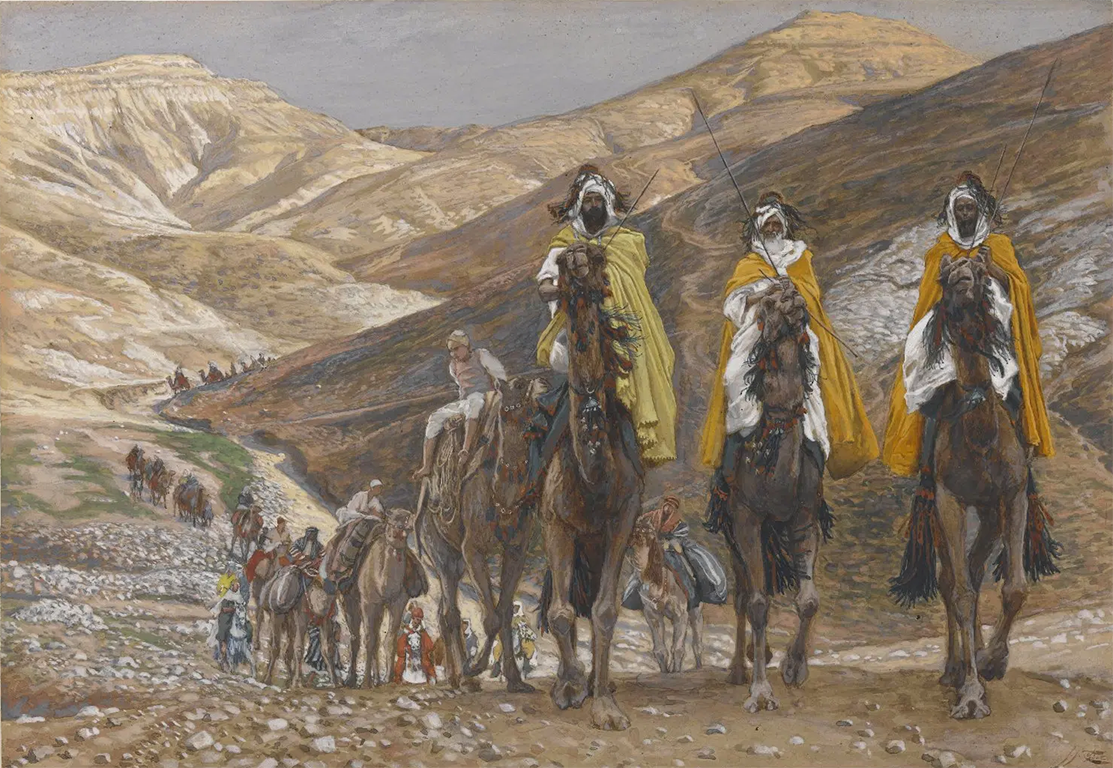
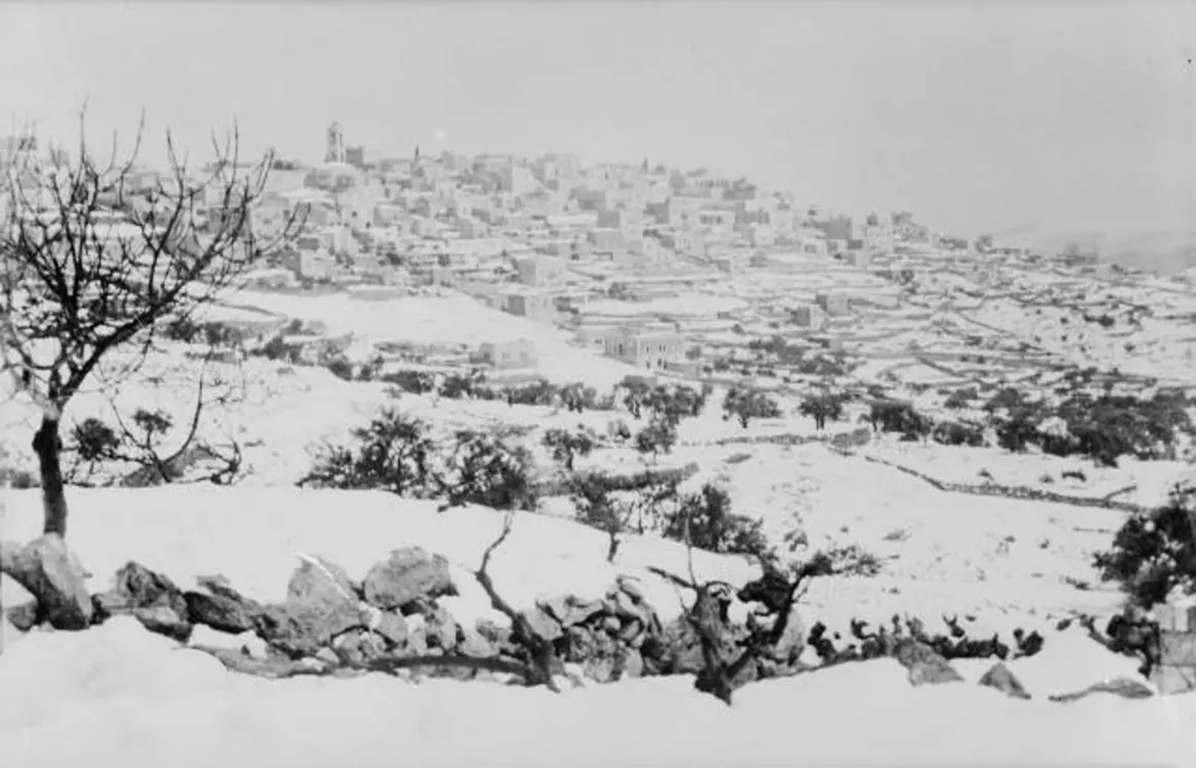
Tissot painted the arid, hot landscape that separates Jerusalem from Jericho: ochres, camels, desert light. The photograph shows Bethlehem in winter, less than 30 kilometres away. Bethlehem lies at an altitude of 762 metres, receives more than 500 mm of rain a year and can have snow. The comparison does not seek to set art against document, but to point out something simpler: a prior idea conditions the representation. If the creator imagines the Holy Land as a perpetual desert, that idea will affect the light, the robes, the atmosphere and the posture of the figures. Artists do not represent only what they see: they also represent from what they think they know.
The levels of authenticity of the world represented
1. The historical and social framework
The birth of Jesus does not happen in an abstract time or in an imaginary land. It is set at a concrete moment: a Judaea under Roman rule, with political tensions, social inequalities and a very marked religious identity.
Representing that scene with greater truth requires, at the very least, not erasing that framework.
This does not mean filling the nativity scene with historical explanations. A scene should not become an illustrated lesson. But the artist who composes it needs to know where they are working from. Imagining a birth in an idealised European village is not the same as setting it in a land that is subjugated, poor, religious and shot through with profound hopes.
History does not appear only in great buildings or in powerful characters. It also appears in the smallness of a dwelling, in the poverty of a few objects, in the shape of a road, in the presence of some shepherds, or in the way of understanding family, hospitality, work and waiting.
2. Material culture
Houses, walls, vessels, fabrics, tools, mangers, lighting, roads and domestic spaces are not secondary ornaments. They form part of the visible world in which the story takes shape.
Authenticity also passes through here: through the everyday matter of a concrete society.
A lamp, a jar, a mantle, a door, a wall or an area of shadow may seem minor details. But in a well-conceived scene they are not mere accessories. They help to say where we are, what kind of life surrounds the characters and what world silently sustains the narrative.
The problem does not lie in a scene being simple. On the contrary: the birth of Jesus often calls for simplicity. The problem arises when that simplicity springs from repeated formulas with no clear relationship to the world one intends to represent.
It is not enough to put in stone, wood or rustic cloth. One has to ask what stone, what wood, what fabrics, what ways of dwelling and what objects make sense within that context.
3. The Jewish identity of the protagonists
Mary, Joseph, the shepherds and their neighbours were first-century Jews. They were not generic characters from an idealised Christmas, nor European peasants of later periods, nor oriental figures constructed out of fantasy.
This difference is not decorative. It affects the way of dressing, of dwelling, of travelling, of working, of praying and of standing within the world.
It also affects the way of understanding the narrative. The birth of Jesus does not happen in a religious vacuum. It belongs to a people with a memory, with Scriptures, with practices, with hope and with a concrete relationship with God, with the Law, with the Temple and with the promises received.
That is why representing Mary, Joseph or the shepherds as Jews of their time does not consist in adding outward signs of «antiquity». It consists in not tearing them out of the world that gives them human and spiritual depth.
The biblical nativity scene does not look for characters dressed up as ancients. It looks for figures that can be understood within their own land, their own culture and their own history.
4. The human condition of the scene
Authenticity is not exhausted by historical fact or by material culture. It also has to do with the human condition of the protagonists.
The birth of Jesus is not an idealised image without depth. It is a scene shot through with vulnerability, waiting, poverty, care and promise.
Mary is not just a figure placed beside the Child. Joseph is not just a companion needed to complete the composition. The shepherds are not just popular characters who liven up the scene. All of them belong to a concrete human situation.
There is weariness, uncertainty, exposure to the elements, protection, silence, attention, faith. There is a real birth, in humble conditions, within a story that cannot be fully understood from outside.
If that human dimension disappears, the scene may still be beautiful, pleasant or decorative, but it loses depth. Biblical fidelity does not consist only in getting the objects right. It also consists in not erasing the fragility of the event being represented.
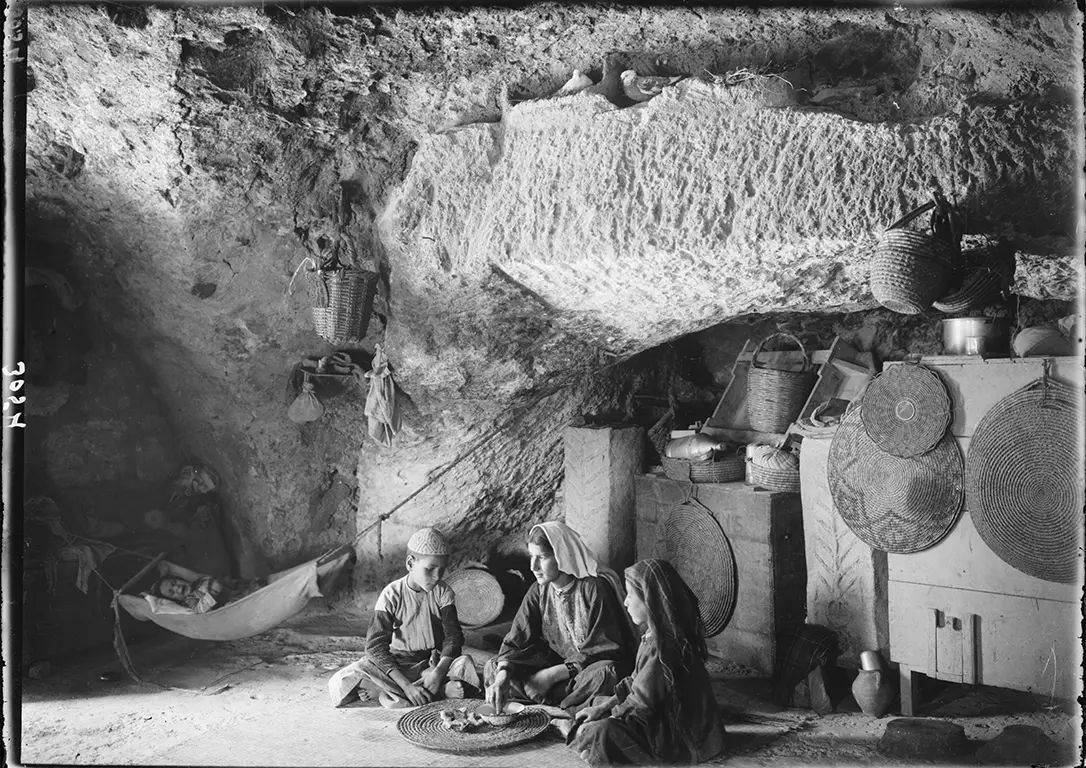
The photograph does not reconstruct first-century Bethlehem, but it allows us to see something important: a scene does not arise only from great symbols, but from domestic spaces, walls, excavated areas, animals, fabrics and gestures of care. Material culture is not an ornament added to the narrative; it is the visible world where life takes shape. 7
Why many inherited images are not enough
The difficulty lies not only in the lack of documentation. It also lies in the force of inherited images.
For centuries, the nativity scene has been shaped by very diverse traditions: Baroque, costumbrista, regional, devotional, orientalist or theatrical. All this has given rise to an extraordinarily rich visual heritage, but one not always coherent with first-century Judaea.
That is why scenes still appear, quite naturally, in which we find side by side:
- medieval, Alpine or regional buildings with figures of oriental air;
- theatrical or luxurious robes foreign to the material reality of the narrative;
- half-naked characters in winter scenes, when in Bethlehem cold and rain are part of the seasonal landscape;
- representations of the Child Jesus naked and with a bodily presence more typical of a baby several months old than of a newborn. Although these images may have a symbolic intention within the artistic tradition, they show how an inherited image can displace the direct reading of Luke, in which Mary wraps the newborn in bands of cloth before laying him in the manger. This point will be dealt with in more detail in the block Scenes of the Birth of Jesus, on the page for that scene;
- Magi constructed more out of iconographic fantasy than out of an attentive reading of the biblical text.
None of this invalidates the aesthetic, devotional or cultural value of other traditions. Some have produced works of enormous beauty and are part of the living history of the nativity scene.
But when what is sought is a biblical nativity scene with greater historical, narrative and human coherence, we have to recognise that those images are not enough on their own.
An image can be inherited, cherished and valuable, and at the same time not be sufficient to represent truthfully the biblical world to which it claims to refer.
The problem arises when inherited images are no longer looked at critically. They are received, repeated and defended as if they were self-evident. Then the visual tradition ceases to act as a living tradition and becomes automatism.
It is not that those images lack value. It is that, when they are not examined, they can end up weighing more than the very narrative they claim to represent.
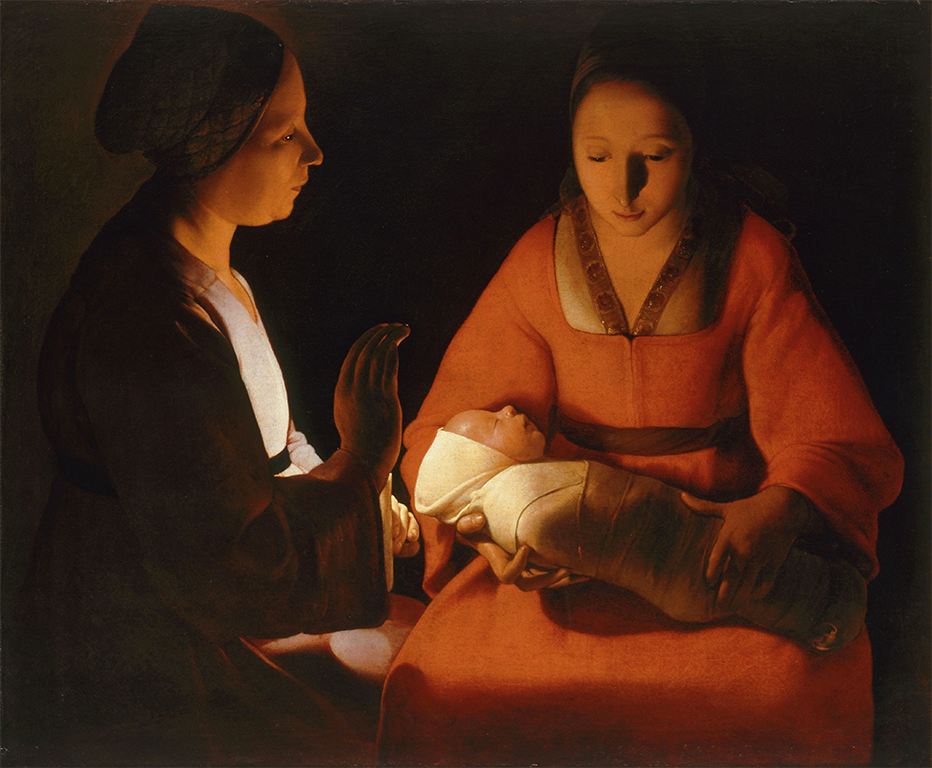
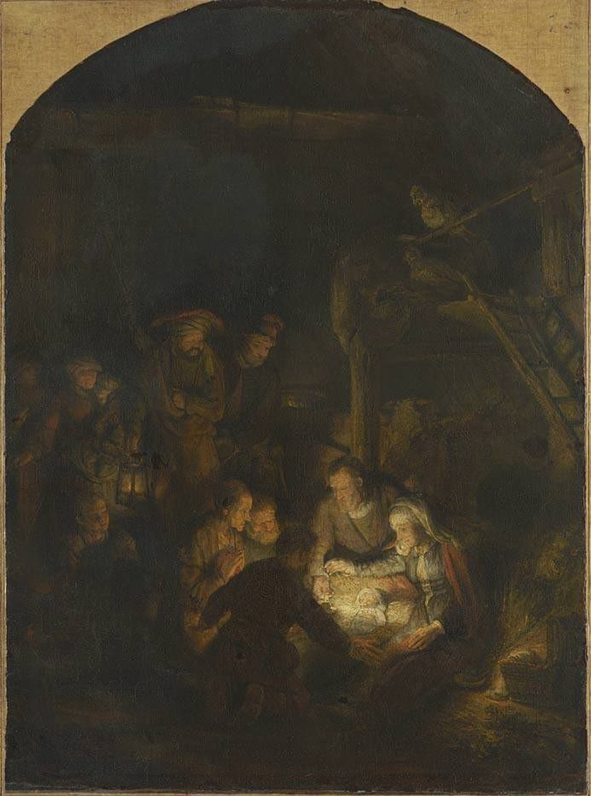
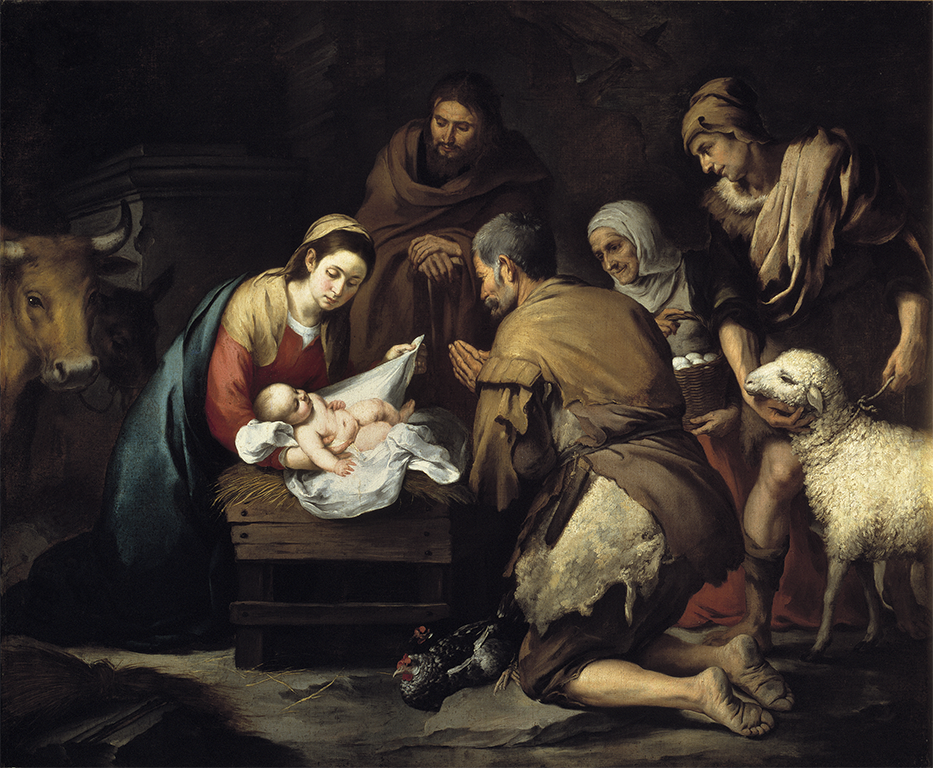
The same century, three readings of the same narrative. In La Tour the Child is wrapped in swaddling bands: he is a newborn. In Rembrandt he is barely visible, but swaddled and encircled by Mary’s arms, and the light comes from an oil lamp that Joseph holds — not from a supernatural radiance—: he is not a spectator but the one who makes it possible for the others to see the Child. In Murillo he is naked, awake and luminous in himself: an image of great devotional power, but one that no longer follows Luke, following instead a pictorial convention that has displaced him.
Visual comparison of the newborn and of Joseph’s role.
The artistic tradition has not always represented the Child Jesus in the same way.
In many works, the Child appears naked, awake and with a bodily presence more typical of a baby several months old than of a newborn.
That image may have a symbolic intention within the Christian tradition, but it also shows how an inherited form can displace the direct reading of Luke, in which Mary wraps the newborn in bands of cloth before laying him in the manger.
The image of the swaddled child brings to mind the human gesture of care.
In Murillo’s Adoration of the Shepherds, Joseph remains above all a contemplative witness to the scene.
In Rembrandt’s Adoration of the Shepherds, his role changes: Joseph takes an active part: he holds the oil lamp. And that is no minor detail. By lighting the newborn, Joseph does not merely «stand» in the scene; he helps to reveal what is happening. The light passes through his gesture. That gives him a compositional, human and almost theological function: he is not an added spectator, but part of the care for the Child and of his manifestation.
The problem is not visual tradition in itself, but ceasing to ask what each image says, where it comes from and what relationship it bears to the narrative it claims to represent.
Not every interpretation raises the same problem
It is worth distinguishing clearly between several ways of representing the birth of Jesus.
One thing is a regional folk interpretation — Provençal, Tyrolean, Neapolitan, Catalan, Madrilenian, Bavarian or from any other local tradition—. In these cases the displacement is evident: nobody expects those scenes to present themselves as a historical reconstruction of first-century Judaea. They are cultural and devotional translations of the narrative, and their truth belongs to another order.
Another thing is a free or contemporary interpretation, even an abstract one. Here too there may be a valuable reading, provided it is recognised as an artistic interpretation and not as a historical representation.
The problem lies elsewhere: when a scene or a set of figures is presented as «Hebrew», «biblical», «authentic» or almost archaeological, and in reality answers to later visual conventions, very often inherited without critical examination.
Then the question is no longer only one of style. It is a question of clarity.
An interpretation can be legitimate even if it is not historical. What is unwise is to clothe it in a historical authority it cannot sustain.
It is not, therefore, a matter of replacing one convention with another. It is not a matter of exchanging a European aesthetic for a «Hebraising» aesthetic and considering the problem solved. It is a matter of learning to represent from a truer understanding.
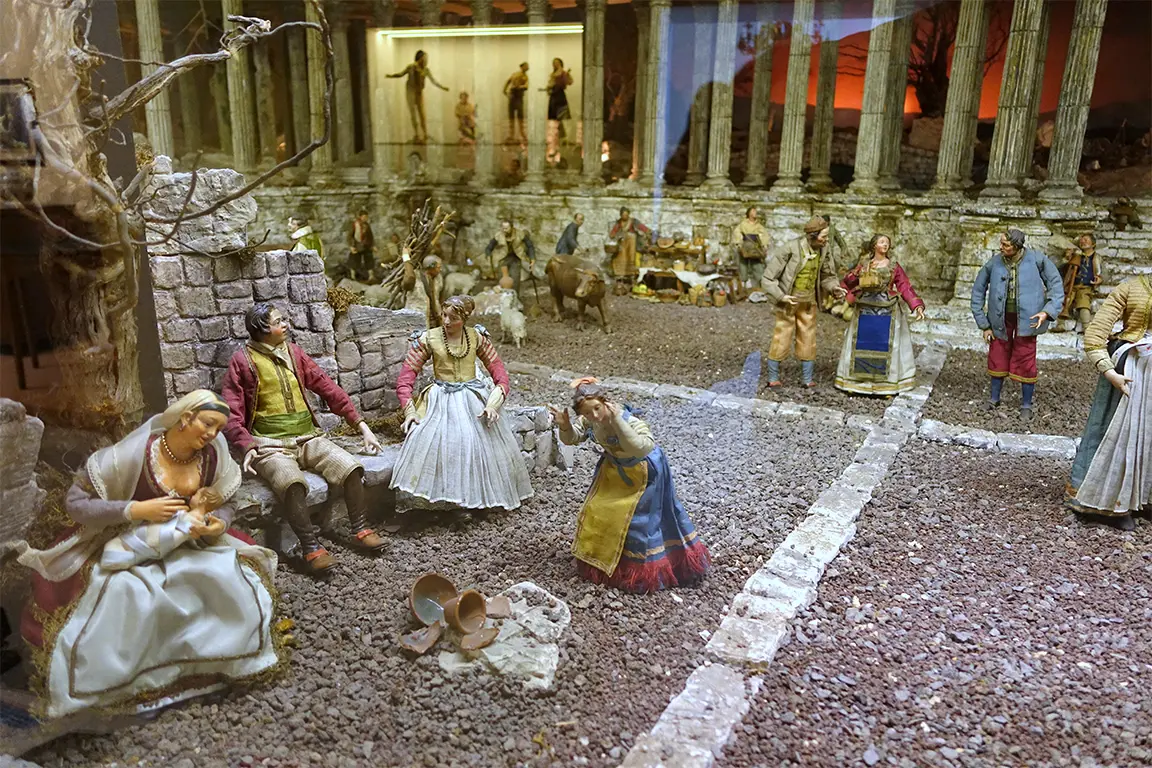
The Neapolitan nativity scene does not set out to reconstruct first-century Judaea. It transfers the birth of Jesus to a cultural world of its own, full of the architecture, dress, trades, gestures and daily life of the Neapolitan tradition. That is why it works as a conscious transposition of the narrative. The problem does not lie in transferring the scene to another world, but in presenting a transposition as if it were a historical reconstruction of the original world. 11
The “Hebrew” style: what it claims to be and what it is
It is worth distinguishing two things that are almost always spoken of as if they were the same.
One thing is what the “Hebrew” style claims to be. Another is what the “Hebrew” style is.
This distinction does not arise from rejection, but from a need for clarity. In the history of the arts, no style lives outside time. Each language appears in a context, responds to certain questions, reaches its moment of fullness and, sooner or later, gives way to new ways of looking.
That a style is superseded does not mean that it loses its value. The Baroque does not lose its grandeur because Classicism comes afterwards. Bach is not worse than Mozart because Mozart belongs to another musical horizon. They are different worlds, with different questions, with different ways of understanding composition, balance, emotion and time.
Something similar happens in nativity-scene art. The so-called “Hebrew” style belongs to a specific stage in the history of the nativity scene. In its day it sought to move away from the European popular nativity scene and to come closer to the biblical world. That intention made sense. But a stage cannot remain frozen as if it were the definitive answer.
The biblical nativity scene is not born against the “Hebrew” style. It is born after it. It recognises it as an earlier attempt, but cannot confine itself to repeating it.
What the “Hebrew” style claims to be is a representation faithful to the land and the time of the birth of Jesus. Hence its prestige: as against the popular nativity scene — which transposes the scene to the Pyrenean, Neapolitan, Arlesian, Bavarian or any other local landscape without disguising it—, the “Hebrew” one presents itself as the one that has returned to the original. That is its claim.
But what it is, if one follows the trail of where its forms come from, is something else. It is a visual convention accumulated above all in the nineteenth and twentieth centuries, built with materials that do not come directly from first-century Judaea and that are not even always properly Jewish materials.
The major contributions that have shaped that image are several.
The first is nineteenth-century European orientalist painting. Holman Hunt, James Tissot and many illustrators of nineteenth-century Bibles travelled to the Holy Land and came back with an image of the East marked by their own time: long, flowing tunics, elaborate turbans, patriarchal beards, solemn postures, dry landscapes, ruins, camels, tents and figures arrested in a kind of imagined antiquity.
That image did not portray the first-century Galilean Jew. It very often portrayed the Ottoman peasant, the Bedouin or the contemporary inhabitant of Palestine, seen through the Romantic, religious and colonial taste of northern Europe. Yet that image gradually became a visual template of how the biblical world «had to be».
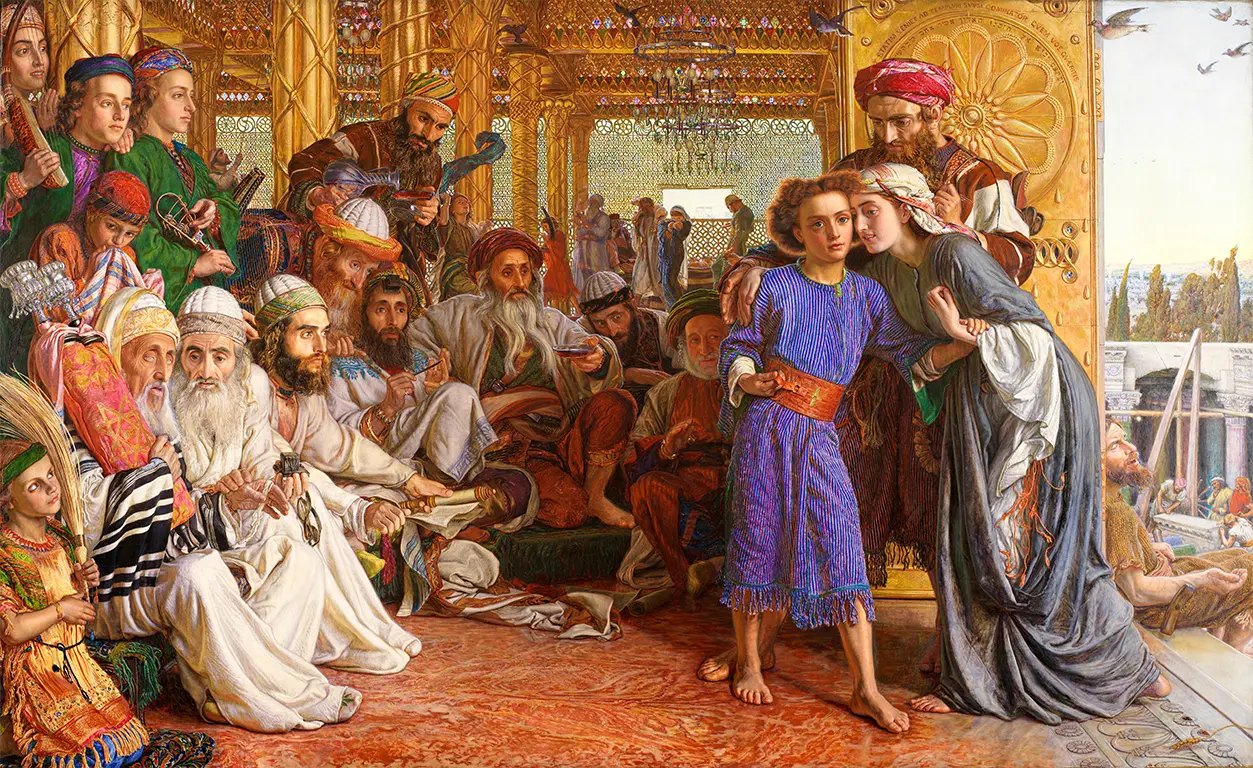
Hunt sought to give the biblical scene a better-documented appearance, closer to the Holy Land, but the image still belongs to the visual horizon of the nineteenth century: an imagined reconstruction of the biblical world filtered through European orientalism, Victorian theatricality and the desire to see in the East a living antiquity. Works of this kind helped to fix an idea of the «biblical» that could later pass into devotional illustration, into cinema and into nativity-scene art itself. 12
The second contribution is cinema. Cecil B. DeMille’s The King of Kings, Ben-Hur, The Greatest Story Ever Told or Franco Zeffirelli’s Jesus of Nazareth fixed in the modern imagination a way of dressing, of moving, of looking at and of lighting the world of the Bible.
These films did not only tell stories. They created a visual grammar. Their mantles, their colours, their gestures, their beards, their tunics, their groups of shepherds and their desert settings became part of what many people later recognised as «biblical». Nativity-scene art absorbed that image and reproduced it, sometimes directly.
A good part of what we identify today as a «Hebrew look» in a figure does not come from a historical study of the first century, but from that visual imaginary accumulated by painting, devotional illustration and cinema.
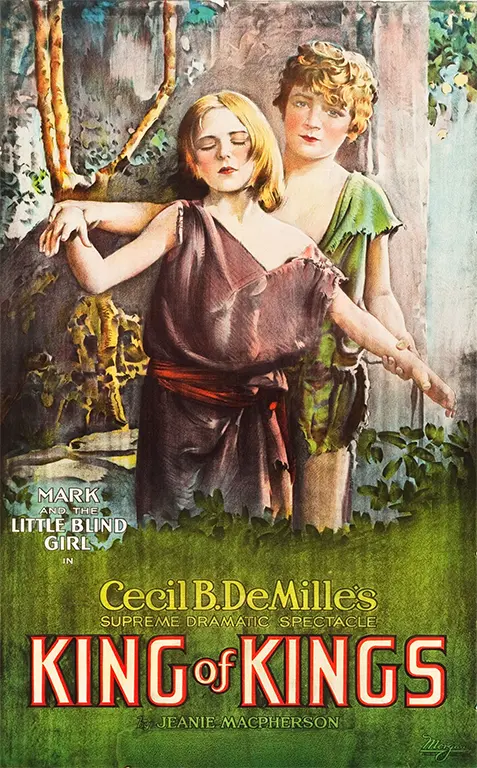
Classic biblical cinema did not only tell religious stories: it fixed a way of visually imagining the world of the Bible. Its tunics, beards, solemn gestures, monumental compositions and orientalising settings became part of what many people later recognised as «biblical». Part of that imaginary also reached nativity-scene art, where it could be confused with a historical authenticity that in reality came from modern visual culture.
DeMille hired religious advisers, commissioned archaeological research and sought historical authenticity. The result was an image of Jesus built on the Western pictorial tradition: white tunic, long hair, symmetrical beard, solemn bearing. That image does not come from any first-century source; it comes from the Christs of the Italian Renaissance and the Northern Baroque transferred to celluloid. The King of Kings distributed it all over the world — screened for decades in churches, schools and missions on every continent— and made it the visual reference for the biblical for whole generations of illustrators, catechists and nativity-scene makers.
The stills from Ben-Hur (1959) and The Greatest Story Ever Told (1965) are still under copyright. 13 14
The third contribution is ethnographic projection. At the end of the nineteenth century and for much of the twentieth, travellers, photographers, archaeologists, missionaries and scholars often described the peasant or Bedouin customs of Palestine as if they were an almost intact survival of biblical times.
From this arose a very persistent idea: that to imagine a shepherd of the time of Jesus it was enough to observe a nineteenth- or twentieth-century Bedouin. But that identification is problematic. 2,000 years do not pass in vain, not even in traditional societies. Moreover, the Jews of first-century Judaea and Galilee were not Bedouin of the modern desert.
The projection was powerful and left its mark. It helped to fix an image of the «biblical East» that seemed ancient because it was rural, poor or traditional, but that could not simply be confused with the historical world of the birth of Jesus.
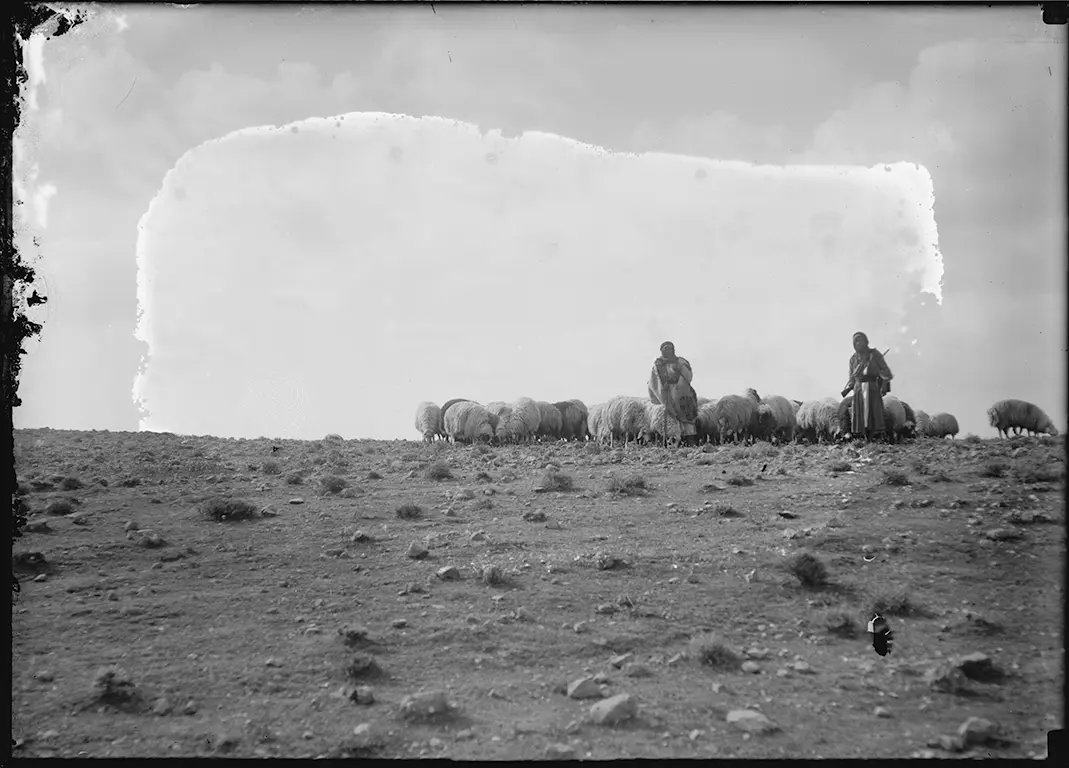
Photographs such as this helped to fix a modern image of the «biblical shepherd»: rural, poor, traditional and apparently outside time. But the image does not document first-century Judaea. It documents a modern Bedouin and Palestinian reality that was often used as a visual analogy for imagining the world of the Bible. Therein lies the problem of ethnographic projection: confusing an apparent cultural survival with a direct window onto the biblical past. 15
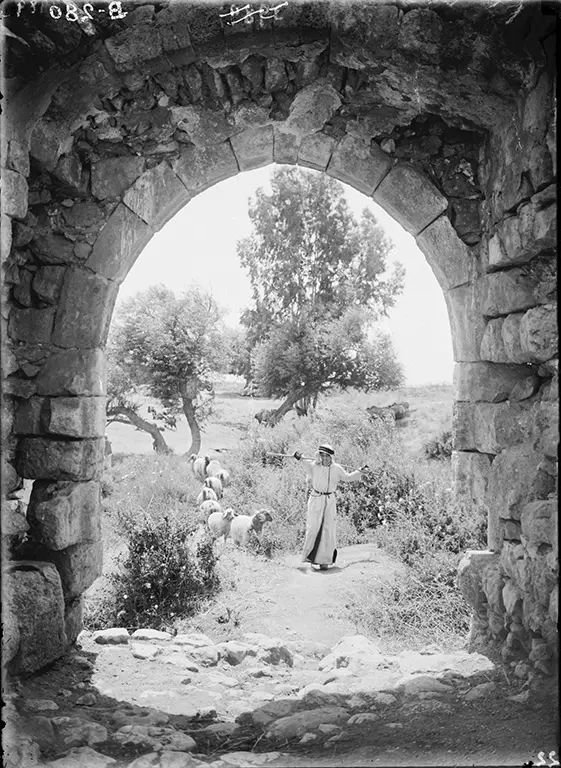
The archive itself titles this photograph as illustrating «He leadeth me in paths of righteousness», from Psalm 23. It does not document first-century Judaea: it documents a Palestinian shepherd of the early twentieth century. But the photographer — and those who bought and published the image— had already turned him into something different: visual proof that the biblical world was still alive, almost intact, before their eyes. That gesture of projection is exactly what nativity-scene art inherited: an image that looks ancient because it is rural and poor, but that belongs to another time and another culture. 16
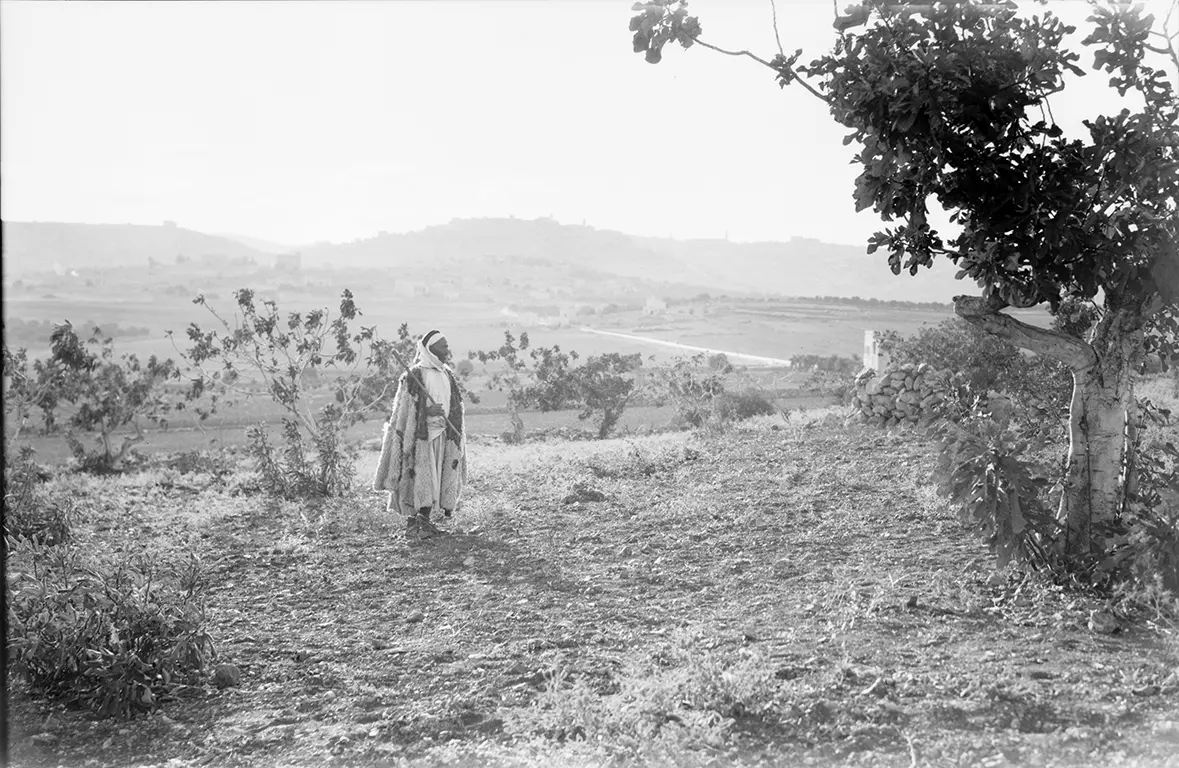
American Colony Photo Dept. Matson Collection. Library of Congress. No known restrictions on publication. Ref. matpc 22262.
This photograph documents a Palestinian shepherd of the 1930s in the surroundings of Bethlehem — not the first-century Jewish shepherd whom the Gospels place in the Nativity narrative—. Between the two lie 20 centuries of transformations in language, culture, religion and way of life. Yet images like this were read for decades as if they were a direct window onto the biblical world: they seemed ancient because they were rural, poor or traditional. That gesture of projection — confusing the contemporary with the historical because both share poverty or simplicity— is exactly what nativity-scene art inherited. 17 To this should be added a fourth ingredient, more discreet but decisive: repetition from workshop to workshop. Workshops copy from earlier workshops. A garment that a sculptor put on a figure 80 years ago because he saw it in an engraving, in a film, in a devotional print or in someone else’s figure reappears in the next catalogue, and in the next, and in the next. In time, what was born as interpretation becomes custom. Then custom takes on the appearance of truth.
That is how many visual conventions are formed. Not through a conscious, documented decision, but through accumulation, repetition and forgetting of the origin.
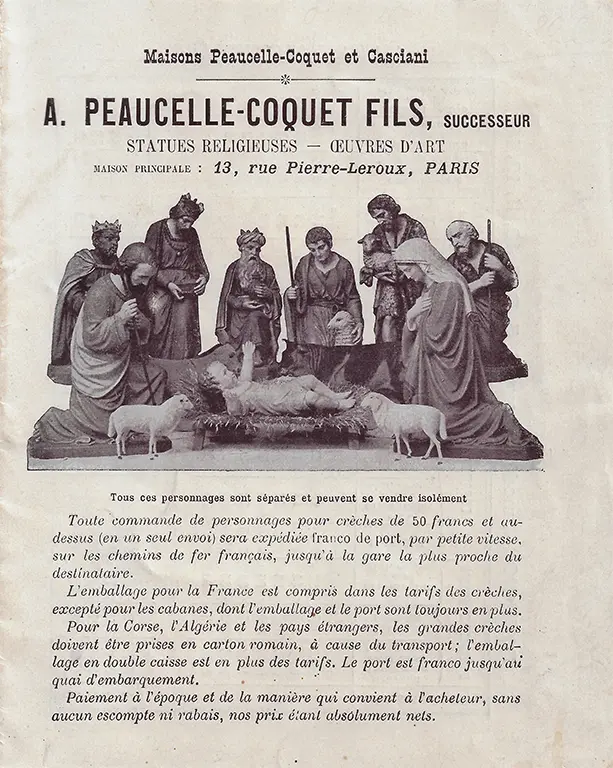
Trade booklet, 16 pages. Wikimedia Commons. Public domain.
One and the same type of shepherd, mass-produced in several sizes and prices, distributed by catalogue to workshops and shops all over Europe. Here is the mechanism in its most literal form: a figure is born as someone’s interpretation, enters a catalogue, and from that catalogue passes to the next workshop, and the next. In time nobody remembers where the garment, the gesture or the object came from. What was born as a decision becomes custom. What was custom takes on the appearance of truth. 18
There is a further discomfort in the very name. Saying «Hebrew» readily evokes the Israelites of the Old Testament: Abraham, Moses, David, the patriarchs, the Exodus, the ancient kingdoms of Israel and Judah. But the birth of Jesus is set in the Jewish world of first-century Judaea and Galilee, after profound transformations in material culture, language, religion, architecture, institutions and daily life.
A high priest of the Herodian Temple did not dress like Abraham. A Galilean peasant of the time of Jesus did not live like a semi-nomadic patriarch. And a Jewish shepherd from the area around Bethlehem cannot simply be imagined as a Negev Bedouin of 1920.
Using «Hebrew» as a label already introduces a confusion before we begin. It seems to give biblical precision, but in reality it mixes very different periods, peoples, images and traditions.
The paradox, if one looks at it calmly, is this: many non-biblical interpretations are more honest than they sometimes seem, precisely because they do not conceal their displacement.
The nativity scene in which Mary and Joseph appear in a Pyrenean, Neapolitan, Provençal, Tyrolean or Bavarian landscape does not claim to be a historical reconstruction of first-century Judaea. It is a cultural and devotional transposition of the narrative: it carries the birth of Jesus into the world of those who create it and contemplate it.
That is why the popular, regional or costumbrista nativity scene works as what it is: a visual prayer of a people, of a region, of a particular tradition, not an archaeological reconstruction of the first century.
There are also contemporary nativity scenes with a campaigning character which use the Christmas tradition to read the present critically: poverty, war, housing, depopulation, loneliness or social injustice. In those cases, too, the displacement is not concealed. The scene does not say «this is how it was historically», but «this still speaks about us».
That is why they can work as what they are: cultural, devotional, social or symbolic transpositions of the narrative.
The problem arises when a representation presents itself as a return to the original world and yet relies on later visual conventions that do not really come from first-century Judaea. For a long time, the so-called “Hebrew” style has occupied that place: that of the «authentic», the «biblical», what supposedly returns the birth of Jesus to its true setting. But that identification must be revised. A scene is not more authentic for abandoning the regional landscape and adopting an orientalising appearance. It is only more authentic if its visual decisions arise from a more rigorous understanding of the narrative, of the context and of the human world it seeks to represent.
The “Hebrew” nativity scene makes a different promise. It does not simply say: «I translate the narrative into my world». It says, explicitly or implicitly: «I am coming closer to the original world». That is where the problem begins.
For if it promises historicity, it must be able to sustain it. And when its forms are examined, it becomes clear that many of them come from later imaginaries: European orientalism, nineteenth-century biblical illustrations, religious cinema, ethnographic projections and workshop repetition.
That is why it can be said that the “Hebrew” nativity scene makes a promise it cannot entirely keep: it says it reconstructs when in reality it stylises. And it stylises, moreover, from visual materials that do not come directly from the world it claims to represent.
This is not to say that it is a bad tradition. It is not. It has moments of beauty, it has produced valuable works and in its day it represented a will to come closer to the biblical world. But it should be put where it belongs: as a stage in nativity-scene art, not as the definitive answer to the question of the biblical nativity scene.
The problem is not that the “Hebrew” style exists. The problem is that it is confused with a historical authenticity it cannot sustain without revision.
From this perspective, the biblical nativity scene cannot arise simply from perfecting the “Hebrew” style. It is not enough to correct a tunic, change an architecture, add more stone, darken the palette or give the figures a more oriental appearance. That would be to remain within the same mental framework.
The biblical nativity scene needs another basis. It must arise from a deeper, reasoned and up-to-date revision of the narrative, of the historical context, of material culture, of the Jewish identity of the protagonists and of the human condition of the scene.
It is not a matter of living against the past, but of not remaining shut up in it. Today we do not work with the same limitations as 50, 100 or 150 years ago. We have more archaeological studies, more specialised literature, more access to museums, catalogues, images, documentary databases, maps, excavations, research on daily life, dress, architecture, Second Temple Judaism and the material culture of the eastern Mediterranean.
We also have new tools for comparison, analysis and consultation that did not exist before. The twenty-first century does not oblige us to scorn what came before, but it does prevent us from working as if nothing had changed.
Honouring a tradition does not consist in repeating it indefinitely. It consists in understanding what it answered in its time and which questions it can no longer answer for us.
The manual is not against the “Hebrew” style. It takes seriously what the style itself says it wants to be. Its value belongs to the history of nativity-scene art and practice, not to a definitive authority on the biblical world. It had its function, its possible beauty and its time. But a stage cannot be confused with the end of the road.
The biblical nativity scene is not born against it; it is born after it. It is born of looking again at the narrative, the context and the human world of the birth of Jesus with the knowledge, the questions and the critical awareness of our time.
If it makes sense today to speak of a biblical nativity scene, it is because we need to go beyond an inherited appearance of the biblical. We need to ask again, with the knowledge and awareness of our time, what world we are representing, what narrative we want to make visible and from what artistic truth we want to compose the scene.
An authenticity that is not rigidity
Seeking greater authenticity does not mean turning the nativity scene into an archaeological scale model, nor demanding certainties where only reasonable hypotheses are possible.
But nor does it mean staying with an inherited appearance and repeating it as if it were enough for something to «look biblical». Between the impossible archaeological copy and the convention repeated without revision there is a much more fertile space: that of conscious interpretation.
That is the place of the biblical nativity scene.
It is a matter of letting documentation illuminate creation without petrifying it. Documentation does not replace the artist’s eye, but it gives it a firmer basis. It helps us to understand before composing. It helps us to choose better, to rule out better and to recognise when a form makes sense within the scene and when it has only come down to us through custom.
The better we understand the world in which the birth of Jesus is set, the less arbitrary our decisions can be. Not more rigid: less arbitrary.
A house, a light, a figure, a fabric, a gesture or an object should not be there only because «they have always been put there», nor because they mechanically reproduce an archaeological fact. They should be there because they help to make the narrative visible within a world that is believable, human and culturally recognisable.
The nativity-scene maker does not need to become an archaeologist, a historian or a theologian. But they can work with a more awakened awareness. They can ask themselves what they know, what they imagine, what they inherit and what they decide. They can distinguish when a form belongs to a legitimate tradition and when it truly approaches the world that the Gospel narrative sets before us.
A biblical nativity scene does not arise from having data, but from cross-checking them and reasoning about them. Documentation does not replace the artist’s eye: it sharpens it. It helps the artist to know what they are choosing, what they are inheriting and what they are deciding.
That awareness does not impoverish the nativity scene. It makes it deeper.
Authenticity is not appearance: it is a way of looking.
What comes next
If the nativity scene seeks to come closer, with greater truth, to the birth of Jesus, it is not enough to put one’s criteria in order. We have to ask what a nativity-scene maker draws on when imagining: with what materials of memory they compose the scene and how they decide what to discard.
For nobody creates out of a void. We imagine with remembered images, with works we have seen, with readings, with landscapes, with inherited figures and with accumulated references, even if we are not always aware of it.
That is why the next step will be to study the role of references: what they are, how they are sought, how they are assessed and how they can help to create a biblical nativity scene without turning creation into copying.
References
- ↑ [1] Tissot, J. (1886–1894). The Birth of Our Lord Jesus Christ (La nativité de Notre-Seigneur Jésus-Christ) [gouache]. Brooklyn Museum. https://www.brooklynmuseum.org/es-US/objects/4430
- ↑ [2] Kluger, Z. (1937). An aerial photo of the city Bethlehem [photograph]. Wikimedia Commons. https://commons.wikimedia.org/wiki/File:AN_AERIAL_PHOTO_OF_THE_CITY_BETHLEHEM._%D7%A6%D7%99%D7%9C%D7%95%D7%9D_%D7%90%D7%95%D7%99%D7%A8_%D7%A9%D7%9C_%D7%94%D7%A2%D7%99%D7%A8_%D7%91%D7%99%D7%AA_%D7%9C%D7%97%D7%9D.D332-057.jpg
- ↑ [3] Papyrus 1 (P1), recto: Matthew 1:1–9, 12 [papyrus, 3rd century AD]. University of Pennsylvania Museum, via Wikimedia Commons. https://commons.wikimedia.org/wiki/File:Papyrus_1_en.pdf
- ↑ [4] Jerusalem Modell BW 2 [model of Jerusalem in the Second Temple period, Israel Museum]. Wikimedia Commons. https://commons.wikimedia.org/wiki/File:Jerusalem_Modell_BW_2.JPG
- ↑ [5] Tissot, J. (1886–1894). The Magi Journeying (Les rois mages en voyage) [gouache]. Brooklyn Museum, via Wikimedia Commons. https://es.wikipedia.org/wiki/Archivo:Brooklyn_Museum_-_The_Magi_Journeying_(Les_rois_mages_en_voyage)_-_James_Tissot_-_overall.jpg
- ↑ [6] American Colony Photo Department (1921). Bethlehem and surroundings. Bethlehem in snow [photograph]. Matson Collection, Library of Congress, LC-DIG-matpc-05487. https://www.loc.gov/resource/matpc.05487/. The Library of Congress holds the same image in another record, LC-DIG-matpc-14749, dated «approximately 1900 to 1920»: https://www.loc.gov/resource/matpc.14749/.
- ↑ [7] American Colony Photo Department (c. 1920–1933). Bethlehem and surroundings. Bethlehem. A manger home. Room, part cave. Swaddled baby & dove-cote [photograph]. Matson Collection, Library of Congress, LC-DIG-matpc-02604. https://loc.gov/pictures/resource/matpc.02604/
- ↑ [8] La Tour, G. de (c. 1645). Le Nouveau-né [oil painting]. Musée des Beaux-Arts de Rennes, via Wikimedia Commons. https://commons.wikimedia.org/wiki/File:Georges_de_La_Tour_-_Newlyborn_infant_-_Mus%C3%A9e_des_Beaux-Arts_de_Rennes.jpg
- ↑ [9] Rembrandt van Rijn (c. 1646). Adoración de los pastores [oil painting]. Alte Pinakothek, Munich, via Wikimedia Commons. https://es.wikipedia.org/wiki/Archivo:Rembrandt_van_Rijn_009_full_image_01.jpg
- ↑ [10] Murillo, B. E. (c. 1650–1660). Adoración de los pastores [oil painting]. Museo del Prado, Madrid, via Wikimedia Commons. https://es.wikipedia.org/wiki/Archivo:Adoration_of_the_Shepherds,_Murillo_(Prado_Museum).jpg
- ↑ [11] Daderot. Nativity scenes of Naples — Museo Nacional de Artes Decorativas, Madrid [photograph]. Wikimedia Commons. https://es.wikipedia.org/wiki/Archivo%3ANativity_scenes_of_Naples_-_Museo_Nacional_de_Artes_Decorativas_-_Madrid%2C_Spain_-_DSC08419.JPG
- ↑ [12] Hunt, W. H. (1860). The Finding of the Saviour in the Temple [oil painting]. Birmingham Museums Trust, via Wikimedia Commons. https://commons.wikimedia.org/wiki/File%3AWilliam_Holman_Hunt_-_The_Finding_of_the_Saviour_in_the_Temple_-_Google_Art_Project.jpg
- ↑ [13] DeMille, C. B. (1927). The King of Kings [film]. Pathé Exchange, via Wikimedia Commons. https://commons.wikimedia.org/wiki/File%3AThe_King_of_Kings_%281927%29.webm
- ↑ [14] Kingofkings poster (1927) [film poster]. Pathé Exchange, via Wikimedia Commons. https://commons.wikimedia.org/wiki/File%3AKingofkings_poster.gif
- ↑ [15] American Colony Photo Department (between 1898 and 1946). Beduin [i.e., Bedouin] shepherds [photograph]. Matson Collection, Library of Congress. https://www.loc.gov/resource/matpc.06061/
- ↑ [16] American Colony Photo Department (c. 1900–1920). Set of thirteen select slides of shepherd life, illustrating the Twenty Third Psalm. «He leadeth me in paths of righteousness» [photograph]. Matson Collection, Library of Congress. https://www.loc.gov/resource/matpc.05673/
- ↑ [17] American Colony Photo Department (between 1934 and 1939). Bethlehem from the east. Shepherds' Fields, shepherd figure [photograph]. Matson Collection, Library of Congress, matpc 22262. https://www.loc.gov/resource/matpc.22262/
- ↑ [18] A. Peaucelle-Coquet Fils (c. 1895–1900). Catalog of Christmas cribs and statues of Saint Anthony of Padua [trade catalogue]. Wikimedia Commons. https://commons.wikimedia.org/wiki/File:A._Peaucelle-Coquet_Fils_-_Catalog_of_Christmas_cribs_and_statues_of_Saint_Anthony_of_Padua_-_page_01.jpg


