
 ≈ 42 min

Every scene is born of a way of looking.
What matters is knowing what that way of looking rests on.
A nativity scene called biblical
Representing a biblical episode is not the same as building a biblical nativity scene in a historical, contextual and material sense. The difference is decisive. And yet it is usually taken as self-evident: something that is not obvious, nor proven, nor necessarily correct is treated as if it were. That is precisely the problem this chapter tries to name.
The example we are going to analyse was presented publicly as Belén Bíblico Monumental — Monumental Biblical Nativity Scene—. The exhibition text states:
«Este año volvemos a la representación más clásica, el Belén Bíblico, que, junto al Napolitano y el Popular, constituye el trío de representación más extendida en el tiempo y el espacio.» — This year we return to the most classic representation, the Biblical Nativity Scene, which, together with the Neapolitan and the Popular, makes up the trio of representation most widespread in time and space—.1
The sentence is revealing. Not because it has to be accepted, but because it shows how far certain inherited categories are repeated without examination. A tradition is invoked, but no criterion is made explicit that would allow a nativity scene to be called biblical: is it enough to represent Gospel scenes?, is a historically situated setting required?, or is it simply a matter of an aesthetic recognisable through visual signs already taken for granted?
To answer, it is worth looking at a concrete work, not at the abstract idea. The scene reproduced here allows us to see clearly the distance that can exist between a name —«biblical»— and the visual references that actually sustain the image.
The skill of those who made the work is not in question, but rather the imaginary from which it is composed and the coherence of calling biblical something that is born of other visual traditions.
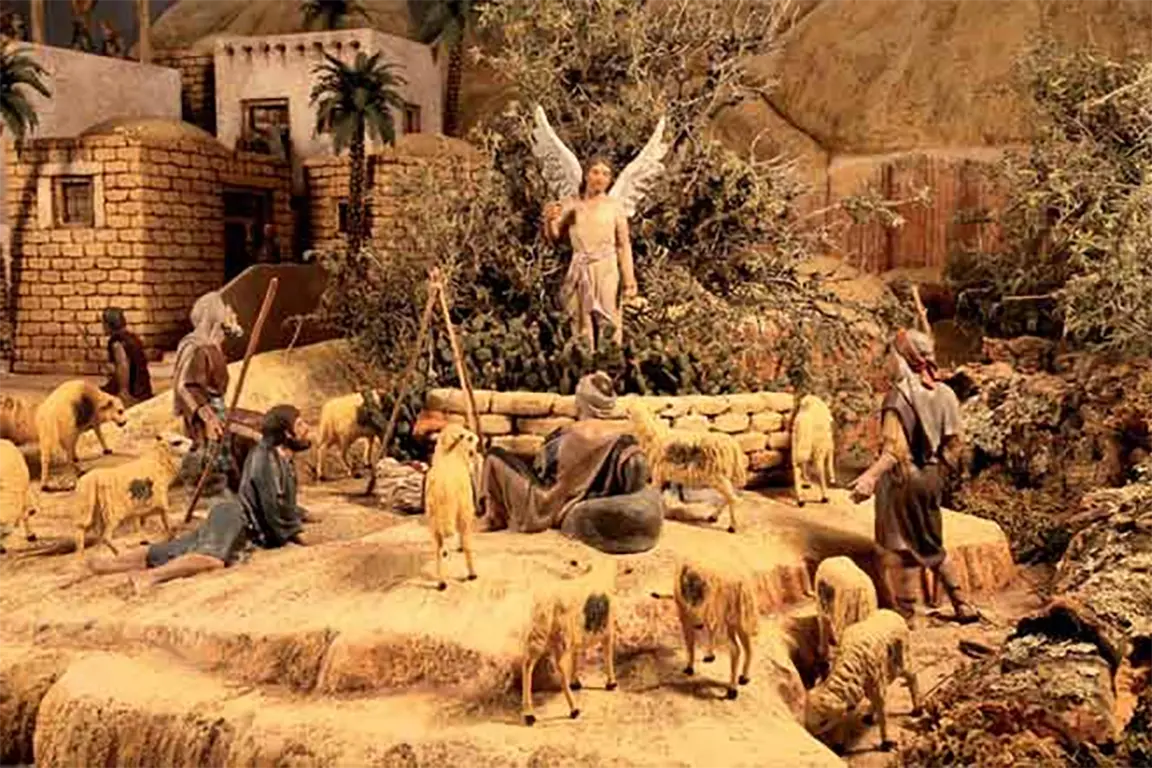
Image reproduced under the right of quotation, for analysis, commentary and critical judgement, in accordance with Article 32 of the Spanish Ley de Propiedad Intelectual (Intellectual Property Act). It is included to the extent necessary for the teaching purpose of the text, not as decorative illustration, but as a working document for examining how certain visual conventions can be presented under the name of «biblical nativity scene».
If we were to rewrite Luke’s episode guided solely by what this scene shows —without adding anything the image does not allow us to see—, the result would be something like this:
There were some shepherds in an arid place, with their sheep scattered over ground with no visible pasture. Near them stood some buildings of oriental appearance, some with rounded roofs, and several palm trees dominated the landscape.
Then an angel appeared in front of a bush, in a scene lit without any clear night-time atmosphere, and the shepherds gazed upon him.
And there the problem appears with complete clarity.
Luke does not describe architecture, or palm trees, or an urban landscape. But he does establish two essential conditions: the shepherds are in the fields and keep watch over their flock by night. If the image visually constructs neither the grazing land nor the night, then it keeps some recognisable signs —shepherds, sheep, angel—, but it does not represent the narrative situation Luke describes.
The scene does not translate the text: it replaces it with a repertoire of visual conventions that make it possible to identify the subject, but not to reconstruct it. In other words: it keeps the signs, but loses the meaning.
Something should be made clear before going on. This chapter does not yet set out to study in detail the domestic architecture, the vegetation, the landscape or the material culture of first-century Judaea. That work will belong to other chapters of the Manual. Here these elements are pointed out in a more limited way: as visible signs of an underlying problem. They interest us because they show how a scene can look biblical while resting on visual conventions that do not always come from the historical world of the narrative
The scenography that says one thing and shows another
The text describing the exhibition adds:
«Siguiendo nuestra andadura llegamos a la población de Ain-Karin donde Isabel recibe la visita de su prima la Virgen María para anunciarla su estado. En las afueras, los pastores se despiertan de su duermevela asombrados por la fulgurante aparición del Ángel anunciando el nacimiento de Jesús.» — Continuing our journey we reach the town of Ain-Karin, where Elizabeth receives the visit of her cousin the Virgin Mary, who comes to announce her condition to her. On the outskirts, the shepherds wake from their half-sleep, astonished by the dazzling appearance of the Angel announcing the birth of Jesus—.
The detail we reproduce here corresponds to the scene of the annunciation to the shepherds on the outskirts of the town of Ain Karin. The image is revealing, not because the whole is badly executed —the figures have quality, the composition works—, but because every element of the scenography contradicts what the name promises.
The problem is not the hands of the makers, nor the material workmanship of the whole. What matters is to determine whether the visual references that sustain the scene make it possible to represent the biblical episode or whether, on the contrary, they only produce an appearance of biblicality by means of inherited signs: shepherds, sheep, a suspended angel, orientalising architecture, palm trees and an arid ground that points more to a generic Orient than to the historical context of the narrative.
Let us begin with the buildings in the background, which are the most visible and the ones that convey the most information.
Two of the four buildings that appear in the image have a roof of spherical section, a kind of approximation to the dome without becoming a fully resolved architectural dome. This detail is no small matter. In a nativity scene that presents itself as biblical, architecture should not work only as a sign of antiquity or of the Orient, but as a situated reference.
The ordinary dwelling of Judaea and Galilee in the first century is better understood through flat-roof solutions: beams, lattices of branches, layers of compacted earth and usable terraces, according to the materials and the local building tradition. A hemispherical roof, placed as a visual sign of «the ancient» or «the oriental», introduces an image that belongs to another building memory. It may be effective in letting the viewer quickly recognise a non-European setting, but that visual effectiveness is not enough to make it an appropriate historical reference.
The other buildings appear whitewashed. Here too a distinction is needed. The problem is not that a surface might have received some kind of coating, but the overall image that is built: white walls, clean, almost Mediterranean in the tourist sense. That total whiteness points more readily to a modern imaginary —Mediterranean villages photographed under the sun, reinterpreted vernacular architecture, an orientalising postcard— than to a prudent reconstruction of the humble dwelling in the surroundings of Judaea.
What is left out is precisely one of the most necessary references: local materiality. Limestone, mud brick, earth, poor walls, terraces, irregular surfaces. The scene seeks to look biblical, but it does so through recognisable signs rather than through a concrete reading of the architecture of the place.
The palm trees and the displaced landscape
The second element the image brings to the foreground is the vegetation, and in particular the palm trees.
The date palm —Phoenix dactylifera— is one of the trees most often repeated in the imaginary of the biblical nativity scene. Its presence is almost taken for granted: Holy Land, palm trees. The association seems natural, and it has some real basis: the palm existed in ancient Palestine and appears linked to certain places and symbols. The problem is not that the palm is an invention. The problem is turning it into the dominant vegetation where it does not belong as the main reference.
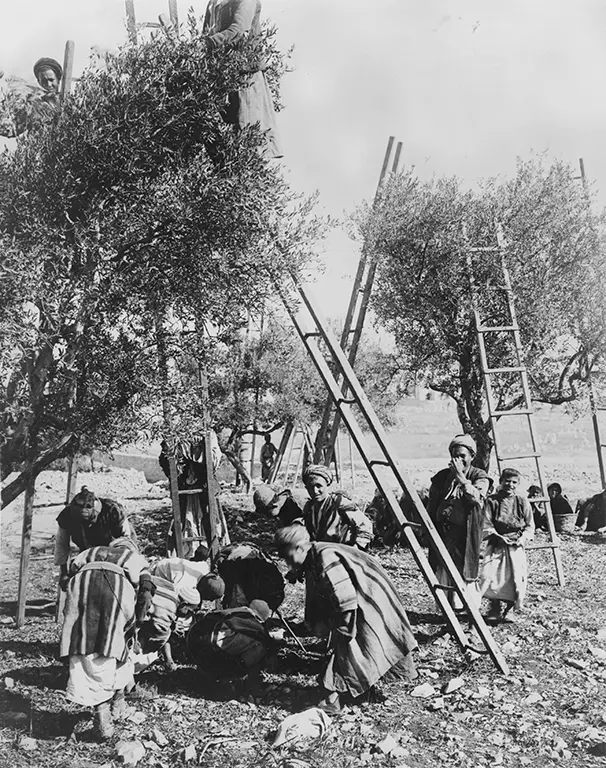
Bethlehem lies in the hills of Judah, at more than 700 metres above sea level. Ain Karin —if the scene means to refer to that setting— also belongs to a mountainous area near Jerusalem. We are not looking at the warm, low-lying landscape of the Jordan valley, nor at the surroundings of Jericho, a city associated with palm trees since antiquity. We are looking at another kind of territory: hills, stone, agricultural terraces, olive trees, fig trees, vines and Mediterranean scrub.
That is why, when the palm appears as the dominant tree in a scene set in those surroundings, it stops describing a place and begins to act as an icon. It says «Orient», «Holy Land», «Bible», but it says so in a generic way. It does not situate: it evokes.
In a truly biblical nativity scene, vegetation should not be chosen only for its capacity to produce an immediate impression. It should help to build the place. And for the surroundings of Bethlehem or Ain Karin, the olive tree would be a far more prudent and far more meaningful reference than the palm.
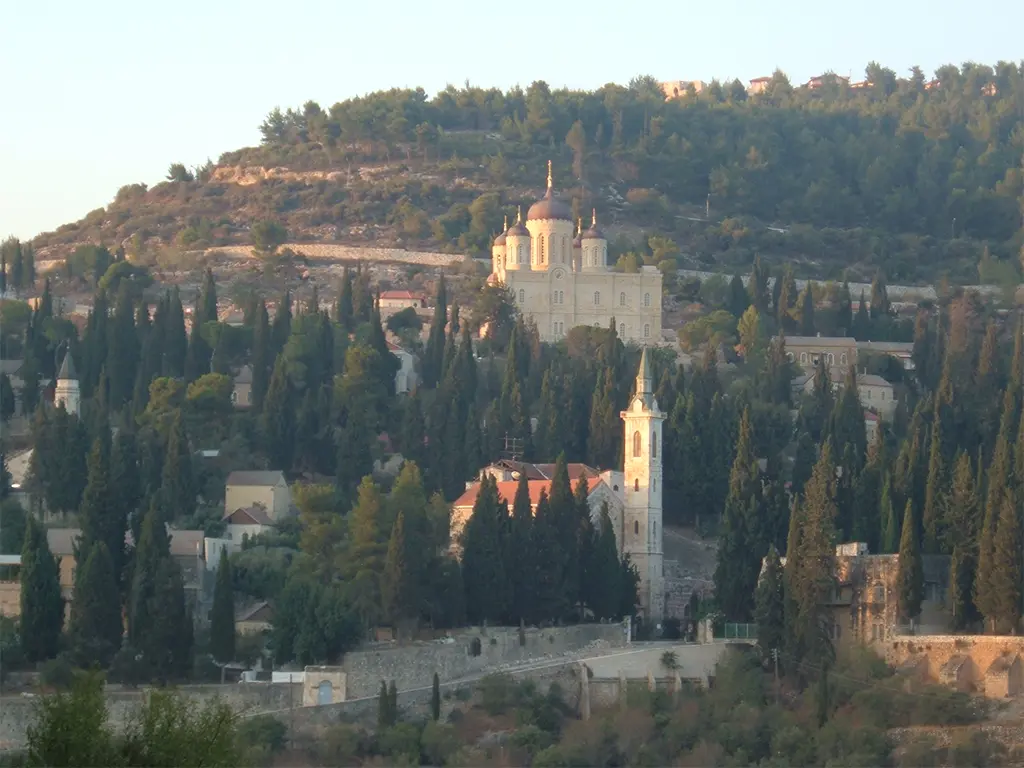
In this image there are cypresses and Aleppo pines, trees characteristic of the present-day landscape of Ein Kerem but not present in first-century Judaea. Their inclusion in the photograph is due to later planting, not to the biblical ecosystem. In the first century, the Judaean hills had holm oaks, terebinths, wild olives, hackberries and mastic trees; not cypresses or pine woods, which are the result of modern interventions.
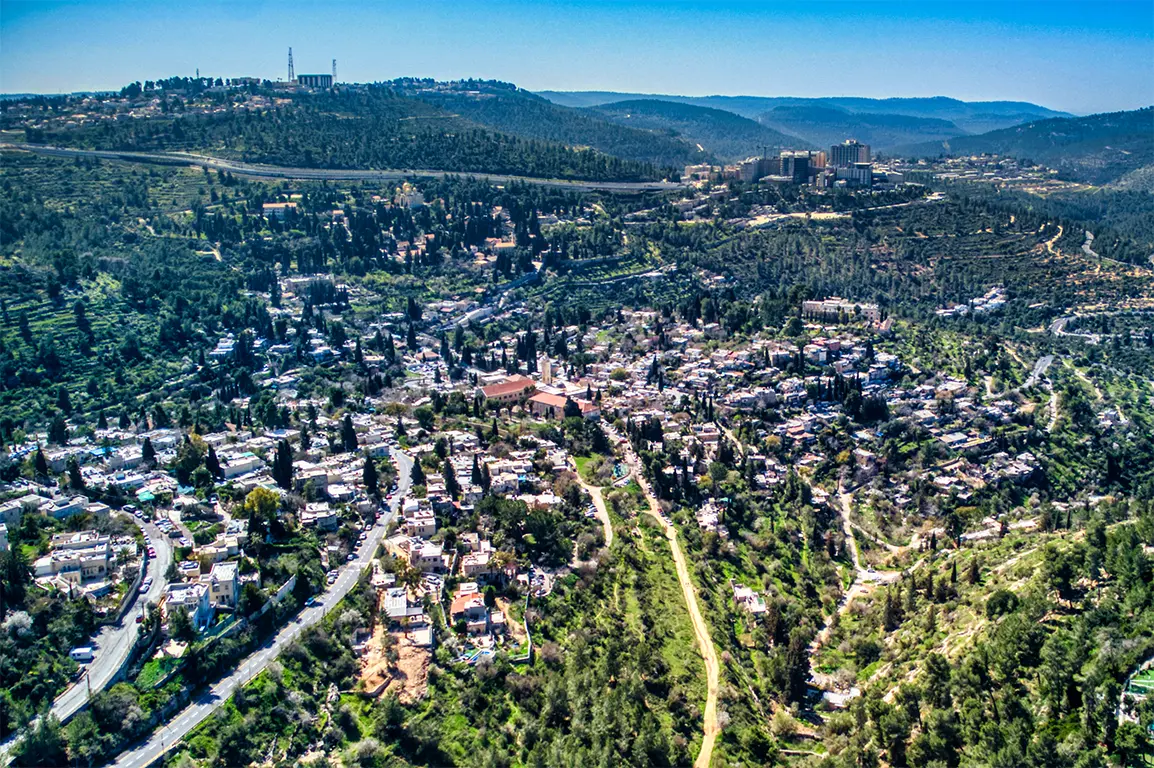
Look for a palm tree in this image of Ein Kerem. And, if there is one, it is worth looking at which one: the question is not whether a palm can grow in these hills, but which palm. The one the biblical imaginary takes for granted is the date palm, with feather-shaped leaves, a tree of the oasis and the warm valley —Jericho, the Jordan—, which needs long, hot summers to grow and bear fruit. The one planted today in the hills, and found in Bethlehem’s own square, is another: a fan palm, with palmate leaves, frost-resistant and brought from elsewhere, from America or from Asia. For no fan palm is native to the Levant: the only one native to the Mediterranean, the dwarf fan palm, grows in the west —Iberia, North Africa—, not here. That palm is, in these hills, doubly foreign: neither the date palm of the oasis nor the dwarf palm of the west. The difference can be seen without knowing any botany —feather against fan— and that is enough: the palm that appears at these heights is a fan palm, planted as an ornament and chosen because it withstands the cold (≈ −6 to −18 °C), not the date palm of the heat. That there is a palm does not prove that it is hot; it proves the opposite.
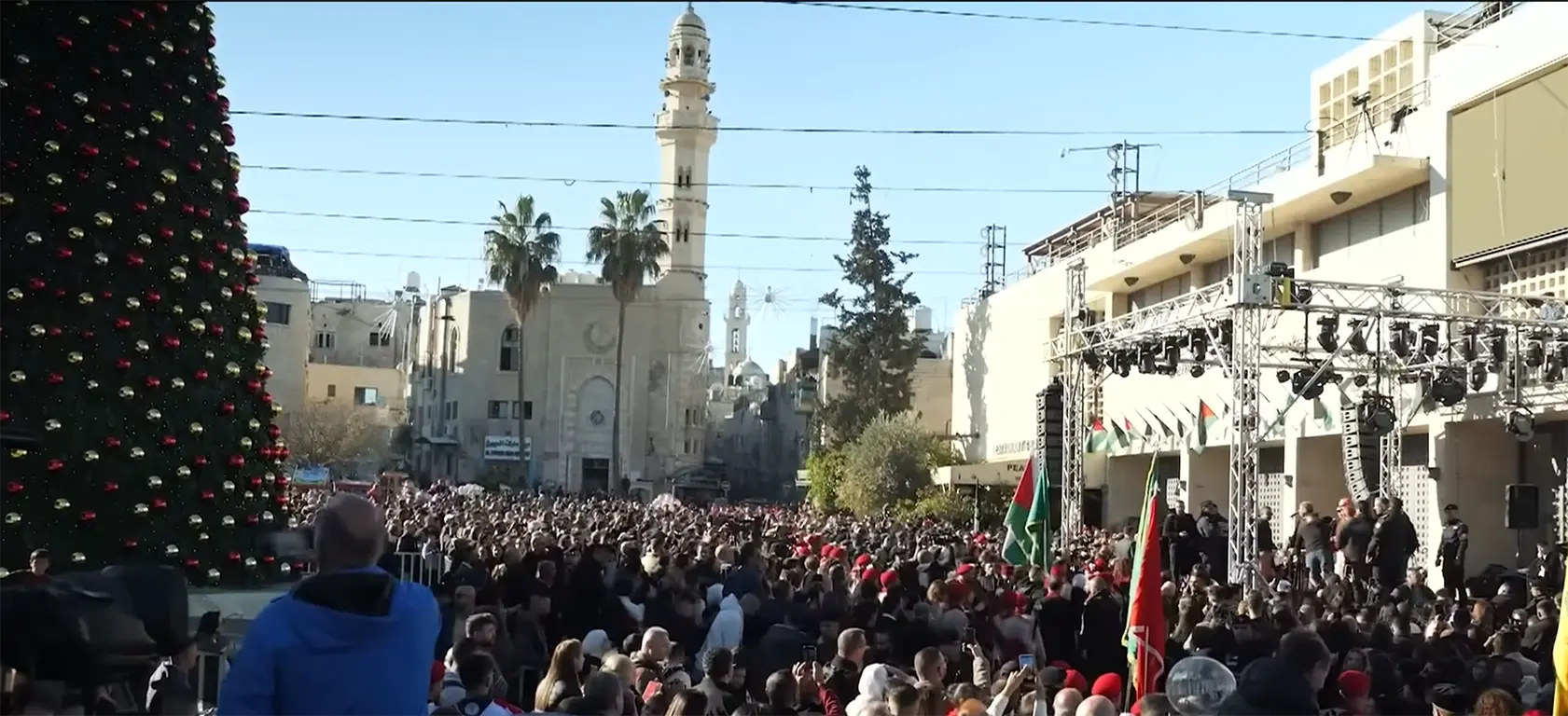
Taking the date palm for a tree native to the Judaean hills is like taking the fir for a tree native to Ibiza: an inherited image, not a real landscape. Why, then, do we take it as biblical?
The real trees of Bethlehem: the observation, with figures
What can be seen with the naked eye in Ein Kerem can cease to be intuition. The Applied Research Institute–Jerusalem (ARIJ), based in Bethlehem itself, surveyed the city’s land use with geographic information systems: out of 10,611 dunums of municipal area (a dunum is 1,000 square metres), forest occupies barely 9 —less than 1 per 1,000—, and permanent crops 4,187, which in these hills are olive groves above all. The inventory of fruit trees confirms it without qualification: it records the olive as the only species present —100 dunums, all rain-fed— against 0 dunums of citrus, 0 of stone fruit, 0 of anything else. The palm does not even appear as a category with a zero next to it. The tree of Bethlehem, documented and counted, is the olive.5
The figure should be read at its own level. It dates from 2007–2008, that is, from the present, and it holds for the first century by the rule of climate —altitude and rainfall pattern have not changed—, not as direct evidence from the period. And the absence of the palm from the record is absence, not impossibility; but crossed with the ecology of the date palm, which demands the heat and the groundwater of the valley, that absence stops being silence and becomes reasonable inference. Where today, with nurseries, what gets planted are fan palms that withstand the cold, never the date palm of the heat: the place is not its own.
The lifeless ground and the flock that does not graze
There is a third element that deserves attention: the ground on which the scene of the shepherds takes place.
Herding is an activity that happens where there is pasture. Not necessarily abundant pasture. In the semi-arid setting of Judaea, flocks may move in search of scarce grass, stubble, low scrub or scattered vegetation. But something must sustain the presence of the flock. If there is no possible food, the scene loses internal coherence.
In the image, the ground appears as a uniform, sand-coloured surface, practically bare of vegetation. There are no visible remains of dry grass, no scrub, no stubble, no sufficient irregularities in the terrain. It is a scenographic surface designed to support the figures visually, but not to represent grazing land.
The consequence is a narrative contradiction: the sheep indicate that we are looking at shepherds, but the terrain does not justify those shepherds being there with their flocks. The scene says «herding», while the ground shows almost a clean, empty desert.
Once again, the problem is not one of execution, but of reference. The sheep appear because they belong to the narrative. But the place in which they appear has not been thought through with the same attention.
A compositional tree, not a situated reference
The central tree of the composition occupies an important place because it visually supports the appearance of the angel. From a scenographic point of view, the decision is understandable: the tree raises, frames and supports a figure that would otherwise be left suspended in a more artificial way.
The problem appears when we ask what tree it is.
Its dense, rounded, generic crown does not clearly point to any species belonging to the setting. It does not look like an olive, which would have a more twisted trunk, a more irregular crown and a more distinctive leaf. Nor does it look like a fig or a carob. It works as a stage tree, not as a situated tree.
In a popular nativity scene or one with a free setting, this would pose no problem at all. But in a work that presents itself as biblical, every important element should be able to answer a simple question: what place, what time and what way of life does it represent?
This tree fulfils a legitimate compositional function, but not a documentary one: it contributes image, not biblical information.
The text that confirms the problem
Up to this point, the analysis has focused on the image. But the work comes with a descriptive text that adds another dimension to the problem.
That text places one of the scenes in the village of Ein Karin, as the place where Elizabeth receives the visit of her cousin Mary. The fact is presented matter-of-factly, as if it were a Gospel location or a historically certain one.
A distinction is needed. The Gospel of Luke, which is the source that narrates the Visitation, says that Mary went to «una ciudad de Judá» — a town of Judah—. It does not name Ain Karin. The identification of the meeting with Ain Karin —Ein Kerem, on the outskirts of Jerusalem— belongs to a later tradition, consolidated by devotional memory and the Christian presence at the site. It is a respectable tradition, with centuries of history. But it is not an explicit fact of the Gospel.
The problem is not in mentioning Ain Karin. It can be done, provided it is explained that this is a tradition. The problem appears when a later tradition is presented with the same degree of certainty as a primary source.
This mechanism is very similar to the one we see in the scenography. The palm in the hills of Judah, the rounded roof as a sign of antiquity and the location of Ain Karin without a warning belong to different registers —visual, architectural, textual—, but they show one and the same confusion: an interpretation repeated for a long time begins to work as if it were the original fact.
Why this happens and why it matters
None of the above is meant to disparage the quality of the whole or the dedication of those who made it. A nativity scene of more than 500 pieces, carefully composed and put on public display, represents serious work that deserves respect.
What this analysis sets out to show is something more specific: calling a nativity scene biblical is not, in itself, an act of documentation. It is a declaration of intent. And that intention may be partly unfulfilled not through lack of skill, but through lack of a method that distinguishes between different sources before starting to compose.
The visible result seems to depend more on an inherited visual memory than on a situated reconstruction of the place. Signs appear that the viewer immediately recognises as biblical: palm trees, rounded roofs, white walls, arid ground, tunics, flocks, angel. Each of those elements has evocative power. The problem is that this power is not necessarily the same as historical accuracy.
A biblical nativity scene that works from those conventions is not directly representing first-century Judaea, but the image that the Western iconographic tradition has built of it; they are different things.
And distinguishing them does not impoverish the nativity scene. It makes it more conscious.
What a truly biblical nativity scene requires
Pointing out the problem is not enough. The question that follows is: what would have to be done differently?
The answer is not complicated in its formulation, although it demands real work before starting to build. A nativity scene with a biblical setting requires that every important element of the scene be able to answer a concrete question: where does this come from?
Not in the sense of where the figure was bought or which mould the palm tree came out of, but in a deeper sense: what documentation supports that this roof, this plant species, this type of ground, this architecture or this way of life correspond to the place and time one intends to represent?
That implies a prior work of research that cannot be replaced by intuition alone or by accumulated experience. Experience in nativity-scene making teaches one to build well. It does not automatically teach what to build when the referent is a precise time and place 2,000 years away.
The sources exist and are accessible. The archaeology of the Second Temple period has provided data on domestic architecture, everyday objects, agrarian landscape, livestock farming, the organisation of space and material culture. There are excavated sites, specialised publications, museums with documented collections, studies of landscape and vegetation, and visual materials that make it possible to approach the historical world of the narrative with greater prudence.
It is not a matter of turning the nativity scene into an archaeological installation or of eliminating its spiritual and narrative dimension. It is a matter of the scenography sustaining the story instead of contradicting it.
A twisted olive tree on limestone ground, next to a humble house with a flat roof and a terrace retaining wall in the background, can say more about the real first-century Judaea than a date palm in front of a whitewashed façade. And it can say so without sacrificing the narrative power of the scene.
The distinction this chapter proposes is not between a pretty nativity scene and an ugly one, nor between a pious nativity scene and a cold one. It is between a nativity scene that has looked at its referent and a nativity scene that has looked, above all, at the images others made of its referent.
That difference, once understood, changes the way of working from the very beginning.
Now that we know more, why go on working as if we did not?
What does a nativity-scene maker imagine from when imagining?
If, after asking ourselves what can give greater authenticity to a biblical nativity scene, we take one step further, a question appears that should no longer be avoided: what does a nativity-scene maker imagine from when imagining?
Not from nothing. But it is best to begin with something simpler: seeing is not enough. We see all the time. We see people, streets, animals, tools, clothes, buildings. And yet almost all of it passes before us without being truly retained.
Think of something very simple. One may have seen bicycles all one’s life and still not know how to draw one without having it in front of one. In that case, one has not really observed it. One has seen it, yes, but has not properly understood its structure or retained it clearly enough.
Here lies the important difference. Seeing is one thing. Observing, another. Understanding, another. And another again is retaining in such a way that what has been seen can reappear from within when it is no longer before one’s eyes.
The philosopher José Ortega y Gasset helps to put a name to an experience every creator knows: images do not appear in the mind as a pure act of will. They arise, link together, return, mingle with memories and fantasies. That is why imagination does not work from emptiness, but from an inner world already formed.
In his lectures of 1933-1934, collected under the title Principios de metafísica según la razón vital, Ortega writes that in our mind «surgen cadenas de imágenes» — chains of images arise— and recalls that this production is called imagination, fantasy or memory depending on whether or not those images are attached to a particular past. He adds, moreover: «No hago yo mis imágenes ni mis recuerdos» — I do not make my images or my memories— and «Imaginación y memoria son mecanismos mentales que funcionan por su cuenta» — imagination and memory are mental mechanisms that work on their own—.6
This observation makes it possible to formulate a decisive question for this chapter: to imagine is not to draw forms out of emptiness, but to work from an inner life already peopled with images.
That is why whoever has learnt to observe, to understand and to retain can imagine with greater richness and with greater truth. Whoever has not done that work imagines with the materials closest to hand: the most visible, the most repeated, the most inherited.
This has a very concrete consequence for the nativity-scene maker. A reference is not only something consulted when the moment comes to decide on a figure, a wall or a scene. Before that, it is something that helps to form the memory from which one later imagines.
That is why documentation does not act only at the moment of consultation. It acts much earlier, when it begins to educate the eye, to order what has been observed and to people with truth that inner world from which one later composes.
The memory of a nativity-scene maker is not just any archive
Two sculptors may have a similar technique, a similar style, a similar faith and a comparable intention. And even so, the scenes they produce may be very different. The difference does not always lie in how they execute the work. Very often it lies in something less visible: in what each one has retained and in how they have retained it.
A nativity-scene maker who has ordered what they know of the first-century world, who has set inherited images against material finds, who has read the Gospels attentively and has discussed with other nativity-scene makers the soundness of one solution or another, imagines with one set of materials. A nativity-scene maker who has only accumulated catalogues and prints imagines with another.
The difference does not usually lie only in talent, but also in the memory each one works with, a memory that cannot be improvised: it is built.
What, then, is a reference
From here on, the definition changes place.
In this work, a reference is not just any image looked at before modelling a figure or composing a scene. A photograph looked at for 5 seconds is not a reference: it is an impression. An illustration seen a thousand times without ever having been thought about is not one either: it is visual inertia.
A reference is a material that has gone through the work of observing, comparing, contrasting and interpreting, and that has therefore become part of the memory with which one imagines.
Sometimes it confirms an intuition.
At other times it corrects it.
At others it forces one to revise a deeply rooted image.
And, on occasion, it opens a possibility that had not even been considered.
The reference does not replace creation. It nourishes it from within.
The layers of memory and the problem of order
The memory of a nativity-scene maker is not made up of a single kind of material. In it live together the Gospel narrative, the human world in which that narrative takes place, the traces that archaeology preserves and the images that the artistic tradition has accumulated over centuries. They should be distinguished, because each answers a different question and not all of them are equally close to the historical world one wants to represent.
But before naming them, it is worth pointing out the problem that appears when they are not distinguished: iconographic memory —the most abundant, the most immediate, the one that offers the most images to hand— tends to take the place of the other three. Not through ill will, but because it arrives first. When a nativity-scene maker has not ordered what they remember, they decide, almost without realising it, from that layer: it is the one with the most material to hand, the one that imposes itself most easily. The problem is not having many images in one’s memory. It is not knowing from what place they speak.
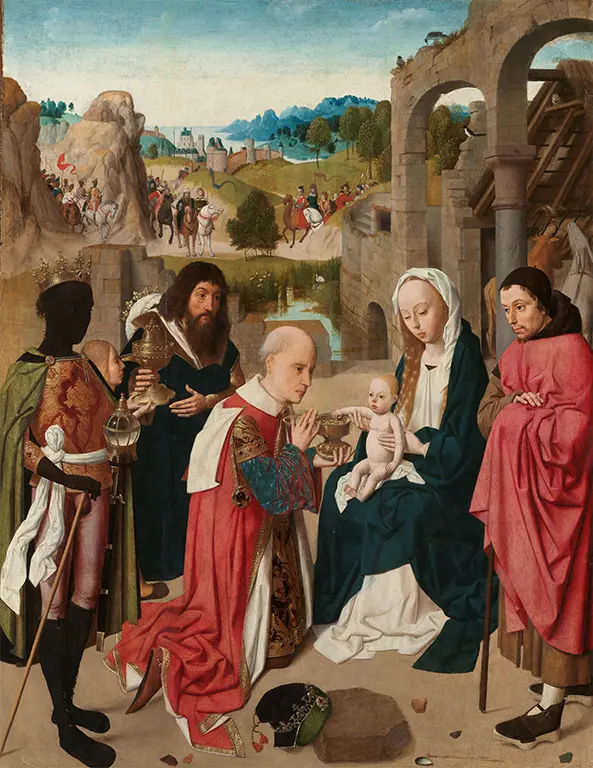
A work of great beauty and narrative force that speaks, above all, of the fifteenth-century Netherlands: the architecture, the garments, the spatial arrangement and the light are conventions of a period and a tradition, not data about first-century Judaea. That does not invalidate it as a compositional or spiritual reference. But it does oblige us to know what kind of reference it is.7
The memory of the narrative comes first, because without it we do not know exactly what we are representing. Its core lies in the infancy Gospels —Matthew 1–2 and Luke 1–2—: the characters, the narrative movements, the actions, the signs, the meaning of what is represented. But retaining this memory is not memorising sentences. It is learning to distinguish between what the text states, what it suggests, what it leaves unsaid and what it leaves open. The silences of the narrative matter too: they oblige us not to state lightly what the text does not say. And the differences between one evangelist and another are not errors to be corrected: they are nuances that the attentive nativity-scene maker can turn into creative decisions.
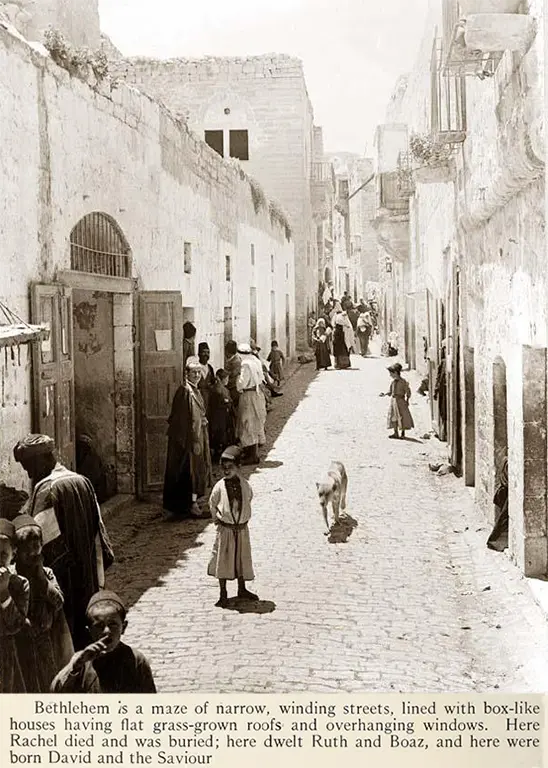
Bethlehem is a labyrinth of narrow, winding streets, lined with box-shaped houses with flat, grass-covered roofs and projecting windows. Here Rachel died and was buried; here Ruth and Boaz lived, and here David and the Saviour were born.
The text comes from the description that accompanies the photograph on its file page.8
There is an interesting detail: the text does not describe only a street, but loads Bethlehem with biblical memory. It joins the urban image —narrow streets, flat houses, projecting windows— with a devotional and historical reading: Rachel, Ruth, Boaz, David and Jesus.
The memory of the context sustains the scene from within. The birth of Jesus does not happen in a neutral space: it happens in first-century Judaism, under Roman rule, within a concrete physical, historical, political, religious and cultural setting.
In that culture, hospitality, honour, purity, poverty and the relationship with power had their own forms and meanings.
This memory rarely translates into an immediately visible detail. But without it, the visible elements remain as loose pieces of a stage set: formally correct, empty of human truth.
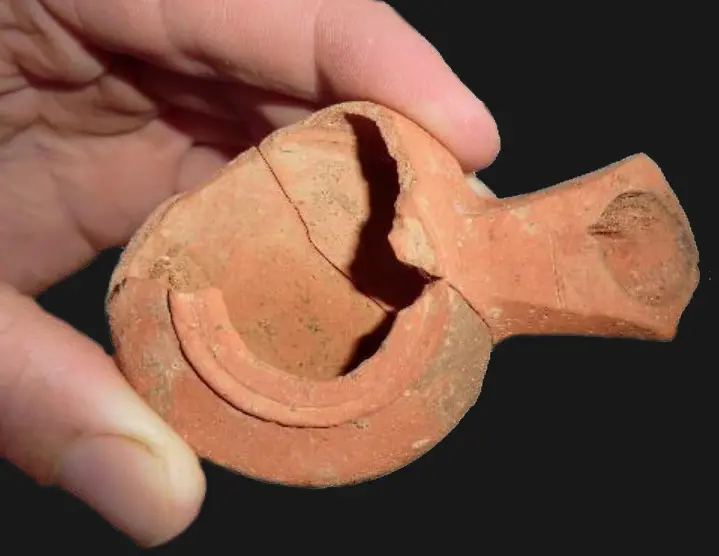
Material memory is what gives body to that world. It comes from archaeology: dwellings, utensils, textiles, tools, domestic spaces, building systems, traces of a concrete life. Thanks to it, the first century stops being a vague idea and begins to have recognisable limits and forms. But one should not ask more of it than it can give. An isolated find does not by itself explain a scene. A documented object does not resolve a composition. Archaeology guides and corrects, but it does not replace the creator’s judgement.
Iconographic memory, finally, is the vastest and also the most equivocal. It is formed by the images of the Nativity that art has produced over the centuries: paintings, prints, illustrations, reconstructions, nineteenth-century Bibles, film stills, workshop catalogues. It should not be despised: in it there is narrative force, visual solutions worked out over centuries and a symbolic language with deep roots. But it is a memory formed through images already interpreted by others. A Baroque painting can say as much or more about the seventeenth century as about first-century Judaea. A widely circulated devotional print can be transmitting a centuries-old convention as if it were a historical fact.
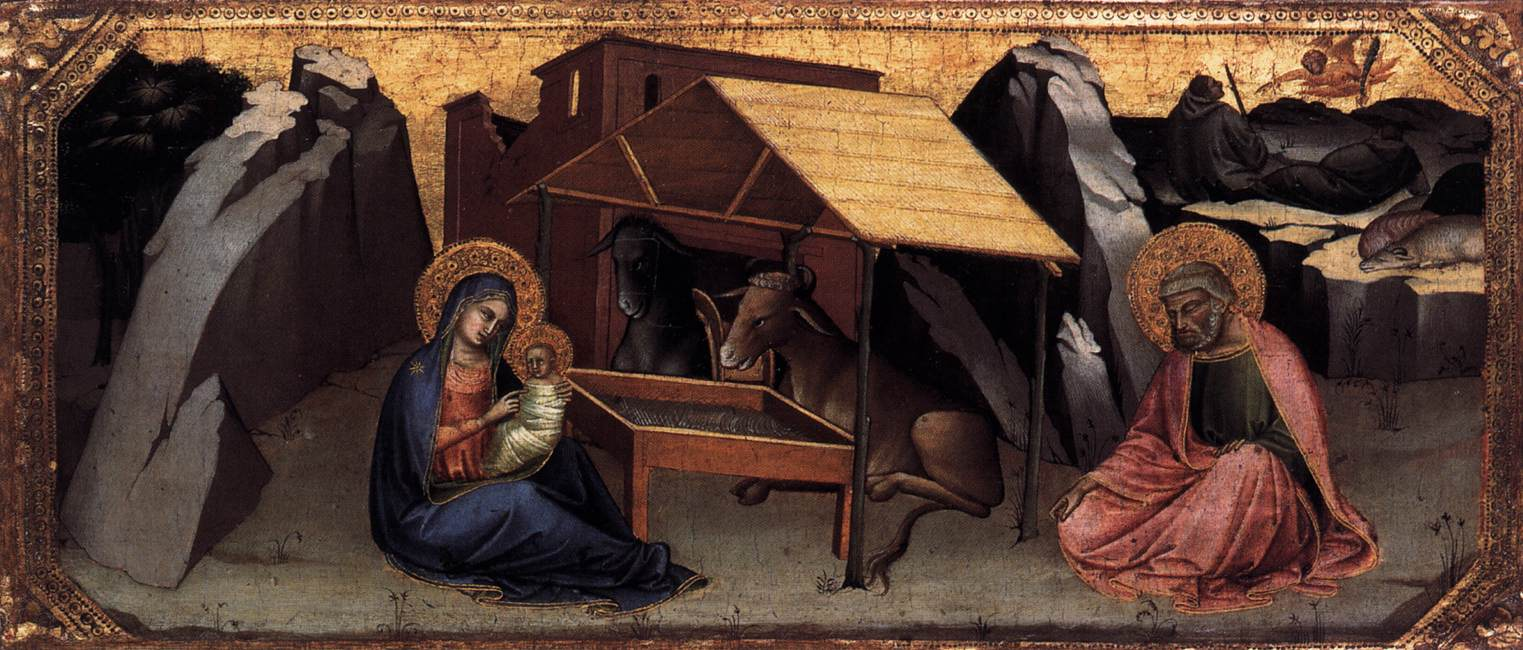
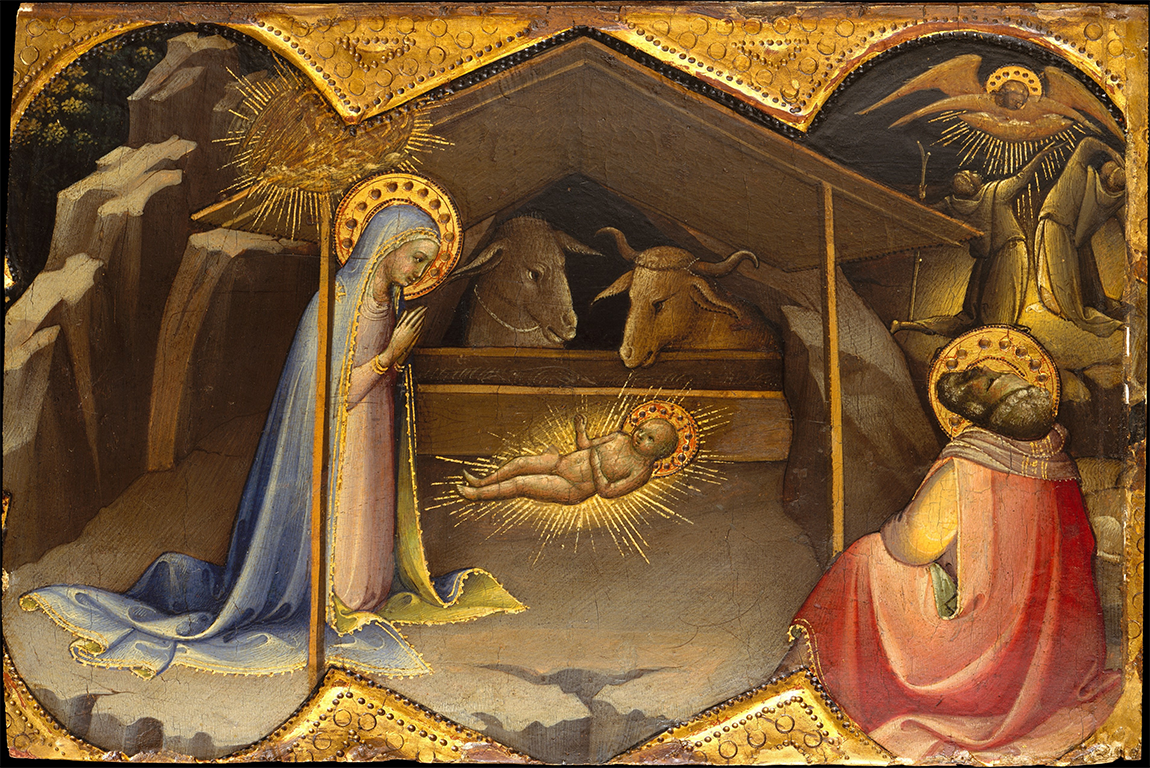
In barely two decades, the same artist treats the same subject in opposite ways. In the first work, the Virgin holds the Child: the gesture is maternal, the contact direct. In the second, the Child lies on the ground, naked, surrounded by his own light, and the Virgin adores him from a distance. It is not a stylistic evolution: it is a change of source. The second composition follows the model of the visions of Saint Bridget of Sweden, whose description of the birth —the Child on the ground, the mother kneeling in adoration, a supernatural light— circulated widely from the mid-fourteenth century. Monaco does not abandon one iconography for a better one: he chooses between two traditions that coexist. Iconographic memory is not a fixed system that artists simply inherit; it is a repertoire in tension. That one and the same Florentine painter should adopt so different a solution in so short a time says something about how that repertoire worked: not as a closed inheritance, but as a field of choice. Other artists of the same period, in the same place, did not move. Geography and workshop weigh as much as theology.
The question to ask of any inherited image is not whether it is beautiful or evocative, but whether it helps to understand better the world one wants to represent or whether it only offers a ready-made way of imagining it. They are different things, and confusing them has consequences in the work.
Not all memory weighs the same
Retaining these memories is not enough. They need to be ordered. They do not answer the same question, nor are they equally close to the first-century world, nor do they deserve the same trust in the same situation.
Iconographic memory, precisely because it is the most abundant, tends to take the place of the others when it is not clearly situated. When a nativity-scene maker does not order what they remember, they produce, almost without realising it, from the iconographic layer: it is the most immediate, the one that offers the most images to hand, the one that arrives first.
The problem is not having many images in one’s memory, but not knowing from what place those images speak.
That is why forming judgement consists, to a great extent, in not letting the most accessible memory decide for the others. The visual tradition can help a great deal in imagining, but it should not decide on its own what a wall looked like, how a house was organised, what kind of object might appear in a scene or what gesture should be attributed to a character.
Forming judgement is learning to distinguish:
- between a primary source and a late reading;
- between a documented reconstruction and a merely evocative image;
- between a valuable tradition and historical evidence;
- between what a source shows directly and what it only allows us to infer with prudence.
The artistic tradition enters memory if one knows how to read it
When documentation is discussed, it sometimes seems as though one had to choose between two extremes: either historical fidelity or the artistic tradition. Framing it that way would be a mistake.
Tradition matters. For centuries it has given visible form to the birth of Jesus. It has created memorable compositions, moving figures, gestures engraved in collective memory and atmospheres that still keep their force today. In it there is art, faith, sensibility, symbols and a long visual experience that should not be despised.
But precisely because that tradition is powerful, it should not be confused with historical proof. A Baroque work, a nineteenth-century devotional image or a widely circulated popular formula can have great artistic and spiritual value and, at the same time, speak more of the period that produced them than of the historical world the narrative refers to.
Reading tradition critically does not mean breaking with it. It means situating it: recognising that it belongs to iconographic memory, not to historical or material memory, even though it can strongly nourish the creative task.
Memory does not replace the voice
No accumulation of references creates a work on its own.
Ordered memory does not decide the composition, does not propose the gesture, does not set the light. The one who does that is the nativity-scene maker. But the difference between a nativity-scene maker who works from a formed memory and another who works from a memory dominated by inertia does not depend only on conviction or talent. It also depends on the materials available to the imagination at the moment of deciding.
That is why building memory is not renouncing one’s own voice. It is giving it something to speak with.
The reference does not extinguish the sculptor. It can refine what he decides, give weight to what he leaves out and make a choice more conscious.
The biblical nativity scene is not an archaeological model. It is a work that tries to sustain, at the same time, a concrete story, a real world and, hardest of all, to say something.
Before the next step
Having seen what a nativity-scene maker imagines from when imagining, and what must have been worked on so that this imagination does not run on inertia, one unavoidable question remains:
How does that memory begin to be translated into the scene?
Building memory does not consist in filling folders with images and notes. It consists in letting what has been observed transform the way of deciding.
A reference does not begin in the scene. It begins in the eye that learns to see.
That will be the next step: seeing how a reference stops being mental or cultural support and begins to guide concrete decisions within the work: architecture, light, manger, clothing, objects, composition, atmosphere.
References
- ↑ [1a] ↑ [1b] Belén Bíblico Monumental [exhibition]. (2010). ARTEINFORMADO. https://www.arteinformado.com/agenda/f/belen-biblico-monumental-43597
- ↑ [2] Ein Karem Churches [photograph]. Wikimedia Commons. https://commons.wikimedia.org/wiki/File:Ein_Karem_Churches.jpg
- ↑ [3] EinKaremMar042023 [photograph]. Wikimedia Commons. https://commons.wikimedia.org/wiki/File:EinKaremMar042023.jpg
- ↑ [4] Palestinos se reúnen en Belén para celebrar la Navidad por primera vez desde 2022 [video]. YouTube. https://www.youtube.com/watch?v=hlqhjfENLIo
- ↑ [5] Applied Research Institute–Jerusalem (2010). Bethlehem City Profile. Land use: ARIJ GIS Unit, 2008; fruit trees: Palestinian Ministry of Agriculture, 2007.
- ↑ [6] Ortega y Gasset, J. Obras completas. Tomo IX (1933/1948). Obra póstuma. Penguin Libros. https://www.penguinlibros.com/es/filosofia/38588-libro-obras-completas-tomo-ix-1933-1948-obra-postuma--9788430606672/fragmento
- ↑ [7] Geertgen tot Sint Jans (workshop) (c. 1480–1485). De aanbidding van de koningen (The Adoration of the Magi) [oil painting]. Rijksmuseum, Amsterdam, inv. SK-A-2150, via Wikimedia Commons. https://commons.wikimedia.org/wiki/File:Geertgen_tot_St._Jans_-_De_aanbidding_van_de_koningen_-_Rijksmuseum_SK-A-2150.jpg
- ↑ [8a] ↑ [8b] Bethlehem street 1880 [photograph]. Wikimedia Commons. https://es.wikipedia.org/wiki/Archivo:Bethlehem_street_1880.jpg — The text quoted comes from the description on the file page; its original printed source is pending verification.
- ↑ [9] Palestine—Picking olives [photograph, c. 1880–1922]. Library of Congress, Prints and Photographs Division. No known restrictions on publication. https://www.loc.gov/item/00651202/
- ↑ [10] Herodian candle at the Khirbet Terpin site [photograph]. Wikimedia Commons. https://commons.wikimedia.org/wiki/File:%D7%A0%D7%A8_%D7%94%D7%A8%D7%95%D7%93%D7%99%D7%90%D7%A0%D7%99_%D7%91%D7%90%D7%AA%D7%A8_%D7%97%27%D7%A8%D7%91%D7%AA_%D7%98%D7%A8%D7%A4%D7%99%D7%9F.jpg
- ↑ [11] Monaco, L. (1395–1400). Nativity [poplar panel, 26.3 × 60.7 cm]. Gemäldegalerie, Staatliche Museen zu Berlin, inv. 1113. https://id.smb.museum/object/863595
- ↑ [12] Monaco, L. (c. 1406–1410). The Nativity [tempera and gold on wood, 22.2 × 31.1 cm]. The Metropolitan Museum of Art, New York, Robert Lehman Collection, inv. 1975.1.66. https://www.metmuseum.org/art/collection/search/459007


