
 ≈ 98 min

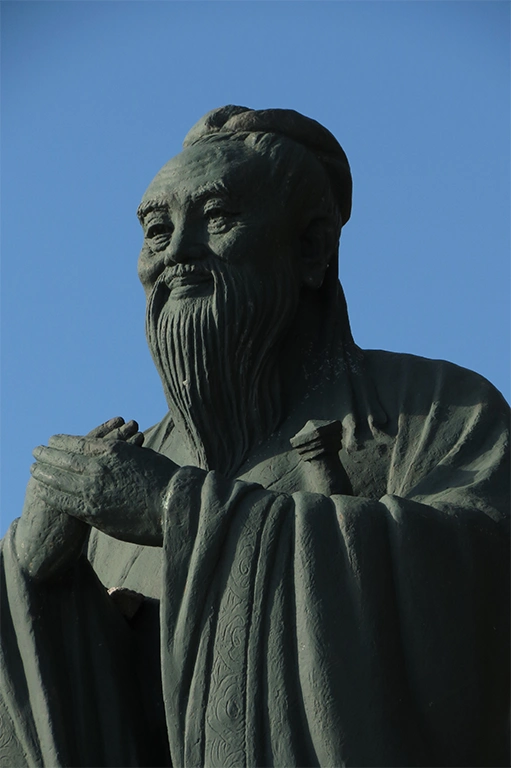
There is an old idea that underpins this chapter: calling things by their right names is not an ornament of thought, but its first condition. It was formulated by Confucius, the Chinese master of the 6th-5th century BC, in the Analects — the collection of his sayings gathered by his disciples—. When he was asked what he would do first if he had to govern, he answered that he would rectify the names, and he reasoned it thus: «If names are not correct, language does not accord with the truth of things; and if language does not accord with the truth of things, affairs cannot be carried on to success».1 This is the doctrine of the «rectification of names» (正名, zhèngmíng), and its reason was practical, not metaphysical. To a ruler who asked him about good government he answered with the same idea turned into an example: there is government «when the prince is prince and the minister is minister; when the father is father and the son is son».2 If the emperor is not called — and does not behave— as emperor, decrees are not obeyed; if the father does not fill the name of father, the family falls into disorder. Naming badly is not an innocent oversight: it ends up twisting what is done.
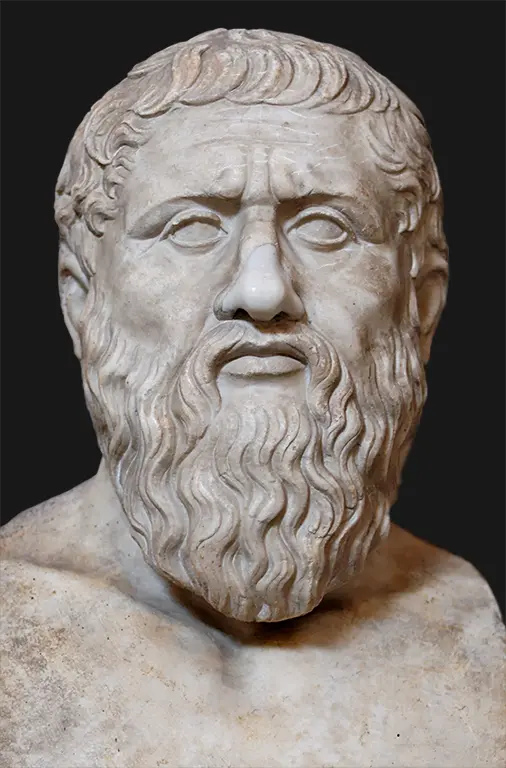
The intuition was not his alone, but in Greece the question became more ambitious. Plato devoted a whole dialogue — the Cratylus— to discussing whether names are correct by nature or by mere convention. At its opening (383a), Hermogenes — addressing Socrates— sums up the thesis of the character who gives the dialogue its title: «Κρατύλος φησὶν ὅδε, ὦ Σώκρατες, ὀνόματος ὀρθότητα εἶναι ἑκάστῳ τῶν ὄντων φύσει πεφυκυῖαν, καὶ οὐ τοῦτο εἶναι ὄνομα ὃ ἄν τινες συνθέμενοι καλεῖν καλῶσι […] ἀλλὰ ὀρθότητά τινα τῶν ὀνομάτων πεφυκέναι καὶ Ἕλλησι καὶ βαρβάροις τὴν αὐτὴν ἅπασιν» — «Cratylus here, Socrates, says that each of the things that are has a correctness of name that belongs to it by nature, and that a name is not whatever some people, having agreed on it, use to call things […], but that there is a correctness of names, the same for all, for Greeks and for barbarians» (the Manual's own translation from the text of Burnet's edition).3 Socrates will put that thesis to the test throughout the dialogue, and the attentive reader will come away suspecting that the natural correctness of names is a mirage. What matters here is not how Plato resolves it, but the underlying agreement: both the Chinese master and the Greek knew that naming has real consequences. This chapter keeps to Confucius's lesson: it does not look for the name that nature has written for the nativity scene, but for the name the practice needs in order to be seen.
And what has this to do with the nativity scene? Everything. In the world of the nativity scene, language has slipped out of true, and the clearest example is borne by the sculptor: whoever models original figures is called an «artesano belenista» — a nativity-scene craftsman—, as if the essence of the work were not authorship but repetition. That work begins as sculpture before any production exists; the name it is given erases it. Is nativity-scene making an art? This Manual has already worked through that question in depth — together with the old pigeonhole that separates the «popular» from the «artistic»— in its chapters on the art of composing nativity scenes, work by work and source by source. The conclusion fits in one sentence: it is an art, and whoever doubts it will have to justify the doubt. This chapter deals with an earlier problem: the name itself. And it is not a matter of conversation: that very shift — from sculptor to craftsman— is written down, with its words and its date, in the regulation that today declares nativity-scene art and practice intangible heritage in Spain, and it is examined in the chapter on the dossier, which is where it belongs.
Nor is what this chapter measures a single word. The three previous chapters have described the whole thing: what the first nativity scene was made for, what a scene of the Nativity conveys to whoever stands before it, and what the world born of that night is made of — works on two levels, modes that do not rank from better to worse, a chain of people, a calendar, customs and two values—. With all that in view, the question of the name changes shape. It is no longer «what does belenismo mean?», which is a dictionary question answered in one line, but this other one: of all that, how much does the word manage to name? And since the word exists in only two of the six languages of this Manual, the question splits in two: what it names where it exists, and what is done where it does not.
The practice is recognisable throughout the Christian world. According to the Church's statistical yearbook — the Annuarium Statisticum Ecclesiae, with data for 2024—, Catholics today number just over 1,422 million, around 17.8% of the world's population;4 the nativity scene accompanies them every December in homes, parishes and public spaces, and many other Christian denominations, without practising nativity-scene art as such, recognise the manger scene as the essential scene of Christmas. The practice, then, is universal. The word is not: in some languages it exists with a density of its own, and in others it has to be described with a phrase. And where it is missing, it is not for lack of practice: France, with its santons de Provence, has no word to name it; nor has German — despite the living tradition of the Krippe— nor English. Italy does have one, by a route of its own, and it is hardly known outside the trade.
Two different things
Everyday speech names this with two verbs, and both say less than what happens. A nativity scene is assembled, the way a piece of furniture is assembled: something that arrives in parts and only has to be put together according to its pieces. And a nativity scene is set out, the way the table is set: a seasonal operation repeated identically every year. The first verb denies that there are decisions; the second, that the result is singular.
It is worth measuring how far that goes. Nobody says of a painter that he has hung the picture, even though hanging it is the last thing he does: one says that he has painted it. With the nativity scene, by contrast, the language names only the last operation — placing the pieces where they go— and leaves everything else out: which scene is represented and on what grounds, with which figures, in what space, with what light, and why this way and not another. By naming only the end, the language describes an ornament. And by describing it as an ornament, it turns it into one.
That is why this Manual says compose, build or create, as the case requires, and not out of fussiness: each of those verbs reveals a decision that assembling and setting out conceal.
Once the vocabulary has been reckoned up, the elementary point comes into view: before arguing about the name, one has to know how many things need naming. And here the Manual has nothing to decide, because Spanish and Catalan have already decided it: there is one word for the object — belén, pesebre, pessebre— and a different one for the practice — belenismo, pesebrismo, pessebrisme—. Two separate words, in the academic dictionaries, with definitions that do not overlap.
The object occupies a space, is finished, is looked at and is put away. The practice is not put away in January: it is what the language names separately, and this chapter will find out since when and with what scope. What that practice is made of was set out in the previous chapter; where it ends and who fits inside it is not settled here, and that should be said at once: defining it is the work of the next chapter, which receives it from this one with the name already measured. What this chapter can do is more modest and comes first: prove that the distinction exists, date it and measure which name has sustained it.
Understanding the nativity scene only as an object is not a mistake of vocabulary: it is what allows it to be treated as an ornament. An object is bought, placed and replaced. A practice is learned, debated and inherited. The word chosen decides, quietly, which of the two conversations the nativity scene enters.
And this distinction is not the Manual's invention. It had already been made, in writing and in Catalan, more than a century ago.
The word has a history, and it can be dated
What follows are six press texts, in two languages and from two archives. They are not quoted by way of illustration: they are the proof of when each thing begins to be said, and all of them can be consulted today in digital copy.
The first two are in Catalan and are kept in the Arxiu de Revistes Catalanes Antigues of the Biblioteca de Catalunya. The next four are in Spanish and were located later, in the Hemeroteca Digital of the Biblioteca Nacional de España; they form a second series that runs parallel to the first and is not to be confused with it. Access is free in all of them except the last, from 1934, which is still in copyright and can only be consulted on the premises.
1868: the thing
On 19 July 1868, a Barcelona satirical weekly called Lo Esquirol describes a character, the senyor Pau, piling up the traits that make him recognisable. Among them, this one:
«¡Ah! me descuidaba de dir que per Nadal no pot faltar á casa sèva ni gall ni pessebre y que pren rapé.» — Ah! I was forgetting to say that at Christmas his house can never be without a cockerel or a nativity scene, and that he takes snuff—.5
It is worth looking slowly at what that sentence takes for granted. The nativity scene appears next to the cockerel: not as a devotion nor as a work, but as one of the things a house cannot be without at Christmas, alongside what goes on the table. And it appears inside a joke, which is the most demanding proof of all: one can only joke about what the reader recognises without having it explained. If the author had had to explain what a nativity scene is, there would be no joke.
There is one more detail, and it is not a minor one: the text is published in July. The word does not need the season to be understood. In 1868, in Barcelona, pessebre is a word for the whole year.
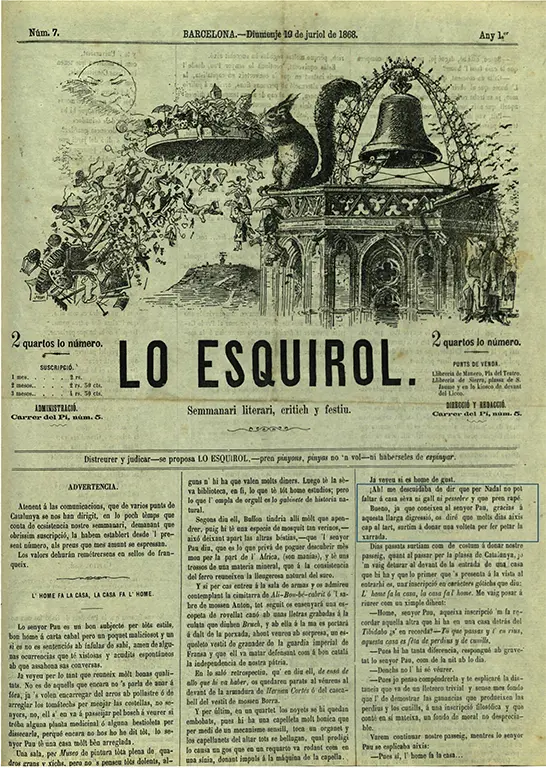
What this testimony proves, then, is modest and firm at the same time: in 1868 the nativity scene is already a domestic institution, so well established that it serves to sketch someone in a single stroke. What it does not prove — and it is worth saying so before someone else does— is anything about the practice. Here there is no trade, no art, no author: there is an object that is in people's homes.
1907: the trade
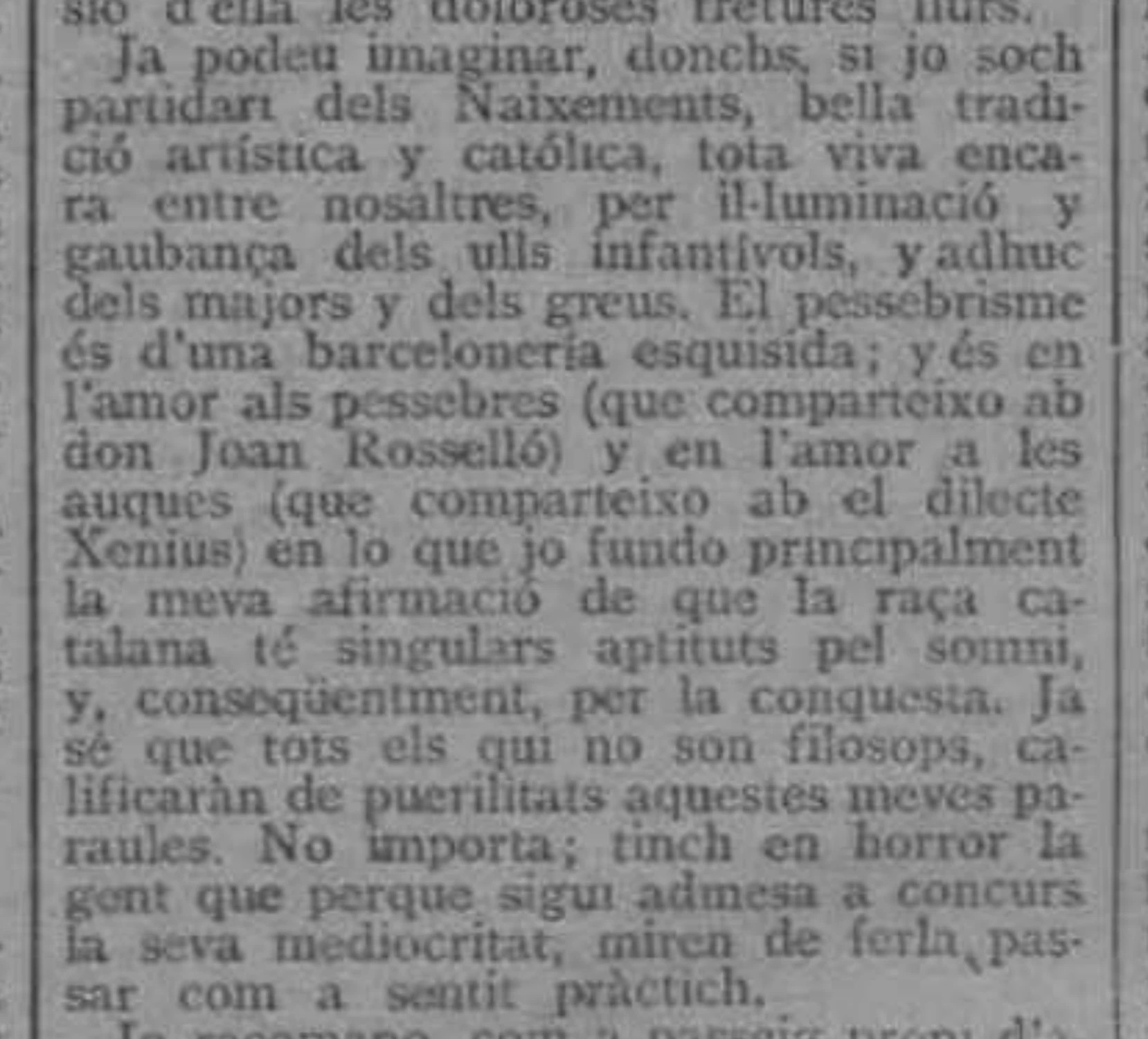
Thirty-nine years later, on 31 December 1907, La Veu de Catalunya publishes in its evening edition an article entitled «El Nostre Naixement» — Our Nativity Scene—. It is signed by Josep Carner, then a young writer who would become one of the central voices of 20th-century Catalan poetry.6 The article defends the Naixement — written thus, with a capital letter— against those who take it for a children's thing:
«Ja podeu imaginar, donchs, si jo soch partidari dels Naixements, bella tradició artística y católica, tota viva encara entre nosaltres, per il·luminació y gaubança dels ulls infantívols, y adhuc dels majors y dels greus. El pessebrisme és d'una barcelonería esquisida; y és en l'amor als pessebres (que comparteixo ab don Joan Rosselló) y en l'amor a les auques (que comparteixo ab el dilecte Xenius) en lo que jo fundo principalment la meva afirmació de que la raça catalana té singulars aptituts pel somni, y, conseqüentment, per la conquesta.» — You can well imagine, then, whether I am a supporter of Nativity scenes, a beautiful artistic and Catholic tradition, still fully alive among us, for the illumination and delight of childish eyes, and even of grown-up and serious ones. Pessebrisme is a thing of exquisite Barcelona refinement; and it is on the love of pessebres (which I share with don Joan Rosselló) and on the love of auques [picture broadsheets] (which I share with the beloved Xenius) that I chiefly ground my assertion that the Catalan race has singular aptitudes for dreaming and, consequently, for conquest—.7
The spelling predates the Fabra standard of Catalan and is quoted as it stands: barcelonería, católica and aptituts keep the accentuation and the forms of 1907.
There are three things here, and all three matter.
The first: Carner distinguishes in a single sentence what this chapter has just separated. He speaks of «amor als pessebres», in the plural — the works—, and of «pessebrisme», in the singular — the practice—, and does not stop to explain the difference. He takes it as given. That is to say: the distinction the Manual needs as its starting point was already at work in written Catalan more than a century ago. The Manual does not invent it; it recovers it.
The second: he uses the word without explaining it. That is the most reliable sign that a word is already in circulation. Nobody coins a term and moves straight on; whoever coins, explains. Carner does not explain.
The third, and it is the one that will weigh at the end of the chapter: he qualifies it. «El pessebrisme és d'una barcelonería esquisida» — pessebrisme is a thing of exquisite Barcelona refinement—. In 1907, the word naming the practice is not felt to be Catalan in general, but Barcelonan in particular. It is born marked by its city.
It is worth adding what the text is not. It is neither a commercial advertisement nor a society column: it is a writer putting his name to a defence. The word appears, the first time we can read it, in a text that defends the practice as an art.
Thirty-nine years
That is the interval between the two testimonies, and the whole argument of this section lies within it:
The thing is named when it is a custom. The practice is named when someone decides to defend it.
In 1868 there are nativity scenes in homes and there is a word for them. For the other word to appear — the one that names the trade— something more than nativity scenes is needed: someone has to think that what is being done is a way of doing, that it deserves a name of its own and that it should be upheld in public. That moment has a date, and it is 1907.
The Spanish-language series: 1864, 1867, 1877, 1934
There is a second series of testimonies, and it was not in the first edition of this chapter. It arrived by a side road —while checking why this Manual is also written in Catalan— and obliges what has been said so far to be qualified without dismantling it. It is in Spanish, it takes place in the same city and it runs on its own course.
The starting point is a society. According to the history published by the Associació de Pessebristes de Barcelona, the Diario de Barcelona announces on 9 February 1862 the «Fundación de una Sociedad de Pesebristas a imitación de otra anterior» — founding of a Society of Pesebristas in imitation of an earlier one—; on 17 November 1863 it reports that «la Sociedad de Aficionados a los Belenes da normas artísticas» — the Society of Nativity-Scene Enthusiasts lays down artistic rules—; and on 9 January 1864 it reviews its statutes, dated 15 March 1863, with twenty-three articles and thirteen prescriptions on how a nativity scene should be made.8
Those three news items and the statutes are known today through the history published by the association itself, which transcribes them: the issues of the Diario de Barcelona from those years are not in the digital newspaper archive that holds that newspaper. What follows, on the other hand, are issues opened one by one.
1864: the joke that explains the word
The day after that review —on 10 January 1864—, a different newspaper, El Lloyd español, picks up the news and makes fun of it:
«Al paso que vamos este año la sociedad se compondrá de sociedades. Ya he visto anunciada una de pesebres, ó de pesebristas. Habrán temido denominarse de belenes, por si la autoridad les hacia algun cargo el dia que hubiese un belen.» — At the rate we are going this year, society will be made up of societies. I have already seen one announced of pesebres, or of pesebristas. They must have been afraid to call themselves a society of belenes, in case the authorities brought some charge against them on the day there was a belen [a commotion]—.9
That joke should not be passed over quickly, because it says more than many arguments.
First, it corroborates the society from outside: an unrelated newspaper records that it has been announced, and records too that the name was wavering — «de pesebres, ó de pesebristas»—.
And second, which is what matters: it laughs at precisely the noise in the word belén. The joke only works if the reader of 1864 understands both senses at once — the nativity scene and the commotion—, and if it seems plausible to him that someone would avoid the first for fear of the second. Further on, this chapter examines that noise in today's dictionary (see the section «The name», point five). Here it is shown not to be a recent problem: a century and a half ago people were already joking about it, and already pointing to it as a reason for choosing the other root.
1867 and 1877: the word circulates and the practice organises itself
On 30 December 1867, a Madrid newspaper, La Ley, quotes «un colega de Barcelona» — a colleague in Barcelona—: «Se nos ha pasado un aviso de la sociedad de pesebristas…» — we have been sent a notice from the society of pesebristas…—.10 The word has left its city.
And on 9 January 1877, the Crónica de Cataluña publishes something that is no longer a mention but a service to the reader:
«Aunque sean muchos mas de los que ponemos á continuacion los belenes que este año hay de manifiesto en varias casas particulares, continuamos aquí los pertenecientes á la sociedad de pesebristas que son: el de D. Domingo Inglada, en la calle de Mercaders, número 19, tienda de dorados, se enseña los lúnes y domingos.—El de D. Alberto Esteve, en la calle de Amalia, número 79, al lado de la Cárcel, los jueves y domingos.—El de D. Domingo Estreicher, calle de Caspe, número 85, los domingos.—El de D. Antonio Bastinos, en la calle de los Baños Nuevos, número 1, piso tercero, los lúnes y viernes.—Y el de D. José Roig, en la misma calle de los Baños, número 7, piso tercero, los martes y viernes.» — Although the nativity scenes on show this year in various private houses are many more than those we list below, we give here the ones belonging to the society of pesebristas, which are: that of D. Domingo Inglada, in the calle de Mercaders, number 19, a gilder's shop, shown on Mondays and Sundays; that of D. Alberto Esteve, in the calle de Amalia, number 79, next to the Prison, on Thursdays and Sundays; that of D. Domingo Estreicher, calle de Caspe, number 85, on Sundays; that of D. Antonio Bastinos, in the calle de los Baños Nuevos, number 1, third floor, on Mondays and Fridays; and that of D. José Roig, in the same calle de los Baños, number 7, third floor, on Tuesdays and Fridays—.11
Five members' nativity scenes, with name, address and days of visiting. Fourteen years after the statutes, the thing works as what it is: an organised practice, with a public calendar and open houses. And the writer notes that there are many more in private homes; he lists only the society's.
1934: the -ismo, seventy years later
The Spanish word for the practice —pesebrismo— does not appear until much later. The oldest testimony located is from 16 January 1934, in La Vanguardia, and it speaks precisely «del pesebrismo catalán» — of Catalan pesebrismo—.12
How the two roots were shared out
There is something in these testimonies that cannot be seen until the two roots are searched for separately, and then it leaps out.
Go back to the 1877 chronicle. In the same sentence it writes: «los belenes que este año hay de manifiesto en varias casas particulares… los pertenecientes á la sociedad de pesebristas».
The same speaker calls the thing a belén and himself a pesebrista.
The counts confirm it. In the Barcelona press, pesebristas returns 962 issues, already present in the 19th century and strong from the beginning of the 20th. Belenista and belenistas, added together, return 91, and of belenista none is earlier than 1901.13
So in Spanish, and in the city where all this was organised, the word naming whoever does it was born from the manger root (pesebre), not from the city root (Belén, Bethlehem). The other came later.
And the 1864 joke had explained why before anyone counted anything: «habrán temido denominarse de belenes» — they must have been afraid to call themselves a society of belenes—. For the thing, belén will do; for naming oneself, it will not.
Two archive traps, declared
These counts call for a warning, because searching for belenista in a national archive returns, above all, two other things.
The first is optical character recognition. The four oldest results —1847, 1877, 1880, 1917— are not about nativity scenes: they are about Greece. «Filólogo y jurisperito, belenista y teólogo» — philologist and jurisconsult, belenista and theologian—; «un busto de mármol á la memoria del eminente belenista J. J. Courtaud» — a marble bust to the memory of the eminent belenista J. J. Courtaud—. It is helenista, Hellenist, misread. The same defect that returns helenismo when one asks for belenismo.
The second is not an error: it is a different word. In March 1899, El Correo de Zamora publishes on several consecutive days a news item about «los Belenistas Palestinos que se hallaban establecidos en una de las casetas de la Plaza» — the Palestinian Bethlehemites who had set up in one of the stalls in the Square—. There belenista means a native of Bethlehem, and the item concerns sellers of goods from the Holy Land.14
This is worth pausing on, because it is not an archive anecdote. The city root produces a derivative that was already taken: whoever calls himself a belenista shares a name with the inhabitant of Bethlehem. It is one more noise, and of the same family as the others — the commotion, the muddle, «estar en Belén» (to be miles away)—: it does not soil the name, but it forces it to compete. The manger root does not have that problem, and those who chose to name themselves in 1864 said so in their own way.
When the name of the trade changed, and why: the open question
Today, in Spanish, whoever makes a nativity scene is a belenista. And we have just seen that in the 19th century he was a pesebrista. Between the one and the other there was a change, and this chapter cannot date it yet. It is worth saying why, and what it would take to do so.
What the archive does say. In the Barcelona press, belenista does not appear before 1901; between 1901 and 1935 there are four issues, and nineteen in the period from 1936 to 1975. But pesebristas, in that same period, does not retreat: it goes from 389 to 566. So within the dates that archive reaches no substitution is observed: what is observed is the appearance of a second word alongside the first.13
What the archive cannot say. Its holdings run out shortly afterwards, and the change we perceive today is later. Asking that archive when people stopped saying pesebrista is asking it about a time it does not contain.
A hypothesis, and a falsifiable one. In 1963 the Federación Española Belenista is founded — today's name, Federación Española de Belenistas, dates from its refounding in 1972—: its regulations are approved by the Ministerio de la Gobernación by official letter of 29 April, and it is constituted in assembly on Saturday 29 June, with five founding associations — Madrid, Pamplona, Valladolid, Lugo and Zafra—.15 A body that federates a sector and names itself fixes the word: the name goes into the statutes, the bulletins, the competitions, the posters and the membership cards of every association that joins. If the word became general that way, the curve for belenista should take off from that date and not before.
It can be checked, and it can be overturned. If belenista were already dominant in the press before 1963, the hypothesis falls, and the cause would have to be sought elsewhere — school, radio, post-war Castilianisation, or simply the weight of the word belén, which is the one the dictionary gives as the main one—. This Manual does not take it as sound until the count has been made.
And there is a detail in those statutes that changes the shape of the hypothesis. Their statement of purpose does not say belenismo: it says «el belenismo o pesebrismo». The two words, one after the other and joined by a conjunction, with no hierarchy and no note.15
So in 1963 the federation does not choose between the two words: it keeps them together in the text and chooses only one for the name. And there lies the mechanism, if this was it: nobody decreed anything, nobody discarded anything. Simply, what is repeated a thousand times —the sign, the letterhead, the signature— carries a single word, and what is read once —the articles— carries both. A word does not need to win an argument to prevail: it is enough for it to be in the place that gets repeated.
If that is what happened, nobody decided the change, and yet it had an author.
And there is a documentary route for which the press is no substitute. The associations of those years were constituted under the Ley de Asociaciones of 1887, which required statutes to be submitted to the Gobierno civil «expresando claramente en ellos la denominación y objeto de la Asociación» — stating clearly in them the name and purpose of the Association—, and ordered that «en cada Gobierno de provincia un registro especial» — in each provincial Government a special register— be kept of the bodies domiciled in its territory.16 That is to say: the name of each society was entered, with its date, in an official register. There, and not in the press, lies the way to date when bodies began to call themselves one thing and stopped calling themselves the other.
And there remains the question that comes before it, which is the fundamental one and is answered by no count: why the word without noise was abandoned. Pesebrista does not share a name with the inhabitant of any city, does not drag along the commotion or the muddle, and names what the evangelist gives as the sign. The other, the one that prevailed, carries the first three and lacks the fourth. It prevailed all the same. To note this is not to lament it: it is to record that usage does not choose the best-motivated word, and that whoever wants to know why a practice is called what it is called will have to look at who named it, not at what was fitting.
What this series adds, and what it does not
It does not move the thirty-nine years. That interval measures something else: the one that separates the two Catalan testimonies cited — pessebre, 1868; pessebrisme, 1907—, and the word for the object is older still: the archive already returns it in 1865. These testimonies are in Spanish and contain neither of those two words.
What they contribute is a second series, parallel and longer. In Spanish, the people are named in 1864 and the practice is not named until 1934: seventy years. In Catalan, from the object to the practice, it was at least forty-two. Two languages, two rhythms, and the same order in both.
So the order in which the words appear is not the one we might have supposed. First, the people who do it are named. Then, the thing they make. And much later, the practice that people carry out on the thing.
And there is one fact that weighs more than all the dates put together. The thirteen prescriptions of 1863 say how a nativity scene should be built so that it has, according to the review, the artistic effect its author seeks. That is: before the practice had a name, it already had written criteria. A group of people had agreed in writing that the thing could be done better or worse, and on how to tell the difference. That is exactly what a definition must capture, and it happened seventy years before the word that names it existed.
One last thing remains, of the same order as all the rest: the society of 1862 does not present itself as the first. It is founded, the headline says, in imitation of an earlier one about which we know nothing.
How much it was used
The two earlier testimonies mark a beginning. The same search, extended to the whole archive, tells what happened next. Pessebrisme appears on 115 pages spread over 26 periods — 25 dated years and one undated group—, with this distribution:17
| Period | Pages |
|---|---|
| 1907-1920 | 11 |
| 1925-1935 | 92 |
| 1938 | 3 |
| 1948-1987 | 8 |
| Undated | 1 |
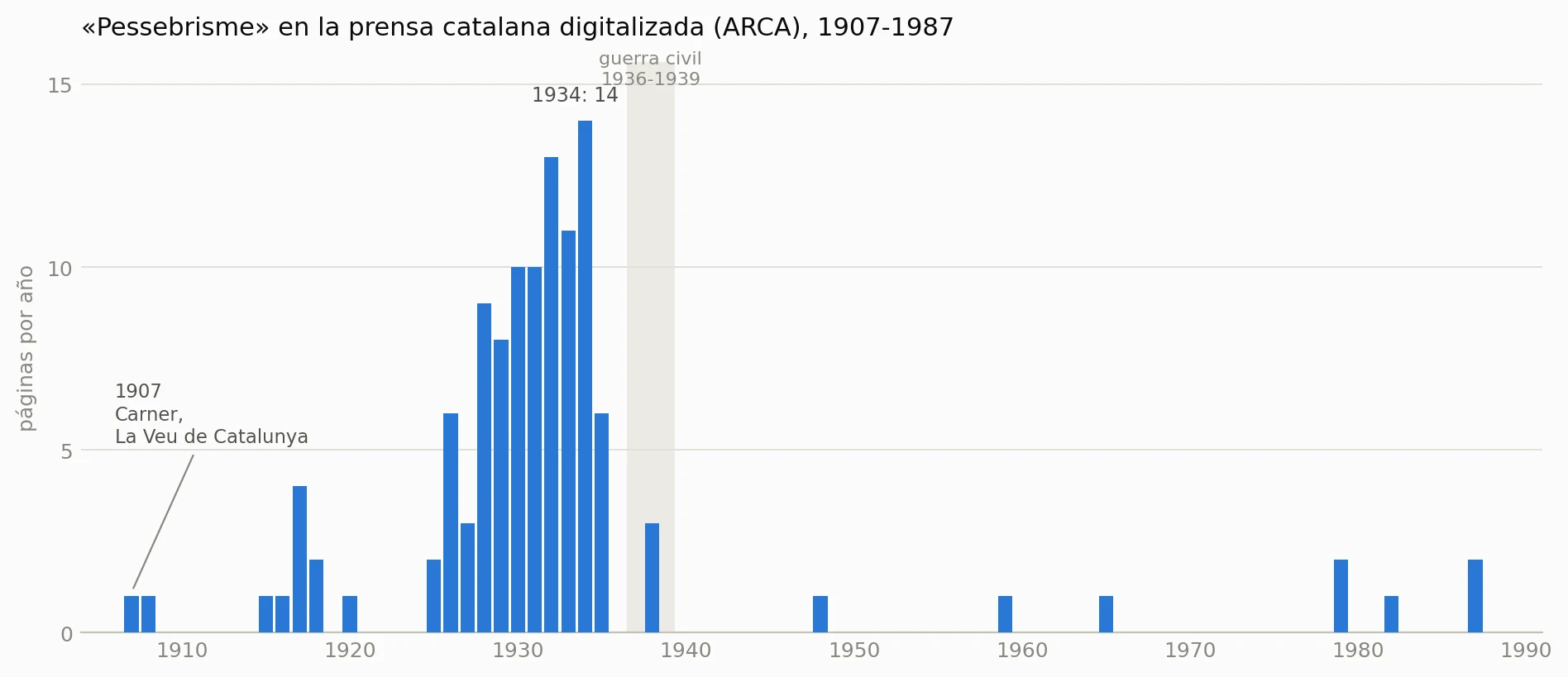
Four out of every five occurrences are concentrated between 1925 and 1935, with the peak in 1934. Throughout that long decade, pessebrisme is neither a specialists' word nor one of occasional circulation: it is a word in ordinary public use, appearing in the press several times a year without anyone introducing it.
Two warnings, before drawing more from this than is there.
The first concerns method: the search finds what optical character recognition has managed to read. The archive itself warns that its results are approximate and depend on the quality of the image. A testimony earlier than 1907 is not ruled out by this search: it remains unlocated, which is a different thing. That is why this Manual says «the oldest testimony locatable in ARCA» and not «the first documentation of the word». The difference between the two formulas is exactly the difference between what has been verified and what one would like to have verified.
The second concerns what the curve really measures. The fall after 1938 says as much about the press as about the word: many Catalan titles ceased to exist in 1939, and an archive of old periodicals records, before anything else, what was being published. Reading that decline as a disappearance of the practice would be confusing the silence of the corpus with the silence of the practice.
The same caution applies looking backwards and to the other word, and here the archive corrects what seemed to be the case. Lo Esquirol is not the oldest testimony of pessebre in the digitised Catalan press: when the years are consulted one by one, the search already returns pages from 1865, 1866 and 1867, all from the Barcelona satirical press (Un tros de paper, Lo noy de la mare, La Rambla, La Pubilla), and none between 1861 and 1864; and within 1868 itself, La Pubilla has it in January, six months before Lo Esquirol. The 1868 testimony stays in this chapter for what it says — the nativity scene next to the cockerel—, not for its date. And the word is, in any case, older than the press: what those dates mark is its appearance in the archive, not its birth.
And a date that circulates without an issue to back it
One date remains to be dealt with, because any reader who has read something on this subject will have come across it.
The year 1805, in the Diari de Barcelona, has been given as the first written appearance of the word pessebrisme. The source is Jordi Dalmau's chronology in his booklet El pessebrisme, published in 1992 in the Quaderns de la Revista de Girona series: there, on page 7, one reads «Surt escrita per primera vegada la paraula pessebrisme. Diari d'en Brusi» — the word pessebrisme appears in writing for the first time. Diari d'en Brusi—.18
The copy has been checked and says no more than that. It is a line of chronology in a popularising booklet, with no note and no reference — normal practice in that genre, not negligence—, so there is no way of following the trail back. Two further things are made visible by the booklet itself: it calls the newspaper by a popular name that is later than 1805, and it places the founding of the first nativity-scene society in 1860, which would mean that the word naming the practice existed half a century before there was any organised practice to name.
It does not hold. And it does not need to hold, because in its place there are two texts with date, masthead, page and digital copy. An unproven claim is not refuted: it is replaced.

It is worth pausing a moment on how this works, because it will happen again in this Manual more than once. Nobody lied. A reasonable claim was published without apparatus, was read, was repeated and came to seem established simply by being in print. All it takes is for nobody to go and look for the issue. Going to look for it is, in fact, almost the whole of the method.
What the works that fix the language say
So far, the word in the street. Now, the word in the dictionaries — which is another matter, and always comes later.
An academic dictionary does not decide which words exist: it records those already in use, once the usage is documented. It follows behind, and follows behind on purpose. This is worth bearing in mind in order to read what follows correctly: that a word enters the dictionary late says nothing about its age; it says when someone gathered sufficient evidence of its use.
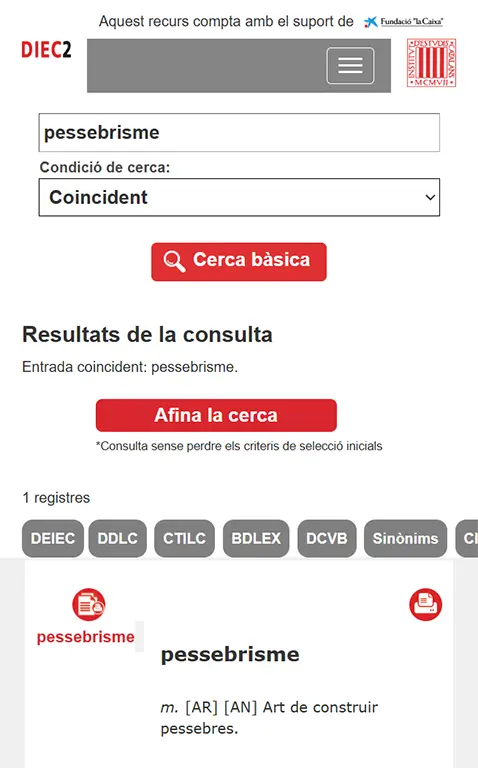
When the reference works for the languages of the Spanish state are put together — five works, six entries—, a fact appears that nobody had placed side by side until now:
| Work | Entry | Definition |
|---|---|---|
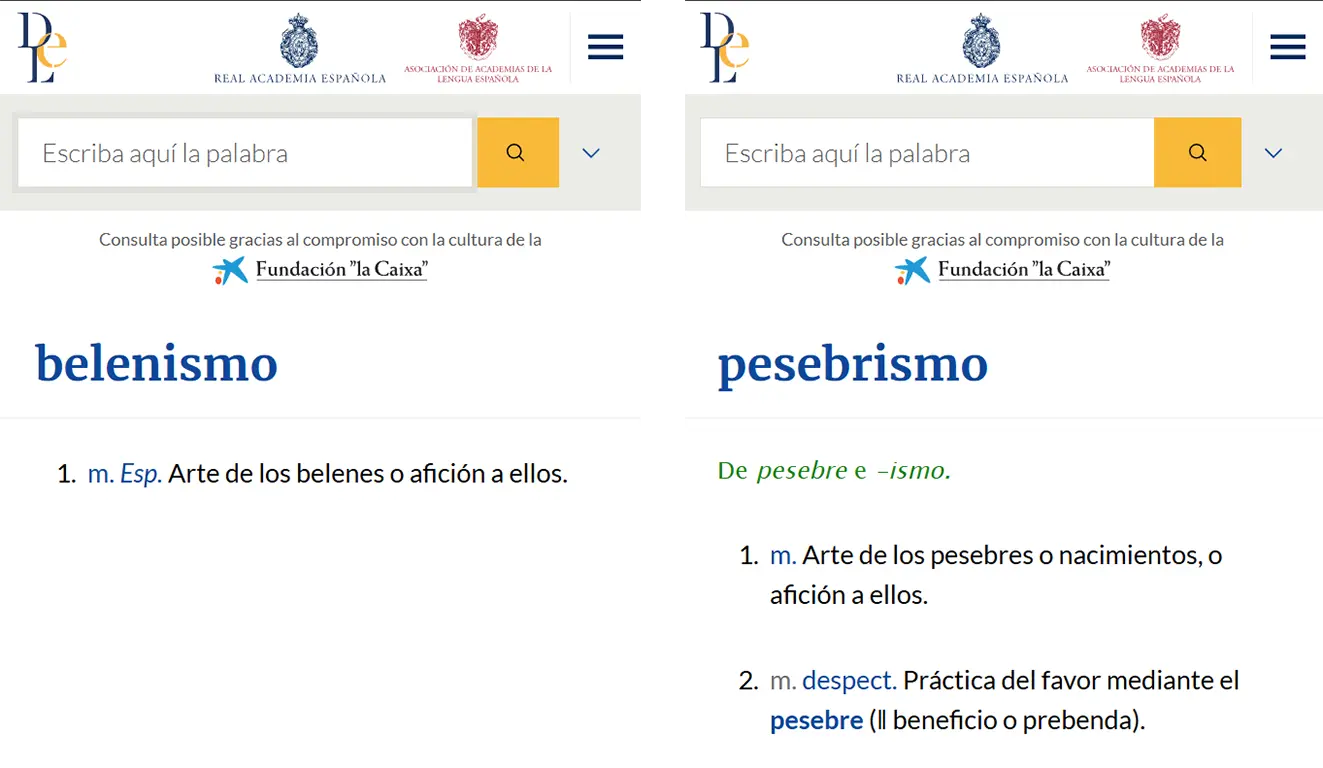
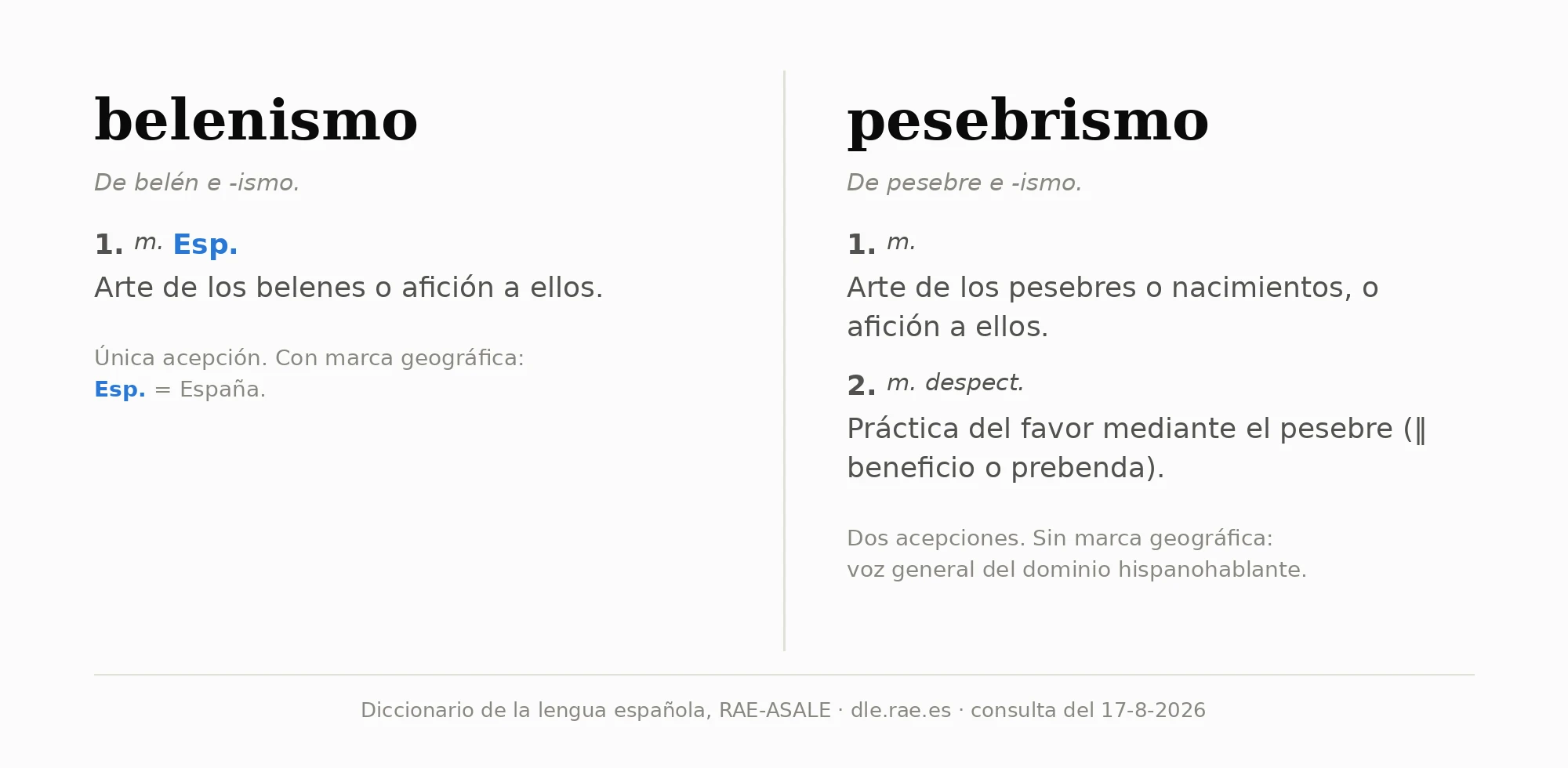
| Diccionario de la lengua española (RAE-ASALE) | belenismo | «Arte de los belenes o afición a ellos». Label Esp. |
| Diccionario de la lengua española | pesebrismo | Two senses: the artistic one and a pejorative one. No geographical label |
| DIEC2 (Institut d'Estudis Catalans) | pessebrisme | «Art de construir pessebres» |
| DNV (Acadèmia Valenciana de la Llengua) | pessebrisme / betlemisme | Labels ETNOL./ART; betlemisme, «Art de construir betlems» |
| Gran Enciclopèdia Catalana | pessebrisme | «Afecció i art de construir pessebres» |
| DCVB (Alcover-Moll) | pesebrisme or pessebrisme | «Art de construir pesebres de Nadal» |
Three academies — the Real Academia Española, the Institut d'Estudis Catalans and the Acadèmia Valenciana de la Llengua— open the definition with the same word: art.19
That fact should be the starting point of any discussion of the status of nativity-scene art and practice, and until now it was not, simply because nobody had gathered it together. Whoever maintains that nativity-scene making is a seasonal handicraft is not arguing with a sculptor's opinion: they are arguing with the concurring definition of three academies.
When they entered the dictionary
The two Spanish entries are, moreover, recent in the academic dictionary, and that says something. Belenismo does not appear in the 22nd edition, of 2001, and does appear in the current one, the 23rd; according to the Federación Española de Belenistas, which had requested it, it entered in the edition presented on 17 October 2014.20 Pesebrismo comes with a more curious history, and it is the one the table sums up in a single cell: today it has two senses — the art one and one labelled pejorative, «práctica del favor mediante el pesebre (beneficio o prebenda)» (the practice of favour through the trough: benefit or sinecure), that is, cronyism—. It too is absent from the 2001 edition: the two words for the practice are, in the academic dictionary, of the 21st century.21
That the word for the art should share an entry with the word for cronyism is not a dictionary anecdote. It is the first warning of something this chapter will find in both roots and that will weigh, in the end, in the decision about the name: neither of the two is clean.
The asymmetry that changes the approach
There is something more in that table, and it is what forces the whole chapter to be rethought.
In the Diccionario de la lengua española, belenismo carries the label «Esp.» — that is, Spain— and pesebrismo carries none. In the system of a pan-Hispanic dictionary, that label is not decoration: it indicates that the use of the word is confined to one territory within the domain of the language. No label means that it holds for the whole domain.
Put plainly: in the dictionary of the Spanish language, the provincial word is belenismo, and the word without borders is pesebrismo. It is the opposite of what peninsular intuition takes for granted.
The languages that do not have the word
The map is completed where there are gaps. The Real Academia Galega records presebe, but only as a feeding trough for livestock: Galician has no word for the practice from either root.22 In Basque, the Elhuyar dictionary offers no equivalent for belenismo or for pesebrismo, and refers pesebre to jaiotza, «birth» — the same route as the American «nacimiento» and the English nativity: naming the scene after the event, not after the trough—. A word for the trough does exist: ganbela, which the Euskaltzaindia dictionary defines by aska — «a box-like container, almost always of wood, in which food is put out for animals»— and illustrates, precisely, with a child laid in a manger because there was no cradle. And that same dictionary records no derivative naming the practice: Basque is in the same position as Galician, with the manger root available and no word for the trade.23
Two languages of the Spanish state, then, are in the same situation as French, English and German: they have a word for the object and none for the trade. The lack usually described as a matter between European languages — and which the following sections document one by one— turns out to be an internal matter as well.
The other four languages: French, German, Italian and English
Outside Spanish and Catalan, none of the languages of this Manual has an established word for the practice — with an Italian nuance that has to be weighed slowly, because it changes the map—. It is worth looking at this language by language and with the dictionary in front of us, and worth saying why it is done this way: an absence is harder to assert than a presence. Whoever says «this word exists» only has to show it; whoever says «it does not exist» has to have looked, and has to say where they looked and when. Hence what follows names in each case the work consulted and the date of the consultation, which is more apparatus than is usually spent on a negative.
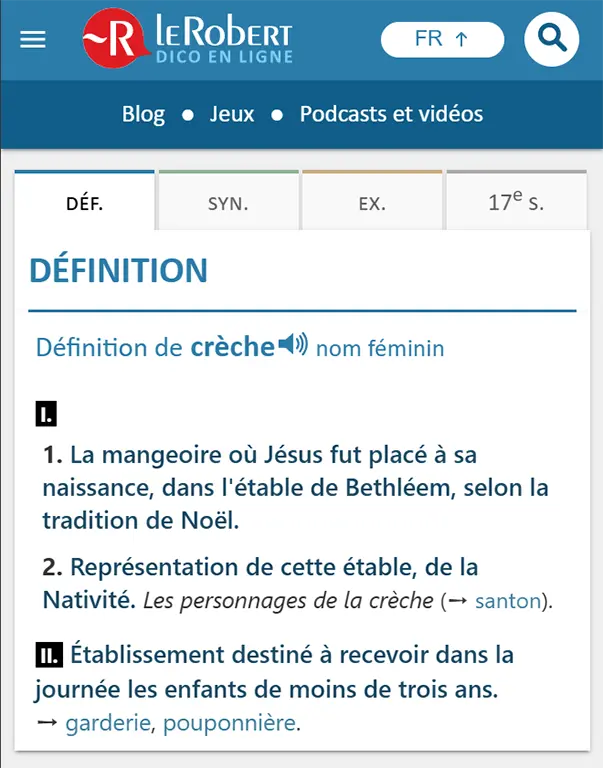
In French, no term for the practice is recorded. Checked for this Manual against Le Petit Robert, and re-verified in August 2026 against Le Robert online: «crèche» names the object — «Représentation de cette étable, de la Nativité. Les personnages de la crèche (→ santon)»— and no entry names the practice that produces it.24
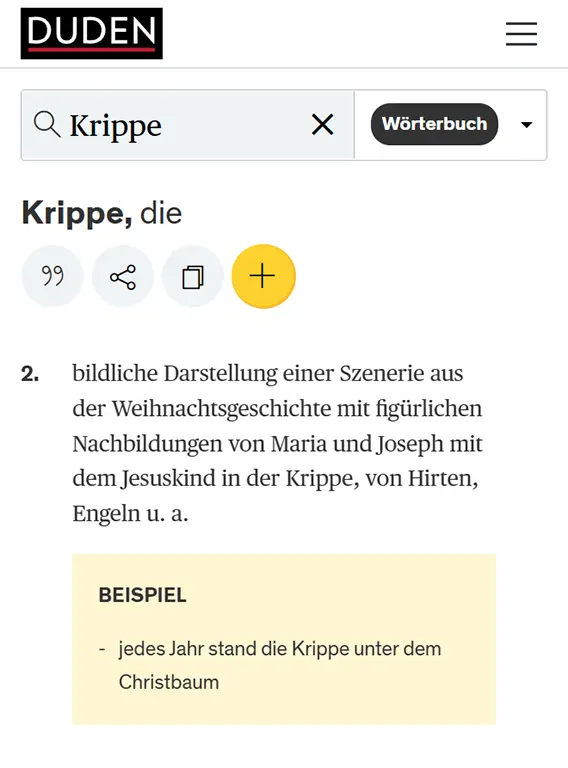
In German, none either. Checked for this Manual against the Duden, and re-verified in August 2026: «Krippe» names the object — sense 2: «bildliche Darstellung einer Szenerie aus der Weihnachtsgeschichte…», the pictorial representation of the Christmas scene—, and neither «Krippe» nor «Weihnachtskrippe» brings any word for the practice.25 German does, admittedly, come close to the exception: the compound Krippenkunst — «crib art»— has circulated in the specialist literature at least since Rudolf Berliner (1886-1967), the art historian who sought to establish the Krippe as an artistic genre in its own right, gave that title to his classic work (Denkmäler der Krippenkunst, Augsburg, 1926-1930);26 but it is a specialists' word: the Duden does not record it.
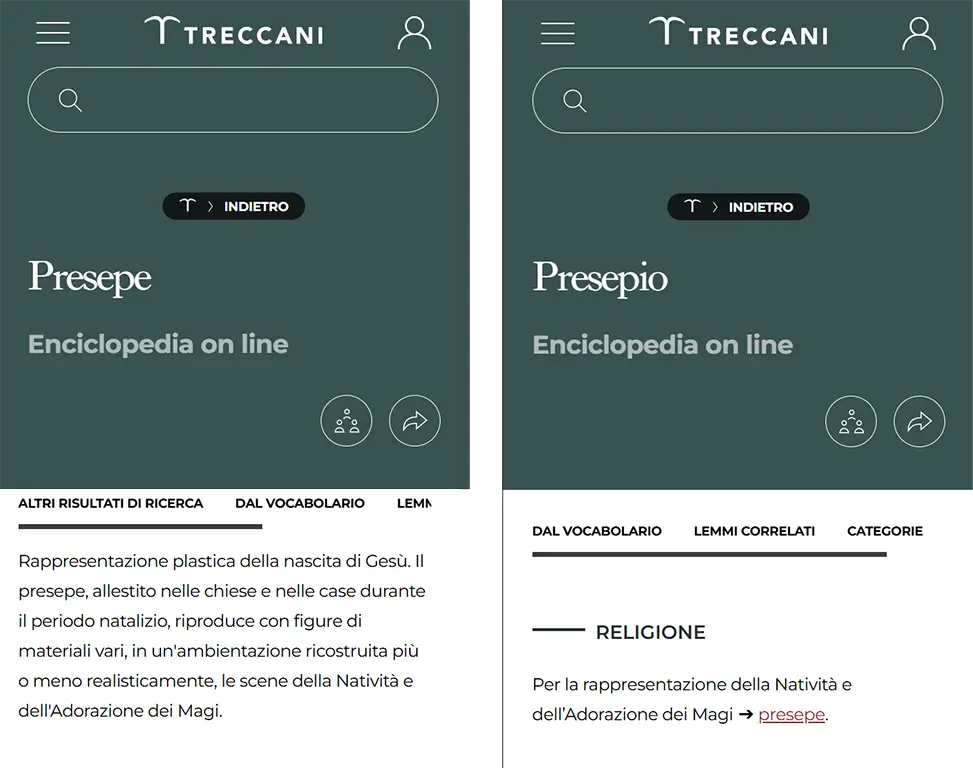
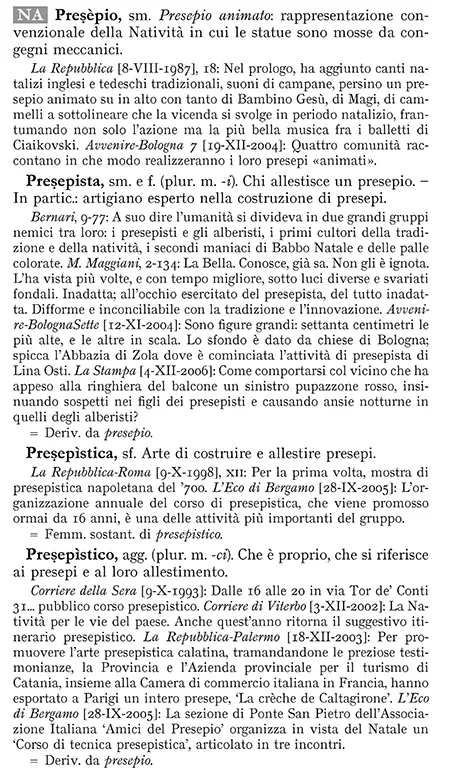
In Italian two words have to be distinguished. «Presepismo» circulates without the backing of the dictionaries: checked for this Manual against the Treccani and re-verified in August 2026 — the entry «presepe» describes the object, its history and its centres of production, without naming any practice, and a search for «presepismo» in the Vocabolario returns no entry—. But the language does have the word for the practice, formed by another route: presepìstica, «sf. Arte di costruire e allestire presepi» — the art of building and setting up nativity scenes—, recorded in the Grande dizionario della lingua italiana with dated press citations (La Repubblica-Roma, 9-X-1998: «mostra di presepistica napoletana del '700»; L'Eco di Bergamo, 28-IX-2005). With it comes its family: presepìstico — «che è proprio, che si riferisce ai presepi e al loro allestimento», documented since 1993— and presepista — «chi allestisce un presepio», and in particular «artigiano esperto nella costruzione di presepi»—. The Treccani Vocabolario records none of the three, as checked on 18 August 2026: the Italian word lives in the historical dictionary and is missing from the dictionary of everyday use.27
Its scope is worth measuring: presepistica names the art of building and setting up nativity scenes, not that of modelling or carving the figures, nor that of studying them, collecting them or publishing on them. This is not an Italian narrowness: the DIEC's pessebrisme also says «art de construir», the art of building. The two Spanish words are the only ones that do not restrict the operation — «arte de los belenes», «arte de los pesebres o nacimientos», the art of nativity scenes—, and that is why they cover everything that is done with them.
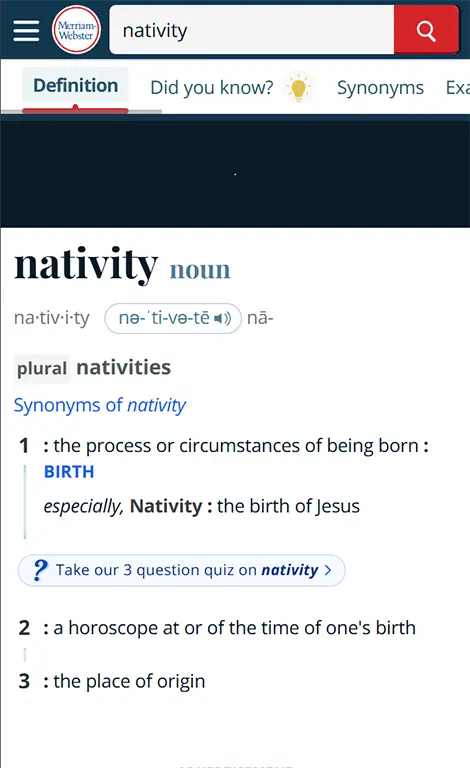
In English, the word does not exist. Checked for this Manual against Merriam-Webster, and re-verified in August 2026: «nativity» is the birth — «the birth of Jesus», in its religious sense— and «nativity scene» names the scene represented; for the practice, nothing.28
These consultations will be repeated from time to time: dictionaries change too, as «pesebrismo» has shown.
The suffix that names whole practices
In Spanish, the suffix -ismo — from Latin -ismus, and that from Greek -ismós— forms nouns that designate doctrines, movements and ways of doing things with features of their own. Interiorismo, paisajismo, escaparatismo, modelismo (interior design, landscape design, window dressing, model-making): in every case, the suffix marks a recognised practice, with tradition, methodology and aims. «Belenismo» belongs to that family: it does not name only a hobby, but a phenomenon that involves artistic creation, cultural transmission, memory and lived experience. In the other languages the suffix exists — -isme, -ismus, -ismo, -ism— but it has not crystallised into an analogous term for this practice.
| Language | Specific term | Available suffix | Situation |
|---|---|---|---|
| Spanish | belenismo / pesebrismo | -ismo | Recorded in the DLE |
| Catalan | pessebrisme | -isme | Recorded in the DIEC and the GEC |
| French | — | -isme | No established equivalent term |
| German | — | -ismus | Not applied to the crib |
| Italian | presepistica / presepismo (unofficial use) | -istica / -ismo | Presepistica in the GDLI, restricted to building and setting up; presepismo, no entry |
| English | — | -ism | Not used for this tradition |
How much each word names: the yardstick of operations
So far, where the word exists. What matters most, and is almost never looked at, is still missing: what each of those words does when it exists. Because a definition does not only identify; in identifying, it sets limits. It says what it is about, and in doing so it also says what it is not about — even if it does not say so—.
In passing through Italian, one has already been measured: presepistica is «arte di costruire e allestire presepi», building and setting up. It is now worth putting the others beside it and applying the same yardstick. The yardstick is the set of operations a nativity scene really requires, and there is no need to invent them: they were inventoried in the previous chapter, in going through the chain of people needed for a scene to exist — modelling and carving, reproducing from a mould, polychroming, dressing, composing the scene, lighting it, collecting, studying, publishing, exhibiting—. The question for each definition is a single one: which of those operations does it name, and which does it leave unsaid?
| Word and language | Work and definition | Which operation it names | What it leaves out |
|---|---|---|---|
| belenismo (es) | DLE: «Arte de los belenes o afición a ellos» | None: it names the art of nativity scenes, without saying what is done with them | Nothing by restriction — the extent remains open— |
| pesebrismo (es) | DLE: «Arte de los pesebres o nacimientos, o afición a ellos» | None, like the previous one | Nothing by restriction |
| pessebrisme (ca) | DIEC2: «Art de construir pessebres» | Building | Modelling, carving, reproducing, painting, dressing, lighting, collecting, studying, publishing, exhibiting |
| pessebrisme (ca) | GEC: «Afecció i art de construir pessebres» | Building — and the hobby— | The same |
| pesebrisme / pessebrisme (ca) | DCVB: «Art de construir pesebres de Nadal» | Building | The same |
| betlemisme (ca, val.) | DNV: «Art de construir betlems» | Building | The same |
| presepistica (it) | GDLI: «Arte di costruire e allestire presepi» | Building and setting up | Modelling, carving, reproducing, painting, dressing, collecting, studying, publishing |
| Krippenbau (de) | Common compound, not an entry for the practice in the Duden: «crib-building» | Building | All the others |
| the art of making nativity scenes (en) | Periphrasis; there is no word | Making | All the others |
| l'art de la crèche (fr) | Periphrasis; there is no word | None in particular, but it names the object | All of them, by not naming them |
The result can be read at a glance: only the two Spanish words do not restrict the operation. All the others name the practice by what is done with the nativity scene in its final stretch — building it, setting it up, making it— and leave out what happens before, which is where authorship lies: modelling and carving the original, reproducing it, painting it, dressing it. And they also leave out what happens afterwards: collecting, studying, publishing, exhibiting. A sculptor who models original figures does not fit into «art de construir pessebres»; nor does a collector; whoever writes a manual like this one, still less.
No reproach to anyone should be drawn from this, because there is none, and because further on, in this same chapter, it is reasoned why a short definition is not a false definition. What there is, is a fact, and the fact belongs to the language, not to people: the words available name the nativity scene by its construction.
The bias of the vocabulary
That fact has a consequence, and it is what this chapter hands on to the next. If the available word names the operation of building, the definition written with that word will define by the object and by its assembly, not by what the practice pursues. German carries it written into the word itself — Krippenbau, crib-building— and that is why it serves as a demonstration: whoever defines from there is not mistaken; they are saying what their word allows them to say.
Hence the inherited definitions resemble one another so closely, including those that do not copy one another: those of the dictionaries, which open with «art» and continue with «of building», and also the administrative definition of the nativity scene that underpins the Spanish heritage declaration — the one that describes it by its figures and its setting, which the first chapter of this series has already set out and the chapter on the dossier examines in full—. They do not coincide because they copy each other: they coincide because they start from the same vocabulary, and the vocabulary looks at the object.
This is what the chapter on the definition receives as established, and not as opinion: the inherited definition defines by the object because the vocabulary does. A definition by purpose will have to break that habit knowingly, and will have to be expressible in the six languages without leaning on any of these words — not even on the two that exist—.
What a word makes visible
Does it really matter that the word is missing? Linguistics has long discussed this under the name of linguistic relativity: in its strong version — language determines thought— it finds no support in experimental research; in its weak versions — language orients attention and makes certain distinctions easier or harder— it does find some, in part.29 Anthropology contributes a useful concept: hypocognition, formulated by Robert Levy in his study of the Tahitians (1973): the lack of an established term for a real experience leaves that experience less well equipped to be thought about, studied and passed on.30 And to see what this means in practice there is no need to look for examples in other languages: «belenismo» itself is one. This is what each language of the Manual needs today in order to say that one word:31
| Language | What it needs today to say «belenismo» |
|---|---|
| English | the art of making nativity scenes — the practice can only be described |
| French | l'art de la crèche (de Noël) |
| German | die Kunst des Krippenbaus — or the compound Krippenkunst, the specialists' word the Duden does not record |
| Italian | l'arte del presepe — or presepistica, which the GDLI records and restricts to building and setting up |
And the decisive proof is the title of this Manual. Without an equivalent word, «Manual de Belenismo» no longer fits into three words: Manual of the Art of the Nativity Scene, Manuel de l'art de la crèche — a phrase where there was a word—. Two languages come close, and neither gets all the way: German, with Handbuch der Krippenkunst — with the word in the title of Berliner's work, Denkmäler der Krippenkunst, which its own dictionary does not record—, and Italian, which could say Manuale di presepistica with a word its historical dictionary does record but restricts to building and setting up: a manual that also teaches modelling, composing and research would no longer fit entirely within that title.
Why each language has responded differently
That some languages have the word and others do not is not an accident spread evenly: each language has its own reasons, and they are worth knowing, because what can be done in each depends on them.
Spanish and Catalan formed their word on the local name of the object — belén, pesebre, pessebre— with the suffix both languages use to name established practices (-ismo, -isme). And they formed it late: the word circulated in use long before it entered the dictionaries — «belenismo» was not yet in the academic dictionary of 2001—. The word was not born with the practice: the practice gradually called for it.
Italian solved the problem by a route other than the suffix -ismo. Its morphology would allow it without strain, and «presepismo» does in fact circulate; but the word that took hold was another: presepistica, with the suffix -istica — that of artistica, which names both a technique and its art—. And it is not alone: presepista for whoever practises it, presepistico for whatever concerns it, and arte presepiale in the Neapolitan sphere. Italian, then, has had the word for almost thirty years, according to the dated citations in its historical dictionary. It lacks two things: appearing where the ordinary speaker would look for it — the everyday reference dictionary— and covering the whole practice, because its definition stops at building and setting up.
German needs no suffix: it compounds. Krippenkunst — the art of the crib, in a single word— has existed for a century in the specialist literature, ever since Rudolf Berliner gave that title to his classic work. Its problem is not one of formation but of recognition: the Duden does not yet record it.
French has the hardest road: its suffix -isme points to doctrines and ideologies before trades, and the base word works against it — crèche today means, first and foremost, a day nursery for children—. A hypothetical crèchisme would be born confused.
And English is the most deceptive case, because its lack is not grammatical. It has tools to spare for naming trades: it compounds with the gerund — woodworking, bookbinding— and has a suffix of its own for trades, -ery — pottery, carpentry, archery—. It could say crib-making tomorrow. The only thing its morphology advises against is the suffix -ism, which in English names doctrines and movements — even within art: impressionism is a movement of painters, not a workshop trade—, so that a hypothetical cribism would sound like an ideology. But that is the small explanation. The large one is historical. The nativity scene as a popular art grew up in Catholic lands — Naples, Provence, Iberia, Bavaria—, and England broke with Rome in the 16th century; on 8 June 1647 its Parliament went so far as to abolish the feast itself: «That the said Feast of the Nativity of Christ […] be no longer observed as Festivals or Holy-dayes within this Kingdome of England».32 Where the feast was forbidden, the practice put down no popular roots in the centuries when the other languages were making their words; and where there is no practice, no language makes its own — it is the same law of hypocognition that this chapter has already shown, seen from the other side—. Today the English-speaking world also composes its nativity scenes, but it names them with what it had to hand, and both its words for the object name it after the manger: crib, its own — Old English cribb, sister of German Krippe: a manger since before the 12th century and, by extension, the representation of the Nativity—, the word of British and Irish Catholics; and crèche, taken from French — another old Germanic word for the manger—, the usual word in America.33 What English never made is the word for the practice. And its habit with the arts of other peoples is well known: it adopts the native name — that is how flamenco, ikebana or origami came in—. Seen properly, it is not the most closed of the six languages: it is the door most open to a loanword.
The solution that was invented once before: the federation's Latin
This problem is not new, and the proof is in the name of the common house. When, on 31 May 1952, seven nativity-scene associations founded the international federation in Barcelona — today there are 21 organisations—, they needed a name that would favour no language, and no modern language could give them one. They solved it in Latin: Universalis Fœderatio Præsepistica.34 The root could not have been better: praesepe is the word of the Nativity narrative itself — «et reclinavit eum in praesepio», says the Gospel of Luke in the Vulgate (2:7), and the manger returns as a sign in 2:12 and 2:16—.35 But the derivative, praesepistica, does not belong to classical Latin: it is a modern formation on that ancient root — and not an isolated oddity: Italian keeps that same formation alive in presepistica—.36 Put plainly: the world federation of nativity-scene art and practice had to build its own word, because none existed. It is exactly the situation this chapter describes — and the precedent for the decision this Manual will have to take—.
One language, many territories
If the unlabelled Spanish word is pesebrismo, the next question is inevitable: what is said on the other side of the Atlantic?
The Diccionario de americanismos of the Association of Academies of the Spanish Language records pesebre only within a set phrase.37 The consequence is counter-intuitive and should be stated with care: if the Christmas sense of pesebre is not recorded as an Americanism, it is because it is not considered specific to America but general throughout the domain. It is not that it is said differently there; it is that it is said there too.
On the relative size of each territory, the most recent figure from the Instituto Cervantes puts native speakers of Spanish at about 520 million, of whom Spain contributes roughly one in ten.38
What this Manual is not going to do is draw the distribution of belén, nacimiento and pesebre by country. A map of that distribution circulates, is repeated with confidence and is not proven. Establishing it would require corpus work — CORPES XXI by country, the Diccionario del español de México of El Colegio de México— that is not the work of this chapter; that is why the map stays out.
From all this follows an editorial decision that this Manual declares here and upholds in all six languages:
There will be a single Spanish version, with the variants named within it. Never two versions.
The aim is not to choose one Spanish and translate the others, but to write a single one that obliges no reader to feel like a guest. It is the same rule that governs among the Manual's six languages, applied inwardly to one of them: no territory is «us».
Why the definitions fall short — and why that is not a reproach
It is easy, at this point, to take the next step and complain: that «arte de los belenes o afición a ellos» — the art of nativity scenes, or a fondness for them— is not much; that «art de construir pessebres» — the art of building nativity scenes— says nothing about research, or scenography, or perspective; that the academies dispatch in six words what takes up a whole manual.
It is better not to take it. That step is an error of method, and it is also unfair.
A dictionary definition does not describe a practice: it identifies it. It gives the nearest genus — art— and just enough for whoever comes across the word to know what is being talked about. It does not develop, because developing is not its job. Nobody reproaches the dictionary because the entry «architecture» does not teach how to calculate a roof.
So two things that the complaint mixes up should be kept apart: one is that a definition is short, and another that it is false. These are short. And in what they say, they get the essential thing right: they say «art», which is exactly what was in dispute.
What is missing, then, is not a correction but a development: what that art links together when it is truly practised. The research that decides what is represented and on what grounds. The sculpture that gives body to the characters, with authorship and with judgement. Reproduction and polychromy, which multiply a figure without betraying the original. Costume, which can be documented or invented, and it is not all the same. Scenography, which manages space, distance and light so that a scene tells its story. And transmission, without which all of the above dies with whoever knew it.
None of that fits into a dictionary entry, nor does it need to. It fits into a manual. And that is exactly the work that begins here.
Why the definition is not here
This chapter ends without defining nativity-scene art and practice, and that is neither caution nor courtesy: it is the order of the work. A definition stated before the research is not proven afterwards — it is illustrated—, and the subject is full of definitions born that way. This Manual's definition arrives in the next chapter, as a result; and it arrives after the word because it needed to know two things that could only be found out here: in which languages the name exists, and how much of this world it manages to name.
What is done, with what has been gathered so far, is the list of conditions: what that definition will have to meet in order to be fair, with each condition arising from something proven and not from a preference. Keep the nearest genus «art», which three concurring academies have secured. Supply the specific difference that it is not a dictionary's place to give. Cover the world and not only production. Mark the upper limit. Not legislate for other people's usage. Not depend on the reader's faith. And be expressible in the Manual's six languages without a note of equivalence. The full list, condition by condition and with the origin of each, is handed over to the chapter on the definition: there it is put to work, and there it is also said which of those conditions does not stand up to examination.
The name
There remains the decision that this chapter has been preparing since its first page, and it prepares it without taking it, because it is not a decision of method but one for the author.
The file puts six things on the table.
One. In the dictionary of the Spanish language, belenismo is the word labelled as peninsular and pesebrismo the unlabelled one. The word that sounds most natural in Spain is, in the dictionary's system, the more local of the two.
Two. The other five languages of the Manual name the object after the manger, not after the city: pessebre, presepe, crèche, Krippe, and in English crib — sister of Krippe— alongside the loanword crèche. The Latin of the international federation, praesepe, goes the same way. Outside the Manual, the city route also appears in Occitan, but as the word of one place. In Mistral's Tresor dóu Felibrige, crècho — in Limousin grèscho, sister of crèche— is, with no label, the «représentation de la nativité de Notre-Seigneur», and for the trough it refers to grùpi; belèn also names the representation, but with an indication of place: «à Arles». In the reference dictionary of Provençal, the city is the local word and the manger the general one.39
Three. The sign the evangelist gives is the manger, not the city. In Luke's account, what identifies the newborn child to the shepherds is that he is lying in a manger, and the detail is repeated three times within a few verses.40 The word that names the practice from that root names, at the same time, what the text points to as the sign.
Four, and it is the one this chapter contributes. In Catalan, the word for the practice was born marked by a city — «una barcelonería esquisida», wrote Carner in 1907— and today it is the standard word in two academies, with no territorial label. That is to say: a century ago the Catalan word travelled the road that the Spanish word still has ahead of it. It was born local and became general, not because anyone decreed it, but because it was used outside its city until the label stopped making sense.
Five. Morphology does not settle the question, and the noise is distributed more symmetrically than it seems. The suffix -ismo on a place name sometimes produces territorial movements — catalanismo, andalucismo— and sometimes practices — alpinismo, andinismo, that is, mountaineering—: usage decides, not grammar. And both roots carry unrelated senses, documented in the same dictionary. And there is a fourth noise that the dictionaries do not label and the newspaper archive does: belenista also names the native of Bethlehem, and that is how it reads in the press of 1899 (see the section «The Spanish-language series»). Nor is any of these noises new: in 1864, a Barcelona journalist joked that the newly announced society had avoided calling itself «de belenes» in case the authorities opened proceedings against it on the day there was a belén (see the section «The Spanish-language series»). The joke required the reader to understand both senses at once, and today both are still in the dictionary. Belén carries, alongside the nativity scene, three colloquial senses with a negative charge — «sitio en que hay mucha confusión», «confusión o desorden», «complicación, dificultad, enredo: meterse en belenes» (a place where there is great confusion; confusion or disorder; complication, difficulty, entanglement: to get oneself into a mess)— and the obsolete phrase «en Belén» for «en Babia» (miles away, daydreaming).41 Pesebre carries its own pejorative sense; and pesebrismo, the finished word, carries another — the one in the DLE, and the sinecure value that the DNV labels as sociological—. Neither of the two houses is clean: the noise of belén lives in the base; that of pesebrismo, in the derivative.
Six, and it is the last thing this chapter puts on the table. When, in Spanish, someone first had to name whoever does this, the manger root was chosen: pesebristas, in 1864, and so for the rest of the century, while the thing went on being called belén. The word belenista does not appear in the Barcelona press until the 20th century, and it is the one in use today. The file on that change —what is known, what is not, and how it might be dated— is in the section «The Spanish-language series». What matters here is the consequence: the root that usage ended up preferring is not the one that usage itself had chosen first.
Two things are left standing from this. The first: the word in -ismo, from either root, does a job that the word for the object cannot do — disambiguate—. The Wikipedia entry in Spanish is titled «Belenismo» and not «Belén», and one need only try the opposite title to see why: «Belén» on its own is at once the city, the scene, a woman's name and a muddle. The second, and it is the only one without noise in any dictionary: the manger root names Luke's sign. That motivation has no rival.
From all the above a proposal ought to emerge: the international word for the practice. This Manual does not declare it yet, and the reason is one of method: choosing the name of a branch of art is not a matter of preference, but of proof. Before deciding, one has to examine what each language — and each academy— has done with the words available: those that name after the city, those that name after the birth and those that name after the sign in the narrative itself, the manger. That examination is what has just been done, language by language and work by work, and here it is gathered together. The decision, on the other hand, is not taken here: it comes out of the next chapter, the one on the definition, and it comes from there for a reason that is not one of order but of drafting — this Manual's definition begins by naming the practice, and it cannot write that first word without having chosen it—.
What is declared from now on is the criterion by which the six versions of this Manual are written: where a language already has, or hints at, a word of its own, the Manual uses it and explains it — belenismo and pesebrismo in Spanish, pessebrisme in Catalan, Krippenkunst in German, presepismo in Italian—; where it does not, the Manual names the practice with clarity rather than with a label. Nothing is imposed: it is examined, proposed and used. That is how words have always been made.
That is what there is. What name this Manual bears — and with it, perhaps, the practice it describes— is a decision to be taken with the file in front of us, and not before.
Clarity, not jargon
One last mismatch remains, and this one occurs within each language: that of the words of the trade. It has two faces, and they should be told apart. The first is jargon as a password: technical vocabulary used without ever being explained, which does not raise the discipline — it puts up a barrier—. The second is its opposite, and does more harm because it goes unnoticed: the approximate word put where the trade word belonged. And this second one comes with an alibi: when someone corrects it, the defence is that «it is the jargon of the sector» — and so technical ignorance is camouflaged as tradition—.
An example the reader will hear a thousand times: calling terracotta figures «barro», raw clay. Barro is clay with all kinds of impurities, and in sculpture it serves one purpose only: modelling the original — which will never go into the kiln—. From that original a plaster waste mould is taken, and the barro goes back to the clay bin to serve for another original; since it already carries traces of plaster, if it were fired the figure would simply explode. What is fired is another material — clean clay or ceramic body—, and in the kiln, from 900 °C upwards, that clay vitrifies: its structure changes and it never again becomes what it was. Only then does the figure deserve the name of terracotta. It is as with metals: once copper and tin have been melted together, nobody goes on calling the result «copper» — it is bronze, and it has a name of its own because it is something else—. Whoever says «barro» where they should say «terracotta» is not simplifying: they are erasing the trade and the transformation the word carries within it.
Naming well is not speaking obscurely; it is the opposite of both things — neither password nor approximation—. If we want the nativity scene to be understood and valued, we need precision, explained.
What this is for, for each person
This chapter is not a disquisition before the work: it is work. And it does not have a single addressee, because nativity-scene art and practice does not have a single protagonist: it is a chain of roles, each with its own trade and its own intention. Whoever models or carves figures is creating sculpture, with authorship, whether aware of it or not. Whoever reproduces them, whoever paints or dresses them, whoever builds the scenery. Whoever buys the figures and composes their scene at home. Whoever collects. Whoever, from within the associations, organises the exhibitions and competitions that bring nativity scenes out into the street. And whoever visits a nativity scene and only looks — they too are inside: the scene is composed for them—. That chain is traced in full in the previous chapter, with what the sociology of art allows us to say about it, and each of its roles then has its own examination in «Who is who in nativity-scene art and practice?»: here it is recapitulated and referred to, not developed. And one of its pieces has its home in the block on composition: that whoever arranges the figures on the moss is already composing — decorating is already creating, because it is already deciding—, with the domestic proof that is reasoned there. All of them are inside nativity-scene art and practice, and none of them is «the» nativity-scene maker, without qualification. And all of them, each in their own way, do the same thing: pay homage to the birth of Jesus — nothing around that event is neutral: even the Christmas Eve table is laid differently from every other supper of the year—.
That is why the word matters to all of them, but to each in a different way. For whoever models, the word decides authorship: whether they are called artist or craftsman. For whoever composes, the status of what they compose: art or ornament. Whoever places their figures at home has to recognise the dignity of what they have in their hands: an artistic discipline with a history, or an ornament that decks out the season from mere habit. The nativity scene is not humble by nature; we make it humble when we treat it as routine. And for the practice as a whole, the word decides cultural recognition: a word badly placed does not harm just one person — it harms every link in the chain, each in its own way—.
The word is not an ornament of the practice: it works within it, like one more tool. Whoever knows how to name what they do does it better — and knows how to explain it and defend it before anyone who doubts it—.
Open questions
There remain questions that this chapter leaves set up, on purpose. If millions of people recognise a nativity scene instantly, why do they not recognise the name of those who have raised that scene to an art form? If Spanish and Catalan have developed a word with a density of its own, is it not time for the other languages to examine it? Is it not paradoxical that so widespread a tradition should lack a common name outside two languages? And what if the first step towards the nativity scene receiving the cultural recognition that its practice already has were precisely to give it a name where it still has none?
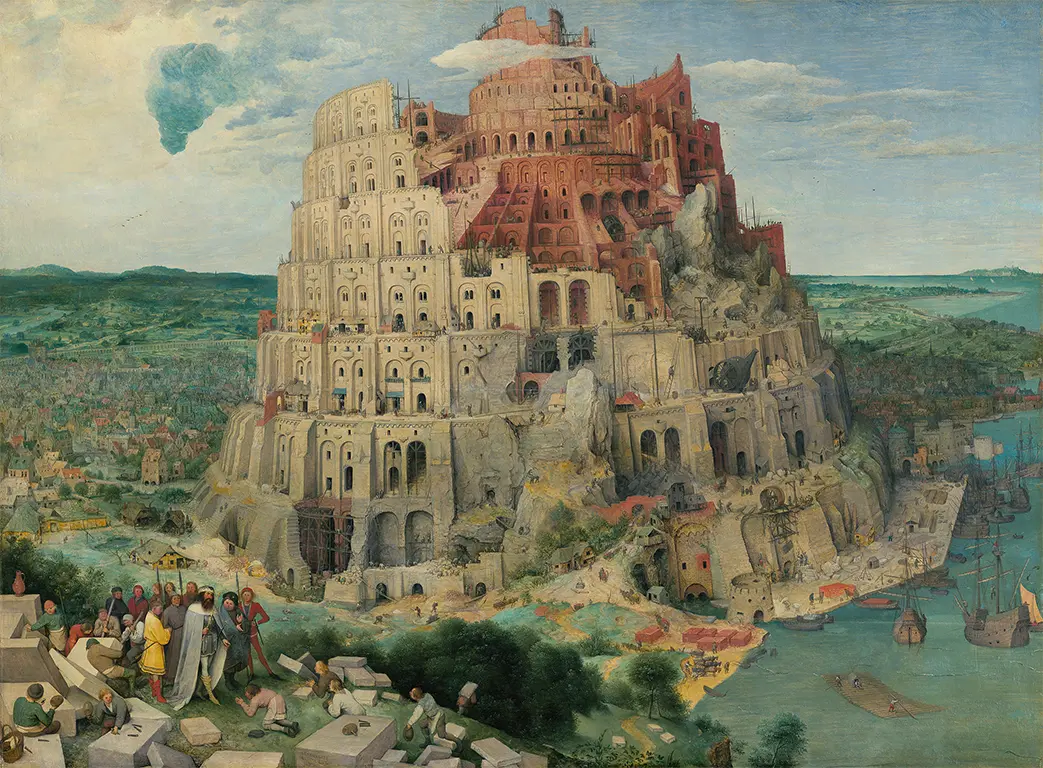
The Tower of Babel tells of the project left unfinished when its builders stopped understanding one another: the confusion of tongues was not only a punishment — it was the division that prevented what had been begun from being finished—. The nativity scene is its inverted image. At Babel men build towards heaven and lose their common language; in the nativity scene heaven comes down to a manger, and the scene is understood in every language at once — millions of people recognise it instantly, without translation—. The shared work left half-done at Babel is finished here every year, in thousands of homes and squares. The whole lacks only one thing: the common name. Without it, the practice remains split into descriptions that do not recognise one another. What this chapter hands on to the next is the measured name: in which languages it exists, how much of this world it manages to name, and why the inherited definition looks at the object. With that in hand, the next chapter defines.
To name well is to begin to understand.
References
The footnotes locate the source and say how and when it was consulted; whatever bears on what the reader should believe is in the body of the text. The numbering is new: when the two chapters were merged, the notes were renumbered in order of first appearance. The translations from Chinese, Greek, Latin, Spanish, Catalan, French, German and Italian are the Manual's own.
Confucius, Analects XIII,3. Checked against James Legge's translation (1893). ↩
Confucius, Analects XII,11 — answer to Duke Ching of Ch'i; Legge (1893): «There is government, when the prince is prince, and the minister is minister; when the father is father, and the son is son»—. Checked on 16-VIII-2026 (monadnock.net/confucius/analects-12.html). ↩
Plato, Cratylus 383a. Greek text of John Burnet's edition (Platonis Opera, Oxford University Press, 1903), checked on 22-X-2026 in its digital edition on Perseus (perseus.tufts.edu, Cratylus, page 383). The Manual's own translation. ↩
Annuarium Statisticum Ecclesiae, data for 2024 (published with the Annuario Pontificio 2026); data released by Vatican News, prepared by the Central Office of Church Statistics, which is the office that compiles the yearbook (28-III-2026, vaticannews.va/en/vatican-city/news/2026-03/new-data-from-annuario-pontificio-2026-shows-catholics-growing.html, consulted on 22-X-2026): in 2024 the Catholic population was «just over 1.422 billion», and the proportion of the baptised in the world remained «at approximately 17.8%». ↩
Lo Esquirol: semmanari literari, crítich y festiu, any 1, núm. 7 (19-VII-1868), p. 1. Barcelona, carrer del Pi, 5. Còpia digital: ARCA — Arxiu de Revistes Catalanes Antigues, Biblioteca de Catalunya. Domini públic. Located for this Manual, with a screenshot in its archive. It is not the oldest testimony of the word in ARCA: the search for «pessebre» (8,910 results, of which the portal shows only 2,000; consulted year by year on 22-X-2026) already returns in 1865 pages of Un tros de paper (the first, núm. 21, 8-X-1865, p. [4]), and in 1868 La Pubilla, núm. 31 (5-I-1868), p. [4]; no result from 1861 to 1864. ↩
Josep Carner (Barcelona, 9-II-1884 – Brussels, 4-VI-1970): Gran Enciclopèdia Catalana, s. v. «Josep Carner i Puig-Oriol» (enciclopedia.cat, consulted on 22-X-2026). The same entry records his membership of the Lliga Regionalista and his contributions, from December 1902, to La Veu de Catalunya, «l'òrgan d'aquell partit». ↩
Carner, Josep [signed «Joseph Carner»], «El Nostre Naixement», La Veu de Catalunya, any 17, núm. 3122, evening ed. (31-XII-1907), p. 3, col. 7. Còpia digital: ARCA, Biblioteca de Catalunya. Domini públic. Literal wording established against the 300 dpi facsimile on 17-VIII-2026; the archive's optical character recognition contains eight misreadings, which have been corrected against the image. ↩
Associació de Pessebristes de Barcelona, «Història de l'Associació de Pessebristes de Barcelona» (pessebristesdebarcelona.cat/historia-de-lassociacio-de-pessebristes-de-barcelona/, consulted on 20-VIII-2026, re-verified on 22-X-2026). Its emblem declares «fundada l'any 1863». The three news items in the Diario de Barcelona —9-II-1862, 17-XI-1863 and 9-I-1864— and the statutes of 15-III-1863 are quoted through that history, which transcribes them. The issues of the newspaper from those years are not in the digital newspaper archive of the Arxiu Històric de la Ciutat de Barcelona, which offers the Diario de Barcelona from 1885; the dates are therefore given as the association gives them. The statutes it transcribes are in Catalan. ↩
El Lloyd español, 10-I-1864, p. 2. Issue in the Hemeroteca Digital of the Biblioteca Nacional de España, checked against the facsimile on 22-X-2026. ↩
La Ley, Madrid, 30-XII-1867, p. 3. Same source and same date of consultation. The text is presented as a quotation from «un colega de Barcelona», who is not identified in the item. ↩
Crónica de Cataluña, afternoon edition, 9-I-1877, p. 2. Issue in ARCA (Biblioteca de Catalunya), checked against the facsimile on 22-X-2026; the ends of some lines fall into the binding gutter. ↩
La Vanguardia, 16-I-1934, p. 23. Same source. Oldest located testimony of pesebrismo, not necessarily the oldest in existence: the search returns 1,370 unrefined results, and that newspaper archive's search engine admits approximate matches — it returns helenismo when asked for belenismo—, so no count and no earliest date is valid until each issue has been opened. Issue still in copyright: it can be consulted on the BNE premises, and cited but not reproduced. ↩
Counts made for this Manual on 20-VIII-2026 in the digital newspaper archive of the Arxiu Històric de la Ciutat de Barcelona (ahcbdigital.bcn.cat), basic search over the whole collection, with a screenshot of each query: pesebristas, 962 issues (1801-1900: 1; 1901-1935: 389; 1936-1975: 566; after 1975: 6); belenistas, 68 issues; belenista, 23 issues, none earlier than 1901. These are index counts, not refined issue by issue, and the bands that archive offers are broad: the internal distribution of the 1936-1975 band cannot be read from them, and that is why nothing is stated here about one word replacing the other. ↩ ↩
El Correo de Zamora, 7, 8, 9 and 10-III-1899, p. 3, consulted in the Hemeroteca Digital of the Biblioteca Nacional de España on 20-VIII-2026. False positives from optical recognition of helenista: Semanario pintoresco español, 5-IX-1847, p. 5; La Tertulia (Santander), 15-VI-1877, p. 7; Revista de Cuba, 1880, p. 183; El Liberal, 22-VII-1917, p. 3. ↩
Federación Española de Belenistas, «Historia de la FEB» (anunciata.es/quienes-somos/historia/, consulted on 20-VIII-2026, re-verified on 22-X-2026): initial contact from the Madrid association at the beginning of 1963, organisational meeting on 6-IV, official letter of approval from the Director General de Política Interior of the Ministerio de la Gobernación on 29-IV (stamp of the Jefatura Superior de Policía, 7-V) and founding assembly on Saturday 29-VI-1963, with five associations — Madrid, Pamplona, Valladolid, Lugo and Zafra—. The body was at first called Federación Española Belenista and adopted its present name when it was refounded on 13-V-1972 (anunciata.es/quienes-somos/). Its first regulations, signed on 6-IV-1963 and published in full by the federation, say in art. 2 a): «Aunar los esfuerzos de cada asociación, para que de esa unión surjan más y mejores iniciativas encaminadas a que el belenismo o pesebrismo adquiera mayor auge y robustez en España». The figure of nearly eighty federated associations is current, not from 1963. The hypothesis that the federation's name fixed the word belenista is this Manual's own (Inferred from context); testing it requires a curve of use by year, before and after 1963, in a corpus that reaches the present day — the newspaper archive used here does not reach that far—. ↩ ↩
Ley de Asociaciones of 30-VI-1887, published in the Gaceta de Madrid, year CCXXVI, no. 193, Tuesday 12-VII-1887, vol. III, pp. 105-106; arts. 4, 7 and 8. Issue consulted. In April 1963 it was still in force, supplemented by the Decree of 25-I-1941 on the exercise of the right of association: both were repealed by Ley 191/1964, de 24 de diciembre, de Asociaciones (BOE, 28-XII-1964, pp. 17334-17336, first final provision). The federation's first regulations were drawn up «al amparo» of those two norms, according to the federation itself (anunciata.es/quienes-somos/historia/). ↩
ARCA, full-text search, s. v. «pessebrisme», faceted by period. Count made for this Manual on 17-VIII-2026, with a screenshot in its archive: 115 pages in 26 periods. ↩
Dalmau i Corominas, Jordi, El pessebrisme, Quaderns de la Revista de Girona 39, Diputació de Girona i Caixa de Girona, Girona, 1992, p. 7 (chronology). Copy checked on 17-VIII-2026. ↩
Diccionario de la lengua española, s. vv. «belenismo» and «pesebrismo» (dle.rae.es, consulted on 15-VIII-2026); DIEC2, s. v. «pessebrisme» (dlc.iec.cat); Diccionari normatiu valencià, s. vv. «pessebrisme» and «betlemisme» (avl.gva.es); Gran Enciclopèdia Catalana, s. v. «pessebrisme» (enciclopedia.cat, consulted on 15-VIII-2026); Diccionari català-valencià-balear, s. v. «pessebrisme» (dcvb.iec.cat). Screenshots in the Manual's archive. ↩
Diccionario de la lengua española, s. v. «belenismo» (dle.rae.es, consulted on 15-VIII-2026). The 22nd edition (2001), in the online consultation maintained by the RAE (rae.es/drae2001/belenismo, 22-X-2026): «La palabra belenismo no está en el Diccionario». That it entered at the federation's request in the 23rd edition, presented on 17-X-2014, is stated by the Federación Española de Belenistas (anunciata.es/quienes-somos/, 22-X-2026). ↩
Diccionario de la lengua española, s. v. «pesebrismo» (dle.rae.es, consulted on 15-VIII-2026). The 22nd edition (2001) does not record it: «La palabra pesebrismo no está en el Diccionario» (rae.es/drae2001/pesebrismo, 22-X-2026). ↩
Dicionario da Real Academia Galega, s. v. «presebe» (academia.gal). ↩
Elhuyar hiztegia, entries «belenismo», «pesebrismo» and «pesebre» (elhuyar.eus). Euskaltzaindiaren Hiztegia (euskaltzaindia.eus, consulted on 22-X-2026), s. vv. «ganbela» («iz. Aska», with the example «Sehaskarik ez zuelako, ganbela batean ipini zuen haurra»), «aska» («Abereei janaria jartzen zaien kutxa moduko ontzia, gehienetan zurezkoa») and «jaiotza» (sense 2, «Jesu Kristoren jaiotzaren irudikatzea…»); the searches for «belen» and «belenzale» return no entry. ↩
Le Petit Robert / Le Robert, s. v. «crèche» (dictionnaire.lerobert.com/definition/creche). First consultation made for this Manual, with a screenshot in its archive; re-verified on 15-VIII-2026. ↩
Duden, s. v. «Krippe» (duden.de/rechtschreibung/Krippe) and search for «Weihnachtskrippe» (duden.de/suchen). First consultation made for this Manual, with screenshots in its archive; re-verified on 15-VIII-2026. ↩
Berliner, R. Denkmäler der Krippenkunst. Augsburg: B. Filser. Published in instalments in 1926-1930, according to the catalogue of the Deutsche Nationalbibliothek (d-nb.info/579181987: «Erscheinungsdatum: 1926-1930»; «Lfg 1-20/21»; consulted on 22-X-2026). Digitised copy on Internet Archive (archive.org/details/denkmlerderkri00berl); its title page — «168 Kunstdrucktafeln», «Dr. Benno Filser Verlag, G.m.b.H., Augsburg»— bears no date. ↩
Treccani, entry «presepe» (treccani.it/enciclopedia/presepe) and online Vocabolario: the search for «presepismo», and also those for «presepistica», «presepistico» and «presepista», return no entry (re-verified on 15-VIII-2026 and 18-VIII-2026). Grande dizionario della lingua italiana (Battaglia; UTET Grandi Opere – Accademia della Crusca), consulted in its digital edition (gdli.it/Ricerca/Pagina?q=presepe, 18-VIII-2026): the search returns three pages — vol. XIV, p. 235 (from PRESENZIALE to PRESEPE); Supplemento 2004, p. 656 (from PREPARATORY SCHOOL to PRESOCIALE); Supplemento 2009, p. 661 (from PREREGÌA to PRESIDENTICIDA)—. The entries presepe and presepio, with their etymology («voce dotta, lat. praesaepe, propr. 'recinto chiuso', comp. da prae 'davanti' e dal tema di saepire 'circondare [con una siepe]'»), are in the main body of vol. XIV (pp. 235-236). The entries presepistica, presepistico, presepista and the sense «presepio animato» are in the Supplemento 2009, p. 661 (image of the page at gdli.it/JPG/GDLI24/GDLI_Supplemento_2009_Pagina_661.jpg, consulted on 22-X-2026). Also recorded there are presepiale and presepiario, both labelled «Letter.» and exemplified with Manganelli: they name what relates to the nativity scene, not the practice, and that is why they are left out of this chapter (a matter for the lexicon). The sense «presepio animato» is preceded by the label «NA», which the digital edition does not explain. ↩
Merriam-Webster, s. v. «nativity» (merriam-webster.com/dictionary/nativity). First consultation made for this Manual, with a screenshot in its archive; re-verified on 15-VIII-2026. ↩
Wolff, Phillip, and Holmes, Kevin J., «Linguistic relativity», WIREs Cognitive Science, doi:10.1002/wcs.104 (consulted on 22-X-2026 in the copy of the article at sites.socsci.uci.edu). A review of the experimental research: it finds no support for the idea that language determines the basic categories of thought, and does find support for the idea that it can make some distinctions difficult to avoid and enhance certain kinds of thinking. ↩
Levy, R. I. (1973). Tahitians: Mind and Experience in the Society Islands. Chicago: University of Chicago Press, pp. 324 and 342 (the book's index, s. v. «Hypocognition»). Levy distinguishes «hypercognated» and «hypocognated» feelings, the latter «controlled by cultural invisibility or at least by difficulty of access to communication». Digitised copy on Internet Archive (archive.org/details/tahitiansmindexp0000levy), search within the text on 22-X-2026. ↩
Descriptive equivalents: the Manual's working translation. The absence of a lexicalised word in each language has been verified against the dictionaries cited in the survey carried out in this same chapter. ↩
«An Ordinance for Abolishing of Festivals», Parliament of England, 8-VI-1647, in Acts and Ordinances of the Interregnum, 1642-1660 (British History Online, british-history.ac.uk/no-series/acts-ordinances-interregnum/p954; checked on 16-VIII-2026). ↩
Merriam-Webster, s. vv. «crèche» — sense 1: «a representation of the Nativity scene»; from Old French creche, 'manger', of Germanic origin— and «crib» — sense 1: «a manger for feeding animals», recorded before the 12th century; sense «a crèche»; from Old English cribb, related to Old High German krippa— (merriam-webster.com; consulted on 16-VIII-2026). ↩
Universalis Fœderatio Præsepistica (unfoeprae.org, consulted on 15-VIII-2026): «La Un.Foe.Prae (Universalis Foederatio Praesepistica) se fundó en Barcelona el 31 de mayo de 1952», with «la reunión de siete asociaciones belenistas»; «Hoy cuenta con 21 organizaciones». ↩
Nova Vulgata, Lk 2:7 («et pannis eum involvit et reclinavit eum in praesepio»), 2:12 and 2:16 (vatican.va, checked on 15-VIII-2026). ↩
On the modern formation of praesepistica: Lewis, C. T., and Short, C., A Latin Dictionary (Oxford, Clarendon Press, 1879), in the Perseus digital edition (consulted on 22-X-2026), records praesepe («praesēpe, praesēpio, etc., v. praesaep-») and no word praesepistic-; a search for «praesepistica» in the dictionary returns no results. ↩
Diccionario de americanismos, Asociación de Academias de la Lengua Española, s. v. «pesebre» (asale.org). ↩
Instituto Cervantes, El español en el mundo, data for 2025. ↩
Mistral, Frédéric, Lou Tresor dóu Felibrige, vol. I, digitised copy on Internet Archive (archive.org/details/loutrsordufelibr01mist, consulted on 22-X-2026): s. v. «crècho», p. 667 («Crèche, représentation de la nativité de Notre-Seigneur […]; pour mangeoire, v. grùpi»); s. v. «belèn», p. 259 («représentation de la nativité de Notre-Seigneur Jésus-Christ, crèche, à Arles»). The initial lead came from the Occitan Wikipedia (s. v. «Betlèm», screenshot by Emili Solé, 17-VIII-2026), which referred to this work; the dictionary says something different from the lead. ↩
Lk 2:7.12.16, checked in the Nova Vulgata (vatican.va). ↩
Diccionario de la lengua española, s. v. «belén» (dle.rae.es, consulted on 17-VIII-2026, screenshot in the Manual's archive): sense 1, nativity scene; senses 2-4, colloquial («sitio en que hay mucha confusión», «confusión o desorden», «complicación, dificultad, enredo. U. m. en pl. Meterse en belenes»); sense 5, Mexico, balsamina (garden balsam); phrase «en Belén», colloquial and obsolete, «en Babia». For «pesebre», pejorative sense: same work, s. v. «pesebre» (consulted on 16-VIII-2026). For the sociological value of «pessebrisme»: DNV, s. v. (screenshot of 15/16-VIII-2026). ↩