
 ≈ 45 min

There is something anyone can check in front of a nativity scene, and which is hardly ever said because it seems too obvious to say: nobody comes to it blank. Whoever stops before a scene of the Nativity already knows who the woman is, who the man is and who the child is; they know what the shepherds are doing there and why three figures dressed differently are coming. They do not read it anywhere; they bring it with them. The exception proves the rule: the small child who asks «and who's that one?» is doing what no adult needs to do, and once it has been explained to them, they do not ask again either.
It is worth being exact about what is brought, because it is not as much as it seems. People know who they are. What many do not know is their whole story, or what they were like, or whether what they are wearing belongs to the first century or to any other. And there is one case that shows this better than any other, because it is in almost every nativity scene. Most of the figures of the Child Jesus made today are completely naked, with open eyes, raised head, and arms and feet held away from the body. That is the opposite of a newborn, who sleeps, cannot hold up its head and keeps its limbs drawn in; and it is the opposite of what the text says, which repeats it twice, the second time as the sign by which he is to be recognised: «le envolvió en pañales, y acostóle en un pesebre» — wrapped him in swaddling clothes, and laid him in a manger—; «hallaréis al niño envuelto en pañales, echado en un pesebre» — you will find the child wrapped in swaddling clothes, lying in a manger—.1 And yet nobody, in front of that figure, doubts who it is. It is recognised at once. What is recognised, then, is neither the story nor the material truth: it is what each person knows, and what each person knows may be an inherited image that the text contradicts. Keep this in mind, because the chapter comes back to it.
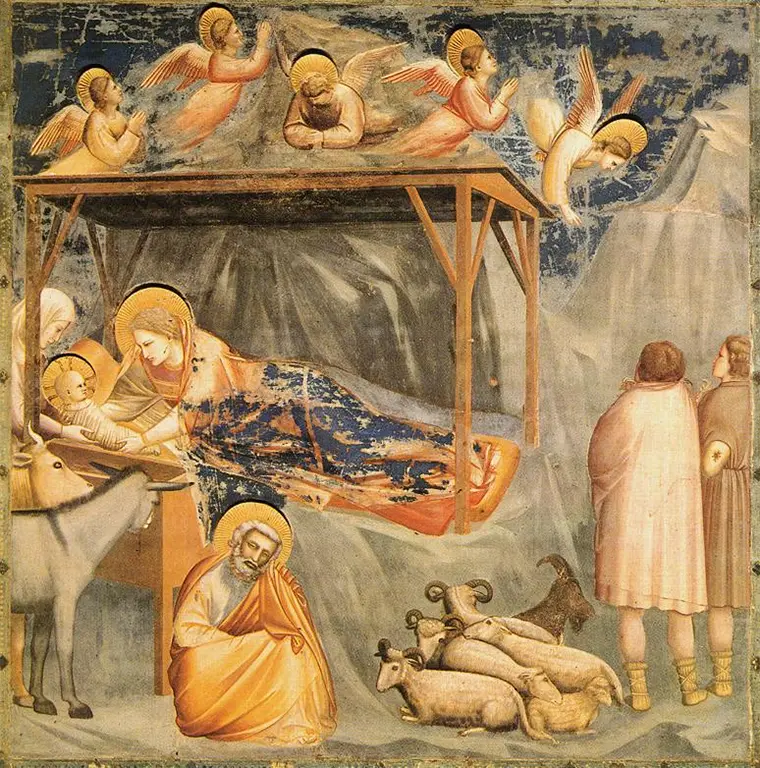
And there is another thing, as obvious as the first, which follows from looking at what a scene is. A scene tells nothing. It has no before and no after; it cannot say «and then». A book narrates, a film narrates, a carol narrates in its own way; a scene does not: it can only set a moment before us, whole and still, and let whoever looks make of it what they know. So if someone, in front of a nativity scene, feels something — and many people feel something, or there would be no nativity scenes—, that something was not given to them by the scene. The scene had nothing to give it with. It was given to them by what they already brought, and the scene did only one thing: set it before them.
The previous chapter ended on a question that it left open on purpose: Francis asked to see with the eyes of the body, and what happened — according to those who told it— was that something forgotten awoke in people's hearts and remained imprinted on memory. What it is that remains, why it remains in some and not in others, and what there has to be in the one who looks for a scene of the Nativity to do this to them. This chapter answers that. And the answer, which will be built slowly and with the texts in front of us, fits in the title: what a scene of the Nativity conveys is not information, but recognition.
Seeing and observing
There are two ways of going into a museum, and the difference is not one of time or of culture.
One is to see what is on display: walk past, register that there are paintings, leave. That way changes nothing in whoever practises it, and it shows in a detail that sounds like a joke and is not one: one sees just as well with the lights on as with them off. If the rooms went dark halfway through the visit, the visit would have been almost the same, because what one took away from it was having been there, not having looked. The other way is to observe: to stop in front of a work and let what is in it — if there is anything— set the mind working and stir the emotions. The eyes are the same in both cases. What changes is whether they are asked to pass through or to glide over.
Today the machine does it for us, and it offers an exact contrast. Any browser has a «reading mode» — in some, the F9 key—, and with it an automatic reader that goes through the whole page aloud, without skipping a word and without having perceived a single one. It reads everything and has read nothing. It is seeing in its pure state: complete sight and zero perception. What Francis asked for at Greccio with the verb pervidere — to see through, to see to the depths— is the opposite of that reader, and the previous chapter noted that the manuscript tradition wavered between videre and pervidere, between seeing and seeing to the depths. Here that wavering is taken for what it is: the hesitation of anyone who has ever stopped before something and wondered why, at other times, they did not stop.
But the image of the museum, looked at closely, raises a question worth asking before going on: what makes one stop in front of one painting and not in front of the next? Not the work alone, because the same work leaves one person cold and holds another fast. And not the disposition alone, because the same visitor, ready to observe, walks past most of what hangs on the walls. Here it pays to be exact, because it is easy to say too much. It is not that one stops because one remembers something: in front of an abstract painting one remembers no face and no light, and yet some people stand there transfixed. What makes one stop is bringing something to look with: not something one has seen, but something one knows. An art expert and a layperson do not observe the same painting in the same way, and the difference is not in the eyes; it lies in what each of them knows about what is in front of them. The way we look needs a prior education, and without it one merely sees — with the lights on or off—. There is, besides, a kind of stopping that resembles observing and is not: that of someone who stops in front of a work because they have been told that one must stop in front of it. That stop is produced by fame, not by knowledge, and telling the art of marketing apart from art is part of the same education of the eye.
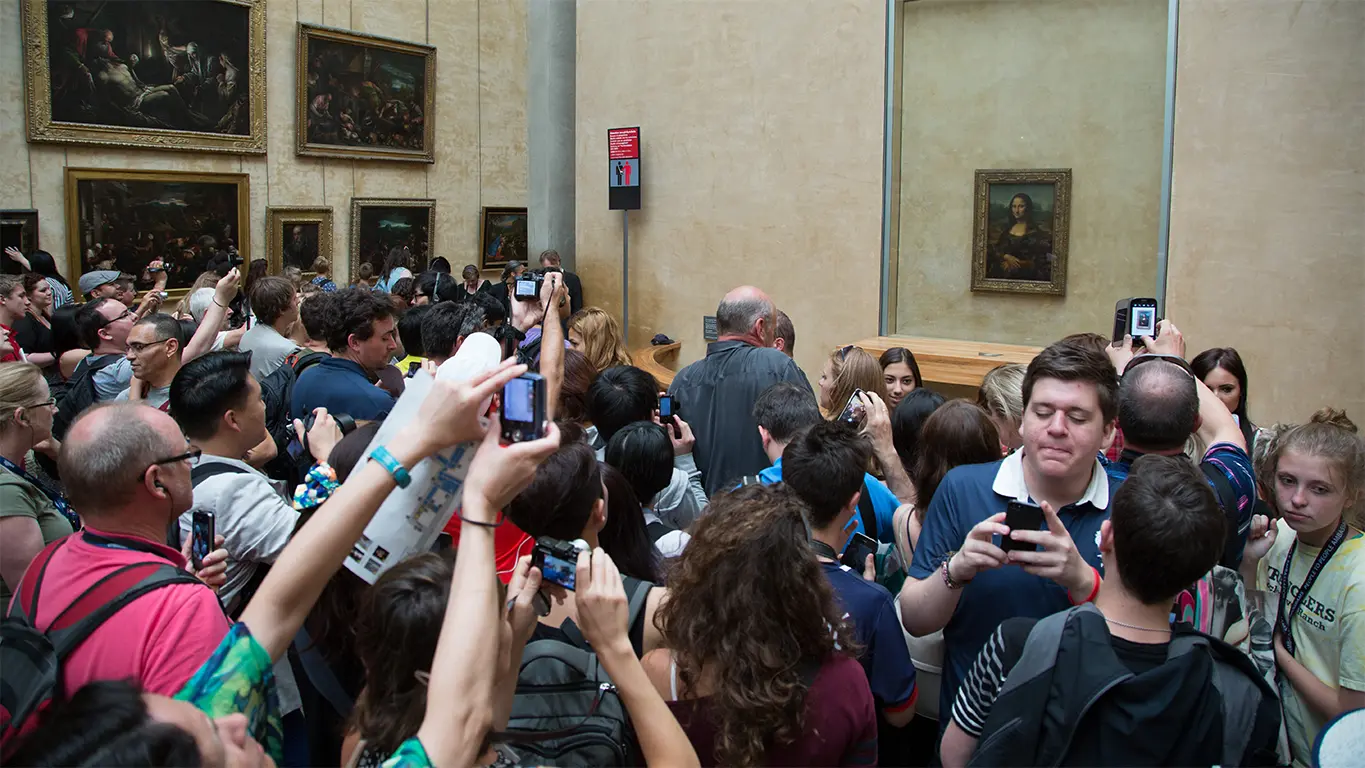
Why one stops in front of the abstract, what is set working there and where it comes from, is a whole question that this chapter leaves open and does not address. Its own case is enough for it, and it is the simplest of all, because in a scene of the Nativity what the onlooker brings is, at the very least, who the people in it are; and we have already seen that the onlooker may bring a good deal more, or a good deal less, than they think. Observing is not looking more intensely: it is looking with what one knows. That is this chapter's thesis for its own case, and now it has to be tested against texts that were not written for us.
The narrative asks for the same
It might be thought that this distinction between seeing and observing is a museum fad, or an intensity peculiar to a thirteenth-century saint. It is not. It is the demand of the very narrative that the nativity scene represents, and the narrative states it in the same words and, in one passage, with the whole mechanism.
Jesus says it quoting Isaiah, and the three Synoptic Gospels record it. In Matthew: «Por eso les hablo por parábolas; porque viendo no ven, y oyendo no oyen, ni entienden» — that is why I speak to them in parables: because seeing they do not see, and hearing they do not hear, nor understand—.3 In Luke: «para que viendo no vean, y oyendo no entiendan» — so that seeing they may not see, and hearing they may not understand—.4 It is, spoken in the first century, the exact definition of the automatic reader: complete sight and zero perception. Parables exist because the meaning is not on the surface, and the text expressly penalises reading on the surface. Up to this point, the narrative agrees with the museum. What follows goes further.
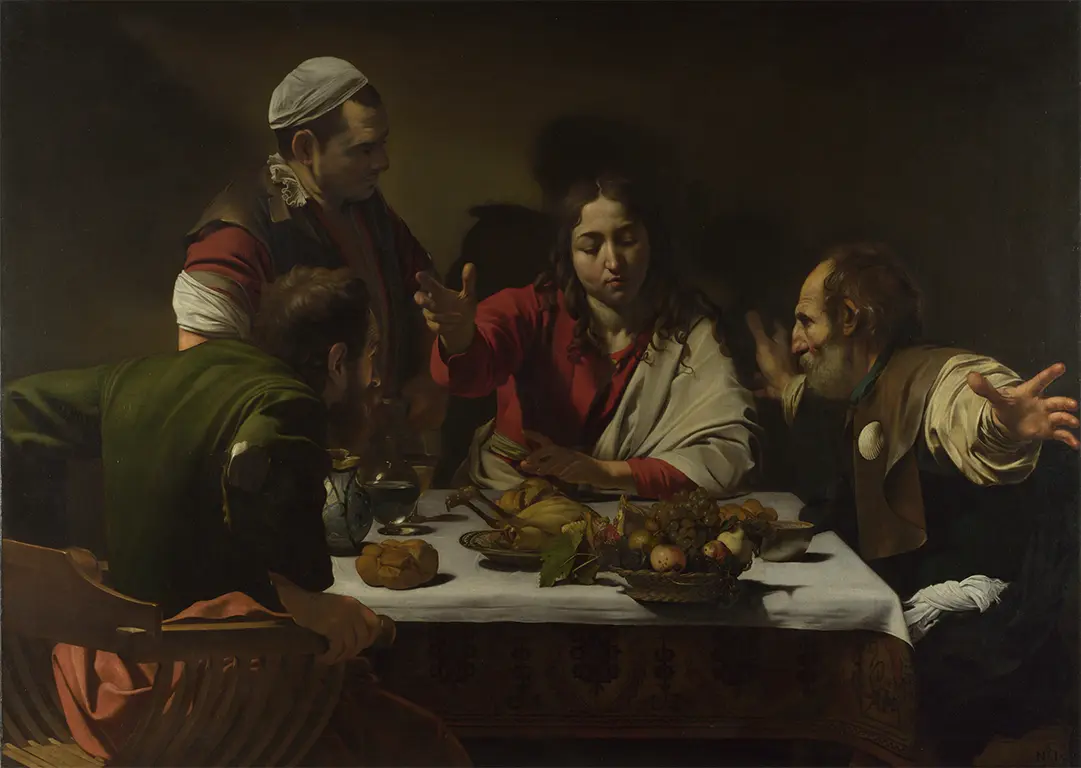
Because at Emmaus the whole mechanism is described in three verses, and it is the passage this chapter needs above all the others. Two disciples walk with the risen Jesus without recognising him: «Mas los ojos de ellos estaban embargados, para que no le conociesen» — but their eyes were held, so that they should not know him—. They walk, they talk with him, they see him for hours; he explains the Scriptures to them along the way. And only at the end, at table: «Entonces fueron abiertos los ojos de ellos, y le conocieron» — then their eyes were opened, and they knew him—; and at that moment, not before, they ask: «¿No ardía nuestro corazón en nosotros, mientras nos hablaba en el camino?» — did not our heart burn within us, while he talked with us on the way?—.5
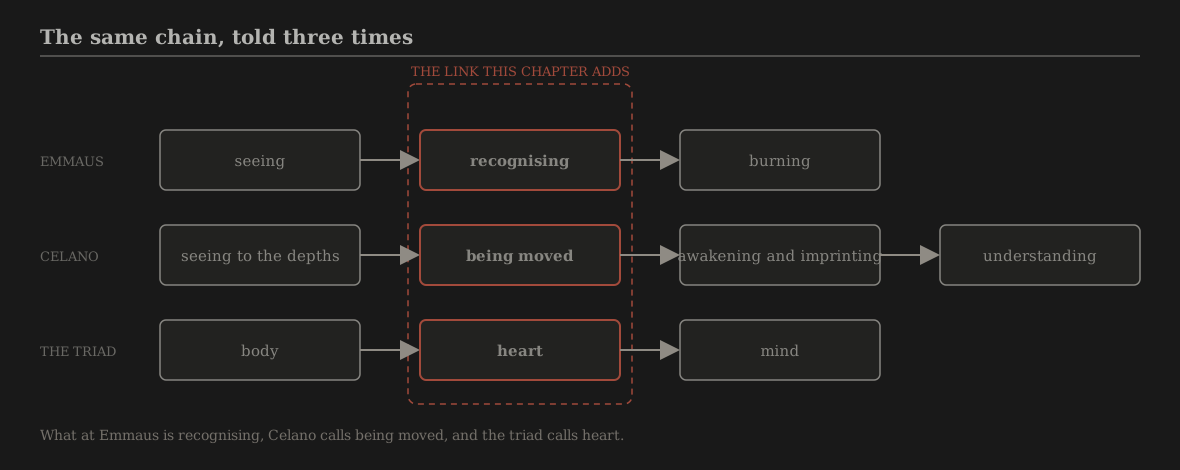
It should be read slowly, because the order of the three steps is the chapter's thesis told by the narrative itself. First, seeing without recognising: the eyes work, the person is in front of them, and nothing happens. Second, recognising: what was in front of them joins with what they already knew — whom they had followed, what he had told them—. Third, burning: the emotion. And what is decisive is where the text places it. The disciples are not moved when they see Jesus. They are moved when they recognise him. They had seen him for hours without anything burning; the heart burns when the eyes are opened, and the eyes are opened when what they see joins with what they knew. The emotion does not come from the senses alone: it comes from recognising, through the senses, what was already known. Emmaus does not suggest this; it describes it.
And it is there, finally, inside the Nativity itself, in the same chapter 2 of Luke with which this whole Manual works. The shepherds arrive, tell what they have seen and heard, and everyone marvels. And the text adds a sentence about Mary that is usually read straight past: «Mas María guardaba todas estas cosas, confiriéndolas en su corazón» — but Mary kept all these things, conferring them in her heart—.6 The Greek verb is symballousa — συμβάλλουσα—: putting some things beside others, comparing them, turning them over.7 And Luke repeats it, almost word for word, at the end of the infancy cycle: «Y su madre guardaba todas estas cosas en su corazón» — and his mother kept all these things in her heart—.8 What Mary does is exactly what Emmaus describes, but seen from within and without a miracle: she keeps what she sees and confers it — collates it— with what she knows. She does not just look: she observes, keeps and compares. The narrative of the Nativity carries within it its own model reader, and that reader does not receive the scene blank: she sets it beside what she brings. Luke is saying, in the scene itself, how he wants to be read.
From the eyes of the body to the eyes of the heart
One expression remains, and it is the one that closes the arc opened in the previous chapter. Francis asked to see with the eyes of the body, corporeis oculis. A letter of the New Testament, the one addressed to the Ephesians, had asked for something else, and it is what Francis wanted to achieve through the first: that «the eyes of your heart» be enlightened — in the Vulgate, illuminatos oculos cordis vestri—.9 The eyes of the body are the means; the eyes of the heart, the end. And between the two lies what Emmaus has just shown: the eyes of the body lead to the heart when what they see is recognised.
There is something here that should be said in full, because it touches the edition the Manual uses. The critical Greek text (SBLGNT) reads καρδίας, heart; but the text that the Reina-Valera of 1909 followed — the so-called textus receptus— reads διανοίας, and that is why the RVA translates: «Alumbrando los ojos de vuestro entendimiento» — enlightening the eyes of your understanding—.9 In the history of its transmission, the verse has swung between heart and understanding. For what is said here this is not a problem but a confirmation: the two words between which the text wavered are exactly the two things that are set working when one recognises what is in front of one — the emotion and the mind—, and Celano had put them together in the first sentence of his chapter on Greccio: toto desiderio mentis, toto cordis fervore, with all the desire of the mind, with all the fervour of the heart.10 Body, heart and mind: the three terms are in the texts checked, and no others. «Soul», which would be the word that comes first to many people, is in none of them.
The route that the previous chapter sketched in its last sentence thus has its three stations in writing, and now we know what joins them. The eyes of the body receive. The heart burns. But it burns only when what has been received joins with what the mind already held; and what burns in this way is what remains imprinted — impressus memoriae diligenti, as Celano put it—, because what has only passed through the eyes is not retained.
And here a time appears that has not yet been spoken of, and it is the one that truly matters. In front of a scene there is a time — however long one decides to stay, tenths of a second or hours—; but what Celano describes does not happen in front of the scene, but afterwards: the Child imprinted on memory is the one who comes back when the manger is no longer there, when the mind turns over what it saw and what it felt without having it in front of it. That later time is governed neither by whoever made the scene nor by whoever looked at it; and it is the only one Francis wanted. Augustine had described it precisely eight centuries earlier: memory also holds the affections, «yet not in the way the mind itself holds them when it undergoes them, but in another, very different way»; I remember having been glad without being glad, and my past sadness without being sad.11 What comes back is not the emotion: it is its memory, which is something else and can last longer. And a poet turned it into the definition of his craft: poetry «takes its origin from emotion recollected in tranquillity: the emotion is contemplated till by a species of reaction the tranquillity gradually disappears, and an emotion, similar to that which was before the subject of contemplation, is gradually produced, and does itself actually exist in the mind».12 It is exactly the third time: the one Celano called impressus memoriae diligenti, the one the Spanish verb recordar carries inside it — passing back through the heart—, and the one that makes a scene seen one night go on working in whoever saw it once the night is over.
The words: memoria, conmemorar, homenaje, recordar
What Francis wanted and what Emmaus describes have names in Spanish, and the Spanish dictionary gives them with more precision than one might expect. It is worth following the chain link by link, because each link lies in one sense of a word, and each sense says something the chapter needs.
Memoriam agere, Francis's formula, is literally «to make memory», in Spanish «hacer memoria». And Spanish preserves that turn of phrase, word for word, in the liturgical sense of conmemoración: «En la liturgia católica, memoria que se hace de un determinado santo en una celebración de rango superior» — in the Catholic liturgy, a memory made of a particular saint within a celebration of higher rank—.13 «Memoria que se hace» — a memory that is made—: not a memory that one has. It is memoriam agere translated without remainder. In the entry memoria the dictionary defines the two things separately, and the difference is the one this chapter is about: sense 1 is «capacidad de recordar» — the capacity to remember: a faculty one has—; sense 2, «recuerdo que se hace o aviso que se da de algo pasado» — a remembrance made, or a notice given, of something past—, and among its synonyms is conmemoración: an act that is performed.13 Having memory and making memory. Seeing and observing, in lexical terms.
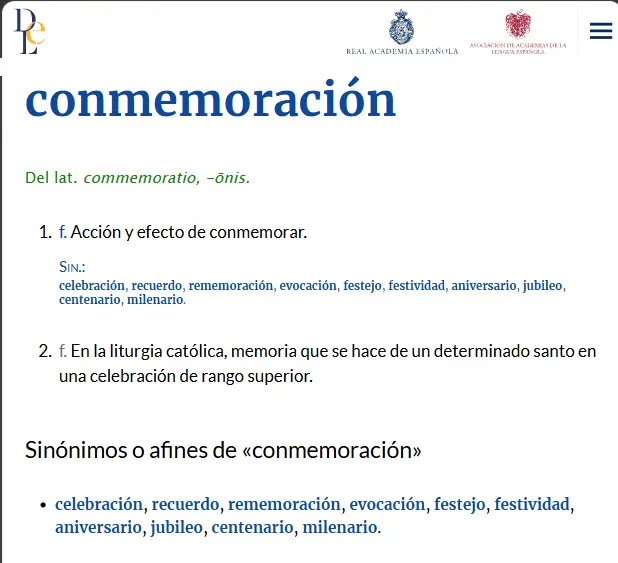
Conmemorar, in its first sense, is «recordar solemnemente algo o a alguien, en especial con un acto o un monumento» — to remember something or someone solemnly, especially with an act or a monument—, and the example the dictionary gives is a building: «El monasterio de El Escorial conmemora la victoria en San Quintín» — the monastery of El Escorial commemorates the victory at Saint-Quentin—.13 That is to say: one commemorates with something made, and a work can commemorate. Greccio is the act; a nativity scene is the monument; both fit the sense without forcing it. And the same entry memoria has, further down, the sense that closes the point: «monumento para recuerdo o gloria de algo» — a monument to the memory or glory of something—.13 In the dictionary's terms, a nativity scene is a memoria.
Homenaje, sense 1: «acto o serie de actos que se celebran en honor de alguien o de algo» — an act or series of acts held in honour of someone or something—; sense 2: «sumisión, veneración, respeto hacia alguien o de algo» — submission, veneration, respect towards someone or something—.13 The first is the definition of a commemoration seen from the side of the person to whom it is addressed; the second is Bonaventure's register, ad devotionem excitandam. And the honour does not have to be inferred: it is in Celano, with its verb — honoratur ibi simplicitas, there simplicity is honoured—, in the very sentence in which he says what was prepared.14 The word with which the dictionary defines homenaje («en honor de alguien o de algo»: in honour of someone or something) appears in the description of Greccio.
The two words are not synonyms, and the difference is useful. Conmemorar looks to the event: one commemorates a date, a victory, a birth. Homenaje looks to the person: it is paid in someone's honour. The Nativity has both faces — it is an event and it is someone—, and a nativity scene does both things: it commemorates the Nativity and pays homage to the Child. With only one of the two words, only half is said. And homenaje is already the Manual's word: the chapter on whom a nativity scene represents closes by saying that every nativity scene pays a double homage; Greccio gives that sentence its source at the very origin.
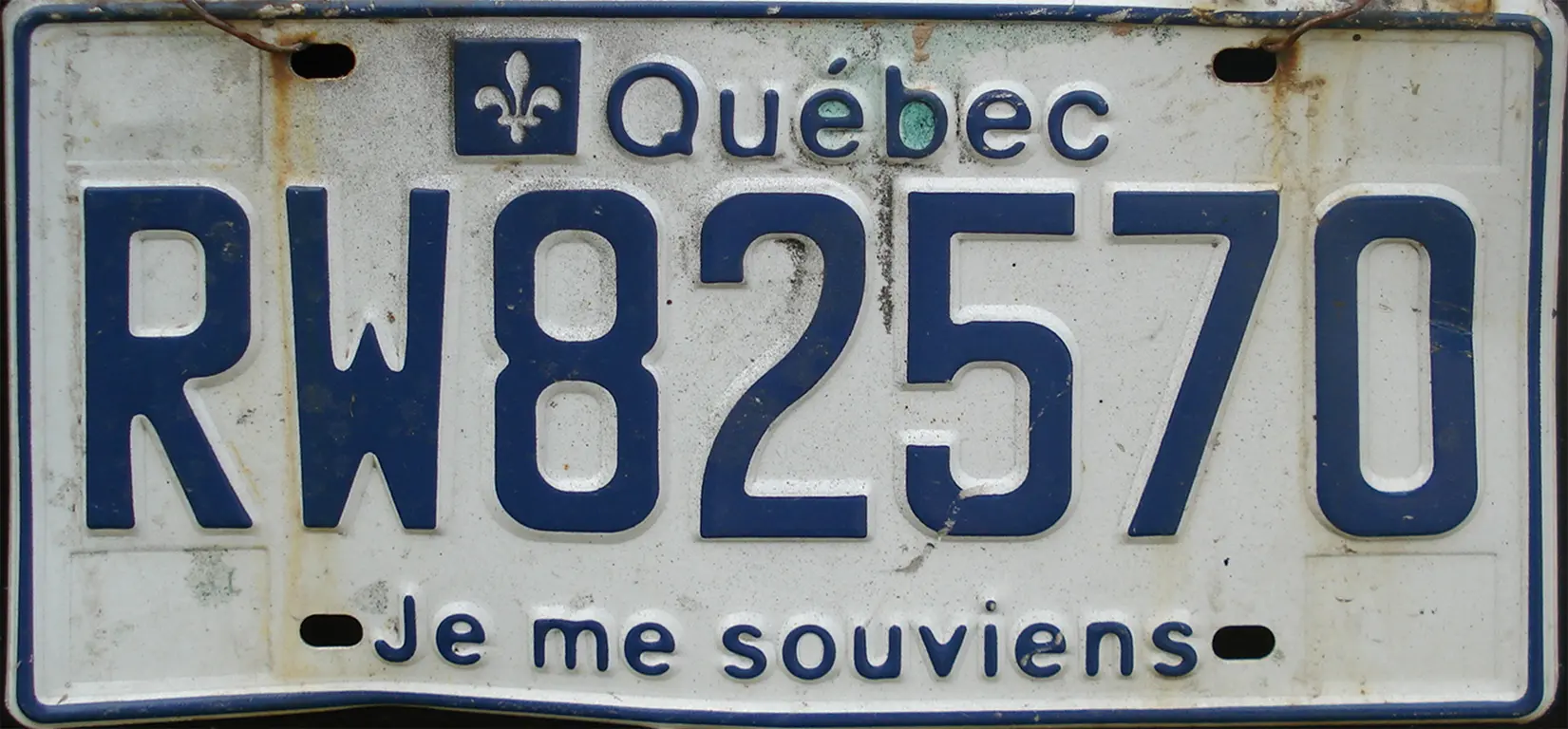
The word in the title of the previous chapter is still missing, and it is the one that says most. Recuerdo, memory. Recordar, to remember, comes, according to the dictionary, from the Latin recordari;13 and recordari is made of re- and cor, cordis, the heart: to pass back through the heart.15 Spanish, Catalan and Italian carry the heart inside the verb, though nobody notices it any more. French, which lost that verb, says se souvenir, from the Latin subvenire: what comes from below, what rises.16 And the motto of Quebec, written on its car number plates since 1978, is Je me souviens: three words that the architect of the Parliament wrote in his plans of 1883.17 Two different roots say the same thing: what one remembers is not what one has seen, but what one has made one's own — what passed through the heart, what was below and rises—. What has only passed through the eyes is not remembered. And what was not remembered is not recognised.
There is one thing that the Spanish homenaje captures less well than Celano's Latin, and it is precisely what Greccio adds. A homage can be a plaque, a speech, a minute's silence: it honours from a distance. Memoriam agere in its liturgical sense is more than honouring: it is making present what is commemorated — «do this in memory of me» does not recall the supper: it sets it on the table again—. Francis did not want only to honour the Nativity; he wanted it to be there, in front of them, corporeis oculis, to the point that Celano says Greccio «has become, as it were, a new Bethlehem».14 The homage of the nativity scene is of that kind: the kind that sets before us what it honours. And now we can see why it sets it before us: so that it may be recognised. What is honoured from a distance is known; what is set before us passes back through the heart.
All these words travel. Conmemorar, homenaje, memoria, hacer presente, observar, reconocer: each has a direct counterpart in the six languages of the Manual, with no need for a note on equivalence. Homenaje is, moreover, a word of the whole Romance world — from the Occitan homenatge: homenatge, hommage, omaggio—.13 The only word in this matter that does not travel is «belenismo», which exists in only two languages.
Understanding before making, on both sides
From all of the above follows something that is not in Celano or in the dictionary, and which this Manual maintains from the trade of the one who writes it. If what a scene conveys is recognition, then recognition has to be possible on both sides: in whoever makes the scene and in whoever looks at it. And on both sides the condition is the same.
In whoever makes. Nobody makes present what they have not understood. Whoever is commissioned to carve a Buddha and carves it without knowing who the Buddha was or what he taught makes an object with that shape; they do not make him present. The form may be correct and the figure mute. And understanding is not accepting: the same sculptor may be commissioned to make a devil and make it — precisely in order to show what does not fit—, and make it present without believing in it. What they cannot do is make present what they have not grasped, because they do not know what they are setting before us. And what has not been grasped reads, in the figure, as caricature, even when no caricature is intended: form without its reason is always a form exaggerated somewhere, because whoever made it did not know what mattered. That is what Francis did before Greccio, according to Celano: the humility of the Incarnation and the charity of the Passion «so occupied his memory that he scarcely wished to think of anything else».10 First he understood it, to the point of being unable to think of anything else; then he asked for the manger. The research this Manual demands before every figure — who the person was, how they dressed, what they did, in what world— is neither a methodological luxury nor a sculptor's fad: it is the condition for a figure to make something present instead of merely resembling something. That is why the Manual always begins by reading, documenting and comparing before touching the material; and that is why this labour is not a preliminary to the work, but its first moment.
In whoever looks. And on the other side the same thing happens, as Emmaus had already said: the disciples are not moved until they recognise, and they do not recognise until what they see joins with what they knew. Emotion that does not pass through the mind does not stay. One can feel something vague in front of a scene one does not understand — a pretty light, a pleasant ensemble—; but that is what one feels in front of a shop window, and it leaves nothing, because there was nothing to join it with. What Celano calls impressus memoriae, imprinted on memory, is what has passed through both places: through the heart and through the mind. That is why it remains in some and not in others. Not because some have more sensitivity, but because some brought something to recognise with and others did not. And here the naked Child of the opening comes back. Whoever recognises him recognises an image; whoever knows what Luke says also recognises that the image is wrong, and in front of a Child wrapped in swaddling clothes would recognise something else: the text. The education of the eye does not change the eyes; it changes what there is to join what they see with. That is exactly what this Manual does by researching before modelling: it does not give the onlooker more sensitivity; it gives them more to recognise.
From this comes a rule that this Manual applies on all its scene pages, and which is only summarised here because its home is elsewhere: emotion is deduced from the argument, not added to it. What a scene must convey — the weariness of a journey, the obedience of an answer, the poverty of a place— is read in the material the scene sets before us, once understood, and is never laid over it with signs: radiance, sentimental gestures, animals that understand. If the scene moves, it is because the material moves whoever recognises it. Added radiance is a confession that the material was not enough, or that whoever made it did not trust the onlooker to know what to join it with.18
The nativity scene as a mirror
If what is recognised is what is already known, then every nativity scene gives back what each person brings. From this follows an image: more than a closed definition, nativity-scene art and practice offers a mirror. It gives back an image of what we value, of how we understand Christmas, of what we want to remember, pass on or reinvent. Some people fill their nativity scene with animals from their own land and people of today; some seek to reconstruct first-century Judaea; some mix the two. In each case there is a decision, and that decision speaks of us.
Now we know why it speaks of us: because what each person puts into the scene is what they want to be recognised in it, and what they want to be recognised is what they know. And here it is worth putting the statement through the test with which this Manual reads every general sentence about «the nativity scene»: does it hold for the biblical one and for the popular one? It holds for both, in different ways, and the difference is instructive.
In the biblical nativity scene, what is recognised is the narrative: Nazareth, Bethlehem, a road, a stable, a period that has to be researched before it can be set before us. The onlooker brings the story; the scene gives it back as a place, and the better researched it is, the more the onlooker has to join it with — and the more it gives back—. In the popular nativity scene, the narrative is recognised and something else besides: one's own land. The shepherd wearing the clothes of the valley, the mill at the edge of the village, the trade the grandfather practised. The onlooker recognises not only Joseph and Mary: they recognise themselves, and their own people, in the Nativity. It is a double recognition, and that is why the popular nativity scene sometimes moves with fewer means: it has two things to give back instead of one. The previous chapter noted, without developing it, that the first gesture of Greccio was already this — quasi nova Bethleem de Graecio facta est, Greccio made Bethlehem: the Nativity set in one's own village—. Its place, if it holds, is in the chapter on the popular style; what is added here is only why it works: because to what is already known of the narrative is added what is already known of home. Who that «us» is that the scene gives back, and whom a nativity scene represents when it does so, has its own chapter in this series, and the reader is referred there.
Closing
A scene of the Nativity does not inform. It cannot: it has no time, no before and no after, and whoever looks at it already knew who they are before arriving. What it does is something else, and the texts read here each say so in their own way. Jesus, quoting Isaiah: one can see without perceiving. Emmaus: emotion does not come with seeing, but with recognising, and recognising is joining what is seen with what was known. Mary: things are kept and compared. Ephesians: the eyes of the body are there to reach those of the heart, or of the understanding — the text wavered between the two, and rightly so—. And the dictionary: not memory that one has, but memory that one makes; not a remembrance, but a homage of the kind that sets before us what it honours, so that it passes back through the heart.
From this comes what this chapter maintains: a scene of the Nativity conveys recognition. It gives back to whoever has it in front of them what they already knew — of the narrative and, in the popular nativity scene, of their home as well—, and gives it back in such a way that it passes through the heart again and stays. That is why it moves whoever brings something to recognise it with, and does not move whoever does not; that is why whoever makes it must first have understood what they are setting there; and that is why emotion is not added but deduced. Francis asked for it with two words, memoriam agere, and Celano told what happened with three, impressus memoriae diligenti. Between the one and the other lies everything a scene can do, and it is this: recognising what is already known.
It remains to ask what the world that produces this recognition is made of — which works, which ways, which people—. That comes next.
References
The footnotes locate, and only locate. The entries explaining why each source comes in, what it contributes and what it does not allow us to assert are in the body of the text, in the panel that accompanies its first appearance. The translations from Latin are the Manual's own.
Lk 2:7 and 2:12, RVA 1909, checked on BibleGateway («Reina-Valera Antigua») on 15-IX-2026: «Y parió á su hijo primogénito, y le envolvió en pañales, y acostóle en un pesebre, porque no había lugar para ellos en el mesón»; «Y esto os será por señal: hallaréis al niño envuelto en pañales, echado en un pesebre». The description of today's figures of the Child (naked, eyes open, head raised, limbs held apart) is Emili Solé's observation of current production; it is not quantified, and no particular piece is cited. ↩
All biblical quotations in Spanish: Reina-Valera 1909, consulted as «Reina-Valera Antigua (RVA)» on BibleGateway on 13-IX-2026; the Greek: SBL Greek New Testament (SBLGNT) and, for the variant in Eph 1:18, Scrivener 1894 (TR1894), both on BibleGateway on 13-IX-2026; the Latin: Biblia Sacra Vulgata on BibleGateway, same date. ↩
Mt 13:13, RVA 1909: «Por eso les hablo por parábolas; porque viendo no ven, y oyendo no oyen, ni entienden». ↩
Lk 8:10, RVA 1909: «Y él dijo: A vosotros es dado conocer los misterios del reino de Dios; mas á los otros por parábolas, para que viendo no vean, y oyendo no entiendan». ↩
Lk 24:16, 31-32, RVA 1909: «Mas los ojos de ellos estaban embargados, para que no le conociesen»; «Entonces fueron abiertos los ojos de ellos, y le conocieron; mas él se desapareció de los ojos de ellos. Y decían el uno al otro: ¿No ardía nuestro corazón en nosotros, mientras nos hablaba en el camino, y cuando nos abría las Escrituras?». ↩
Lk 2:19, RVA 1909: «Mas María guardaba todas estas cosas, confiriéndolas en su corazón». Vulgate: «Maria autem conservabat omnia verba haec, conferens in corde suo». ↩
Lk 2:19, SBLGNT: «ἡ δὲ Μαρία πάντα συνετήρει τὰ ῥήματα ταῦτα συμβάλλουσα ἐν τῇ καρδίᾳ αὐτῆς». ↩
Lk 2:51, RVA 1909: «Y descendió con ellos, y vino á Nazaret, y estaba sujeto á ellos. Y su madre guardaba todas estas cosas en su corazón». ↩
Eph 1:18. Vulgate: «illuminatos oculos cordis vestri, ut sciatis quae sit spes vocationis ejus». SBLGNT: «πεφωτισμένους τοὺς ὀφθαλμοὺς τῆς καρδίας ὑμῶν». TR 1894: «πεφωτισμενους τους οφθαλμους της διανοιας υμων». RVA 1909: «Alumbrando los ojos de vuestro entendimiento, para que sepáis cuál sea la esperanza de su vocación». That the reading διανοίας belongs to the textus receptus as the basis of the Reina-Valera is a general fact of the history of the text; here it is verified by the agreement between TR 1894 and the RVA. ↩ ↩
Thomas of Celano, Vita prima, 84.1 and 84.3; ed. d'Alençon (Rome, 1906), p. 85, l. 14-23: «toto desiderio mentis, toto cordis fervore»; «Praecipue incarnationis humilitas et charitas passionis ita eius memoriam occupabant ut vix vellet aliud cogitare». Presentation of the source, edition and checking: previous chapter in this series, source panel and note 1. ↩ ↩
Augustine of Hippo, Confessions, X, 14, 21: «affectiones quoque animi mei eadem memoria continet, non illo modo quo eas habet ipse animus cum patitur eas, sed alio multum diverso […] et laetatum me fuisse reminiscor non laetus, et tristitiam meam praeteritam recordor non tristis, et me aliquando timuisse recolo sine timore». Latin text checked on 15-IX-2026 and again on 22-X-2026 (thelatinlibrary.com, Confessiones, book X, 14, 21). The translation is the Manual's own. ↩
William Wordsworth, preface to Lyrical Ballads, 2nd ed., London, T. N. Longman and O. Rees, 1800, pp. xxxiii-xxxiv: «Poetry is the spontaneous overflow of powerful feelings: it takes its origin from emotion recollected in tranquillity: the emotion is contemplated till by a species of reaction the tranquillity gradually disappears, and an emotion, similar to that which was before the subject of contemplation, is gradually produced, and does itself actually exist in the mind». Checked on 15-IX-2026 against the University of Virginia transcription made from the images of the 1800 copy (anthology.lib.virginia.edu). Quoted in the original in the body of the text. ↩
Diccionario de la lengua española, RAE, online edition (dle.rae.es), checked on 15-IX-2026 against Emili Solé's screenshots of 12-IX-2026. Memoria («Del lat. memoria»): sense 1, «Capacidad de recordar»; sense 2, «Recuerdo que se hace o aviso que se da de algo pasado», with the synonyms «recuerdo, remembranza, evocación, rememoración, mención, conmemoración, membranza»; sense 6, «Monumento para recuerdo o gloria de algo». Conmemorar («Del lat. commemorāre»): sense 1, «Recordar solemnemente algo o a alguien, en especial con un acto o un monumento. El monasterio de El Escorial conmemora la victoria en San Quintín»; sense 2, «Celebrar una fecha importante». Conmemoración («Del lat. commemoratio, -ōnis»): sense 1, «Acción y efecto de conmemorar»; sense 2, «En la liturgia católica, memoria que se hace de un determinado santo en una celebración de rango superior». Homenaje («Del occit. homenatge»): sense 1, «Acto o serie de actos que se celebran en honor de alguien o de algo»; sense 2, «Sumisión, veneración, respeto hacia alguien o de algo»; sense 3, «En la Edad Media, juramento solemne de fidelidad hecho a un rey o señor». Recordar («Del lat. recordāri»): sense 1, «Pasar a tener en la mente algo del pasado». ↩ ↩ ↩ ↩ ↩ ↩ ↩ ↩
Celano, 85.4-5; d'Alençon, p. 86, l. 28 - p. 87, l. 3: «Honoratur ibi simplicitas, exaltatur paupertas, humilitas commendatur, et quasi nova Bethleem de Graecio facta est». Presentation of the source: previous chapter in this series. ↩ ↩
That recordari is formed from re- and cor, cordis is not given by the DLE (only «Del lat. recordāri»); it is given by Lewis and Short's Latin dictionary, which sets out the entry separating the prefix and refers to cor: «rĕ-cordor, ātus, 1, v. dep. a. and n. cor.» (Charlton T. Lewis and Charles Short, A Latin Dictionary, Oxford, Clarendon Press, 1879, s. v. recordor; digital edition of the Perseus Digital Library, consulted on 22-X-2026). ↩
Le Robert, Dictionnaire de la langue française online (dictionnaire.lerobert.com, s. v. souvenir), consulted on 15-IX-2026: the Latin etymology subvenire appears in the section of old definitions that Le Robert reproduces from Furetière's Dictionnaire universel (1690), with the gloss «comme qui diroit in mentem venire»; the modern definition of the pronominal verb: «Avoir de nouveau présent à l'esprit (qqch. qui appartient à une expérience passée)». It is confirmed by the Trésor de la langue française informatisé (CNRTL, s. v. souvenir, «Étymologie et histoire», consulted on 22-X-2026): «Du lat. subvenire (de sub « sous » et venire « venir ») « survenir, se présenter à l'esprit (en parlant d'idées) »». ↩
Bibliothèque de l'Assemblée nationale du Québec, «Je me souviens et les devises du Nouveau Monde», Première lecture, 21-VI-2023 (premierelecture.bibliotheque.assnat.qc.ca), consulted on 15-IX-2026: «la première mention du Je me souviens apparaît sur les plans du Palais législatif préparés par Taché en 1883» (Eugène-Étienne Taché, 1836-1912, architect); «l'inscription en 1978 du Je me souviens sur les plaques d'immatriculation, en remplacement du slogan touristique La belle province». Gouvernement du Québec, «Devise du Québec : Je me souviens» (quebec.ca), consulted on 21-X-2026: «L'adoption en 1939 de nouvelles armoiries du Québec sur le listel desquelles elle figure, raffermit son caractère officiel». ↩
Criterion set in this Manual on 12-VII-2026 for the scene pages («What the scene conveys»). It is summarised here, not developed. ↩