
 ≈ 55 min

The two previous chapters have dealt with one night at Greccio and with what happens to whoever stands before a scene of the Nativity, and they have done so — it is worth noticing— without naming a single figure and almost without using the word that gives its name to all of this. That was not an oversight. At Greccio there were no figures, and what a scene conveys does not depend on what it is made of. But now it is time to look around, because what was born that night is not only a class of objects, nor only an effect on whoever looks. It is wider than that, and the question of this chapter is what it is made of.
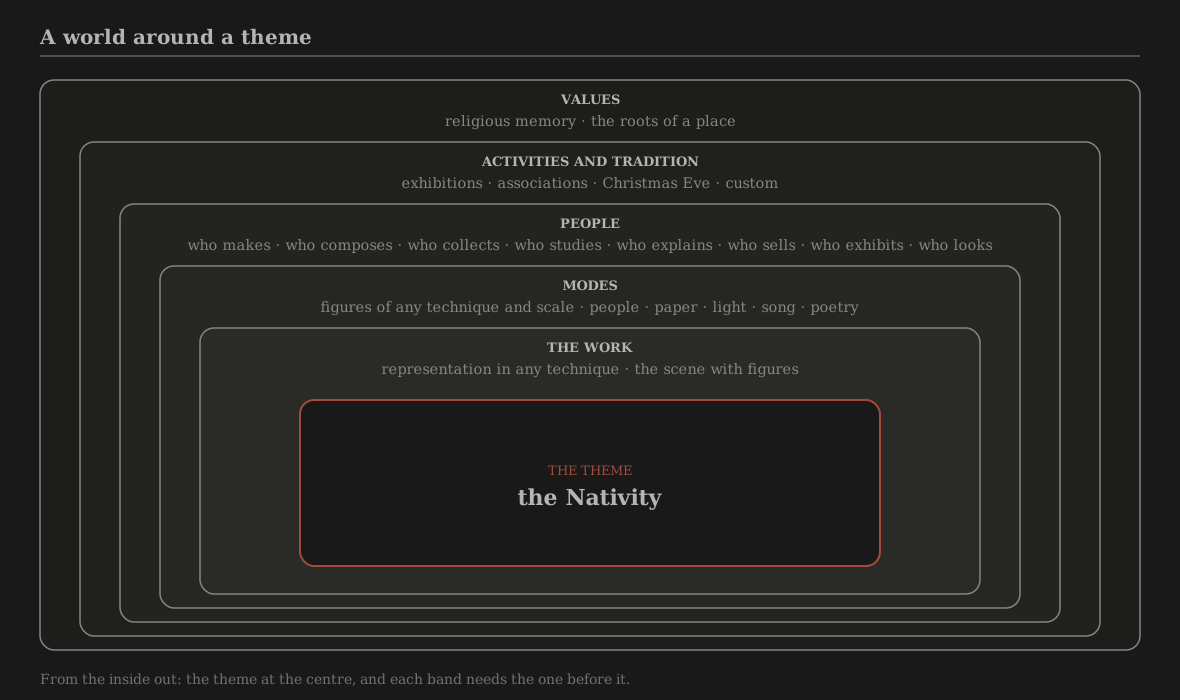
The short answer can be given now, and the rest of the chapter unfolds it: it is a world. Not a genre, as landscape or portraiture are — classes of works, defined by what they represent—, but something with people inside it: works, yes, but also those who make them, those who seek them out, those who keep them, those who study them, the dates on which they are made and the customs that surround them. Landscape has no associations and no Christmas Eve; this does. It is worth going through it all, layer by layer, because each layer is needed to understand the next, and because the definition this Manual will give later has to cover all of it, not only the part that can be seen on a table in December.
The work, on two levels
Starting with the work is the natural thing to do, because it is what everybody sees. But «the work» hides a distinction that should be made before anything else, because without it two things that are not the same get confused, and many of the poor definitions come out of that confusion.
The first level is the visual representation of the Nativity — and of its whole cycle, from the Annunciation to the Presentation, and beyond, to the Child among the doctors— in any technique in which it exists: sculpture, painting, engraving, stained glass, mosaic, whatever it may be. A Romanesque tympanum with the Nativity is a representation of the Nativity; a panel by Giotto is one; a terracotta figure is one too. They all share the theme, and the theme is what brings them together. This Manual has devoted a whole chapter of the block on composition to that first level, and what was established there can be summed up here in one sentence: the subject of the nativity scene has never lived outside art — Giotto painted it, La Tour painted it, and the list is the history of painting itself—, so that whoever takes it up today is not asking to be let in anywhere; they are already inside, and the only thing that can be asked of them is to be equal to it.1
The second level is the scene: the nativity scene, properly so called. And here lies the distinction that matters. A scene is not an image of the Nativity: it is a place in which the Nativity is set, with its characters occupying a real space, at a scale, at a distance from one another, lit from some side. And this second level has a condition the first does not: it does not exist without figures. There may be a magnificent setting — a grotto, a whole village, a winter night built out of light—, and as long as there is nobody in it there is no scene. It is exactly as in the theatre: there may be a stage, with its scenery and its lights, and there is no play until the actors come on. The stage is the condition; together with the actors it makes the play. Each has a different function — the one is place, the others are action— and neither of them, on its own, is the work: the work is the relation between the two. In the nativity scene, the figures: a landscape without them is a set, and a figure without a place is an exhibition piece; the nativity scene is what comes about when the two are brought into relation.
That said, to say «figures» is not to say «terracotta figures». The word should be widened as far as it really reaches, because practice reaches further than vocabulary. A figure can be a sculpture in any technique and at any scale: modelled, carved, cast, reproduced from a mould, cut out of paper and built up in planes. And in any material: not all figures for the nativity scene are made of terracotta; they come in a multitude of materials. Living beings can be figures: people who embody the characters, and real animals — that is what a living nativity scene does, and it is what there was, in part, at Greccio, where the ox and the ass were real—. And so can what will be called here, to avoid any misunderstanding, brand-name figures: those that have no author but a manufacturer — the life-size shop-window mannequin, the nativity scene made with Playmobil figures and, if its cost one day allows it, the programmed robot that is not yet to be seen—. They are not authored figures; they are brand-name figures, and they are figures: they occupy the place of the character, and without them there would be no scene. They should not be confused with something else that does have an author and also moves: the automaton, the figure with moving parts that works a tool or an object, which has existed in the nativity scene for a long time and is sculpture like any other. What separates a brand-name figure from an authored figure is not whether it moves, but who answers for it. Whether they are good or bad, whether they make something present or merely point to it, is the question of value, which this Manual has already placed where it belongs: in the particular work, not in the category.1 All that is being said here is what the world is made of, and it is made of this as well.
Where a scene is looked at from — from a single place, as one looks at a painting, or from as many places as there are gazes around a table— is the first decision of scenography, and this Manual has dealt with it in the chapter on framing, which is not repeated here.1 What this chapter keeps is prior to that decision: in either of the two framings, a scene is figures occupying a place. At Greccio, people attended the Mass standing still, each from their own place and none in anyone else's line of sight; there was a place, and in it a manger with hay and two live animals. What there was not was characters.
The modes, placed without hierarchy
Once it has been said what a scene is, it has to be said in what ways it is made, and that has to be said without ranking them from better to worse, because that is not the business of this chapter and because the order anyone would set is almost always that of their own trade. What follows is an inventory, not a scale.
Figures, in any technique, scale and material, from the size of a fingernail to life size, from polychrome terracotta to resin, from carved wood to plaster. This is the majority mode and the one that gives its name to everything else in most languages, and that fact — that the vocabulary names the whole after the majority mode— will have its consequence in the next chapter.
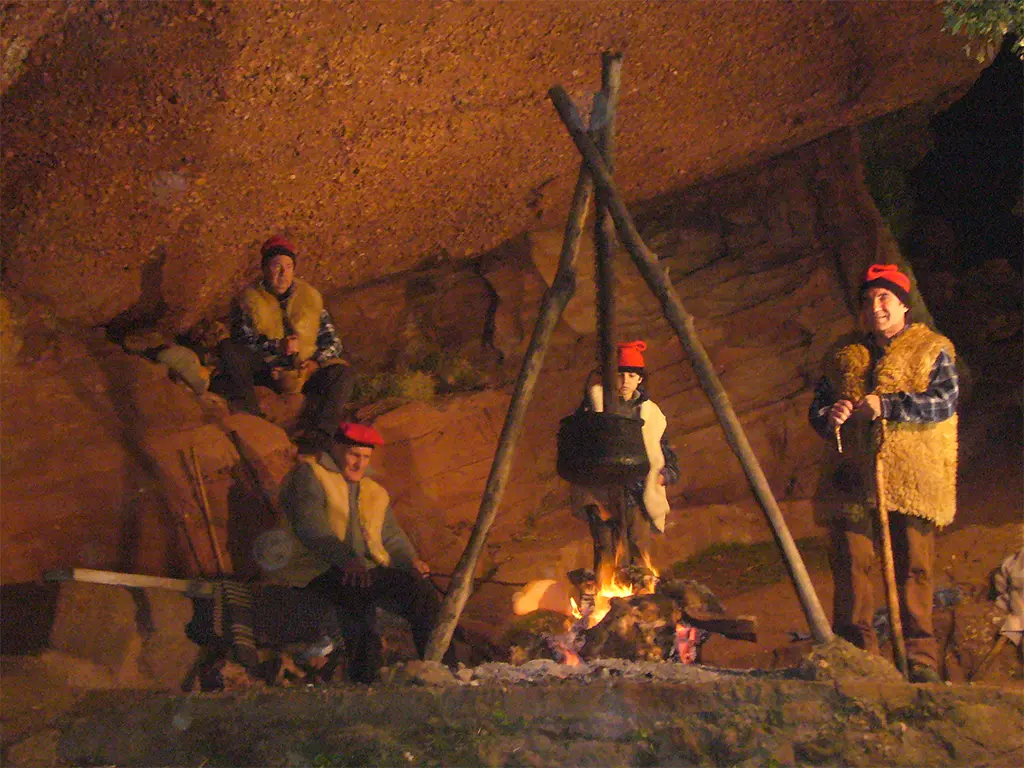
People, in the living nativity scene: the people of a village who embody the characters for a night or a few hours, with real animals and, almost always, with the village itself as the setting. This mode has a particular feature worth noting: it is the one closest to what was done at Greccio — a real place, real animals, the people in front— and, at the same time, the only one that the document which today defines the nativity scene by law in Spain knowingly left out. The technical report of the IPCE writes it on its page 5: «Se decidió que en dicha propuesta no se incluyeran los Belenes vivientes» — it was decided that living nativity scenes should not be included in that proposal—, without saying who decided it or why; and on its page 40, when classifying nativity scenes, it describes them as nativity scenes: «vivientes (con personas y animales reales) o inanimados» — living (with real people and animals) or inanimate—.2 The same text that describes them as nativity scenes leaves them out of the declaration. What that means for the dossier is examined in its own chapter; here the fact is enough: the mode exists, it is practised across half of Europe, and it is inside this world even though a piece of paper left it off a list.
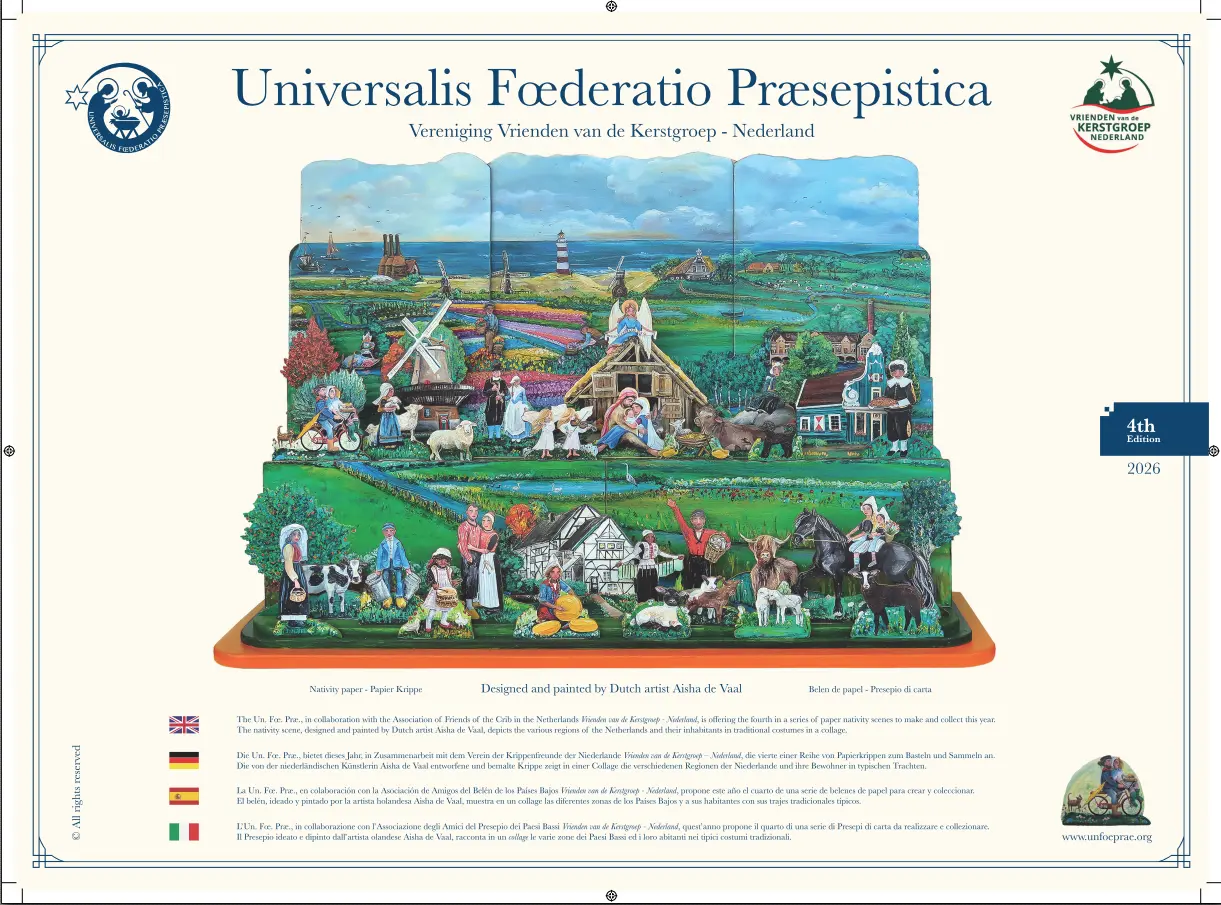
Paper. It may seem a minor mode and it is not: it is the oldest of the inexpensive ones and the one that more people have held in their hands. The cut-out paper nativity scene — printed figures and planes that are cut out, folded and assembled— has a tradition of its own in several countries, and today it is published by the international federation of the associations itself. Every year, for four years now, the Universalis Fœderatio Præsepistica has published a paper nativity scene «para crear y coleccionar» — to create and collect—; the 2026 one, made with the Dutch association Vrienden van de Kerstgroep, was designed and painted by the artist Aisha de Vaal and «muestra en un collage las diferentes zonas de los Países Bajos y a sus habitantes con sus trajes tradicionales» — shows in a collage the different regions of the Netherlands and their inhabitants in their traditional costumes—.3 It is a popular and ethnographic nativity scene — in a country, incidentally, that has no word for this practice— made in a mode that no definition by «movable figures» would recognise if the figures are painted on the plane. Whether there is any free-standing figure in that nativity scene cannot be told from the reproduction; Unknown until the object itself is seen. And it has, besides, a quality that no other mode has so clearly: it is made to be made. Whoever cuts out and assembles a whole paper nativity scene has not seen it in passing.
Light. Not as an aid to the other modes — the lighting that every scene needs— but as a mode of its own: there are nativity scenes made of light, projected onto façades, drawn with lamps in a square, and there are scenes whose only material is a silhouette lit from behind. They are named here because they exist, with no further development: the mode is marginal and the Manual has not studied it. Unknown as to its extent and its history.
Song, and with it music. This is the mode that meets the most resistance, and that is why it has to be taken slowly and with the texts at hand. The first reason for including it is not a theory: it is a fact of the origin. Greccio was a sung night. Celano says so three times in a few lines: Francis, vested as a deacon, «sings the holy Gospel in a sonorous voice» — voce sonora sanctum evangelium cantat—; the friars «sing, paying the Lord the praises due to him, and the whole night resounds with jubilation» — cantant fratres … et tota nox iubilatione resultat—; and before that, «the wood resounds with voices» — personat sylva voces—.4 Nobody sings in order not to be heard. Whoever sings does so to be heard, and those who sang at Greccio were there, in front of everyone, as much as the hay and the animals; they were part of what people had before them. And this holds just the same today: whoever sings in a group in front of a scene is not a loudspeaker set off to one side, but someone who also takes part visually — they are seen singing—, and their presence is part of what the onlooker receives.
Three distinct things follow from this, and they should be kept apart. The first: the music that accompanies a scene is part of the work. It is not a background. What music does in cinema has been described precisely by film theory, and the description holds word for word for a scene with music: Michel Chion, a French composer and theorist, called added value in 1990 — the term used in the English translation of his book— «the expressive and informative value with which a sound enriches a given image so as to create the definite impression […] that this information or expression "naturally" comes from what is seen, and is already contained in the image itself».5 In other words: music makes the onlooker believe that the emotion came from the scene, when it came from the two together. And Claudia Gorbman, an American theorist, had in 1987 listed the principles on which the music of classical cinema works, two of which matter here: being a «signifier of emotion» and providing «narrative cueing» — telling the spectator what to feel and where what they are seeing is heading—.6 Giving time, steering the mood, making present what cannot be seen: that is what music does in a cinema, and that is what it does when it sounds in front of a nativity scene. Whoever puts it there is not decorating; they are composing with one more material.
The second: music written on the Nativity, without a scene, belongs to the same world, and it does so by purpose and by origin, not by analogy. By purpose, because what it seeks is what Francis sought: to make the Nativity present so that it is recognised and stays. By origin, because Greccio was sung. Carols are the domestic case: they are sung in front of the nativity scene or without it, and whoever sings them is doing nothing other than what was done by whoever set out the figures. And written music is so on another scale: Bach composed a Magnificat — Mary's canticle from chapter 1 of Luke, within the infancy cycle— and first performed it in Leipzig on 25 December 1723 with four Christmas pieces interpolated, which he removed a few years later when he transposed it to D major so that it could serve outside Christmas;7 Vivaldi wrote a violin concerto «for the Most Holy Nativity» and called it Il riposo, the rest.8 Neither of them is a nativity scene. They are another mode of doing the same thing, and this Manual has no reason to leave them out of a world they have belonged to since the origin.
The third, which is the one that avoids saying too much: the mode is not the same. A scene makes present in space. It is not that it has no time: one can pass in front of it in tenths of a second or stay for hours, and that is time; but that time is set by whoever looks, with the eyes of the body. Music makes present in time, and that time is set by the composer: fixed in the score, down to the length of each note, and the listener receives it. In the one, time belongs to the observer; in the other, to the author. And there is a third time that neither mode governs: the time afterwards, when what was seen or heard comes back without being in front of one and the mind turns it over. It is what Celano called impressus memoriae, and it is the only one of the three that Francis wanted; its place is in the previous chapter. That difference is not one of rank but of nature, and it is what makes music accompanying a scene part of it, and music on its own a sister tradition: same theme, same purpose, another mode. And one more thing has to be stated exactly, because it is where it is easiest to claim too much: music does not enter this world through the words of Francis, who said eyes — corporeis oculis—; it enters through his purpose, which Celano and Bonaventure describe with verbs that are not verbs of sight — to awaken, to imprint, to stir hearts—, and through the fact that that night was sung. Put that way, it holds with the texts in hand.
Poetry. The last mode, and the one least expected in an inventory of nativity scenes; and yet it is the oldest of all, because it is inside the narrative itself. Luke's infancy cycle carries four poems within it: the canticle of Mary, that of Zechariah, that of the angels and that of Simeon.9 The text that the nativity scene represents is, at its culminating moments, verse. And the tradition has made whole cycles of the Nativity in verse, in the languages of this Manual and in others: Lope de Vega, Pastores de Belén, prosas y versos divinos (Madrid, 1612); Jacint Verdaguer, the trilogy Jesús infant — Nazaret, Betlem, La fugida a Egipte (1890-1893)—; Rainer Maria Rilke, Das Marien-Leben (dated at Duino in January 1912); Josep Maria de Sagarra, El poema de Nadal (1931); Luis Rosales, Retablo sacro del Nacimiento del Señor (1940).10 No verse is quoted here — there is no need and this is not the place—; it is enough to know that they exist, that they are cycles and not single poems, and that Rosales's title already says what this chapter maintains: a retablo, that is, a sequence of scenes, made of words.
With poetry, a distinction that serves for the whole inventory is complete. There are three ways of making the Nativity present, according to the material in which it is done: in space — the scene—, in time — music— and in the word — poetry, and with it the narrative itself—. All three do the same thing; none does it in the same way. The scene is there, and the time is set by whoever looks; music unfolds, and the time is set by whoever wrote it; the word tells. And all three were at Greccio: the manger with the animals, the singing of the friars and the Gospel sung by Francis. The world does not have to be invented: it was there whole on the first night.
The people
A genre has no people inside it. Landscape is a class of paintings; its whole history can be written without naming a single collector. Not this. For a scene of the Nativity to exist, a chain of people is needed, and the chain is long, and most of its links appear in no definition.
There is whoever makes: the one who models or carves the original figure — and who makes sculpture, with authorship, whether aware of it or not—; the one who reproduces it from a mould; the one who paints it; the one who dresses it, when the figure is dressed; the one who builds the scenery; the one who lights it. There is whoever composes: the one who buys or inherits the figures and composes their scene at home, even if all they want is a well-laid table — decorating is already creating, because they are already making decisions—.11 There is whoever collects, keeping figures they will never set in a scene and valuing them for what they are. There is whoever studies — the art historian, the ethnographer, whoever writes a manual like this one—. There is whoever popularises: the one who edits the association's magazine, who gives the talk, who maintains the website, who curates an exhibition — chooses the works, orders them and presents them— and answers for it to those who visit it. There is whoever sells: the workshop that reproduces, the shop, the fair. There is whoever exhibits: the one who organises the show and the competition, the museum that keeps Salzillo's nativity scene and has it in its gallery all year round. And there is, finally, whoever looks, for whom everything else is done, and who is inside the world as much as the others: without them there would be nothing to make present to anyone.
This chain has its own chapter in this Manual, where each role is examined separately; here it is enough to have named it in full, because what matters to this chapter is that it exists.12 And it exists with a feature that the sociology of art described accurately forty years ago, and which is worth borrowing together with its limit.
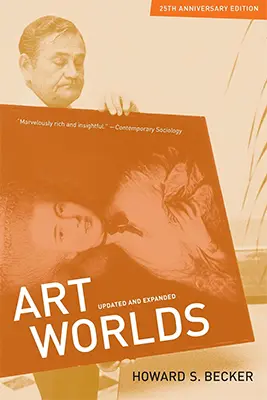
Becker defines an art world as «the network of people whose cooperative activity, organized via their joint knowledge of conventional means of doing things, produces the kind of art works that art world is noted for».13 And he adds, so that it is not taken to mean only the artists: an art world comprises «all the people whose activities are necessary to the production of the characteristic works which that world, and perhaps others as well, define as art».13 All of them: whoever makes the brushes, whoever hangs the picture, the critic, the public. It is exactly the chain set out above. The sculptor who models the original needs whoever reproduces it; whoever reproduces it needs whoever paints it; all three need whoever composes the scene; and all of them need whoever looks at it, whoever exhibits it and whoever writes about it. What Becker allows one to say in a word is that nativity-scene art and practice — whatever name it goes by— is not the sum of nativity scenes, but the network that makes them possible. And that network has «conventional means of doing things» — the scale, the inherited iconography, the order of the characters, the dates— that each of its members knows without anyone having taught them at a school: they learned them by looking.
The activities and the tradition
A world with people inside it also has a calendar and customs. And these are not a folkloric addition to the work: they are the condition for the work being made.
The first is Christmas Eve, and with it the family custom of composing the scene at home in the preceding weeks and keeping it up until after Epiphany. It is the most widespread activity of all, the one carried out by millions of people who would never call themselves by any of the words in this block, and the one that sustains everything else: without it there would be no workshops reproducing figures and no shops selling them. That it is a custom does not lower it — this Manual has already said that decorating is creating, and that whoever arranges the figures on the moss is already composing—;1 here it is recorded for what it is: the base of the world, the part of the network nobody sees because it is in every home.
The second is the associations, which are the way this world has organised itself since the 19th century. The Barcelona association «ja existia abans del 1863» — already existed before 1863— and in that year obtained government approval;14 the international federation that groups them was founded in Barcelona on 31 May 1952 by seven associations and today brings together twenty-one organisations.15 The associations organise the exhibitions and the competitions — the activities in which scenes leave the home and are set before people who did not make them—, the fairs at which workshops sell and collectors buy, the magazines, the courses. They are the visible part of Becker's network, the part with premises and statutes. How they are organised, what they do and where they are has its own chapter in this Manual; here they are only placed.
The third is the permanent exhibition, which seems to contradict the other two and does not: the nativity scene that is not composed for a season or taken down, but stands in its gallery all year round. Francisco Salzillo's, modelled between 1776 and 1783 for Jesualdo Riquelme and completed by his disciple Roque López up to 1800, with figures about 30 centimetres tall in clay and wood, today occupies a gallery of the Museo Salzillo in Murcia, which the museum presents as a gallery of its collection and opens all year round.16 It is a nativity scene, it is sculpture with an author, and it is neither ephemeral nor seasonal. It is here as proof that the tradition of this world is not a single one: alongside the custom of composing and taking down there is that of keeping and exhibiting, and both are as old as the practice. This Manual has already dealt with why the ephemeral belongs to the nativity scene by necessity and not by essence; here that is summed up and referred to.17
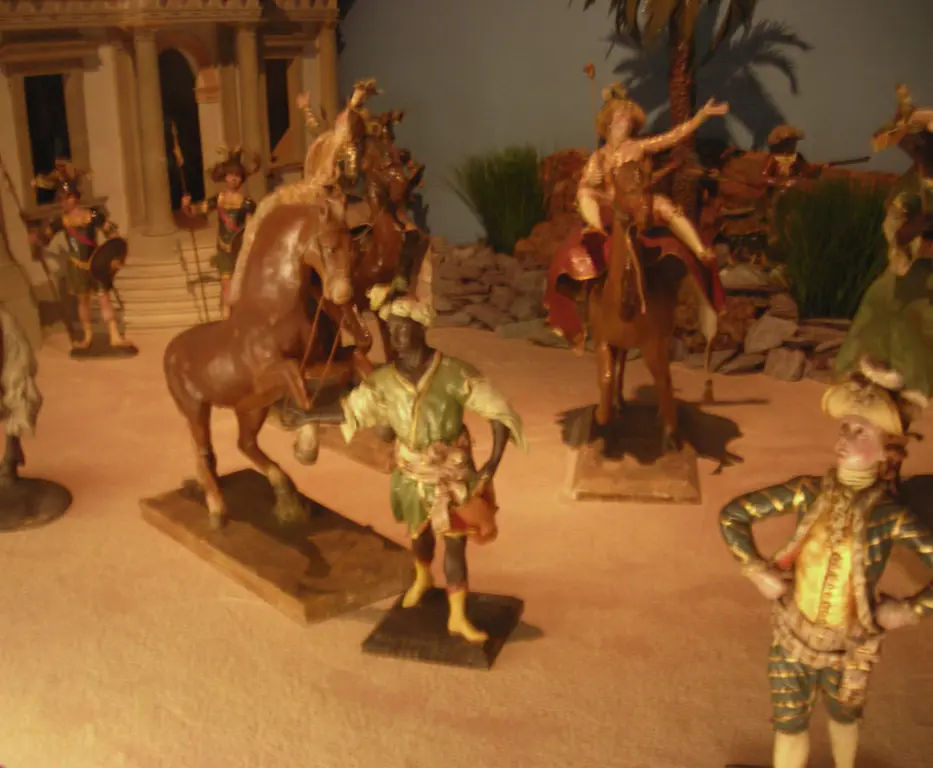
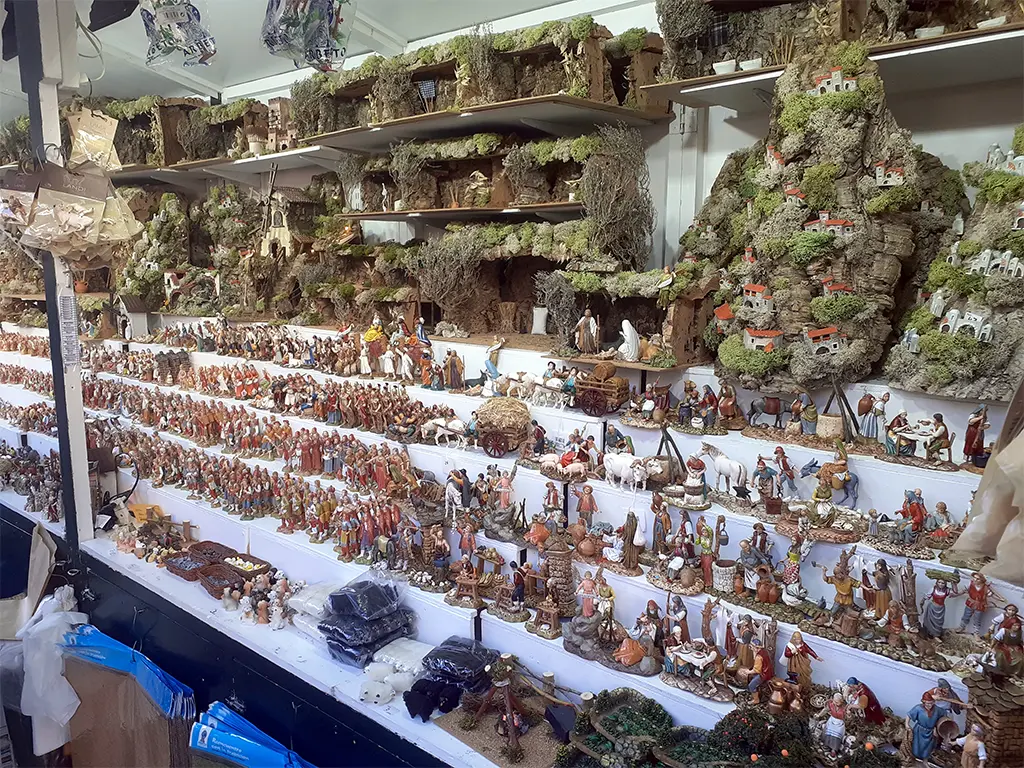
And the fourth is the shop window, which has to be named because it is there and is part of the December landscape: the snowy village with figures in the shop, the scene in the shopping centre, the nativity scene in the square put up by the town council. It belongs to the world by its material — figures, brand-name ones more often than not—, by its date and by its people — someone makes it, someone sells it, a great many people see it—. Whether it is a work in the sense this Manual will give the word, or only an ornament in the shape of one, is the question that decides the definition, and it is answered in the chapter on the definition, not here; this chapter confines itself to recording that the world reaches as far as the shop window, and that for that very reason a criterion will be needed to say what lies inside it.
The values it conveys
The last layer remains, and it is the one that gives meaning to the others: why the people who do all this do it. In the first edition of its chapter on the word, with the image of three pillars, this Manual said that for many this begins in tradition — the family nativity scene, the figure kept in its box—, that it is also a form of art, and that it conveys a message.18 Now, with the two previous chapters written, it can be said more precisely what it conveys, and there are two things that should be told apart because they are not conveyed in the same way.
The first is religious remembrance: the commemoration of the Nativity and homage to the Child. It is what Francis wanted — memoriam agere, to celebrate the memory— and what the previous chapter found in the dictionary: not memory that one has but memory that one makes, and a homage of the kind that sets before one what it honours. There is no need to repeat it; it is there in full. All that is added here is that this value is the one that gives unity to the whole inventory: the figure, the living scene, the paper, the song, the poem and the household custom all do the same thing, and that is why they are a world and not a list.
The second is the roots of a place: remembering where we come from. This value is not at Greccio or in the dictionary; practice put it there, centuries later, when the nativity scene began to be peopled with the people of the place where it was made — 18th-century Naples, the Provence of the santons, the Tyrolean valley, the Catalonia of Amades, the Madrid of Galdós—. The previous chapter explained why it works: in the popular nativity scene recognition is twofold — one recognises the story and one recognises one's own land—, and that is why it sometimes moves with fewer means. And the chapter on the popular style, in the block on composition, explained why it exists: because a trade is lost when the chain that passed it from one body to another is broken, and the figure is the support in which a people keeps the way it dressed, worked and saw itself. Neither of these is developed again here; they are summed up and referred to.19 What should be said in this chapter is that this value has today a name recognised outside nativity-scene art and practice, and that it is worth citing with its limit.
Article 2 defines intangible heritage as «los usos, representaciones, expresiones, conocimientos y técnicas — junto con los instrumentos, objetos, artefactos y espacios culturales que les son inherentes— que las comunidades, los grupos y en algunos casos los individuos reconozcan como parte integrante de su patrimonio cultural» — in the Convention's official English text, the practices, representations, expressions, knowledge, skills – as well as the instruments, objects, artefacts and cultural spaces associated therewith – that communities, groups and, in some cases, individuals recognize as part of their cultural heritage—.20 And it goes on with the sentence that matters here: that heritage, «que se transmite de generación en generación, es recreado constantemente por las comunidades y grupos en función de su entorno, su interacción con la naturaleza y su historia, infundiéndoles un sentimiento de identidad y continuidad» — transmitted from generation to generation, is constantly recreated by communities and groups in response to their environment, their interaction with nature and their history, and provides them with a sense of identity and continuity—.20 Identity and continuity: knowing who one is, and knowing that one is still the same. It is, put in the language of a treaty, what the popular nativity scene does when it sets the night watchman and the water-carrier before the people of the village they came from. The Convention does not say this of the nativity scene — it does not name it—; but it gives the name of the value, and the name serves.
Two clarifications should be added, because this Manual is read in six languages and in all six there are those who may draw more from this than is there. The first: the Convention lists five domains in which intangible heritage «se manifiesta en particular» — is manifested inter alia—, and none of them is called «arte» — art—: «tradiciones y expresiones orales» — oral traditions and expressions—, «artes del espectáculo» — performing arts—, «usos sociales, rituales y actos festivos» — social practices, rituals and festive events—, «conocimientos y usos relacionados con la naturaleza y el universo» — knowledge and practices concerning nature and the universe— and «técnicas artesanales tradicionales» — traditional craftsmanship—.20 A nativity scene can enter through several of them — the rite, the festival, the technique—; what the Convention cannot do, because it is not made for that, is say whether what enters is a work. That is another matter and has another chapter. The second: what travels from here to the other five languages is not any national dossier — each country has its own, or has none—, but the mechanism: a value of roots that practice put into the scene long before anyone declared it.
And there is one last observation about this second value that this chapter must record with care, because it is easy to say too much. Celano writes, at the end of his list of what was prepared at Greccio, that «Greccio was made, as it were, a new Bethlehem» — quasi nova Bethleem de Graecio facta est—.21 That sentence describes the gesture of the popular nativity scene: Bethlehem brought to one's own village. But it describes it only halfway, and it is worth measuring how far. At Greccio it was the place that was transformed: an Italian wood was Bethlehem for one night. The content was not: nobody from the village played a shepherd, there were no clothes of the valley or trades of the district; there was hay, two animals and a Mass. The popular nativity scene does both things — it transforms the place and puts itself inside it—; Greccio did only the first. So «Greccio was a popular nativity scene» does not hold with Celano in hand; «Greccio was the first gesture of the popular one» does. And it is Celano's sentence, not Francis's: Francis said memoriam agere and pervidere; the new Bethlehem is said by the one telling the story. If this reading holds, its place is in the chapter on the popular style, and the reader is referred there.
Closing
What, then, is what was born at Greccio made of? Of works on two levels: the representation of the Nativity in any technique, and the scene, which does not exist without figures — of terracotta or any other material, of paper, of flesh or from a factory—. Of modes that are not ranked from better to worse: figures, people, paper, light, song, poetry; in space, in time and in the word; and all three were there on the first night. Of people: a chain that runs from whoever models to whoever looks and in which no link is superfluous, what Becker called an art world. Of a calendar and customs: Christmas Eve, the associations, the exhibition, the museum gallery, the shop window. And of two values that give it meaning: commemorating the Nativity and paying homage to the Child, which is what was intended at the beginning, and remembering where we come from, which is what practice added later and which today has a name in a treaty.
It is a world, and it has a theme at its centre. Everything in it is ordered around that theme, and that is why it can be so wide without ceasing to be one: landscape is a class of paintings and this is a network of people around a scene. What this chapter has not done, on purpose, is say what inside that network is a work and what is not. It has gone as far as the shop window and stopped there. For the rest a criterion is needed, and the criterion first needs one more thing: to know what name all this has, where that name exists and how much of this world it manages to name. That comes next.
References
The footnotes locate, and only locate. The entries that explain why each source comes in, what it contributes and what it does not allow one to assert are in the body of the text, in the panel that accompanies its first appearance. Translations from Latin, Spanish, Catalan and Italian are the Manual's own; Chion, Gorbman and Becker are quoted in English.
Chapter «Is nativity-scene making an art or just a Christmas tradition?»: the main door (the disciplines a nativity scene is made of), «the theme never left art» (Giotto, Scrovegni, c. 1303-1305; La Tour, Louvre, RF 2555) and «the domestic test» (whoever arranges the figures is already composing). Chapter «A question of framing»: the two types of nativity scene by number of framings — the single one of the diorama, «as one looks at a painting», and the infinite ones of the nativity scene one walks around, where «the framing lies in the eyes of the observer»—, and «one composes for the gaze, not for applause». Summed up and referred to here. ↩ ↩ ↩ ↩
Instituto del Patrimonio Cultural de España, Informe técnico definitivo for the declaration of nativity-scene art and practice («belenismo») as a Manifestación Representativa del Patrimonio Cultural Inmaterial, March 2022, p. 5: «Se decidió que en dicha propuesta no se incluyeran los Belenes vivientes»; p. 40: «vivientes (con personas y animales reales) o inanimados». The same in the resolution initiating the procedure, BOE no. 4, 5-I-2022. Checked against the PDF on 12-IX-2026. The Real Decreto 481/2022 does not contain the word «viviente». Presentation of the source: first chapter of this series, panel on the report. ↩
Universalis Fœderatio Præsepistica and Vereniging Vrienden van de Kerstgroep – Nederland, poster for the 4th edition (2026) of the paper nativity scene, Spanish text: «La Un. Fœ. Præ., en colaboración con la Asociación de Amigos del Belén de los Países Bajos Vrienden van de Kerstgroep – Nederland, propone este año el cuarto de una serie de belenes de papel para crear y coleccionar. El belén, ideado y pintado por la artista holandesa Aisha de Vaal, muestra en un collage las diferentes zonas de los Países Bajos y a sus habitantes con sus trajes tradicionales»; captions «Nativity paper – Papier Krippe» and «Belen de papel – Presepio di carta». Checked against the reproduction of the poster on 13-IX-2026. The federation's website, entry «From the Netherlands: the new 2026 paper Nativity scene» (unfoeprae.org/en/from-the-netherlands-the-new-2026-paper-nativityscene/, 2-VII-2026, signed RogerZen), checked on 16-IX-2026: «is this year offering all its member associations the fourth in a series of paper nativity scenes to create and collect»; «The Nativity scene, designed and painted by the Dutch artist Aisha de Vaal, will be printed in a limited edition and depicts a collage of the various regions of the Netherlands and their inhabitants»; «All the figures depicted wear the traditional costumes of the province they represent and are bringing gifts for Jesus from their homeland». The translation of the Spanish text in the body is the Manual's own. Reproduced in this chapter as a quotation (Spanish Ley de Propiedad Intelectual, Real Decreto Legislativo 1/1996, art. 32.1; consolidated text in the BOE, consulted on 21-X-2026). ↩
Thomas of Celano, Vita prima, 86,1; 85,9; 85,8; ed. d'Alençon (Rome, 1906), p. 87, l. 13-14; p. 87, l. 6-8; p. 87, l. 5: «Induitur sanctus Dei leviticis ornamentis, quia levita erat, et voce sonora sanctum evangelium cantat»; «Cantant fratres, Domino laudes debitas persolventes, et tota nox iubilatione resultat»; «Personat sylva voces, et iubilantibus rupes respondent». Checked against the edition on 13-IX-2026. Presentation of the source, edition and numbering: first chapter of this series, panel and note 1. ↩
Michel Chion, L'audio-vision. Son et image au cinéma, Paris, Nathan, 1990; English edition Audio-Vision. Sound on Screen, ed. and trans. Claudia Gorbman, foreword by Walter Murch, New York, Columbia University Press, 1994, ch. 1, «Projections of Sound on Image», p. 5: «By added value I mean the expressive and informative value with which a sound enriches a given image so as to create the definite impression, in the immediate or remembered experience one has of it, that this information or expression "naturally" comes from what is seen, and is already contained in the image itself». Checked on 22-X-2026 against the 1994 copy on Internet Archive (item audiovisionsound0000chio). Its copyright page gives the original: «L'Audio-Vision © 1990 Editions Nathan, Paris». Quoted from the English edition, and in English in the body. ↩ ↩
Claudia Gorbman, Unheard Melodies. Narrative Film Music, Bloomington, Indiana University Press / London, BFI Publishing, 1987, p. 73: the principles of classical film music — invisibility, inaudibility, signifier of emotion, narrative cueing, continuity, unity, and the violation clause—. The violation clause reads: «A given film score may violate any of the principles above, providing the violation is at the service of the other principles». Checked on 22-X-2026 against the 1987 copy on Internet Archive (item unheardmelodiesn00gorb), p. 73. ↩ ↩
J. S. Bach, Magnificat, BWV 243a (E-flat major) and BWV 243 (D major). Nederlandse Bachvereniging, record «Magnificat BWV 243» (bachvereniging.nl/en/bwv/bwv-243), consulted on 15-IX-2026: first version first performed on «25 December 1723» with interpolated Christmas hymns; revised «ten years later», transposed to D major and without the Christmas pieces, first performed on «2 July 1733». The Bach Cantatas Website (bach-cantatas.com/Vocal/BWV243.htm, consulted on 16-IX-2026) gives the revision as «Leipzig, 1728-1731 [revision of BWV 243a]» and the performance of 2-VII-1733; the two sources agree on the first performance of BWV 243a on 25-XII-1723. The canticle: Lk 1:46-55. ↩
Antonio Vivaldi, violin concerto in E major «Il riposo – per il Santissimo Natale», RV 270. IMSLP (imslp.org, «Violin Concerto in E major, RV 270 (Vivaldi, Antonio)», consulted on 16-IX-2026): title «Concerto Il riposo per il Santissimo natale», E major, from the autograph manuscript in Turin, Biblioteca Nazionale, Giordano 34, ff. 88-95; three movements (Allegro, Adagio, Allegro). The IMSLP score is a transcription by Mario Bolognani (Rome, Baroquemusic.it, 2014) «Based on autograph manuscript I-Tn Giordano 34, Bl. 88-95» (consulted on 22-X-2026). ↩
Lk 1:46-55 (Mary); Lk 1:68-79 (Zechariah); Lk 2:14 (the angels); Lk 2:29-32 (Simeon). The texts are not quoted here; their place in the cycle is in the Manual's narrative map, «The scenes of the infancy cycle of Jesus». Verse numbering of the RVA 1909. ↩
Luis Rosales, Retablo sacro del Nacimiento del Señor, illustrated by José Romero Escassi, Escorial [Silverio Aguirre], 1940, 54 p.; 2nd corr. and enl. ed., Madrid, Edit. Universitaria Europea, 1964 (catalogue of the Biblioteca Nacional de España, records of the two editions, consulted on 22-X-2026). Jacint Verdaguer, trilogy Jesús infant: Nazaret (1890), Betlem (1891), La fugida a Egipte (1893), according to lletrA, la literatura catalana a internet (UOC, lletra.uoc.edu, «Jacint Verdaguer», consulted on 16-IX-2026). Lope de Vega, Pastores de Belén, prosas y versos divinos, editio princeps Madrid, Juan de la Cuesta, at the expense of Alonso Pérez, 1612, according to the online critical edition of the Universidad de Huelva (uhu.es/vies2, «1612_LDP_22.pdf», consulted on 16-IX-2026). Rainer Maria Rilke, Das Marien-Leben, Leipzig, Insel-Verlag, with no year on the title page; the leaf following the title page bears the date «Duino, Januar 1912» (microfilm copy from the University of Illinois, Internet Archive, item 3545127, consulted on 22-X-2026). Josep Maria de Sagarra, El poema de Nadal, 1931 (Gran Enciclopèdia Catalana, s. v. «Josep Maria de Sagarra i de Castellarnau», enciclopedia.cat, consulted on 22-X-2026: «Entremig quedaria El poema de Nadal (1931)»). ↩
Chapter on the word, The word: «Belenismo, in two languages», section «What this is for, for each of them»: the chain of roles and «decorating is already creating». The chain of roles is summed up here and has a block of its own: «Who is who in the nativity scene». ↩
Howard S. Becker, Art Worlds, Berkeley and Los Angeles, University of California Press, 1982; 25th anniversary ed., 2008. Preface, p. x: «the network of people whose cooperative activity, organized via their joint knowledge of conventional means of doing things, produces the kind of art works that art world is noted for»; ch. 1, p. 34: «all the people whose activities are necessary to the production of the characteristic works which that world, and perhaps others as well, define as art». Checked on 22-X-2026 against the 1982 copy on Internet Archive (item artworlds00beck). Quoted in English in the body. ↩ ↩ ↩
Gran Enciclopèdia Catalana, s. v. «pessebrisme» (enciclopedia.cat): «La primera associació que es constituí fou la de Barcelona, que ja existia abans del 1863, però que fou aprovada per disposició governativa aquell any». Checked on 15-VIII-2026 for the chapter on the word; taken from there. ↩
Universalis Fœderatio Præsepistica (unfoeprae.org): «La Un.Foe.Prae (Universalis Foederatio Praesepistica) se fundó en Barcelona el 31 de mayo de 1952», with «la reunión de siete asociaciones belenistas»; «Hoy cuenta con 21 organizaciones». Checked on 15-VIII-2026 for the chapter on the word; taken from there. ↩
Museo Salzillo, Murcia, page «Belén de Salzillo» (museosalzillo.es/coleccion/belen-salzillo/), consulted on 13-IX-2026: «El belén fue realizado por Francisco Salzillo entre 1776 y 1783 para el noble murciano Jesualdo Riquelme y Fontes y completado por su discípulo Roque López y su taller. Quedaría concluido en 1800»; «Las figuras tienen un tamaño de unos treinta centímetros»; «modeladas en arcilla pero también las hay en madera, con lienzos y telas encoladas». The page presents it as «Sala del Belén de Salzillo» within the collection; the museum's opening hours are weekly and all year round. The expression «exposición permanente» (permanent exhibition) does not appear on the pages consulted: that it is not composed for a season or taken down is inferred from context. ↩
Chapter «Ephemeral by necessity, not by essence»: the three endings (of the experience, of the exhibition, of the work) and Salzillo's nativity scene preserved in its scene. Summed up and referred to here. ↩
The image of the three pillars comes from the first edition of the chapter on the word (August 2026), section «Tradition, art and message: three inseparable pillars», which did not pass into the current edition, The word: «Belenismo, in two languages»; summed up here. ↩
Twofold recognition: previous chapter of this series, section «The nativity scene as a mirror». The mechanism of the loss of a trade and the figure as support (Halbwachs, Assmann, Connerton, Barth; Sedikides and Wildschut): chapter «Popular, the other word», where each source is presented with its limit. Whom a nativity scene represents and the choice of a village: «Whom a nativity scene represents». ↩
UNESCO, Convención para la Salvaguardia del Patrimonio Cultural Inmaterial, Paris, 17 October 2003, art. 2, paragraphs 1 and 2; Spanish text at ich.unesco.org/es/convención, checked on 15-IX-2026. Paragraph 1: «Se entiende por patrimonio cultural inmaterial los usos, representaciones, expresiones, conocimientos y técnicas -junto con los instrumentos, objetos, artefactos y espacios culturales que les son inherentes- que las comunidades, los grupos y en algunos casos los individuos reconozcan como parte integrante de su patrimonio cultural. Este patrimonio cultural inmaterial, que se transmite de generación en generación, es recreado constantemente por las comunidades y grupos en función de su entorno, su interacción con la naturaleza y su historia, infundiéndoles un sentimiento de identidad y continuidad y contribuyendo así a promover el respeto de la diversidad cultural y la creatividad humana». Paragraph 2: «El patrimonio cultural inmaterial se manifiesta en particular en los ámbitos siguientes: a) tradiciones y expresiones orales, incluido el idioma como vehículo del patrimonio cultural inmaterial; b) artes del espectáculo; c) usos sociales, rituales y actos festivos; d) conocimientos y usos relacionados con la naturaleza y el universo; e) técnicas artesanales tradicionales». The English wording given in the body is that of the official English text of the Convention, Convention for the Safeguarding of the Intangible Cultural Heritage (ich.unesco.org/doc/src/01852-EN.pdf). The Real Decreto 481/2022 (BOE-A-2022-9969) is examined in this series' chapter on the dossier. ↩ ↩ ↩ ↩
Celano, 85,5; d'Alençon, p. 87, l. 1-3: «et quasi nova Bethleem de Graecio facta est». Checked on 13-IX-2026. That Francis did not say that sentence: 84,8 (memoriam agere, pervidere), first chapter of this series. ↩