
 ≈ 16 min

Map of the cycle for the nativity-scene maker
A scene does not stand alone.
It occupies a place in a sequence, and a good part of its meaning depends on that place.
What this map is for
This chapter gathers, one by one, the scenes of the cycle of the birth of Jesus as the Gospels of Luke and Matthew present them. It does not develop each one: it only orders them, locates them, dates them and says in one or two sentences what each contributes to the whole. The detailed development —characters, gestures, props, scenography, sculptural reconstruction— belongs to each scene’s own page, in the block of scenes of the cycle.
A naming convention, before those of the map: this map covers the complete infancy cycle, from the betrothal to Jesus among the doctors; within it, the core of the Nativity runs from the Annunciation to the Presentation. The two terms are used with that scope throughout the Manual.
Two conventions sustain the map.
The first is the reference date. The cycle is anchored on 25 December as a tool of composition, not as a historical claim. The chapter 25 December: the zero point in creating biblical nativity scenes in this block explains why and under what conditions. From that anchor are derived 25 March for the Annunciation and 2 February for the Presentation; 6 January, the Epiphany, is a liturgical anchor.
The second is the parallel presentation of Luke and Matthew from the Nativity onwards. The two evangelists narrate different things after the birth; there is no faithful way of fusing them into a single chronology. The map shows them side by side, preserving the internal logic of each. Where one is silent, this is indicated; where both coincide, it is marked.
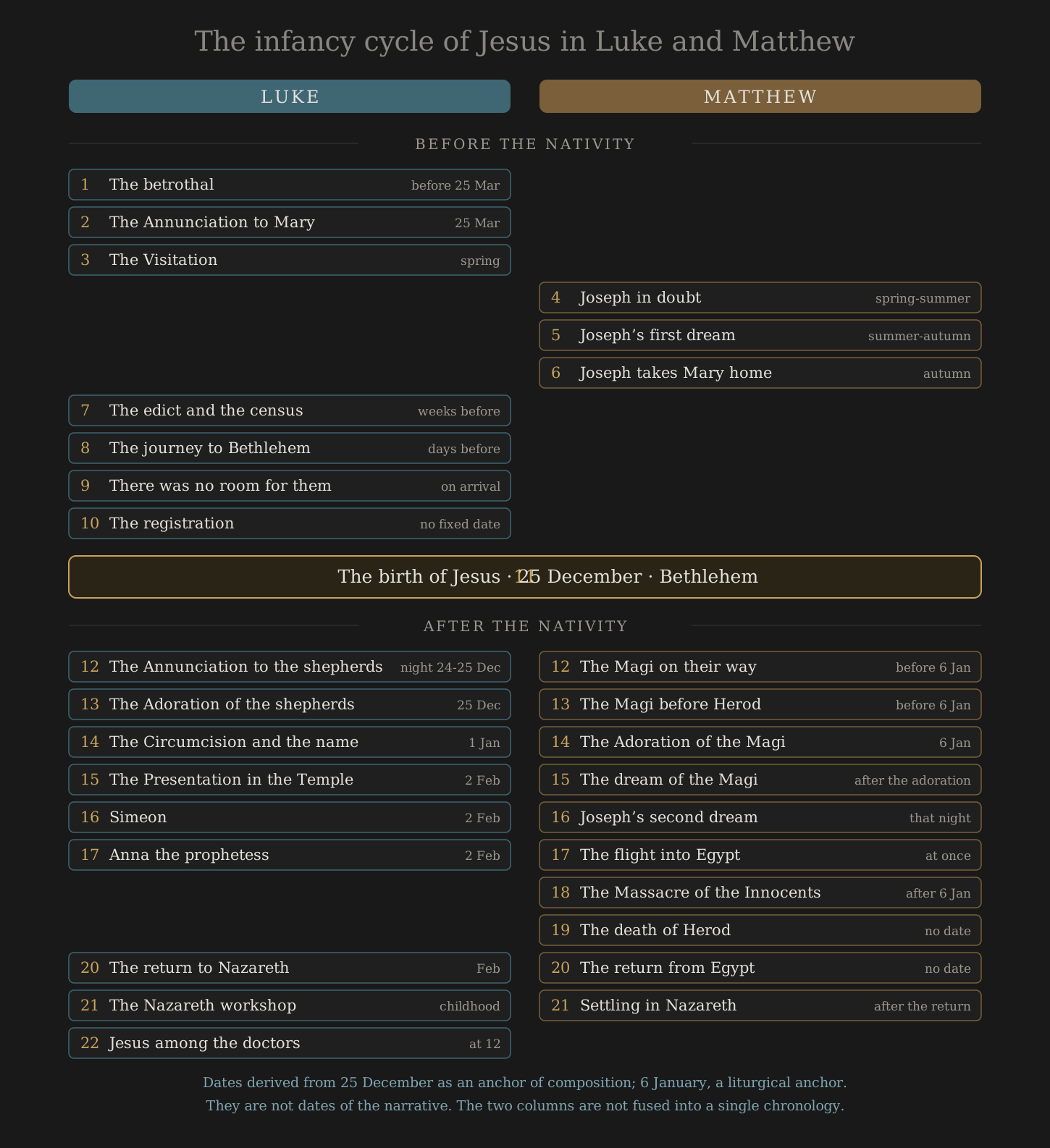
Before the Nativity
1. The betrothal
Luke 1:26–27 — before 25 March — Nazareth.
Mary and Joseph already appear formally betrothed (kiddushin): a legal bond prior to living together. The human starting point of the cycle. Matthew states it (1:18) without a scene of its own.
2. The Annunciation to Mary
Luke 1:26–38 — 25 March (≈ 9 months before 25 December) — Nazareth.
Gabriel announces the conception to Mary. A domestic interior; an interruption of routine. Matthew does not narrate this scene.
3. The Visitation
Luke 1:39–56 — spring, shortly after the Annunciation (1:39); Mary stays about three months (1:56) — «una ciudad de Judá» — a town of Judah—.
Mary visits Elizabeth; the child leaps in her womb and Mary utters the Magnificat. A scene of recognition between two women. Matthew does not narrate this scene.
4. Joseph in doubt
Matthew 1:18–19 — between spring and summer — Nazareth (implicit).
Joseph, a just man, discovers Mary’s pregnancy and decides to divorce her quietly so as not to expose her. The moral knot of the cycle. Luke does not narrate this doubt.
5. Joseph’s first dream
Matthew 1:20–23 — summer or early autumn — Nazareth (implicit).
The angel appears in a dream and resolves the conflict: Joseph must take Mary in and give the child his name. Luke does not narrate dreams of Joseph.
6. Joseph takes Mary to himself
Matthew 1:24–25 — autumn — Nazareth (implicit).
The passage from betrothal to life together, with the precision that there was no conjugal union before the birth. Luke does not narrate this change of state.
7. The edict of Augustus and the census
Luke 2:1–3 — a few weeks before 25 December — Nazareth (the edict is issued in Rome; the scene is its reception, and the next one is already the start of the journey).
An imperial decree obliges people to register. An external cause that sets the journey in motion. Matthew does not mention the census.
8. The journey to Bethlehem
Luke 2:4–5 — December, a few days before the 25th — from Nazareth to Bethlehem.
The decree becomes bodily experience: distance, time, fatigue, advanced pregnancy. The text mentions no mount; the donkey is a plausible reconstruction. Matthew does not narrate the journey.
The order of these two scenes is inferred, not textual. Luke narrates neither of the two acts as a dated event: the «no había lugar» — there was no room— describes a situation, it does not tell that anyone shut the door on them, and the registration is a purpose («para ser empadronado» — to be registered—). The sequence lodging → registration is not fixed by the text —which only lists them in neighbouring verses (2:5 and 2:7)—, but by the material logic of the journey: whoever arrives with a woman at full term sorts out a roof before nightfall; the formality, spread out over time, can wait. It is ordered thus by context, and this is declared, like the donkey of the journey.
9. There was no room for them («Seeking lodging»)
Luke 2:7 — a few days before 25 December, on arrival — Bethlehem.
«No había lugar para ellos.» — There was no room for them—. There is no dramatised rejection and no night-time search: the sentence says that there was no room for them in the katályma, the lodging, not that anyone turned them away. It is the same word Luke uses for the room where the Last Supper is held (22:11). What the katályma was here, the text does not say. Reading it as the house that receives them, with its guest space already taken, is a plausible reconstruction, and it is declared as such. The term «inn» does not designate a modern hotel. Matthew does not narrate the search for lodging.
10. The registration
Luke 2:1–5 — around the time of arrival; the exact moment, not determined — Bethlehem.
The scene that nobody narrates: Luke gives the purpose of the journey —«para ser empadronado» — to be registered—, not the act. Whether the formality took place before the birth, in the days of waiting or afterwards, within the 40 days, the text does not fix; representing it is a plausible reconstruction, declared as such. Register, scribes, queues: the impersonality of the empire frames, without knowing it, what is about to happen. Matthew does not narrate the registration.
The Nativity
11. The birth of Jesus
Luke 2:6–7 · Matthew 1:25 and 2:1 — 25 December — Bethlehem.
Birth in a crowded lodging: the solution, whichever is chosen, is improvised —humble through lack of space, not through rejection—. The manger as a functional piece of furniture; the child wrapped in swaddling clothes. Luke narrates it with sobriety; Matthew states it without describing it. It is the centre of the cycle and the point from which the two Gospels part ways.
After the Nativity: two itineraries
From the Nativity onwards, Luke and Matthew follow different paths. Luke prolongs the scene with the shepherds, the Jewish rites and the encounter in the Temple; Matthew shifts the focus to the Magi from the East and links together an arc of threat, flight and return. The scenes are presented side by side when they exist in both, and separately when only one of the two narrates them.
12. The night of the birth
12 Lk. The Annunciation to the shepherds. Luke 2:8–14 — night of 24 to 25 December — fields near Bethlehem. Shepherds spending the night beside the flock; an irruption of light; an announcement with a «señal» — sign—: the child wrapped in swaddling clothes, lying in a manger. And suddenly, the multitude of the heavenly host and the Gloria (2:13–14): one of the most modelled images of the whole night, which belongs to this scene and should not be lost between the announcement and the adoration.
12 Mt. The Magi on their way. Matthew 2:1–2 — before 6 January, a date derived from the anchor — from the East towards Judaea. Matthew does not narrate the journey: he presents the Magi as already arrived in Jerusalem (2:1), saying they have seen «su estrella» — his star— (2:2). The road, and the caravan, are reconstruction, like the donkey of the journey to Bethlehem. The tension of the journey, not of the encounter.
13. Arrival at the place
13 Lk. The Adoration of the shepherds. Luke 2:15–20 — early hours of 25 December — Bethlehem. The shepherds pass from fear to searching and reach the place they were shown. Mary, in silence, keeps and ponders what they tell.
13 Mt. The Magi before Herod. Matthew 2:1–8 — early January — Jerusalem. The search enters the terrain of power. Herod grows uneasy and sets the machinery of the palace in motion.
14. The fulfilment of the law and the eastern adoration
14 Lk. The Circumcision and naming. Luke 2:21 — 1 January (eighth day) — family setting. A brief and solemn rite that incorporates the child into the Covenant and gives him the name that had been announced.
14 Mt. The Adoration of the Magi. Matthew 2:9–12 — 6 January — Bethlehem. The Magi enter the house (2:11); neither gospel speaks of a stable, and they prostrate themselves before the child. Gold, frankincense and myrrh. 6 January is a liturgical anchor, not the time of the narrative: Matthew places the visit in a house, with a child who is no longer a newborn, and Herod’s order against those «de dos años para abajo» — two years old and under— (2:16) gives only an upper limit, calculated by Herod from what the Magi had told him. The date orders the cycle; it does not date it.
15. The fortieth day and the return by another way
15 Lk. The Presentation in the Temple. Luke 2:22–24 — 2 February (fortieth day) — Temple of Jerusalem. The ascent to Jerusalem and a humble offering: a pair of turtledoves or two young pigeons, the offering the Law allows to someone who cannot afford a lamb (Leviticus 12:8). Luke cites the Law; he does not say they were poor.
15 Mt. The dream of the Magi. Matthew 2:12 — after the adoration — Bethlehem. Warned in a dream not to return to Herod, the Magi go back by another way. A discreet close to the visit and the trigger of what will follow.
16. Recognition and flight
16 Lk. Simeon. Luke 2:25–35 — 2 February — Temple of Jerusalem. The righteous man, who was waiting for the consolation of Israel, recognises the child, takes him in his arms, blesses God and blesses his parents.
16 Mt. Joseph’s second dream: fleeing into Egypt. Matthew 2:13 — the night after the departure of the Magi — Bethlehem. The urgency of protecting the child; a discreet departure.
17. Spreading the word and exile
17 Lk. Anna the prophetess. Luke 2:36–38 — 2 February — Temple of Jerusalem. The aged prophetess gives thanks and speaks of the child to those who are waiting for the redemption of Jerusalem. What is recognised begins to circulate.
17 Mt. The flight into Egypt. Matthew 2:14–15 — immediately after the dream — from Bethlehem to Egypt. Matthew says only that they left by night and stayed in Egypt until the death of Herod. The stages of the journey, the hardship of the road and a welcome in Jewish communities in Egypt are plausible reconstruction. (Coptic tradition links the family with Al-Muharraq, a fact that does not belong to Matthew’s text).
18. The violence of power (Matthew only)
18 Mt. The Massacre of the Innocents. Matthew 2:16–18 — the days after 6 January — Bethlehem and its district. A reprisal ordered by Herod. The historicity of the episode as a mass event has been debated; its symbolic force has reached the liturgy (28 December, Holy Innocents).
19. The end of the threat (Matthew only)
19 Mt. The death of Herod. Matthew 2:19 — weeks or months after the flight — Egypt (the place where the family receives the news). The text does not describe the death; it records it as the fact that unblocks the return.
20. The return
Here the two lines draw closer again, but with different atmospheres. In Luke, the return is serene, almost domestic. In Matthew, it is the end of an exile, with caution and the memory of danger.
20 Lk. Return to Nazareth. Luke 2:39 — early February, after the Presentation — from Jerusalem to Nazareth. Having fulfilled what was prescribed, the family returns.
20 Mt. Return from Egypt. Matthew 2:19–21 — date undetermined, after the death of Herod — from Egypt to the land of Israel. Not a joyful homecoming, but a cautious return.
21. Life in Nazareth
21 Lk. The workshop of Nazareth. Luke 2:39–40 and 51–52 — childhood, with no specific date — Nazareth. Domestic life and trade. The text does not describe a «workshop»; its presence in the sculptural scene is an admissible reconstruction, supported by Matthew 13:55, which calls Jesus «el hijo del carpintero» — the carpenter’s son—, and by Mark 6:3, which gives that trade to Jesus himself.
21 Mt. Settling in Nazareth. Matthew 2:22–23 — after the return from Egypt — Nazareth. A prudent decision after the danger: Galilee, and not Judaea, as a place to live.
22. A glimpse of the future (Luke only)
22 Lk. Jesus among the doctors. Luke 2:41–52 — Passover, when Jesus is 12 years old — Temple of Jerusalem. The boy stays among the teachers, listens, asks questions, astonishes. Luke thus closes the infancy cycle with a moment that already announces what is to come.
Before going on
What this map orders is not the cycle —the cycle belongs to the Gospel text and to tradition—, but the way into the concrete work. Each scene listed here will have its own page: which characters are needed, which gestures are coherent, which props and which scenography make sense, what can be stated on the basis of the Gospel and what must be put forward as a plausible reconstruction.
With this the block In search of the biblical nativity scene comes to a close. What we have gathered —the references, the reading of the script, the truth that befits the nativity scene, the zero point of 25 December, the human world of first-century Judaea, the anthropology of the figures and, now, the map of the cycle— has been the preliminary work. From here one can now enter each scene without starting from scratch.
Next block: the characters of the cycle. It is being written. Some of its pages already have a draft, awaiting revision, and others have not yet been started. They will be published as they are finished.