
 ≈ 13 min

Time, too, is represented.
A scene does not happen only in a place: it happens in a season and in a light.
What would happen if time did not exist in your nativity scene?
So far we have worked on the biblical nativity scene from the narrative, from the world in which that narrative takes place, from the four truths the scene can sustain and from the figure of the nativity-scene maker who decides between them.
But something still remains that often goes unnoticed:
time, too, is part of the scene.
Not only the chronology of the episodes, but the season, the quality of the light, the climate, the clothing that protects the bodies and the rhythm with which the scene makes itself felt. The nativity scene is often built as if everything happened in a neutral time —neither winter nor summer, neither dead of night nor cold afternoon—, and the scene is then left suspended in a present without depth.
A scene truly changes when time stops being an indifferent background and begins to be part of what is represented.
Time is also a matter for representation
In building a nativity scene we usually think straight away of figures, architecture, landscape, composition and props. Not always with the same clarity of the time represented. And yet time is not an abstract measure: it too has a visible body.
It makes itself present in the slant of the light and in the length of the shadows, in the state of the ground, in the way people wrap up, in the attitude of the bodies and in the quality of the air. A winter night scene does not feel the same as a scene open to a generic day. A family that has travelled in a cold season does not present itself in the same way as if it arrived from a climate without harshness. A newborn wrapped and protected does not communicate the same as an idealised image removed from every real condition.
Time does not accompany the scene from outside. It is inside what the scene represents.
25 December as a working anchor
The date of the birth of Jesus is not historically documented in the Gospels. We possess no firm fact that would allow us to state that it happened exactly on 25 December.
The date does, however, have a history that can be traced. The oldest written record to survive is in a collection of calendars compiled in Rome in the year 354: its list of martyrs’ anniversaries opens with a terse line, «VIII kal. Ian. natus Christus in Betleem Iudeae» (on the eighth day before the Kalends of January —25 December— Christ was born in Bethlehem of Judea).1 The feast began in Rome, apparently in the 330s; in Asia Minor it is attested around 380 and in Egypt around 430, while other Churches went on celebrating the birth on 6 January, as some still do today.2
Why that day and not another is not stated in any text of the period. Louis Duchesne, a historian of the liturgy, set out the two explanations that have been proposed. The first looks to the civil calendar of that same collection, which marks 25 December as the Natalis Invicti, the birth of the Unconquered Sun, on the day the Roman calendar took to be the winter solstice: the Church of Rome would have chosen that date to counter the solar cult. The second starts from the date assigned to Christ’s death, 25 March: if conception and death fell on the same day, the birth falls nine months later. Augustine records this correspondence —«Octavo enim Kalendas Apriles conceptus creditur quo et passus […]. Natus autem traditur octavo Kalendas Ianuarias» (he is believed to have been conceived on 25 March, the same day on which he suffered; and tradition holds that he was born on 25 December)—, but by then the feast was established, and Duchesne himself acknowledges that no earlier text contains the calculation: «l’on est réduit à la supposer» (we are reduced to supposing it).3, 4
The solar explanation is the one most often repeated, and also the one that least withstands scrutiny. Steven Hijmans, who has studied the Roman cult of Sol, points out that this feast appears in no source before that same calendar of 354 and a hymn by the emperor Julian from the year 362, and that nothing proves it preceded Christmas: it may even have been the pagan feast that answered the Christian one. In his view, what weighed in the choice was the cosmic value of the dates —the birth of Christ at the winter solstice, that of John the Baptist at the summer solstice, and their conceptions at the equinoxes— rather than any wish to displace a cult.2
One clarification is nonetheless needed: the astronomical solstice now falls on 21 or 22 December. The 25th was the date the Roman calendar assigned to it by tradition, and by the fourth century it already fell a few days after the actual solstice.2, 3 For the scene the difference does not matter: three or four days change neither the height of the noon sun nor the length of the night.
None of the explanations is proven.
But that does not prevent us from recognising what that date does within the cycle.
The point here is not to present it as a proven fact, but as a working tool. For the nativity-scene maker, 25 December works as a narrative and scenographic zero point: it orders the cycle, helps to think through the sequence of scenes, places the representation in a concrete winter and offers a working framework for dealing with climate, light, clothing, interiors and journeys. It also makes it possible to distinguish more clearly, within the cycle, the night of the Nativity, the Epiphany, the Presentation and the other moments.
It is not a matter of turning a liturgical tradition into historical proof. It is a matter of recognising that this date, accepted as a conscious convention, can serve as a compositional and visual anchor. The error begins only when that value as a reference is confused with a closed historical certainty.
Properly understood, 25 December does not diminish the scene: it gives back to it a temporal anchoring that it needs.
What winter brings to the scene
Accepting 25 December as a starting point does not mean only fixing a date on the calendar. It means accepting that winter enters the scene.
Bethlehem and Jerusalem lie in high areas, where winter is not an abstraction. Cold, rain, damp and, at times, snow are part of the possible world of the scene. And climate changes life: it forces one to think in layers, veils, mantles and warm clothing; it changes the way of walking and of waiting; it darkens or dampens the ground; it makes a sheltered interior more precious; it makes a small source of light more significant; and it gives the birth a concrete fragility.
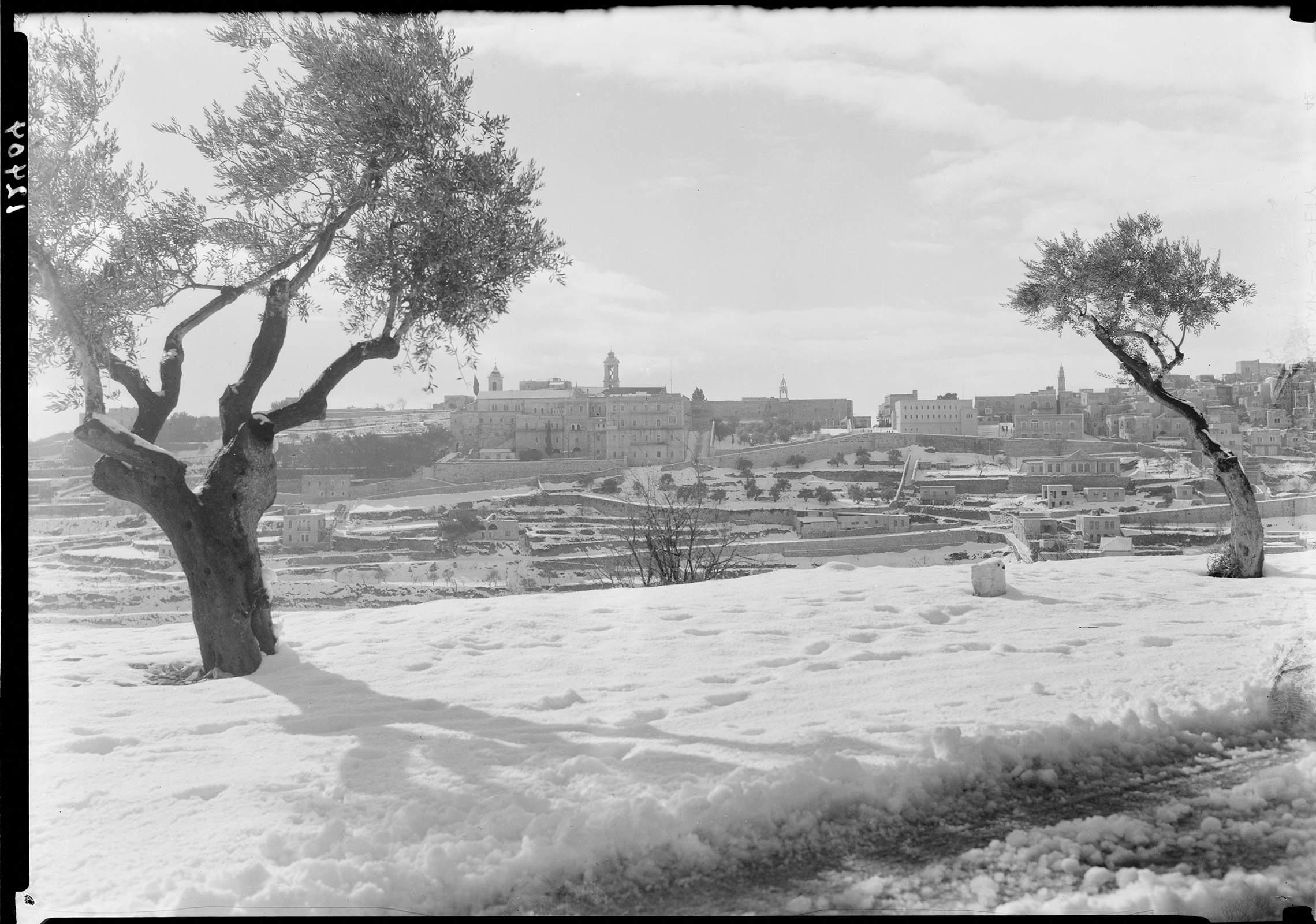
The figures for that winter —temperatures, rain, days of snow— and what they ask of each figure’s clothing are dealt with in «The warm garment (I): the cold and the sheepskin».
When the climate is erased, the scene loses an important part of its human truth. It is not a matter of dramatising the cold for the sake of it, but of understanding that the weariness of the journey, the need for shelter and the intimacy of the refuge become recognisable when winter stops being an abstract word.
Cold is not represented with a word, but with bodies that draw in on themselves, fabrics that weigh, hands that seek warmth, interiors that become more necessary.
Winter does not enter the scene as an effect. It enters as a condition of life.
The light of the solstice
Not only the climate. The light too.
Around the winter solstice, the sun’s path is lower, the shadows lengthen, the day grows shorter and the relationship between outside and inside becomes different. That changes the scene before any lighting decision is made.
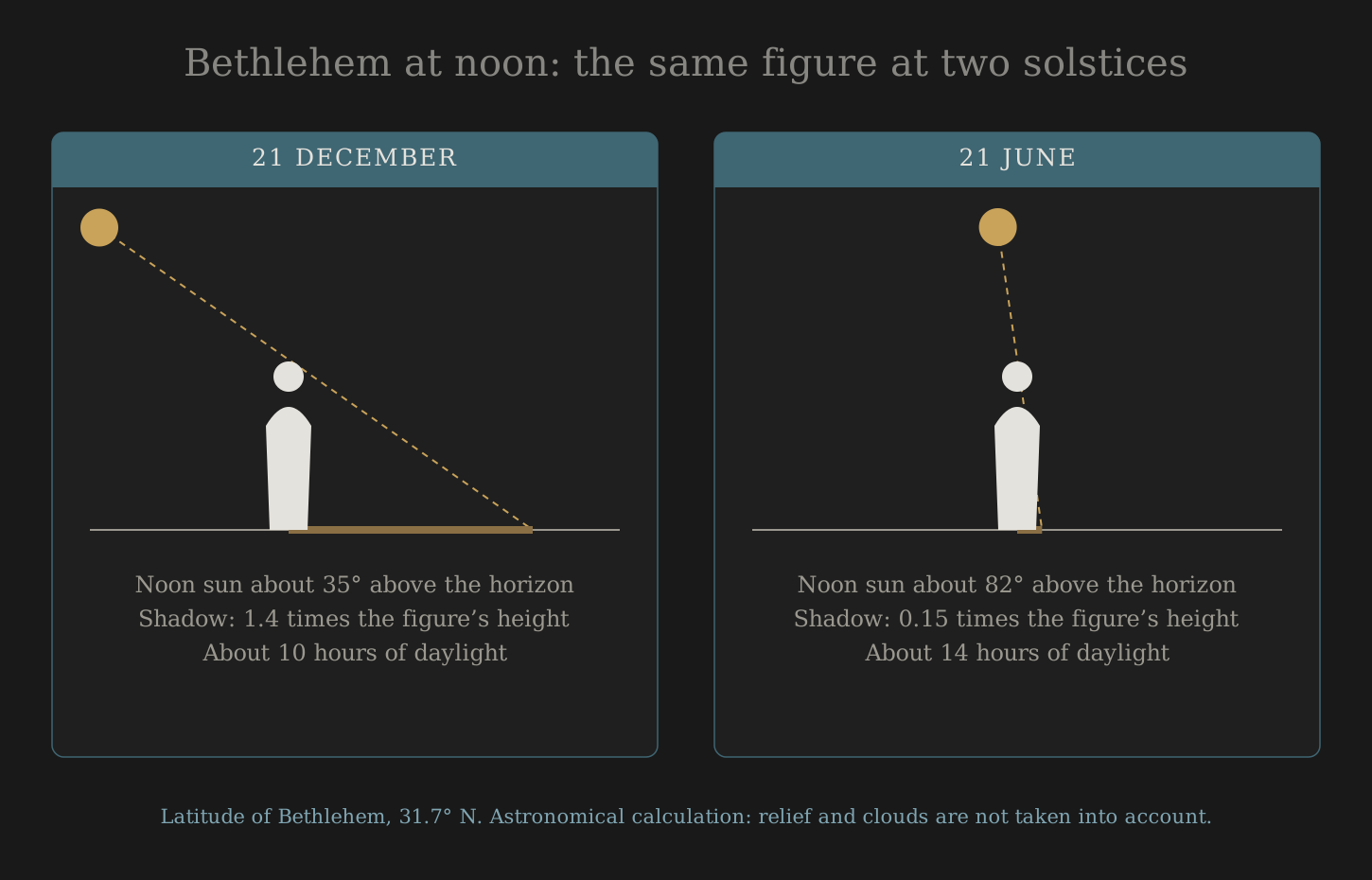
What this low light does to the volume of a figure —and why the overhead light of noon flattens it— is explained in «Shadow makes the volume».
A low, raking light does not tell the same thing as an open, neutral illumination. A short afternoon does not order the volumes as a broad morning orders them. A longer night gives greater weight to the fire, to the half-light and to the oil lamp, and makes the tension between shadow and withdrawal decisive.
The light does not only illuminate the nativity scene. It also places it in a time.
And when that light answers to no season and to no hour, the scene begins to contradict itself.
Tradition, yes; naivety, no
Accepting 25 December as the zero point does not oblige one to pretend that it is a historically proven date. On the contrary: it demands a clear distinction between a tradition with strong symbolic value and a documentary certainty that we do not possess.
That distinction does not weaken the work of the nativity-scene maker. It makes it more honest.
25 December can be used as a visual and compositional reference without turning it into historical dogma. And precisely for that reason it is useful: because it works as a conscious convention, not as a feigned fact.
What changes when time is taken seriously
When the scene stops being built in a neutral time and begins to be thought out from a concrete date, season and light, more changes than it seems. The palette changes, the air that surrounds the figures changes, and —above all— the relationship between vulnerability and shelter changes, which is, to a large extent, what a biblical nativity scene represents.
It is not enough to know what happened or where it happened. One also needs to understand in what human time it makes itself felt.
Before going on
We have seen that the biblical nativity scene needs not only narrative, context, references and visible matter. It also needs time: a time that makes itself felt in the scene as season, climate, light and sequence.
But another decisive dimension is still missing: the human world in which that birth is inscribed. Place and time are not enough; there must also be the real society —occupied, stratified, expectant— that the narrative presupposes and that the scene cannot ignore.
That will be the next step.
References
- ↑ [1] Mommsen, Th. (ed.), Chronica minora saec. IV. V. VI. VII., vol. I (Monumenta Germaniae Historica, Auctores antiquissimi 9), Berlin, 1892, p. 71. https://www.dmgh.de/mgh_auct_ant_9/index.htm#page/71/mode/1up
- ↑ [2a] ↑ [2b] ↑ [2c] Hijmans, S. E., Sol: The Sun in the Art and Religions of Rome, PhD thesis, University of Groningen, 2009, ch. 9, pp. 584-595. https://research.rug.nl/en/publications/sol-the-sun-in-the-art-and-religions-of-rome/
- ↑ [3a] ↑ [3b] Duchesne, L., Origines du culte chrétien, 5th ed., Paris, 1920, pp. 275-278. https://archive.org/details/origines-du-culte-chretien-duchesne-louis
- ↑ [4] Augustine of Hippo, De Trinitate IV, 5, 9. https://bkv.unifr.ch/works/cpl-329/compare/the-fifteen-books-of-aurelius-augustinus-bishop-of-hippo-on-the-trinity/55/de-trinitate
- ↑ [5] Matson Photo Service. Snow scenes. Bethlehem showing Church of Nativity under snow from J'lem-Beth. [i.e., Bethlehem] Road [safety film negative, 5 × 7 in, 1941?, 4–5 January]. Library of Congress, Prints and Photographs Division, Matson (G. Eric and Edith) Photograph Collection, LC-DIG-matpc-14805. No known restrictions on publication. https://hdl.loc.gov/loc.pnp/matpc.14805