
 ≈ 12 min
A nativity scene can be exact in its facts and still be false as a scene.
The truth that befits it is not measured with a single yardstick.
After the script, another question
Once the narrative has been read as a script, with its two distinct sources and with what each of them states, suggests or leaves unsaid, there still remains a question that should not be evaded.
What kind of truth can the scene about to be built embody?
Because on that question depends not only how one composes, but what kind of work one is trying to make. Working on the assumption that a nativity scene aims to reproduce exactly what happened is not the same as working on the assumption that it aims to move, nor the same as working in the knowledge that it must sustain several demands at once, without being reduced to any one of them.
Without clarifying that question, the whole scene may be built on an underlying confusion.
What kind of texts the infancy Gospels are
The infancy Gospels are not modern chronicle. They were not written to answer the historical curiosity of a contemporary reader, nor do they follow the criteria of a documentary reconstruction. But neither are they empty fables cut off from a real world.
They are narratives of faith born in a concrete world: a Jewish family, a land subject to Roman power, a culture with its religious expectations, a language, a domestic life. That world is not ornament: it is the ground on which the narratives stand.
And they do not only narrate. They also proclaim. They do not merely say that something happened; they try to express what what happened means. That twofold condition —narrating an event and proclaiming a meaning— gives the texts their particular form.
For the nativity-scene maker, this changes the opening question. It is not a matter of proving or of illustrating, but of giving visible form to something that lives in that tension.
A badly framed question
Sometimes the question is put like this: is this nativity scene historically exact? And a binary answer is expected —yes or no—, as if the only alternative to exactness were fantasy.
That dilemma is false.
Between archaeological reconstruction —impossible, and which would moreover falsify the nature of the narrative— and pure imaginative invention —which gives up the world in which the scene takes place— there is a wide space in which what a biblical nativity scene can truly do is at stake.
And in that space there is not just one way of being true.
There are several. And they do not exclude one another.
Four truths that do not exclude one another
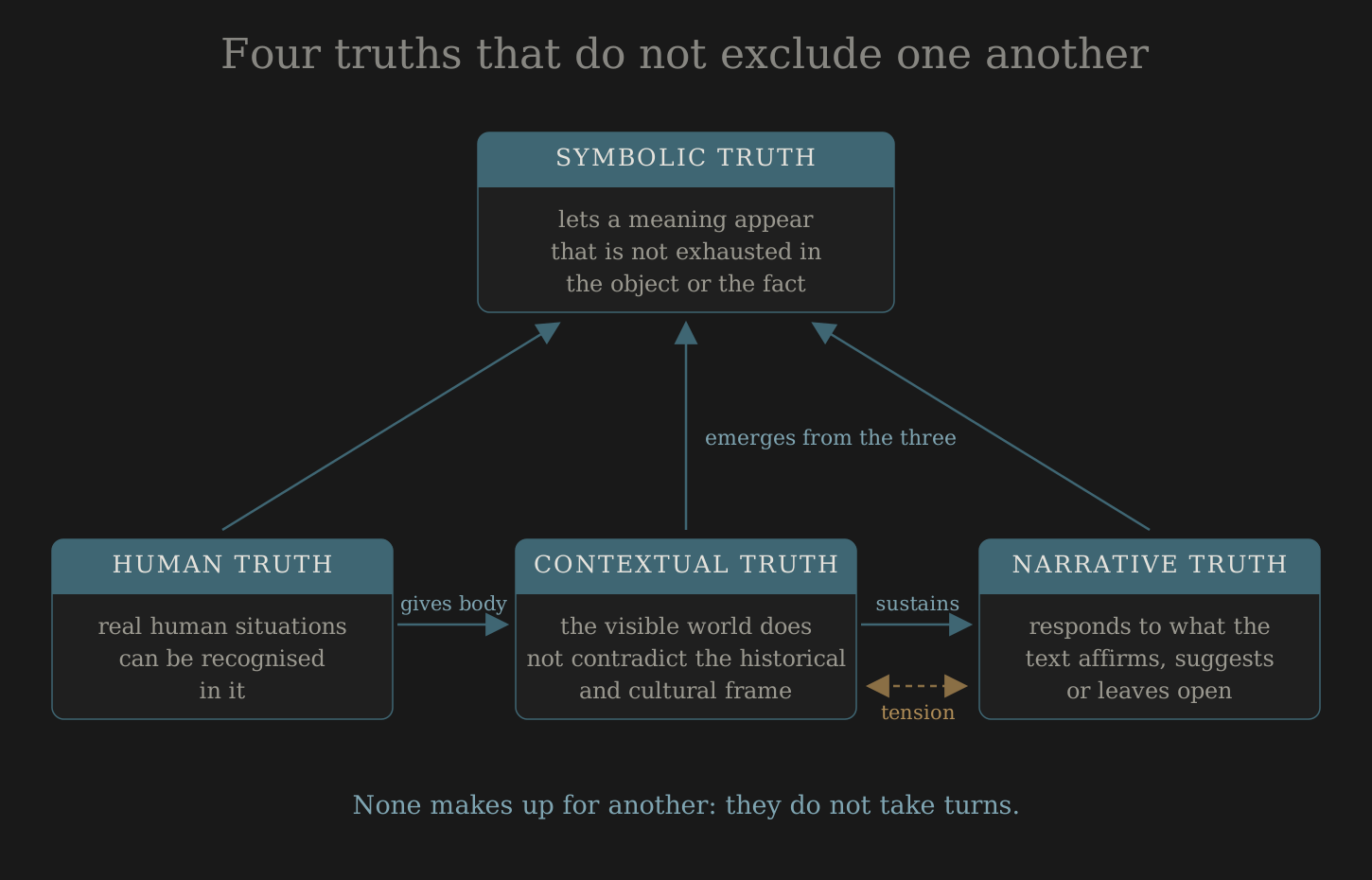
A biblical nativity scene can aspire to four different forms of truth. They are not academic labels: they are four planes on which the scene depends and which the nativity-scene maker, like it or not, works on with greater or lesser awareness.
Contextual truth
The scene is contextually true when the visible world does not contradict the historical and cultural framework in which the narrative is set. Not when it reproduces that whole world —which is impossible— but when it stops stumbling against it.
A flat roof instead of a Central European gabled roof. A manger of stone or mud instead of one of sawn planks. A dwelling with a courtyard and a place of shelter instead of an open medieval stable porch. None of this turns the scene into an excavation, but it keeps the space represented from visibly belonging to another century or another land.
Contextual truth is usually the first to be lost when the scene is composed from inherited images without examination.
Narrative truth
The scene is narratively true when it responds coherently to what the text states, suggests or leaves open. Not when it illustrates every verse, but when it does not contradict the narrative or erase its internal differences.
Matthew’s Magi visit the child in a house, probably months after the birth, and the narrative is silent about the shepherds. Representing them prostrate at the same time as the shepherds before a newborn is not a secondary detail: it is a narrative decision that overlooks the time of the narrative and the different function of each visit.
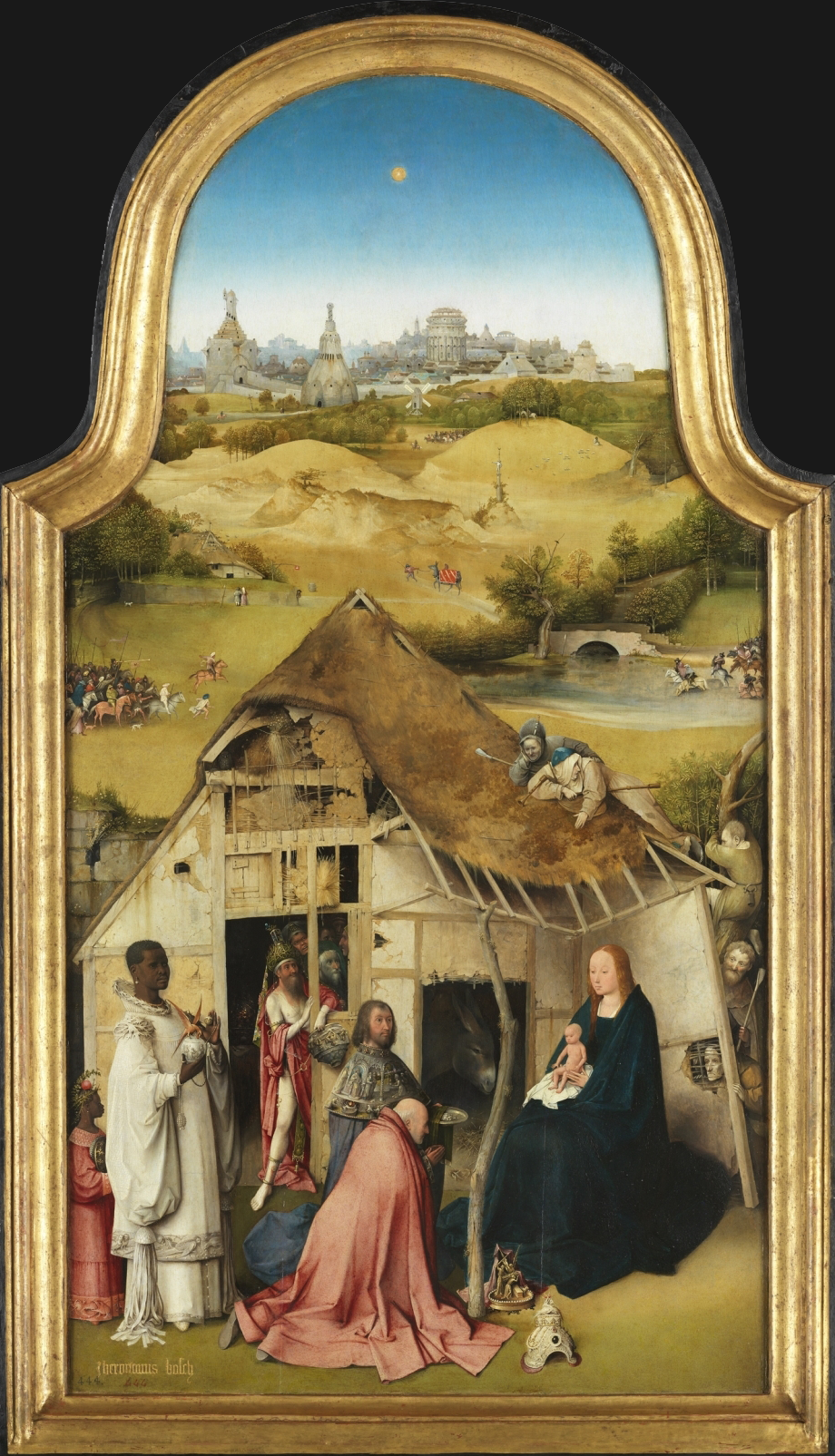
Narrative truth does not demand literal fidelity to the text. It demands not betraying its logic.
Human truth
The scene is humanly true when the bodies, the gestures, the poverty, the cold, the tiredness, the care and the shelter are convincing. Not when it moves us, but when real human situations can be recognised in it.
A mother wrapping up her son on a cold night. A man who has walked for hours and whose body shows it. A shepherd who arrives from the open air and not from a fashion plate. That truth is not borrowed from the sculptor’s sensibility: it is born of having observed how a body behaves in those conditions.
A true body does not only occupy a place: it registers a temperature, an effort, a wait, a concrete way of being in the world.
Human truth is one of the few that admits almost no pretence: when it is missing, the scene gives it away at once.
Symbolic truth
The scene is symbolically true when it lets a meaning appear that is not exhausted in the object or in the fact. Not when it adds conventional signs, but when the composition, the light, the gesture or the silence open a reading that goes beyond the inventory of what is represented.
A low oil lamp that does not light the whole scene and that chooses what is seen. A space that sets Mary apart from the rest without anyone declaring it. A posture of Joseph’s that supports without occupying the centre.
Symbolic truth is not added: it emerges when the other three have been worked well. It is a consequence, not decoration.
How they sustain one another
Naming them separately helps one to think. But in the work they never appear in isolation.
The four truths do not take turns, nor do they compensate for one another. A scene weak in contextual truth is not saved by adding symbolic force. A scene that is humanly convincing but narratively confused conveys with intensity a scene that is not the one the text tells.
It is worth distinguishing how they support one another and where they may clash.
Contextual truth sustains narrative truth: a text well read in an incorrect world loses its weight. Human truth gives body to contextual truth: a correct archaeological fact without human presence is left as a display case. Symbolic truth needs the other three: when it is sought for its own sake, it produces empty symbols; when it rests on the others, it imposes itself without any need to show off.
And between them there are real tensions. The contextual fact may clash with narrative effectiveness —asking for the house instead of the stable porch forces one to rethink the whole inherited composition—. Narrative fidelity may grate against the expected emotional effectiveness —separating Magi and shepherds bids farewell to a beloved iconography—. The work of the nativity-scene maker consists, to a large extent, in sustaining those tensions without resolving them by suppression.
Hence, the nativity-scene maker as interpreter
From this follows, without any need to declare it, what a nativity-scene maker is when working on a biblical nativity scene.
Not an archaeologist: they cannot prove every element, nor do they claim to. Nor a decorator: their task does not end with the scene being pleasing. Nor a preacher: the meaning the scene may open is not announced, it is allowed to appear.
An interpreter. Someone who receives a narrative, sets it against a world, distinguishes what the text states from what it leaves open, and from there gives visible form to a scene that must hold up at the same time as context, as narration, as human presence and as meaning.
What distinguishes the interpreter from the archaeologist, the decorator and the preacher is not erudition, nor sensibility, nor devotion taken separately. It is the discipline of not giving up any of the four truths while working.
Every decision already says how it has been understood
This responsibility does not need to be declared. It shows.
A gesture, a posture, a light that comes in from one side and not from another, a distance between two figures, the height of a roof, the texture of a cloth: every decision of the nativity-scene maker is already saying how they have understood the text and the world in which it is set. There is no possibility of saying nothing.
Even the formal silence of a scene is already saying from where it has been understood.
That is why the prior work matters. Not because it will be put on show in the scene, but because it is the only thing that allows that scene to say something firm when the sculptor, alone with the clay, has to take decisions that nobody can take for him.
Before going on
We have seen what kind of texts the infancy Gospels are, what truths a biblical nativity scene can sustain and what position the nativity-scene maker takes before them. But every scene is also set in a time, and that time is not neutral.
Tradition fixed the birth of Jesus on a specific date —25 December— which the biblical nativity scene has inherited and which should not be reopened as a historical debate. But that date, accepted as an anchor, brings with it consequences that do matter: a climate, a light, an hour and an inner rhythm that the scene cannot ignore.
That will be the next step.
References
- ↑ [1] Bosch, H. Tríptico de La Adoración de los Magos [grisaille, oil on oak panel, ca. 1494]. Museo Nacional del Prado, P002048. Public domain. Commentary: Silva, P., «El Bosco. Tríptico de la Adoración de los Magos», in El Bosco. La exposición del V Centenario, Madrid, Museo Nacional del Prado, 2016, pp. 195-207. https://www.museodelprado.es/coleccion/obra-de-arte/triptico-de-la-adoracion-de-los-magos/666788cc-c522-421b-83f0-5ad84b9377f7