
 ≈ 39 min

The previous sieve did not leave on the table all the animals and plants of the biblical landscape, but only those that matter to this stretch of the Manual for one strict reason: a material, principal or secondary, useful for clothing and for its later representation in sculpture, could come from them. Here the question is not which animals or plants there were in the first-century Mediterranean Levant, nor which may appear in a scene of the biblical nativity scene, but which fibres, leathers or hides could be obtained from each one, and whether those materials could have been available to the people who lived and worked in the lands of the narrative.
The scope should be fixed before going further. In this research, the animal does not yet enter as a figure. Its gesture, its silhouette, its narrative weight and its place in the scene are not studied here. That belongs to the block of scenes, when the specific scene calls for it. There the animal will be presence, visual rhythm and sign. Not here. Here the animal enters only as material origin.
When a plant enters, the logic is the same. The cultivated field is not studied here as landscape, nor linen as a white tunic, nor its ritual or social value. What is studied is the plant before the fibre: the living stem from which a textile material can be obtained.
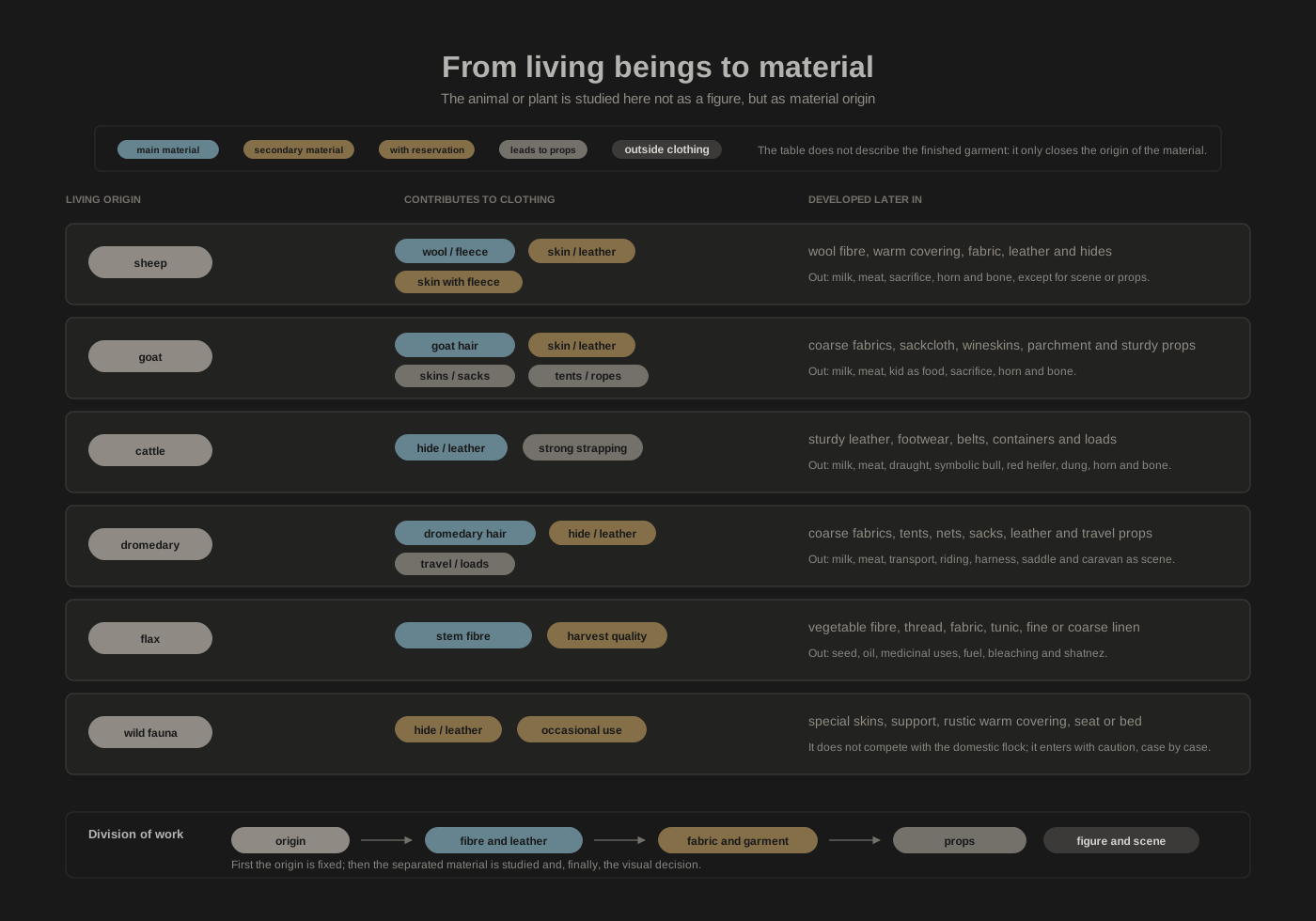
That is why the route is limited and deliberate: sheep, goat, cattle, dromedary, flax and, with caution, the band of wild fauna of the Levant. Each contributes something different —wool, hair, vegetable fibre, leather or hide— and each enters for a documented reason: availability, material evidence, written source or chronology.
The distinction is not rhetorical: it has practical consequences. Looking at the animal or the plant as raw material demands questions of another order: what fibre or hide it produces, in what quantity, with what seasonal variation, in what relation to the domestic flock or the cultivated field, and with what trace in first-century clothing. Looking at it as figure, landscape or symbol demands others: what it does in the scene, what symbolic charge it carries, what silhouette identifies it for the reader. Mixing those ways of looking would muddle the chapter.
This stretch of the Manual, therefore, is not zoology, botany or animal iconography. It is a chapter about origin: what material comes from which animal or plant, with what degree of certainty and with what consequences for the garment that the sculptor will later have to model. Only after understanding that first link —fibres, hides, weights, textures, natural colours and limits— can the material already separated from its living origin be addressed and, later still, the human operation that transforms it.
The sheep: the fleece before the wool
Of the animals that survived the sieve, the sheep is the most solid case. The main support for ordering this first stretch is Oded Borowski, Every Living Thing: Daily Use of Animals in Ancient Israel (1998), especially his chapter on ruminants, where he brings together biblical vocabulary, zooarchaeological data, pre-industrial ethnographic comparisons and zoological literature on the sheep and goats of the Levant.1 The quantitative archaeological anchor comes from Orit Shamir, curator of organic materials at the Israel Antiquities Authority, and from Naama Sukenik, a researcher in archaeology and ancient textiles: in their study of the Qumran textiles they publish a regional table of 1,727 Roman textiles from the Land of Israel, with 1,101 pieces of wool, 549 of linen, 61 of goat hair, 3 of camel hair and 13 mixed.2 That set allows us to speak of a regional predominance of wool, but with two warnings. The first applies to the whole block: the chapters of the foundation (What we know and do not know about first-century clothing to Where the evidence survives) follow another table by the same researcher —Shamir (2015), with 1,635 textiles and a different distribution by fibre—, and the two counts do not coincide; they come from different publications and the difference is pending verification against the originals. Until it is resolved, each chapter states which table it follows: this stretch of the sieve (The material before the figure to Wool as a separated fibre), the 2011 one. The second is a limit on reading: Qumran should not be used as an example of that majority, because Shamir and Sukenik set apart the textiles that are properly Qumranic and conclude that there they are of linen, without wool. The sheep thus passes through the four meshes with no need for interpolation: there are living flocks today in the same productive band, regional archaeological evidence of wool, abundant mention in biblical and rabbinic sources, and complete chronological compatibility. It enters on its own merit.
What needs to be made precise is not whether the sheep enters, but which sheep. Borowski identifies the Awassi sheep, or fat-tailed sheep, as the most widespread pre-industrial breed in Palestine and links it with ancient representations of fat-tailed sheep in the Near East.1 For the Manual, the prudent reference is therefore the fat-tailed sheep of the Levant, comparable to the present-day Awassi. This does not assert a breed identity between the first-century sheep and today’s Awassi —that would be a zootechnical anachronism—, but it does assert a continuity of type: an animal adapted to heat and to seasonal aridity, with a leaner body than the selected European breeds, with fat accumulated in the tail as its characteristic morphological feature, and coarse or medium wool, not fine. It is a sheep different from the Ripollesa, the modern Manchega or the Merino, and the difference is not decorative: it conditions everything from the silhouette of the animal to the material it yields.
From that sheep comes, principally, the fleece; secondarily, the skin and the leather of the slaughtered animal. The fleece is obtained by annual shearing, usually in April or May, before the strong heat. Here Borowski gathers data from Siegfried Hirsch, author of Sheep and Goats in Palestine (1933), an economic and zootechnical monograph on small livestock in Mandate Palestine: 1.75 kg of wool a year from an Awassi ewe, 2.25 kg from a ram, 1.40 kg from a yearling and 0.50 kg from a lamb.13 We do not carry those figures over to the first century as if they were an exact census; they serve as an order of magnitude, so as to imagine neither a fine Merino nor a modern European fleece. A good part of that weight is grease, suint and vegetable matter; what reaches usable fibre is less. Seasonality matters: the spring fleece does not behave like the autumn one, and that difference reaches, attenuated, as far as the garment.
The material inventory of the sheep does not end with the wool. The skin could be used as leather once the animal was slaughtered, and the skin with its fleece could work as rustic warm covering, bed, seat or occasional protective piece, although it should not be confused with an ordinary garment of woven wool. In the field of writing supports, sheepskin also belongs to the general horizon of parchment, together with goatskin and the skins of other animals; here it is enough to leave it marked as a possible by-product, because its specific properties and uses will be dealt with later in the chapter on leather. Left out of this stretch are milk, meat, fat, sacrifice, horn and bone: they are important economic and ritual realities, but they do not explain clothing unless a scene or a props sheet calls for them.
The division of work should be recalled. The sheep as a figure —its gesture, its silhouette in the scene, its mixing with goats, the features that identify it as an animal of the Levant and not as a modern European sheep— is dealt with in the block of scenes, when the specific scene calls for it. Here it matters only as origin. Wool as a fibre —its thermal behaviour, its qualities, its dyeing and its measurable physical parameters— will be analysed in the next chapter, with the material already separated from the animal; leather and hides will be studied in their own material stretch. What this section closes is the first link: which animal, which materials it yields, in what hierarchy and by what means.
The goat: the hair before the sack
The goat enters the sieve together with the sheep, not after it. In the flocks of the Mediterranean Levant both animals lived side by side within the same pastoral economy; Borowski deals with sheep and goats precisely within the same chapter on ruminants because they form the core of small livestock in the daily life of ancient Israel.1 For the Roman period, the same table by Shamir and Sukenik adds a concrete archaeological support: among 1,727 Roman textiles excavated in the Land of Israel, 61 are of goat hair, approximately 3.5% of the total, against 1,101 of wool, approximately 64%.2 The proportion is smaller, but enough to show that goat hair is neither an ethnographic fantasy nor a mere visual tradition. The four meshes are passed without effort: living flocks today in the same band, regional material evidence, repeated biblical mention —the curtains of the tabernacle in Exodus, women spinning goat hair, mixed flocks in the narratives of Genesis and Samuel, wineskins and sackcloth in various places— and complete chronological compatibility. The working question is not whether the goat enters, but which goat enters each scene.
Three types should be distinguished. This is not a visual whim of the Manual: it comes from Borowski’s synthesis on the goat in the modern Levant, used here as a regional analogy and not as a closed breed identity for the first century.1 The Damascus goat —also called the hill-country or Syrian goat— lives near the permanent settlements of the hills of Judaea, Samaria and Galilee: reddish-brown hair, long ears, blue eyes, between 30 and 50 kilos in weight, up to 400 litres of milk a year, fed close to home on green vegetation and fodder. The Bedouin goat, or black goat, occupies the Negev and Sinai: black hair, short ears, brown eyes, between 12 and 25 kilos, about 75 litres of milk a year, able to go up to 4 days without water, grazing in the open. The Baalbek goat, with black and white hair, is raised in the Golan and in the mountains of Hermon, outside the central scenes of the biblical nativity scene; it should nevertheless be named, so as not to present the Levant as a uniform goat landscape. The consequence for the sculptor is not to choose a universal goat, but to assign the right goat to the place and the gesture: the Damascus goat in the sedentary economy of the village —Bethlehem, Nazareth, the houses of Judaea and Galilee, the narratives of the kid immediately available for a meal (Gen 27:9, Judg 6:19, 13:15, 15:1)—; the Bedouin or black goat in the open pastoral landscape, arid or transhumant, when the scene justifies it by context and not by mere visual habit. The difference is not decorative: it conditions the colour of the coat, the relative size of the silhouette within the flock and the posture of the animal in the composition.
From any of these goats comes, principally, the hair; secondarily, the skin and the leather of the slaughtered animal, including kidskin as a specific case. Borowski describes the shearing of goats as an annual operation, normally in May or June, without prior washing —goat hair is short, straight and generally clean—; in old goats only the belly, chest and flanks are shorn, in young ones the whole body.1 The yield per adult animal is modest, between 300 and 500 grams a year, enough to cover the costs of the operation and little more. The quality is not that of wool: a thick, resistant fibre, hardly suited to fine garments. The table of Shamir and Sukenik shows that goat hair also appears in the excavated Roman textile corpus of the Land of Israel.2
The material inventory of the goat does not end with the hair. That hair can later be turned into resistant objects —Borowski links it with tents, sacks and cordage—, but those objects belong to a later level of the chain: they are not the direct product of the animal, but things made with its fibre.1 Sackcloth and the penitential sack belong to the biblical and ritual corpus, not to Borowski’s zootechnical data. The skin and the leather, for their part, open another material front: skins for water, milk and wine —nō'd, ḥēmet, nebel—, strapping, pieces of leather and, in the case of the Dead Sea Scrolls, parchments, as Borowski records in his treatment of skins and by-products.1 Left out of this stretch are milk, meat, the kid as food, sacrifice, horn and bone: they are economic, dietary, ritual or props realities, but they do not explain clothing unless a scene or a specific sheet calls for them.
The division of work should be recalled here too. The goat as a figure —its silhouette among the sheep, the visual contrast between the Damascus goat of the village and the black goat of the open flock, its symbolic charge in the Old Testament cycle and in the Gospel separation of the sheep from the goats (Matt 25:32-33)— belongs to the block of scenes, when the scene calls for it. Here it matters only as origin. Goat hair as a fibre, its qualities, its behaviour in spinning and weaving, its measurable physical parameters, will be analysed in the corresponding chapter, in parallel with that on wool, with the material already separated from the animal; leather, hides, wineskins and parchments will be studied in their own material or props stretches. What this section closes is the second link: which goats, which materials they yield, in what hierarchy and by what means.
Cattle: the hide before the leather
Cattle enter this chapter by a route different from that of the sheep and the goat. They do not contribute an ordinary textile fibre for clothing: there is no equivalent here of wool or goat hair. Their interest for this research lies in the hide that can be turned into leather. Borowski deals with large livestock as part of the ancient economy of Canaan and the Near East, with a division that is useful for the Manual: cows and bulls as animals for milk, meat and hide; oxen as working animals.1 That distinction helps not to mix levels. What matters here is not yet the ox as an agricultural figure or the bull as a symbol, but cattle as the origin of a resistant material.
The relevant animal is domestic cattle, Bos taurus, integrated into a more sedentary and agricultural economy, one of accumulated wealth, than the light flock of sheep and goats. Borowski recalls that large livestock appear alongside small livestock, donkeys, camels and tents as a measure of wealth in the patriarchal narratives, and he records cattle remains at Iron Age sites such as Ashdod, Dan, Halif, Lachish and Jerusalem.1 That documentation is not used here to reconstruct an exact breed of first-century Judaea, but to fix the economic place of the animal: less mobile and less common in the ordinary pastoral scene than sheep and goats, but fully known, raised and used in the region.
From cattle comes, for this stretch, above all the hide. The clearest datum worth retaining is that the narrative of Wenamun, around 1100 BC, records 500 cowhides among the goods sent to Egypt, cited by Borowski as an indication of trade in live animals and livestock products from Syria-Palestine.1 The example predates the first century and does not directly describe Roman-period Jewish clothing; its value lies in showing that cattle hide could circulate as a recognisable commodity, not only as an unspecialised domestic leftover. Once turned into leather, that hide belongs to the field of strong materials: footwear, strapping, belts, pieces under tension, containers or load-bearing elements, as documented in the corresponding chapters and sheets.
The material inventory of cattle is therefore narrower than that of the sheep or the goat, but no less important. It contributes hide and leather to this research; it contributes no textile fibre. Left out of this stretch are milk, meat, draught work, sacrifice, the bull as a symbol, the red heifer, the golden calf, dung, horn and bone: all are real aspects of the animal, but they belong to economy, diet, agriculture, cult, iconography, props or tools, not to the chain of clothing, unless a specific scene calls for them.
The division of work should be recalled here too. Cattle as a figure —working ox, cow, bull, animal of wealth, of sacrifice or of symbol— belong to the block of scenes or to the scene sheets where appropriate. Here they matter only as material origin. Cattle leather, its properties, its thickness, its behaviour and its possible uses will be studied in the chapter on leather, together with the hides of sheep, goat, dromedary and wild fauna. What this section closes is the third domestic link: what cattle contribute to the material palette, what is left out and why their economic or symbolic weight should not be confused with their function within this research.
The dromedary: the hair before the caravan
The dromedary enters this research by two routes: its hair and, secondly, its hide that can be turned into leather. It does not enter here as a picturesque caravan animal, nor as the mount of the magi, nor as a general sign of the East. That reading belongs to the scene. In this chapter it matters as the origin of a rough, recognisable and documented material: camel or dromedary hair, together with a hide usable for resistant objects.
The animal should be made precise. Within the camelids Borowski distinguishes the dromedary, Camelus dromedarius, with one hump, from the Bactrian camel, Camelus bactrianus, with two.1 For Judaea, Arabia and Syria-Palestine, the relevant animal is the dromedary. The Bactrian appears in the Assyrian and eastern world, and may turn up in tribute lists or in broader imperial contexts, but it is not part of the ordinary local repertoire of the scenes of the Manual. That distinction had already been prepared by the previous sieve: we are not working with a generic «camel», but with the dromedary as the animal of the arid routes and of long-distance trade.
From the dromedary comes, principally, the hair. Borowski records an important technical datum for this stretch: camel hair is not shorn like sheep’s wool, but plucked or gathered in spring, when it loosens; one animal can produce between 2 and 3 kilos of hair.1 That yield does not make it an everyday fibre comparable to wool, but it does make it a real and recognisable material. The table of Shamir and Sukenik records only 3 textiles of camel hair among 1,727 Roman textiles from the Land of Israel, a minimal proportion beside wool and linen, but enough to avoid two opposite errors: excluding it as an Orientalist fantasy or turning it into a common fibre of local clothing.2
The material inventory of the dromedary does not end with the hair either. Borowski points out that, once incorporated into the economies of transport and of arid regions, the camel went on providing derived products, among them hair, meat, milk, dung and hide.1 For this research, only the hair and the hide on that list matter. The hair can end up as coarse fabrics, tent cloths, nets or sackcloth; Borowski also mentions the use of camel hair together with black wool for tents and nets, and notes that in Egypt it was used for cloth, tent cloths and sackcloth at least from the Roman period.1 On the textual level, John the Baptist’s clothing of «camel’s hair» (Matt 3:4; Mark 1:6) confirms that the material was recognisable as a sign of roughness and austerity, not as a fine fabric.
The hide and leather of the dromedary open a second front, more tied to the world of transport and props than to the garment. Straps, bags, containers or load-bearing elements can be thought of, but with caution: when Borowski records the tribute imposed by Esarhaddon with camels and kunzu bags —some kind of leather sack containing aromatic matter—, the datum belongs to the world of tribute and caravans, not to the local clothing of Judaea.1 It serves as a reminder that camelid leather enters the universe of resistant objects, not to assert automatically a dromedary-skin garment in a Galilean village.
Left out of this stretch are milk, meat, dung, transport, riding, the incense trade, military camelry, saddle and harness. All are important aspects of the animal, and Borowski deals with them because his chapter 3 covers draught and pack animals; but for the Manual they belong elsewhere: travel props, caravan scene, desert economy or narrative composition. Also left out here is the dromedary as a figure: its silhouette, its hump, its scale beside the donkey or its appearance in a scene of the magi, of the flight or of trade must be decided in the block of scenes when the scene calls for it.
The division of work should be recalled here too. The dromedary as a figure and as a pack animal belongs to the block of scenes and to the travel props sheets. Here it matters only as material origin. Dromedary hair, its qualities, its roughness, its behaviour in spinning and weaving, will be studied in the chapter on animal fibres; the hide and leather of the dromedary will be studied in the stretch on leather together with the other domestic hides. What this section closes is the fourth domestic link: what the dromedary contributes to the material palette, with what relative rarity, and which part of its enormous scenic weight must remain outside this research.
Flax: the stem before the fibre
Flax enters this chapter as the principal vegetable fibre of the palette. It does not enter here as a white tunic, nor as a sign of purity, nor as a shroud, nor as a priestly garment. All of that belongs to later layers of the Manual. What matters here comes before the fibre: the plant as cultivated, pulled up and processed until a textile material is freed from the stem. The main support for placing this vegetable origin is Andrea Orendi, an archaeobotanist at the University of Tübingen, whose study of flax cultivation in the southern Levant brings together the published remains of flax seeds from the Bronze Age to the Iron Age and analyses their regional distribution.4
The relevant plant is Linum usitatissimum. Orendi recalls that domesticated flax is one of the ancient crops of the Fertile Crescent and that the first evidence of domesticated seeds already appears in Neolithic contexts such as Jericho and Tell Ramad.4 For the Manual, that datum does not by itself prove the clothing of the first century, but it does fix a long continuity: flax is not an exotic import nor a late material, but a textile plant known since very early times in the Near East. Its entry into this research is therefore well grounded.
From flax comes, for this stretch, the fibre of the stem. The complete process —drying, retting or soaking, separating the fibres, spinning and weaving— belongs to the chapter on fibre and production, not to this section. But the first gesture should be fixed here: to make use of the long fibre, the plant is not cut like any other herb, but pulled up whole. Orendi also records a distinction that is useful so as not to imagine «flax» as a single uniform quality: young green plants produce finer fibre; plants beginning to ripen, with the stem turning from green to yellow, give coarser fibres suited to good-quality clothing; older plants, golden and with ripe capsules, are better used for heavy textiles and ropes.4
Flax demands a geographical way of looking different from that of wool. It does not grow beside every house merely because it is in the region. It requires water, suitable soil and growing conditions. Orendi shows that the archaeobotanical remains are significantly concentrated in the Jordan valley, with a prominent role for the area of Beth Shean, and also in areas related to the Dead Sea and to irrigated land.4 This fits the prudence already set down in the working sheet: for Bethlehem and Jerusalem, linen should be thought of as an accessible regional material, not necessarily produced at the door of the house; for Galilee, it is better to look towards the northern centres and the valley of Beth Shean rather than automatically depend on Jericho.
The textile evidence confirms that the fibre does not remain in the abstract. Shamir and Sukenik record 549 linen textiles among the 1,727 Roman textiles of the Land of Israel, and the case of Qumran calls for particular caution: the textiles that are properly Qumranic are of linen, without wool, while the complete regional table shows a majority of wool.2 So flax passes the sieve strongly, but Qumran should not be used as a direct model for the common clothing of Bethlehem or Nazareth. It proves presence, technique and use; it does not by itself prove the ordinary wardrobe of all first-century Jews.
The material inventory of flax does not end with the textile fibre, although that is the only part that matters here. The seed can give linseed oil; the residue of pressing, secondary uses; ancient sources and ethnobotany know of medicinal, fuel, preservative or lubricant applications. All of that is left out of this stretch. Also left for other chapters are fine linen, coarse linen, bleaching, colour, shatnez, tunics, shrouds, priestly garments and linen as a sign of status or purity. Here only the first vegetable link is closed: a plant with a fibrous stem, grown where water allows, which contributes to this research the principal vegetable fibre.
The division of work should be recalled here too. Linen as a fibre —its thermal behaviour, its fall, its initial stiffness, its bleaching, its difficulty with dye and its qualities— will be studied in the corresponding chapter, with the material already separated from the plant. Linen as a garment will be dealt with when tunics, undergarments, shrouds or priestly clothing arrive; colour and white will go to their own stretch. What this section closes is the only vegetable link of the palette: which plant contributes the fibre, where it could be grown or circulate, which qualities are already born at harvest and which uses remain outside clothing.
Wild fauna: the hide before the animal of the scene
The wild animals of the Mediterranean Levant enter the sieve by a route different from that of the domestic flock. They are not bred animals, they do not produce a regular material and they are not part of a stable textile chain. Borowski devotes a specific chapter to the wild animals of ancient Israel and opens it with a distinction useful for this Manual: some animals, such as deer, gazelles and birds, were hunted mainly for their meat; others, such as lions, wolves, bears and foxes, could be hunted for their skins.1 That distinction is enough to fix the scope of this research: wild fauna contributes no wool, no harvestable hair and no vegetable fibre, but possible hides, always irregular and of limited use.
The first group is formed by the wild ungulates permitted for eating in Deuteronomy 14:5: deer, gazelle, fallow deer, ibex and other names that are hard to identify. Borowski shows that several of them are documented by biblical references, hunting scenes and zooarchaeological finds, but the central datum is not textile: they were hunted mainly as food, and only secondarily could they leave hide, leather, antler or horn.1 For the Manual this prevents two opposite errors. They should not disappear from the ancient landscape as if they did not exist; nor should they become an ordinary palette for village clothing.
The second group is formed by the skins of carnivores. Lion, wolf, bear and fox belong to another register: hunting, danger, prestige, symbol or scene. That they could be hunted for their skin does not authorise automatically dressing a Bethlehem shepherd in a wolfskin, nor turning a lion skin into a visual resource available for any figure. In this research they remain a marginal or exceptional possibility, always depending on scene, status and documentary justification. Their natural place will often be in the block of scenes, as narrative presence or as a threat to the flock, not in the ordinary chain of the garment.
There are also borderline cases. The hare appears in Borowski as an animal hunted and used for meat and skins, but its weight for the clothing of the Manual is minimal.1 The biblical term taḥaš/teḥašîm designates a costly or exotic skin used in the Tabernacle and, in Ezekiel 16:10, in sandals; but its identification is disputed, and Borowski’s proposal to relate it to the crocodile should remain the author’s hypothesis, not a basis for everyday clothing.1 These cases do not disappear: they pass to the chapter on leather, to props or to a specific note if some scene calls for them.
Borowski’s chapter on animals in the cult of ancient Israel does not change this division. Wild ungulates appear there, above all deer and gazelles, in some cultic assemblages, as well as indications of lion and bear in ritual or symbolic contexts; but those data belong to the cult, to the scene or to the future chapter on leather, not to the ordinary palette of clothing.1
Wild fauna therefore enters this chapter with a clear label: it is not the main palette, but a material reserve. Its relevant product for this research is the hide; its probable use is occasional; its development belongs to the chapter on leather or to specific scenes. The only animal that deserves an entry of its own here, because of the convergence between zoological presence, textual identification and the limited material use of its hide, is the Nubian ibex.
The Nubian ibex: the hide before the parchment
The Nubian ibex (Capra nubiana) is the strongest wild species in this stretch, but its entry must be marked as narrower than that of sheep and goat. Borowski deals with it among the wild ungulates and places it as a caprine of the mountains of Arabia, southern Palestine, Sinai and southern Egypt; the modern zoological synthesis by Heinrich Mendelssohn and Yoram Yom-Tov confirms that it belongs to the fauna of Israel.15 To this are added the biblical naming of the yael at En-Gedi and in rocky landscapes (1 Sam 24:2; Ps 104:18; Job 39:1), and the modern documentation of animal skins used as writing supports in materials from the Judaean Desert.6 The whole allows it to be kept in the repertoire of possible hides; it does not allow it to be turned into an ordinary material for village clothing.
It should not be confused with the domestic goat. It belongs to the same genus, Capra, but it is a wild species, adapted to the desert and to arid mountains, not to the pastoral economy. Borowski describes it with curved, not twisted, horns, with frontal ridges and a goat’s beard; Mendelssohn and Yom-Tov likewise place it as a rock animal, light brown in colour, with a white belly, dark markings on the legs and long horns curved backwards in adult males.15 Those features serve as a visual reference when the ibex enters as a figure in a desert scene; here they matter only to separate its possible hide from the skin of the domestic goat.
What the ibex yields as raw material is limited and specific. It produces no usable textile fibre: it has no wool, nor any harvestable hair comparable to that of the black goat. Its material interest lies in the hide. Borowski points out that ibex skin was used to a limited extent as parchment for documents, although it was less common than goatskin.1 DNA studies on parchments from the Judaean Desert show, moreover, that writing supports can preserve information about the animal species used.6 For this chapter, that authorises only a prudent conclusion: the hides of wild fauna may enter the repertoire of supports or special pieces, but not the ordinary textile economy.
The division of work should be recalled here too. The ibex as a figure —its long-horned silhouette on the mountainside and its presence in scenes of the desert or of the flight— belongs to the block of scenes, when a scene calls for it. Here it matters only as material origin. Ibex skin as leather or parchment will be dealt with in the chapter on leather, together with the domestic hides and the other hides of the wild fauna of the Levant. What this section closes is the reserve stretch: which wild animals can contribute hide, why they do not form an ordinary palette and why the ibex remains a documentable but marginal case.
References
References
Borowski, O. (1998). Every Living Thing: Daily Use of Animals in Ancient Israel. Walnut Creek, CA: AltaMira Press. This chapter makes particular use of chapter 2, "Ruminants", for pastoral systems, sheep, goats, shearing, yields, skins and by-products; chapter 3, "Draft and Pack Animals", for large livestock, oxen, dromedaries, pack animals, derived products and transport; chapter 7, "Wild Animals", for wild fauna, hunting, ungulates, carnivores, skins and the case of the ibex; and chapter 8, "Animals in Ancient Israelite Cult", to check that the cultic data on wild ungulates, carnivores and the processing of skins do not alter the material division of the chapter. Oded Borowski is professor emeritus at Emory University; he taught biblical archaeology and Hebrew for more than 40 years, took part in excavations and surveys from the 1970s onwards and helped to launch the Lahav Research Project at Tell Halif. See Emory University, "Oded Borowski", Department of Middle Eastern and South Asian Studies: https://mesas.emory.edu/people/biographies/Borowski-Oded.html ↩ ↩ ↩ ↩ ↩ ↩ ↩ ↩ ↩ ↩ ↩ ↩ ↩ ↩ ↩ ↩ ↩ ↩ ↩ ↩ ↩ ↩ ↩ ↩
Shamir, O. and Sukenik, N. (2011). Qumran Textiles and the Garments of Qumran's Inhabitants. Dead Sea Discoveries, 18(2), 206-225. Table 1, p. 215: 1,727 Roman textiles from the Land of Israel distributed by material —549 linen, 1,101 wool, 61 goat hair, 3 camel hair and 13 mixed—. The article is also important for its methodological limit: it separates Qumran from the Christmas Cave and concludes that the textiles that are properly Qumranic are of linen. See also Shamir, O. (2013). "Dress: Hellenistic and Roman Period". In D. Master (ed.), Oxford Encyclopedia of the Bible and Archaeology (pp. 328-336). Oxford University Press, for the synthesis that wool was the preferred material for tunics in the Near East, except in Egypt. Orit Shamir is curator of organic materials at the Israel Antiquities Authority and the leading specialist in the archaeological textiles of the Land of Israel; Naama Sukenik is a researcher in archaeology and ancient textiles, linked to material and dye research on the Levant. ↩ ↩ ↩ ↩ ↩
Hirsch, S. (1933). Sheep and Goats in Palestine. Palestine Economic Society. Cited through Borowski (1998) for the modern pre-industrial data on yields of wool and milk, shearing, skins and the economy of small livestock in Palestine. ↩
Orendi, A. (2019). "Flax Cultivation in the Southern Levant and its Development during the Bronze and Iron Age". Quaternary International. https://doi.org/10.1016/j.quaint.2019.10.007. The PDF kept in the vault is a journal pre-proof version accepted for publication; it is used here as an overall archaeobotanical study of Linum usitatissimum in the southern Levant, especially for regional distribution, growing conditions, the relationship with water and soils, and the difference between harvesting for fine fibre, clothing, coarse textiles or ropes. ↩ ↩ ↩ ↩
Mendelssohn, H. and Yom-Tov, Y. (1999). Fauna Palaestina: Mammalia of Israel. Jerusalem: The Israel Academy of Sciences and Humanities. Used here as a modern zoological synthesis to place the Nubian ibex within the fauna of Israel and distinguish it from the domestic goat; it is not a source on clothing, nor does it prove by itself the textile use of its skin. ↩ ↩
Woodward, S. R., Kahila, G., Smith, P., Greenblatt, C., Zias, J. and Broshi, M. (1996). "Analysis of Parchment Fragments from the Judean Desert Using DNA Techniques". In D. W. Parry and S. D. Ricks (eds.), Current Research and Technological Developments on the Dead Sea Scrolls (pp. 215-238). Leiden: Brill. It is a technical chapter on ancient DNA applied to parchment fragments from the Judaean Desert; it is used here only to support the point that animal skin used as a writing support can be identified by material analysis, not to turn the ibex into an ordinary source of clothing. ↩ ↩