
 ≈ 21 min

What the evidence allows us to assert
The previous chapter fixed the method: levels of evidence, necessary distinctions, criteria of decision. All of that remains active, but it will not be repeated. What this chapter sets out to do is something else: before entering the specific study of the material evidence, the sites, the written sources and the garments, it is worth stopping for a moment to look at the terrain as a whole. What do we really know about first-century clothing in the land where the scenes of the birth of Jesus are set? How much of what we take as known comes from the evidence, and how much from the inherited image?
The answer is not bleak. We do not start from a void. In the sites of the Roman period in Israel alone, Orit Shamir has catalogued more than 1,600 textiles in wool, linen, goat hair and mixed fibres, coming from some 20 sites. And the published figure is only a part: from Masada, for example, thousands of textile fragments still remain unstudied. To these remains are added footwear preserved in dry caves, and tools of textile production —spindles, spindle whorls, loom weights, needles— found in domestic and craft contexts. There are ancient written sources that mention garments, fabrics, dyes, trades and rules of dress: biblical texts, sources from the Second Temple period, references in later rabbinic literature. And there are images of the period —mosaics, frescoes, funerary reliefs, scenes from Roman and Early Christian iconography— which, read with caution, make it possible to complement what the material remains and the texts cannot say on their own.
But the evidence, however abundant it may be compared with what was known half a century ago, does not make up a complete first-century wardrobe. We do not have a closed catalogue of garments, sizes, colours, combinations, uses by season or variants by trade. What we have is a set of fragmentary pieces of evidence, unevenly preserved, coming from specific contexts —many of them funerary, military or exceptional— which must be read with the same precision with which the fragments of an incomplete mosaic are read: each piece says something, but none says everything, and the overall design only emerges when they are brought into relation and one accepts that there are blank areas.
That is the starting point of this chapter. Not an inventory of garments —that will come later—, but a map of the state of knowledge: what can be asserted, what can be inferred with caution, what must remain open.
What survives and what does not
The preservation of organic materials —fabrics, leather, plant fibres, hair, wood— depends on conditions that time does not usually offer. In humid or temperate climates, organic matter decomposes within a few decades. Only exceptional circumstances preserve it: the extreme aridity of the desert, the accidental sealing of a cave, a burial that remained intact, a fire that charred without destroying completely, the mineralisation of fibres in contact with metal objects.
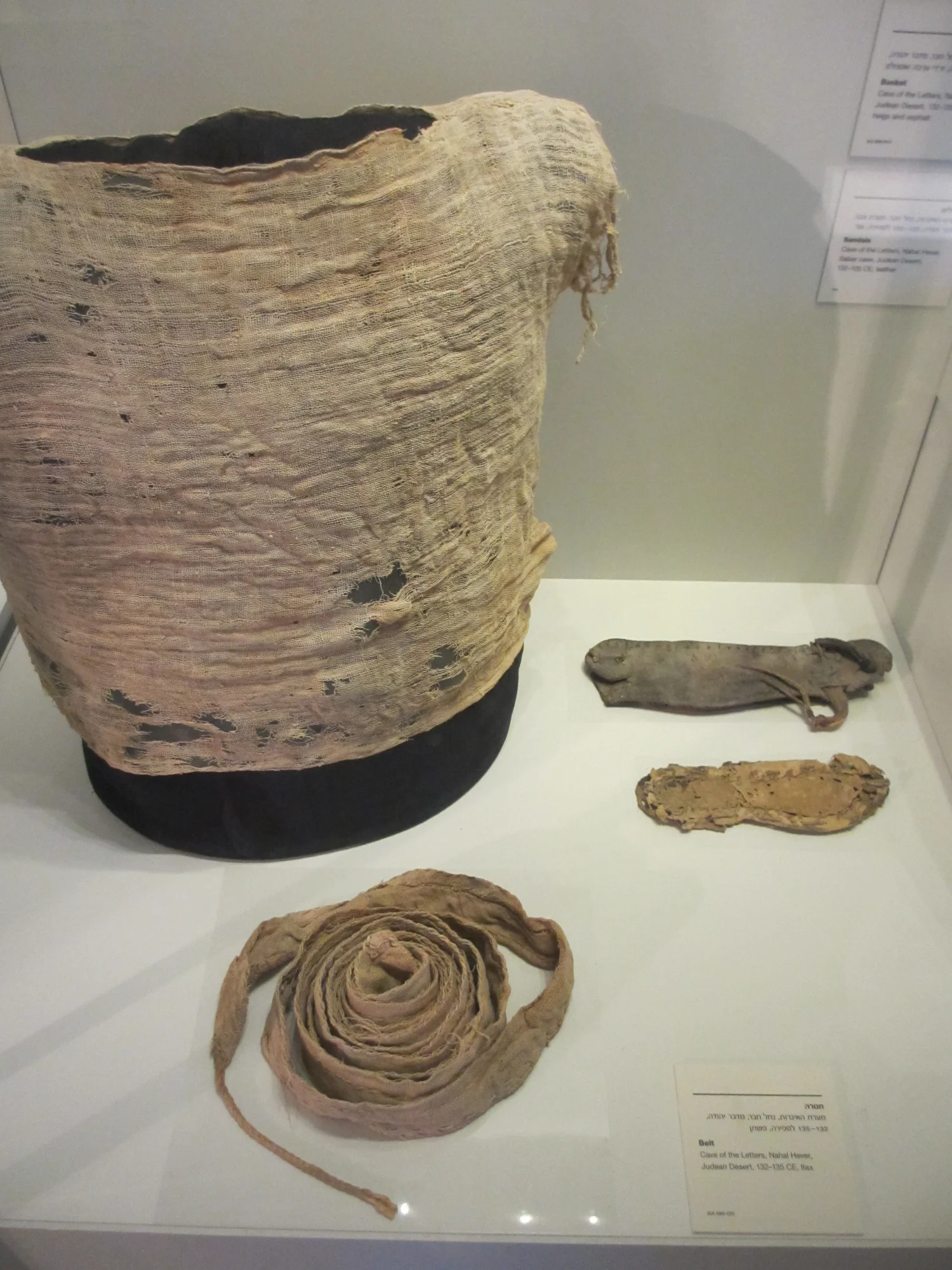
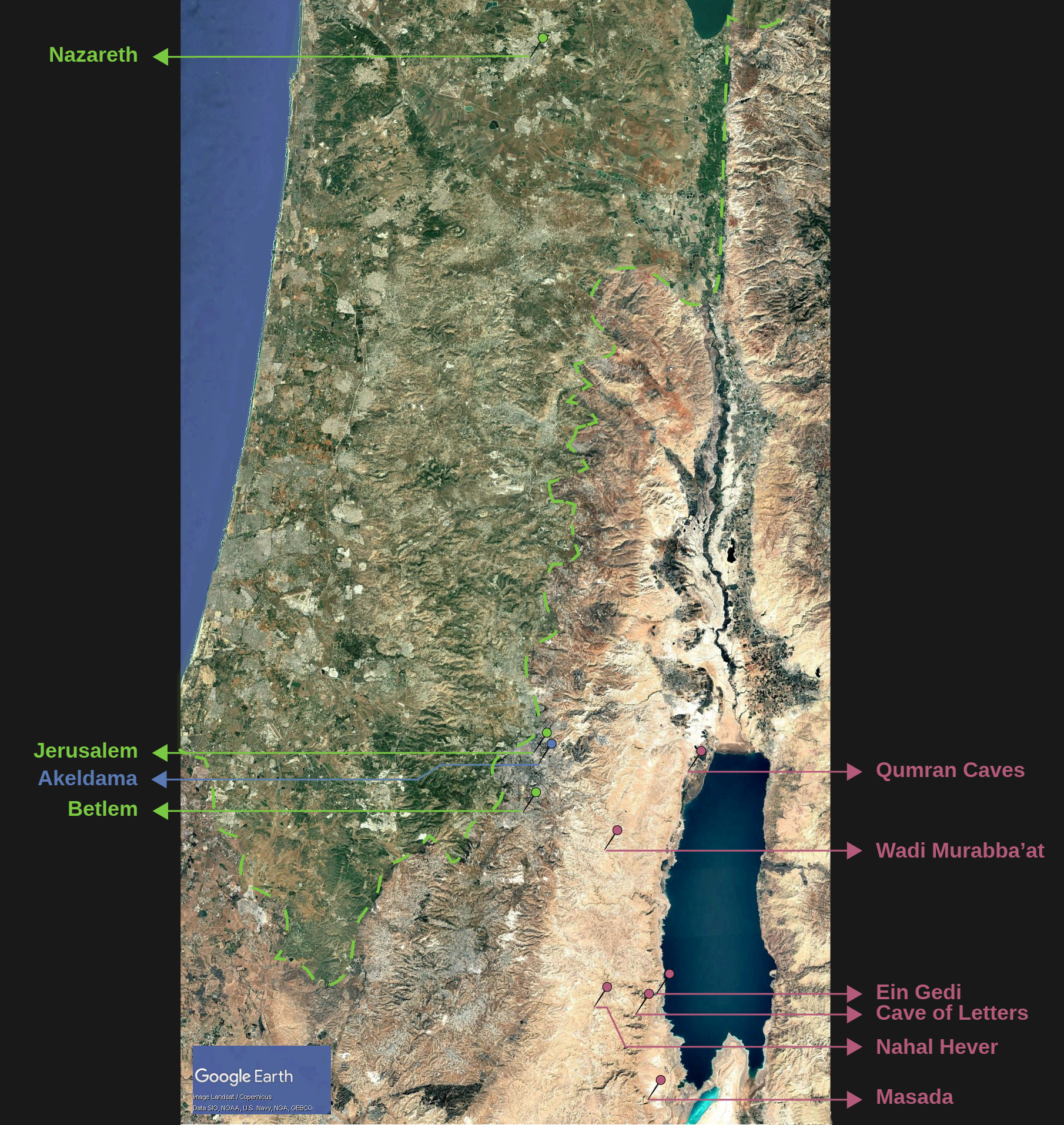
In the land of Israel, these conditions have occurred at particular points. Masada, on the eastern edge of the Judaean Desert, has yielded hundreds of textile fragments of wool and linen, remains of footwear, cords and other organic materials1, preserved thanks to the aridity of the surroundings and to the circumstances of the destruction of AD 73–74. The caves of Nahal Hever and Wadi Murabba'at, a refuge for fighters during the Bar Kokhba revolt (AD 132–135), have preserved textiles, sandals, objects of everyday use and documents2. Qumran has yielded textiles associated with the Dead Sea Scrolls, studied by Shamir and Sukenik3. And in Jerusalem, the Akeldama tomb has offered an exceptional case: a first-century woollen shroud preserved in a sealed loculus, radiocarbon-dated to between 95 BC and AD 53.4
What these sites preserve is valuable, but partial. Fragments of fabric survive, not complete garments worn on a body. Fibres and twists survive, not cuts or finished patterns of making. Footwear survives —the sandals of Nahal Hever are the best-known example—, but not the clothing that went with that footwear on an ordinary day. Funerary remains survive —shrouds, wrappings, layers of cloth that covered a dead body—, but not the clothing of someone who walked, worked, cooked or slept.
What does not survive is equally significant. There are no complete garments of everyday use found in their original context of life. There are no thick woollen mantles preserved in Bethlehem or Jerusalem: the climate of those cities does not allow it. There are no undergarments, no intermediate warm garments, no leg protection, no caps, no headscarves, no gloves, nothing of what a body needs in winter and which, by its organic nature and its intensive use, wears out, is mended, is reused and finally disappears.
Nor are there direct representations of everyday first-century Jewish dress made by Jews. The Jewish iconographic tradition of the period is scant, conditioned by the restrictions on the human image. The representations that do exist —synagogue mosaics, the frescoes of Dura Europos, Jewish catacombs— are later than the first century or belong to contexts with Graeco-Roman influence that make them useful but not directly transferable.
Documented dress and reconstructed dress
It is worth distinguishing two operations that are often confused.
To document first-century dress means to gather and analyse the available evidence: to identify which materials have survived, which weaving and dyeing techniques have been verified, which garments the written sources mention, which forms appear in the iconography of the period. The result is a body of data, uneven but firm at its best points, on which one can work.
To reconstruct first-century dress is something else. It involves filling the gaps: imagining how the garments we know were combined, proposing solutions for what has not survived, extending to an everyday context what comes from a funerary or military context, applying to Bethlehem what has been found at Masada. Reconstruction is not illegitimate —it is, in fact, necessary for any visual representation—, but it is an operation different from documentation, and the reader must know at every moment when we are in one and when in the other.
The difference matters for a practical reason: when a study presents as documented what is in reality reconstructed, the reader loses the ability to assess for themselves the solidity of what they are told. And when a sculptor takes as a secure base what is in reality a plausible hypothesis, the figure they model rests on a foundation that does not have the firmness it appears to have.
This Manual will always distinguish between the two operations. What is documented will rest on verifiable references. What is reconstructed will be presented as what it is: a reasoned proposal, not a certainty. And when it is not possible either to document or to reconstruct with a reasonable degree of confidence, it will be said that we do not know —without that meaning a renunciation of representation, but an acceptance that the representation, at that point, rests on an artistic decision rather than on a proof.
The limits of Bethlehem and Jerusalem
Here a problem appears that the reader must understand before going further, because it conditions everything that follows.
Most of the direct textile evidence of the first century comes from arid places located to the east and south of Jerusalem: Masada, the caves of Nahal Hever, Wadi Murabba'at, Qumran. These sites have preserved organic materials thanks to climatic conditions that do not occur in Bethlehem or in most of Jerusalem, where relative humidity is considerably higher and the decomposition of organic matter operates more efficiently.
Jerusalem, where important scenes of the cycle are set —the Magi before Herod, the Presentation in the Temple—, has yielded very little direct textile evidence. The case of Akeldama is exceptional precisely because it is exceptional: a funerary loculus that remained sealed for 2,000 years in a tomb that had been looted. It cannot be taken as representative of preservation in general in Jerusalem.
From Bethlehem, where the central scenes of the birth are set —the shelter, the manger, the adoration of the shepherds, the arrival of the Magi—, there is no known direct textile evidence for the first century. This does not mean that Bethlehem lacks a material history; it means that the conditions of preservation, the continuity of occupation of the place and the building history of the site have not preserved organic remains from that period.
Does this invalidate the research? No. But it obliges us to work with what in the previous chapter we called prudence. The evidence from Masada, Qumran or Nahal Hever belongs to the same material world, to the same region, to a nearby period —Masada is some sixty years later than the birth; the caves of Nahal Hever, more than a century— and to a great extent to the same textile techniques. A woollen fabric found at Masada does not prove how a shepherd dressed in Bethlehem, but it does prove that that type of wool, that weaving technique and that finish existed in first-century Judaea. The distance between the datum and the figure is not an abyss: it is a space that can be crossed with judgement, provided it is not leapt over without warning.
What cannot be done is the opposite: to take a piece of evidence preserved in an arid place and turn it automatically into the everyday dress of a scene set in another place, with another climate and other conditions of life. Each transfer must be explicit, reasoned and presented as what it is.
Absence of remains is not absence of clothing
This principle was already stated in the previous chapter as one of the three necessary distinctions, but here it is worth developing, because it directly affects several later chapters.
The archaeological record preserves what conditions allowed to be preserved. What has not survived was not necessarily non-existent: it was perishable, it was used until it fell apart, it was recycled or it decomposed in an environment that did not protect it. This asymmetry of the record is not a defect of the research; it is a characteristic of the material with which one works.
Some specific consequences:
That no thick woollen mantles survive in Bethlehem does not mean that they were not used. Winter in the area of Bethlehem and Jerusalem, between December and February, has night-time temperatures that can fall below 5 °C, with frequent rain and wind. Anyone who lived there needed warm clothing, and that warm clothing had to be made of something. Thick wool, sheepskin or goatskin, multiple layers of fabric are solutions that indirect evidence, climatic logic and analogy with the Mediterranean pastoral world make more than plausible.
That no socks, leg wraps or closed protection for the feet survive does not mean that feet were always bare or that open sandals were the only option in every circumstance. Woollen socks existed in the ancient world. Roman fasciae crurales protected the legs. Closed footwear was known. The chapter on problematic garments will deal with these questions in detail, but the principle must be clear from now on: not everything missing from the record was missing from life.
That no undergarments survive —short shirts under the tunic, cloth sashes, breast bands, protective cloths— does not mean that the body was covered directly by a single layer of fabric in every circumstance. The logic of human dress, in any climate with seasonal variation, tends towards layering: layers that are put on and taken off according to the hour, the activity and the temperature. That those intermediate layers have not come down to us says more about preservation than about dress.
The opposite risk also exists: the absence of remains does not authorise unlimited invention. That a type of garment does not survive does not prove that it existed. What the principle establishes is more modest: that absence of evidence is not, on its own, an argument against existence. When, in addition, climatic logic, bodily function, comparative analogy or the written sources point in the same direction, the convergence of demonstrated factors —what the Manual’s method calls the calculation of possibilities— makes it possible to consider existence more probable than non-existence. The result, however, will still be a reasoned inference —or, when it reconstructs something whose object does not survive, a grounded conjecture—, never a proof, and it must be presented as such.
A provisional inventory
Before entering the detail of the following chapters, it may be useful to place the state of knowledge about first-century clothing in the region that concerns us into three general categories. The three correspond to the Manual’s canonical labelling —proven, inferred from context, unknown— and are named here in full for greater clarity of exposition.
What can be asserted firmly (proven). The main fibres were wool and linen. Weaving was done on vertical looms: the warp-weighted loom, which fell out of use in the region at the end of the 1st century, and the two-beam loom, which became popular at that time4. Dyes existed and covered a wider range than is usually imagined: from the natural tones of undyed cream and brown to the blue of woad, the red of madder, the yellow of various dye plants and, at the luxury extreme, murex purple7. The basic garments were the tunic —short- or long-sleeved, of variable length according to gender and condition— and the rectangular mantle that served as warm covering, bed and shelter. The usual footwear was the sandal. The head was covered, at least in certain circumstances. The prohibition of shatnez —the mixing of wool and linen in the same garment— was respected: of the thousands of textiles examined from sites of the Roman period in Israel, not a single piece of shatnez has been recovered in a Jewish context8. The absence extends even to Nabataean sites, which Shamir explains by the fact that the textiles produced in the region were to a great extent of Jewish manufacture: the producer’s rule also governed the buyer. The only shatnez textiles found in Israel predate the Roman period and have been associated with the priestly dress prescribed in the Hebrew Bible. The ritual fringes (tzitzit) at the corners of the mantle were a specifically Jewish marker. And the linen shrouds found in burials of the period —at 'En Gedi, Gesher Haziv, Jericho— are cream or beige in colour, not white: bleaching was a long and intentional process that must not be taken for granted. This observation matters because it challenges the tendency, rooted in visual tradition, to represent biblical dress with clean and idealised whites.
What can be inferred with caution (inferred from context). The male working tunic was probably shorter (below the knee) than the one Christian artistic tradition usually shows (down to the ankles)9. The difference between male and female dress lay more in length, head covering and certain details of ornament than in a radically different silhouette. Warm clothing in winter must have included additional layers, thicker fabrics and probably skin or leather. Jewish dress was not radically different from that of the surrounding Graeco-Roman world, but a local variant within a repertoire shared across the eastern Mediterranean, with identity markers of its own.
What must remain open (unknown). The exact appearance of undergarments. The specific protection of legs and feet in winter. The use of trousers or hose in everyday Jewish life. The real extent of silk as a material of extreme luxury. The variants of dress according to trade, beyond what the sources mention in scattered form. The degree of standardisation or local variation within first-century Judaea and Galilee. Many of these questions will be dealt with in the corresponding chapters; some may advance; others will have to remain as open questions.
What the following chapters are going to build
This chapter has drawn the general map: what ground we have, what ground we lack, where the supports are firm and where the floor becomes uncertain. From here on, the research enters the concrete matter.
The next chapter will deal with the material evidence: the excavated textiles, the preserved footwear, the tools of production. Not as a catalogue of pieces, but as an analysis of what those objects allow us to know and of what they cannot say.
Next, a chapter devoted to geography will put that evidence in its place: where it has been found, why it has survived there and not elsewhere, and what distance there is between the site where a textile has survived and the scene in which one wishes to place a figure.
After that, the study of the written sources and ancient iconography will complete the picture: what the texts say about clothing, what the images of the period show and what limits each of those sources has.
The three chapters together —material evidence, geography, written sources and images— will build the base on which the later chapters will study the specific garments, the materials, the colours, textile production and, finally, the passage from the archaeological datum to the sculptural decision.
The map does not replace the territory. But it allows us to know, before walking, where there is firm ground and where one must tread more carefully.
References
Sheffer, A. and Granger-Taylor, H. (1994). Textiles from Masada: A Preliminary Selection. In Masada IV: The Yigael Yadin Excavations 1963–1965, Final Reports. Israel Exploration Society. NLI catalogue ↩
Yadin, Y. (1963). The Finds from the Bar Kokhba Period in the Cave of Letters. Israel Exploration Society. Cave of Letters — Wikipedia ↩
Shamir, O. and Sukenik, N. (2011). Qumran Textiles and the Garments of Qumran’s Inhabitants. Dead Sea Discoveries, 18, 206–225. Academia.edu ↩
Shamir, O. (2015). A Burial Textile from the First Century CE in Jerusalem Compared to Roman Textiles in the Land of Israel and the Turin Shroud. SHS Web of Conferences, 15. ResearchGate; Matheson, C. D. et al. (2009). Molecular Exploration of the First-Century Tomb of the Shroud in Akeldama, Jerusalem. PLoS ONE, 4(12), e8319. ↩
Photograph: Chamberi (2013), «Clothes. Nahal Hever. Israel Museum, Jerusalem», Wikimedia Commons, licence CC BY-SA 3.0. File page on Wikimedia Commons. ↩
Map by Emili Solé (labels and drawing) on Google Earth imagery. Image Landsat / Copernicus; Data SIO, NOAA, U.S. Navy, NGA, GEBCO. ↩
Koren, Z. C. (2005). Chromatographic Analyses of Selected Historic Dyeings from Ancient Israel. Dyes in History and Archaeology, 20, 194–201. Edelstein Center; Sukenik, N., Iluz, D., Shamir, O., Varvak, A. and Amar, Z. (2013). Purple-Dyed Textiles from Wadi Murabba’at. Archaeological Textiles Review, 55, 46–54. ↩
Shamir, O. (2017). Sha’atnez — The Biblical Prohibition Against Wearing Mixed Wool and Linen Together. In Textile Terminologies from the Orient to the Mediterranean and Europe, 1000 BC to 1000 AD. Academia.edu ↩
Taylor, J. E. (2018). What Did Jesus Look Like? Bloomsbury T&T Clark. Extract published as What Did Jesus Wear? (Christian Evidence Society, 2021). Christian Evidence ↩
