
 ≈ 18 min
From the statement of the problem to the method
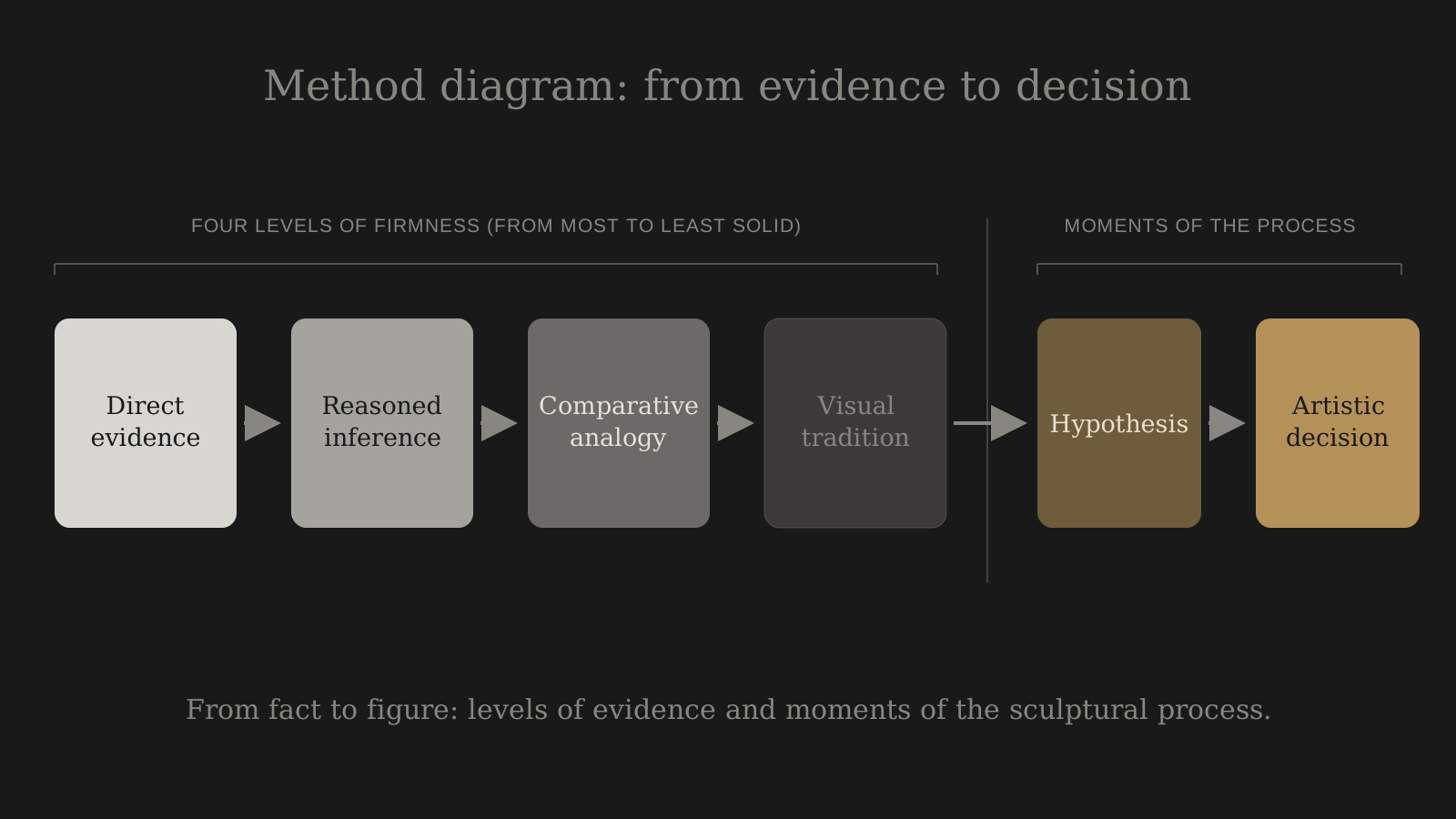
The previous chapter has set out the problem: the figures of the biblical nativity scene often rest on an inherited image that does not always come from historical evidence, and today there is a sufficient documentary base to work in another way. It has also presented the levels of evidence —direct evidence, reasoned inference, comparative analogy and visual tradition— with which this study will distinguish the degree of firmness of each statement.
All that has been said. Here it will only be recalled when needed to follow the thread.
What remains is to explain how the work will proceed from now on. Because having documentation is not the same as knowing how to use it. Between a textile excavated in the Judaean Desert and a figure modelled for a scene of the birth of Jesus there is a long road, and that road is not automatic. The datum does not turn into a figure on its own. It needs a method of reading, a criterion of selection and a sculptural decision capable of transforming information into form, weight, gesture and narrative.
This chapter fixes that framework before entering the specific study of the sources, the materials, the garments and the uses of clothing in the first century.
What this study does not seek
This study does not claim to reconstruct with total certainty how each person dressed in Bethlehem or Jerusalem in the time of Jesus. That certainty does not exist. We do not have a complete first-century wardrobe, nor do we have a direct image of each type of person, of each season of the year, of each everyday activity and of each social condition.
The evidence is fragmentary. Some of it comes from tombs. Some from arid places where preservation has been exceptionally possible. Some belongs to nearby contexts, but not identical ones. Some informs us about a technique, a fibre, a colour, a seam or a form of footwear, but does not allow us simply to reconstruct the complete appearance of a living person in a specific scene.
Two opposite errors should be avoided.
The first would be to act as if we could know nothing. If little survives, that does not mean that everything is free invention. There are material remains, written sources, ancient images, textile studies, climatic data and knowledge of daily life that allow us to think on a sound basis.
The second would be to act as if each datum found resolved the figure on its own. If something existed, that does not mean it must appear in any scene. If a garment is documented, that does not mean it was usual for everyone. If a form appears in an ancient image, that does not mean it corresponds directly to Bethlehem, to Judaea or to the narrative moment one wishes to represent.
Between free invention and absolute certainty there is a serious space for work: that of the reasoned decision. That is the space that concerns this Manual.
From documentation to interpretation
Documentation is not applied by accumulation, but by interpretation.
To accumulate is to gather everything that is known about a subject and pour it onto the figure, as if rigour consisted in showing the greatest possible quantity of historical data. To interpret is another operation: to read the documentation, understand what it says and what it does not say, distinguish what belongs to one context and what can be carried over with prudence to another, and decide —with judgement, not out of inertia— which part of what is known enters the representation and which part stays out.
An archaeological proof does not automatically become a sculptural criterion. For it to be able to guide a figure, it must first pass through a series of questions: what context does the find belong to?, is it a funerary textile, a garment of everyday use, a military remain, a workshop fragment?, does it come from the same place and from a period close to the scene one wishes to represent, or from a different context?, can what that find demonstrates for one case reasonably be extended to another?
The four levels of evidence presented in the previous chapter will work throughout the whole study as an active system of reading, not as a classification repeated mechanically in each chapter.
To the four levels are added two operational rules, also fixed in the previous chapter, which will be active throughout the study. The first reverses the question when there is no direct evidence: instead of demanding proof of existence, it asks whether there is any material, economic or technological reason why something could not have been present. The second adjusts the decisions to the real place and season, not to the climate of the sites that have preserved the archaeological corpus, and to the real period: what survives from decades or centuries after the Nativity does not simply clothe a figure from the first third of the first century.
But the work does not end with classifying the evidence. There are two later moments that are worth naming now, because they will appear constantly throughout the study.
The first is the open question: the explicit recognition that there are points that cannot be closed. Some garments, uses or solutions may be possible but not sufficiently probable; they may be documented in one context without that justifying them for a specific scene. Leaving a question open is not a failure. On the contrary: recognising it avoids turning a possibility into a certainty and allows honest work. The problem is not in leaving questions open; it is in presenting them as conclusions. It is also worth fixing the name of what is done with them: when the study reconstructs something whose object does not survive, what it produces is a grounded conjecture —«hypothesis» is reserved, in the vocabulary of the method, for what admits testing—. And when a question remains open, the study turns to the calculation of possibilities: it gathers the demonstrated factors that surround it, observes whether they fit together and assesses whether the existence of something is more probable than its non-existence.
The second is the artistic decision: the moment in which the sculptor chooses what to represent, how and why. The artistic decision is not arbitrary —it rests on everything that precedes it—, but nor is it reduced to a sum of data. The figure needs unity, character, weight, gesture and meaning. Documentation does not replace the sculptor’s eye; it sharpens it.
Three necessary distinctions
Before entering the specific research, it is worth clearing away three confusions that, if they are not named now, will appear later as problems.
Historical possibility and representative probability. That something could exist in the first century does not mean that it is the most probable thing in a specific scene. Woollen socks existed; trousers were known in eastern settings; fasciae crurales appear in certain Roman contexts. But that does not authorise dressing a Jewish peasant from Bethlehem in any of those solutions without first asking whether it is the most reasonable for that character, in that place and in that action. Possible and probable are not the same, and the distance between them is one of the spaces where sculptural judgement works.
The documented and the representable. Not everything documented must be represented. A find may be exceptional, funerary, military, luxurious or foreign to the context of the scene. A fabric of great value documented in an excavation does not make that fabric usual. A type of footwear preserved in a desert cave does not prove that it was the common footwear on the roads of Bethlehem. Documentation marks out the field of the possible; the sculptural decision selects within that field what is relevant, coherent and legible.
Absence of evidence and absence of reality. The archaeological record preserves what the conditions of deposition, climate and use allowed to survive. That no thick woollen mantles survive in Bethlehem does not mean that they did not exist; it means that that type of material, in that place and under those conditions, has not been preserved. This distinction will be especially important when speaking of warm clothing, leg protection, undergarments or thick fabrics: things necessary for life, but hard to find centuries later.
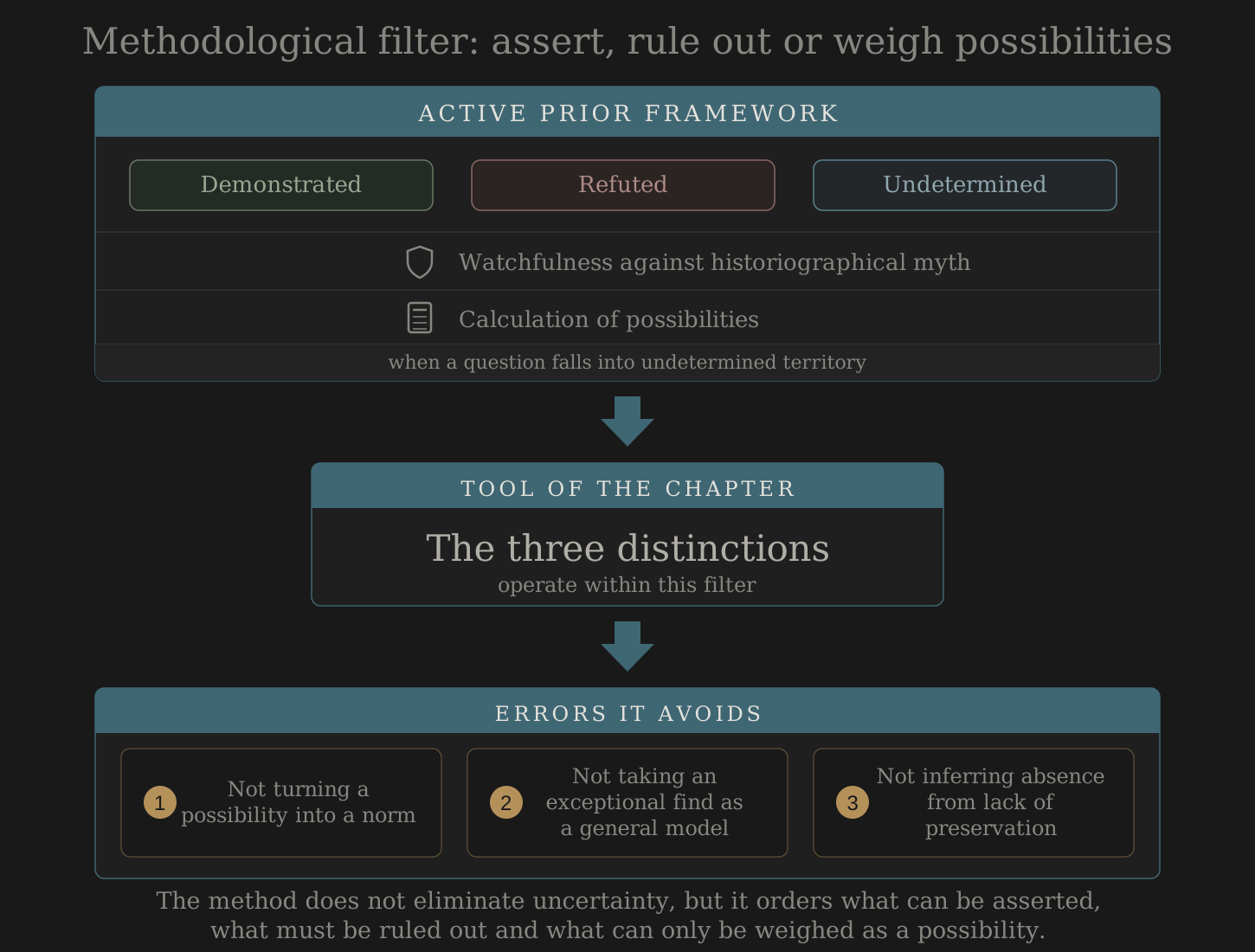
The three distinctions operate within a broader filter already fixed in the previous chapter: the distinction between three states —demonstrated, refuted, undetermined—, distrust of the hypothesis repeated without proof and, as an operational way out when a question falls into undetermined territory, the calculation of possibilities. Here they are only named; they remain active.
The three distinctions do not solve every problem, but they prevent some serious errors: turning a possibility into a norm, transforming an exceptional find into a general model or deducing that something did not exist only because it has not survived.
The criteria of the sculptural decision
When the sculptor has read the documentation, what lies in front of them is not yet a figure, but a field of possibilities. The concrete decision will be something else: this figure, in this scene, wears this garment, in this way and not another.
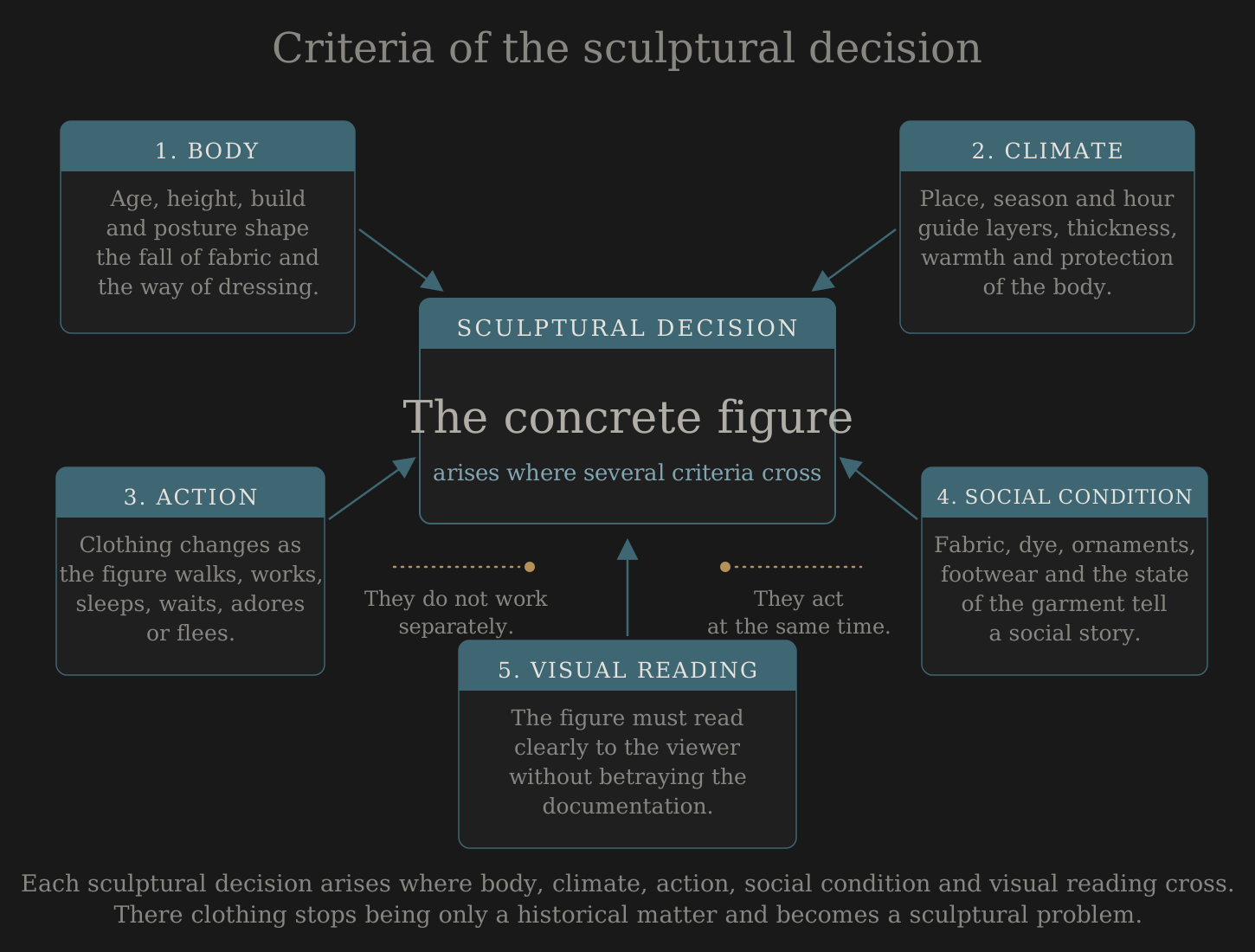
That decision cannot depend on a single factor. At least five criteria come into play, and none works separately.
Body. The garment is worn. A child does not dress like an old man; a pregnant woman does not wrap herself like a soldier. Height, age, build and posture condition the fall of the fabric, the length of the tunic, the way of girding the belt, the way of covering the head.
Climate. The scene happens in a place, a season and an hour. When it is set in winter, at night or in a poorly sheltered space, the clothing must think in terms of layers, thickness, warmth and protection of the body. The point here is not to discuss the historical date of the birth of Jesus, but to accept the visual and material consequences of the nativity-scene cycle when it sets the scene in winter. This sculptural criterion should be distinguished from the rule of climate that operates when reading the evidence: that rule decides how the archaeological corpus is interpreted —the Judaean Desert is not the hill country of Bethlehem—; this criterion decides how the figure is dressed in the scene. The rule prevents an error of reading; the criterion guides the final decision.
Action. Clothing does not behave in the same way if the figure walks, works, sleeps, waits, adores or flees. A shepherd keeping watch at night needs freedom of movement and warmth at the same time. A traveller carries his mantle differently from someone who is seated. Action conditions which garments are in use, how they are worn and which parts of the body are covered, taut, free or protected.
Social condition. Not everyone could dress alike. The quality of the fabric, the type of dye, the presence or absence of ornaments, the state of repair of the garment, the footwear or the head covering tell a social story. It is not a matter of turning poverty into theatrical destitution or dignity into luxury, but of allowing clothing to say, without exaggeration, who that person is and where they come from.
Visual reading. A figure does not exist only as a historical possibility; it exists as an image that someone is going to look at. The viewer of the nativity scene is not an archaeologist. They read the figure from their visual experience, and if a garment turns out to be incomprehensible, unintentionally anachronistic or visually confusing, communication breaks down. Visual reading does not stand above the documentation, but nor can it be ignored. The sculptor works at that crossing: what the evidence allows and what the viewer’s eye needs in order to understand what it sees.
These five criteria are not applied one after another. They work at the same time. Each sculptural decision arises from the crossing of all of them. There clothing stops being a merely historical matter and becomes a sculptural problem.
Prudence does not mean visual poverty
It is sometimes thought that a more documented figure ought to have more visible elements: more bands, more layers, more ornaments, more signs, more recognisable details. But accumulation can give an appearance of richness and at the same time weaken the truth of the figure.
A sculpture needs hierarchy. Not everything can speak with the same intensity. If every detail wants to prove something, the figure stops breathing and the clothing becomes an inventory.
Sobriety, on the other hand, can be very expressive when it is born of a conscious decision. A simple tunic can speak of work, humility, weariness or dignity. A thick mantle can speak of the cold without turning the scene into a display of fabrics. A decorated border can suggest social condition without falling into luxury. A covered head can place a figure culturally without any need to overload it.
Visual prudence does not impoverish the figure. It frees it from unnecessary accumulation and allows each decision to carry more weight.
Connection with In search of the biblical nativity scene
This study is part of a broader project. Its general framework lies in In search of the biblical nativity scene, where the underlying questions are raised: what makes a biblical nativity scene authentic, how the Gospel script is read, what relationship exists between memory, tradition and history, and what kind of truth a representation can reach.
The relationship between the two blocks is close, but the division must be clear. This study builds the general knowledge about clothing, footwear and personal presentation: what existed, on what evidence, what it was made of, how it was manufactured and what variants could arise according to gender, age, work, climate or social position. It does not deal with specific characters or decide what each one wears.
That second operation belongs to the blocks of the characters and of the scenes. There, each character page and each scene chapter will open this work as one opens a wardrobe: it will look for the garments, the materials, the colours, the footwear and the personal presentation that the moment, the place and the action of each figure require. Mary on the journey to Bethlehem, Joseph looking for shelter, the shepherds in the night or the Magi before the Child will not be resolved here; they will be studied in their scene, with the criteria fixed here and with the documentation that the following chapters are going to build.
Put simply: this study researches the possible wardrobe; the blocks of the characters and of the scenes decide what each character wears in each scene.
This separation avoids two problems at once: that the general study should fragment into premature applications, and that the decisions for each scene should be taken without first establishing the base on which they rest.
Prudence as method
Nothing said in this chapter amounts to a renunciation. Distinguishing levels of evidence does not weaken the argument; it makes it harder to dismantle. Recognising that an absolute reconstruction is unattainable does not mean resigning oneself, but marking out with precision the ground where work can indeed be done. Accepting that not everything documented must be represented is the condition for the figure to be legible.
Prudence, understood in this way, is not a limitation: it is an instrument of creation. Knowing what not to put in is as important as knowing what to put in. The figure that results from this method will be neither an archaeological replica nor a historical appearance built by accumulation: it will be an informed sculptural decision, aware of what it knows, of what it does not know and of what it chooses to show.
From the next chapter onwards, the research will enter the concrete matter: what we know, what survives, where it survives and what the sources say. Each statement will have to be placed on the level of evidence that corresponds to it, and where appropriate it will carry one of the three marks —proven, inferred from context or unknown—. The criterion of reading and selection just fixed will remain active at all times, even if it is not repeated.
It is not a matter of accumulating historical data so that the sculptor may later choose among them like loose pieces. It is a matter of building ordered knowledge so that the decision, when it comes, has foundation, has context and has judgement.
In sculpture, a garment is not only historical information. It is volume, weight, gesture and narrative.