
 ≈ 24 min

Why this work exists
I have been modelling figures for more than 40 years. I have made groups for Holy Week in Tarragona, author figures for the nativity scene and historical characters. In all that time, every time I have come close to the figures called «Hebrew style» or «biblical», I have found the same problem: it is not always clear what they are based on.
Models are repeated, traditions are copied, what exists is assumed to be correct. But when one asks where that visual code comes from —the long tunics, the draped mantles, the bare feet, the soft colours, the generic turbans or headscarves—, the answer does not usually lead us straight to first-century Judaea, but to later artistic traditions: academic painting, nineteenth-century Orientalism, biblical cinema, devotional workshops or commercial models repeated for decades.
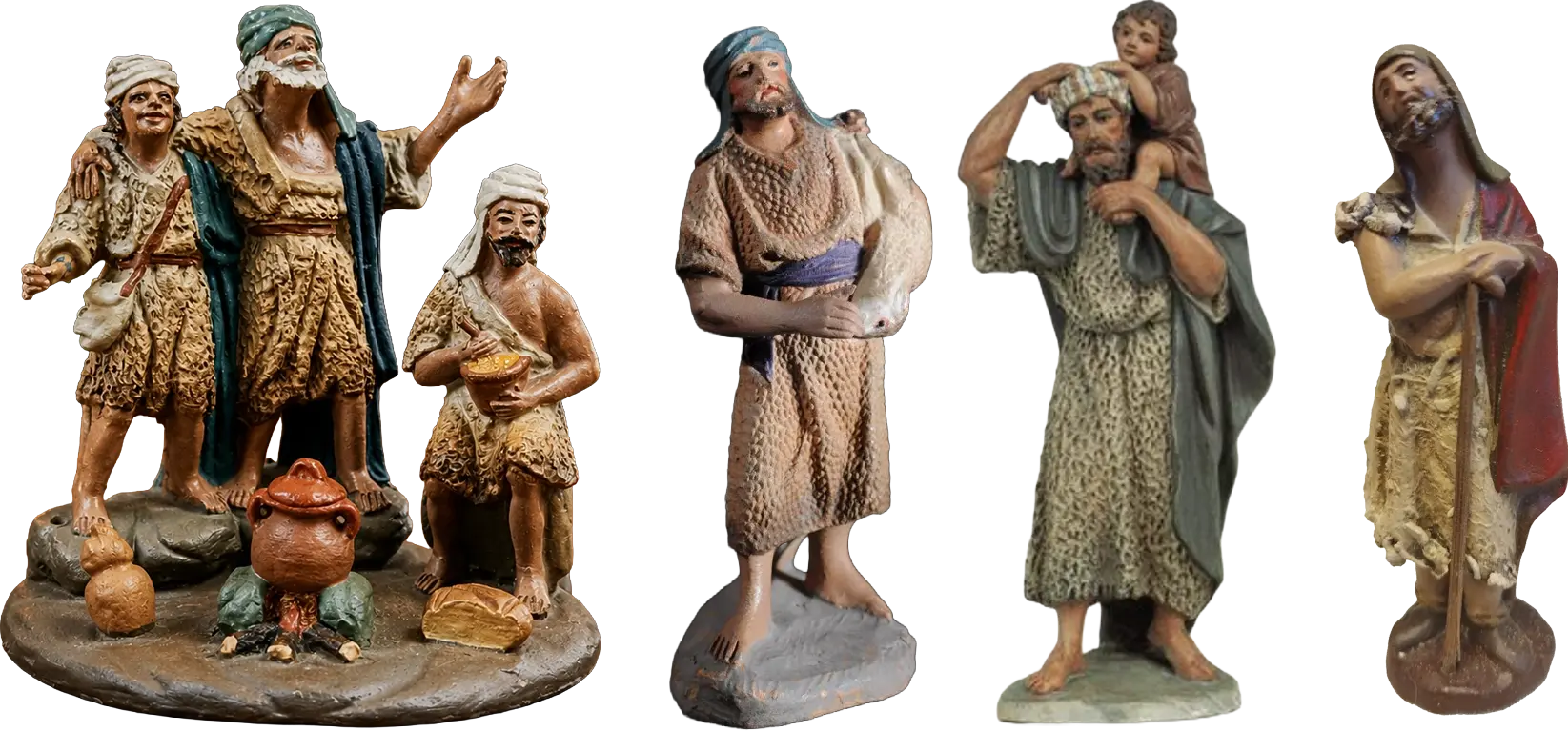
This does not mean that those figures lack value. They are part of the visual history of nativity-scene art and have given shape to a shared memory. But it is one thing to recognise their value within the tradition, and quite another to accept that those images tell us, on their own, how people really dressed in the world where the scenes of the birth of Jesus are set.
The need to revise this field does not arise only from a personal concern. As Francisco Manuel Valiñas López has pointed out 1, the nativity scene has long been an artistic expression insufficiently attended to by criticism, despite its formal, religious, social and cultural richness. Its study demands a methodology of its own, capable of attending not only to the figures, but also to the setting, the scenography, the religious contents, the period and the place. This research stands on that same line, but applied to a specific problem: the clothing of biblical figures and the material world that made it possible.
Pointing out that the nativity scene needs to be studied with greater rigour is not the same as setting to work on a specific problem. This Manual is born of that second attitude: not to stop at complaint, but to build tools of knowledge for the study and creation of nativity scenes. It is not enough to call for more rigour for the nativity scene. That rigour has to be turned into method, into sources, into decisions and, finally, into figures.
In 2015, in a nativity-scene forum, I tried to answer the question raised at the outset: where that visual code comes from. I documented materials, dyes, weaving techniques, climate and geography. The work remained incomplete, but it made one thing clear: the question was legitimate and deserved to be treated with more rigour than had usually been devoted to it within the nativity-scene tradition.
11 years have passed. In that time the textile archaeology of the Mediterranean Levant has kept advancing: the kermes-dyed textile shown further down was published in 2024. But much of what the sculptor needs had already been published before that attempt —the analyses of the textiles from Masada 2, those from Qumran 3 or the syntheses on clothing in Roman Palestine 4— and had not been incorporated systematically into the study of nativity scenes. That is the gap this work sets out to begin closing.
In those same years the way of obtaining an answer has also changed. Today a generator —of text or of images, it is the same machine— returns in seconds, from a few written lines, a fact sheet on first-century clothing, a piece of workshop advice or a figure that looks biblical. It is worth understanding what it returns. It turns each word of the question into what it has most often seen associated with that word; and what has most often been seen alongside “tunic”, “shepherd” or “first century” is not the textile from Masada nor the excavation report, but academic painting, biblical cinema, the workshop figure and what others had already written from memory. The generator does not correct the inherited image: it serves it, faster and in quantity.
The error begins before the answer: in the question. Whoever writes “a figure in blue” has already taken as settled the questions that here come first —who that figure is, where it is, in which season, what it is doing, which garment it wears and whether an entirely dyed garment makes sense on it—, and the machine will not ask them on his behalf: it answers what it is asked, gaps included, and fills them with whatever is most repeated. And the error continues in the answer: the fact it remembers and the one it invents come out with the same face, the same assurance and in the same well-written sentence; nothing in the text warns which is which. What a machine of this kind cannot receive is the chain this block follows: which animal the wool comes from, on which loom it is woven, how wide the cloth is, which garment is made from it, what it is for, in which climate and in which scene. It can only receive the last link: how it looks or how it sounds. For it to return a figure in keeping with what is researched here, each of those decisions would first have to be taken, checked, translated into words or into appearance, and the result watched against the source, because where its statistics fall short it substitutes without warning. The work is not saved; it is displaced. The only thing saved is the modelling, which is precisely what cannot be separated from the decision. That is why a fact sheet or a print file that circulates without its research is a form without a chain: nobody knows what anyone decided or what it was checked against, and reading or looking at it there is no way to tell whether it is right or wrong.
It is like getting a coffee from a vending machine: you put in the coin, press the button and out comes a coffee. Nobody knows where the beans come from, how they were roasted or who picked them; you have a coffee, and nothing more. The answer that comes out of the button is that coffee. The hours of searching, checking and reasoning that this block gathers are not spared to anyone by the button: they are what one has to have done in order to know what to ask, and to recognise, when it comes out, that it is wrong.
I say this because today's reader no longer arrives with a blank slate: before opening this block, the search engine has already placed a ready-made answer in front of him, and texts and charts circulate on social media with the look of a research sheet —sections, materials, recommended colours, tips— that nobody has checked. It is not exactly the same thing, and it is worth knowing in what way. One of those answers cost the seconds it takes to type a question. What follows has cost more than forty years of learning what to look at and where, and months of reading each source, seeking the one that might refute it, and deciding, piece by piece, what can be affirmed and what cannot. The reader will see where each decision lies and what it was checked against; that is the difference, and it is the only thing offered here that a machine cannot give.
That is why I am now taking up this research again. Not to repeat what I already did, but to take it further: to build a documentary base solid enough to model a collection of biblical figures with a degree of rigour that, as far as my knowledge reaches, has not yet been applied systematically to the creation of nativity figures.
What I set out to do
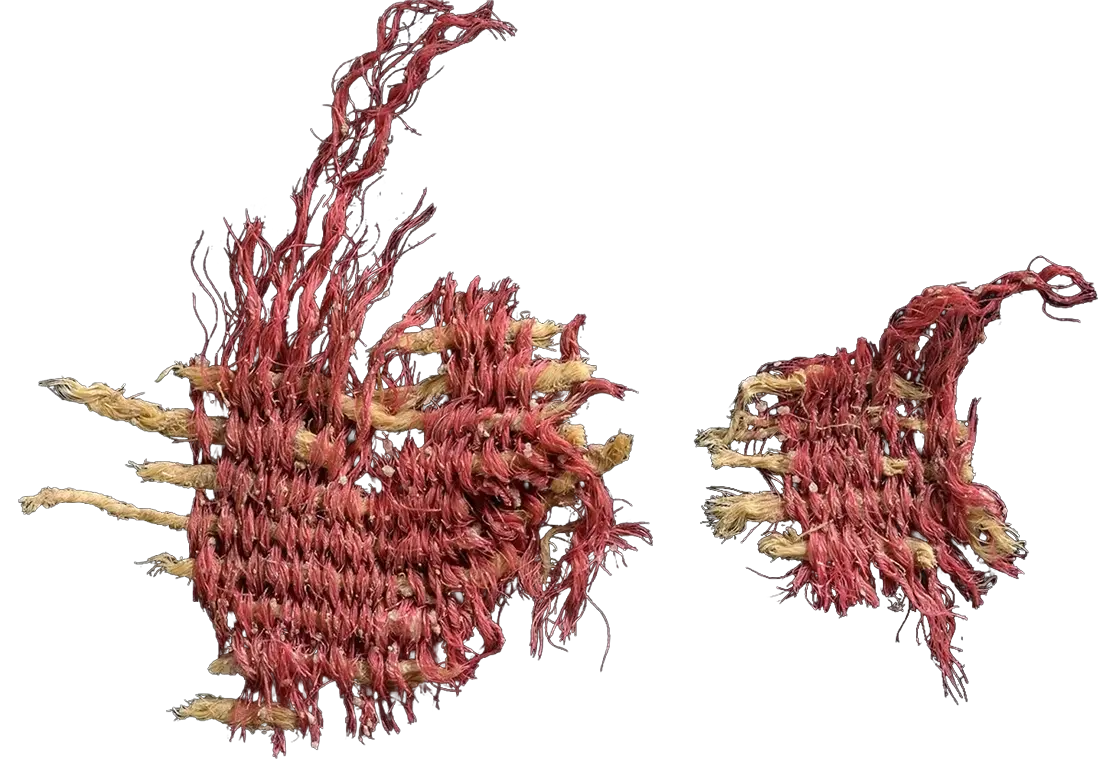
I set out to document the material world of first-century Judaea and Galilee with a specific purpose: to model a collection of figures of the Nativity cycle —the characters of the Gospel scenes and the complementary figures that set the scene— with the greatest possible fidelity to the evidence available today.
It is not only a matter of knowing what they wore. It is a matter of understanding who produced that clothing, how the raw materials were obtained, which animals or plants were involved, who spun, who wove, who dyed, who sewed, who mended, what tools were used, what each social group could afford and how climate, work, age or the specific situation of each scene had an influence.
Because each answer to those questions is a possible figure: the spinner, the dyer, the weaver, the shearer, the shepherd with his sheep, the goatherd, the tanner, the shoemaker, the woman who sews, the old woman who hands down a trade, the girl who learns, the merchant who sells fabrics or the labourer who wears on his body a garment that is worn but cared for.
These figures are not mere «extras». If they belong to the world that made that clothing possible, they also belong to the world that the nativity scene can represent.
The artistic interpretation will come later. First the documentation has to be there. And that documentation, to be useful, has to be verifiable, open to comparison and hard to discredit without better evidence. Every important statement will have to rest on a reference. Every inference will have to be clearly distinguished from direct proof. Every analogy will have to be named for what it is: a useful comparison, not a historical certainty.
How this work is built
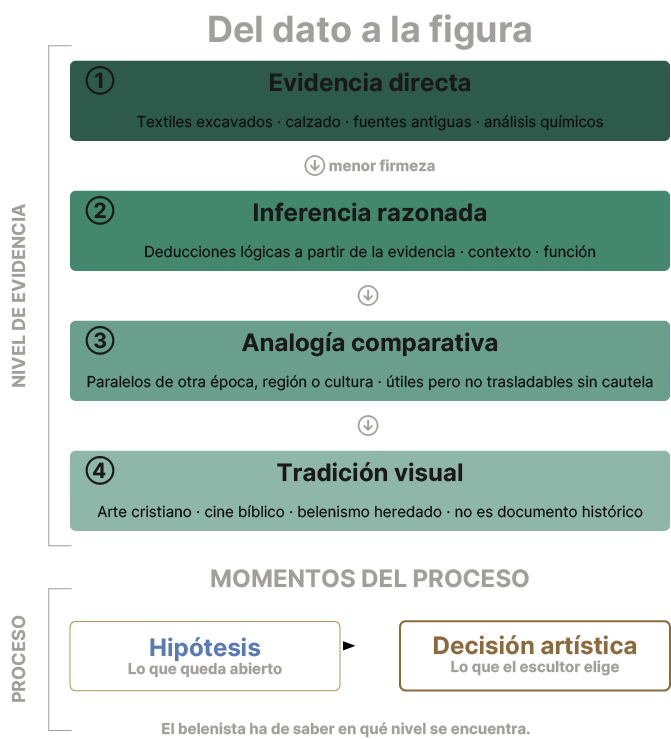
This work is built on two different questions that should not be confused. The first, prior one is whether a statement can be made at all. The second, later one is where the firmness with which it is made comes from. The reader must know at every moment which of the two they are in.
Before classifying a statement by its level of evidence, it is worth passing it through a prior filter. A statement only deserves to be treated as such if it could be refuted by some possible finding: what is not falsifiable is not a statement, it is a dogma. The burden of proof, moreover, falls on whoever asserts, not on whoever doubts; a statement without positive proof is not a provisional truth, but a statement without foundation.
It is also worth distinguishing three states —not two— when speaking of any question: what is demonstrated —there is sufficient positive evidence—, what is refuted —there is positive evidence of the contrary— and what is undetermined —there is not sufficient evidence in either direction—. Absence of evidence is not evidence of absence: that something has not been found does not mean that it did not exist, it means that it has not been found. Nor is repetition proof: a hypothesis quoted a thousand times is still a hypothesis.
Once the statement has passed that filter, it is placed on one of four levels, according to where its firmness comes from.
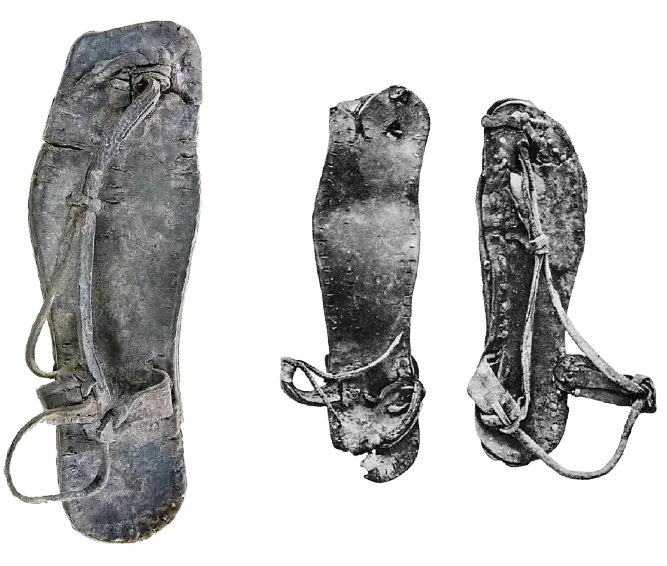
The first level is direct evidence: textiles excavated and published, surviving remains of footwear, tools identified at sites, installations related to textile or dye production, explicit ancient sources and specialised studies. This level forms the firmest core of the research. It cannot be treated as a mere opinion, because it comes from materials, texts or studies with a verifiable provenance. What is debatable, in many cases, will be its interpretation; that is why it will always be indicated what is stated directly and what is deduced from it.
The second level is reasoned inference: what can be deduced from the evidence with logic, caution and knowledge of the context. If a type of fabric, a fibre, a loom technique or a form of footwear is documented, consequences can be drawn for the modelling, but those consequences are not identical to the original proof. They are reasoning. That is why they will be presented as such.
The third level is comparative analogy: comparison with Palestinian clothing documented in later periods, with parallels from the contemporary Roman world or with textile traditions of the eastern Mediterranean. This method can be legitimate and necessary where direct evidence does not reach, but only if it is used with prudence. An analogy helps to imagine possibilities; it does not replace proof.
To these levels another will be added, especially important in nativity-scene art: visual tradition. Many images we hold in memory do not come from history, but from the Christian artistic tradition. Byzantine and medieval art fixed certain symbolic and liturgical codes; the academic and Orientalist painting of the nineteenth century projected onto the first century the clothing of Palestinian, Syrian, Egyptian or Algerian peasants of its own time; biblical cinema consolidated that image and distributed it globally.67 The Neapolitan nativity scene, the devotional schools, the Olot workshops and many commercial models of the twentieth century inherited part of that imagery without always questioning it from a historical point of view. Its value is not negligible, but it must be recognised for what it is: artistic tradition, not a direct historical document.
These four levels, however, do not manage to resolve a good part of the everyday decisions of the work. The textile evidence of the first century has survived almost exclusively in caves of the Judaean Desert, not in the hill country of Bethlehem or in Nazareth. To bridge the gap between what survives and what is needed, this work operates with two rules. The first reverses the question: where there is no direct proof, the right question is not «is there evidence that it existed?», but «is there any material, economic or technological reason why it could not have been present?». If there is none, the presence is considered reasonable, without turning it into proof.
The second adjusts the decisions to the real time and place: the Judaean Desert is not the hill country of Bethlehem; January at about 770 metres of altitude is not August in a cave at Murabba'at. What has survived in the desert gives guidance on techniques, materials and vocabulary; not on what was worn on a cold night halfway up a mountain. And time also counts on its long scale: what survives at Masada, in the Cave of Letters or at Dura-Europos is decades or centuries later than the birth, woven when the loom and its uses had already changed. A technique, a material or a garment that appears later cannot simply dress a figure from the first third of the first century: it is not wise to jump a century, or a year, and where a later parallel is used, the distance between the source and the scene is named.
There will be cases —many— in which we will simply have to say that we do not know. Not having enough information does not authorise inventing a certainty. The study will say so without concealment and, if possible, will offer several reasonable options. But «we do not know» has a way out that is worth naming: when a question falls into undetermined territory, the demonstrated factors that surround it can be gathered —tools, skills, materials, cultural context, practices documented in neighbouring regions or nearby periods— and it can be assessed whether the existence of something is more probable than its non-existence. This is what this work calls a calculation of possibilities. It does not turn the probable into the demonstrated, but it allows the sculptor to take reasoned decisions without leaping into the void.
When the reader needs to know where they stand, the statement carries one of three marks. Proven, when there is direct material evidence or conclusive contemporary textual evidence for the region and the period. Inferred from context, when there is no direct evidence but technology, climate, trade routes or close cultural parallels make the presence reasonable. Unknown, when it can be neither asserted nor ruled out. Unknown is the name that the undetermined takes in practice; what is refuted needs no mark: it is said to be refuted, and with what proof.
Whoever wishes to dispute this work will have to do so from that same ground: by bringing better evidence, sources or arguments. An opinion does not refute an excavated textile. A visual custom does not refute an archaeological publication. An aesthetic preference does not invalidate a documented conclusion. But better proof, a more precise source or a sounder interpretation must always be heard.
Who it is for
This work is addressed to nativity-scene makers who want to understand what the figures they know are based on and what alternatives may exist. Also to sculptors who wish to work with real documentation, and to anyone who wonders what lies behind those images that tradition has taken as good for generations.
I do not intend to convince anyone to abandon their tradition. The great aesthetic currents of nativity-scene art —the eighteenth-century Neapolitan, the devotional Saint-Sulpice style linked to workshops such as those of Olot, nineteenth-century Romantic Orientalism or the popular and regional styles— have their own coherence and their place in the history of art.
What I propose is to add another path: the documented biblical figure. It is not a path that this work invents out of nothing; it is the road that archaeological research, the history of dress, material culture and studies of the ancient Mediterranean have been building over the last decades; what is new is to bring it to the modelling of nativity figures.
This work does so from the only position from which I can do it: that of someone who has had to research before being able to sculpt.
It is not a matter of proving that traditional figures are wrong. It is a matter of proving that a more documented representation is possible.
And, for a sculptor, that possibility changes things a great deal. Because before modelling a figure one has to know what world sustains it. Clothing is not an ornament added at the end: it is material, work, climate, trade, age, dignity, social condition and narrative. Dressing a biblical figure demands understanding it before giving it form.
References
- ↑ [1] Valiñas López, F. M. (2009). «El belén ante la historia del arte. Apuntes para el estudio de sus elementos y contenidos escenográficos». Cuadernos de Arte de la Universidad de Granada, 40, 415–432.
- ↑ [2] Sheffer, A. and Granger-Taylor, H. (1994). «Textiles from Masada: A Preliminary Selection». In Masada IV: The Yigael Yadin Excavations 1963–1965, Final Reports. Israel Exploration Society. National Library of Israel catalogue.
- ↑ [3] Shamir, O. and Sukenik, N. (2011). «Qumran Textiles and the Garments of Qumran’s Inhabitants». Dead Sea Discoveries, 18(2), 206–225. Academic copy.
- ↑ [4] Shlezinger-Katsman, D. (2010). «Clothing». In C. Hezser (ed.), The Oxford Handbook of Jewish Daily Life in Roman Palestine (pp. 362–381). Oxford University Press; Taylor, J. E. (2018). What Did Jesus Look Like? Bloomsbury T&T Clark. Extract.
- ↑ [5] Sukenik, N., Davidovich, U., Amar, Z., Abu-Ghosh, S., Maor, Y., Porat, R., Ganor, A., Klein, E. and Iluz, D. (2024). «Early evidence of an archaeological dyed textile using scale-insects: The Cave of Skulls, Israel». Journal of Archaeological Science: Reports, 57, 104673. doi:10.1016/j.jasrep.2024.104673.
- ↑ [6] On the academic and Orientalist painting of the nineteenth century, which projected onto the first century the clothing of the Near East of its own time, see «Orientalism in Nineteenth-Century Art», The Metropolitan Museum of Art, Heilbrunn Timeline of Art History. Read the essay. A paradigmatic case: James Tissot, who between 1886 and 1896 travelled to the Holy Land to illustrate the New Testament by documenting contemporary Jerusalem; his «realism» was shot through with anachronisms by the Orientalist fallacy of taking the Jerusalem of 1900 as a mirror of a much earlier period.
- ↑ [7] Reinhartz, A. (2007). Jesus of Hollywood. Oxford University Press.
- ↑ [8] Rosenthal-Heginbottom, R. (2013). «‘A Man must not go out with a nail-studded sandal’ – footwear in Jewish sources and from archaeological remains». In A. De Moor, C. Fluck and P. Linscheid (eds.), Drawing the Threads Together. Textiles and Footwear of the 1st Millennium AD from Egypt (pp. 268–275, figs. 1–2). Tielt. Yadin, Y. (1963). The Finds from the Bar Kokhba Period in the Cave of Letters. Israel Exploration Society, pl. 57.