
 ≈ 26 min

What is touched, not what is read
Until now, this study has worked with a map: what can be known, what cannot be known, where the ground is firm and where it becomes uncertain. This chapter enters the concrete terrain. It is now a matter of objects: the fragments of cloth that someone wove, the leather that someone cut for a sandal, the spindle with its whorl that someone set turning by hand.
Material evidence has a status different from that of a written source or an image. A textile fragment excavated at Masada does not argue, does not interpret, does not project: it is there. Its fibre can be examined, its thread density measured, the direction of twist of its spinning identified, the remains of dye analysed chemically, the structure of the weave observed, seams, finishes or signs of wear looked for. It is the type of evidence hardest to dispute, because it does not pass through the intention of whoever describes it — it passes through the material itself.
But that solidity has precise limits. A textile fragment says a great deal about the fibre and little about the garment. It says what material existed, how it was spun, how it was woven, and sometimes what colour it was — but it does not say who wore it, or how that cloth was combined with others, or what it looked like on a body that walked or slept. Between the fragment and the figure there is a route that this study will build step by step. The first thing is to know what kind of objects we have in our hands.
What this chapter gathers corresponds, in the Manual’s labelling, to the proven stratum: the statements rest on physical objects that have been catalogued, dated and published. The discussion almost always moves to the interpretation of each find and the scope it admits; rarely to the existence of the object itself. When the text passes from asserting to inferring —for example, when deducing importation from the Z direction of the spinning—, it will say so with the corresponding verb.
Five types of find, five different questions
Not everything excavated at a first-century site provides the same information or answers the same question. It is worth distinguishing five types of material find related to clothing, because each has its own possibilities and its own limits.
The textile fragment is the most frequent find. A piece of cloth, sometimes of a few square centimetres, preserved by the aridity of the desert or by the accidental sealing of a cave. What it can say is considerable: type of fibre (wool, linen, goat hair), direction of twist of the spinning, structure of the weave (tabby, twill), density of threads per centimetre, remains of dye, presence of seams or finishes. What it cannot say is equally clear: which garment it belonged to, how it was worn, who used it, or what it was for. The fragment is a piece of the mosaic, not the whole mosaic.
The garment or recognisable part of a garment is much rarer. Almost no complete first-century garments of everyday use survive in the region. The few exceptions —fragmentary tunics and mantles found in the Cave of Letters or at Khirbet Qazone— make it possible to deduce dimensions, type of construction (1 piece or 2, sewn at the shoulders or folded) and sometimes the position of the decorative bands. The distance between this type of find and the loose fragment is enormous: a recognisable garment allows one to speak of form, of cut, of proportions; a fragment only allows one to speak of material.
The funerary textile occupies an intermediate place, and deserves a section of its own later in this chapter. A shroud or a linen wrapping preserved in a tomb is direct evidence of a material, of a technique, of a real colour. But its function is specific: to dress a dead person, not a living one. Treating a shroud as if it were everyday clothing is a category error.
Footwear — sandals, closed shoes, intermediate forms — survives more often than fabrics, because leather in a dry environment resists better than plant or animal fibre. Footwear tells us material, construction, size, wear. Unlike the textile fragment, a surviving sandal is a complete functional object: one can know how it was fastened to the foot, how many layers the sole had, what size of foot it shod. Footwear is the most complete material evidence this study handles.
The tool of textile production — whorl (the small weight of the spindle, called the spindle whorl in the archaeological literature), loom weight, bone or metal needle, carding comb — does not say how anyone dressed. It says something else: what it was possible to make in a given place and at a given time. The presence of whorls in a domestic context indicates that someone spun there. The presence of loom weights indicates that someone wove. These tools do not answer the question «how did they dress?», but the question «what could they make?» — and that question, although different, is equally necessary.
Each of these five types of find requires its own reading. The most frequent error consists in asking of one what only another can offer: treating a fragment as if it proved a garment, treating a shroud as if it described the clothing of a living person, or treating a tool as if it dictated fashion.
Textiles: what the fragments say
The most complete catalogue of textiles of the Roman period in Israel is the one Orit Shamir has gathered over decades of work at the Israel Antiquities Authority. Her summary table records 1,635 catalogued textiles from some 20 sites, from Masada and Qumran to the caves of Nahal Hever, Wadi Murabba'at, Mo'a and 'En Rahel1. The figure is significant, but it should be put in context: from Masada alone, thousands of additional textile fragments remain unpublished. What has been catalogued is a fraction of what has been excavated.
And a warning that applies to the whole block. The chapters of the material sieve (from The material before the figure to Wool as a separated fibre) follow another table by the same researcher —Shamir and Sukenik (2011), with 1,727 textiles and a different distribution by fibre—, and the two counts do not coincide. With the two tables checked against each other, the rest of the sites coincide figure for figure; the difference lies in Qumran and in one burial: the 2011 table counts Cave 11 (58 textiles) and the Christmas Cave (184) separately, and the 2015 table puts in their place a still unpublished group from Qumran (150) and adds Gesher Haziv (1). That is why each chapter declares which table it follows. This one, and the chapters running from What we know and do not know about first-century clothing to Where the evidence survives and where the scenes are set, follow that of Shamir (2015).
The distribution by material shows a clear landscape. Of the 1,635 textiles, 1,030 are of wool, 531 of linen, 58 of goat hair, 3 of camel hair and 13 of mixed composition. Wool is the dominant material in the surviving evidence, which should not be surprising: wool takes dye better than linen, resists reasonably well in a dry environment, and was the main fibre of local textile production. Linen, the second fibre in importance, appears frequently in funerary contexts and in garments of higher quality. Goat hair is associated with utilitarian fabrics: ropes, sacks, coverings.
What each fragment can reveal depends on its state of preservation, but in favourable conditions it offers several levels of information.
The fibre. Microscopic identification distinguishes wool from linen from goat hair. This distinction is not trivial: the type of fibre conditions the weight of the cloth, its drape, its capacity to take dye, its coolness or its warmth. For a sculptor, the difference between a linen tunic and a woollen one translates into different folds, into a different relationship with the body.
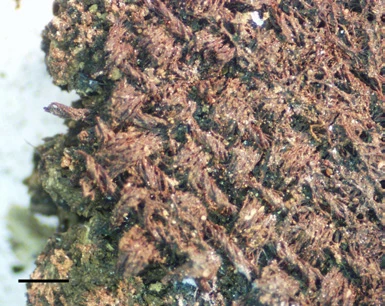
The twist of the spinning. Threads can be spun in two directions: S (anticlockwise) and Z (clockwise). In the woollen textiles of the Roman period in Israel, S twist is overwhelmingly predominant: 715 of the 826 woollen textiles with a recorded spinning direction are S-spun2. Z twist, more frequent in Greece, Italy and the western Mediterranean, appears in only 37 woollen pieces. This technical datum may seem minor, but it has an important consequence: when a woollen textile shows Z spinning at a site in Israel, it is probably an import. The direction of the spinning works as an indicator of provenance.
The structure of the weave. The dominant weave is tabby — the simplest structure, in which each weft thread passes alternately over and under each warp thread. Of the 1,635 catalogued textiles, only 32 show a twill weave, all of them of wool3. Twill required a loom with 3 or more shafts that was not in habitual use in the region; the twill textiles were imported. This datum says something precise: local production was technically competent but did not cover the whole range of weaves that existed in the first-century Mediterranean. The textile world of Roman Judaea was simpler in structure than that of Palmyra, Egypt or Rome, although not necessarily poorer.
The colour. When conditions allow, the fragments retain remains of dye that can be analysed chemically. But here an essential precaution appears: the present colour of the fragment is not the original colour. 2 millennia of oxidation, decomposition and contact with the soil transform colours. A madder red may have turned brown; a woad blue may have faded until it looks grey. Chromatographic analyses, such as those by Koren on textiles from the Dead Sea, make it possible to identify the original dye even when the visible colour no longer gives it away4. Without those analyses, the eye deceives: a brownish fragment may have been red, blue or yellow. The chapters on dyes and colours will develop this question in detail.
Seams and finishes. When a fragment retains a seam, a hem, a fringed edge or a fastening cord, the information multiplies: one can deduce that the fragment belonged to a garment with a particular form, that someone sewed it with a specific technique, that the finish had an identifiable degree of care. Fastening cords, for example, are frequent in woollen textiles of the Roman period and have been documented at sites from Masada to Palmyra5. But most fragments do not retain these details: they are pieces without edge or seam, floating without the context of a garment.
When the textile is a shroud
Among the surviving textiles, those from funerary contexts form a category apart. They are not garments, although they were sometimes made from cloths that had been. They are wrappings for a dead body, and their function conditions everything they can tell us.
The most studied case is the Akeldama shroud, in Jerusalem: a woollen textile in tabby weave, with a Z-spun warp and an almost untwisted weft, radiocarbon-dated to between 95 BC and AD 53.7 It is one of the few first-century textile pieces from Jerusalem, preserved because the funerary loculus where it lay remained sealed for 2 millennia. The textile has no decoration, no seams and no signs of previous use. The Z direction of its spinning is infrequent in the local context, which suggests an import — perhaps from Greece or Italy — and, with it, a social level of the deceased who could afford a shroud of imported cloth.
But Akeldama is not the only case. In the caves of the Judaean Desert, at 'En Gedi, at Gesher Haziv and at Jericho, linen shrouds have been found that share a feature that matters for this study: their colour is cream or beige, not white8. Bleaching was a long and intentional process — weeks of chemical treatment and exposure to the sun — that must not be taken for granted. The tendency of the Christian artistic tradition to represent biblical dress with clean and idealised whites finds no correspondence in the real colour of unbleached linen.
Shrouds provide valuable information about materials, techniques and real colour. What they do not provide is information about the clothing of the living. A shroud wraps; a garment clothes. The shroud has no sleeves, no belt, no cut fitted to a torso. In some cases, as in the Cave of Letters, the shrouds were made of reused cloths — torn woollen tunics and mantles, repurposed linen sacks — which confirms the extreme value of textiles in the ancient world and provides an indirect datum about the garments that existed before being cut9. But the step from the shroud to the garment is a step of interpretation, not of direct observation.
It is worth remembering this distinction every time a study mentions «textiles found» at a site: most well-preserved textiles come from funerary contexts or from exceptional situations (the destruction of Masada, refuge in caves during the Bar Kokhba revolt). They are not representative samples of everyday dress, but fragments of a material world that reached us through circumstances that had nothing to do with normal life.
Leather and footwear
Leather survives in a dry environment more easily than fabric, and footwear is the type of find in which the material evidence reaches its greatest completeness. Unlike textile fragments — which are loose pieces, without recognisable form —, a surviving sandal or shoe is a complete functional object: it has a sole, it has a fastening system, it has a size that corresponds to a real foot.
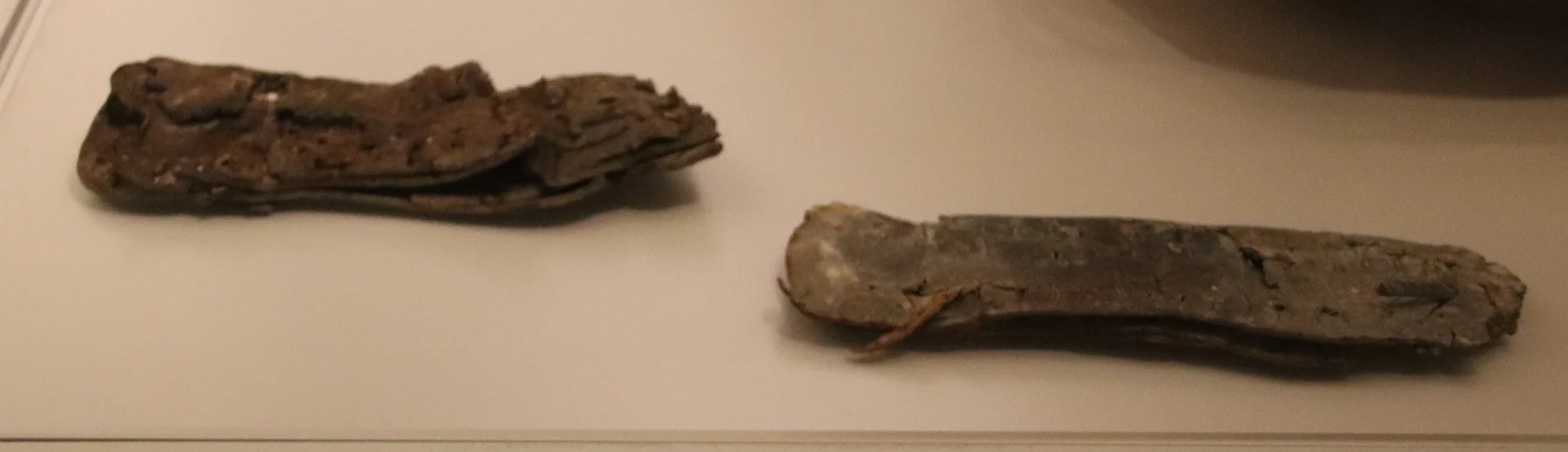
The sandals found in the Cave of Letters and at Masada show a consistent construction: a multi-layered sole of thick leather stitched with leather thongs, 2 tabs at the heel, 1 tab between the first and the second toe, and a main strap threaded through the tabs with a sliding band to adjust it to the foot10. 2 sandals from Qumran measure between 20 and 21 centimetres in length — equivalent to a European size 34–36 —, which corresponds to an average male height of about 166 centimetres and a female height of about 147 centimetres, figures consistent with the osteological studies of the period11.
But the open sandal was not the only form of footwear. At the site of Masada itself a child’s closed shoe was found, with a reinforced leather sole and a leather upper reaching the ankle, covering the whole foot12. This find is important because it shows that closed footwear existed in the region and in the period, not only as a Roman military item but as civilian footwear, even for children. S. A. Baker, in «Loosing a Shoe Latchet: Sandals and Footwear in the First Century» (BYU Studies 36:3), a study devoted to first-century footwear that draws on the finds from the Judaean Desert and on Roman typology, documents a range of forms that goes from the simple sandal to calcei (closed boots up to the ankle), crepidae (heavy sandals with a leather upper), carbatinae (a single piece of leather with a soft sole) and gallicae — heavy shoes of coarse leather, described as the ancestors of waterproof footwear, designed for wet weather and muddy ground13.
Footwear was also combined with socks. Shamir documents woollen socks worked in a netting technique without knots (knotless netting) found at Masada and at Dura Europos14. The combination of an open sandal with a woollen sock — which today may seem incongruous — was a practical solution: the sock insulated the foot from the leather and provided some thermal protection, although it absorbed water in rainy weather.
Leather was also used for belts — some preserved at Nahal Hever and 'En Rahel —, for bags, pouches and wineskins. But unlike footwear, these objects rarely survive complete: what reaches us are fragments of leather that make it possible to identify the material and sometimes the tanning technique, but not always the object they formed.
Tools: what could be made
A fourth type of find does not speak of clothing itself but of the capacity to make it. Tools of textile production appear frequently at first-century sites, both in domestic contexts and in spaces that can be interpreted as workshops.
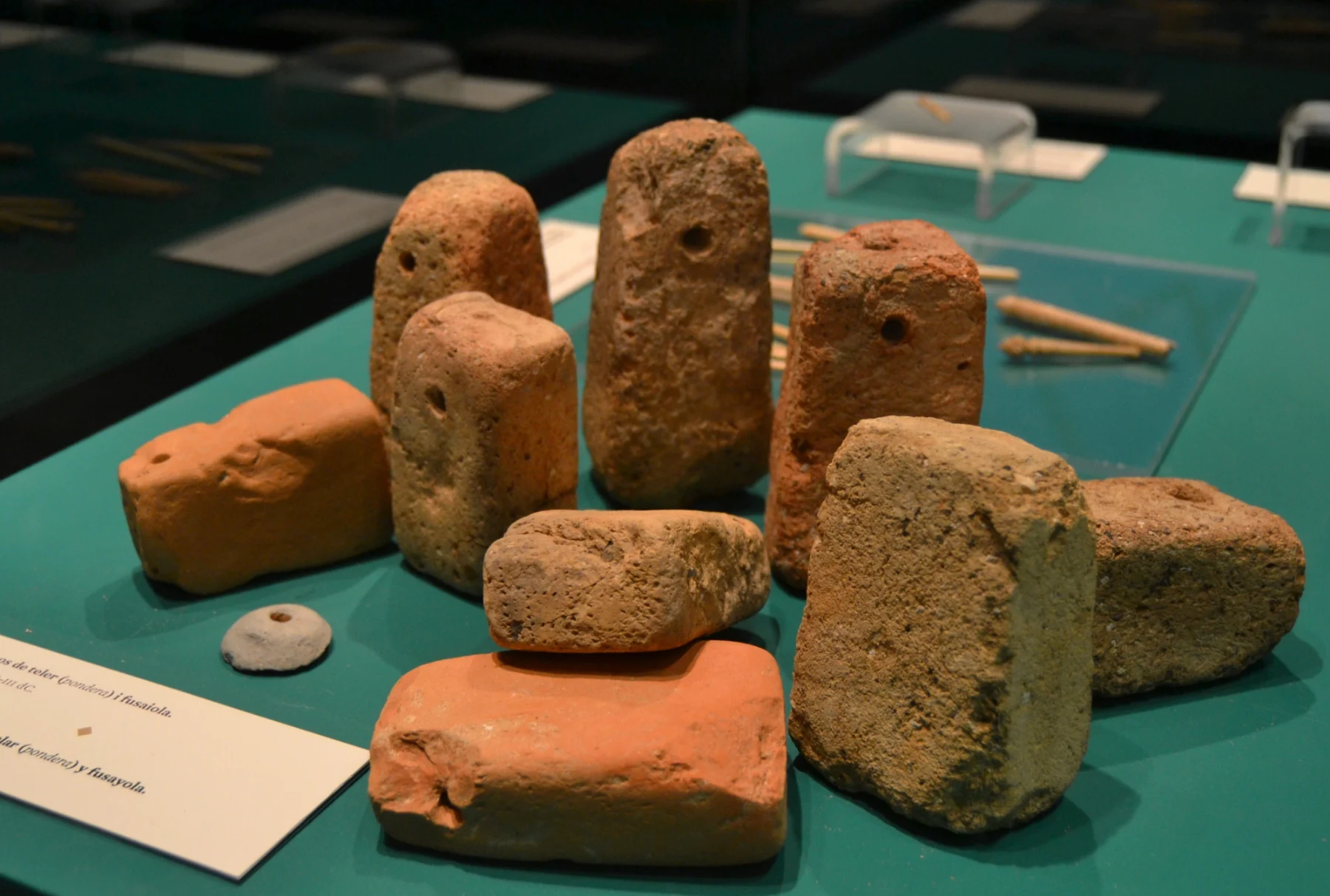
Whorls — small weights of pottery or stone fixed to the lower end of the spindle to stabilise its rotation during spinning (in the Spanish archaeological literature they appear as fusayolas, from the French fusaïole; in English, spindle whorls) — are among the most common finds at sites of the period16. Their presence in domestic contexts indicates that spinning was a habitual household activity, not exclusive to specialised workshops. Each whorl implies someone who spun — and that someone, according to the sources and the analogy with the ancient Mediterranean world, was almost always a woman.
Loom weights, heavier than spindle whorls, document the existence of warp-weighted vertical looms — the dominant type of loom in the region until the end of the first century AD, when it was replaced by the two-beam vertical loom17. Shamir studied the loom weights found at Masada as part of the volume of final reports of Yadin’s excavations, which makes that site one of the few where one can document not only the textile product but also the tools with which it was made.
Bone and metal needles, carding combs and complete spindles appear less frequently, but they complete the picture of a textile production that covered the whole process: from the preparation of the fibre to the finished garment.
This chapter will not go into the production process — the complete route from raw material to finished garment will be developed later. What matters here is to place tools as a type of material evidence with its own question: not «how did they dress?», but «what productive capacity existed?». The answer, in the light of the finds, is that textile production in first-century Judaea was local, to a good extent domestic, technically competent within the simple weaves, and capable of covering the basic needs of dress — although the more sophisticated textiles (twill, fine imported cloths) came from outside.
From the object to the datum: what can be drawn out and what cannot
Each of the five types of find examined in this chapter answers a different question. The textile fragment tells material. The recognisable garment tells form. The shroud tells funerary practice. Footwear tells construction and use. The tool tells productive capacity. None of them says, on its own, how a specific person dressed on a specific day.
The most frequent error in the popularisation of textile archaeology consists in jumping from the object to the character without passing through the intermediate steps. A fragment of red-dyed wool at Masada does not prove that Mary wore a red tunic. A cream linen shroud at Akeldama does not prove that the shepherds dressed in beige. A 20-centimetre sandal at Qumran does not prove that Joseph wore exactly that on his feet. What each find proves is more modest and more solid: that those materials existed, that those techniques were practised, that those objects were part of the material world where the scenes this study wants to understand are set.
The distance between the material evidence and the sculptural figure cannot be covered in a single step. The following chapters will build that route: first the geography of the evidence — where it survives and why —, then the written sources and iconography, then the function of clothing, textile production, colours, specific garments, and finally the passage from the archaeological datum to the sculptural decision. But at the base of that whole route are the objects examined here: fragments of cloth, remains of leather, surviving shoes and working tools. What is touched before what is read.
References
Shamir, O. (2015). A Burial Textile from the First Century CE in Jerusalem Compared to Roman Textiles in the Land of Israel and the Turin Shroud. SHS Web of Conferences, 15, Table 1. ResearchGate The wool and linen figures follow the author's own erratum, published in the same volume: Shamir, O. (2015). Erratum to: A burial textile from the first century CE in Jerusalem compared to roman textiles in the land of Israel and the Turin Shroud. SHS Web of Conferences, 15, 00011, which corrects Table 1: 531 of linen and 1,030 of wool out of 1,635. https://doi.org/10.1051/shsconf/20151500011 ↩
Shamir, O. (2015), Table 2: spinning direction in woollen textiles of the Roman period in Israel. Of 826 woollen textiles with spinning data, 715 show S twist. ↩
Shamir, O. (2015), data on twill weave: 32 of 1,635 textiles, all of wool, most of them Z-spun, found at Masada (13), Mo'a (9), Murabba'at (6), the Cave of Letters (1), caves of the Judaean Desert (1), Sha'ar Ramon (2). ↩
Koren, Z. C. (2005). Chromatographic Analyses of Selected Historic Dyeings from Ancient Israel. Dyes in History and Archaeology, 20, 194–201. Edelstein Center ↩
Shamir, O. (2015), data on fastening cords documented at 'En Rahel, Mo'a, Masada, Murabba'at, the Cave of Letters, Quseir al-Qadim, Nubia, Dura Europos and Palmyra. ↩
Photograph: Shamir, O. (2015), fig. 2 («Jerusalem, Akeldama, wool, Z-spun, ×16»), in «A Burial Textile from the First Century CE in Jerusalem Compared to Roman Textiles in the Land of Israel and the Turin Shroud», SHS Web of Conferences, 15, 00010, p. 3. Article published under a Creative Commons Attribution 4.0 licence. https://doi.org/10.1051/shsconf/20151500010 ↩
Shamir, O. (2015); Matheson, C. D. et al. (2009). Molecular Exploration of the First-Century Tomb of the Shroud in Akeldama, Jerusalem. PLoS ONE, 4(12), e8319. ↩
Shamir, O. (2015), section on linen shrouds: those found at 'En Gedi, Gesher Haziv and Jericho are cream or beige in colour (undyed cream or beige), not white. ↩
Shamir, O. (2015), section on textiles reused as shrouds in the Cave of Letters and at Khirbet Qazone. ↩
Taylor, J. E. (2018). What Did Jesus Look Like? Bloomsbury T&T Clark. Extract published as What Did Jesus Wear? (Christian Evidence Society, 2021). Christian Evidence ↩
Taylor (2018/2021): sandals from Qumran of 20–21 cm; average male height ~166 cm, female ~147 cm. ↩
Baker, S. A. "Loosing a Shoe Latchet: Sandals and Footwear in the First Century." BYU Studies, 36:3, p. 196. ↩
Baker, S. A. (ibid.): typology of first-century footwear, including calcei, crepidae, carbatinae and gallicae. ↩
Shamir, O. (2013). Dress: Hellenistic and Roman Period. In Master, D. (ed.), Oxford Encyclopedia of the Bible and Archaeology, vol. 1, pp. 328–336. Oxford University Press. p. 335: "Socks in knotless netting were found at Masada and Dura-Europos." ↩
Photograph: Gary Todd (2018), Israel Museum, Jerusalem; cropped. Public domain (CC0 1.0). Wikimedia Commons, «Leather Sandals, Cave of the Letters, Judean Desert, 132-135 AD (43169537782).jpg». Museum label: «Sandals. Cave of the Letters, Nahal Hever, Judean Desert, 132–135 CE, leather. IAA». File page on Wikimedia Commons. ↩
Shamir, O. (1994). Loomweights from Masada. In Masada IV: The Yigael Yadin Excavations 1963–1965, Final Reports, pp. 265–279. Israel Exploration Society. ↩
Shamir, O. (2015), datum on the transition from the warp-weighted loom to the two-beam vertical loom at the end of the first century AD. ↩
Photograph: Joanbanjo (2013), «Pesos de teler (pondera) i fusaiola, vil·la romana de Cornelius», Wikimedia Commons, licence CC BY-SA 3.0. File page on Wikimedia Commons. ↩

