
 ≈ 37 min

Up to this point, wool has still appeared joined to its origin. In The material before the figure it was the fleece of the sheep; in The gesture before the fibre, the material just separated by shearing. This chapter begins afterwards. The sheep is no longer in front of us. Nor is the shearer’s hand. What remains on the table is fleece.
That change seems small, but for the sculptor it is decisive. Fleece is not yet thread, nor cloth, nor tunic, nor mantle. It is a mixed material: fibre, suint, dust, plant remains, damp, animal smell, cleaner areas and coarser areas, long parts and short parts. Before it falls over a figure, wool must go through a series of operations that change its weight, its feel, its volume and the way it obeys the hand.
That is why this chapter does not ask again where wool comes from or how it is shorn. That has already been closed. The question now is a different one: what happens to wool when it stops being fleece and begins to become textile material.
The answer matters as much to the sculptor as to the set designer of the nativity scene. In a figure, the first glance does not separate composition, material and style: it takes them in at once. If the posture says cold but the mantle falls like a veil; if the texture says fine linen but the character represents a shepherd at night; if the setting suggests winter and the clothing gives no warmth, the eye notices the incoherence before the mind can formulate it. This chapter prepares that reading. The sculptural and scenographic consequences are gathered at the end, but it is worth knowing from the start that every operation on wool will end up affecting the volume, the edge, the fold, the colour and the credibility of the scene.
Wool occupies a central place in the palette of the Manual. Orit Shamir, curator of organic materials at the Israel Antiquities Authority, and Naama Sukenik, a researcher in archaeology and ancient textiles, record in their study of Qumran a regional table of 1,727 Roman textiles from the Land of Israel: 1,101 of wool, 549 of linen, 61 of goat hair, 3 of camel hair and 13 mixed.1 That figure does not allow us to dress all the characters of Bethlehem in wool automatically, but it does fix the centre of gravity: in the surviving regional Roman corpus, wool is the dominant fibre.
That explains why wool deserves a chapter of its own, and a more developed one. It does not enter the Manual as one material among others, but as the probable axis of the ordinary wardrobe: the most versatile fibre for tunics, mantles, warm covering, work, travel and cold scenes. The other materials that have passed the sieve do not disappear, but their representable weight is different. Linen, goat hair, dromedary hair, leather and hides must not be turned, for the sake of symmetry, into a parallel wardrobe for Mary, Joseph or the shepherds. The material palette is broad; the wardrobe of a specific figure will always be narrower.
Caution is still needed. Within that same debate, Qumran works as a methodological warning: the textiles that are properly Qumranic are of linen, not wool. Masada, Nahal Hever, Murabba'at, Akeldama and other places preserve real fragments, but none of them is simply equivalent to a house in Nazareth or a night of shepherds at Bethlehem. What they contribute is something else: fibre, twist, weave, density, colour, use, wear and possible origin. Those data do not by themselves dress a figure, but they train the eye that will make it possible to dress it.
For the sculptor, the consequence is not statistical but material. A woollen garment does not behave like a linen garment. It has more body, more thickness, more capacity for warmth, more response to dye and a less smooth surface. It can fall in ample folds, keep the shoulders warm, cover the head, weigh on the arm or close against the body in the cold. Wool does not decorate the scene: it makes it physically credible.
Raw fleece: fibre, suint and impurities
The fleece that comes off the sheep is not an abstract material. It is a concrete, irregular and heavy mass, in which the usable fibre comes mixed with natural grease, dust, bits of straw, seeds, earth and dirt from the animal. That mixture has a technical name: suint, or wool grease, accompanies the wool before washing and immediately changes the way it is handled. Dirty fleece weighs more, mats more and does not behave like a clean skein.
This was already prepared in the previous chapter. If water was available, the sheep could be washed before shearing; if not, the fleece came off dirty and was sold or transported as a complete piece. For this chapter, what matters is the consequence: the fibre separated from the animal still keeps part of the animal. Not as a symbol, but as matter. Freshly cut fleece is not pure white, it is not uniform, it is not soft in all its areas, it does not have the visual cleanliness of a modern shop-bought skein.
Nor is the wool the same over the whole body. The areas most exposed to rubbing, to the ground or to damp give a different fibre from the protected areas. A fleece may contain long and short fibres, more compact locks and more open parts, different natural tones and different degrees of dirt. The later quality of the wool is not born only of spinning or weaving: it begins already in this first selection. Whoever prepares the fibre decides which part will serve for a finer garment, which part is kept for a coarser cloth and which part may end up as stuffing, rope, felt or some lesser use.
Excerpt 0:15-1:21 of Antigua fábrica lanar: cleaning and sorting raw wool by hand. Hosted on YouTube. To watch it, allow audiovisual content.
For the sculptor, this stage rules out too clean a reading of wool. If a scene of textile work is represented, the fleece should not look like cotton wool or a cloud. It must have weight, irregularity and substance. If a finished garment is represented, it is worth remembering that the finished cloth is not born of a perfect fibre, but of a material that has been chosen, cleaned and ordered. In a humble figure, that history may remain visible in a more matt surface, a less uniform natural tone, a thicker edge or a less fine texture.
“Lana de oveja para hacer hilo a mano”, hosted on YouTube. To watch it, allow audiovisual content.
Washing, drying and losing weight
Washing is not a cosmetic operation. It changes the weight, the value and the behaviour of the wool. A dirty fleece keeps grease, dust and plant remains; a washed fleece loses part of that weight and becomes more manageable. The difference had already been announced by Borowski when explaining that, when there was water, the sheep could be washed before shearing and the fleece was sold by weight; when there was none, it was sold dirty and as a complete piece.2 That datum should not be read as a picturesque pastoral detail. It affects the way the whole chain is understood.
Washing wool involves water, time and drying. It is not the same to do it beside a watercourse as in a village with limited resources. Nor is it the same to wash before shearing as to wash the fleece afterwards, once separated. In both cases, the work seeks to reduce what is superfluous: excess grease, earth, dust, plant matter. But a modern cleaning should not be imagined. Ancient wool could keep residual grease, smell and natural colour; precisely for that reason it could be spun in different ways, more or less clean, more or less soft, more or less regular.
Pliny the Elder, with his encyclopaedic Roman view, mentions radicula as a plant used to wash wool and improve its whiteness and softness.3 The source is useful because it shows that the washing of wool could be understood as a technical operation, not as a simple rinse in water. But its value for this Manual is comparative: it does not directly describe a washing place in Judaea, nor does it authorise turning every local wool into wool whitened or softened by specialised procedures. It serves, rather, as a reminder that cleanliness, whiteness and softness had work behind them. For the sculptor and for the set designer, that work widens the palette of the nativity-scene maker: not all wools need have the same cleanliness, the same tone or the same scenic presence.
The visual consequence is clear. A wool washed and selected for a quality garment can admit a more regular surface, a lighter colour and a more controlled fall. A wool less washed, coarser or worked for rustic use can keep a thicker reading: a less fine fabric, a heavier edge, a duller natural colour, a less elegant fold. The sculptor does not have to model the suint; he has to know that it existed, so as not to turn every woollen garment into an ideal cloth. The texture has to agree with the character represented, with his work, his condition and the specific situation of the scene.
Opening, cleaning and ordering the fibre
Between the washed fleece and the thread there is a stage that should be named with care. The wool must be opened, cleaned and ordered so that it can be spun. That much is certain by material logic: a matted fibre, full of plant remains and mixed in different directions, does not produce a regular thread without prior preparation. What should not be done is to turn the lack of a surviving tool into a denial of the operation.
Modern vocabulary usually distinguishes between carding and combing. The technical distinction is useful: preparing a soft, airy wool with less parallel fibres does not produce the same thread as aligning longer fibres to obtain a smoother and firmer thread. Penelope Walton Rogers, a textile archaeologist specialising in the materials from Coppergate, in York, explains that some ancient threads can be recognised by the parallel appearance of their fibres and allow us to speak of combed wool; in other cases, by contrast, the specific tool cannot be identified with certainty.4 That caution is valuable, but it should not be read the other way round. It does not prove that wool was not prepared; it only reminds us that we cannot always reconstruct the exact instrument.
In this chapter, therefore, it is better to speak first of operations, not of closed tools: separating remains, opening locks, choosing fibre, partly aligning it, preparing rolags or rovings for the spindle. The spinner needs a fibre she can take in one hand and feed little by little while the spindle turns. That preparation could have been done by hand, with simple combs, with spikes, with some plant implement, with a toothed tool or with specialised tools. The comb as a technical principle was known in the ancient world; what remains undetermined is the specific form of the instrument used in each house, workshop or productive context in Judaea or Galilee.
This does not impoverish the scene; on the contrary, it makes it more exact. A woman preparing wool need not disappear from the cycle of work for lack of a specific find. She can be seated separating fibre, shaking out impurities, forming rolags, choosing locks or using a simple toothed tool. On the small scale of a nativity scene, the point is not to reproduce the lost tool, but to show a necessary material operation: wool does not pass by magic from the washed fleece to the spindle. The figure does not assert a specific card; it shows textile work.
The consequence for the garment also matters. A more ordered fibre allows a more regular thread; a more regular thread produces a finer and more controlled cloth. A less prepared fibre produces a more irregular thread, a thicker fabric, a livelier surface. The viewer does not need to know the technical word. He will see it in the fall, in the edge, in the texture and in the way the garment occupies space on the body.
Excerpt 9:54-11:32 of La lana en el Pirineo: teasing the wool apart with the fingers. Hosted on YouTube. To watch it, allow audiovisual content.
Spinning: when wool begins to be thread
Wool becomes thread through twist. That step is firmly supported by the archaeological and textual repertoire of the Manual. The spindle is the basic tool of hand spinning; the whorl, a small weight of pottery, stone or bone, steadies its turning. The spindle shaft is rarely preserved because it is usually of wood, but whorls appear in archaeological contexts and allow the presence of spindles to be inferred. At Masada, Shamir studied loom weights and tools related to textile production in the same volume in which Sheffer and Granger-Taylor published the textiles from the site.5
The action of spinning is also named in the textual tradition. Exodus 35:25-26 speaks of women who spin with their hands; Proverbs 31:13 presents wool and flax as materials sought out and worked; Proverbs 31:19 mentions the spindle and the distaff. These texts do not describe a house in Bethlehem in the first third of the first century, but they do show that spinning wool and flax was a recognisable action within the domestic and productive horizon of the biblical tradition. For the Manual, cross-checked against whorls and surviving textiles, they are enough to support the figure of the spinner as a strong possibility.
Twist is not a minor detail. The direction of spinning, S or Z, can help to identify origins, technical traditions or imports. Orit Shamir, in her study of the burial textile from Akeldama, dated between 95 BC and AD 53, observes that the woollen shroud has a Z-spun warp, whereas most woollen textiles of the Roman period in Israel tend to be S-spun; that is why she suggests that the fabric may have been imported, perhaps from Greece or Italy.6 The datum belongs to a funerary and well-to-do context, not to everyday clothing; even so, it teaches something essential: thread keeps a technical memory.
For the sculptor, twist is not modelled literally except at large scales or on objects seen very close. But its consequence is modelled. A thicker thread produces thicker cloth; a finer one allows a closer weave. An irregular thread leaves a less uniform surface. The finished garment is not a smooth skin stuck to the body: it is a set of threads twisted, crossed and tensioned. The more the hand understands this, the less it will tend to model every mantle as an indifferent sheet, without personality.
The accumulated time of a garment
A temptation should be resolved here: giving a categorical figure. Saying that a tunic takes 6 months or 1 year seems useful, but at this point it must not enter the Manual as a closed statement. The working sheet on wool has it marked as a datum pending verification, and that mark must be respected.
What can be stated is something else: a woollen garment represents a large accumulation of work. The complete chain includes raising the animal, shearing, washing or cleaning, opening and ordering the fibre, spinning, warping, weaving, finishing, mending, reusing and, in some cases, dyeing or decorating. Not all those operations fall on the same person or are done at once, but all of them are inside the final object. A tunic or a mantle was not a cheap surface: it was time turned into matter.
A single system of access to clothing should not be imagined. It is not asserted here that each village had a clothes shop, nor that the only alternative was to wait for a caravan. Part of the textile work could be done at home; part could depend on trades, workshops, local or regional markets, commissions, the circulation of cloth and the purchase of ready-made garments when the context allowed. In an economy where fabric was costly, the norm was not to wear new clothes constantly, but to make, buy when possible, inherit, mend, transform and reuse.
Experiments in textile archaeology help to calibrate that scale without transferring figures mechanically. Linda Olofsson, Eva Andersson Strand and Marie Louise Bech Nosch published in 2015 a peer-reviewed chapter on experimental tests with Bronze Age textile tools in the Aegean and the eastern Mediterranean.7 Their value for this Manual lies not in describing first-century Judaea, but in allowing a proportion to be observed: spinning and the preparation of thread consume an enormous part of the textile process. Before the loom begins to cross warp and weft, many hours have already been invested.
That proportion changes the visual reading of clothing. An old garment is not automatically a poor garment; it may be a valuable garment, mended and kept because it cost work to replace. An inherited mantle, a mended edge or a cloth cut down for another use are not signs of neglect, but of material economy. Shamir insists, when dealing with the burial textile from Akeldama and other reused shrouds, that ancient textiles were too costly to be simply thrown away.6 Clothing lives a long time, is mended, cut, transformed and, in the end, may finish as a wrapping, a patch or a rag. In the biblical nativity scene it does not fit for all the figures to come out as if they had just put on new clothes.
The sculptural consequence is immediate. Wear should not be represented only as dirt. It can be history: a more worn hem, a mended area, a reused band, a different edge, a mantle that has lost regularity without losing value. The humble garment need not be a torn cloth; it can be a cloth cared for to the limit.
Qualities of wool: coarse, medium, fine
«Wool» does not designate a single quality. The wool of a local fat-tailed sheep should not be imagined as modern Merino; nor was all ancient wool rough. The Manual needs to hold two ideas at once: sheep’s wool was a common and central material, and its quality could vary greatly.
The variation begins in the animal and in the fleece, but it continues in selection, preparation, spinning and weaving. A longer and better-ordered fibre allows a more regular thread; a finer and more constant thread allows a more careful weave; a more careful weave allows a different fall, a cleaner surface and a greater capacity to take dye or decoration. The difference between a peasant garment, a mantle for ordinary use and a piece of higher status lies not only in the colour: it lies also in the regularity of the thread, the density of the weave, the finish and the state of preservation.
Orit Shamir, in her synthesis on Hellenistic and Roman dress, recalls that status is communicated by the quality of the fabric, the colour, the size of the garment, the decoration, the state of preservation and the way it is worn.8 This observation is decisive for nativity-scene art and practice. There is no need to dress a character in a spectacular colour to mark social difference; sometimes a better-woven, cleaner, more regular, ampler or less mended wool is enough.
At the rustic end, coarse wool has more body and less softness. It serves for warmth, work and the outdoors. In a figure, it calls for heavier folds, thicker edges, a less smooth surface. At a middle level, wool can make ordinary tunics and mantles of good durability: not necessarily poor, not necessarily luxurious. At the fine end, well-prepared, well-spun and well-woven wool can become a garment of value, especially if combined with dye, bands or a careful finish.
The sculptor must avoid two errors. The first is turning all wool into sackcloth (a very coarse cloth woven from rough wool). The second is turning all wool into fine and uniform broadcloth (a very dense woollen cloth with a nap that is shorter the finer the weave). The real palette lies between the two extremes.
Natural colour and dye
Before dyeing, wool already has colour. For the Levantine fat-tailed sheep that the Manual takes as a prudent reference, comparable to the present-day Awassi, a uniform white fleece should not be imagined. The working sheet on the sheep notes light but irregular wool, raw, yellowish, beige, brown or greyish tones, and often a darker head, ears, front of the neck or legs. That natural variation matters because the nativity-scene tradition has inherited two opposite simplifications: the clothing of the people as an undifferentiated brown mass, and biblical clothing as an idealised clean white. Neither will do.
Natural wool allows a sober but not monotonous range. In a group of shepherds, not all the mantles need be the same. A light wool, a brown wool, a grey wool, a darker wool or a partly dyed piece produce visual differences without having to turn the scene into a parade. Variety can come from the material before it comes from the dye.
When dyed, wool responds better than linen to many natural dyes. The working sheet in the vault already records that difference: wool readily takes madder, woad, pomegranate, saffron and murex purple, while linen is harder to dye. Zvi Koren’s analyses of the dyes of Masada and other textiles from the Judaean Desert, together with the studies of Shamir and Sukenik, show that the ancient palette is not reduced to undyed and brown.5 This does not authorise saturating all the figures, but it does prevent impoverishing them out of habit.
The question of colour belongs in detail to Colours and dyes: the colour palette of biblical figures, but the material criterion must be fixed here: wool is a chromatically generous fibre. It can remain natural, it can be whitened with work, it can be dyed with accessible colours or it can receive prestige dyes. The decision depends not only on technical possibility, but on social condition, occasion, scene, climate and composition.
For the sculptor, this opens a very precise palette. The work garment can stay in natural wool without being visually poor. The festive garment can introduce colour without falling into fantasy. The figure of higher condition can be differentiated by saturation, cleanliness, amplitude and finish. And the winter scene can sustain dark and middle tones without becoming monotonous if the texture and value of each wool are well thought out.
Wool and the other materials: hierarchy, not catalogue
Wool needs to be compared with the other fibres so as not to absorb them, but that comparison must not create a false symmetry. In the previous chapter the origins were separated: sheep, goat, dromedary and flax do not yield the same material. The sieve showed that several materials were possible; it did not show that all were equally probable in the wardrobe of each character.
Sheep’s wool is the principal fibre for garments. It keeps warm, has weight, takes dye, can be spun in various qualities and works well as tunic, mantle, covering or sock. Its natural field within the biblical nativity scene is broad: ordinary clothing, winter covering, shepherds’ mantles, work garments, travel garments and pieces of higher quality as the case may be.
Linen is something else. It comes from the stem, requires a primary production more dependent on water and falls in finer folds, closer to the body and with more persistent creases. It may be in the possible wardrobe as a light garment, a cloth, an inner piece, a shroud or an item of higher quality; but in most winter scenes of the Nativity cycle its sculptural visibility will be limited. That linen fabrics existed does not authorise filling the wardrobe of Mary or Joseph with visible linen.
Nor does goat hair compete with wool as the ordinary material of the tunic. In the regional Roman corpus it appears much less than wool: 61 textiles against 1,101 in the table of Shamir and Sukenik.1 Its visual field is coarser and tougher: tents, sacks, cordage, coverings, surfaces exposed to sun and water. It may enter rough or penitential garments, but it must not become a general solution for dressing ordinary figures.
Dromedary hair is even more restricted. The same regional table records only 3 textiles of camel hair.1 The Gospel reference to John the Baptist’s clothing of camel’s hair confirms that the material was recognisable as a sign of roughness and austerity, but precisely for that reason it should not be normalised as ordinary domestic clothing. In a nativity scene, dromedary hair belongs better to ascetic figures, desert settings, travel or sturdy props than to the common wardrobe of Bethlehem or Nazareth.
Nor should leather and hides take the place of wool as a general garment. Leather comes in strongly in footwear, belts, strapping, wineskins, bags and objects under tension; a visible skin as warm covering or wrap requires justification by scene, character and function. Separating these materials avoids a common error: dressing every poor figure in undifferentiated «coarse fibre» or «skin». A shepherd wrapped in thick wool, a goat-hair tent, a light linen tunic, an ascetic garment of camel hair and a leather wineskin are not the same thing. Each material has its own weight, colour, feel, economy and degree of representability.
Workshop parameters: weight and thickness
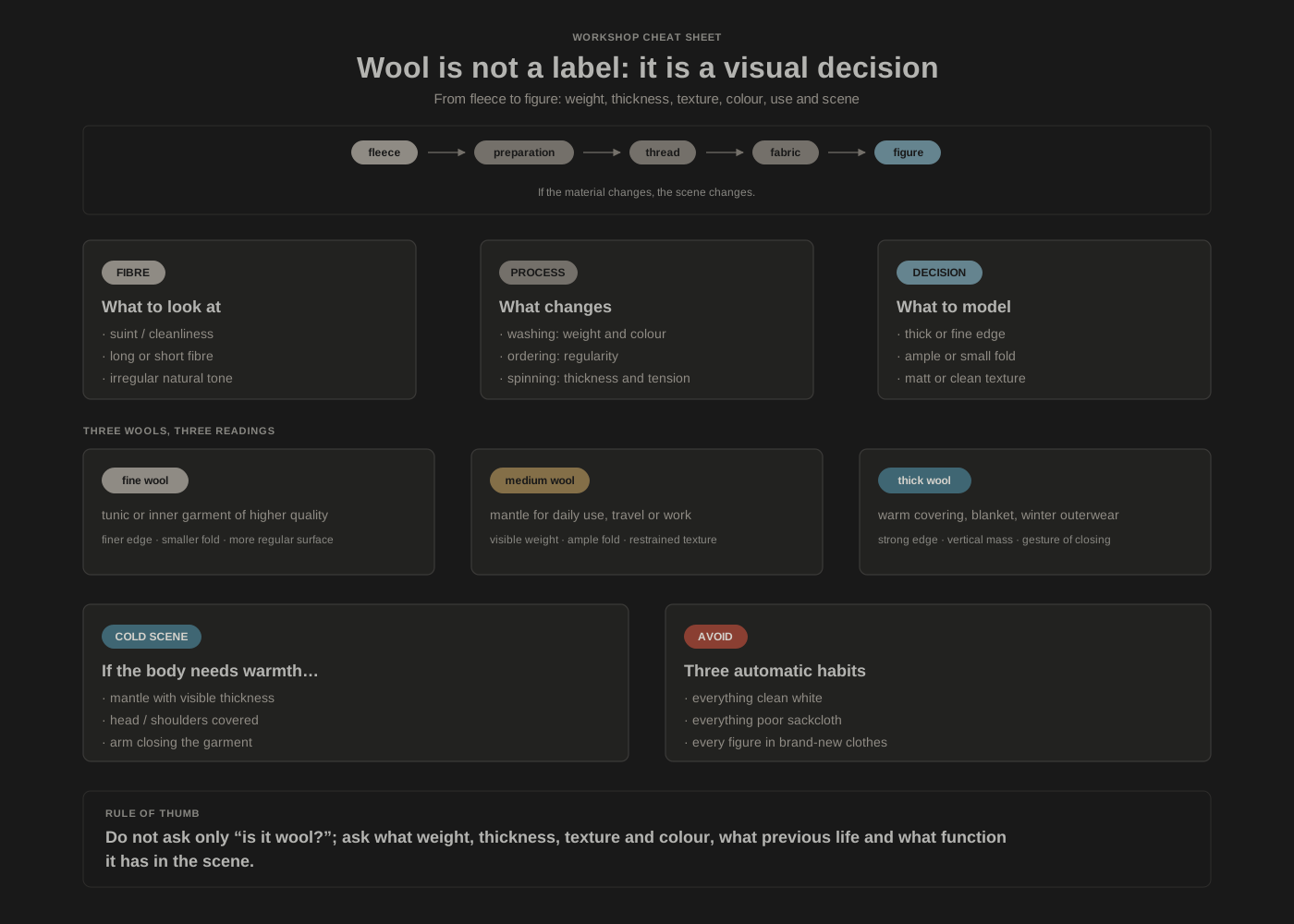
Wool should not be understood as a single label. In workshop terms, a woollen garment can be thought of through its weight, its thickness and its resistance to folding. These parameters, which textile-simulation programs such as Marvelous Designer handle precisely today —weight or density, thickness, resistance to folding, bending behaviour—, help to formulate something that the traditional sculptor also perceives with the hand: a light cloth does not fall like a heavy blanket.9
A fine wool may serve for a tunic or an inner garment of higher quality; a medium wool may form mantles for daily use; a thick wool produces warmth, volume and ampler folds. The greater the thickness, the more visible the edge of the cloth becomes. The greater the weight, the more the garment tends to fall in vertical masses and the less to form small folds. The coarser the fibre, the more texture the surface calls for.
This kind of parameter does not claim to reconstruct an exact technical sheet for a first-century garment. It serves so that the sculptural and scenographic decision is not abstract. If the shepherd is wrapped up beside a fire on a cold night, his mantle cannot behave like a linen veil: it needs weight, thickness and capacity for warmth. The material must make the function visible.
Sculptural consequences
Wool forces one to model weight. A woollen mantle does not float like a fine cloth. When it covers the shoulders, it falls by gravity and forms ample folds. When it is gathered up with the arm, it accumulates. When it covers the head, it does not cling like a light veil, but creates volume around the skull, the temples and the nape. When it is pressed against the body for cold, it does not disappear: it increases the thickness of the figure.
It also forces one to model warmth. Wool explains gestures: hunched shoulders, an arm holding the mantle, an edge crossed over the chest, a head partly covered, a body closed around the heat. In a December scene in the hills of Judaea, wool is not only costume; it is a bodily response.
It forces one to model texture. Not every woollen surface should show visible fluff, especially at a small scale; but nor should it look like a polished sheet. Texture can be suggested with less sharp edges, slightly broken surfaces, rounder folds, thicker hems and less uniform colour. At larger scales, a clearer reading of thread, weave or wear may appear.
It forces one to think about colour. Natural wool offers a range sufficient to build sober scenes without making them uniform. Dyed wool allows colour to be introduced with good grounds, especially in bands, better-quality mantles or garments for special occasions. Social difference can be resolved through the quality of the fabric as much as through the pigment.
And it forces one, above all, to think about duration. A woollen garment is not an accessory changed at the whim of the scene. It is a reserve of work, a piece mended, inherited, reused and cared for. The sculptor who understands this does not dress his figures in new, interchangeable and abstract cloths. He dresses them in material that has had a life before reaching the body.
At that point, wool stops being a generic word and becomes a sculptural decision. It is not enough to say «mantle». One has to decide whether that mantle is of light or brown wool, coarse or fine, new or used, local or of better quality, clean or worn, for work or for presentation. Each decision changes the volume, the colour, the gesture and the visual truth of the figure.
What comes next is not to open an equivalent technical chapter for each material that survived the sieve. The next step is a different one: passing from the possible material to the representable garment. Wool remains the axis; the other materials will come in when the scene, the character, the season, the economy and the function make them necessary.
References
References
Shamir, O. and Sukenik, N. (2011). "Qumran Textiles and the Garments of Qumran's Inhabitants". Dead Sea Discoveries, 18(2), 206-225. Table 1, p. 215: 1,727 Roman textiles from the Land of Israel distributed by material --549 linen, 1,101 wool, 61 goat hair, 3 camel hair and 13 mixed--. The article is used here both for the quantitative datum and for its methodological warning: the textiles that are properly Qumranic must be separated from other nearby groups and are of linen, not wool. ↩ ↩ ↩
Borowski, O. (1998). Every Living Thing: Daily Use of Animals in Ancient Israel. Walnut Creek, CA: AltaMira Press. Used here as a secondary synthesis for the handling of small livestock, shearing, prior washing when there was water, and the distinction between washed fleece sold by weight and dirty fleece sold as a complete piece. ↩
Pliny the Elder. Naturalis Historia, book 19, especially 19.18 for radicula as a plant used in washing wool. Used as Roman and Mediterranean technical context on the cleanliness, whiteness and softness of wool; not as a direct description of Judaea or Galilee. ↩
Walton Rogers, P. (1989). Textiles, Cordage and Raw Fibre from 16-22 Coppergate. The Archaeology of York, 17/5. York: Council for British Archaeology for the York Archaeological Trust. Used here in a limited and comparative way, not as a direct parallel for Judaea. Its discussion of combed wool threads and of the difficulty of identifying the specific tool in other ancient textiles helps to distinguish between two things: the necessary preparation of the fibre, which is not denied, and the reconstruction of a precise instrument, which remains undetermined. York Archaeological Trust keeps the PDF in open access: https://www.collections.yorkarchaeologicaltrust.co.uk/files/original/74494/GB2837-PUB-AY-17-05_Textiles-Cordage-and-Raw-fibre-from-16-22-Coppergate_Penelope-Walton.pdf ↩
Sheffer, A. and Granger-Taylor, H. (1994). "Textiles from Masada: A Preliminary Selection". In Masada IV: The Yigael Yadin Excavations 1963-1965. Final Reports (pp. 151-256). Jerusalem: Israel Exploration Society. In the same volume, see also Koren, Z. C., "Analysis of the Masada Textile Dyes" (pp. 257-265), and Shamir, O., "Loomweights from Masada" (pp. 265-279). Used here as direct archaeological evidence for textiles, dyes and production tools at a first-century regional site, with the caution of not turning Masada into an automatic model for Bethlehem or Nazareth. ↩ ↩
Shamir, O. (2015). "A burial textile from the first century CE in Jerusalem compared to roman textiles in the land of Israel and the Turin Shroud". SHS Web of Conferences, 15, 00010. https://doi.org/10.1051/shsconf/20151500010. Orit Shamir studies here a woollen burial textile from Akeldama, in Jerusalem, radiocarbon-dated to between 95 BC and AD 53. It is used within limits: it is a funerary and well-to-do context, not everyday clothing, but it provides direct data on material, twist, weave, density, possible import, shatnez and the reuse of textiles. ↩ ↩
Olofsson, L., Andersson Strand, E. and Nosch, M. L. B. (2015). "Experimental testing of Bronze Age textile tools". In E. Andersson Strand and M.-L. Nosch (eds.), Tools, Textiles and Contexts: Investigating Textile Production in the Aegean and Eastern Mediterranean Bronze Age (pp. 75-100). Oxford: Oxbow Books. Used as comparative experimental support to calibrate the scale of the work of hand spinning and weaving, not as direct proof for first-century Judaea. Bibliographic record on the University of Copenhagen portal: https://researchprofiles.ku.dk/en/publications/experimental-testing-of-bronze-age-textile-tools ↩
Shamir, O. (2013). "Dress: Hellenistic and Roman Period". In D. Master (ed.), Oxford Encyclopedia of the Bible and Archaeology (pp. 328-336). Oxford: Oxford University Press. Used as a synthesis by the leading researcher on the Roman textile corpus of the Land of Israel for garments, materials, tunics, mantles, gender, status, shatnez, tools and secondary uses of textiles. ↩
Marvelous Designer Support. "FABRIC PHYSICAL PROPERTIES: Physical Property Detail Setting" and related pages on weight/density, thickness, bending and resistance to folding. Used here only as a contemporary workshop analogy to name material parameters that the traditional sculptor perceives by hand; not as a historical source on ancient fabrics. Reference page: https://support.marvelousdesigner.com/hc/en-us/articles/47358427696025-FABRIC-PHYSICAL-PROPERTIES-Physical-Property-Detail-Setting ↩