
 ≈ 32 min

The evidence is not where we need it
The previous chapter examined the objects: textile fragments, footwear, shrouds, tools of production. Each answers a different question and has its own limits. But all those objects share a condition that until now has been named without being developed: they come from particular places, preserved by particular circumstances, and those places are not the same as the ones where the scenes of the Nativity cycle are set.
Most of the direct textile evidence of the first century in the land of Israel comes from sites located in the Judaean Desert or on its edges: Masada, Qumran, the caves of Nahal Hever and Wadi Murabba'at, and a few points in the Negev. They are places where aridity has allowed organic materials —wool, linen, leather, goat hair, wood— to survive for 2 millennia. The scenes of the birth, by contrast, are set in Bethlehem, Jerusalem and, in their narrative antecedent, Nazareth: towns with a Mediterranean climate that destroys those same materials within decades.
That distance does not invalidate the evidence. But it is the first fact that must be understood before using it, because it conditions everything that can be done with it. A textile preserved at Masada is not a fragment of the everyday dress of Bethlehem. It is evidence of what existed in the same region, in a nearby period —the distance is named site by site— and with the same techniques, preserved in a place that is not Bethlehem precisely because Bethlehem preserves nothing similar.
What this chapter builds is the geographical argument that makes it possible to handle that distance with rigour: why things survive where they survive, what each site contributes, what the places where the scenes are set cannot offer, how to read without extrapolation a corpus that nobody chose, and how a piece of evidence can be carried from one site to another without forcing the step.
Why things survive where they survive
The preservation of organic materials is not an accident: it responds to identifiable physical conditions. Understanding them makes it possible to know, before examining any particular site, where it is reasonable to expect textile finds and where it is not.
Organic matter —animal and plant fibres, leather, wood— decomposes through the action of micro-organisms that need water, oxygen and moderate temperature to act. When any of those three conditions is missing or drastically reduced, decomposition slows down or stops. Four circumstances have preserved textiles of the Roman period in the land of Israel:
Extreme aridity is the most important. The Judaean Desert, east of the line of ridges that runs from Jerusalem to the Dead Sea, receives less than 100 mm of annual rainfall. Average relative humidity at Masada is around 40 %, against 60–70 % in Jerusalem and Bethlehem1. In those conditions, fibres dehydrate before micro-organisms can degrade them.
The accidental sealing of burial chambers or caves. The case of Akeldama illustrates it: a loculus that remained closed for 2 millennia in a tomb in Jerusalem —a city that, as a general rule, does not preserve textiles— preserved a first-century woollen shroud because the sealing prevented the exchange of moisture and oxygen with the outside2. Sealing turns a humid environment into a dry microclimate.
Mineralisation through contact with metal: fibres that were in contact with bronze or iron objects become impregnated with metallic salts that inhibit bacterial activity. The remains preserved in this way are not textiles in the strict sense —they are pseudomorphs, mineral casts of vanished fibres—, but they make it possible to identify the type of fibre, the direction of spinning and the structure of the weave.
Carbonisation: a fire that partially destroys a cloth can char the fibres without turning them to ash. Charcoal is stable and does not decompose. Some carbonised fragments retain enough structure to be analysed, although they lose all information about colour and flexibility.
Of these four routes, the first is the one that has provided the immense majority of the textiles of the Roman period in Israel. The second explains the few exceptional cases in humid zones. The third and fourth contribute isolated data but not large assemblages.
The consequence is direct: where there is aridity, there is a possibility of textile finds; where there is Mediterranean humidity, that possibility disappears except in exceptional circumstances. And the scenes of the birth of Jesus are set, all of them, in the humid zone.
The sites: what each one contributes
The previous chapter examined the objects according to their type: fragment, garment, shroud, footwear, tool. This chapter examines them according to their provenance. It is not a matter of repeating the data already set out, but of placing each site in its geographical, climatic and human context, and of asking what kind of population left those remains and how much distance there is between that context and that of the scenes of the birth.
Masada is the site that has provided the most textile evidence for the Roman period in the land of Israel. Its situation on the eastern edge of the Judaean Desert, on the shores of the Dead Sea, explains the preservation: the extreme aridity of the surroundings preserved hundreds of textile fragments of wool and linen, footwear, ropes, baskets and other organic materials. The excavations of Yigael Yadin (1963–1965) and the later studies by Sheffer, Granger-Taylor and Shamir catalogued part of that material, although thousands of fragments remain unpublished3.
What kind of population left those remains? Masada was neither a shepherds’ village nor an ordinary town. It was a fortress built by Herod the Great as a luxury refuge and barracks, later turned into a stronghold of the Jewish rebels during the first revolt against Rome (AD 66–73). The textiles of Masada therefore reflect two layers: the remains of the Herodian equipment and the materials brought or made by the defenders during the siege. Neither layer represents the daily life of a family of craftsmen or shepherds in Bethlehem. But both belong to the same material world: the same fibres, the same spinning and weaving techniques, the same dyes. The distance is not one of technique but of context of use.
Qumran, on the north-western shore of the Dead Sea, has yielded textiles associated with the Dead Sea Scrolls and with the settlement of the community that produced or kept them. The textiles studied by Shamir and Sukenik are all of linen —the group of wool textiles kept with them at the Rockefeller Museum turned out to come from another cave, the so-called Christmas Cave, in the Kidron valley—, and the authors relate their simplicity and whiteness to the dress of a community with its own rules of purity and dress4. Qumran is not Bethlehem: it is a sectarian settlement, with rules of life different from those of the general population. But its textiles, like those of Masada, document materials and techniques that circulated in the same region and in the same period.
Nahal Hever and Wadi Murabba'at are caves of the Judaean Desert that served as a refuge during the Bar Kokhba revolt (AD 132–135) — a century after the birth of Jesus. In the Cave of Letters (Nahal Hever), Yadin found textiles, sandals, personal documents, ritual objects and household goods that the refugees took with them5. At Wadi Murabba'at, Sukenik and others identified three textiles dyed with murex purple; the authors consider that they may have belonged to the refugees or been spoils taken by the rebels, but judge it more probable that they belonged to a Roman military unit stationed in the caves after the revolt6.
The chronological distance matters: a century separates these finds from the period of the birth. But the continuity is remarkable in the fibres, the types of spinning, the weave structures and many of the dyes, which are the same as those that appear at Masada and at other first-century sites. It was not total: the loom changed in that interval —the warp-weighted vertical loom, which dominates the window of the birth, gives way to the two-beam loom at the end of the first century (see From thread to cloth: loom, width and stripes)—, so that what can be asserted is continuity of fibres, spinning and dyes, not of the whole technology. What the revolt did introduce is a bias: the objects preserved in those caves are the ones that people in flight chose to take with them or the ones they already owned when they took refuge. It is not a random sample of everyday dress, but a selection conditioned by urgency.
Akeldama, in Jerusalem, is the case that breaks the geographical rule. A sealed funerary loculus in a tomb of the Second Temple period preserved a first-century woollen shroud, radiocarbon-dated to between 95 BC and AD 53, together with remains of hair adhering to the textile7. Akeldama shows that preservation is possible even in Jerusalem when the conditions of sealing allow it. But precisely because it is exceptional, it cannot be taken as representative: a single find does not allow generalisation about dress in the city. What Akeldama offers is a point of direct contact with the zone of the scenes — a precious datum, but an isolated one.
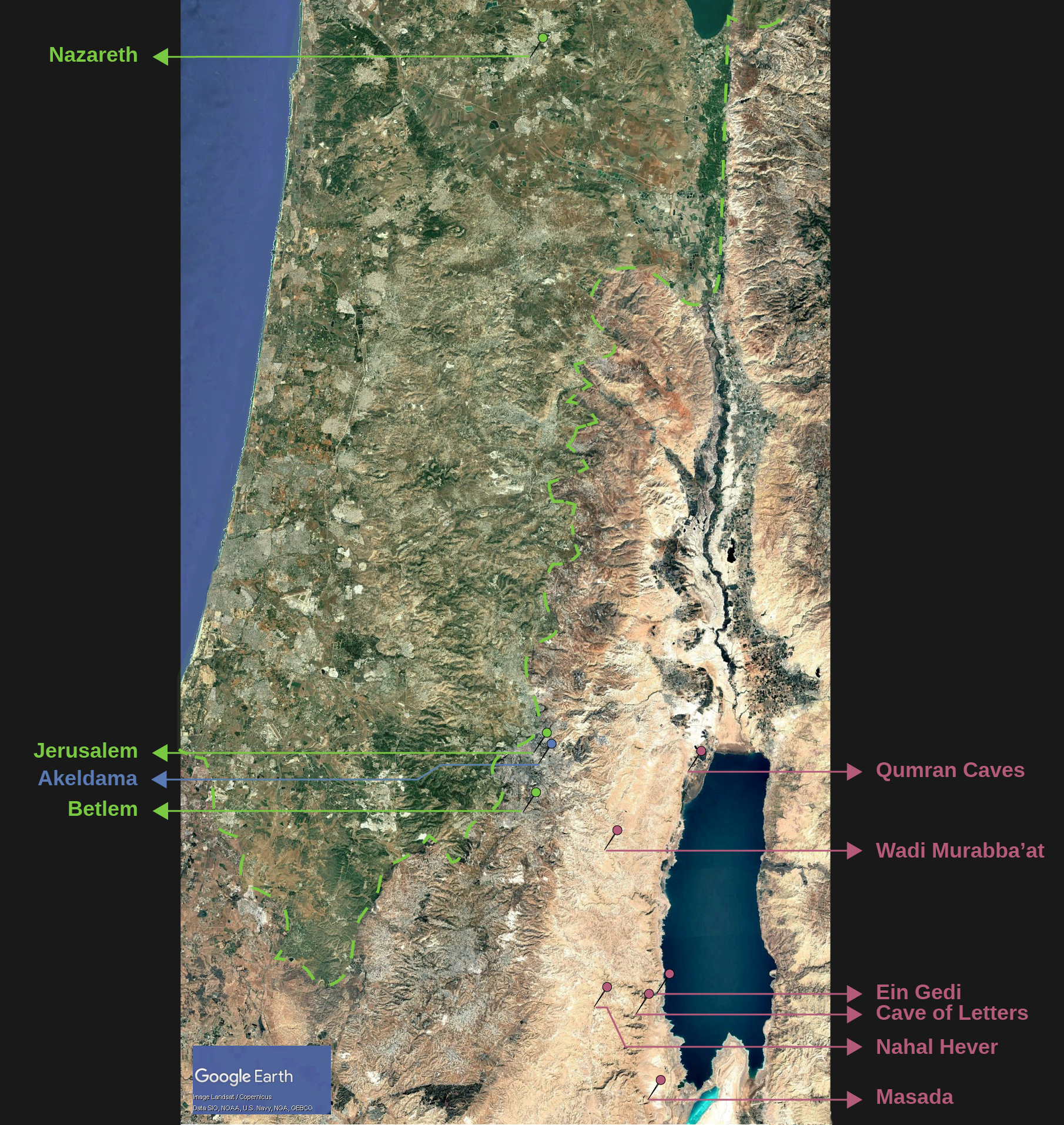
Where the scenes are set: Bethlehem, Jerusalem, Nazareth
The scenes of the Nativity cycle are set in three towns that share one condition: none of them has preserved direct first-century textile evidence in significant quantity.
Bethlehem, where the shelter, the manger, the adoration of the shepherds, the arrival of the Magi and the massacre of the Innocents are set, has yielded no known textile remains of the Roman period. The town has been continuously inhabited for more than 3,000 years; uninterrupted occupation has disturbed, destroyed and replaced the ancient archaeological levels. Its climate —average annual rainfall of about 500–600 mm, wet winters with temperatures that drop below 5 °C on December and January nights— is incompatible with the preservation of organic materials in the open air or in unsealed burials.
Jerusalem, where the Presentation in the Temple and, according to Matthew, the visit of the Magi to Herod are set, presents similar conditions: rainfall of about 550 mm a year, average relative humidity of 60–70 %, continuous occupation that has turned the subsoil into a palimpsest of superimposed buildings. The case of Akeldama, already mentioned, shows that preservation is possible in exceptional circumstances of sealing, but at the same time confirms the general rule: outside those circumstances, Jerusalem does not preserve textiles.
Nazareth, where the Annunciation is set and from where the family sets out for Bethlehem, is a first-century Galilean village whose archaeological record for the Roman period is modest: remains of dwellings cut into the rock, silos, oil presses, pottery. There is no textile evidence. The Galilean climate is somewhat more humid than that of Jerusalem, and the scale of the settlement was never large.
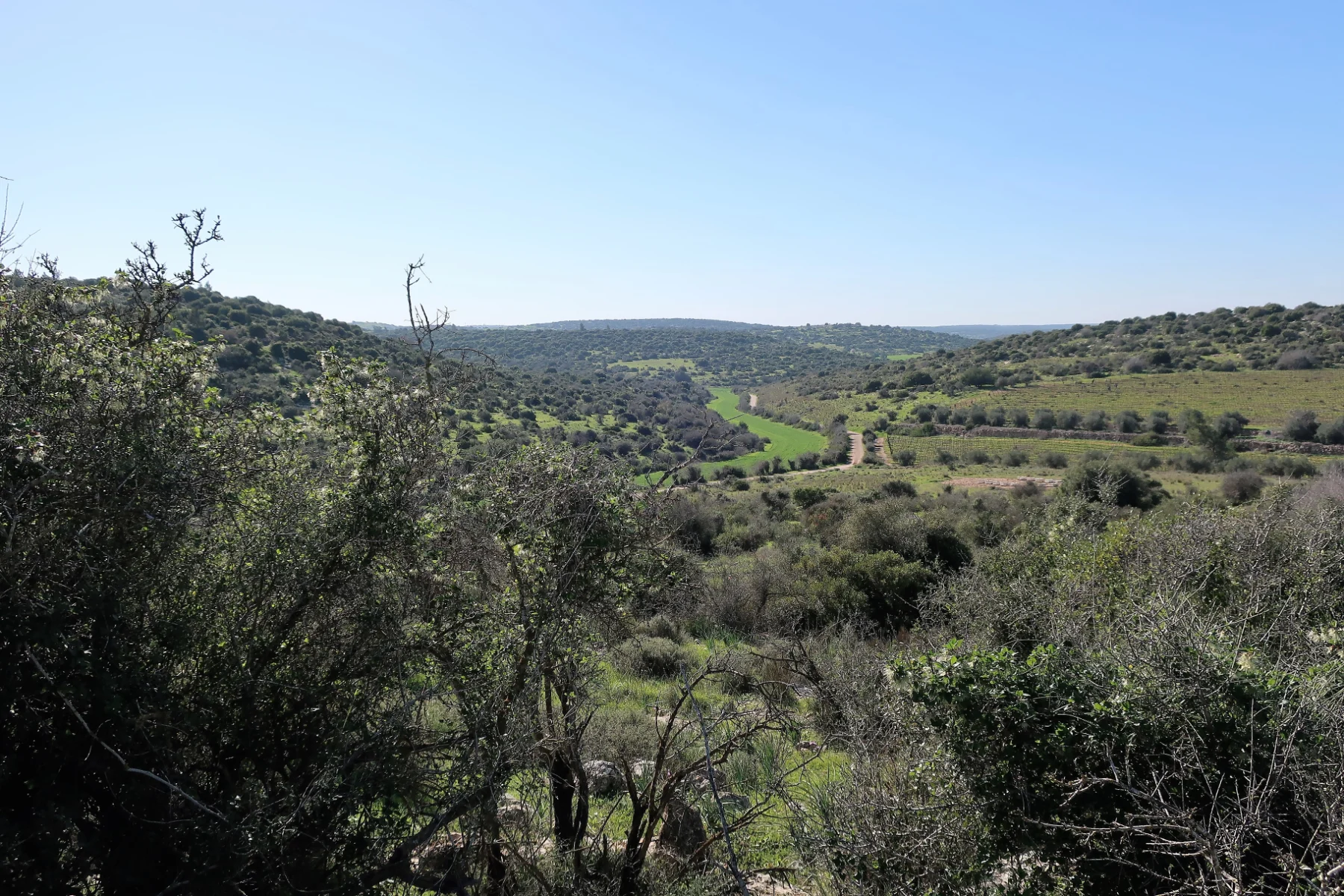
The result is a void that must not be mistaken for a failure or for a negative datum. That Bethlehem preserves no textiles says nothing about how its inhabitants dressed. It says only that the physical conditions of the place have not preserved that information directly. Knowledge must be built by another route: from the evidence preserved at other points of the same region and from nearby periods, read with the prudence that this distance demands.
The burnt shop: how to read a corpus that nobody chose
The chapter has now brought together the two halves of the problem: a corpus preserved in the desert and scenes set in the hill country. Before carrying anything from one side to the other, it is worth fixing how such a corpus is read, because the error that lies in wait here is not one of data but of reading. The reason fits into a story.
Imagine a large department store devoted to selling every kind of clothing, and a fire that razes it. When the fire is put out, only one small section is left standing: the one for golfing clothes. And not all of it: the summer season, which was the one on display. Then someone arrives, examines what is there and concludes: golfing clothes were sold here; and since it was the only shop in the place, its inhabitants were all golfers dressed in short sleeves. Each step of that deduction seems reasonable, and the result is absurd, because what the fire left is not a sample of the shop: it is the crossing of two filters —which section held out, which season was on display— that nobody chose and that say nothing about what the shop sold.
The textile corpus of the Judaean Desert is that surviving section, and its filters have already paraded through this chapter; it is enough to name them together. Section: only what was in the arid zone held out — the desert preserves; the climate of Bethlehem, Nazareth and Jerusalem destroys. Season: what survives comes from 2 catastrophes later than the window of the cycle (10 BC–AD 12) — the siege of Masada, in 73/74, and the caves of the Bar Kokhba generation, 60 years later—; not a single piece falls within the window. Clientele: a besieged garrison and a few dozen fugitive families — not the peasant villages of the scenes.
Put in the language of statistics, which here clarifies more than that of archaeology: to extrapolate from a sample to the whole —from the handful to the million—, the sample has to be representative, and representativeness is given not by size but by the mode of selection: individuals must enter it at random, not through a circumstance that distinguishes them from the rest. The desert corpus fails on every count at once. Nobody selected it at random: it was selected by a climate and 2 catastrophes —and whoever holds out in a besieged fortress or flees to a cave is not just any inhabitant of the country—. That is what statistics calls selection bias, and no sample size cures it. To that is added size: some 960 people at Masada, according to Josephus10, and a few dozen families in the caves, in a country whose ancient population has been estimated, at its peak, at around 1 million11. Even with half that population they would not reach 1 per cent. And to that, the wrong population: those sampled lived decades after the window. A tiny, biased subgroup from another generation is not a small sample: it is, technically, a null sample. Nothing counted in it —proportions, frequencies, absences— can be extrapolated to the million. The only thing that survives that verdict is what needs no extrapolation: the piece that lies on the table.
And the order of the culprits is worth stating, because it matters. Small size on its own does not kill a sample —1,000 well-drawn people out of 1 million would suffice—; what kills it beyond remedy is selection bias, which no size cures. Bias first, size next, date last: three charges, and the first is already a conviction.
The corpus delivers, then, a floor, and it is worth saying so in positive terms: what has been found proves with certainty that at least this existed —these techniques, these materials, these garments, in that world—. From there upwards, everything else —how much, who, how often— can only be reasoned by possibilities. And there is a certainty prior to any find that obliges us to reason instead of keeping silent: nobody went naked. 1 million people got dressed every day of the window, with a null sample or without one; the question is never whether they dressed, it is with what. For the workshop, the consequence is inescapable: the figure cannot sculpt the «undetermined» —it comes out dressed or it comes out naked, there is no third option—, so that abstaining is not prudence: it is also a decision about clothing, and the worst documented of all.
The symmetrical question remains: if a new find were to appear dated within the window, what would happen? Nothing to regret: the Manual’s statements are written for that. What today is «undetermined» would rise to proven and a line would be corrected; only what was built on «it did not exist» would collapse, and the Manual does not write on that ground. Negations are the only victims of finds. (Note also that some key dating in the field itself rests on negative evidence —the two-beam loom is dated by the disappearance of weights from the record (see From thread to cloth: loom, width and stripes)—, all the more reason for soft labels.)
From all this comes the rule that governs the rest of the Manual: existence is proved with a single piece; frequency is not proved with a thousand. The corpus serves for existence, technique, material and vocabulary; never for frequency, proportion or «invariably». «Dominant» is said only with its qualifier attached: dominant in the surviving corpus.
What circulated: accessible materials, fabrics and dyes
Up to here, the argument has been geographical and climatic: where things survive, where they do not, what distance lies between the two. But the geography of clothing is not exhausted by preservation. There is another equally important dimension: the circulation of materials. Which fibres, which fabrics and which dyes were available in Bethlehem, in Jerusalem and in first-century Galilee, and for whom.
The general framework of that circulation —the economy of a land subject to the Roman Empire, the trade routes that crossed it, the social stratification that determined who could have access to what— belongs to another chapter of this Manual: Jesus in his time (c_1_08), where the human world of first-century Judaea is studied as an indispensable context for the construction of the scenes of the birth. What this chapter gathers is not that complete framework, but its specific textile consequence: which materials travelled and what was accessible to each stratum12.
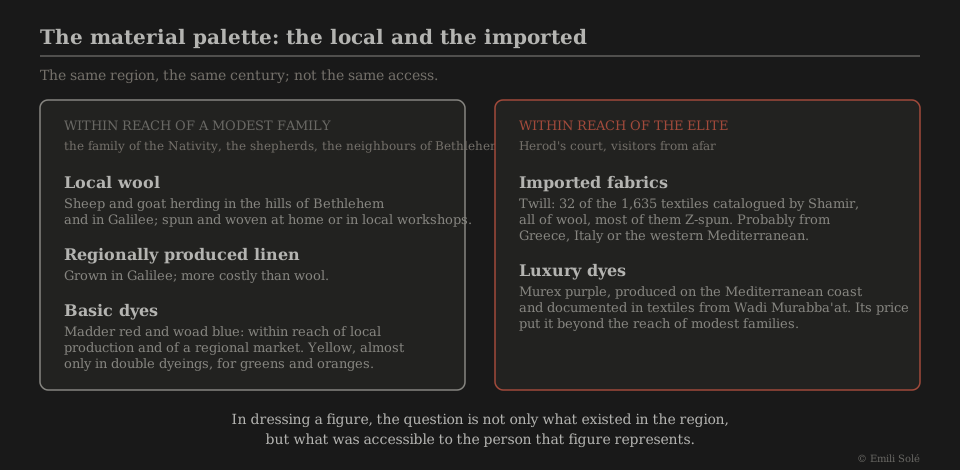
Wool was the locally produced fibre par excellence. The herding of sheep and goats was an activity widespread throughout the region, including the hills of Bethlehem and Galilee. Wool was spun and woven in homes and in local workshops. Of what has been published from Masada, 105 of the 129 catalogued textiles are wool; Shamir warns that thousands of textiles from the site remain unpublished and probably include many more of wool. It is the dominant material in the surviving corpus, not a proportion of the dress of the time11. For families of modest condition —craftsmen, day labourers, shepherds—, local wool was probably the main material of everyday clothing and, above all, of warm clothing.
Linen came partly from the local production of Galilee —where flax was grown— and partly from Egypt, the main producer of the ancient Mediterranean. Linen was more costly than wool and was associated with garments of higher quality, with ritual use and with funerary contexts. Its presence in the archaeological record is proportionally smaller than that of wool, but substantial: 531 of the 1,635 textiles catalogued by Shamir are of linen13.
Dyes document a wider range than is usually imagined: madder red, woad blue and, at the luxury extreme, murex purple, produced on the Mediterranean coast and documented in textiles from Wadi Murabba'at14. Yellow is another case: in the record of the Roman period it appears mainly as a component of double dyeings, to obtain greens or oranges, and a garment dyed yellow as its final colour is rare (see Yellow in the biblical nativity scene). But accessibility was not the same for everyone. The basic dyes — madder and woad — were within reach of local production and of a regional market. Murex purple was a luxury product whose price placed it beyond the reach of modest families. For a shepherd in the hills of Bethlehem, madder red or woad blue were possible; purple was not.
Imported textiles arrived along the trade routes that crossed the region. The twill fabrics found at sites in Israel —32 of Shamir’s 1,635 textiles, all of wool, most of them Z-spun— are imports, probably from Greece, Italy or the western Mediterranean15. Z spinning in woollen textiles works as a marker of foreign provenance in a context where local production spun almost exclusively in S. These imported textiles existed on the market, but their accessibility depended on purchasing power: a well-off family in Jerusalem could dress in imported cloth; a family of craftsmen in Bethlehem, in all probability, could not.
The consequence for the nativity-scene maker is concrete. When dressing a figure, it is worth asking not only which materials existed in the region, but which were accessible to the type of person that figure represents. Local wool, regionally produced linen and the basic dyes make up the probable palette of the family of the Nativity, of the shepherds, of the neighbours of Bethlehem. Imported fabrics, luxury dyes and exotic fibres belong to another band: the court of Herod, the visitors from afar, the elite characters. That distinction is not decorative; it is a decision of material coherence.
The prudent transfer: from lateral evidence to the scene
This chapter has built an argument that can be summed up in one sentence: the direct evidence on first-century clothing survives in places that are not the places where the scenes of the birth are set, and that distance must be managed with method, neither ignored nor exaggerated.
Transferring evidence from a site to a scene is legitimate and necessary. Without it, there would be no way of dressing any figure of the Nativity cycle with a minimum of material foundation. But the transfer has conditions.
The first is explicitness. When a datum comes from Masada and is applied to a scene in Bethlehem, the reader must know it. Not because the datum is false — the wool of Masada is first-century wool from the land of Israel, and that is valid information —, but because the distance between the site and the scene introduces a margin of uncertainty that the reader has a right to know.
The second is the distinction of context. The textiles of Masada come from a fortress under siege. Those of Nahal Hever come from refugees in flight. Those of Qumran come from a sectarian community. Those of Akeldama come from a burial. None of these contexts is equivalent to that of a family of craftsmen arriving in Bethlehem under a census order, nor to that of some shepherds keeping their flocks in the nearby fields. The technique may be the same; the use may be different.
The third is proportionality. Not all data have the same resistance to transfer. A datum about fibre — that the wool of the region was predominantly spun with an S twist — is transferable with high confidence: the spinning technique does not vary from Masada to Bethlehem. A datum about the form of a garment — the length of a tunic found in the Cave of Letters — is transferable with more caution: form may depend on use, status or circumstance. A datum about colour or decoration — a dyed band on an elite fragment — is transferable with the greatest prudence: colour and ornament are the elements most sensitive to the social condition of the wearer.
The rule can be formulated thus: the closer the datum comes to material and technique, the more resistant it is to transfer; the closer it comes to use, status and personal decision, the more fragile it becomes.
In the Manual’s labelling, that gradation translates naturally: what is materially robust enters the text as proven; what depends on context and is sustained by a convergence of factors, as inferred from context; what the datum cannot bear, as unknown. The rule of climate and the rule of reasoning by context, fixed in the chapter on method and operative since then, are the ones that allow that transfer without turning geographical distance into either an abyss or a shortcut.
The next chapter will complete the base of this study by examining the written sources and ancient iconography: what the texts say about first-century clothing, what the images of the period show, and what limits each of those sources has. Together with the material evidence and the geography examined in the last three chapters, those sources will form the ground on which the later chapters will study the specific garments, the materials, the colours, textile production and the final passage from the archaeological datum to the sculptural figure.
References
General climatic data for the Judaean Desert and the Jerusalem–Bethlehem area. Average annual rainfall: Masada ~50 mm, Dead Sea ~100 mm, Jerusalem ~550 mm, Bethlehem ~500–600 mm. Average relative humidity: Judaean Desert 30–45 %, Jerusalem 60–70 %. Sources: Israel Meteorological Service; Goldreich, Y. (2003). The Climate of Israel: Observation, Research and Application. Springer. ↩
Shamir, O. (2015). A Burial Textile from the First Century CE in Jerusalem Compared to Roman Textiles in the Land of Israel and the Turin Shroud. SHS Web of Conferences, 15. ResearchGate; Matheson, C. D. et al. (2009). Molecular Exploration of the First-Century Tomb of the Shroud in Akeldama, Jerusalem. PLoS ONE, 4(12), e8319. ↩ ↩
Sheffer, A. and Granger-Taylor, H. (1994). Textiles from Masada: A Preliminary Selection. In Masada IV: The Yigael Yadin Excavations 1963–1965, Final Reports. Israel Exploration Society. NLI catalogue ↩
Shamir, O. and Sukenik, N. (2011). Qumran Textiles and the Garments of Qumran's Inhabitants. Dead Sea Discoveries, 18, 206–225. Academia.edu ↩
Yadin, Y. (1963). The Finds from the Bar Kokhba Period in the Cave of Letters. Israel Exploration Society. Cave of Letters — Wikipedia ↩
Sukenik, N., Iluz, D., Shamir, O., Varvak, A. and Amar, Z. (2013). Purple-Dyed Textiles from Wadi Murabba'at. Archaeological Textiles Review, 55, 46–54. ↩ ↩
Shamir, O. (2015); Matheson, C. D. et al. (2009). See note 2. ↩
Map by Emili Solé (labels and drawing) on Google Earth imagery. Image Landsat / Copernicus; Data SIO, NOAA, U.S. Navy, NGA, GEBCO. ↩
Photograph: Davidbena (2021), «Judea in early Spring», Wikimedia Commons, licence CC BY-SA 4.0. File page on Wikimedia Commons. ↩
Flavius Josephus, The Jewish War, VII, 399-400, in the numbering of Niese’s edition. Josephus gives 960 dead at Masada, women and children counted with them (VII, 400); two women and five children survived, hidden in the underground water conduits (VII, 399). Greek text consulted in the Perseus Digital Library: https://www.perseus.tufts.edu/hopper/text?doc=Perseus:abo:tlg,0526,004:7:400 ↩
Broshi, M. (1979). «The Population of Western Palestine in the Roman-Byzantine Period». Bulletin of the American Schools of Oriental Research, 236, pp. 1-10. Broshi estimates the population in two independent ways —urban area multiplied by a density coefficient (p. 5), and the country’s grain-producing capacity (pp. 6-7)— and concludes that the population of Palestine in antiquity did not exceed one million persons, a figure reached only at its peak, the late Byzantine period, around AD 600 (pp. 5 and 7). He rejects the higher estimates, such as the some 2,500,000 inhabitants adopted by Baron and Avi-Yonah (p. 6): Avi-Yonah reaches that figure from the 60,000 Galilean warriors mentioned by Josephus, or by assuming four times as many settlements in the Roman period as in 1900, and Broshi considers both courses fallacious. With either figure, the desert corpus remains far below 1 per cent. ↩
The complete framework of the economy, the trade routes and the social stratification of first-century Judaea is developed in Jesus in his time (c_1_08), within the block In search of the biblical nativity scene. ↩
Shamir, O. (2015), Table 1: distribution by fibre of 1,635 catalogued textiles of the Roman period in Israel. Masada: 129 textiles, 105 of wool, with this footnote to the table: “Thousands of textiles, presumably including wool ones to a large extent, from Masada are still not accommodated in the current literature”. The same warning in Shamir and Sukenik (2011), table 1 (see note 4): “Thousands of textiles from Masada have not yet been published. Their publication will probably add many more wool textiles to the total”. The wool and linen figures follow the author's own erratum, published in the same volume: Shamir, O. (2015). Erratum to: A burial textile from the first century CE in Jerusalem compared to roman textiles in the land of Israel and the Turin Shroud. SHS Web of Conferences, 15, 00011, which corrects Table 1: 531 of linen and 1,030 of wool out of 1,635. https://doi.org/10.1051/shsconf/20151500011 ↩
Koren, Z. C. (2005). Chromatographic Analyses of Selected Historic Dyeings from Ancient Israel. Dyes in History and Archaeology, 20, 194–201. Edelstein Center; Sukenik, N. et al. (2013), see note 6. ↩
Shamir, O. (2015), data on twill weave: 32 of 1,635 textiles, all of wool, most of them Z-spun. See also The material evidence — textiles, leather, footwear and tools, paragraph “The structure of the weave”. ↩
Diagram by Emili Solé with the data of this chapter (notes 11, 12 and 13). ↩
