
 ≈ 24 min

What the sources can say and what they cannot
The previous chapters worked with material. Fragments of cloth that can be measured, analysed, weighed; sites that can be placed on a map and in a climatic zone. The question was: what survives? Now the question changes.
What can a source contribute that does not preserve the garment?
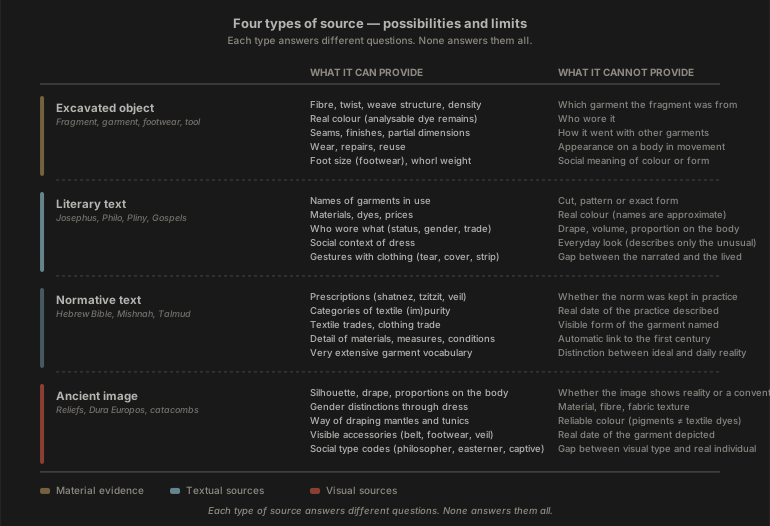
An ancient text names garments, prescribes colours, legislates uses, narrates gestures — but shows nothing. An ancient image shows silhouettes, folds, proportions, gender distinctions — but it does so with the codes of whoever painted it, not with the fidelity of a mirror. Neither of these two routes delivers the real garment. What they deliver is different from what the textile fragment can offer, and that difference matters.
Material evidence speaks without arguing: an excavated fabric exists, with its fibre, its twist, its structure, its trace of dye. The written source argues without showing: it names, legislates, distinguishes, but it does so from the author’s intention — be it a rabbinic legislator, a Roman historian or a Christian polemicist. The ancient image shows without naming: it offers a visual form, but that form always passes through an artistic convention, through a code of representation that does not necessarily coincide with the reality it sets out to represent.
The previous chapter ended with a rule of transfer: the closer to the material, the safer the datum; the closer to use, the more fragile. That rule remains in force here, but with a complication: texts and images always work in the terrain of use, of name and of representation — never in that of the material itself. This does not invalidate them; it places them. But a nuance should be added: the three routes — object, text, image — do not provide the same kind of datum or the same resolution. The object is direct but incomplete; the text is precise but abstract; the image is concrete but conventional. The work consists in crossing them without confusing their levels of evidence.
The task, then, is to examine these two routes with the same rigour with which the previous chapters examined the objects: what they offer, from when, at what distance from the first century, and what risk of interpretation they present.
The textual sources: names, norms and mentions
There are ancient texts that speak of clothing. Some name garments. Others prescribe what must or must not be worn. Others mention a garment in passing, within a narrative that is about something else. The information they offer is valuable, but it should be placed with care, because an ancient word is not automatically equivalent to a reconstructable garment.
A term such as ketonet appears in the Hebrew Bible to designate a tunic. The same concept reappears in the first century as haluq in Mishnaic Hebrew or chiton in Greek. The word has travelled, but that does not mean that the garment has remained identical: its cut, its length, its material and its social use may have changed along the way. Two different terms may refer to similar garments; a single term may cover different garments according to the period, the region or the context. Terminology helps us to think, but does not on its own resolve the concrete form of what it names. This is worth keeping as a general principle: the names of garments are not stable. They change meaning according to period, region and function. The same word may designate different garments in texts separated by centuries — the meil of the Hebrew Bible is not necessarily the same meil as in the literature of the Second Temple. And two different garments may share a name in sources that do not know each other. Expecting rigid equivalences between word and object is the first error to avoid.
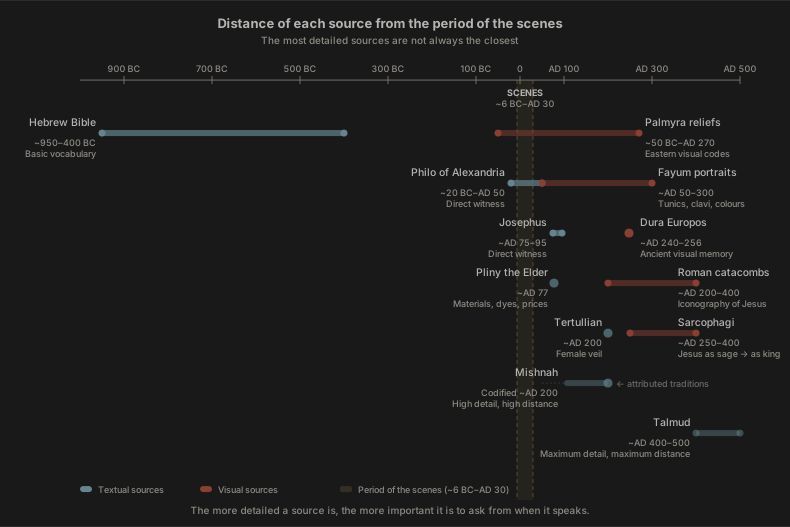
With that caution, the textual sources can be organised into four groups, ordered by their proximity to the first century.
The Hebrew Bible establishes the basic vocabulary: ketonet (tunic), simlah (mantle), meil (long mantle of dignity), ezor (belt or sash). Those terms were still in use in the first century, but with shifted meanings. The Bible also prescribes the tzitzit (fringes at the corners of the mantle, Numbers 15:38) and forbids shatnez (the mixing of wool and linen in the same garment, Leviticus 19:19 and Deuteronomy 22:11) — two identity markers that first-century archaeology confirms as in force2.
The literature of the Second Temple period offers the literary testimonies closest to the period that concerns us. Flavius Josephus, a Jewish historian writing in the last third of the first century, describes in detail the priestly vestments of the Temple and mentions everyday garments in several passages of his works3. Philo of Alexandria, a contemporary of Jesus, writes from the Egyptian diaspora and provides data on the dress of the Essenes and on the textile practices of the eastern Mediterranean4. In both cases, these are authors who saw what they describe or who describe what their contemporaries saw. Their chronological proximity does not eliminate their partiality — Josephus writes for a Roman public, Philo for a Hellenised public —, but it makes them the most direct literary sources available to us.
The ancient Graeco-Roman and Christian authors provide scattered but useful data. Pliny the Elder, in his Natural History (first century), documents materials, dyes and prices — including the cost of murex purple, a datum that makes it possible to gauge the real accessibility of certain colours5. Tertullian, at the beginning of the third century, writes that Jewish women could be recognised by the veil, a detail that places a recognisable visual practice outside the Jewish sources6. But Tertullian is already a Latin Christian author, some two centuries later than the period of the scenes; his testimony is valuable as confirmation of a custom, not as a direct document of the first century. The same holds for the scattered mentions in authors such as Quintilian, Martial or Juvenal: they illuminate the textile world of the Roman Mediterranean, but from a cultural and geographical distance that should not be forgotten.
The Mishnah and the Talmud make up the most tempting and most delicate group. Their wealth of detail about garments, dyes, textile trades, rules of purity, the clothing trade and customs of dress has no equivalent in any other source of the period7. The Mishnah, codified around AD 200, gathers traditions that its redactors attributed to earlier centuries. The Talmud, compiled between the fourth and fifth centuries, expands and comments on them. Both texts are extraordinarily informative. But the wealth of detail does not eliminate the problem of temporal distance.
The warning that Dr Katie Turner formulates clearly must be repeated here: the rabbinic texts are later than the first century and cannot be projected automatically onto that period without critical caution8. The Mishnah sometimes describes what ought to be, not necessarily what was. When a Mishnaic tractate (relating to the Mishnah) legislates on the length of the tzitzit or on the conditions of impurity of a garment, it is prescribing — and a prescription reflects both the norm and the possibility that the norm was not kept. When Lucille Roussin —author of the chapter on the dress of Roman Palestine in The World of Roman Costume (1994)— or Dafna Shlezinger-Katsman —author of the chapter «Clothing» in the Oxford Handbook of Jewish Daily Life in Roman Palestine (2010)— use the Mishnah to complement the archaeological evidence, their work is legitimate and necessary, but the reader of this study must know that the data coming from the Mishnah have neither the proximity of those from Josephus nor the solidity of those from an excavated textile. The rule of use adopted in this study is twofold: when these sources cite archaeological evidence, they are read on the first level; when they cite exclusively Mishnaic or Talmudic sources, they are read on the second, with the caution stated9.
The limits of the written sources
An ancient word designates a garment, but does not deliver its pattern. The term chiton says that a tunic existed; it does not say exactly what the tunic worn by a woman of Bethlehem in the winter of the birth was like. Colour names are equally approximate: what a text calls «white» may be fulled wool, undyed wool or raw linen — three materials with very different appearances. What a text calls «purple» may range from genuine murex to a cheap imitation of madder and woad mixed together.
The written sources can say: this garment existed, it was called this, it was made of this material, it cost so much, such people wore it and such others did not. They cannot say: this was its cut, this is how it fell on the body, this is how it was combined with the other garments. Between the name and the form there is a leap. The form demands other supports — the excavated objects, when they exist; the images, when they are early enough; and, in the last resort, reasoned inference when no source offers the missing piece.
One idea is worth keeping: the written sources legislate, narrate or argue. They rarely describe. When an ancient author mentions a garment, he takes it as known — he does not explain what it is like, because his reader already knows. What the first-century reader saw every day is precisely what the text did not need to describe and what today we need to reconstruct.
But the silences of the sources are also data. The Hebrew Bible almost never describes everyday clothing — which indicates that it did not consider it a relevant narrative marker. Josephus, by contrast, describes in detail the priestly dress of the Temple — which indicates the symbolic and political function he attributed to it. When the sculptor looks in the texts for a description of the clothes a shepherd or a craftsman wore and does not find it, that absence is not a failure of the source: it is a sign of what the source considered worth mentioning. The absence of description also informs.
Ancient visual sources: silhouettes, codes and visual memory
From the name to the form there is a leap, and ancient images seem to promise a bridge. They show dressed figures, with folds, proportions, colours, gender distinctions. But that promise has conditions. An ancient image is not a photograph of the past: it is a representation made with the codes of its own time.
It is worth distinguishing three groups of visual sources in chronological order, each with its own possibilities and its own limits.
Coins, reliefs and provincial representations offer images of dressed figures from before the first century. The reliefs of Palmyra show eastern costume in detail — mantles, trousers, headdresses, jewellery. The mummy portraits of Roman Egypt show tunics, clavi, hairstyles, skin and clothing colours with remarkable fidelity. Herodian and Roman coins sometimes depict a dressed figure, though with the simplification that the format imposes. Roman triumphal arches show eastern captives in their own clothing11. None of these images directly portrays the Jews of first-century Judaea, but they help to understand the visual codes of the world in which they lived: how Rome represented the easterner, the provincial, the priest, the philosopher, the captive. Those codes matter, because part of the inherited image of the nativity scene comes from them — although indirectly and often without awareness of its origin. A principle of reading should be formulated before going on: ancient images do not represent individuals, but social types. Gender, status and function determine the silhouette more than period or region. In Roman art, an «easterner» is a visual code — a type recognisable by his headdress, his trousers, his beard —, not an ethnographic portrait. Reading these images demands knowing what type is being represented before asking what garment is being shown.
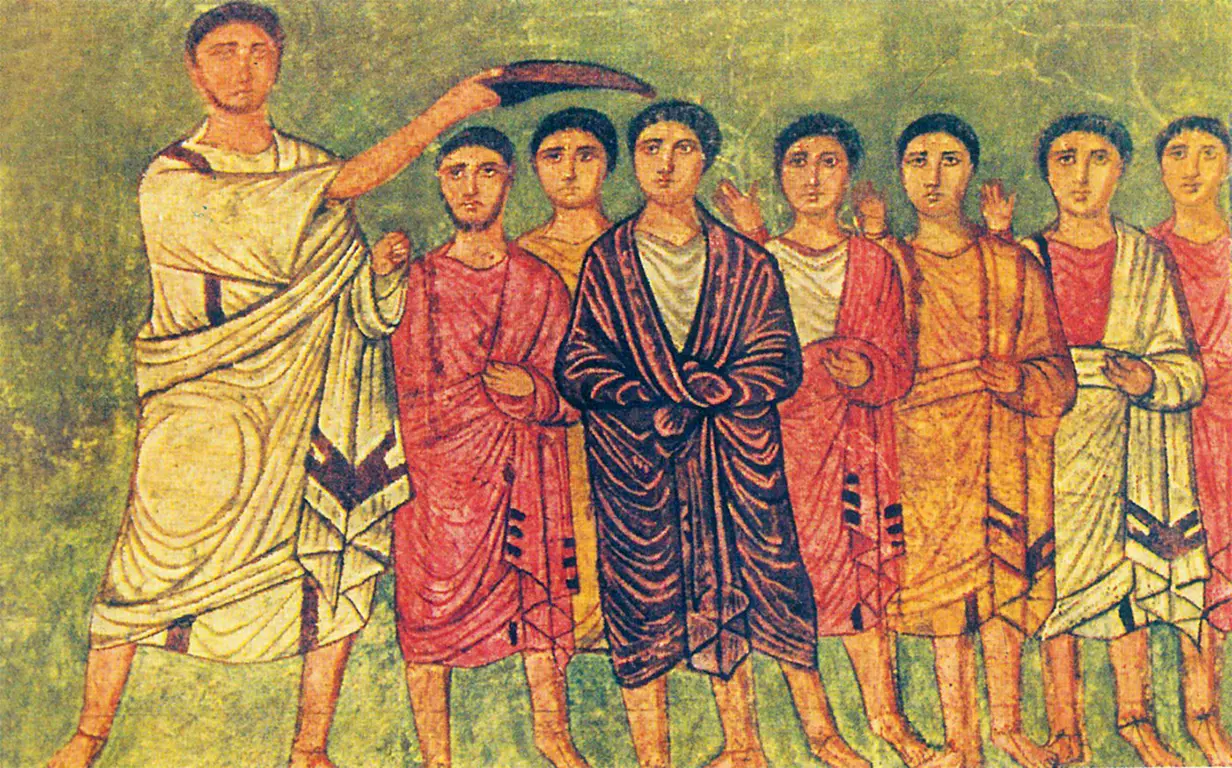
Dura Europos deserves particular attention. This Roman garrison town on the Euphrates, destroyed around AD 256 and sealed beneath the military defences, preserved a synagogue and a house-church with wall paintings that constitute the earliest visual testimonies of biblical and Jewish figures dressed in differentiated clothing12.
In the synagogue paintings, Moses appears with a mantle showing visible tzitzit. The men wear white or undyed mantles with woven bands whose ends are notched; the women, coloured mantles with gamma-shaped decoration. In the house-church, Jesus appears healing the paralytic in a short tunic and mantle — dressed as an ordinary man, not as a figure of authority13.
These data are valuable. But their value does not consist in telling us «this is how they dressed in the first century». Dura Europos is a third-century community, more than 600 kilometres from Jerusalem, which paints characters from Exodus and from the Gospels in the clothing of its own time and place. What Dura Europos documents is not directly the first century: it is an ancient visual memory. It shows how a third-century Jewish community visually imagined the sacred characters — and that imagination, because it is ancient and founded on a living practice, carries more weight than the later Western artistic tradition, but must not be confused with a direct document.
Early Christian art — Roman catacombs and sarcophagi from the second to the fourth centuries — offers the first representations of Jesus. Taylor has traced their evolution in detail: in the earliest representations (second–third centuries), Jesus appears with short hair, beardless, dressed in a short tunic and the philosopher’s pallium — an ordinary man, not a king or a priest. In the representations from the fourth century onwards, the image changes: long hair, beard, long tunic, regal bearing. It is the birth of the inherited image that the Western tradition has handed down to this day15.
What Early Christian art allows us to understand is not how Jesus dressed, but how the first Christian communities imagined him visually. The catacombs do not document the historical Jesus; they document the visual code with which the Christians of Rome represented their teacher — first as a philosopher, then as a king. That evolution is a datum about the artistic tradition, not about first-century clothing.
The limits of the visual sources
What images show always passes through a filter. The artist of Dura Europos paints Moses in the clothing of the third century, not in that of the thirteenth century BC. The catacomb painter dresses Jesus as a Roman philosopher because that was the visual type available for representing a teacher. The Egyptian funerary portrait shows its subject in the clothing he or she wants to be seen in, which is not necessarily what was worn every day.
The ancient image interprets. It does not transcribe. Each representation dresses its character according to the codes of whoever paints it, not according to those of whoever lived. This does not invalidate images as a source — in fact, they are indispensable for understanding how ancient dress looked on a body, with its drape, its proportions and its gestures. But it places them on the level of comparative analogy: what they offer is a visual approximation mediated by a convention, not a record. The most frequent methodological error — and the most widespread in nativity-scene art — consists in taking an ancient image as if it were a photograph. None is. All are interpretations situated in their time, with their conventions, their agendas and their technical limitations. Recognising this does not weaken their usefulness; on the contrary, it allows them to be used with greater precision.
There is also a problem of scale. The visual sources we have for the first-century Jewish world are very scarce. There are no Jewish paintings earlier than Dura Europos (third century). There are no portraits of first-century Jews comparable to the Fayum mummy portraits. There are no Jewish mosaics with dressed figures earlier than the fourth century. The visual void is almost as marked as the textile void we examined in the previous chapter — and for different reasons: here it is not climate that destroys, but the biblical prohibition of the image (Exodus 20:4), which for centuries limited the production of figurative images in the Jewish world, although that limitation was never absolute or uniform16.
What the sculptor can draw out
The three routes examined in this study — objects, texts, images — complement one another without replacing one another.
Excavated objects provide materiality: fibre, structure, real colour, seams, dimensions. They are the firmest base, but the most fragmentary: the textile fragment does not say who wore it or how.
Texts provide names, materials, norms and social categories. They make it possible to know that there was a garment called haluq, that it was made of wool or linen, that men wore it short and women long, that white had one meaning and colour another. But they do not deliver the visible form.
Images provide silhouettes, proportions, gestures and gender distinctions. They are the only route that shows how a mantle fell on a body, what volume a tunic girded by a belt had, how a man was distinguished from a woman by the way of dressing. But what they show is a convention, not a document.
The sculptor crosses the three routes. He takes the fibre from the excavated textile, the name and the norm from the text, the silhouette from the image, and builds a figure that did not exist in any of those sources separately. Between what survives and what is represented there always remains an uncovered zone. That zone is not filled with visual tradition as if it were evidence: it is marked with the label that corresponds to it —proven, inferred from context or unknown— and, when what remains is already a choice made by the sculptor in undetermined territory, it is also acknowledged as an informed artistic decision. The reader knows in each case what ground they are treading on.
It is not a matter of choosing between text or image, but of not asking more of each source than it can give. Written sources help us to name. Ancient images help us to look. Material remains help us to touch, even if only fragmentarily, the reality of the fabrics. But none of these routes delivers a finished figure on its own. Between what survives and what is represented there always remains a zone of decision. The sculptor does not reconstruct a lost garment: he builds a grounded visual conjecture. His responsibility is not to get right a pattern that does not exist, but to show that his decision is born of an honest crossing of evidence. Custom must not enter there as if it were evidence; the sculptor’s awareness must.
References
Original diagram. © Emili Solé. ↩
Numbers 15:38 (tzitzit); Leviticus 19:19 and Deuteronomy 22:11 (shatnez). The total absence of textiles mixing wool and linen at Jewish sites is documented in Shamir, O. (2013). Dress: Hellenistic and Roman Period. In Master, D. (ed.), Oxford Encyclopedia of the Bible and Archaeology, vol. 1, pp. 328–336. Oxford University Press. ↩
Josephus, F. Jewish Antiquities, III.7.1–7 (priestly vestments); The Jewish War, II.8.5 (Essene dress). Reference editions: Loeb Classical Library (Greek–English). ↩
Philo of Alexandria. Quod omnis probus liber sit, XII.75–91 (life and dress of the Essenes). Loeb Classical Library edition. ↩
Pliny the Elder. Natural History, IX.124–141 (murex purple, prices and processing); XXXIII.29 (weakening of the status value of the clavi). Loeb Classical Library edition. ↩
Tertullian, De corona 4 (c. 211, according to the Judaism and Rome database): “Among the Jews, so usual is it for their women to have the head veiled, that they may thereby be recognised” (trans. S. Thelwall, Ante-Nicene Fathers, vol. 3, 1885). Shamir (2013), p. 333, quotes the same passage but attributes it to De virginibus velandis 4 and dates it to the mid-second century; the work and the date are corrected here. ↩
Shlezinger-Katsman, D. (2010). Clothing. In Hezser, C. (ed.), The Oxford Handbook of Jewish Daily Life in Roman Palestine, pp. 362–381. Oxford University Press. OUP Academic ↩ ↩ ↩
Turner, D. K. "What Would Jesus Wear?" Biblical Time Machine (podcast). For the full discussion of this methodological principle, see also Shlezinger-Katsman (2010), note 7. ↩
Roussin, L. A. (1994). Costume in Roman Palestine: Archaeological Remains and the Evidence from the Mishnah. In Sebesta, J. L. and Bonfante, L. (eds.), The World of Roman Costume. University of Wisconsin Press; Shlezinger-Katsman, D. (2010), see note 7. ↩
Original diagram. © Emili Solé. ↩
Colledge, M. A. R. (1976). The Art of Palmyra. Thames and Hudson (Palmyrene reliefs); Walker, S. and Bierbrier, M. (1997). Ancient Faces: Mummy Portraits from Roman Egypt. British Museum Press (Fayum mummy portraits). ↩
Kraeling, C. H. (1956). The Synagogue (Excavations at Dura-Europos, Final Report VIII, Part 1). Yale University Press; Kraeling, C. H. (1967). The Christian Building (Excavations at Dura-Europos, Final Report VIII, Part 2). Yale University Press. Digital collection: Yale University Art Gallery, Dura-Europos Collection. ↩
Shamir, O. (2013), pp. 331–332. Taylor, J. E. (2018). What Did Jesus Look Like? Bloomsbury T&T Clark, ch. 2 (iconography of Dura Europos). Notched bands: Yadin, Y. (1963). The Finds from the Bar Kokhba Period in the Cave of Letters. Jerusalem: Israel Exploration Society, p. 221 and fig. 74 (p. 220): bands that do not run from selvedge to selvedge but begin and end within the web, the ends being notched; p. 227: in the Dura paintings the notched band appears only on men’s mantles and the gammas only on women’s mantles (referring to Kraeling 1956, pls. LXVI and LXVII). ↩
Paintings of the Dura Europos synagogue. The originals are in the National Museum of Damascus; the Yale University Art Gallery holds the copies painted by Herbert J. Gute in 1933–1936 (Yale University Art Gallery, Synagogue). Data on the mantles: Shamir, O. (2013), pp. 331–332; Yadin, Y. (1963), pp. 221 and 227 (n. 46). Photograph: Wikimedia Commons, «Dura Synagogue WC3 David anointed by Samuel.jpg», reworked by Marsyas (2008) from the Yale Gilman collection; reproduction of a public-domain work. ↩
Taylor, J. E. (2018), chs. 1–4 (iconographic evolution of Jesus from the catacombs to Byzantine art). Booklet: Taylor, J. E. (2021). What Did Jesus Wear? Christian Evidence Society. ↩
On the prohibition of the image and its limits in ancient Judaism: Fine, S. (2005). Art and Judaism in the Greco-Roman World: Toward a New Jewish Archaeology. Cambridge University Press. ↩
