≈ 39 min

Before the fibre: animals and plants
Where did their clothing come from?
We are speaking of the people who lived and worked in the lands where the scenes of the Nativity cycle are set: shepherds and peasants, craftsmen and merchants, women in their houses and priests in their service. The question seems simple, but it is not. Before a human hand sheared the sheep, pulled the flax from the field or made use of an animal’s hide, there was something prior: the living organism from which the fibre or the hide would be obtained.
This chapter deals with that first origin. Not yet with the separated fibre, nor with the fabric, nor with the finished garment, but with the animal before shearing, the plant before cutting, the hide before tanning. Only when that ground is clear can the first human operation be looked at in perspective.
The procedure is not to list the safe materials and leave the rest out in silence. It is better to put all the cards face up: those that any attentive observer would recognise as reasonable candidates, those that the visual tradition of the nativity scene has been placing on stage for centuries, and those that turn up from time to time in books, films or catalogues without belonging to the place and the moment. Only when all of them can be seen does the sieve start working and separate them with judgement.
On the table
The candidates fall into five families.
Animal fibres. Sheep’s wool, goat hair, dromedary hair, silk.
Vegetable fibres. Flax, hemp, jute, cotton.
Hides of domestic animals. Leather of sheep, goat, cow and dromedary, as well as the use of the whole skin with or without hair.
Hides of local wild fauna. Wolf, jackal, striped hyena, fox, gazelle, deer, hare, hyrax. They are not the dominant source of clothing, but they exist in the region and could have been used for occasional purposes: mantles of austere or prophetic characters, skins for seats and beds, containers. Their entry in the inventory acknowledges that presence without anticipating how much weight it carries.
Borderline cases and curiosities. Asbestos, palm fibres, esparto, rush, papyrus. These are materials that have been put forward at some point as possible, whether through an ancient mention —Pliny on asbestos—, through environmental presence in the region —papyrus in the wetlands of the Levant—, or through attested use as cordage or basketry —esparto, rush, palm fibres—. Their place on the table is not because we take them as probable, but because it is better to declare them before discarding them. In this same band sits the European rabbit (Oryctolagus cuniculus), not because it is a real candidate —it is native to the Iberian Peninsula and was not present in the Levant in the first century— but to clear up a frequent misunderstanding: some Bible translations render as «rabbit» what in fact designates the hare or the hyrax in the lists of unclean animals in Leviticus and Deuteronomy. It is worth naming here so that the well-read reader does not bring it mentally to the table without knowing that it does not apply here.
What does not go into this sieve
There is a group of materials that does not appear in the inventory, and it is worth explaining why. Roman military dress —the greased leather of the straps, the iron of the loricae and the helmets, the bronze of the buckles, the specific wool of military cloaks— belongs to another productive system. It was not made by local Jewish workshops nor did it answer to the raw material of Judaea and Galilee: it arrived with the legions, already assembled, from the supply circuits of the imperial army. That is why it remains outside the sieve of local raw materials. When a scene calls for it —the census, the massacre of the innocents, the Passion—, its natural treatment is scene by scene in the block of scenes, the block of scenes, not here.
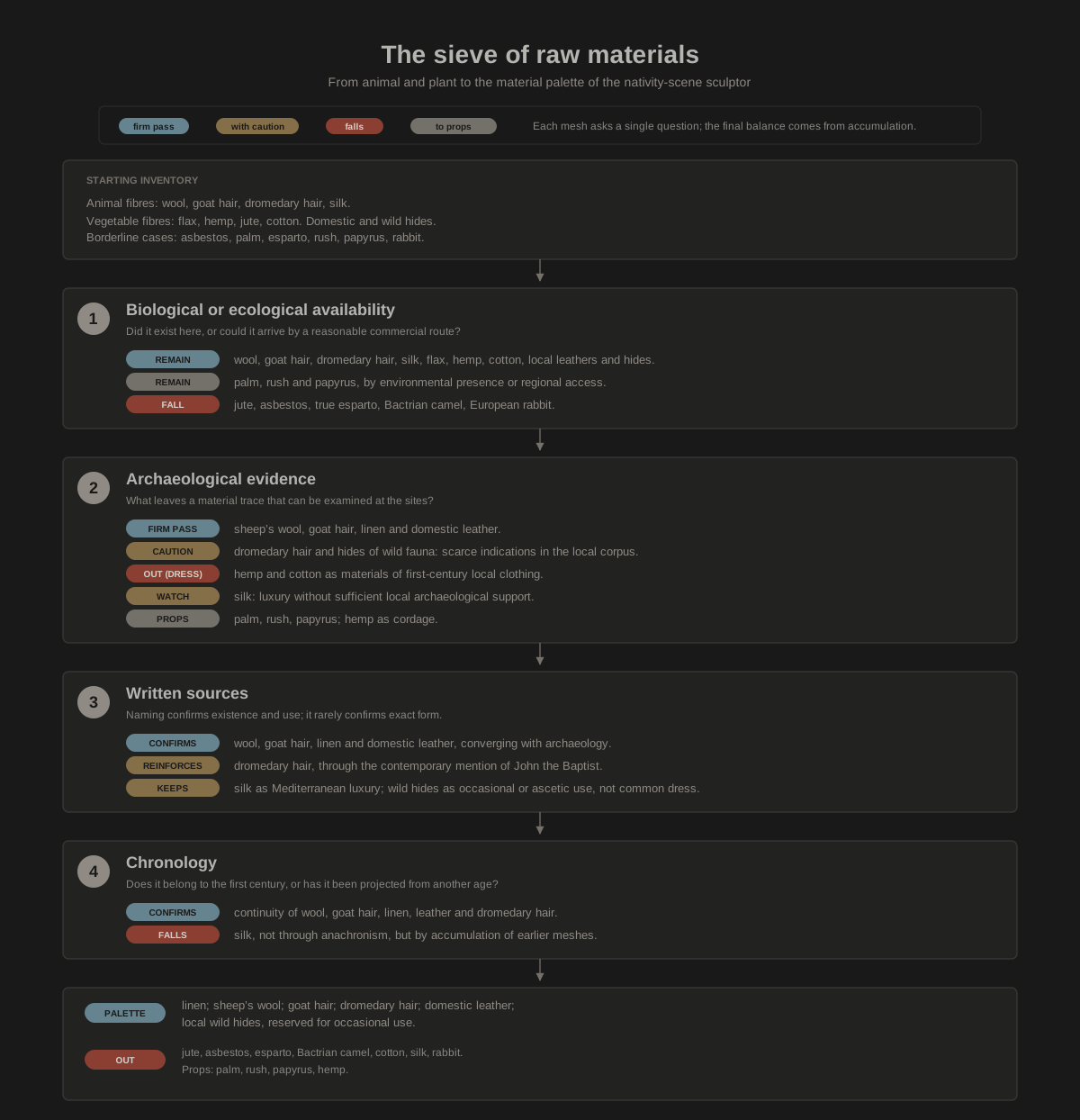
With the cards laid out, the sieve starts working. The first question looks at biological or ecological availability: did the animal or the plant exist in Judaea and Galilee in the first century, or could its product be obtained by a reasonable regional or commercial route?
First mesh: biological or ecological availability
The question of this mesh is the most concrete of the four: did the animal, the plant or the source material exist in the first-century Mediterranean Levant —with particular attention to Judaea and Galilee—, or could its product be obtained by a reasonable commercial route? This is not yet a question about textile evidence, nor about ancient texts, nor about fine chronology. It is a question of geography, biology and material availability. Whatever was not in that environment and could not plausibly reach it falls before any other consideration.
Animal fibres
Sheep’s wool is the firmest item in the inventory. The sheep of the Levant —the fat-tailed animal that zooarchaeology documents in continuity with the modern Awassi— had been the basis of the domestic flock for millennia. Goat hair is at the same level: the black goat of rustic habits, with its head held high and hair longer than the sheep’s, was the other central animal of herding. The two species form the substratum of the rural economy of Judaea and Galilee.
Dromedary hair deserves the distinction that was already made in the inventory. The dromedary —Camelus dromedarius, one hump— was an animal of the Levant and of Arabia, used in caravans and known in rural and urban settings. The two-humped Bactrian belongs to the steppes of Central Asia and is ruled out by habitat. When the Greek of the Gospel says tríches kamélou of the clothing of John the Baptist, what it has in mind is the dromedary, because the popular term covered both without distinguishing them.
Silk is the first case that does not belong to the local fauna. Sericulture was a Chinese secret, still jealously guarded in the first century; the fibre reached the Mediterranean by the long routes that passed through Central Asia, Parthia and northern Mesopotamia. It was an article of extreme luxury; the sources compare its price with that of gold. Did it reach Judaea? Yes, it reached the eastern Mediterranean as goods in transit and as a luxury good. It passes the first mesh, but through a narrow door: not by local availability but by reasonable commercial access, and with the warning that this access was for a very thin band of society.
Vegetable fibres
Flax is the other firm pillar, alongside wool. Linum usitatissimum was grown in the Jordan valley, at Jericho and in other irrigated areas, and it appears consistently in the sources and finds of the Levant. Galilee and upper Judaea had more limited conditions, but regional access to flax was immediate.
Hemp (Cannabis sativa) has a less firm position. Pliny mentions it as a textile plant known in the first-century Mediterranean, above all for sails, cordage and nets; in some regions it was also worked as a fibre for household use. Its presence in Judaea and Galilee is not well documented, but access by the Mediterranean trade route was reasonable. It passes the first mesh with that caution: its arrival is not ruled out, and it remains for the following meshes to show whether it arrived as a clothing material or only as cordage.
Jute (Corchorus) falls here. It is a plant of the Indian subcontinent and did not reach the Mediterranean in the first century as a regular textile material. Its widespread textile use is much later; in the first century, it was simply not in this world.
Cotton (Gossypium) sits in an intermediate position that should be made precise. It was grown in India and in some areas of Roman Egypt on the Upper Nile, and the classical texts mention it as a curiosity. There are isolated finds in the eastern Mediterranean, but its circulation as a household material in first-century Judaea and Galilee is not attested. The large-scale introduction of cotton into the Levant is much later, in the Islamic period. It passes this first mesh with a clear label: it existed in the known world, but its arrival in the everyday clothing of the region is marginal or non-existent. The following meshes will decide.
Hides, domestic and wild
The whole family passes this first mesh without discussion. The sheep, the goat, the cow and the dromedary were the animals of the domestic flock and herd, and their hide is a direct by-product of livestock use. The wild fauna of the Levant —wolf, jackal, striped hyena, fox, gazelle, deer, hare and hyrax— is documented in the region both in ancient sources and in modern zoological records. How many of these hides passed from occasional use to regular use in clothing is already a question for the second mesh.
The borderline cases
Here a good part of the family falls, for different reasons.
Asbestos belongs to another world. Pliny mentions it in the Naturalis Historia as a mineral curiosity of Cyprus and other Mediterranean areas, and describes it as an incombustible fibre used in Rome for napkins that were cleaned by throwing them into the fire. It was an extremely rare article, known practically only in imperial circles. There is no reasonable commercial route that would have brought it to provincial Judaea as a textile material for use. It falls in this mesh.
Esparto in the proper sense —Stipa tenacissima— is a plant of the western Mediterranean: the Maghreb and Iberia. It is not from the Levant. What was used in Judaea and Galilee for cordage and basketry was other grass fibres, rushes and palms, not esparto properly speaking. It falls here; it remains named in order to undo an automatic equivalence that the Mediterranean reader might make.
Palm fibres —from the date palm, Phoenix dactylifera, abundant in the oasis of Jericho and other areas of the Jordan valley— pass the first mesh by indisputable local presence. Rush, in its various wetland species, also passes: the wetlands of the Hula and of some stretches of the Jordan’s banks supplied it. Papyrus (Cyperus papyrus) has an attested presence in Lake Hula and in certain stretches of the lower Jordan, enough for it to pass this mesh too, although its main use —writing support, mats, ropes— is far from the territory of clothing. The next mesh will decide.
The European rabbit does not even enter the sieve: it has already been said that it was not in the Levant in the first century and that its mention serves only to undo the misunderstanding of the Bible translations. The hare and the hyrax, which were there, already travel within the family of wild fauna.
Balance of the first sieve
Remaining on the mesh: sheep’s wool, goat hair, dromedary hair, silk (with caution as to access), flax, hemp (with caution), cotton (with caution), hides of sheep, goat, cow and dromedary, hides of local wild fauna, palm fibres, rush and papyrus.
Falling, for reasons of biological or ecological availability: jute —it does not reach the Mediterranean in the first century—, asbestos —an imperial rarity with no reasonable route to provincial Judaea—, esparto properly speaking —a plant of the western Mediterranean, not of the Levant— and the Bactrian camel —Central Asian steppes, outside its habitat—.
What remains on the mesh goes down to the second question: which of all this leaves a trace in the ground? The next mesh looks at the archaeological evidence.
Second mesh: archaeological evidence
The question changes. The first mesh looked at the environment: what was here or reached here. The second looks at the ground: of everything that was or could have been here, what has left a material trace that we can examine today? The difference matters. A material may have been available and left no archaeological trace, whether because its use was marginal, because the conditions of preservation did not allow it, or because no find has yet brought it to light. Archaeological evidence does not exhaust reality, but it limits what we can uphold.
A preliminary note, because it weighs on this whole mesh. The preservation of textiles in the Levant depends above all on the climate and on the context of the site: the desert, sealed caves and mineralised funerary deposits are the places where fabric survives. Judaea and Galilee have not preserved the textiles of Bethlehem, or of Nazareth, or of Jerusalem in any general way; what we have comes from Masada, Qumran, Nahal Hever, Wadi Murabba'at, Akeldama and a few nearby sites. That displacement of the evidence has already been dealt with in Where the evidence survives. Here it is enough to recall that absences do not mean non-existence, but that evidence is preserved where it is preserved.
Animal fibres
Wool is what leaves most trace. At Masada, Murabba'at, Nahal Hever and Akeldama, the published textile corpora —Sheffer and Granger-Taylor, Yadin, Sukenik and her collaborators, Shamir— show a clear predominance of wool over any other fibre. It is not an impression: it is a count repeated in independent publications, and it holds for the surviving corpus, not for the proportion of common dress. It passes this mesh with direct evidence.
Goat hair also has a firm archaeological trace, although quantitatively smaller. It appears in sacks, in heavy cloths, in coverings. It is the fibre of what the ancient sources call cilicium —a coarse, dark cloth used for sacks, for tents and, occasionally, as clothing of penance or austerity—. Its identification in the corpora of the Levant is attested. It passes with direct evidence.
Dromedary hair is more difficult. The animal was there, the use of its hair is documented ethnographically and mentioned in sources —Matthew 3:4 on John the Baptist is the most visible passage—, but the direct archaeological trace in the first-century textile corpora of Judaea is not abundant. Microscopic identification of dromedary hair is possible and has been carried out on some finds from the Near East, but in the specific first-century corpus of Judaea and Galilee the weight of the datum is smaller than for wool or goat. It passes this mesh with a label of caution: it exists, it was used, there are mentions, but the direct material trace is scarce in this specific temporal and geographical band.
Silk arrives here in an uncomfortable position. Archaeological finds of silk in the first-century Mediterranean are scarce and concentrated in Roman elite contexts. At Palmyra, in the 2nd and 3rd centuries, fragments identified as silk appear in tombs. In first-century Judaea, by contrast, the direct archaeological trace is very weak or non-existent. That is why silk passes the archaeological sieve only in the strict sense: there is no local evidence to confirm it, but nor is there a material reason to exclude it entirely, given that it circulated in the eastern Mediterranean. It goes in, but remains under observation, on the verge of falling. The next mesh —the written sources— will decide whether its mention justifies keeping it in the repertoire or whether it should be recognised as a material that circulated without becoming part of local clothing.
Vegetable fibres
Linen appears at the same sites as wool, in a smaller but significant proportion. It is the characteristic fibre of shrouds —those of 'En Gedi and 'En Tamar, studied by Shamir, are linen; the Akeldama shroud, by contrast, is wool— and it also appears in tunics, in fragments of fine fabric, in veils. Linen is moreover the fibre of priestly clothing according to the Levitical prescription, which gives it a place of its own in the textile universe of the region. It passes with direct evidence.
Hemp falls by the wayside as a textile fibre. The archaeobotanical identification of hemp is technically difficult because it can be confused with flax under the microscope without specialised analysis. In the first-century Levant, there are no textile finds securely attributed to hemp in the published corpus. Its documented use in the Mediterranean of the period is concentrated in cordage, nets and ships’ sails, not in clothing. It finds no material evidence for textile use in Judaea and Galilee; its natural place is elsewhere —ropes, rigging— and it passes, for the same reason as palm, rush and papyrus, into the territory of props.
Cotton falls too. The archaeological finds of cotton in the Mediterranean Levant belong to the late Byzantine and, above all, the Islamic period. For the first century, its presence as a household material in Judaea or Galilee is not attested by any material find. What circulated in the eastern Mediterranean as a curiosity came from the Upper Nile or from India, and did not reach local use in clothing. It falls with negative evidence: it is not that the find is missing by chance, but that the introduction of cotton as a textile material in use in the Levant is later.
Hides, domestic and wild
Leather leaves a material trace at the Dead Sea sites in the form of footwear, fragments of strapping, containers and garments. The sandals of Masada, the children’s shoes of Nahal Hever, the fragments of strapping collected by Baker —the study of first-century footwear presented in The material evidence— and others are direct evidence of leatherwork in the first century in the region. Identifying the species in ancient finds was traditionally difficult, but recent proteomic studies have begun to distinguish sheep, goat and cow in archaeological leathers. The four domestic species of the inventory —sheep, goat, cow, dromedary— pass this mesh with direct evidence, with the caution that the proportion of each in the published finds varies from site to site.
Wild fauna presents a particular difficulty. Tanned leather is identified as leather, but distinguishing whether it comes from gazelle, deer, wolf, hyena or fox is technically complicated and has only recently become routine with proteomic analysis. In the published archaeological corpus of the first-century Levant, the identification of leathers from wild fauna is a minority and almost always marked as tentative. The reasonable course is for this family to pass with a label of caution: the animals existed, there is a tradition of occasional use, there is some tentative identification, but the weight of direct material evidence for use in clothing is low. The next mesh —written sources— and, above all, the decisions on specific figures in the character pages and the block of scenes will qualify how much of this holds up.
The move to props
Palm fibres, rush and papyrus have abundant archaeological evidence at the Dead Sea sites: mats, baskets, ropes, humble sandals, writing supports. The direct material evidence exists and is robust. But their place is not clothing. Their natural place is as accessories to the scene: the mat of the bed, the peasant’s basket, the rope of the rigging, the merchant’s hamper. They therefore leave the route of the clothing sieve and pass into the territory of props and accessories, where they have their own treatment. Hemp joins them for the same reason: it exists, it is worked, but not as a clothing material. The decision is recorded and the material is not lost: it is relocated.
Balance of the second sieve
Remaining on the mesh, with firm direct archaeological evidence: sheep’s wool, goat hair, linen, and leather of sheep, goat, cow and dromedary.
Remaining with explicit caution —there are indications, but the direct material trace in the first-century corpus of Judaea and Galilee is scarce—: dromedary hair, silk, and hides of wild fauna.
Falling, for lack of material evidence to support its textile use in this temporal and geographical band: cotton —whose introduction into the Levant is later—.
Passing into the territory of props: palm fibres, rush, papyrus and hemp.
What follows goes down to the third question: what do the written sources say? The next mesh looks at the Hebrew Bible, at Josephus and Philo, at the Graeco-Roman authors and at the Mishnah and the Talmud, with the caution that temporal distance requires.
Third mesh: the written sources
The question changes again. The first mesh asked about the environment; the second, about the ground. The third asks about the page: what do the ancient textual sources say about the materials that have come this far? The sources are five groups, each with its own weight and its own distance. The Hebrew Bible, which precedes the first century and gives it vocabulary. The mentions in the New Testament, contemporary with the period. Josephus and Philo, who write in the first century itself about Jewish realities. The Graeco-Roman authors, in particular Pliny the Elder, who record what the Mediterranean of the period knew. And the Mishnah and the Talmud, which gather later Jewish tradition —the Mishnah around AD 200, the Talmud Bavli around AD 500— and which should be read with the caution of temporal distance, because they record practices that may go back to the first century or may already belong to another age.
A distinction that the method has already fixed is also needed: naming is not the same as describing. A source may mention a material without saying anything about its pattern, its colour, its specific use; and conversely, it may describe practices without giving a technical name. The mention confirms existence and use; it rarely confirms exact form. This mesh asks about the first, not the second.
Animal fibres
Wool is the most frequently named fibre in the ancient textual corpus of the Levant. It appears regularly in the Hebrew Bible: in the Levitical prescription of shatnez —the prohibition on mixing wool and linen, Leviticus 19:19 and Deuteronomy 22:11—, in the proverbs of the capable woman in Proverbs 31, in the mentions of household weaving, in the trade of Tyre described by Ezekiel. The Mishnah devotes entire tractates to questions of weaving, spinning and mixtures that have wool as their principal subject. Pliny devotes a good part of book VIII of the Natural History to sheep and the quality of their wool, with classifications by region. The textual evidence is massive and converges with the archaeological. It passes with full confirmation.
Goat hair also has a robust textual place, in a band of its own. The curtains of the Tabernacle, in Exodus 26, are prescribed as made of goat hair. Sackcloth —saq in Hebrew, sakkos in Greek— is the coarse goat-hair cloth worn as clothing of penance, of mourning and of the prophet, mentioned dozens of times in the prophets and the psalms. The Mishnah records uses and prescriptions concerning sackcloth. Pliny describes the goat herds of the Levant and of Cilicia, from which the cloth itself takes its Latin name, cilicium. It passes with full confirmation.
Dromedary hair arrives here with the caution of the previous sieve and finds clear textual reinforcement. Matthew 3:4 describes John the Baptist clothed in camel’s hair, with a leather belt round his waist; Mark 1:6 repeats it. The Gospel mention is contemporary with the period and, read with the qualification already made about the popular term kámelos, confirms the use of dromedary hair as a textile material identifiable and recognisable to the first-century reader. The Mishnah also includes references to the use of camel hair and camel hide. The textual reinforcement does not cancel the archaeological caution, but it balances it: it existed, it was used, it was recognised as a material with a place of its own.
Silk arrives at this mesh in the most delicate position in the inventory. The Hebrew Bible is ambiguous: the word meshi in Ezekiel 16:10 and 16:13 is traditionally translated as silk, but the identification is disputed and it could also designate fine cloth of another fibre. Pliny, by contrast, is explicit about sericum as a fibre in transit from the East, extremely costly, reserved for extreme luxury. Revelation 18:12 includes silk in the list of merchandise mourned at the fall of Babylon, that is, of Rome: it confirms the presence of silk as a luxury good in the first-century Mediterranean. The Mishnah mentions luxury fabrics whose identification with silk is disputed by specialists. It passes this mesh, but with the nature of its passage now clear: silk exists as a Mediterranean good in transit, its mention in contemporary sources confirms it as a reality of extreme luxury, but no source places it in the everyday clothing of Judaea or Galilee. It is, in the strictest sense, a material that circulated without belonging to the local wardrobe except in very thin bands of society —and even then, without any direct material trace to confirm it.
Vegetable fibres
Linen has a textual place comparable to that of wool, and with an added symbolic weight. It appears in Genesis already, with Joseph clothed in fine linen when he is raised up by Pharaoh; in Exodus as the material prescribed for priestly clothing —the ephod, the tunic, the breeches, the mitre—; in Leviticus in the prescription of shatnez, on the other side of the scale; in the proverbs of the capable woman, in the prophets, in the descriptions of the trade of Tyre. The New Testament names it in the shroud of Jesus —Matthew, Mark, Luke and John agree in mentioning sindṓn or othónia, the vocabulary of linen—. Pliny devotes book XIX of the Natural History to fibre plants, with flax as the protagonist, describing cultivation, retting, spinning and qualities. The Mishnah deals with it in numerous tractates. It passes with full confirmation.
Hides, domestic and wild
Leather has a constant textual presence in the biblical and rabbinic corpus. Genesis 3:21 opens the motif with the tunics of skin that God makes for Adam and Eve —a mythical reference that gives leather a symbolic place of origin—. Elijah, in 2 Kings 1:8, is identified by the leather belt round his waist, and John the Baptist, in Mark 1:6 and Matthew 3:4, reproduces the gesture. Leather footwear is implicit in the constant mentions of sandals —na'al in Hebrew, hypódēma and sandálion in Greek— throughout the corpus. The Mishnah pays attention to the trades of tanning and to the ritual purity associated with the hides of different animals. The four domestic animals of the inventory —sheep, goat, cow, dromedary— appear named as a source of leather in various contexts. It passes with full confirmation.
Wild fauna arrives here with the caution of the previous sieve and finds partial, not complete, textual reinforcement. There is a clear biblical place for skin as austere or prophetic clothing: Hebrews 11:37, in the list of those persecuted of old, describes them going about en mēlōtaís, en aigeíois dérmasin, in sheepskins and goatskins. Zechariah 13:4 mentions the addereth se'ar, the «mantle of hair» that the prophets wore as a sign of their office, without specifying the species. The identification of the tahash —the skin that covers the Tabernacle in Exodus 25 and 26— has been debated for centuries without agreement: dugong, seal, badger, gazelle, narwhal, or simply an unidentified material. Mentions of wild fauna as a source of leather exist —Leviticus 11 lists the unclean animals, several of them wild, and rabbinic tradition distinguishes the use of hides of unclean animals for non-ritual purposes—, but the textual attribution of the hides of specific wild fauna as clothing is scarce. The caution of the archaeological sieve is not fully compensated: the animals existed, their skin was occasionally used, there is a textual place for the image of the prophet or the ascetic clothed in skins, but the specific material —wolf, jackal or hyena skin— is rarely named. It therefore continues with the same caution: a reasonable presence in occasional uses, not a general source of clothing.
Balance of the third sieve
Remaining on the mesh with full textual confirmation, converging with the archaeological: sheep’s wool, goat hair, linen, and leather of sheep, goat, cow and dromedary.
Dromedary hair rises from archaeological caution to a presence confirmed by a contemporary source: it exists, it was used, it was recognisable. The caution is softened, not removed.
Silk confirms its dual nature: present in the Mediterranean as a luxury good in transit —Pliny and Revelation declare it—, with no place in everyday local clothing, and with an ambiguous identification even in its Hebrew biblical mentions. It remains in the sieve, but its nature is now almost settled.
The hides of wild fauna keep the caution of the previous sieve: a textual place for the image of the prophet or ascetic clothed in skins, but scarce specific attribution. They continue with the same reservation.
What remains goes down to the fourth and last question: does this material belong to the first century, or is it a displacement from another age —non-existent before, generalised afterwards—? The next mesh looks at chronology.
Fourth mesh: chronology
The last question is the subtlest. A material may have passed the three previous meshes —it existed in the region, it leaves a material trace, it is named in the sources— and still belong to another century. Chronology is the mesh that distinguishes between what belongs to the first century and what the inherited image of the nativity scene has incorporated through temporal displacement: anachronisms incorporated later, survivals of practices already extinct, materials generalised afterwards that are projected backwards as if they had always been there. The question is twofold: was this material in active use in the first century, and does the documented practice belong to it or is it displaced onto it?
Unlike the three previous meshes, the fourth produces few casualties at this stage of the sifting. The materials that are problematic in chronological terms —cotton, jute, Maghrebi esparto, the European rabbit— have already fallen earlier, on availability or on evidence, because chronological impossibility tended to coincide with ecological or archaeological impossibility. This mesh, then, works above all in a confirmatory and closing role.
Materials of long continuity
Sheep’s wool, goat hair and leather belong to the oldest band of the material culture of the Levant. Sheep and goats have been domesticated in the region since the Neolithic —around 9,000 BC—, and the use of their wool, hair and skin is documented continuously from the Bronze Age to the present day. The zooarchaeological continuity between the first-century flocks and the present-day flocks of the Levant reinforces the chronological place of these materials. They pass without qualification.
Flax has a parallel history. Grown in the Near East since the Chalcolithic, worked in Egypt and the Levant since early times, it is fully established in the first century as the region’s principal vegetable fibre. The Levitical prescription of shatnez and the linen clothing of the priests are already ancient for the period. It passes without qualification.
The case of the dromedary
Dromedary hair and leather belong to a shorter continuity, but a sufficiently firm one. The domestication of the dromedary is relatively late in the Levant: it is placed around the 1st millennium BC, with large-scale introduction as a beast of burden in the late Iron Age and consolidation during the Persian and Hellenistic periods. By the first century, the dromedary had been integrated for centuries into the caravan economy of Judaea, Galilee and the adjacent Arabia, and its textile use was an established practice —the Gospel mention of John the Baptist takes it as something recognisable to the contemporary reader, not as a curiosity—. It passes without a chronological fall.
The final case of silk
Silk arrives at this mesh in its almost settled position. Chronologically, its presence in the Mediterranean coincides precisely with the period: the trade routes bringing Chinese silk to the West were consolidated between the 2nd century BC and the 1st century AD, and in the times of Augustus, Tiberius and Claudius silk was a recognised luxury good in Rome. Chronologically, therefore, it does not fall. But the previous meshes have already prepared the file. Silk existed as a Mediterranean commodity, not as local clothing; it circulated without any material trace in the wardrobe of Judaea or Galilee; the mentions in Hebrew sources are ambiguous and the Graeco-Roman mentions place it as an article of extreme luxury in Rome, not in the provincial Levant.
The verdict, then, is not chronological but cumulative. Silk does not belong to the everyday wardrobe of Judaea or Galilee in the first century. It exists on the horizon as a good in transit, known to the Mediterranean elites, but its place in local clothing —if it had one— is reduced to a foreign imperial band or to a priestly band of the very highest rank, with no material trace to confirm it. It falls from the sieve at this point, not through anachronism, but through the convergence of three previous meshes that have laid its nature bare. It remains named for the reader, and it is clear why it does not enter the material analysis of the next chapter.
The hides of wild fauna
Chronologically there is no problem. The wild animals of the Levant —wolf, jackal, hyena, fox, gazelle, deer, hare, hyrax— have been present in the region since prehistoric times and, in several cases, still are today. What chronology does not decide is the caution accumulated from the two previous meshes: the material exists, there are mentions supporting the image of the prophet or the ascetic clothed in skins, but the textual and archaeological attribution of the hides of specific wild fauna as regular clothing is scarce. They therefore pass with the same reservation already stated: a reasonable presence in occasional uses, not a general source of dress.
A look back
Some materials of the initial inventory fell earlier for reasons that were ultimately chronological, even though they were declared in the mesh of availability or in that of evidence. Cotton is the clearest case: it is not that it did not exist in the first century —it existed in Egypt on the Upper Nile and in India—, but that its large-scale introduction into the Mediterranean Levant as a textile material belongs to the late Byzantine and, above all, the Islamic period. Jute belongs to an even later chronology for its arrival in the Mediterranean. Maghrebi esparto does not belong to the Levant in any period. The European rabbit is a late introduction. The fourth mesh, read backwards, confirms that those falls could not be reopened by chronological revision.
Balance of the fourth sieve and close of the sifting
On the table, after the four sieves, remain the materials that enter the material analysis of the next chapter:
Sheep’s wool —the dominant fibre in the surviving corpus—. Goat hair —sackcloth and heavy cloths—. Linen —the principal vegetable fibre—. Dromedary hair —confirmed presence, recognised use—. Leather of sheep, goat, cow and dromedary —clothing, footwear, strapping—. Hides of local wild fauna —occasional uses and the figure of the ascetic or the prophet, with caution—.
Fallen from the sieve, for different reasons:
Jute, for not reaching the Mediterranean in the first century. Asbestos, for being an imperial rarity with no reasonable route to provincial Judaea. Esparto properly speaking, for being a plant of the western Mediterranean. The Bactrian camel, for its Central Asian habitat. Cotton, because its arrival in the Levant as a household material in the first century is not attested. Silk, for circulating in the Mediterranean without forming part of the local wardrobe. The European rabbit, for not being present in the Levant in the first century.
Passed into the territory of props, where they will have their own treatment:
Palm fibres, rush, papyrus and hemp. They exist in the region or reach it, leave an abundant material trace, are named in the sources and belong to the first century, but their place is not clothing. Their natural place is among the accessories of the scene —mats, baskets, ropes, rigging, humble footwear, writing support— and they will be worked on there.
And declared outside the sieve, for belonging to another productive system: Roman military dress, whose treatment is scene by scene in the block of scenes when the scene calls for it.
The sieve is finished. What remains on the table is the palette of the nativity-scene sculptor for first-century clothing in Judaea and Galilee: one vegetable fibre —linen—; three animal fibres —wool, goat hair, dromedary hair—; the leather of four domestic species; and the hides of wild fauna with their reservation. But that palette does not yet begin with the fabric or the garment. Before speaking of wool, linen or leather as separated materials, it is worth looking at the previous link: the animals and plants from which they come. The next chapter opens that passage through the animals that have passed the sieve, not as figures in the scene, but as material origin.