
 ≈ 165 min
The previous chapter established, with the vocabulary of the discipline that describes sculpture, who is the author of a figure and who is not: the author is whoever conceives and models the original; the executant, whoever reproduces it with the author’s permission. This chapter puts the same question to another authority, and it is the one that decides: the law. It is not a second argument added to the first. It is the only one that binds everyone, including those who would rather not hear it.
It is not a second argument added to the first. It is the only one that binds everyone, including those who would rather not hear it.
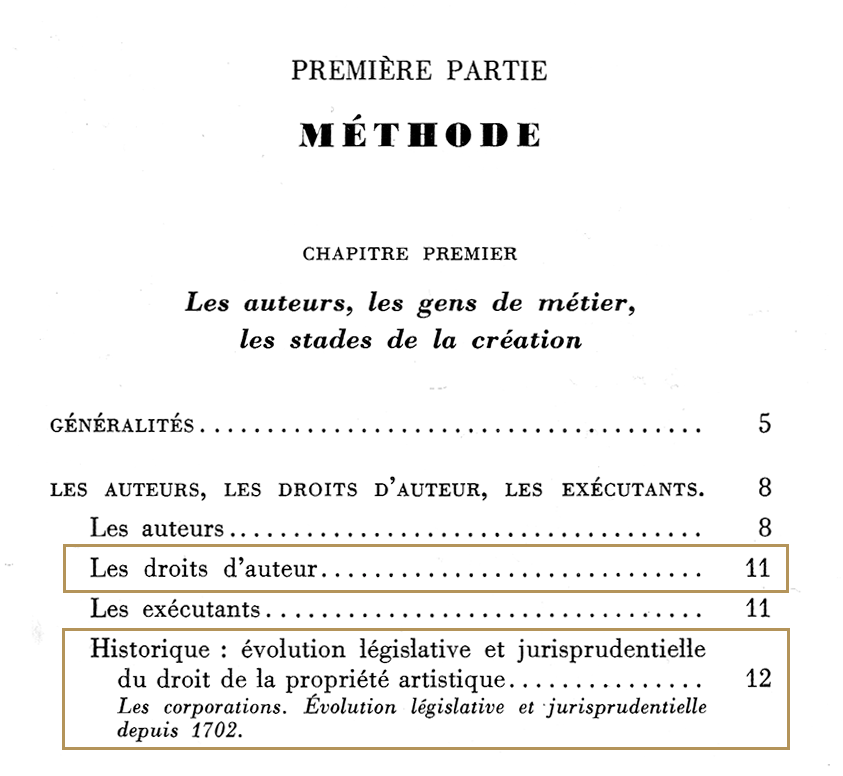
It is worth saying from the outset what kind of texts are going to be read here and what weight they carry, because in nativity-scene art and practice documents of very different rank circulate as if they were worth the same. What defines who is an author lies in a rule with the rank of law — in Spain, a consolidated text approved by Real Decreto Legislativo— and in an international convention signed by 182 States. What has called the sculptors of the nativity scene craftsmen is the dossier of a Real Decreto that declares belenismo a representative manifestation of the intangible cultural heritage: a two-page regulation — the law on intangible heritage says that such a declaration is made «por Real Decreto», by royal decree— which refers «a la documentación obrante en el expediente» — to the documentation contained in the dossier—, and it is in the technical report of that dossier that the list of names under the word artesanos, craftsmen, is found.119 In the hierarchy of rules, a regulation cannot contradict a law, and a heritage declaration does not define who is the author of anything.120 So, whatever the dossier says, none of those who signed it can deny what the law defines as an author. And the same holds for whatever comes after: a fair’s regulations, the statutes of a federation or of an association, the custom of a market may name badly, or be confused, and often are; the law and its definitions are respected, like it or not, by law. Whoever wants to dispute them has an easy and a clear path: it is not a matter of changing the word on a poster, it is a matter of asking for the law to be amended. That dossier is examined in the chapter on the dossier;113 here the law that stands above it is read.
A warning is also needed about what this chapter is and what it is not. It is long, and dense in stretches, because it sets out the laws of six countries with the article in front of the reader; and nothing in it is there for ornament or as padding. Nobody likes reading the rules of a game, or the manual of an appliance, or the terms of a program: one wants to start straight away, and one does. The same happens with the nativity scene, and all the more if it is taken for what it is not: a Christmas decoration, a vase with flowers stuck in without judgement — not an ikebana—. One can create a nativity scene, exhibit it and even sell it without having read any of this, just as one can drive without having passed the driving test; what one cannot do is plead afterwards that one did not know. And the day comes, because it always comes: whoever goes out to gather moss or holly for their scene and runs into the forest rangers may come home with a fine of three or four figures, and the nativity scene will be no excuse.121 The law says it in a handful of words that have been in the Civil Code since 1889: «La ignorancia de las leyes no excusa de su cumplimiento» — ignorance of the laws does not excuse compliance with them—.122 And there is one more reason for writing it, and it is the one that justifies it: in nativity-scene art and practice there is no text in which any of this can be looked up. There are decrees, fair regulations, statutes and customs, and all of them name; none of them refers to the law that stands above them. This chapter, and those that follow it in the block, are written to fill that void: so that from now on whoever names each person has to do so by their legal definition — not by whim, but by law—, and whoever does not cannot say there was nowhere to look.
The law says precisely who is an author, what belongs to the author, for how long, and what others may and may not do with what the author has made. And it says so in a way that almost nobody in nativity-scene art and practice has ever had explained, because it is not taught: not in the faculties of Fine Arts, not in the schools of sculpture, not in the associations, not at the fairs.
This chapter is that explanation. It is not a summary of laws nor a list of links: it is a journey through what six legal systems say exactly about a nativity figure, read with the article in front of the reader. It has been written with the legal texts open, one by one, in the official sources of each country, and every statement carries the article that supports it. Where a text could not be opened, this is said; where the law is silent, this is said too, because a silence of the law is a fact, not a gap to be plugged with common sense.
Two warnings are needed before starting. The first: nothing that follows is legal advice, nor can it be — whoever has a specific dispute needs a lawyer, not a manual—. What this chapter offers is something else: knowing what is being talked about, which is the condition for being able to ask the right questions. The second: the law changes, and in this matter it has changed a great deal in the last two years. Everything stated here is dated, and the date is part of the statement.
1. What the law protects, and whom
The exact moment the right is born
Let us begin with the shortest and most important text in the whole chapter.
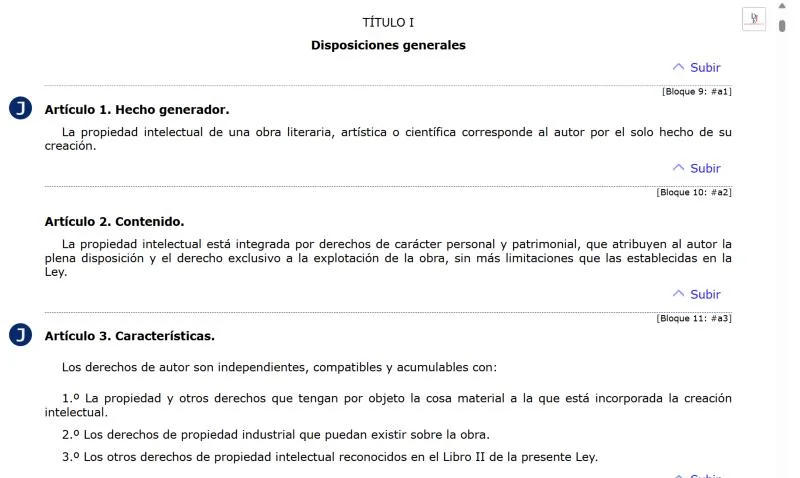
«La propiedad intelectual de una obra literaria, artística o científica corresponde al autor por el solo hecho de su creación.» — The intellectual property of a literary, artistic or scientific work belongs to the author by the mere fact of its creation.—4
Eight words do all the work: por el solo hecho de su creación, by the mere fact of its creation. Nothing has to be registered, nothing has to be paid, nobody’s permission has to be asked, one does not have to belong to any association or hold any title. The instant the figure exists, the right exists. A sculptor who finishes a shepherd on a Tuesday afternoon has, that Tuesday afternoon, all the rights this chapter is going to describe, whether the sculptor knows them or not.
Eight words do all the work: by the mere fact of its creation.
This is not a Spanish peculiarity. It is the first of the two great rules of the Berne Convention, which will be seen in the next section, and that is why it applies equally in the six countries. It is worth saying early because the opposite circulates in nativity-scene circles: that the figure has to be registered, that it has to be photographed and sent to oneself by registered post, that without paper there is no right. Registration serves to prove — which is another problem, and a real one—, not to have.
Who is an author
«Se considera autor a la persona natural que crea alguna obra literaria, artística o científica.» — The author is considered to be the natural person who creates a literary, artistic or scientific work.—5
Two words are worth underlining. Persona natural, natural person: not a company, not a workshop, not an association, not a machine; section 6 comes back to this and now has a great deal to say. And crea, creates: does not commission, does not pay, does not distribute, does not exhibit, does not collect. Creates.
From this follows, with no need for any other article, the answer to the question most often repeated in nativity-scene circles: whoever commissions a figure is not its author. They may have the idea, they may describe it in detail, they may provide an old photograph of their grandfather the wafer seller and pay whatever it costs: none of that is creating the work.
Whoever commissions a figure is not its author. It is the same thing the vocabulary of sculpture said in the previous chapter in other words, and the same thing the United States Code says when it expressly excludes the idea from protection:
«In no case does copyright protection for an original work of authorship extend to any idea, procedure, process, system, method of operation, concept, principle, or discovery,6
regardless of the form in which it is described, explained, illustrated, or embodied in such work.»
What this means for the nativity scene is very specific, and it is worth saying with an example. The idea «a chestnut seller with her brazier and her paper cone» belongs to nobody: it is in the tradition, in the street and in a thousand figures. What belongs to someone is this chestnut seller — this lean of the body, this fold of the apron, this way of looking at the brazier—, because it is the specific form a sculptor gave her. That is why two sculptors who model a chestnut seller do not arrive at two similar figures, but at two entirely different versions: each decides a different age, a different weight, a different gesture, different clothes and a different instant of what that woman is doing. Starting from the same subject there is no way of arriving at the same place, and what the law protects is, in each case, the place each one arrived at.
Here the first real difference between the six countries appears, and it has to be looked at slowly, because at first sight there seems to be none: in all of them, when a sculptor works as an employee of a workshop, it is the workshop that ends up exploiting the figures. The economic result is the same. What is not the same is who the author is, and three things that money does not show depend on that: the name, the integrity and the duration.
Spanish law does not touch authorship: the author is the natural person who creates, always. What it does is presume an assignment:
«A falta de pacto escrito, se presumirá que los derechos de explotación han sido cedidos en exclusiva y con el alcance necesario para el ejercicio de la actividad habitual del empresario en el momento de la entrega de la obra realizada en virtud de dicha relación laboral.» — In the absence of a written agreement, the exploitation rights shall be presumed to have been assigned exclusively and to the extent necessary for the exercise of the employer’s usual activity at the time of delivery of the work made under that employment relationship.—104
And it limits it: «En ningún caso podrá el empresario utilizar la obra o disponer de ella para un sentido o fines diferentes» — in no case may the employer use the work or dispose of it for a sense or purposes different— from those of its usual activity.104 The employed sculptor remains the author: the sculptor keeps the moral rights — their name on the figure, the integrity of the work— and the term of protection is counted from the sculptor’s death, not from the workshop’s. Germany and France work the same way. German law applies to works made in an employment relationship the same rules as to any other assignment, «soweit sich aus dem Inhalt oder dem Wesen des Arbeits- oder Dienstverhältnisses nichts anderes ergibt» — insofar as nothing else follows from the content or nature of the employment relationship—;105 French law says that the employment contract «n'emporte pas dérogation» to the author’s right, and its only exception is computer programs.106 Italy has no general rule for the employee — only for programs, industrial design and photographs—, so the principle that the right is born of creation applies.107
Andorran law, the law of the country where the person who signs this Manual was born, does something else:
«Pel que fa a una obra creada per un empleat en el compliment de les seves obligacions o seguint les instruccions donades pel seu patró, el patró ha de ser considerat com l'autor de l'obra, llevat que s'estableixi el contrari en un contracte escrit.» — As regards a work created by an employee in the performance of their duties or following the instructions given by their employer, the employer shall be considered the author of the work, unless otherwise provided in a written contract.—7
It does not assign the rights: it changes the author. The employer «ha de ser considerat com l'autor» — shall be considered the author—, and with authorship go, in principle, the moral rights. The law does not say expressly what happens to them in this case, and what is stated here is a reading of the text: article 6 attributes the moral rights to «l'autor d'una obra», the author of a work, and the author, under 19.4, is the employer. The duration goes too: if the employer is a company, the work is protected for 70 years from when it was made public, not from anyone’s death, unless the natural persons who created it are named on it.108
The United States goes even further down the same road. A work made by an employee within the scope of their employment is a «work made for hire», and then «the employer or other person for whom the work was prepared is considered the author».109 And since the definition of «work of visual art» expressly excludes «any work made for hire»,41 the employed sculptor has no moral rights of any kind there: neither name nor integrity.
| Who is the author? | Who exploits the work? | Who keeps the name and the integrity? | From when do the 70 years run? | |
|---|---|---|---|---|
| Spain | the employed sculptor (art. 5.1) | the workshop, by a presumed assignment limited to its usual activity (art. 51) | the sculptor | from the sculptor’s death |
| Germany | the employed sculptor (§ 7) | the workshop, under the general rules on assignment (§ 43) | the sculptor | from the sculptor’s death |
| France | the employed sculptor (L111-1) | the workshop, by contract; no automatic assignment except for programs (L113-9) | the sculptor, in perpetuity | from the sculptor’s death |
| Italy | the employed sculptor (art. 6); no general rule | the workshop, by contract | the sculptor | from the sculptor’s death |
| Andorra | the employer (art. 19.4), unless otherwise agreed in writing | the employer, as author | the employer, on a reading of art. 6 | if the employer is a company, from disclosure (art. 18.6); if the creators are named, from their death |
| United States | the employer (§ 201(b)) | the employer | nobody: a work made by an employee falls outside moral rights (§ 101) | the 70 years do not run: 95 from first publication or 120 from creation, whichever expires first (§ 302(c))132 |
One figure is missing from that table, and it is worth asking why. In nativity-scene art and practice, whoever makes the figures is often called a craftsman; there is no craftsman in the table. It is not an oversight: copyright law does not know that word. It is not in the Spanish Ley de Propiedad Intelectual — in none of its articles—.112 Where it does appear is in two other laws, and in both it names something very precise: in the law on industrial design, the craftsman is whoever makes products — «todo artículo industrial o artesanal», any industrial or handicraft article—;9 in French tax doctrine, «les productions artisanales ou de série» — craft or series productions— are precisely what is denied the status of work of art.72 For the law, the craftsman is whoever produces articles; for the tax authorities, it is what is not art. And for copyright law, the craftsman is nobody: that law knows only whoever conceives a work, and everyone else.
Now go back to the table with that in hand. What it shares out is what happens to the employee who conceives the originals: in four countries that employee remains the author; in two, ceases to be. That employee has a name in the law, and it is author. The other employee in the same workshop — the one who reproduces, polychromes or dresses on models they did not conceive, the executant of the previous chapter1— does not appear in the table because there is nothing to share out: that person was never an author in any country, and no article has to assign them or take from them anything. That is the position that design law and tax doctrine describe when they speak of craft production: the position of whoever makes copies of something, not of whoever conceived it.
From this follows what nativity-scene art and practice needs to know and is not usually told. The two words do not name degrees of one and the same thing, nor is one the modest version of the other: they name the two positions that the law separates, one on each side of the only line it draws. Calling the sculptor who conceives and models the original a craftsman is not a humble way of calling them a sculptor, nor a synonym in use: it is placing them, with a single word, on the side of the line where the law recognises no author. It is the same mistake as calling the person who wrote the book a printer. And it has consequences that are not a matter of vocabulary: it is the word with which an official dossier has catalogued the person who signs this Manual and dozens more, and it is the subject of the chapter on the heritage dossier.113
What copyright law does allow is to say, at last, what a craftsman does, because it says so by exclusion. If the author is whoever conceives, and the executant whoever reproduces with the author’s permission a work that someone else conceived, a third position remains: that of whoever reproduces something nobody conceived — a type, an object with no original behind it: the espadrille, the basket, the roof tile—. That is the craftsman, and it is what is said, without their having agreed, by the Catalan dictionary with its «repetició de peces», repetition of pieces, by design law with its «artículo […] artesanal», handicraft article, and by French tax doctrine with its «productions artisanales ou de série»: none of them speaks of the hand or of quality; they speak of what is repeated having no author.
| Conceives? | Reproduces? | Reproduces what? | Is there an author behind it? | |
|---|---|---|---|---|
| Author | yes | yes, in their own right | their own work | the author themselves |
| Executant | no | yes, by delegation | a work conceived by someone else | yes: the author of the model |
| Craftsman | no | yes | a type, an object with no original | no |
| Forger | no | yes, without permission | a work conceived by someone else | yes, but the forger usurps them |
The fourth row is not a trade but its opposite, and the vocabulary of sculpture names it on the same page as the executant; it is examined in section 5.
And the position is not fixed: the basket maker who conceives a basket different from all the others is, in that basket, an author — the law protects plastic works «sean o no aplicadas», whether applied or not8—, and the ones made afterwards identical to it are editions of their work, not craft; they may also register the design, because design law admits the «artesanal», handicraft, product and declares that protection cumulative with copyright.911 What decides is neither the trade nor the tool: it is whether there was someone who conceived what is repeated. Section 6 comes back to this table, because today there is a new figure that falls exactly into its third row.
And a clarification that matters to almost all the readers of this Manual more than the table: none of this applies to a commission given to an independent sculptor. The Andorran article speaks of «empleat» and «patró», employee and employer; the American one, of an «employee within the scope of his or her employment», and its second route — the commissioned work— only applies to a closed list of types of work in which sculpture does not appear;110 and Spanish law has no article on the commissioned work outside the employment relationship: the only time it names it is to say that it is not the subject of the publishing contract.111 A client who commissions a figure from a sculptor working on their own account is not the sculptor’s employer. The sculptor is the author in the six countries, and what the client acquires is what the contract says and, if it says nothing, the object. That is the subject of the chapter on the client and the commission.
Whoever has a workshop with assistants, in any of the six countries, has reason to read their own law before this chapter.
What is protected: the work, and what counts as a work
«Son objeto de propiedad intelectual todas las creaciones originales literarias, artísticas o científicas expresadas por cualquier medio o soporte, tangible o intangible, actualmente conocido o que se invente en el futuro, comprendiéndose entre ellas: […] e) Las esculturas y las obras de pintura, dibujo, grabado, litografía y las historietas gráficas, tebeos o comics, así como sus ensayos o bocetos y las demás obras plásticas, sean o no aplicadas.» — The subject matter of intellectual property is all original literary, artistic or scientific creations expressed by any means or medium, tangible or intangible, now known or invented in the future, including among them: […] e) Sculptures and works of painting, drawing, engraving, lithography and graphic stories, strip cartoons or comics, as well as their studies or sketches and other plastic works, whether applied or not.—8
Three things in that text matter to nativity-scene art and practice, and none is usually said.
First: sketches too. «Así como sus ensayos o bocetos», as well as their studies or sketches. The modelled sketch the previous chapter spoke of — the one the sculptor makes to think out the pose before the definitive figure— is a protected work in its own right, not a working paper. Whoever photographs someone else’s sketch and circulates it is circulating someone else’s work.
Second: size, material and purpose do not matter. The law says «por cualquier medio o soporte», by any means or medium, and «sean o no aplicadas», whether applied or not. A 10-centimetre figure in terracotta stands at exactly the same level as a 3-metre marble statue. There is no lower category in the law for small works, nor for those that are to form part of an ensemble, nor for those with a religious subject, nor for those sold at a fair.
Third: quality does not matter. The law requires originality, not merit. This connects with what the vocabulary of sculpture already said in the previous chapter — that the apparent quality of a work offers no guarantee of its originality—1 and it is worth reading in both directions: a mediocre figure is protected just as an excellent one is, and an excellent figure is not more protected for being so. The law protects authorship; judgement on the work is another matter and is not the law’s business.
Two properties that are not the same: intellectual and industrial
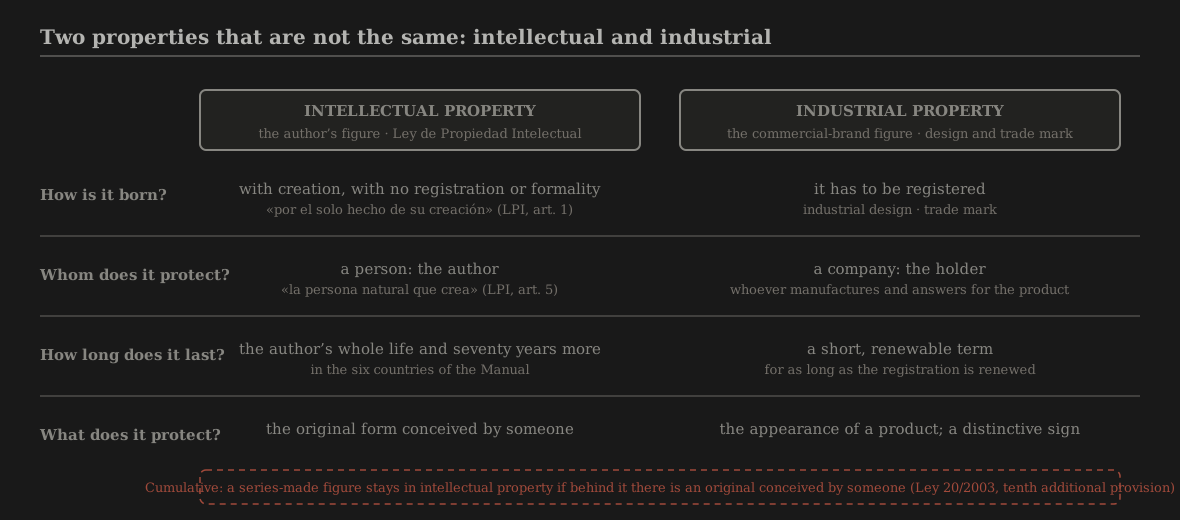
The chapter on the world distinguished the author’s figure from the commercial-brand figure: those that have not an author but a manufacturer — the shop-window mannequin, the Playmobil figure—.2 That distinction, made there from the side of who answers for the figure, has its exact counterpart in the law, and they are two distinct legal worlds.
The author’s figure is protected by intellectual property: it is born with creation, lasts the author’s whole life and 70 years more, and protects the original form.
The commercial-brand figure is protected by industrial property, which is something else. Industrial design is defined thus:
«Diseño: la apariencia de la totalidad o de una parte de un producto, que se derive de las características de, en particular, las líneas, contornos, colores, forma, textura o materiales del producto en sí o de su ornamentación.» — Design: the appearance of the whole or a part of a product resulting from the features of, in particular, the lines, contours, colours, shape, texture or materials of the product itself or its ornamentation.—9
And the trade mark, thus:
«Podrán constituir marcas todos los signos, especialmente las palabras, incluidos los nombres de personas, los dibujos, las letras, las cifras, los colores, la forma del producto o de su embalaje, o los sonidos, a condición de que tales signos sean apropiados para: a) distinguir los productos o los servicios de una empresa de los de otras empresas y b) ser representados en el Registro de Marcas de manera tal que permita a las autoridades competentes y al público en general determinar el objeto claro y preciso de la protección otorgada a su titular.» — A trade mark may consist of any signs, in particular words, including personal names, designs, letters, numerals, colours, the shape of the product or of its packaging, or sounds, provided that such signs are capable of: a) distinguishing the goods or services of one undertaking from those of other undertakings and b) being represented in the Register of Trade Marks in a manner which enables the competent authorities and the public to determine the clear and precise subject matter of the protection afforded to its proprietor.—10
The working difference between the two properties shows in three points. Design and trade mark have to be registered; the work does not. Design and trade mark protect a company; the work, a person. And design lasts a short, renewable term, while the work lasts 70 years after its author’s death.
What is not true is that one excludes the other. Spanish law says so expressly:
«La protección que se reconoce en esta ley al diseño industrial será independiente, acumulable y compatible con la que pueda derivarse de la propiedad intelectual cuando el diseño de que se trate presente en sí mismo el grado de creatividad y de originalidad necesario para ser protegido como obra artística según las normas que regulan la propiedad intelectual.» — The protection granted by this law to industrial design shall be independent of, cumulative with and compatible with that which may derive from intellectual property when the design in question itself displays the degree of creativity and originality necessary to be protected as an artistic work under the rules governing intellectual property.—11
From this follows something worth keeping in view: that a figure is manufactured industrially in series does not take it out of intellectual property if behind it there is an original conceived by someone. What takes it out is the absence of such an original — its being a catalogue product and nothing more—. It is, in the language of the law, the same border this Manual drew in the language of the trade: what separates craft from sculpture is not whether something is repeated, but whether behind what is repeated there is a conceived original.12
2. Where it comes from: 1710, 1886 and the six laws
None of the above is self-evident or old. For most of the history of sculpture it did not exist; the first law that recognised a right for the author is 316 years old and did not speak of sculptors.
1710: the right passes from the printer to the author
What the law says of itself, in the preamble, is that it is made because printers and booksellers had been printing and reprinting works «without the consent of the authors or proprietors of such books and writings, to their very great detriment, and too often to the ruin of them and their families»; and «for the encouragement of learned men to compose and write useful books».13
And what it establishes is this:
«That the Author of any Book or Books already composed and not printed and published or that shall hereafter be composed and his assignee or assignes13
shall have the sole liberty of printing and reprinting such Book and Books for the term of fourteen years to commence from the day of the first publishing the same, and no longer.»
Two things change there, and both are still in force. The first: the right belongs to the author, not to the guild that prints. The second: it lasts a limited time, not for ever. All modern copyright, including the copyright that protects a nativity figure, is the development of those two ideas.
And there is a third thing, the one that interests this Manual and that can be seen by reading the text: sculpture does not appear. The law speaks of «Books and other writings», of printers and booksellers, of printing and reprinting. Sculptors would take almost two more centuries to come in. The origin should not be idealised: copyright is born as a printing problem, and the plastic arts arrive later, when there is a technique that allows them to be reproduced in series. It is no coincidence that they arrive at the same time as industrial moulding and photography.
1886: the right crosses borders, and sculpture comes in
What travels from one country to another is not the law, it is Berne.
Berne does three things that directly affect a nativity figure.
It names sculpture. The list of protected works includes, literally, «las obras de dibujo, pintura, arquitectura, escultura, grabado, litografía» — works of drawing, painting, architecture, sculpture, engraving and lithography—.16 Since 1886 sculpture has been inside, on the same line as architecture and painting.
It abolishes formalities. «El goce y el ejercicio de estos derechos no estarán subordinados a ninguna formalidad y ambos son independientes de la existencia de protección en el país de origen de la obra.» — The enjoyment and the exercise of these rights shall not be subject to any formality; such enjoyment and such exercise shall be independent of the existence of protection in the country of origin of the work.—17 This is the sentence behind the «por el solo hecho de su creación» of Spanish law, and behind the same rule in German, French, Italian and Andorran law. It is the same rule in six languages.
It creates moral rights. «Independientemente de los derechos patrimoniales del autor, e incluso después de la cesión de estos derechos, el autor conservará el derecho de reivindicar la paternidad de la obra y de oponerse a cualquier deformación, mutilación u otra modificación de la misma o a cualquier atentado a la misma que cause perjuicio a su honor o a su reputación.» — Independently of the author’s economic rights, and even after the transfer of the said rights, the author shall have the right to claim authorship of the work and to object to any distortion, mutilation or other modification of, or other derogatory action in relation to, the said work, which would be prejudicial to his honour or reputation.—18 These are two rights, and both matter a great deal to a sculptor of nativity figures: that their name remains attached to the figure, and that nobody alters it in a way that harms them.
And it sets a minimum duration: the life of the author and 50 years more.19 The six countries give 70 today, that is, more than the treaty requires.
The dates of accession, which WIPO Lex publishes in the table of contracting parties to the Convention — 182 today—, say something on their own:20
| Country | Signature | Instrument | In force |
|---|---|---|---|
| Germany | 9-IX-1886 | Ratification: 5-IX-1887 | 5-XII-1887 |
| Spain | 9-IX-1886 | Ratification: 5-IX-1887 | 5-XII-1887 |
| France | 9-IX-1886 | Ratification: 5-IX-1887 | 5-XII-1887 |
| Italy | 9-IX-1886 | Ratification: 5-IX-1887 | 5-XII-1887 |
| United States | — | Accession: 16-XI-1988 | 1-III-1989 |
| Andorra | — | Accession: 2-III-2004 | 2-VI-2004 |
Four of the six countries of this Manual were in the room on the day it was signed. The United States took 102 years and Andorra 118. And that explains, in part, two of the particularities that will be seen in the next section: that the American system of moral rights differs from the European one, and that Andorran law, being the most recent of the six, is written in a different way.
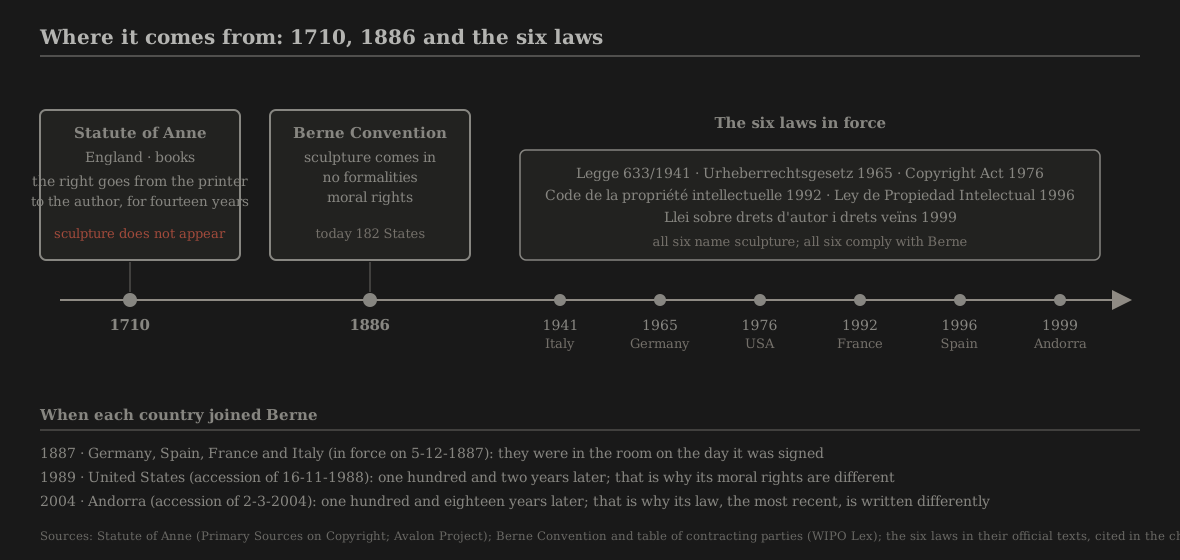
The six laws
Each of the six languages of this Manual has its own copyright law. They are presented here in order of age, with what each one adds; the specific articles are examined in the next section.
Italy — Legge 22 aprile 1941, n. 633, «Protezione del diritto d'autore e di altri diritti connessi al suo esercizio». The oldest of the six in force, from 1941, amended many times; the latest amendment affecting this chapter dates from September 2025 and is examined in section 6. It is quoted from the consolidated text on Normattiva, the official portal of the Presidency of the Council of Ministers, consulted on 21 September 2026.21 It protects «le opere della scultura» under its article 2, number 4.22
Germany — Gesetz über Urheberrecht und verwandte Schutzrechte (Urheberrechtsgesetz, UrhG), of 1965. It is quoted from the official text on gesetze-im-internet.de, consulted on 21 September 2026, in its current version.23 It protects «Werke der bildenden Künste», works of the visual arts,24 and has the tersest definition of author of the six: «Urheber ist der Schöpfer des Werkes» — the author is the creator of the work—.25
France — Code de la propriété intellectuelle, of 1992, which codifies two earlier laws decisive for sculpture: the 1909 law on works of applied art and the 1957 law on literary and artistic property, already cited in the previous chapter. Légifrance, the official French source, could not be opened for this chapter —an automatic access check prevents it—, so it is quoted from the consolidated text as at 13 March 2025 published by WIPO Lex, consulted on 21 September 2026.26 It protects «les oeuvres de dessin, de peinture, d'architecture, de sculpture, de gravure, de lithographie».27
Spain — Real Decreto Legislativo 1/1996, consolidated text of the Ley de Propiedad Intelectual, already presented. It protects «las esculturas […] así como sus ensayos o bocetos» — sculptures […] as well as their studies or sketches—.8
Andorra — Llei sobre drets d'autor i drets veïns, of 10 June 1999. The most recent of the six and the only one written with an article of definitions at the beginning, in the manner of international treaties. It is quoted from the facsimile of the Butlletí Oficial del Principat d'Andorra published by WIPO Lex and from the text of the Consell General, consulted on 21 September 2026; it remains in force, amended only by Llei 23/2011 creating the collective management society.28 It protects «obres de dibuix, pintura, escultura, litografia, gravats i altres obres de belles arts» — works of drawing, painting, sculpture, lithography, engravings and other works of fine art—.29
United States — Copyright Act of 1976, codified in title 17 of the United States Code. It is quoted from the text of the Code published by the Legal Information Institute of Cornell Law School, consulted on 21 September 2026.30 It protects «pictorial, graphic, and sculptural works».31 It is the most different of the six, and the next section explains how.
3. The rights, one by one
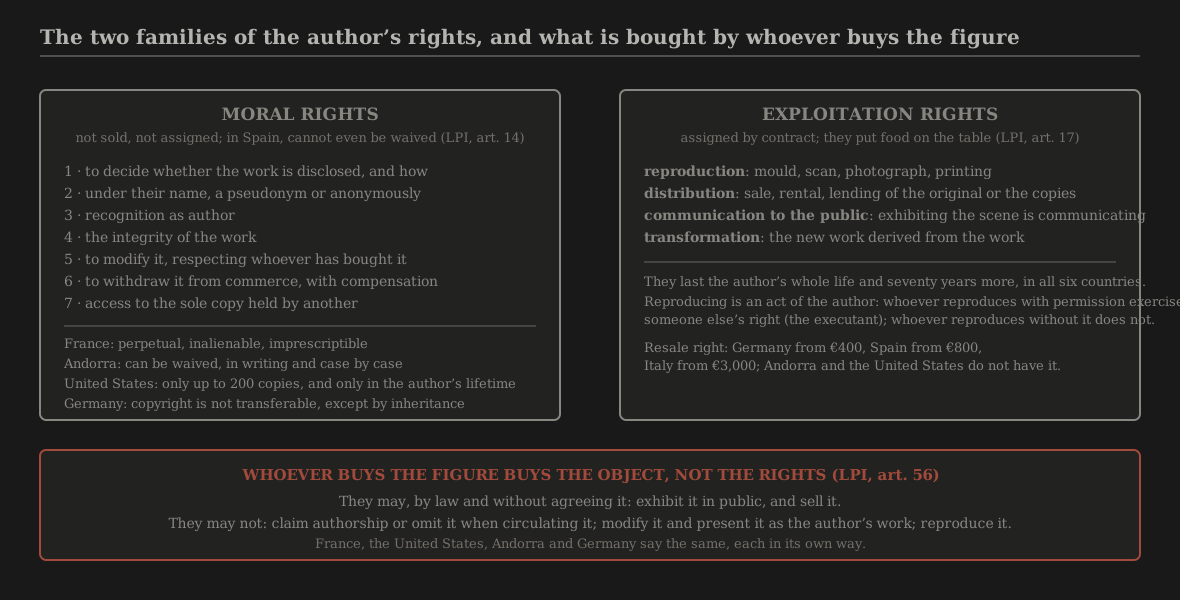
The author’s rights are divided into two families that work in opposite ways. The moral rights are not sold, not assigned and, in Spain, cannot even be waived. The exploitation rights can: they are the ones that are negotiated, that are assigned by contract and that put food on the table. Confusion between the two families lies behind almost all the misunderstandings in nativity-scene circles, because whoever buys a figure buys an object and sometimes believes they have bought the work.
Moral rights
The Spanish list is the longest and most detailed of the six, and it is worth reading in full because each point has an immediate application in nativity-scene practice:
«Corresponden al autor los siguientes derechos irrenunciables e inalienables: 1.º Decidir si su obra ha de ser divulgada y en qué forma. 2.º Determinar si tal divulgación ha de hacerse con su nombre, bajo seudónimo o signo, o anónimamente. 3.º Exigir el reconocimiento de su condición de autor de la obra. 4.º Exigir el respeto a la integridad de la obra e impedir cualquier deformación, modificación, alteración o atentado contra ella que suponga perjuicio a sus legítimos intereses o menoscabo a su reputación. 5.º Modificar la obra respetando los derechos adquiridos por terceros y las exigencias de protección de bienes de interés cultural. 6.º Retirar la obra del comercio, por cambio de sus convicciones intelectuales o morales, previa indemnización de daños y perjuicios a los titulares de derechos de explotación. […] 7.º Acceder al ejemplar único o raro de la obra, cuando se halle en poder de otro, a fin de ejercitar el derecho de divulgación o cualquier otro que le corresponda. […]» — The following rights, which cannot be waived or transferred, belong to the author: 1. To decide whether the work is to be disclosed and in what form. 2. To determine whether such disclosure is to be made under the author’s name, under a pseudonym or sign, or anonymously. 3. To demand recognition of their status as author of the work. 4. To demand respect for the integrity of the work and to prevent any distortion, modification, alteration or attack on it that is prejudicial to their legitimate interests or detrimental to their reputation. 5. To modify the work, respecting the rights acquired by third parties and the requirements for the protection of assets of cultural interest. 6. To withdraw the work from commerce, owing to a change in their intellectual or moral convictions, subject to prior compensation for damages to the holders of exploitation rights. […] 7. To have access to the sole or rare copy of the work, when it is in the possession of another, in order to exercise the right of disclosure or any other right belonging to them. […]—32
Translated into the workshop and the fair, point by point:
- 1. A figure that the sculptor has not declared finished, or has decided not to show, may not be disclosed by anyone. Photographing and publishing a piece seen in the workshop, without permission, infringes this right even if the photograph is excellent and the comment full of praise.
- 2 and 3. The name. It is the right most often infringed in nativity-scene circles and the easiest to respect: a photograph of a scene published without saying whose the figures are. It is not a discourtesy: it is the infringement of a right that cannot be waived.
- 4. Integrity. Repainting a purchased figure, sawing off its base, changing an arm, adding an attribute: section 5 examines this slowly, because the case is not as simple as it seems.
- 5. The author may modify their own work, but not at the expense of whoever has already bought it.
- 6. The right of withdrawal, which in practice is hardly ever exercised because it requires compensation.
- 7. The right of access: a sculptor who keeps no photographs of a unique piece sold 20 years ago may ask for access to it in order to photograph it. It is a little-known right and a very useful one for anyone compiling their catalogue.
The other five laws say the same with fewer words, and two of them with an important difference.
France has the most protective legal system of the six, spectacularly so: «L'auteur jouit du droit au respect de son nom, de sa qualité et de son oeuvre. Ce droit est attaché à sa personne. Il est perpétuel, inaliénable et imprescriptible.» — the author enjoys the right to respect for their name, their status and their work; that right is attached to their person; it is perpetual, inalienable and imprescriptible—.33 Perpetual: it never lapses, neither at 70 years nor at 500. The work of an 18th-century santonnier still has, in France today, an author whose name and work are owed respect.
Andorra, by contrast, has a particularity that goes in the opposite direction and that anyone working there ought to know:
«L'autor i, després de la seva mort, la persona física o jurídica en qui recau el dret d'exercir els seus drets morals […] pot renunciar a qualsevol dels drets esmentats a l'apartat 1) d'aquest article, sempre que aquesta renúncia sigui per escrit i especifiqui clarament el dret o els drets a què renuncia i el cas o els casos en què la renúncia és aplicable.» — The author and, after the author’s death, the natural or legal person in whom the right to exercise the author’s moral rights is vested […] may waive any of the rights mentioned in paragraph 1) of this article, provided that the waiver is in writing and clearly specifies the right or rights waived and the case or cases to which the waiver applies.—34
Andorran moral rights can be waived in writing. In Spain they cannot be waived, under article 14 itself; in France they are perpetual and inalienable. One and the same sculptor, with the same figure, is in three different situations depending on where the contract is signed. Whoever signs a commission with a waiver clause ought to know what they are signing and where it is valid.
Germany divides them into three short, precise articles: the right of disclosure,35 the right to recognition of authorship — «Der Urheber hat das Recht auf Anerkennung seiner Urheberschaft am Werk»—36 and the right to object to distortion of the work.37 And it adds a rule that has no equally clear-cut equivalent in the others: «Das Urheberrecht ist nicht übertragbar» — copyright is not transferable—, except by inheritance.38 In Germany copyright is not sold: rights of use are granted.
Italy gathers them in a single article that reproduces Berne’s almost word for word: the author keeps «il diritto di rivendicare la paternità dell'opera e di opporsi a qualsiasi deformazione, mutilazione od altra modificazione» that may harm their honour or reputation.39
The United States is the case apart, and it has to be explained carefully, because it is where anyone who assumes that the whole world works the same way goes most wrong. American law had no moral rights until 1990, when the Visual Artists Rights Act introduced them for a very narrow group of works. It recognises them — to claim authorship, to prevent the use of one’s name on a distorted work, to prevent distortion and, for works «of recognized stature», to prevent their destruction—;40 but only for what the law calls a work of visual art, and the definition is restrictive:
«A "work of visual art" is— (1) a painting, drawing, print, or sculpture, existing in a single copy, in a limited edition of 200 copies or fewer that are signed and consecutively numbered by the author, or, in the case of a sculpture, in multiple cast, carved, or fabricated sculptures of 200 or fewer that are consecutively numbered by the author and bear the signature or other identifying mark of the author […]»41
That is: in the United States, a sculpture published in an edition of more than 200 copies has no moral rights. And those it does have last only for the author’s life, not 70 years more.42 We shall come back to that figure in section 4, because it is the first of the two arithmetics that this chapter has to distinguish.
Exploitation rights
There are four, and Spanish law lists them all at once before defining them one by one:
«Corresponde al autor el ejercicio exclusivo de los derechos de explotación de su obra en cualquier forma y, en especial, los derechos de reproducción, distribución, comunicación pública y transformación, que no podrán ser realizadas sin su autorización, salvo en los casos previstos en la presente Ley.» — The author has the exclusive exercise of the rights to exploit the work in any form and, in particular, the rights of reproduction, distribution, communication to the public and transformation, which may not be carried out without the author’s authorisation, except in the cases provided for in this Law.—43
Reproduction: «la fijación directa o indirecta, provisional o permanente, por cualquier medio y en cualquier forma, de toda la obra o de parte de ella, que permita su comunicación o la obtención de copias» — the direct or indirect, temporary or permanent fixation, by any means and in any form, of the whole or part of the work, which allows it to be communicated or copies of it to be obtained—.44 Taking a mould from someone else’s figure is reproducing it. Scanning it in three dimensions is too. Photographing it is too — and here it is worth pausing, because in nativity-scene circles everything is photographed all the time—. French law says it even more clearly for our trade, because it names the procedure: reproduction may be made «par imprimerie, dessin, gravure, photographie, moulage et tout procédé des arts graphiques et plastiques» — by printing, drawing, engraving, photography, moulding and any process of the graphic and plastic arts—.45 Moulding is named in the law, with that word.
It is worth pausing on what has just been read, because it decides a question that nativity-scene art and practice has settled the wrong way round. The reasoning has four steps, and each is in an article already quoted:
- Reproduction is an exploitation right, and exploitation rights belong exclusively to the author. Article 17 says so: «Corresponde al autor el ejercicio exclusivo de los derechos de explotación de su obra en cualquier forma y, en especial, los derechos de reproducción, distribución, comunicación pública y transformación» — the author has the exclusive exercise of the rights to exploit the work in any form and, in particular, the rights of reproduction, distribution, communication to the public and transformation—.43
- Reproducing is, therefore, an act of the author. When a sculptor takes moulds from their own figure and makes a run, they are exercising the right that the law gives them precisely for being the author. They have no other title to do so, and they need none.
- When someone else reproduces, they do so by delegation. The same article 17 goes on: those rights «no podrán ser realizadas sin su autorización» — may not be carried out without the author’s authorisation—;43 and the vocabulary of sculpture says it in the same words: only those who work «sous le contrôle de l'auteur du modèle ou avec son autorisation» — under the control of the author of the model or with the author’s authorisation— have a legally recognised activity.86 Whoever reproduces with permission exercises someone else’s right, not their own: they are the executant of the previous chapter.1
- So reproduction turns nobody into a craftsman. Neither the one who does it by delegation — who is an executant—, nor, still less, the author, who does it in their own right. The right can be assigned, and whoever reproduces under licence reproduces lawfully; but the assignment transmits the author’s right, it does not create a new author nor turn the assignee into anything other than the holder of a right that is not theirs.
From this follows something that has to be said in so many words. In nativity-scene circles the sculptor is called a craftsman for reproducing — because reproduction is the stage that is seen at the fair, as was said in the previous chapter1—. The law says that this stage is, precisely, the author’s. The word sculptor is denied them for doing the one thing the law reserves to the author: the proof of authorship is taken for proof of the opposite. It is not an error of degree nor a question of courtesy; it is an error of concept, and one of those that have consequences, because an official dossier has been written on it.113 Nobody calls Goya a printer for pulling impressions from his own plates: in pulling them, Goya exercises his right of reproduction. Exactly the same happens with the sculptor who publishes an edition of their own figure, and the law has no other word for them than author.
Reproducing is, therefore, an act of the author.
Distribution: «la puesta a disposición del público del original o de las copias de la obra, en un soporte tangible, mediante su venta, alquiler, préstamo o de cualquier otra forma» — making the original or copies of the work available to the public, in a tangible medium, by sale, rental, lending or in any other way—.46
Communication to the public: «todo acto por el cual una pluralidad de personas pueda tener acceso a la obra sin previa distribución de ejemplares a cada una de ellas» — any act by which a plurality of persons may have access to the work without prior distribution of copies to each of them—, and the law itself expressly includes among its forms «la exposición pública de obras de arte o sus reproducciones» — the public exhibition of works of art or their reproductions—.47 Exhibiting a nativity scene is communication to the public of all the works that make it up.
Transformation: «su traducción, adaptación y cualquier otra modificación en su forma de la que se derive una obra diferente» — its translation, adaptation and any other modification of its form from which a different work derives—.48
All four are present in the other laws under other names and with the same content: France groups them in two, représentation and reproduction;49 Germany lists reproduction, distribution and exhibition;50 Italy reproduces the scheme in separate articles;51 Andorra gives the longest and most modern list, of 9 acts;52 and the United States, 6 exclusive rights, among them that of preparing derivative works.53
Duration
All six give 70 years after the author’s death.54 With two qualifications that should not be overlooked. The first: in Italy the 1941 text still says «cinquanta», fifty, and the 70 arrive through a later law of 1996 that raises all the terms at a stroke; whoever reads article 25 without the update note will come away with the wrong figure.55 The second: the terms are counted from 1 January of the year following the death, not from the day.
Once the 70 years have passed, the work enters the public domain, and then:
«Las obras de dominio público podrán ser utilizadas por cualquiera, siempre que se respete la autoría y la integridad de la obra, en los términos previstos en los apartados 3.º y 4.º del artículo 14.» — Works in the public domain may be used by anyone, provided that the authorship and integrity of the work are respected, on the terms laid down in paragraphs 3 and 4 of article 14.—56
Anyone may today reproduce and sell a figure by Salzillo. What they may not do is sign it with their own name or present it distorted as if it were Salzillo’s: authorship and integrity outlive the term.
The resale right
It is the least known, and the one that carries the most confusion in the first edition of this Manual, for a specific reason: the Spanish law that regulated it no longer exists.
Berne recognises it as optional: the authors of original works of art «gozarán del derecho inalienable a obtener una participación en las ventas de la obra posteriores a la primera cesión operada por el autor» — shall enjoy the inalienable right to an interest in any sale of the work subsequent to the first transfer by the author—.57 The European Union made it compulsory in 2001.58 Spain took it out of the Ley de Propiedad Intelectual in 2008 to give it a law of its own — Ley 3/2008—, and in 2019 returned it to the LPI and repealed that law. So linking to Ley 3/2008 today is linking to a repealed rule: the text in force is article 24 of the LPI, and along the way the threshold fell from 1,200 to 800 euros.
What that article says matters to this chapter for one sentence, not for the percentages:
«Los autores de obras de arte gráficas o plásticas, tales como los cuadros, collages, pinturas, dibujos, grabados, estampas, litografías, esculturas, tapices, cerámicas, objetos de cristal, fotografías y piezas de vídeo arte, tendrán derecho a percibir del vendedor una participación en el precio de toda reventa que de las mismas se realice tras la primera cesión realizada por el autor. Los ejemplares de obras de arte objeto de este derecho que hayan sido realizados por el propio autor o bajo su autoridad se considerarán obras de arte originales. Dichos ejemplares estarán numerados, firmados o debidamente autorizados por el autor.» — Authors of graphic or plastic works of art, such as pictures, collages, paintings, drawings, engravings, prints, lithographs, sculptures, tapestries, ceramics, glassware, photographs and pieces of video art, shall be entitled to receive from the seller a share of the price of every resale of them made after the first transfer by the author. Copies of works of art covered by this right that have been made by the author or under the author’s authority shall be considered original works of art. Such copies shall be numbered, signed or duly authorised by the author.—59
Note what is said there and what is not. It is said that a copy reproduced under the author’s authority is an original work of art, provided it is numbered or signed. And no maximum number is given: not eight, not two hundred, none. The European directive says the same — «los ejemplares […] que hayan sido hechos en ediciones limitadas por el propio artista o bajo su autoridad se considerarán obras de arte originales», copies […] made in limited numbers by the artist himself or under his authority shall be considered to be original works of art—60 and does not give a figure either. The figure will come in the next section, from somewhere else and for something else — and there it will be seen that the word original has three meanings in three laws—.
The thresholds, on the other hand, are very different, and that difference does have consequences for a sculptor of nativity figures:
| Country | Does it exist? | Threshold from which it is payable | Initial percentage | Cap |
|---|---|---|---|---|
| Germany | Yes, § 26 UrhG | €400 | 4% | €12,500 |
| Spain | Yes, art. 24 LPI | €800 | 4% | €12,500 |
| Italy | Yes, arts. 144 and 150 | €3,000 | 4% | €12,500 |
| France | Yes, art. L122-8 CPI | set by decree; exception of €10,000 for a resale made by someone who bought from the author less than three years earlier | — | — |
| Andorra | No | — | — | — |
| United States | No, at federal level | — | — | — |
The data for Germany, Spain and Italy have been checked in the articles cited.61 Andorra deserves a sentence, because it is an absence and absences have to be proved: the full text of the Andorran law has been searched — «participació», «revenda», «segona venda», «seguiment», «plusvàlua»— and none of them appears, nor is there any article on the matter among the 46 the law contains.28 Andorran law does not recognise a resale right.
The honest thing is also to say what this is good for in nativity-scene art and practice, and the answer is: almost nothing, and it is better to explain why than to keep quiet about it. The right is payable only on resales in which an art-market professional takes part — a gallery, an auction house—, and above a threshold that in Spain is 800 euros and in Italy 3,000. Nativity figures are resold between private individuals, in collectors’ markets and at fairs, almost never above those thresholds and almost never with an art-market professional involved. It is explained here because it forms part of the picture of rights and because the reader should know it exists; not because they are going to collect it.
The right that is not transferred with the figure
There remains the most practical article in the whole chapter, and it is the one that settles half the collector’s doubts:
«1. El adquirente de la propiedad del soporte a que se haya incorporado la obra no tendrá, por este solo título, ningún derecho de explotación sobre esta última. 2. No obstante, el propietario del original de una obra de artes plásticas o de una obra fotográfica tendrá el derecho de exposición pública de la obra, aunque ésta no haya sido divulgada, salvo que el autor hubiera excluido expresamente este derecho en el acto de enajenación del original. En todo caso, el autor podrá oponerse al ejercicio de este derecho […] cuando la exposición se realice en condiciones que perjudiquen su honor o reputación profesional.» — 1. Whoever acquires ownership of the medium in which the work is embodied shall not, by that title alone, have any exploitation right over the work. 2. Nevertheless, the owner of the original of a work of the plastic arts or of a photographic work shall have the right to exhibit the work publicly, even if it has not been disclosed, unless the author expressly excluded this right when the original was sold. In any case, the author may object to the exercise of this right […] when the exhibition is held in conditions that harm their honour or professional reputation.—62
Buying the figure is not buying the rights to the figure. But the buyer does have, by law and with no need to agree it, the right to exhibit it publicly. It is exactly what a nativity-scene maker needs who buys figures for their scene and opens it to the public.
Buying the figure is not buying the rights to the figure.
The six legal systems say the same, each in its own way, which proves it is not a Spanish peculiarity:
- France: «La propriété incorporelle définie par l'article L. 111-1 est indépendante de la propriété de l'objet matériel.» — the incorporeal property defined by article L. 111-1 is independent of ownership of the material object.—63
- United States: «Ownership of a copyright […] is distinct from ownership of any material object in which the work is embodied.»64
- Andorra: if the author transfers ownership of the original or of a copy, «no es considera, llevat que s'estableixi el contrari en el contracte de transmissió, que ha cedit cap dret econòmic» — the author is not considered, unless otherwise provided in the contract of transfer, to have assigned any economic right—.65
- Germany: in selling the original, the author does not thereby grant a right of use; but the owner of the original of a work of the visual arts is entitled to exhibit it publicly, unless the author expressly excluded this in the sale.66 It is, article by article, the same mechanism as the Spanish one.
4. Original, edition, artist’s proof, unlimited
Here is the section that was most needed and where everyone goes most wrong, starting with the first edition of this Manual. There is a number —eight— that circulates in the world of sculpture and that almost nobody knows where it comes from, what exactly it means or what it is for. It comes from three different places, it means three different things, and in one of the six countries it is not even written down.
First: the custom of the foundry
The origin is not a law, it is a workshop practice, and it is recorded by the official vocabulary of French sculpture that already supported the previous chapter:1
«Le nombre des exemplaires authentiques de série est actuellement limité et contrôlé. Cette limitation, décidée par le sculpteur, doit être respectée par le fondeur. De nos jours, chaque tirage de série excède rarement huit exemplaires, dont quatre hors commerce.»67
The number of authentic series copies is at present limited and controlled. This limitation, decided by the sculptor, must be respected by the founder. Nowadays, each series run rarely exceeds eight copies, four of them not for sale.
Read carefully what it says: «excède rarement», rarely exceeds. It is a description of a custom, not a rule. And the limitation is decided by the sculptor, not by the law. This is the original state of the figure eight: a usage of bronze casting, born so that the edition would not be diluted, which the founder must respect because the artist imposes it.
Second: the European tax border
The custom became a border when the European Union wrote it into a directive, and there it ceased to be a custom and began to decide how much is paid.
«esculturas originales y estatuas de cualquier materia, siempre que hayan sido realizadas totalmente por el artista; vaciados de esculturas, de tirada limitada a ocho ejemplares y controlada por el artista o sus derechohabientes (código NC 9703 00 00); para los vaciados de esculturas anteriores al 1 de enero de 1989, en casos determinados por los Estados miembros, podrá rebasarse, con carácter excepcional, el límite de ocho ejemplares;» — original sculptures and statuary in any material, provided that they are executed entirely by the artist; sculpture casts the production of which is limited to eight copies and supervised by the artist or his successors in title (CN code 9703 00 00); on an exceptional basis, in cases determined by the Member States, the limit of eight copies may be exceeded for statuary casts produced before 1 January 1989;—69
Three things in it are hardly ever quoted. One: the run must be «controlada por el artista o sus derechohabientes», supervised by the artist or his successors in title, which is the same condition the custom laid down. Two: there is an exception — casts made before 1989 may exceed eight—, which confirms that the figure is a dated administrative convention, not a property of sculpture. Three: the text carries a tariff code, 9703, and that will have consequences when we get to Germany.
Spain transposes the rule almost word for word:
«Esculturas originales y estatuas de cualquier materia, siempre que hayan sido realizadas totalmente por el artista; vaciados de esculturas, de tirada limitada a ocho ejemplares y controlada por el artista o sus derechohabientes (código NC 9703 00 00).» — Original sculptures and statues in any material, provided that they have been made entirely by the artist; sculpture casts, in a run limited to eight copies and supervised by the artist or the artist’s successors in title (CN code 9703 00 00).—70
Italy does too, but not in its VAT law: it has to be looked for in a decree-law of 1995 on the margin scheme, to which the VAT law refers. There it says: «opere originali dell'arte statuaria o dell'arte scultoria, di qualsiasi materia, purché siano eseguite interamente dall'artista; fusioni di sculture a tiratura limitata ad otto esemplari, controllata dall'artista o dagli aventi diritto», with the same 1989 exception.71
France has it in the Code général des impôts, whose text could not be opened; but the official doctrine of the French tax administration could, and it comments on the rule and adds the fact that is missing from all the others:
«Sont également considérées comme œuvres d'art, les fontes de sculpture exécutées à partir d'un moulage de la première œuvre, sous réserve que leur tirage soit contrôlé par l'artiste ou ses ayants droit et limité à huit exemplaires numérotés. Les tirages dits "d'artiste" portant des mentions spéciales sont admis au même régime dans la limite de quatre exemplaires. La condition du numérotage n'est exigée que pour les fontes exécutées depuis le 1er janvier 1968.»72
Sculpture casts made from a mould of the first work are also considered works of art, provided that their run is supervised by the artist or the artist’s successors in title and limited to eight numbered copies. So-called «artist’s» casts bearing special markings are admitted under the same scheme up to a limit of four copies. The numbering condition is required only for casts made since 1 January 1968.
There, at last with a source, are the four artist’s proofs that the custom of the foundry already mentioned («dont quatre hors commerce») and that in market practice are taken as known without anyone knowing where they are written: they are in French tax doctrine, and they are four in addition to the eight, not within the eight.
Germany does not write it down. And this deserves a whole sentence because it is a finding that changes how the matter should be told. The German VAT law refers to an annexed list, and in that list the heading for works of art says, for sculpture, exactly this and nothing more: «Originalerzeugnisse der Bildhauerkunst, aus Stoffen aller Art — Position 9703», original products of the art of sculpture, of materials of all kinds, heading 9703.73 No casts, no eight copies, no supervision by the artist. Nor is it said in the administrative manual of the German Ministry of Finance or in the circular of December 2025 on works of art. The figure eight appears, in the whole of the official German corpus, only in the reproduction of Annex IX of the European directive that the same Ministry publishes as an appendix.74 From this follows something that should be said with the conditional in place: in Germany the eight-copy rule is not written German law, but the European definition that comes in through the door of the tariff; the content of «heading 9703» is set by the common nomenclature, not by the German legislator. Inferred from context, on the basis of the two texts cited.
Third: the American arithmetic, which is different and for something else
It has already appeared in the previous section and now it becomes clear why it matters: in the United States the figure is not eight, it is two hundred, and it decides not a tax but whether the sculptor has moral rights.41 A sculpture in 200 signed and numbered copies has them; in 201, it does not.
Putting the two figures together shows what neither shows on its own. Eight and two hundred are not two different answers to the same question: they are answers to different questions. The European one asks how much is paid for this?; the American one asks what is left to the author when the work is no longer theirs?. And neither asks what nativity-scene circles tend to believe they ask: whether the work is art, or whether whoever made it is a sculptor. On that, the four sources in this section keep silent, and the silence is the answer.
Three laws, three «originals»
Before setting out the states of a figure, a trap of vocabulary has to be undone, because the word original has just appeared in two different laws with two different meanings, and it is going to appear in a third. The three definitions coexist, they do not correct one another, and one and the same figure can be «original» under one and not under another.
| What is the question for? | Which law answers? | What does it answer? | Is there a figure? |
|---|---|---|---|
| Whose is the work? | copyright (LPI arts. 1, 5 and 17-18) | the author who conceived it; each copy is a reproduction of their work, and the work is always original | no: authorship is not diluted by multiplication |
| Is it an «original work of art» for resale purposes? | LPI art. 24.1; Directive 2001/84, art. 2.2 | yes, if the copy is made by the author or under the author’s authority and numbered or signed | no: «limited editions», with no number |
| Is it a «work of art» for VAT purposes? | Ley 37/1992 art. 136; Directive 2006/112, Annex IX | yes, if the artist made the sculpture or if the cast belongs to a run supervised by the artist and limited | yes: eight for sculpture casts; two hundred for engravings and lithographs; thirty for photographs70 |
Read it with a specific figure in front of you: a copy numbered 37/100, signed by the sculptor. It is the sculptor’s work and an original work, with all its moral and exploitation rights, like 1/100 and like the clay original it came from; if a gallery resells it above the threshold, the sculptor collects their share, because for those purposes it is an «original work of art»; and on the invoice it pays the standard rate of VAT, because for those other purposes it is not a «work of art»: the run exceeds eight. All three things are true at once. Note too that the tax figure changes with the technique — eight for a cast, two hundred for a print—, which is enough to see that it measures nothing about the work: it measures a market convention. A Goya alive today would have a «work of art» up to print 200/200; a sculptor, up to cast 8/8; and the work of both would be just as original at 201 and at 9. And a literal reading of the article, which is the Manual’s and not a verified administrative practice: the text says «de tirada limitada a ocho», in a run limited to eight, not «the first eight copies»; read that way, when the run is of nine, the whole run falls outside, not just the ninth.
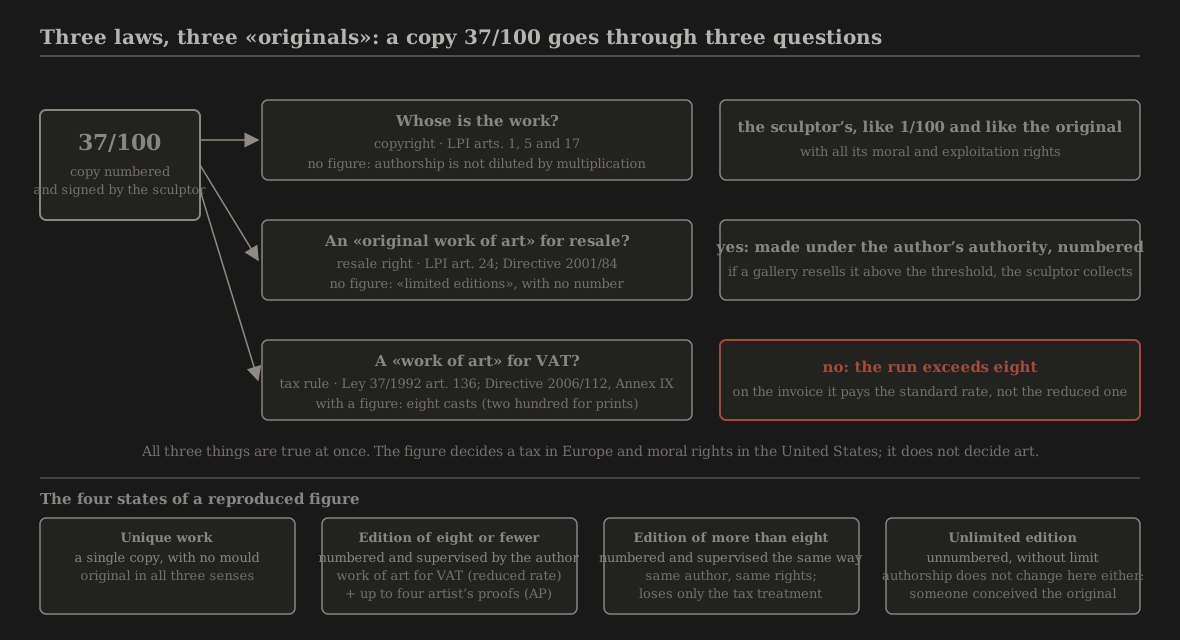
The four states of a reproduced figure
With all the above in view, the possible states of a figure can be set out; in the nativity-scene market they are badly named and confused every day:
Unique work. A single copy, from the sculptor’s own hands, with no mould or with the mould destroyed unused. It is an original work in every sense: that of the discipline, the tax sense and the copyright sense.
Edition limited to eight or fewer. Reproductions — from a mould, by milling or by printing— of an original conceived and modelled by the sculptor, numbered (1/8, 2/8…) and supervised by the sculptor. For European tax purposes they are original work, with the reduced rate. For copyright purposes, the authorship and the moral rights belong to the sculptor in all the copies.
Limited edition of more than eight. Numbered in the same way (1/50, 1/100…) and supervised in the same way. They are still the work of the same author with the same rights; what they lose, in Europe, is the tax treatment as a «work of art». Nothing more, and nothing less. It is an «original work of art» for the resale right and ceases to be a «work of art» for VAT because the run exceeds eight: both things at once, as was said above.
Unlimited edition. Unnumbered and without limit: it is reproduced for as long as the mould or the file holds out. Authorship does not change here either. It is the point that nativity-scene circles find hardest to accept and the most important: however many copies are made, someone conceived the original, and that someone remains the author, with their moral rights intact.
Artist’s proofs. Those made during the process to check the milling, the mould or the polychromy. They are marked AP/1, AP/2…, and French doctrine admits up to four of them, outside the edition.72
What the figure does not say
None of the four states says anything about the quality of the figure, about the trade of whoever made it or about their standing as a sculptor. A unique original can be bad and an edition of a hundred can be excellent. The figure decides a tax in Europe and moral rights in the United States; it does not decide art. Whoever uses the number of copies as an argument about the value of a work is using a tax rule as if it were an aesthetic criterion.
The figure decides a tax in Europe and moral rights in the United States; it does not decide art.
What an original work in sculpture is, today
One question remains that the tax laws do not answer and that arises in the workshop every day: what counts as making the original.
The law asks two things: that it be an original creation and that the author have made it. It does not ask for particular tools. So modelling in clay with the fingers and a modelling tool, carving in wood, or modelling in three dimensions with a digital pen are, legally, the same: the sculptor conceives and gives form. The previous chapter already established this from the side of the discipline — digital modelling is modelling— and here it is confirmed from the side of the law: no article of the six mentions the tool.
Two specific cases, because they circulate badly in nativity-scene circles:
One’s own bases. Many sculptors start from mannequins, heads or proportions they themselves modelled earlier. Starting from a basic structure of one’s own does not detract from the originality of the result if the result is a new creation: the sculptor is reusing their own preparatory work, which is exactly what the vocabulary of sculpture calls preparatory work.1 The coincidence of some proportions between two figures by the same author is no indication of anything, just as the coincidence of manner in two pictures by the same painter is not.
«A palillo» and «semi palillo». These are expressions of Spanish nativity-scene slang — literally «by modelling tool» and «semi modelling tool»—, not technical terms, and it is worth seeing what they really name, because they do not name what they seem to. The «palillo», the modelling tool, is a tool, not a technique: every modelled figure — in clay, in wax, in plasticine or on screen— is modelled with a modelling tool and with the fingers, and the only thing the expression leaves out is carving, which is not modelling. The pen used for modelling in a three-dimensional program changes none of this: its tip is plastic and does not write, draw or paint; it pushes form, like the boxwood modelling tool, and on the same tablet one also models with the fingers.114 But in the nativity-scene market «a palillo» is not said in order to speak of the tool: it is said to name the unique figure, the one with no reproductions, and to distinguish it — and charge for it— as against the editioned ones. It is no accident: the words of that market are fixed by those who buy and those who compose scenes, not by those who model, and they name what they see from outside — a single piece or a series—, not the operation that lay behind it. That is: the word has jumped from the sculptor’s hand to the state of the edition, and names by the tool what can only be distinguished by the run. It is the same confusion this section has just undone with three laws: the tool means nothing to any of them, and the run matters to only one. «Semi palillo», for its part, names nothing — half a pen?—. The examination of the two expressions, and of why a jargon that does not distinguish well ends up deciding prices and categories, belongs to the chapter on the language of nativity-scene art and practice, still to be written.75 Here it is enough to say what the law allows one to say: in law there are no intermediate categories. Either there is an original work — created by its author, with whatever tools— or there is a reproduction of an original work. And a substantial modification made on one’s own mould, if it gives rise to a new creation, is an original work.
The tax, country by country, and what happened in 2025
The table that follows was checked rule by rule on 21 September 2026. It is given because the reader of this Manual sells or buys figures in six countries, and because the previous version of this material had two figures wrong.
| Country | Original sculpture supplied by its author | Standard rate | Since | Rule |
|---|---|---|---|---|
| France | 5.5% | 20% | 1-I-2025 | CGI art. 278-0 bis, I; art. 83 of the 2024 finance law76 |
| Italy | 5% | 22% | 1-VII-2025 | Tabella A, parte II-bis, n. 1-novies, introduced by D.L. 95/202577 |
| Germany | 7% | 19% | 1-I-2025 | § 12.2.1 UStG and Anlage 2 no. 53; Jahressteuergesetz 202478 |
| Spain | 10% | 21% | unchanged since 2014 | Ley 37/1992, art. 91.Uno.4.1.º, and art. 90.Uno79 |
| United States | Unknown: state sales tax, fifty different regimes | — | — | — |
And there is something in that table that is in none of the rules and can only be seen by putting them together. In 2025, three of the four European countries untied the reduced rate from the person of the author. In France, the 5.5% applies since 1 January 2025 to every supply of a work of art, except those subject to the margin scheme, and no longer because it is the author who sells.76 In Germany, the Jahressteuergesetz of 2024 repealed the paragraph that contained precisely the author rule and returned works of art to the general list of goods at the reduced rate.78 In Italy, the new 2025 entry does not distinguish by author either: the condition is that the margin scheme does not apply.77 Only Spain keeps the old wording, the one that says «las entregas de objetos de arte realizadas por las siguientes personas: 1.º Por sus autores o derechohabientes» — supplies of works of art made by the following persons: 1. By their authors or successors in title—.79
What is maintained here is a reading of those four texts, not a statement made by any of them: favourable tax treatment is ceasing to be a recognition of whoever creates and is becoming a characteristic of the object that circulates. For a sculptor who sells their own work the immediate result is good — they pay less in three countries—; what is lost is one of the few occasions on which a general law explicitly distinguished the author from other sellers.
5. The figure within the ensemble: what each person may do
A nativity figure hardly ever lives alone. It is bought, travels to someone’s house, enters a scene built by another person, is lit, photographed, published, sometimes repainted and sometimes sold again. At each of those steps there is someone doing something with a work that is not theirs, and the question of what each person may do has no common-sense answer: it has a legal answer, and it is more nuanced than it seems.
The figure does not dissolve into the scene
The conclusion first, before the path, because it is the one each reader takes home: the scenography is the scenographer’s work, and its rights are the scenographer’s; the figures are not the scenographer’s work, and their rights still belong to the sculptor. That the figure enters the scene does not make it part of the work of whoever places it, like the moss or the cork; it remains a whole work, with its whole author, inside another work that has another author. What follows is why the law says this, and not the opposite.
A film shows it better than any definition. The director is the author of the film: the scene — the framing, the light, the rhythm, where each person stands— is the director’s, and Spanish law names the director as an author of the audiovisual work.115 But the music heard in it has another author, the composer, who does not cease to be one because the music forms part of the film; and the novel the film adapts still belongs to the novelist, because the film is a work derived from it and a derivative work does not swallow the work from which it derives.116 An actor — who is the author of nothing: the law gives actors other rights, those of performers, and the right to their own image— may not be photographed in a scene and that photograph sold without their authorisation.117 If that holds for someone who only performs, it holds all the more for someone who has created a work. The nativity scene is to the figure what the film is to the novel it adapts: the work of another, made with works that still belong to those who made them.
The nativity scene is to the figure what the film is to the novel it adapts.
The law has three names for the ways in which several people can take part in a work, and it is worth looking at them because the nativity scene falls into one of them and not into the other two. French law defines them in a single article:
«Est dite de collaboration l'oeuvre à la création de laquelle ont concouru plusieurs personnes physiques. Est dite composite l'oeuvre nouvelle à laquelle est incorporée une oeuvre préexistante sans la collaboration de l'auteur de cette dernière. Est dite collective l'oeuvre créée sur l'initiative d'une personne physique ou morale qui l'édite, la publie et la divulgue sous sa direction et son nom et dans laquelle la contribution personnelle des divers auteurs participant à son élaboration se fond dans l'ensemble en vue duquel elle est conçue, sans qu'il soit possible d'attribuer à chacun d'eux un droit distinct sur l'ensemble réalisé.»80
A work of collaboration is one in whose creation several natural persons have taken part. A composite work is a new work into which a pre-existing work is incorporated without the collaboration of the author of the latter. A collective work is one created on the initiative of a natural or legal person who edits it, publishes it and discloses it under their direction and name, and in which the personal contribution of the various authors merges into the whole without it being possible to attribute to each of them a distinct right over the whole produced.
The nativity scene with bought figures is, in the French word, a composite work: a new work — the scene— into which pre-existing works — the figures— are incorporated without the collaboration of their authors. Spanish law has the same notion in the same words — «obra compuesta [es] la obra nueva que incorpore una obra preexistente sin la colaboración del autor de esta última», a composite work [is] a new work that incorporates a pre-existing work without the collaboration of the author of the latter— and adds what matters here: «sin perjuicio de los derechos que a éste correspondan y de su necesaria autorización» — without prejudice to the rights belonging to that author and to their necessary authorisation—; and a work that is an autonomous creation «se considerará independiente, aunque se publique conjuntamente con otras» — shall be considered independent, even if it is published together with others—.118 It is not a work of collaboration, because the sculptor has not taken part in making the scene; it is not a collective work, because the figures do not merge into the whole: they can be taken out one by one, and each remains what it was. That criterion — whether the contributions can be separated or not— is the one the other laws use too: Spanish law allows each co-author to exploit their contribution separately81 and reserves the collective work for when a distinct right over the whole can no longer be attributed to anyone;82 Italian law requires, for joint ownership, that the contribution be «indistinguibile ed inscindibile»;83 German law, that the parts cannot be exploited separately.84 The figures of a nativity scene are distinguishable and separable, so none of those laws absorbs them into the whole. It is a reading of the four texts, not a statement by any of them, and it is declared as such; but it is a reading that all four support equally, which is the most that can be asked when no law has ever thought about a nativity scene.
And the other side, with the same clarity: the scenographer is the author of the scene. Their work is the composition — the framing, the place, the light, the rhythm, the relationship between the figures—, and it is their work even if the figures are someone else’s, just as the film is the director’s even if the novel is someone else’s. The chapter on composition develops that trade from the side of the work; here it is established from the side of the law.85
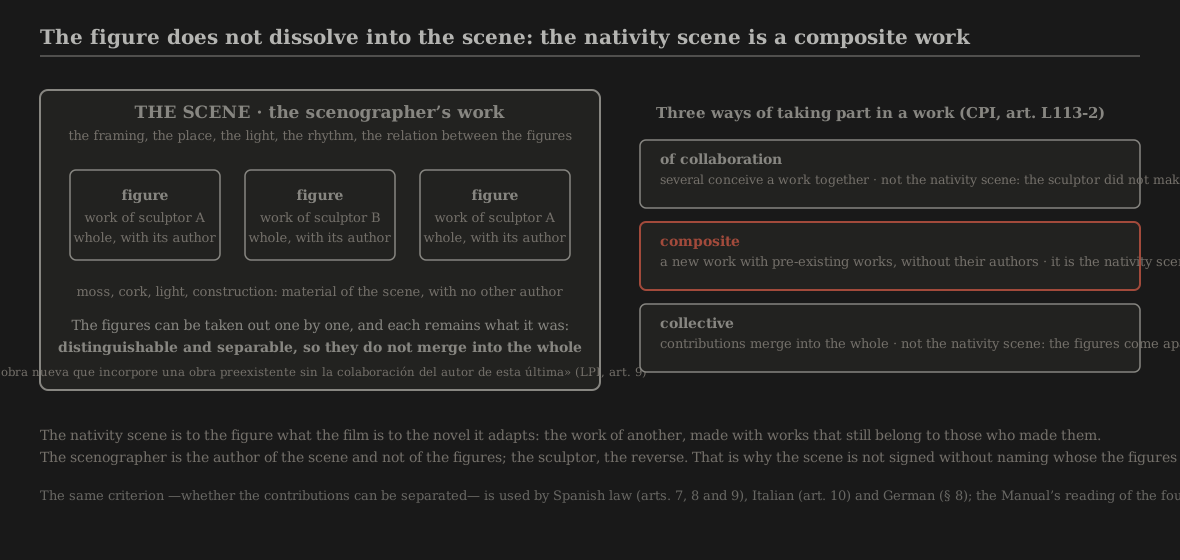
What the collector may do
They may exhibit. By law and without agreeing it: the owner of the original of a work of the plastic arts has the right of public exhibition, unless the author expressly excluded it in the sale.62 Germany says the same.66
They may sell. They own the object and may resell it. If the resale goes through an art-market professional and exceeds the threshold, the resale right becomes payable, and the seller pays it.59
They may not claim authorship nor omit the sculptor’s when circulating the figure. It is the moral right of recognition, and in Spain it cannot be waived.32
They may not modify the figure if the modification harms the author’s legitimate interests or damages their reputation. Here it is worth being precise, because the real case is finer than is usually told. Spanish law does not prohibit every modification: it prohibits «cualquier deformación, modificación, alteración o atentado contra ella que suponga perjuicio a sus legítimos intereses o menoscabo a su reputación» — any distortion, modification, alteration or attack on it that is prejudicial to the author’s legitimate interests or detrimental to their reputation—.32 The harm is part of the definition. Repainting a bought figure and keeping it at home, without showing it or attributing it, is hardly going to damage anyone’s reputation; repainting it, photographing it and publishing it with the sculptor’s name is something else, because then what circulates under their name is not their work. And so is sawing off the base, changing an arm or adding an attribute and circulating it like that. The border does not lie in touching or not touching: it lies in whether the result is presented as the author’s work.
Photographing and publishing is reproduction and communication to the public of someone else’s work.44 In practice, whoever sells a figure tacitly consents to the buyer photographing it for their own enjoyment; from there to publishing it in a virtual exhibition or in a magazine there is a step that is best taken with the author’s name attached. Again: it is not courtesy, it is article 14.3.
What the scenographer may do
Everything the collector may, and also compose: place, light, group, build the scene and exhibit it. That is their work.
What they may not do is the same as what the collector may not, with an addition specific to their trade: they may not sign the scene as theirs without naming whose the figures are. Not because it is good manners, but because the scene is a composite work and the incorporated work has an author.80
There is a borderline case that this Manual has already dealt with from another side and that here receives its legal name: dressing and polychromy. If the sculptor delivers the figure undressed and unpainted, and another person dresses and paints it on the sculptor’s commission or with the sculptor’s authorisation, those people are executants in the sense of the previous chapter1 and their work forms part of the author’s work. If an already finished figure is repainted afterwards, without the author, someone else’s work is being transformed, and transformation requires authorisation.48 The difference lies in the moment and in the permission, not in the skill of whoever paints.
The copy, the study, the version and the forgery
Reproducing a work that is not one’s own is not a single case but five, and the law does not treat them alike. It is worth looking at them one by one, because in nativity-scene circles they are confused every day, and the confusion runs in both directions: there are those who believe everything is forbidden and those who believe everything is allowed.
Reproducing with permission. This is the executant’s case, and the answer was already given in the previous chapter with the text of the discipline: among the executants, «seuls ceux qui travaillent sous le contrôle de l'auteur du modèle ou avec son autorisation ont une activité légalement reconnue» — only those who work under the control of the author of the model or with the author’s authorisation have a legally recognised activity—.86 The law says the same without adjectives: reproduction may not be carried out without the author’s authorisation.43 And the same book adds something almost nobody knows: not only does the executant acquire no copyright by reproducing accurately, but since the French law of 1909 they have been obliged to do the opposite, to name the author: «ceux-ci ne peuvent plus prétendre à une protection légale et sont même tenus de mentionner sur l'œuvre achevée le nom de l'auteur du modèle» — they can no longer claim legal protection and are even obliged to put on the finished work the name of the author of the model—.124 The figure that comes out of the mould of an authorised workshop carries the name of whoever conceived it, not of whoever cast it.
Reproducing without permission. This is the forger’s case, and the vocabulary of sculpture names it on the same page on which it names the executant, as its opposite: «ceux qui s'emparent d'une œuvre (modèle original ou œuvre achevée) pour la reproduire sans l'autorisation de l'auteur, sont considérés comme des contrefacteurs» — those who seize a work, whether the original model or the finished work, in order to reproduce it without the author’s authorisation, are considered forgers—.125 Taking a mould from someone else’s figure to reproduce it, scanning it in three dimensions to print it, milling it from a photograph: these are reproductions, and without authorisation they are unlawful. French law says it at once and without nuance: «Toute représentation ou reproduction intégrale ou partielle faite sans le consentement de l'auteur ou de ses ayants droit ou ayants cause est illicite.»87 In whole or in part: copying a head is copying too.
Copying a work in the public domain. Once the 70 years have passed, the work belongs to everyone, and copying it is free: one may copy a painting by Van Gogh or a figure by Salzillo, and sell them. What one may not do is sell them with his signature, or present them as his work: authorship and integrity outlive the term,56 and selling a copy as an original is, moreover, giving false information about «la existencia o la naturaleza del bien» — the existence or nature of the goods—.102 The copy is sold as a copy, or as a study, and says whose the original is. The Spanish Código Penal has no article that names the forgery of an artist’s signature: the words «obra de arte» and «artista», work of art and artist, do not appear in it.130 What it has are two general offences into which the case may fit. One is the offence against intellectual property, which punishes whoever, «con ánimo de obtener un beneficio económico directo o indirecto y en perjuicio de tercero, reproduzca, plagie, distribuya […]» — with intent to obtain a direct or indirect economic benefit and to the detriment of a third party, reproduces, plagiarises, distributes […]— a work without the authorisation of its rights holders; it therefore reaches only a work that is still protected. The other is fraud: «Cometen estafa los que, con ánimo de lucro, utilizaren engaño bastante para producir error en otro, induciéndolo a realizar un acto de disposición en perjuicio propio o ajeno» — those commit fraud who, for profit, use sufficient deceit to lead another into error, inducing them to perform an act of disposal to their own or another’s detriment—, and this holds even after the 70 years.130 Which of them applies to a specific case, and whether either applies, is for a judge to decide, not this Manual. What is maintained here is only that a false signature is not a lapse of courtesy: it lies in the territory of criminal law.
Copying in order to learn. It is the oldest way of learning a trade, and the law allows it within precise limits: no authorisation is needed for the reproduction of works already disclosed made «por una persona física exclusivamente para su uso privado, no profesional ni empresarial, y sin fines directa ni indirectamente comerciales» — by a natural person exclusively for their private use, neither professional nor business, and with no directly or indirectly commercial purpose—, from a lawful source, and provided that the copy «no sea objeto de una utilización colectiva ni lucrativa, ni de distribución mediante precio» — is not put to collective or profit-making use, nor distributed for a price—.126 Copying the figure of a living master in order to understand how they resolved a hand is lawful; the day that copy is exhibited at a fair or put up for sale, it ceases to be a study and becomes one of the two previous cases.
Making a version. This is something else: not reproducing someone else’s work, but making a new work from it — interpreting it, transforming it, translating it into another technique or another scale—. The law protects it as the work of whoever makes it, «sin perjuicio de los derechos de autor sobre la obra original» — without prejudice to the copyright in the original work—.116 Velázquez’s Las Meninas, painted in 1656 and held in the Museo del Prado, has versions by great masters. The best known is the series Picasso painted in Cannes between 17 August and 30 December 1957: 58 works, of which 45 are, in the words of the museum that holds them, «interpretaciones de la obra Las Meninas de Velázquez» — interpretations of Velázquez’s Las Meninas—. He donated them to the Museu Picasso in Barcelona in 1968.127 Each of those 45 is a work by Picasso, and the picture they start from is still Velázquez’s. On a work in the public domain, the version is free; on a protected work, transforming it requires its author’s authorisation,48 and the result has two authors, each of their own part.
And it is worth saying what is not prohibited, because fear of the law produces as much confusion as ignorance of it: making a chestnut seller is not copying someone else’s chestnut seller. The subject is free, traditional iconography is free, the posture of a trade observed in the street is free. What is not free is the specific form someone else gave it.
Making a chestnut seller is not copying someone else’s chestnut seller.
The limit case: Renoir and Guino
One case remains that the vocabulary of sculpture itself brings up as a warning, and it has to be told because it puts the whole line between author and executant to the test. The book summarises it thus in its appendix:
«Pierre-Auguste Renoir, à la fin de sa vie, atteint de rhumatismes déformants lui interdisant physiquement l'exécution de sculptures, avait fait appel, sur la proposition de son marchand de tableaux, A. Vollard, à un jeune élève âgé de 23 ans, R. Guino, pour réaliser l'œuvre sculptée à laquelle il avait toujours pensé. Près de 50 ans après, Guino, devant le refus des héritiers Renoir de l'autoriser à divulguer et à éditer certaines ébauches qui étaient restées sa propriété et que P.-A. Renoir n'avait pas voulu signer, s'est adressé à la justice pour se faire reconnaître coauteur d'une vingtaine de sculptures qu'il avait exécutées, de 1913 à 1917, sous la direction de Renoir.»128
Pierre-Auguste Renoir, at the end of his life, suffering from a deforming rheumatism that physically prevented him from executing sculptures, had turned, at the suggestion of his dealer, A. Vollard, to a young pupil aged 23, R. Guino, to produce the sculptural work he had always had in mind. Almost 50 years later, faced with the refusal of Renoir’s heirs to authorise him to disclose and publish certain rough sketches that had remained in his possession and that Renoir had not wished to sign, Guino went to court to be recognised as co-author of some twenty sculptures he had executed, from 1913 to 1917, under Renoir’s direction.
The Paris court, in a judgment of 11 January 1971, relied on the report of an expert, who stated that he had found «l'empreinte d'une création personnelle de Guino dans certaines expressions et certaines attitudes, car elles auraient été acceptées plutôt que dictées par Renoir» — the imprint of a personal creation by Guino in certain expressions and certain attitudes, because they had been accepted rather than dictated by Renoir—; the court of appeal confirmed it on 9 July 1971, and the Cour de cassation dismissed the appeal on 13 November 1973.131 The conclusion, in the words of the appendix: «Guino n'était pas un simple modeleur, mais […] il avait conservé sa liberté de création, concourant ainsi à une œuvre de collaboration avec le célèbre peintre.»128 Guino, who was not a mere modeller but had kept his freedom of creation, was recognised as co-author.
The Cour de cassation judgment says it in its own words: certain attitudes and expressions «avaient été acceptées et non dictées» by Renoir and bore «l'empreinte du talent créateur personnel de Guino»; Guino, «conservant sa liberté de création», had executed each sculpture in cooperation with Renoir, and the works were «de collaboration et non […] collectives». And it adds a sentence worth underlining, because it is the criterion of this whole chapter stated by a court: those findings «ne comportent aucune appréciation du mérite» of the works compared.131 The court did not judge whether Guino was a better or worse sculptor than Renoir. It judged who had decided what.
The case seems to break the line, and the book itself warns that it was so criticised that it «ne devrait pas pouvoir constituer un précédent».129 But read carefully, it confirms the line. Renoir did not touch the clay and was an author, because he conceived and directed; Guino modelled and was co-author only to the extent that he decided, and not for having modelled. What the court looked for was not who had had their hands in the clay, but who had taken the decisions that can be seen in the work: the expression, the attitude. It is exactly the criterion of this whole block, and it holds in both directions: the executant who merely reproduces someone else’s model is not an author however skilful they may be; and the one who, working for another, puts creative decisions of their own into the work is an author in that part. That is why it matters so much, in a workshop with assistants, to have it on record who decides what: not to diminish anyone, but so that each is what they are.
6. The work without a human author
The previous chapter ended by describing a new figure and naming it by what it lacks: a figure without a sculptor. Someone writes a description, an artificial-intelligence system generates a three-dimensional model, a printer materialises it. There is someone who asked for it and someone who printed it; there is nobody who conceived and modelled it. There it was established, with the vocabulary of sculpture, that whoever writes the description does not model and that the system is neither author nor executant.1 What the law says about it is what follows.
Between March 2023 and August 2026 the question has received four answers, two of them in this last year, and it is worth putting them in order.
Italy has written it into law, and it is the only one of the six
Its article 25 amends article 1 of the 1941 law —the article that opens the whole of Italian copyright— in two ways:
«a) all'articolo 1, primo comma, dopo le parole: "opere dell'ingegno" è inserita la seguente: "umano" e dopo le parole: "forma di espressione" sono aggiunte le seguenti: ", anche laddove create con l'ausilio di strumenti di intelligenza artificiale, purché costituenti risultato del lavoro intellettuale dell'autore";»88
So the Italian article 1 now reads:
«Sono protette ai sensi di questa legge le opere dell'ingegno umano di carattere creativo che appartengono alla letteratura, alla musica, alle arti figurative, all'architettura, al teatro ed alla cinematografia, qualunque ne sia il modo o la forma di espressione, anche laddove create con l'ausilio di strumenti di intelligenza artificiale, purché costituenti risultato del lavoro intellettuale dell'autore.»89
Works of the human intellect of a creative character belonging to literature, music, the figurative arts, architecture, theatre and cinematography are protected under this law, whatever their mode or form of expression, even where created with the aid of artificial-intelligence tools, provided that they constitute the result of the author’s intellectual work.
Two words and a phrase, and the question is settled for Italy in both directions: the tool does not disqualify — a figure modelled with the help of a system is still protected— and the absence of the author’s intellectual work does disqualify. The hinge is «risultato del lavoro intellettuale dell'autore»: one has to be able to point to what the person contributed.
The same law adds a new article on text and data mining for training systems, allowing it within the limits of the existing exceptions,88 and makes mining that goes beyond them an offence, «anche attraverso sistemi di intelligenza artificiale».90 That directly affects any sculptor whose photographs of their work are published online, which today means almost all of them.
The United States has been giving the same answer for three years
The federal copyright registration office published guidance in March 2023 whose central sentence is this:
«If a work's traditional elements of authorship were produced by a machine, the work lacks human authorship and the Office will not register it.91
For example, when an AI technology receives solely a prompt from a human and produces complex written, visual, or musical works in response, the "traditional elements of authorship" are determined and executed by the technology—not the human user.»
And in the same text, the comparison most useful to a sculptor:
«Instead, these prompts function more like instructions to a commissioned artist—they identify what the prompter wishes to have depicted,91
but the machine determines how those instructions are implemented in its output.»
It is exactly the distinction in section 1 of this chapter: whoever commissions is not an author. The office confirmed it in a report of January 2025 — «Based on the functioning of current generally available technology, prompts do not alone provide sufficient control»—92 and a federal court of appeals settled it in March 2025:
«The Creativity Machine cannot be the recognized author of a copyrighted work93
because the Copyright Act of 1976 requires all eligible work to be authored in the first instance by a human being.»
The other four laws are silent, and something follows from their silence
Spain, France, Germany and Andorra have written nothing on this. But they are not mute texts: all four define the author, and all four define the author the same way.
- Spain: «la persona natural que crea» — the natural person who creates—.5
- Germany: «Urheber ist der Schöpfer des Werkes».25
- France: «L'auteur d'une oeuvre de l'esprit» enjoys the right «du seul fait de sa création».94
- Andorra: «"autor" és la persona física que ha creat l'obra» — “author” is the natural person who has created the work—.95
From those four texts it follows —and this is this Manual’s reading, not a statement by any law— that a figure generated without human creative intervention has no author in any of the four countries; and that, if it has no author, there is no copyright in it; and that, if there is no copyright in it, anyone may reproduce and sell it without asking anyone’s permission. Whoever buys such a figure does not buy a work: they buy an object that is, from the first day, in something like the public domain. It is a consequence that is rarely mentioned and that has more practical effects than the abstract debate on whether the machine creates.
It must also be said that the question is open and moving, and that this chapter dates what it says: 21 September 2026.
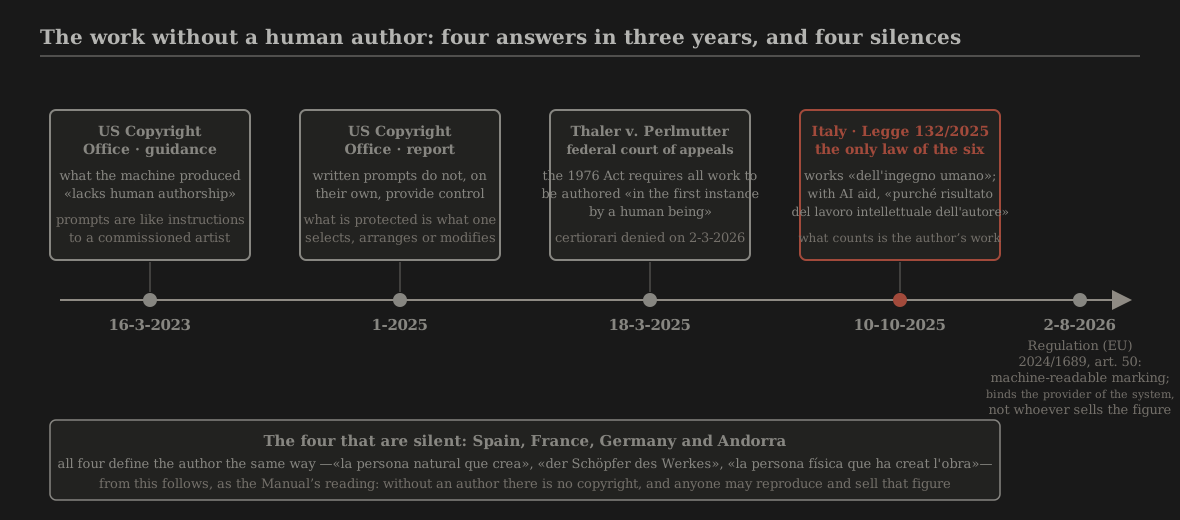
Must one declare that a figure has been made with artificial intelligence?
The question comes up at fairs and exhibitions, and the answer has two parts that should not be mixed.
The first is European and binds whoever makes the system, not whoever sells the figure.
«Los proveedores de sistemas de IA, entre los que se incluyen los sistemas de IA de uso general, que generen contenido sintético de audio, imagen, vídeo o texto, velarán por que los resultados de salida del sistema de IA estén marcados en un formato legible por máquina y que sea posible detectar que han sido generados o manipulados de manera artificial.» — Providers of AI systems, including general-purpose AI systems, generating synthetic audio, image, video or text content, shall ensure that the outputs of the AI system are marked in a machine-readable format and detectable as artificially generated or manipulated.—98
Read carefully who is bound and to what. The one bound is the provider of the system, not the seller of the figure. And what it must do is mark the output in a machine-readable format: a technical mark inside the file, not a sign in the display case. For systems already on the market before 2 August 2026 there is also a grace period until 2 December 2026.99
The same article imposes an obligation to declare on whoever deploys the system, but only in two cases: images, audio or video constituting a deep fake, and texts published to inform the public on matters of public interest.100 A printed nativity figure is neither of the two. So the European Regulation does not today oblige anyone to label a figure as «made with AI». This is a check of the text, not an opinion; and it does not mean that no obligation exists, because the second part follows.
The second is unfair competition, and that does reach whoever sells.
The European rule behind it considers misleading any practice that deceives as to «la existencia o la naturaleza del producto» — the existence or nature of the product— or as to its main characteristics, among which it expressly names «el procedimiento y la fecha de su fabricación» — the method and date of manufacture—.101 Spanish law transposes it in the same words:
«Se considera desleal por engañosa cualquier conducta que contenga información falsa o información que, aun siendo veraz, por su contenido o presentación induzca o pueda inducir a error a los destinatarios, siendo susceptible de alterar su comportamiento económico, siempre que incida sobre alguno de los siguientes aspectos: a) La existencia o la naturaleza del bien o servicio. b) Las características principales del bien o servicio, tales como […] el procedimiento y la fecha de su fabricación o suministro […]» — Any conduct is considered unfair as misleading if it contains false information, or information that, although truthful, by its content or presentation misleads or may mislead its recipients and is liable to alter their economic behaviour, provided that it concerns any of the following aspects: a) The existence or nature of the goods or service. b) The main characteristics of the goods or service, such as […] the method and date of their manufacture or supply […]—102
And what is kept quiet counts just as much as what is said:
«Se considera desleal la omisión u ocultación de la información necesaria para que el destinatario adopte o pueda adoptar una decisión relativa a su comportamiento económico con el debido conocimiento de causa.» — The omission or concealment of the information necessary for the recipient to take, or be able to take, a decision on their economic behaviour with due knowledge of the facts is considered unfair.—103
From this follows what matters to nativity-scene art and practice, and it should be said without beating about the bush and without accusing anyone: the problem is not using artificial intelligence; the problem is selling as an author’s figure what is not one. Whoever presents a generated and printed figure as modelled by hand is giving false information about the method of manufacture; whoever keeps quiet about it knowing that the buyer is paying for an author’s work is omitting necessary information. And none of this requires a new law: unfair competition law has been in force since 1991.
The problem is not using artificial intelligence; the problem is selling as an author’s figure what is not one.
From all of the above comes a practical consequence for whoever buys, for whoever composes with other people’s figures and for whoever organises a fair or an exhibition, and it is worth stating because it does not depend on any change in the law. What distinguishes an author’s figure from a figure without a sculptor is not in the object: it is in the process. By eye, today, a sculptor recognises the generated figure by its faults — the pose with no reason, the hesitant hands, the drapery that does not obey the body, the object that would not work, the mixture of periods—; but that eye is today’s, and tomorrow it may not be enough, even for the expert. What the machine cannot have, on the other hand, is what every sculptor has: the path — the sketches, the intermediate states, the file with its version history, the prior research— and the ability to modify live what they have made while keeping their hand. Footage of work can be faked, and this has already been seen; a working history with its decisions and a variation requested on the spot, much less so. For someone starting out who has no track record, this is precisely what they can show.
Hence the useful criterion is to ask for the procedure and not the promise. It is the same thing that unfair competition law already requires of the seller — not to deceive or keep quiet about «el procedimiento […] de su fabricación», the method […] of its manufacture102—, taken one step ahead: that whoever exhibits declares how the figure was made and can show it, and that the fair or exhibition asks for this in writing before the conflict arrives. It is not a hypothesis: it has already happened. On 12 August 2026 the organisers of the Feria Internacional de Belenismo in Alcobendas notified their exhibitors of two new rules for the 2026 edition. Rule 4: «El expositor se responsabiliza de exponer y vender sus propios productos. […] Los artículos en venta tienen que ser artículos realizados por el expositor y nunca comerciales.» — the exhibitor is responsible for exhibiting and selling their own products […]; the articles on sale must be articles made by the exhibitor and never commercial ones—. And rule 15: «No se permiten diseños realizados por IA, copias y similares» — designs made by AI, copies and the like are not allowed—, with this reasoning: «Los diseños realizados por IA son muy parecidos, casi iguales, por ello No se aceptaran en la Feria creadores con IA porque básicamente sería como tener varios expositores con el mismo artículo y eso sería como un artículo comercial que podemos comprar en una tienda» — designs made by AI are very similar, almost identical, which is why creators using AI will not be accepted at the Fair, because it would basically be like having several exhibitors with the same article, and that would be like a commercial article we can buy in a shop—; and in its summary: «No es lo mismo pasarse horas diseñando un modelo que realizarlo en segundos por Inteligencia Artificial (IA). La Feria InterNacional de Belenismo busca Escultores» — spending hours designing a model is not the same as producing it in seconds by Artificial Intelligence (AI); the International Fair of Belenismo is looking for Sculptors—.123 A fair has arrived on its own, from practice, at what this chapter has been drawing out of the law: that what is missing from the generated figure is the work that lay behind it, that its mark is the resemblance between one and another, and that what is being sought is the sculptor. And it has also arrived, without seeing it, at the contradiction this block examines: the rule calls the fair a «Feria de Productos Artesanales» — a fair of craft products— and on the same page declares that it «busca Escultores», is looking for sculptors. The two things in one and the same text are the best possible summary of why the previous chapter was needed. And it holds exactly the same for the generated figure as for plagiarism and the pastiche of figures modelled by hand: in all three cases the same path is missing. The signs by which a figure without a sculptor can be recognised by eye today are workshop observation, change with the technique and belong to the chapter on the figure; what stays here is what does not change: whoever has conceived a work can show how they conceived it — the sketches, the states, the decisions—; whoever has written a description can only show what the machine returned to them — an STL, OBJ, FBX, USD or glTF file— and what they did with it afterwards, which is the work of an executant on a model they did not conceive, with the difference that this one was conceived by nobody. Before the file there is nothing to show, because there was nothing. It should be said with the gradation the law requires, because not every description is the same: the United States copyright office protects «the creative selection, coordination, or arrangement of material in the outputs, or creative modifications of the outputs» and examines each case;92 Italian law protects what is made with the aid of a system «purché costituenti risultato del lavoro intellettuale dell'autore».89 Whoever truly conceives — whoever writes in detail what they want, in what attitude, with what composition and with what style of their own, and not «in the style of» an author the law still protects; whoever corrects the result again and again and decides at each step— is doing intellectual work, and can show it. With a single description and a button there is nothing to show. And with this the table in section 1 is closed: whoever prints and sells what a written description returned to them reproduces a work that nobody conceived, and that is, exactly, the third position — the craftsman’s—. They are not an executant, because there is no author whose model they execute. They are the only person in today’s nativity scene to whom the word craftsman properly belongs, and they are called anything but that; whereas the sculptor who conceives, the only one to whom it does not belong, has been called that for decades. Whether a figure downloaded from a system can be registered as an industrial design by whoever downloaded it is a question this chapter does not settle: design law asks for novelty and individual character, not authorship, and who is entitled to register what nobody conceived is a question the sources consulted do not answer.
Ask for the procedure and not the promise.
One warning of method remains, and this Manual has to give it to itself. Everything above consists of texts checked today, in a field that has changed three times in three years. Read it with the date in place; and what is declared here as this Manual’s own reading — the consequence of the four silences— will remain its own reading until a court or a legislator confirms or refutes it in each of those four countries.
7. Closing
What this chapter has done is not to teach laws: it is to show that the distinction of the previous chapter — between whoever conceives a figure and whoever executes it— is not a sculptor’s opinion, because it is written in six legal systems that have not agreed among themselves and that nevertheless say the same thing in essence. The right is born with creation, belongs to the person who creates, does not depend on any registration or any title or on the size of the work, has one part that is never sold and another that is negotiated, and does not dissolve because the figure enters a scene.
From this come three consequences that nativity-scene art and practice handles badly every day and that should be stated plainly.
The first: recognition of the author is not a courtesy that is asked for, it is a right that is held. Publishing a scene without saying whose the figures are is not a lapse of etiquette; it infringes a right that cannot be waived, which Spanish law lists in its article 14 and which the Berne Convention has imposed on all countries since 1886.
Recognition of the author is not a courtesy that is asked for, it is a right that is held.
The second: the number of copies measures nothing of what it is believed to measure. The eight of the European rule decide a rate of VAT; the two hundred of the American rule decide moral rights; neither says whether a work is good, or whether whoever made it is a sculptor. Using those figures as an aesthetic argument is taking a tax rule for a criterion of art.
The third: the figure without a sculptor calls for better naming, not for alarm. Italy has already written into its law that what is protected is the work of the human intellect; the United States has been saying for three years that a written description is not enough; the other four countries are silent, and from their silence it follows that such a figure has no author and that anyone may reproduce it. The real problem is not the tool: it is selling one thing as another, and for that the law has had a name for a long time.
With this, what the law recognises for the sculptor is established. The next chapter changes subject and looks at the figure itself: what a nativity figure is when it is considered as a work and not as a component, what destinies it admits and what decides which of them is its own. Then will come the client and the commission, where everything in this chapter becomes a contract; and the remaining roles, where each of those who have appeared here in passing — the reproducer, the polychromer, the dresser, the scenographer, the collector— receives their own.
References
Chapter on the sculptor, The sculptor: «One trade, two names», section 2 «What a sculptor is and how a sculptor works» and section 4 «What the sculptor does, and what the sculptor does not do»: the author / executant distinction according to Baudry and Bozo, La Sculpture. Méthode et vocabulaire, chap. I; and section «The figure without a sculptor». ↩ ↩ ↩ ↩ ↩ ↩ ↩ ↩ ↩
Chapter on the world, What it covers: «A world around a theme», section «The work, on two levels»: author’s figures, commercial-brand figures, automata. ↩ ↩
Chapter on the definition, The definition: «Making the Nativity present so as to move»: «practice, not title»; the category is no guarantee. ↩
Spain, Real Decreto Legislativo 1/1996, de 12 de abril, consolidated text of the Ley de Propiedad Intelectual, art. 1. Consolidated BOE text (boe.es/buscar/act.php?id=BOE-A-1996-8930), latest update published on 30-III-2022, consulted on 21-IX-2026. ↩
United States, 17 U.S.C. § 102(b). Legal Information Institute, Cornell Law School (law.cornell.edu/uscode/text/17/102), consulted on 21-IX-2026. ↩
Andorra, Llei sobre drets d'autor i drets veïns, de 10 de juny de 1999, art. 19.4. See note 28. ↩
Spain, Ley 20/2003, de 7 de julio, de Protección Jurídica del Diseño Industrial, art. 1.2 a). Consolidated BOE text (BOE-A-2003-13615), latest update published on 4-VII-2018, consulted on 21-IX-2026. ↩ ↩ ↩
Spain, Ley 17/2001, de 7 de diciembre, de Marcas, art. 4. Consolidated BOE text (BOE-A-2001-23093), latest update published on 28-VII-2022, consulted on 21-IX-2026. ↩
Ley 20/2003, disposición adicional décima (tenth additional provision), «Compatibilidad de la protección». ↩ ↩
Criterion set by this Manual on 21-IX-2026 and applied in The dossier: «The Real Decreto 481/2022: the declaration that demotes what it declares», section 4, and in The sculptor: «One trade, two names», section 3: repetition does not make craft; what separates is whether behind what is repeated there is a conceived original. ↩
An Act for the Encouragement of Learning, by Vesting the Copies of Printed Books in the Authors or Purchasers of such Copies, During the Times therein mentioned, 1710, 8 Anne c. 19. Diplomatic transcription of the original parchment (Parliamentary Archives, United Kingdom) published in Primary Sources on Copyright (1450-1900), eds. L. Bently and M. Kretschmer, copyrighthistory.org, record «Statute of Anne, London (1710)», consulted on 21-IX-2026. The original has no punctuation; it is reproduced as it stands. ↩ ↩ ↩
Ibid., checked against the modernised version of the Avalon Project, Yale Law School (avalon.law.yale.edu/18th_century/anne_1710.asp), consulted on 21-IX-2026. Checking note: the formula «the sole Right and Liberty of Printing» corresponds in the text to the term of twenty-one years for books already printed; for new works (fourteen years) the text says «the sole liberty of printing and reprinting». The two versions agree. ↩
Convenio de Berna para la Protección de las Obras Literarias y Artísticas, Paris Act of 24-VII-1971, amended on 28-IX-1979. Official Spanish translation, WIPO Lex, TRT/BERNE/001 (wipo.int/wipolex/es/text/283700), consulted on 21-IX-2026. ↩ ↩
Ibid., art. 2.1). ↩
Ibid., art. 6bis.1). ↩
Ibid., art. 7.1). ↩
WIPO Lex, «Partes Contratantes / Signatarios — Convenio de Berna» (wipo.int/wipolex/es/treaties/ShowResults?search_what=C&treaty_id=15), consulted on 21-IX-2026: «Total Miembros: 182». The «Firma» (signature) columns for Andorra and the United States are empty: both joined by accession. ↩
Italy, Legge 22 aprile 1941, n. 633, «Protezione del diritto d'autore e di altri diritti connessi al suo esercizio», GU n. 166 of 16-VII-1941. Consolidated Normattiva text (normattiva.it), in force as at 21-IX-2026, consulted that day. The double brackets in the text are Normattiva’s convention for marking what was introduced by amending rules. ↩
Ibid., art. 2, n. 4. ↩
Germany, Gesetz über Urheberrecht und verwandte Schutzrechte (Urheberrechtsgesetz, UrhG). Official text on gesetze-im-internet.de, status «zuletzt geändert durch Art. 2 G v. 26.5.2026 I Nr. 157», consulted on 21-IX-2026. Translations are the Manual’s own. ↩
Ibid., § 2 Abs. 1 Nr. 4 and Abs. 2: «Werke im Sinne dieses Gesetzes sind nur persönliche geistige Schöpfungen» — only personal intellectual creations are works. ↩
France, Code de la propriété intellectuelle, version consolidated as at 13-III-2025. WIPO Lex, no. FR625 (wipo.int/wipolex/fr/legislation/details/23227), consulted on 21-IX-2026. It is quoted from the consolidated text that WIPO publishes in its legislation database; the spelling «oeuvre» without the ligature is that of the document. ↩
Ibid., art. L112-2, 7°. ↩
Andorra, Llei sobre drets d'autor i drets veïns, de 10 de juny de 1999, Butlletí Oficial del Principat d'Andorra no. 38, any 11, 7-VII-1999. Facsimile of the BOPA in WIPO Lex, no. AD002 (wipo.int/wipolex/es/legislation/details/6925), and text of the Consell General (consellgeneral.ad), consulted on 21-IX-2026. In force; amended only by Llei 23/2011, del 29 de desembre, de creació de la Societat de gestió col·lectiva de drets d'autor i drets veïns. ↩ ↩
Ibid., art. 2.1) f). ↩
United States, Copyright Act of 1976, 17 U.S.C. Legal Information Institute, Cornell Law School (law.cornell.edu/uscode/text/17), consulted on 21-IX-2026. ↩
Ibid., § 102(a)(5); definition in § 101: «"Pictorial, graphic, and sculptural works" include two-dimensional and three-dimensional works of fine, graphic, and applied art […]». ↩
France, CPI, art. L121-1. ↩
Andorra, Llei of 1999, art. 6.3. ↩
Germany, UrhG, § 12. ↩
Ibid., § 13. ↩
Ibid., § 14. ↩
Ibid., § 29 Abs. 1. ↩
Italy, L. 633/1941, art. 20, first paragraph. ↩
United States, 17 U.S.C. § 106A(a). ↩
Ibid., § 101, definition of «work of visual art», with its exclusions. ↩ ↩ ↩
Ibid., § 106A(d)(1): for works created after VARA came into force, the rights last «a term consisting of the life of the author». ↩
France, CPI, art. L122-3, first and second paragraphs. ↩
Spain, LPI, art. 19.1. ↩
Ibid., art. 20.1 and art. 20.2 h). ↩
France, CPI, art. L122-1: «Le droit d'exploitation appartenant à l'auteur comprend le droit de représentation et le droit de reproduction.» ↩
Germany, UrhG, § 15 Abs. 1 (reproduction, distribution, exhibition), § 16 Abs. 1, § 17 Abs. 1, § 23 Abs. 1. ↩
Italy, L. 633/1941, arts. 12, 13, 17 and 18. ↩
Andorra, Llei of 1999, art. 5.1), letters a) to i). ↩
United States, 17 U.S.C. § 106, in full. ↩
Spain, LPI, art. 26; Germany, UrhG, § 64 («Das Urheberrecht erlischt siebzig Jahre nach dem Tode des Urhebers»); France, CPI, art. L123-1; Italy, L. 633/1941, art. 25 with the update note note 55; Andorra, Llei of 1999, art. 18.1; United States, 17 U.S.C. § 302(a). Common European framework: Directive 2006/116/EC, art. 1.1 (EUR-Lex, CELEX 32006L0116, consulted on 21-IX-2026). ↩
Italy, Normattiva, apparatus «AGGIORNAMENTO (14)» to art. 25 of L. 633/1941: «La L. 6 febbraio 1996, n. 52, ha disposto (con l'art. 17, comma 1) che "I termini di durata di protezione dei diritti di utilizzazione economica delle opere dell'ingegno […] sono elevati a 70 anni."». ↩
Berne Convention, art. 14ter.1). ↩
Directiva 2001/84/CE del Parlamento Europeo y del Consejo, de 27 de septiembre de 2001, on the resale right for the benefit of the author of an original work of art (EUR-Lex, CELEX 32001L0084), consulted on 21-IX-2026. ↩
Spain, LPI, art. 24.1. Note on the text in force, checked on 21-IX-2026: art. 24 was repealed by Ley 3/2008, de 23 de diciembre, and reintroduced into the LPI by Ley 2/2019, de 1 de marzo, which in turn repealed Ley 3/2008 with effect from 3-III-2019. The threshold of the repealed law was €1,200; the one in force, in art. 24.7, is €800. ↩ ↩
Directive 2001/84/EC, art. 2.2. ↩
Germany, UrhG, § 26 Abs. 1 (threshold: «wenn der Veräußerungserlös weniger als 400 Euro beträgt») and Abs. 2 (percentages and cap of €12,500); Spain, LPI, art. 24.7 and 24.8; Italy, L. 633/1941, art. 150.1 (threshold of €3,000) and 150.2-3 (percentages and cap); France, CPI, art. L122-8 (the €10,000 exception and the reference to a decree). ↩
France, CPI, art. L111-3, first paragraph. ↩
United States, 17 U.S.C. § 202. ↩
Andorra, Llei of 1999, art. 25. ↩
Baudry / Bozo, La Sculpture. Méthode et vocabulaire, p. 298, section «Les exemplaires authentiques». Checked against Emili Solé’s copy, scan of 21-IX-2026. Translation is the Manual’s own. Home of the argument: this chapter; in The dossier: «The Real Decreto 481/2022: the declaration that demotes what it declares» it remains as a supporting note. ↩
Directiva 2006/112/CE del Consejo, de 28 de noviembre de 2006, on the common system of value added tax, consolidated version 02006L0112 — ES — 01.01.2025 — 029.001 (EUR-Lex), consulted on 21-IX-2026. ↩
Ibid., Annex IX, Part A «Works of art», point 3). ↩
Spain, Ley 37/1992, de 28 de diciembre, del Impuesto sobre el Valor Añadido, art. 136.Uno.2.º c). Consolidated BOE text (BOE-A-1992-28740), latest update published on 28-II-2026, consulted on 21-IX-2026. ↩ ↩
Italy, Decreto-legge 23 febbraio 1995, n. 41, converted with amendments by L. 22 marzo 1995, n. 85, tabella allegata, lettera a), third indent. Normattiva, consulted on 21-IX-2026. The Italian VAT law (D.P.R. 633/1972) refers to this table from Tabella A, parte II-bis, n. 1-novies; in D.P.R. 633/1972 itself the word «scultur-» does not appear. ↩
France, BOFiP-Impôts, BOI-TVA-SECT-90-10, «Biens d'occasion, œuvres d'art, objets de collection ou d'antiquité — Définitions», §§ 180-210, published on 20-III-2024 (bofip.impots.gouv.fr/bofip/1279-PGP.html), consulted on 21-IX-2026. It is administrative doctrine of the Direction générale des Finances publiques, not legal text: it comments on art. 98 A, II, 3° of Annex III to the Code général des impôts, which is cited here through it. The BOI itself states in its § 1 that those definitions come from Directive 2006/112/EC. Translation is the Manual’s own. ↩ ↩ ↩
Germany, UStG, Anlage 2 (zu § 12 Absatz 2 Nummer 1, 2 und 14), no. 53, letter c) (gesetze-im-internet.de/ustg_1980/anlage_2.html), consulted on 21-IX-2026. The whole heading consists of three letters: a) paintings and drawings (heading 9701), b) original engravings (9702), c) the text quoted (9703). ↩
Bundesministerium der Finanzen, Amtliche Umsatzsteuer-Handausgabe, C. Anhänge, Anhang 1 (Mehrwertsteuer-Systemrichtlinie), Anhang IX (ao.bundesfinanzministerium.de), consulted on 21-IX-2026: «unter Aufsicht des Künstlers oder seiner Rechtsnachfolger hergestellte Bildgüsse bis zu einer Höchstzahl von acht Exemplaren (KN-Code 9703 00 00)». Checking method: search for the term «Bildgüsse» in the official edition of the work, seven results, all in this reproduction of Annex IX; none in the UStG, in Anlage 2 or in the Umsatzsteuer-Anwendungserlass (Abschnitt 12.1 and the BMF circular of 18-XII-2025 on works of art also checked). ↩
Chapter on the language of nativity-scene art and practice,
a_6, still to be written: «a palillo», «semi palillo» and the rest of the slang. ↩France, Code général des impôts, art. 278-0 bis, I (reduced rate of 5.5%) and art. 278 (standard rate of 20%), cited through the official doctrine: BOFiP, BOI-TVA-SECT-90-40, § 1, and BOI-TVA-LIQ-30-10-60, § 70, both of 14-V-2025, and BOI-TVA-LIQ-20, § 1 (bofip.impots.gouv.fr), consulted on 21-IX-2026. The BOI attributes the reform to art. 83 of loi n° 2023-1322 du 29 décembre 2023 de finances pour 2024, with effect for supplies whose chargeable event occurs from 1-I-2025. ↩ ↩
Italy, D.P.R. 633/1972, Tabella A, parte II-bis, n. 1-novies, introduced by Decreto-legge 30 giugno 2025, n. 95, art. 9, comma 2, lettera a), converted with amendments by L. 8 agosto 2025, n. 118; and art. 16 (ordinary rate of 22%). Normattiva, consulted on 21-IX-2026. Checking note: Tabella A is repealed by D.lgs. 19 gennaio 2026, n. 10, with effect from 1-I-2027; it is still in force today. ↩ ↩
Germany, UStG, § 12 Abs. 1 (19%) and § 12 Abs. 2 Nr. 1 read with Anlage 2 no. 53 (7%); Jahressteuergesetz 2024, of 2-XII-2024, BGBl. 2024 I Nr. 387, Art. 25 Nr. 5 b) («Die Nummern 12 und 13 werden aufgehoben») and Art. 56 (7) (entry into force on 1-I-2025). Texts from gesetze-im-internet.de and from the Bundesgesetzblatt (recht.bund.de), consulted on 21-IX-2026. Administrative confirmation: BMF-Schreiben of 18-XII-2025, § 1: the legislator has «(wieder) eingeführt» the reduced rate on works of art. ↩ ↩
Spain, Ley 37/1992, art. 91.Uno.4 and art. 90.Uno. Checked on 21-IX-2026: no rule of 2025-2026 has amended art. 91.Uno.4; the wording comes from Real Decreto-ley 1/2014, de 24 de enero, art. 9.1. ↩ ↩
France, CPI, art. L113-2, all three paragraphs. Translation is the Manual’s own. The application of the notion of œuvre composite to the nativity scene is this Manual’s reading. ↩ ↩
Spain, LPI, art. 7.3. ↩
Ibid., art. 8, first paragraph. ↩
Italy, L. 633/1941, art. 10, first paragraph. ↩
Germany, UrhG, § 8 Abs. 1. ↩
Block on composition, The missing word, section «Two trades compose»: the sculptor composes the figure, the scenographer composes the scene. ↩
Baudry / Bozo, La Sculpture, p. 11, section «Les exécutants». Quoted and translated in The sculptor: «One trade, two names», section 2. ↩ ↩
France, CPI, art. L122-4. ↩
Italy, Legge 23 settembre 2025, n. 132, «Disposizioni e deleghe al Governo in materia di intelligenza artificiale», GU n. 223 of 25-IX-2025, in force since 10-X-2025; art. 25, «Tutela del diritto d'autore delle opere generate con l'ausilio dell'intelligenza artificiale», letters a) and b). Letter b) inserts into L. 633/1941 an art. 70-septies which allows reproductions and extractions of lawfully accessible works «ai fini dell'estrazione di testo e di dati attraverso modelli e sistemi di intelligenza artificiale, anche generativa», in accordance with arts. 70-ter and 70-quater of the same law: art. 70-ter allows reproductions «compiute da organismi di ricerca e da istituti di tutela del patrimonio culturale, per scopi di ricerca scientifica, ai fini dell'estrazione di testo e di dati», and defines that mining as «qualsiasi tecnica automatizzata volta ad analizzare grandi quantità di testi, suoni, immagini, dati o metadati in formato digitale con lo scopo di generare informazioni»; art. 70-quater extends it to anyone with lawful access, «quando l'utilizzo delle opere e degli altri materiali non è stato espressamente riservato dai titolari del diritto d'autore» (text in force since 12-XII-2021). Normattiva, consulted on 21-IX-2026 and 18-X-2026. Translations are the Manual’s own. ↩ ↩ ↩
Italy, L. 633/1941, art. 1, first paragraph, text in force since 10-X-2025 (Normattiva). The bold marks what was added by L. 132/2025. ↩ ↩
Italy, L. 633/1941, art. 171, primo comma, letter a-ter), introduced by art. 26, comma 3, of L. 132/2025. ↩
United States, U.S. Copyright Office, Copyright Registration Guidance: Works Containing Material Generated by Artificial Intelligence, Federal Register 88 FR 16190, 16-III-2023, section III (federalregister.gov), consulted on 21-IX-2026. ↩ ↩
United States, U.S. Copyright Office, Copyright and Artificial Intelligence. Part 2: Copyrightability, report of the Register of Copyrights, January 2025, Executive Summary, p. iii, and conclusion: «Prompts alone, however, at this stage are unlikely to satisfy those requirements.» (copyright.gov/ai), consulted on 21-IX-2026. ↩ ↩
Thaler v. Perlmutter, no. 23-5233, United States Court of Appeals for the District of Columbia Circuit, decided on 18-III-2025, opinion of Judge Millett, pp. 2-3 (media.cadc.uscourts.gov/opinions/docs/2025/03/23-5233.pdf), consulted on 21-IX-2026. In the same opinion: «Because many of the Copyright Act's provisions make sense only if an author is a human being, the best reading of the Copyright Act is that human authorship is required for registration.» ↩
France, CPI, art. L111-1, first paragraph. ↩
Andorra, Llei of 1999, art. 1.2). ↩
Reglamento (UE) 2024/1689 del Parlamento Europeo y del Consejo, de 13 de junio de 2024, laying down harmonised rules on artificial intelligence. Consolidated version 02024R1689 — ES — 27.07.2026 (EUR-Lex), consulted on 21-IX-2026; corrected in OJ L 90802 of 9-X-2025 and OJ L 90343 of 4-V-2026, and amended by Regulation (EU) 2026/1744 of 8 July 2026. ↩
Ibid., art. 113: «Será aplicable a partir del 2 de agosto de 2026», with exceptions that do not include art. 50. ↩
Ibid., art. 50.2, first sentence. ↩
Ibid., art. 111.4, added by Regulation (EU) 2026/1744: providers of systems placed on the market before 2-VIII-2026 must comply with art. 50.2 «a más tardar el 2 de diciembre de 2026». ↩
Ibid., art. 50.4, both paragraphs. The 2026 correction replaced «ultrasuplantación» with «ultrafalsificación» (deep fake) in the Spanish text. ↩
Directiva 2005/29/CE del Parlamento Europeo y del Consejo, de 11 de mayo de 2005, concerning unfair commercial practices, art. 6.1 a) and b) (EUR-Lex, CELEX 32005L0029), consulted on 21-IX-2026. ↩
Spain, Ley 3/1991, de 10 de enero, de Competencia Desleal, art. 5.1, opening words and letters a) and b). Consolidated BOE text (BOE-A-1991-628), latest update published on 27-XII-2025, consulted on 21-IX-2026. ↩ ↩ ↩
Ibid., art. 7.1, first sentence. The picture is completed by art. 4.1 (general good-faith clause) and art. 11 (acts of imitation: imitation is free unless there is an exclusive right, and it is unfair when it creates association or takes undue advantage of another’s reputation or effort). ↩
Spain, LPI, art. 51.2 and 51.3 («Transmisión de los derechos del autor asalariado»). Checked on 22-IX-2026. ↩ ↩
Germany, UrhG, § 43 («Urheber in Arbeits- oder Dienstverhältnissen»). Translation is the Manual’s own. Checked on 22-IX-2026. ↩
France, CPI, art. L111-1, third paragraph, and art. L113-9 (programs). In the public sector there is also an assignment by operation of law to the State, art. L131-3-1; it does not affect the workshop. WIPO Lex FR625, consulted on 22-IX-2026. ↩
Italy, L. 633/1941: search for «datore di lavoro», «lavoratore dipendente», «rapporto di lavoro» and «committente» in the full text (Normattiva, 22-IX-2026): only arts. 12-bis (programs and databases), 12-ter (industrial design) and 88 (photographs). General rule, art. 6: «Il titolo originario dell'acquisto del diritto di autore è costituito dalla creazione dell'opera». ↩
Andorra, Llei of 1999, art. 18.6 read with 18.3. On the employer’s moral rights the law is silent; the preamble says that «el propietari original dels drets econòmics i dels drets morals és l'autor» and, immediately afterwards, that in the employee’s work «el patró ha de ser considerat l'autor». Checked on 22-IX-2026. ↩
United States, 17 U.S.C. § 201(b). Checked on 22-IX-2026. ↩
Ibid., § 101, definition of «work made for hire», paragraphs (1) and (2): the list in (2) is contribution to a collective work, audiovisual work, translation, supplementary work, compilation, instructional text, test, answer material for a test and atlas. ↩
Spain, LPI, art. 59.2: «El encargo de una obra no es objeto del contrato de edición». Search for «encarg» in the full consolidated text: no other mention regulates the commissioned work. ↩
Spain, LPI, full consolidated text (BOE-A-1996-8930): search for «artesan» on 22-IX-2026, zero matches. Ley 3/1991 de Competencia Desleal, art. 2: craft appears only as an economic activity. ↩
Chapter on the dossier, The dossier: «The Real Decreto 481/2022: the declaration that demotes what it declares», section 4 «Worker, craftsman, artist» and section 10. ↩ ↩ ↩
The person who signs this Manual has modelled since 2021 in ZBrush on a Wacom Intuos Pro Large tablet, with a digital pen and with the fingers; the observation on the tip of the pen is theirs (22-IX-2026). ↩
Spain, LPI, art. 87: «Son autores de la obra audiovisual […]: 1. El director-realizador. 2. Los autores del argumento, la adaptación y los del guión o los diálogos. 3. Los autores de las composiciones musicales, con o sin letra, creadas especialmente para esta obra.» Checked on 22-IX-2026. ↩
Spain, LPI, art. 11 («Obras derivadas»): «Sin perjuicio de los derechos de autor sobre la obra original, también son objeto de propiedad intelectual: 1.º Las traducciones y adaptaciones. […] 5.º Cualesquiera transformaciones de una obra literaria, artística o científica.» Checked on 22-IX-2026. ↩ ↩
Spain, LPI, arts. 105-108 (performers): «Corresponde al artista intérprete o ejecutante el derecho exclusivo de autorizar la fijación de sus actuaciones» (art. 106.1), their reproduction (107.1) and their communication to the public (108.1); art. 113, the performer’s moral rights. Ley Orgánica 1/1982, de 5 de mayo, art. 7.5 and 7.6: it is an unlawful intrusion «la captación, reproducción o publicación por fotografía, filme, o cualquier otro procedimiento, de la imagen de una persona» and «la utilización del nombre, de la voz o de la imagen de una persona para fines publicitarios, comerciales o de naturaleza análoga», save express consent (art. 2.2) and the exceptions in art. 8.2. Checked on 22-IX-2026. ↩
Spain, LPI, art. 9.1 and 9.2 («Obra compuesta e independiente»). Checked on 22-IX-2026. ↩
Real Decreto 481/2022, de 14 de junio, por el que se declara el Belenismo como Manifestación Representativa del Patrimonio Cultural Inmaterial, BOE núm. 142, of 15-VI-2022, BOE-A-2022-9969 (two pages): approval formula «de acuerdo con lo previsto en el artículo 12 de la Ley 10/2015, de 26 de mayo, a propuesta del Ministro de Cultura y Deporte, y previa deliberación del Consejo de Ministros […] DISPONGO»; art. 3: «La descripción complementaria de la manifestación a que se refiere el presente real decreto consta en la documentación obrante en el expediente». The words «anexo» (annex) and «informe técnico» (technical report) do not appear in the text of the royal decree: the list of «Artesanos figuristas» is in the technical report of the dossier, examined in The dossier: «The Real Decreto 481/2022: the declaration that demotes what it declares». Ley 10/2015, de 26 de mayo, para la salvaguardia del Patrimonio Cultural Inmaterial, art. 12.2: «Por Real Decreto podrá otorgarse una singular protección a los bienes culturales inmateriales anteriormente citados, mediante su declaración como Manifestación Representativa del Patrimonio Cultural Inmaterial.» Checked on 22-IX-2026. ↩
Constitución española, art. 9.3: «La Constitución garantiza el principio de legalidad, la jerarquía normativa, la publicidad de las normas, la irretroactividad de las disposiciones sancionadoras no favorables o restrictivas de derechos individuales, la seguridad jurídica, la responsabilidad y la interdicción de la arbitrariedad de los poderes públicos.» Checked on 22-IX-2026. That a regulation cannot contradict a rule with the rank of law is a consequence of the principle of the hierarchy of rules. ↩
The gathering of moss, yew and holly is prohibited or regulated according to the rules of each territory; anchor verified in the Manual: official notice of the Comunidad de Madrid, 6-XII-2019 (moss, yew and holly protected; fines of up to €2,000), cited in The wherewithal. It is recapitulated and referred; the home of the fact is that chapter. ↩
Spain, Código Civil, art. 6.1: «La ignorancia de las leyes no excusa de su cumplimiento. El error de derecho producirá únicamente aquellos efectos que las leyes determinen.» Consolidated BOE text (BOE-A-1889-4763), checked on 21-IX-2026. ↩
Grupo Artesanos y Escultores Belenistas (organisers of the Feria Internacional de Belenismo in Alcobendas), Normas Organización Feria, 2026 edition, three-page PDF document dated 12-VIII-2026 and sent to exhibitors, rules 4 and 15 and unnumbered closing text (copy provided by Emili Solé, exhibitor). Spelling and capitals as in the original. ↩
Baudry / Bozo, La Sculpture, p. 12, section «Les exécutants». Scan of Emili Solé’s copy, 23-IX-2026. ↩
Ibid., p. 11, section «Les exécutants». Scan of 23-IX-2026. ↩
Spain, LPI, art. 31.2 («Reproducciones provisionales y copia privada»), letters a) to c). Consolidated BOE text, checked on 21-IX-2026. ↩
Museu Picasso de Barcelona, «La cronología de Las Meninas de Picasso» (museupicassobcn.cat, 13-VIII-2015), «Origen y cronología» and record MPB 70.433, consulted on 23-IX-2026: «La serie se compone de 58 obras: 45 interpretaciones de la obra Las Meninas de Velázquez […], las 9 pinturas de Los pichones […], tres paisajes y el retrato de Jacqueline»; the first work is from «Cannes, 17 de agosto de 1957» and the last interpretation from 30 December; donation of 1968, accepted by the City Council on 22 May. Velázquez, Las Meninas, 1656, oil on canvas, Museo del Prado. Checking note: the page «Origen y cronología» gives 31 December, and the Spanish version of a news item from the museum (10-VII-2009) gives «1986» as the year of the donation, where the Catalan and English versions of the same item say 1968. These are errors on the website. ↩
Baudry / Bozo, La Sculpture, p. 49, appendix no. 4, «Rapports entre l'auteur et ses élèves ou collaborateurs : l'affaire Guino». Scan of Emili Solé’s copy, 23-IX-2026. Translation is the Manual’s own. Cour de cassation decision: see note 131. ↩ ↩
Ibid., p. 12, note 23. ↩
Spain, Código Penal (LO 10/1995), art. 270.1 and art. 248, first paragraph, as worded by LO 1/2026, de 8 de abril, in force since 10-IV-2026. Consolidated BOE text (BOE-A-1995-25444), updated to 9-IV-2026, checked on 23-IX-2026. Search for «obra de arte», «obras de arte» and «artista» in the full text: zero matches. ↩ ↩
Cour de cassation, Première chambre civile, 13-XI-1973, appeal no. 71-14.469, Rejet, published in the Bulletin, against the judgment of the Cour d'appel de Paris of 9-VII-1971. Judilibre (courdecassation.fr), consulted on 23-IX-2026. The Judilibre text is anonymised: «B...» is Renoir, and «Z...» and «Y...» replace by mistake the words «œuvres» and «œuvre». That is why only what is unaffected is quoted. Bulletin number: not given in the source. ↩ ↩
United States, 17 U.S.C. § 302(c): «In the case of an anonymous work, a pseudonymous work, or a work made for hire, the copyright endures for a term of 95 years from the year of its first publication, or a term of 120 years from the year of its creation, whichever expires first». Legal Information Institute, Cornell Law School (law.cornell.edu/uscode/text/17/302), consulted on 18-X-2026. ↩