
 ≈ 34 min
Most commonly, a nativity figure is made from beginning to end by a single person. The chapter on the sculptor described that trade, conceiving a form and modelling it, and then reproducing it or having it reproduced (The sculptor: «One trade, two names»); the chapter on the author and the law established what the six laws recognise in whoever conceives it (Author and law: «What the law recognises, and to whom»). This chapter dwells on the first of those operations, conceiving, because it is the only one that cannot be seen and the one that decides everything else.
Hence its question: when a figure passes through several hands, what is each of them with respect to the figure? The answer depends on a prior question: who conceived the form. Conceiving the form is not choosing the subject or commissioning the figure. Whoever asks for a Saint Joseph with the child in his arms has said what they want, not what it is like: the posture, the gesture, the proportion, the age of the face, the weight of the cloth come out of the head and the hands of whoever conceives it. The law protects what is expressed, not the idea: the subject matter of intellectual property is «todas las creaciones originales literarias, artísticas o científicas expresadas por cualquier medio o soporte» — all original literary, artistic or scientific creations expressed by any means or medium.1 A commission is not authorship; it is dealt with in the chapter on the client and the commission.
Whoever conceives the form is its author. They decide the character, the attitude, the gesture, the proportion, the scale, and those decisions are what make the figure exist, whether they are taken in clay, on screen, on the scan of a body that is given composition and pose, or, within the limit that section 2 sets, in the instructions with which an artificial intelligence program is directed. The medium changes how one conceives, not who conceives. Being an author is a position with respect to the work, not a title or a skill, and it requires neither starting from nothing nor standing out from anyone: two authors may conceive in a similar way and each still be the author of their own work. What it requires is that the decisions be one’s own; whoever lets the decision be made by the scanner, by the catalogue of three-dimensional figures and bodies that are downloaded ready-made, by the artificial intelligence program or by someone else’s model, does not conceive: they reproduce.
Whoever reproduces someone else’s form with their permission and under their name is an executant: the word comes from the vocabulary of sculpture, which the chapter on the sculptor presented with its source (The sculptor: «One trade, two names»).2 Whoever reproduces, with their trade, a form they did not conceive and that belongs to nobody, inherited through tradition, by an unknown or lost author, or a variant that does not leave that tradition, is the person this Manual calls a craftsman. They do not decide the form, neither in the first piece nor in the thousandth; what changes from one to the next is the hand, not the decision. They reproduce without limit because there is no author to limit the series, and they stop being a craftsman the moment they conceive a new form. Calling them a craftsman is a conclusion of the Manual, not someone else’s definition: neither the laws checked nor the vocabulary of sculpture use the word craftsman for this position, and the Manual adopts it for a single purpose, to name exactly a position that the nativity-scene world names with another.
These three positions should not be confused with the trade. The trade is the technique one masters and with which one produces: sculptor, potter, painter. It says how the thing is made, not whose the form is, and one and the same trade can occupy any of the three positions: the sculptor is an author when conceiving, an executant when reproducing someone else’s form with their permission, a craftsman when reproducing a form that no longer belongs to anyone. The three positions can all occur in the stages of realisation; in the stage of conceiving only one fits, because the other two consist in reproducing, and while the form is being conceived there is still nothing to reproduce.
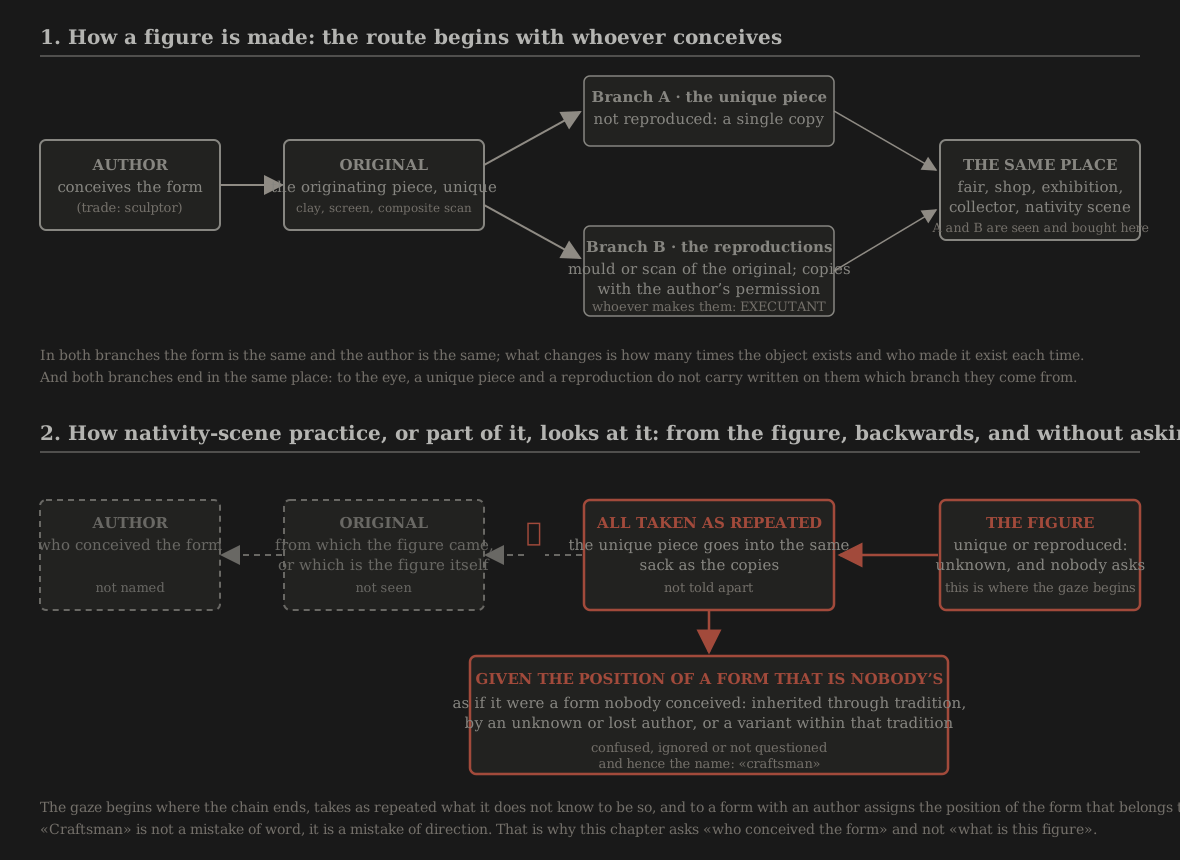
These three positions are ordered in the direction in which the figure is made: first someone conceives it, then the original exists, and only afterwards, if it is reproduced, are there copies. Part of the nativity-scene world reads them in the opposite direction. It looks at the figure in front of it, at the fair or in the shop, without asking whether it is a unique piece or a reproduction, because that is not written on it for the eye to see; it takes them all to be repeated; and to a form that has an author it assigns the position that belongs only to the form that belongs to nobody. The name craftsman comes from there. It is not a mistake of word, it is a mistake of direction: that of reading the chain from the last link. The diagram sets the two routes one above the other. That is why this chapter asks «who conceived the form» and not «what is this figure».
What follows examines what the chapter on the sculptor did not examine: the cases in which conceiving and modelling come apart, the cases in which several people conceive, and how one knows who conceived. The forms that have no author, which today’s workshop produces in new ways, have the next chapter (The form without an author).
1. One author and two executants: the David
It is worth having before us a case in which the positions are seen separated by centuries, because that is how one understands what later happens in a single workshop in a single week.
Michelangelo received the commission for the David on 16 August 1501 and the statue was unveiled on 8 September 1504.3 He conceived the form and carved it himself: he occupied both stages, and while he occupied them there was no need to distinguish them. In 1846, by order of the Grand Duke of Tuscany of 29 August, Clemente Papi took a plaster mould from the original, finished in 1847, from which the copies have come ever since; the original was moved from the Piazza della Signoria to the Galleria dell'Accademia in the summer of 1873; and in June 1910 the marble copy by Luigi Arrighetti, which is still there, was placed in the square.4 Papi and Arrighetti conceived nothing of the form; they worked so that someone else’s would come out, and the copy in the square is called Michelangelo’s David. They are executants. There was no need to ask Michelangelo’s permission: he had been dead for three centuries, the exploitation rights that the six laws recognise had expired, and what does not expire is the name and the integrity of the work, which the chapter on the author and the law examined when dealing with the rights one by one (Author and law: «What the law recognises, and to whom»). And it is worth seeing what does not change: Arrighetti was a sculptor by trade, and in this work he occupied the position of executant. The trade goes with the person; the position is decided by each work.
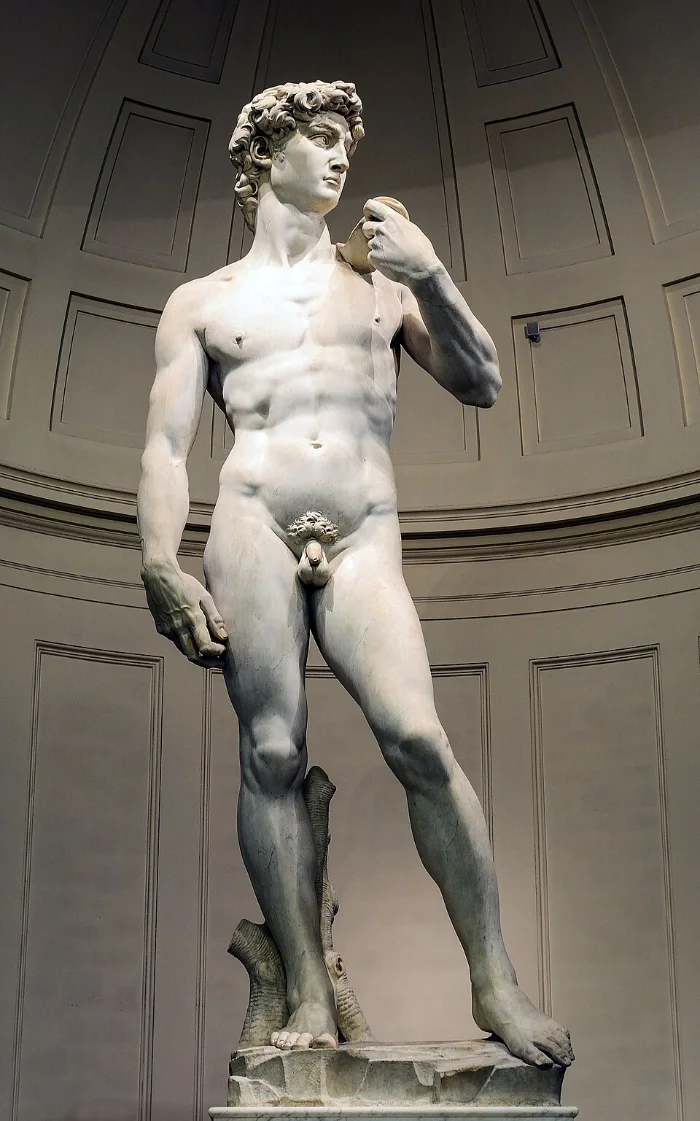
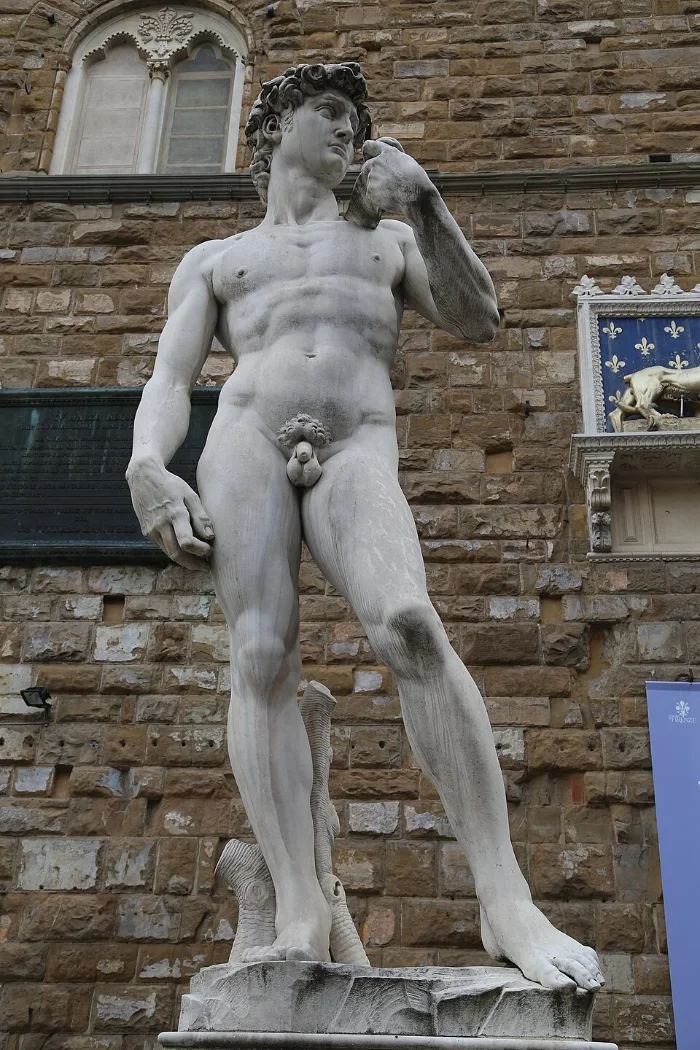


The trade goes with the person; the position is decided by each work.
2. Conceiving without modelling
The chapter on the sculptor said that a sculptor is whoever conceives and models, or carves directly (The sculptor: «One trade, two names»). This Manual knows three ways of making the original of a nativity figure: modelling in a malleable material — and here the organic modelling of digital sculpture comes in—, direct carving in wood, and the dressed figure, a mannequin whose visible parts come from the two preceding techniques; nativity scenes carved in ice or in sand, cut-outs and colouring sheets are exceptions this block does not deal with. There are cases, few, in which someone conceives without modelling or carving, and is an author without being a sculptor. There are three, and in all three the question is the same: who decided the form; what changes is that the hands that made it are not those of the person who decided it.
The sketch and the maquette. The discipline distinguishes the preparatory works from the definitive model. La Sculpture, in its chapter on modelling, sets it out like this: before fixing their definitive model, the sculptor executes studies and sketches, «en argile, crue ou cuite, et en cire»; then the preparatory models and the maquettes, «plus achevés […] que les esquisses»; and finally the definitive «originaux» models, which «doivent être aussi terminés “que le sera dans la suite le marbre ou le bronze”».5 The law protects that chain from the first link: among plastic works it includes sculptures «así como sus ensayos o bocetos» — as well as their studies or sketches.1 Whoever conceives the form in a modelled sketch or in a maquette and has someone else take it to the definitive size or material is the author of the form; whoever takes it there is an executant. That is what Michelangelo did with the models his pupils carved, a case the chapter on the sculptor told (The sculptor: «One trade, two names»). And it is what Rubens did in painting: the Museo del Prado holds six panels from the Eucharist series, models of 63.5 by 105 centimetres «painted by Rubens as the basis for much larger cartoons that weavers follow», which served «as a guide for his assistants and collaborators», who were entrusted with painting the large-format cartoons;6 nobody has attributed the cartoons to the assistants. Drawing is something else, and it should be said: a drawing decides the profile and the attitude, but it does not decide the whole volume, which has infinite points of view, and whoever models from a drawing decides everything the drawing did not decide. Whoever draws for someone else to model is the author of the drawing and, of the figure, a co-author to the extent of what their drawing fixed; the modeller, a co-author to the extent of what they added.
Directing whoever models. Renoir, his hands deformed, had Richard Guino model the sculptures he conceived, and half a century later a court decided what each of them was. The chapter on the author and the law told the whole story, with the text of the judgment (Author and law: «What the law recognises, and to whom»); here the rule that follows from it is enough, read from the author’s side. The court did not look at who had had their hands in the clay: it looked at which attitudes and expressions had been «accepted and not dictated» by Renoir and bore Guino’s imprint.7 Everything else, what had been dictated, belonged to Renoir, who did not touch the clay. Whoever directs an assistant until the form is the one they had conceived is the author of that form; the assistant is an executant if they only gave body to what was dictated, and a co-author if they put in something of their own. Where the line lies is said, in each case, by what is seen in the work and what can be proved about the process; section 4 returns to this.
Directing a generation. This is the new case. An artificial intelligence system returns a three-dimensional form from a description, an image or a drawing. If whoever asked for it wrote a sentence and accepted what came out, they did not decide the form: the chapter on the sculptor described it as the figure without a sculptor (The sculptor: «One trade, two names»), and the chapter on the author and the law examined what the laws say about it (Author and law: «What the law recognises, and to whom»). But the same system allows another way of using it: asking, looking, correcting, asking again, until what comes out is what one had in mind. Today one needs to know nothing to do it: the platforms that generate volumes build in correction by conversation — «podrias cambiarle a una expresion mas seria», could you change it to a more serious expression— as one more function of the product (The form without an author).15 Is whoever directs in this way an author? What this Manual holds is that they are, to the extent of what they decided, and that this extent is not measured by the number of instructions, which nobody can see, but by what of them remains recognisable in the figure.
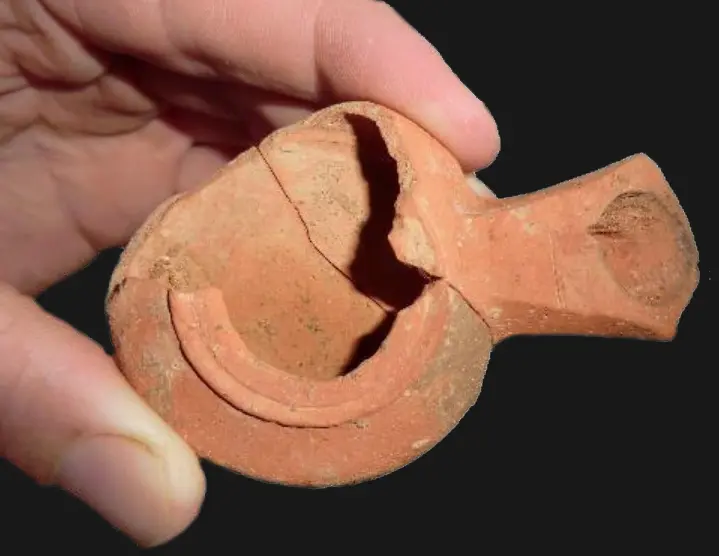
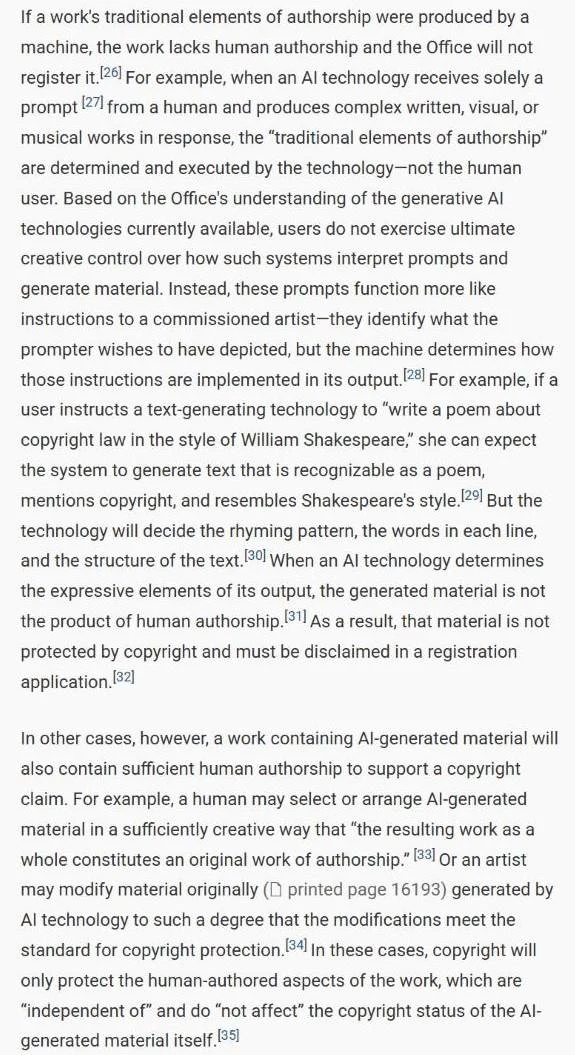
It is worth saying this with an example that the reader can apply to any figure, because a gradation is of no use if only someone who already knows what it is about understands it. Take the lamp that Saint Joseph holds in a Nativity. An oil lamp from 1st-century Judaea is a terracotta piece of 8 to 11 centimetres, with a rounded body and a short nozzle for the wick; the record sheets of this Manual include it.14 First case: someone went to look at what that lamp was like and modelled it. They are a sculptor, and what they decided is seen twice: in the lamp being the one it is, and in the fact that it can be seen taking shape under their hands. Second case: nobody modelled it; it came out of a generator; but whoever asked for it knew what it was like, rejected the first, the second and the third, and did not stop until one came out in terracotta, small and with a short nozzle. That person is not a sculptor, because they modelled nothing; but they are the author of something that can be recognised: that the lamp is the correct one, something the system, on its own, does not give. Third case: nobody modelled it and nobody went to look; the lamp is the one the system returns when it is told «ancient lamp», with a ring handle, a long nozzle and the size of a jug, and it is published all the same. There is no author in any sense. The first decided the form and the truth of the figure; the second did not decide the form, but did decide the truth; the third decided nothing.

From this comes the measure: what is recognised as decided is what departs from what the system gives on its own and comes closer to what has been verified. A generative system looks at nothing; it returns what such a figure usually looks like, the average of millions of images made before by others (The form without an author). That is why the correct lamp is recognised as decided, because the average does not give it; and that is why a shoulder lowered on request is not recognised as decided, because a shoulder lowered to order and one lowered by the average are the same shoulder. Whoever directs a generation until the lamp, the manger and the clothing are the ones they were is the author of the truth of that figure, and this can be checked; whoever directs it until they «like it» is the author of nothing that anyone can see, even if they have written a hundred instructions and kept them. And it is worth saying what each thing proves: the list of instructions does not prove decision, it proves commission, exactly like a client’s commission to a sculptor; what proves the decision is having gone to look, and that is seen in the figure and can be shown in its sources.
What is recognised as decided is what departs from what the system gives on its own and comes closer to what has been verified.
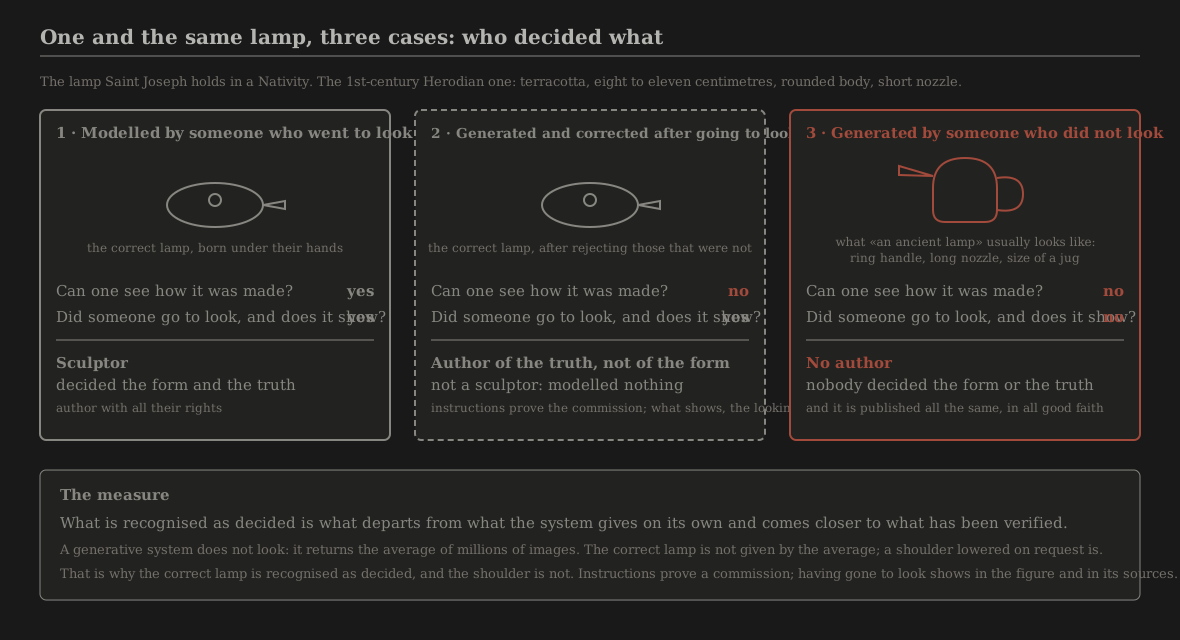
That position has to be read alongside the most elaborate written criterion that exists. The United States Copyright Office, which is a registration office and not a court, and whose criterion binds none of the Manual’s six countries, published guidance in March 2023 and a report in January 2025 on the authorship of what is generated with artificial intelligence. The 2023 guidance says that instructions to a system «function more like instructions to a commissioned artist—they identify what the prompter wishes to have depicted, but the machine determines how those instructions are implemented in its output», and accepts that a person may select, arrange or modify the generated material until the result is their own work.8 The 2025 report goes further the other way: «Repeatedly revising prompts does not change this analysis or provide a sufficient basis for claiming copyright in the output. […] By revising and submitting prompts multiple times, the user is “re-rolling” the dice, causing the system to generate more outputs from which to select, but not altering the degree of control over the process»; and at the same time it recognises authorship in what the human contributes and is perceptible in the result, in «the creative selection, coordination, or arrangement of material in the outputs, or creative modifications of the outputs», and leaves the door open: «There may come a time when prompts can sufficiently control expressive elements in AI-generated outputs to reflect human authorship».9 The Office and this Manual agree on more than it seems. On the point that asking many times for changes of posture does not make someone an author, this chapter agrees with it: that is, in the Office’s words, re-rolling the dice, and in the words used here, commissioning. Where the Manual goes further is in naming what the Office leaves in the abstract, what the human contributes and remains perceptible in the result: in a nativity figure, what is perceptible is the truth of what is represented, and it is perceived with the sources at hand. And it is worth not leaning on Renoir and Guino here: Guino was a person, who understood what was asked of him and who ended up recognised as a co-author for what he put in of his own; a machine does not understand, puts in nothing of its own and shares authorship with no one. The criterion that the Court of Justice of the European Union set for photography applies here: a creation is the author’s own «cuando el autor ha podido expresar su capacidad creativa al realizar la obra tomando decisiones libres y creativas» — when the author has been able to express their creative capacity in making the work by taking free and creative decisions.10 Both positions will age: the 2025 report ties itself to «current generally available technology», and this section is written in October 2026 with the same tie.
And there remains the name. Whoever conceives a form and obtains it by directing an assistant is the author of the form, and is an artist, because they have created an original work; they are not a sculptor, because they have not modelled it. Whoever directs a machine until the figure is true is the author of that truth, not of the form, and is not a sculptor either. Neither of the two trades has a name yet, and this Manual does not invent one for them.
3. With whom one conceives
A form can be conceived among several people without ceasing to have an author, and the law has words for each case.
The co-authors. When two sculptors conceive a figure together, one the body and the other the drapery, the law calls that a work of collaboration: «Los derechos sobre una obra que sea resultado unitario de la colaboración de varios autores corresponden a todos ellos» — the rights in a work that is the unitary result of the collaboration of several authors belong to all of them—, and «para divulgar y modificar la obra se requiere el consentimiento de todos los coautores» — the consent of all the co-authors is required to disclose and to modify the work.11 Whoever models the drapery of a figure whose body someone else modelled is not that person’s executant: they have conceived a part of the form. What separates the co-author from the assistant is how much they decided; Guino is an assistant who turned out to be a co-author because he decided.
Whoever completes the work of a dead master. The Belén de Salzillo, which the chapter on the sculptor presented (The sculptor: «One trade, two names»), was begun by Francisco Salzillo in 1776 and, on his death in 1783, «Roque López tomó la responsabilidad de la finalización del Belén» — Roque López took on responsibility for completing the nativity scene—, up to the Slaughter of the Innocents, made from 1800 onwards.12 They are not co-authors in the sense of the law, because they did not collaborate: each conceived his own part, and each one’s part can be told apart. Salzillo is the author of Salzillo’s figures; Roque López, of Roque López’s. This seems obvious said of an 18th-century nativity scene and stops seeming so when a workshop today goes on producing under the name of a dead sculptor: what that workshop conceives afterwards belongs to whoever conceives it, not to the name on the door.
The author of a derivative work. The law protects transformations: the subject matter of intellectual property includes «cualesquiera transformaciones de una obra literaria, artística o científica» — any transformations of a literary, artistic or scientific work—, and the rights in the result «corresponderán al autor de esta última, sin perjuicio del derecho del autor de la obra preexistente de autorizar, durante todo el plazo de protección de sus derechos sobre ésta, la explotación de esos resultados» — shall belong to the author of the latter, without prejudice to the right of the author of the pre-existing work to authorise, throughout the term of protection of their rights in it, the exploitation of those results.11 Whoever takes someone else’s figure and transforms it until it becomes another is the author of what they transformed, and needs, as long as the work they started from is protected, its author’s permission. Where reproduction ends and transformation begins is said by what was decided: a faithful copy is reproduction; a copy that decides is transformation.
The declared copyist. Whoever reproduces someone else’s work and says so, presenting the copy as a copy, is an executant; if there are decisions of their own in the copy, they are the author of those. What they are not, as long as they say so, is a forger. The case of José Nicolás Almansa with the Belén de Salzillo, in the 1950s, is the example of that role and of what surrounds it, and it is told with its sources in the chapter on the executants.
4. How it is proved who conceived the form
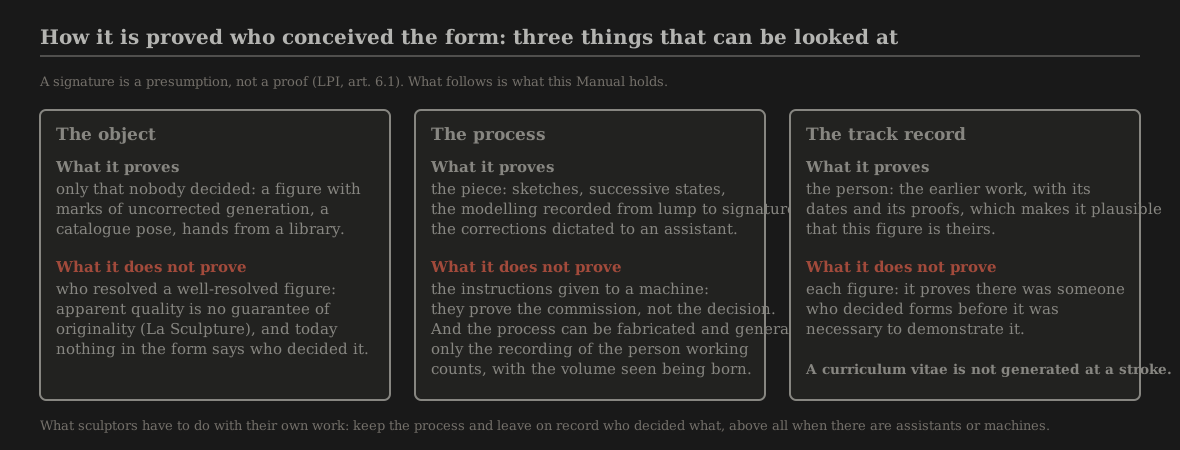
Everything above assumes that it is known who conceived the form. In the workshop it is known; in front of someone else’s figure, it has to be proved. The law gives a starting point: «Se presumirá autor, salvo prueba en contrario, a quien aparezca como tal en la obra, mediante su nombre, firma o signo que lo identifique» — whoever appears as such on the work, by means of their name, signature or a sign identifying them, shall be presumed to be the author, unless there is proof to the contrary.13 A signature is a presumption, not a proof, and proof to the contrary exists. What follows is not said by any law: it is what this Manual holds about how it is proved.
A signature is a presumption, not a proof.
There are three things that can be looked at, and they do not prove the same thing. The object can only prove that nobody decided: a figure with the marks of an uncorrected generation, with a catalogue pose, with hands from a library, says of itself that nobody decided it. But a well-resolved figure does not prove who resolved it; the chapter on the sculptor quoted from La Sculpture that the apparent quality of a work offers no guarantee of its originality (The sculptor: «One trade, two names»).2 The process proves the piece: the sketches, the successive states, the photographs of the modelling, the version history of the file, the corrections dictated to an assistant. That is what the court looked at in Guino’s case, comparing the sculptures with Renoir’s paintings. The instructions given to a machine are not on that list: they prove the commission, not the decision, as section 2 said. And the process can also be fabricated, and today it can also be generated; what a recording has to show to count as proof is set out in the next chapter (The form without an author). The track record proves the person: the earlier work, with its dates and its proofs, which makes it plausible that this figure is theirs. Nobody creates a Pietà or Las Meninas out of nothing: whoever conceives a form has conceived others before, and that can be seen. What cannot be generated at a stroke is a curriculum vitae.
The list of instructions does not prove decision, it proves commission.
From this follows what sculptors have to do with their own work, and it is little: keep the process and leave on record who decided what, above all when there are assistants or machines. Not to belittle anyone, but so that each is what they are.
5. Closing
Conceiving a form is deciding it; what has been decided is recognised in the work wherever it departs from what a machine gives on its own, and it is proved in the process when the process is that of a person. With hands or without them, alone or with others, in clay, in wood or on screen, whoever decided is the author; whoever gave body to what another decided, the executant. The next chapter deals with the forms in which nobody decided, or in which what was decided has no author that the law recognises: the inherited ones, those taken from reality, the generated ones, those assembled from other people’s pieces (The form without an author). They are the ones today’s workshop produces in new ways, and the ones that make it necessary to keep this chapter’s question always at hand.
Whoever decided is the author; whoever gave body to what another decided, the executant.
References
Ley de Propiedad Intelectual (Real Decreto Legislativo 1/1996), art. 10.1 and its letter e). Consolidated BOE text (BOE-A-1996-8930), latest amendment 30-III-2022; also checked in Author and law: «What the law recognises, and to whom», section 1. ↩ ↩
The sculptor: «One trade, two names», section 2, «What a sculptor is and how a sculptor works», with La Sculpture. Méthode et vocabulaire, pp. 9 and 11. ↩ ↩
Galleria dell'Accademia di Firenze, «Michelangelo's David», galleriaaccademiafirenze.it/en/artworks/david-michelangelo/. Consulted on 1-X-2026. ↩
Giuliana Videtta, «The Florentine copies of Michelangelo's David by Clemente Papi: the plaster cast at Istituto d'Arte», Victoria and Albert Museum blog, 10-XI-2017 (ducal order of 29-VIII-1846; moulds finished in 1847; the original moved between 31-VII and 4-VIII-1873; Arrighetti’s copy placed in June 1910); Catalogo generale dei Beni Culturali, record «David, calco di scultura, post 1846 - ante 1848», Papi Clemente (1801-1875), Gipsoteca of the Istituto Statale d'Arte, Florence; Comune di Firenze, press release of 12-III-2022: «La statua è stata realizzata nel 1910 da Luigi Arrighetti». Consulted on 1-X-2026. ↩
La Sculpture. Méthode et vocabulaire, p. 85, «Les œuvres préparatoires : esquisses, études, modèles, maquettes». Scan of Emili Solé’s copy (27-IX-2026). In the book, the inner quotation refers to Watelet, Dictionnaire des arts…, art. «Modèle», vol. III, p. 474 (note 44), quoted through La Sculpture. ↩
Museo del Prado, record for El triunfo de la Iglesia (P-1698), Peter Paul Rubens, c. 1625, oil on panel, 63.5 × 105 cm, and presentation of the exhibition Rubens. Pintor de bocetos, museodelprado.es. Consulted on 1-X-2026, in their English version. ↩
Cour de cassation, Première chambre civile, 13-XI-1973, appeal no. 71-14.469, quoted through Author and law: «What the law recognises, and to whom», section 5, «The limit case: Renoir and Guino»; procedural history in Musée d'Orsay, répertoire «Richard Guino (1890-1973)», musee-orsay.fr. The Manual’s translation. ↩
U.S. Copyright Office, «Copyright Registration Guidance: Works Containing Material Generated by Artificial Intelligence», Federal Register, vol. 88, 16-III-2023, p. 16190, federalregister.gov/documents/2023/03/16/2023-05321. Consulted on 1-X-2026. ↩
U.S. Copyright Office, Copyright and Artificial Intelligence, Part 2: Copyrightability, January 2025, Executive Summary and pp. 20-21, copyright.gov/ai/Copyright-and-Artificial-Intelligence-Part-2-Copyrightability-Report.pdf. Consulted on 1-X-2026. What has since been decided in the courts of the United States (Thaler v. Perlmutter, D.C. Circuit 2025; certiorari denied by the Supreme Court on 2-III-2026) concerns a work created by a machine with no person involved, not directed generation. ↩
Court of Justice of the European Union, judgment of 1-XII-2011, case C-145/10, Painer, paragraph 89. Spanish text on EUR-Lex (CELEX 62010CJ0145). Consulted on 1-X-2026. ↩
LPI, art. 7, «Obra en colaboración» (paragraphs 1 and 2); art. 11, «Obras derivadas», 5.º; art. 21.2, «Transformación». Consolidated BOE text. ↩ ↩
Museo Salzillo, «Sala del Belén de Salzillo», museosalzillo.es/coleccion/belen-salzillo/. Consulted on 1-X-2026. ↩
LPI, art. 6.1, «Presunción de autoría, obras anónimas o seudónimas». Consolidated BOE text. ↩
Record sheet «Herodian oil lamp» in the domestic props of this Manual. The full example —the image generated on 13-X-2026 with the lamp that «an ancient lamp usually looks like»— is in the next chapter, The form without an author, section 6 and its note 21. ↩
The instruction quoted, as it was written in the Tripo Studio interface, and the platform’s functions, with their sources and dates, in The form without an author, section 9 and note 20. ↩