
 ≈ 97 min
There is a third answer to the question of who conceived the form, and it is the one that has changed most in 10 years: the form has no author that the law recognises. It is not accurate to say that nobody conceived it, because nothing comes from nothing: every form was conceived by someone, or something, at some time. What happens is that the law recognises no author, for two different reasons: because whoever conceived it lies so far back that neither name nor right remains, or because it was conceived by a system and not by a person. Whoever reproduces those forms the previous chapter called a craftsman, and it said that the word is a conclusion of the Manual (Who conceives the form).
This chapter first goes through the forms without an author that today’s workshop produces or reproduces, of which there are four, and through what looks like an answer to the question and is not: the administrative lists. Then it dwells on what those four forms have changed for nativity-scene art and practice, which is not the law but something else; on what a figure no longer lets one see of its origin; on the only thing that today proves that someone decided a form; on the market that this lack of an author sinks, with its prices in plain view; and on what nativity-scene art and practice loses, first in the figure and then in the scene. It ends with a way out, declared with its exact measure.
1. The form inherited through tradition
The pitcher, the storage jar, the farm implement, the figure taken from an old mould whose author nobody knows. Someone conceived them, but so far back that there is no name left to cite nor any living right to respect. The law provides for the neighbouring case of the work disclosed without a signature, which is not exactly this one, but it shows where the right ends: when a work is disclosed anonymously, the rights are exercised by «la persona natural o jurídica que la saque a la luz con el consentimiento del autor, mientras éste no revele su identidad» — the natural or legal person who brings it to light with the author’s consent, for as long as the author does not reveal their identity—, and the exploitation rights last «setenta años desde su divulgación lícita» — 70 years from its lawful disclosure—.1 Once those years have passed, with no name to respect, the form belongs to everyone and to no one. Whoever reproduces it is nobody’s executant, because there is nobody: they are a craftsman, and here the word fits them with complete propriety. It is the position of whoever makes the props of inherited forms for the nativity scene, and that is why the chapter on props takes it up again; when that same craftsman invents a form, they are its author, like anyone else.
2. The form taken from reality
A scanner, or a series of photographs processed by photogrammetry, turns a real body into a three-dimensional file: a person, an animal, a basket. There are businesses in Spain that scan a person and hand them their printed figure,2 and there is already a shop selling nativity figures that offers it as a catalogue product: «us podem escanejar —vestit amb roba d'època— i convertir-vos en una figura de pessebre feta a mida», with skirts, waistcoats and kerchiefs that the shop itself lends for the session and with a porrón, a basket or a pitchfork in the hand if desired.3 Who conceived that form? Nobody: the body gave it.
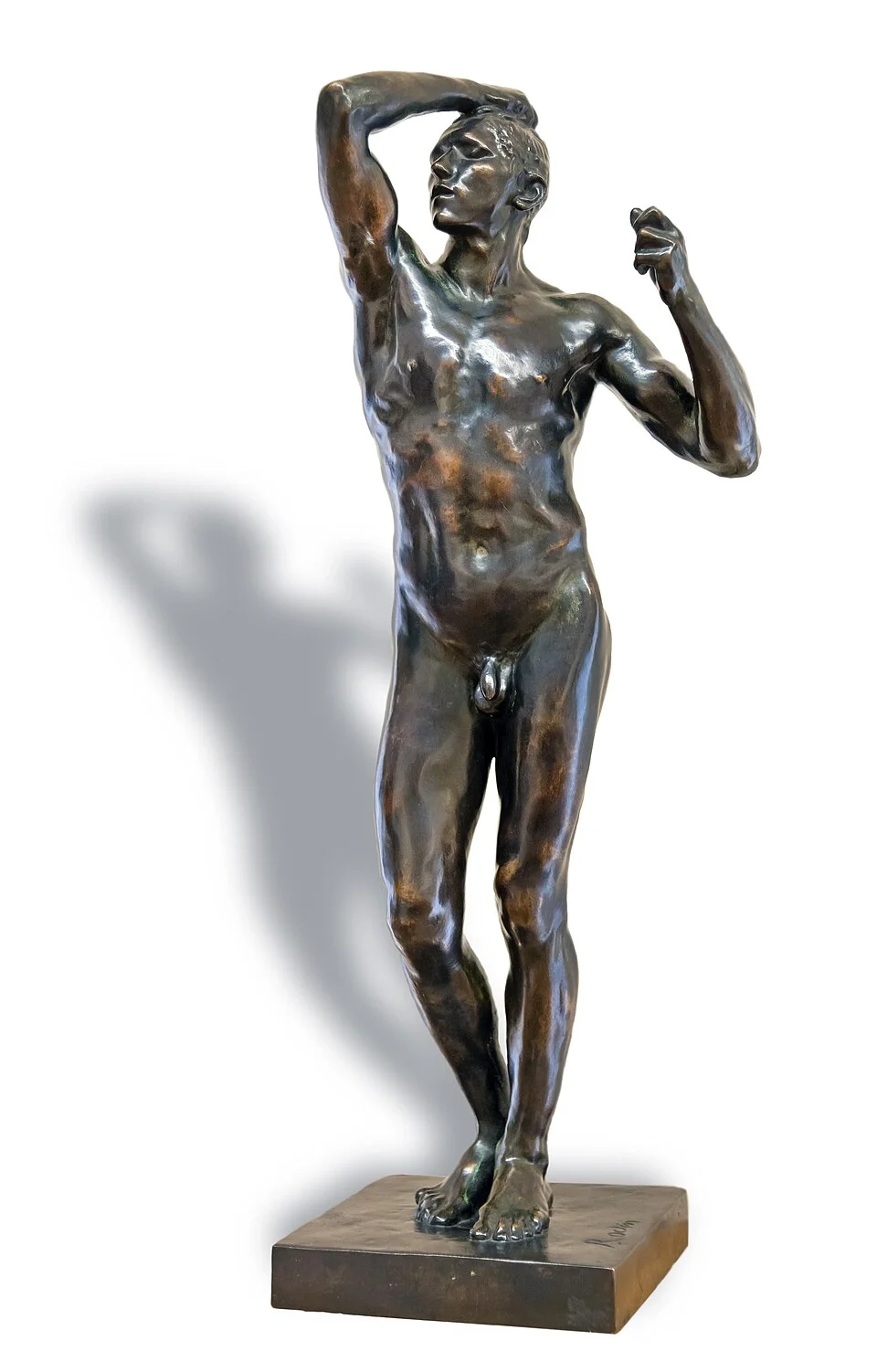
Sculpture has known this case for a century and a half, under another name: casting from life, the mould taken directly on the model’s body. In 1877 Auguste Rodin exhibited in Brussels and then at the Paris Salon a male figure, The Age of Bronze, modelled on a Belgian soldier, Auguste Neyt, and he was accused of having cast it from life. The Musée Rodin tells it like this: «Accusé, lors de son exposition à Paris, de l'avoir moulée directement sur le modèle, Rodin dut prouver que la qualité du modelé de sa sculpture provenait bien d'une étude approfondie des profils et non d'un moulage sur nature»; to defend himself he commissioned the photographer Gaudenzio Marconi to take photographs of the plaster and of Neyt himself, and «ses détracteurs finirent par reconnaître la bonne foi du sculpteur».4 What matters here is not that Rodin was innocent, but what he was accused of: of not having conceived the form, of having taken it from the body. A cast from life has no author in the form; scanning is a cast from life without contact.
A cast from life has no author in the form; scanning is a cast from life without contact.
But in a scan there are decisions, and one has to see where they remain. Whoever composes an artistic photograph decides the pose, the expression, the fall of the cloth, the objects, the light. If, instead of the camera, a scanner is used on the same person in the same pose, the result keeps all of that except the light, which in scanning is a tool and not a result: what photography fixes in a frame, scanning fixes in volume, and it can be turned round. The scan does not return the body in anatomical position, with arms outstretched like Vitruvian Man; it returns the body exactly as it was, with the whole composition inside the file. That is the difference between a composed scan and a mere scan: the second is the body in the pose in which nobody has yet decided anything, which is, incidentally, the starting pose of the programs that produce human bodies without modelling them, dealt with in section 4.
To know what that composition is worth, the precedent lies in the art that took its form from reality and had to earn the status of a work: photography. In 1884 the Supreme Court of the United States decided whether a portrait of Oscar Wilde was the work of its photographer, Sarony, by listing what he had decided: «posing the said Oscar Wilde in front of the camera, selecting and arranging the costume, draperies, and other various accessories in said photograph, arranging the subject so as to present graceful outlines, arranging and disposing the light and shade, suggesting and evoking the desired expression»; and it concluded that the photograph was «an original work of art, the product of plaintiff's intellectual invention, of which plaintiff is the author».5 In 2011 the Court of Justice of the European Union said the same in other words in the case of the photographer Eva-Maria Painer: «En la fase preparatoria, el autor podrá elegir la escenificación, la pose de la persona que se va a fotografiar o la iluminación. Al hacer el retrato fotográfico, podrá seleccionar el encuadramiento, el enfoque o incluso el ambiente creado» — in the preparatory phase, the author can choose the staging, the pose of the person to be photographed or the lighting; when taking the portrait photograph, they can choose the framing, the angle of view or even the atmosphere created—; and that is why a portrait photograph is protected «siempre que sea una creación intelectual del autor que refleje su personalidad y que se manifieste por las decisiones libres y creativas del mismo al realizarlo» — provided that it is an intellectual creation of the author which reflects their personality and is expressed through the free and creative choices they made in producing it—.6 Nobody holds that the photographer conceived Oscar Wilde’s face. What is his are the decisions.
Hence the category this Manual proposes, declared as what it is, a reading by analogy, Inferred from context, because it rests not on a ruling about scanned figures but on the criterion that photography has already won: the form taken from reality has no author in the form; the decisions that the scan preserves, the pose, the gesture, the composition, the retouching, can have one, to the extent of those decisions. A scan of a still body in anatomical position, with no more decision than pressing a button, is a form without an author that the law recognises, and whoever prints it stands where whoever reproduces the pitcher stands. A scan of a composition is, in what is composed, the work of whoever composed it, and in that part they are an author. Author of the composition, not sculptor: the shape of the body was given by the body, and nobody modelled it. Outside this chapter lies another question that the scanning of a person opens and that is not one of intellectual property: that of the rights of that person over their own image.
3. The form generated by an artificial intelligence, without any person deciding
A written description, or a photograph, handed to an artificial intelligence system; a key; and the file as it comes. The form has been produced by the system, and a system is not a person: none of the laws that this block checked recognises it as an author. The systems that do this today are sold for what they are, and it is worth reading them in their own words. Hyper3D presents itself as «el generador de modelos 3D con IA que combina calidad de referencia y control preciso. Convierte indicaciones de texto o imágenes en recursos 3D detallados en segundos, sin experiencia en 3D» — the AI 3D model generator that combines benchmark quality and precise control; it turns text or image prompts into detailed 3D assets in seconds, with no 3D experience—, and promises «recursos 3D prácticamente listos para producción a partir de texto o imágenes» — practically production-ready 3D assets from text or images—.7 Meshy: «Sube una foto, un boceto o una pieza de concept art, y Meshy lo convierte en un modelo 3D que puedes imprimir» — upload a photo, a sketch or a piece of concept art, and Meshy turns it into a 3D model you can print—; and it advertises itself as «la única IA 3D entrenada para imprimir» — the only 3D AI trained for printing—, with models «generados pensando en la impresión: watertight, manifold y listos para cortar» — generated with printing in mind: watertight, manifold and ready to slice—.8 «Sin experiencia en 3D», «en segundos», «listos para cortar» — no 3D experience, in seconds, ready to slice—: that is what is being sold, and it is being sold to whoever cannot model.
The chapter on the sculptor described this figure as the figure without a sculptor (The sculptor: «One trade, two names»); the one on author and law examined what the laws checked say about it (Author and law: «What the law recognises, and to whom»); and the previous chapter separated this case from that of whoever directs the generation up to the form they conceived (Who conceives the form). Here it is enough to place it: it is a form without an author that the law recognises, and whoever prints the file as it comes stands in the position that the previous section gave to whoever prints a scan without decisions.
It is worth establishing, in passing, what each person decides in that gesture, because words blur it. A written description decides a description: «Judean shepherd, 40 years old, beard, cloak, leaning on his crook». The form — how much that cloak weighs on the shoulder, where the gaze falls, which hand holds what— is decided by the system. Whoever writes the description and accepts what comes back is in the position of the client who commissions: they say what they want and receive something they have not made; what is truly theirs is the commission — the character, the attitude, the judgement with which they asked for it—, and of that they are the author, as any client is of what they decided when commissioning. Whoever repeats the description 10 times and picks the best of the 10 is still choosing among forms they did not decide: choosing is not conceiving. The chapter on the client, later in this block, takes up that position with its rights and its limits. And it is not a value judgement: a generator copies nobody — it produces—, and the problem this chapter examines is not plagiarism but the absence of decision. That is why this Manual does not write «it is not art», which is a bottomless debate lost in advance; it writes what it can sustain: nobody decided the form.
Choosing is not conceiving.

4. The figure composed with generators and libraries
There are programs — here they are called generators— that deliver a complete human body by moving sliders: age, build, sex, facial features; clothing is chosen for it from a library and it is given a pose, and out comes a figure without anything having been modelled. Three of them are DAZ Studio, MakeHuman and Character Creator. And there is a neighbouring practice, kitbashing, which consists in composing a figure with heads, hands, bodies and clothes from different libraries.
The first question is whose the forms of the pieces are, and the licences answer it, and they are not all the same. DAZ 3D permits three-dimensional printing of its content «only for personal, non-commercial use by the User», and separately offers a printing licence that permits commercial use «so long as it is produced by 3D Printing».9 MakeHuman releases the characters exported with its program under the CC0 public domain dedication: «The person who associated a work with this deed has dedicated the work to the public domain by waiving all of his or her rights to the work worldwide under copyright law».9 Reallusion, the maker of Character Creator, permits selling and publishing «your Original Character Creations for any commercial use, including […] 3D printing», with a ban on selling them as a model on a content marketplace and on using the base model unchanged.9 Three programs, three answers: forms with an author whose reproduction is authorised by licence; forms whose authors have waived their rights; forms with an author that may be sold transformed but not as they are. Before asking what one is with respect to the figure, one has to have read whose the pieces are.
The second question is the usual one: what did whoever moved the sliders decide? The forms of the pieces were conceived by the authors of the program or of the library; the user chose among them, combined them and put them in a pose, starting from the body in anatomical position of section 2. That is selection and arrangement, and the United States Copyright Office, in the 2025 report that the previous chapter presented (Who conceives the form), recognises authorship in «the creative selection, coordination, or arrangement of material».10 Hence the second proposed category, also Inferred from context: in the figure composed with generators, the forms have the authors of the pieces; whoever composes them is, with respect to the pieces, whatever the licence says (executant, if it authorises reproduction; craftsman, if the authors waived their rights), and, with respect to the figure, author only of the composition, to the extent of what they decided in choosing and arranging. They are not a sculptor, because they did not model; and they are not the author of a Saint Joseph with the child in his arms for having chosen «man, 40 years old, beard» on three sliders. If they then retouch the figure in a digital sculpture program until they have changed its face, its hands and the weight of the cloth, they have gone back to the chapter on the sculptor (The sculptor: «One trade, two names»), and what they have modelled is theirs.
This count lacks a fourth place from which form comes, and it is not a program but a shop: the general catalogues of three-dimensional models, intended for cinema, video games and advertising, where a religious figure is bought as one buys a chair or a car. On TurboSquid, one of the largest, a «Jesus Christ Rigged Real Model» — a Christ with a skeleton prepared for animation, in an arms-outstretched pose— was selling for $149, and a «Jesus Christ PACK» for $199.11 There the nativity figure is one more asset in a warehouse that does not know what a nativity scene is. Whoever downloads and prints it stands, with respect to it, wherever the catalogue’s licence says; with respect to the nativity scene, they have not yet decided anything.
5. What looks like an answer and is not: the lists
There are two things that the nativity-scene world sometimes takes for an answer to the question of who conceived the form, and which answer a different one. Both are administrative lists.
Craftsman status is a recognition that an administration grants to whoever applies for it and meets its requirements, for access to fairs, grants and services. In Catalonia it is regulated by Decret 182/2014: «El carnet d'artesà/ana és una acreditació voluntària, expedida per la Generalitat de Catalunya, que pot sol·licitar qualsevol persona física que desenvolupa la seva producció artesanalment».17 Voluntary and on application. Its definition of craft looks at the way of producing, «que en cap cas sigui susceptible d'una producció industrial, totalment mecanitzada o en grans sèries», and its register of craft trades includes, in family 14, trades 14.5 «Escultor/a», 14.6 «Figurista de pessebre», 14.10 «Modelista» and 14.11 «Pessebrista».17 The tax heading does the same for another purpose: the Impuesto sobre Actividades Económicas brings together in a single group, 861 of the second section, «Pintores, Escultores, Ceramistas, Artesanos, Grabadores, Artistas Falleros y artistas similares» — painters, sculptors, ceramists, craftsmen, engravers, Falla artists and similar artists—.18
| List | Who makes it | What it is for | What it says about who conceived the form |
|---|---|---|---|
| Register of craft trades (Decret 182/2014) | Catalonia’s commerce administration | Access to the card, fairs, grants | Nothing: it places the sculptor, the figurista and the modelista in the same family |
| Group 861 of the IAE | The tax authorities | Paying tax | Nothing: painters, sculptors and craftsmen pay tax together |
| A fair’s requirements | Each fair | Admitting exhibitors | Nothing: a tax registration, photographs of what one makes |
What a list proves is that someone wrote a list. If it does not say who drafted it or from which discipline, it does not prove that it is accurate, and none of these says either thing; that the sculptors of the Renaissance had to argue for a century over whether they were artists or craftsmen, as the chapter on the sculptor recalled (The sculptor: «One trade, two names»), shows how little an outside classification is worth for saying what a trade is. Lists are good for what they are good for. What travels from this example to the Manual’s other countries is the mechanism: every administration classifies for its own purposes, and none of its purposes is to decide who conceived a form.
What a list proves is that someone wrote a list.
6. What has changed and what has not
Having come this far, it is worth pausing, because it is easy to draw from the four preceding forms a conclusion that does not follow from them: that the sculptor’s authorship has changed. It has not changed. The law is the same as it was: «Se considera autor a la persona natural que crea alguna obra literaria, artística o científica» — the author is considered to be the natural person who creates a literary, artistic or scientific work—, and that property belongs to them «por el solo hecho de su creación» — by the sole fact of its creation—.12 A shepherd whose form someone decided has today exactly the author it had before any generator existed, with the same rights and the same duration. What a machine returns does not touch that.
What has disappeared are two things that were in no law, and that is why nobody missed them while they lasted.
The first is the scarcity of form. Until recently, a nativity figure could only come from a sculptor or from a mould taken from a sculptor’s work; form was scarce because making it cost trade and hours. Today it comes from three places that need no sculptor: a volume generator like those of section 3, a library of bodies like those of section 4 and a file shop like those of section 9. And a file, once it exists, can be reproduced in any material: milled in bronze or in marble, a plaster mould for clay or ceramic paste, a silicone mould for resin, any printer. And, once sold, it is copied without limit, and every buyer can be the next seller.
The second is the presumption of an author. Before a figure, the nativity-scene world took it for granted that behind it there was someone who had decided it; the question was, at most, who. That presumption has ceased to hold: before a figure, today, one does not know whether anyone decided its form, and the object does not say.
Three planes that the first impulse mixes must therefore be separated. The law: unchanged. The market: broken, and section 9 deals with that. The proof: where the answer lies today, and the two following sections deal with that. And it is worth noting a consequence of the law that works in favour of whoever decides: whoever sells figures whose form nobody decided has no author to invoke, and whoever copies them from that seller infringes no copyright, because there is no author. The form without an author is, by definition, the most unprotected of all.
From here it also follows where the line runs, and it does not run where it is usually said to. The line is not clay versus screen: it is decided form versus generated form. A shepherd modelled point by point in a digital sculpture program has a sculptor, just like one modelled in clay or carved in wood; a shepherd requested from a generator and accepted as it comes does not have one, and one generated and redone until nothing is left undecided has one again. The tool classifies nobody. What clay contributes today is not authorship — a sculptor’s digital modelling already had that— but something different, which section 8 names: a proof of authorship that the file cannot give.
The line is not clay versus screen: it is decided form versus generated form.
And one thing that does not change with any tool: research is an author’s work in any medium. Knowing what a Judean shepherd wore, how the cloak was fastened, what a crook was and how one leaned on it, is work that has to be done before modelling in clay, before carving in wood, before modelling on screen and before writing a description for a generator. Whoever does it is the author of that work, however the modelling is done afterwards. What a machine cannot do for anyone is to have gone to look. And it is worth saying what looking is, because the word deceives: it is the eyes of a particular person before a particular thing — a preserved implement, a garment in a display case, a gesture that someone still knows how to make—, seeing what that thing is and what it is not. A generative system looks at nothing: it produces a form from the regularities of millions of images made before by others, and returns what such a figure usually looks like. If in those images the crook was leaned on wrongly, its crook will be leaned on wrongly. There is no observation; there is the average. The looking that research demands cannot be delegated to that, because there is nobody looking.
There is no observation; there is the average.
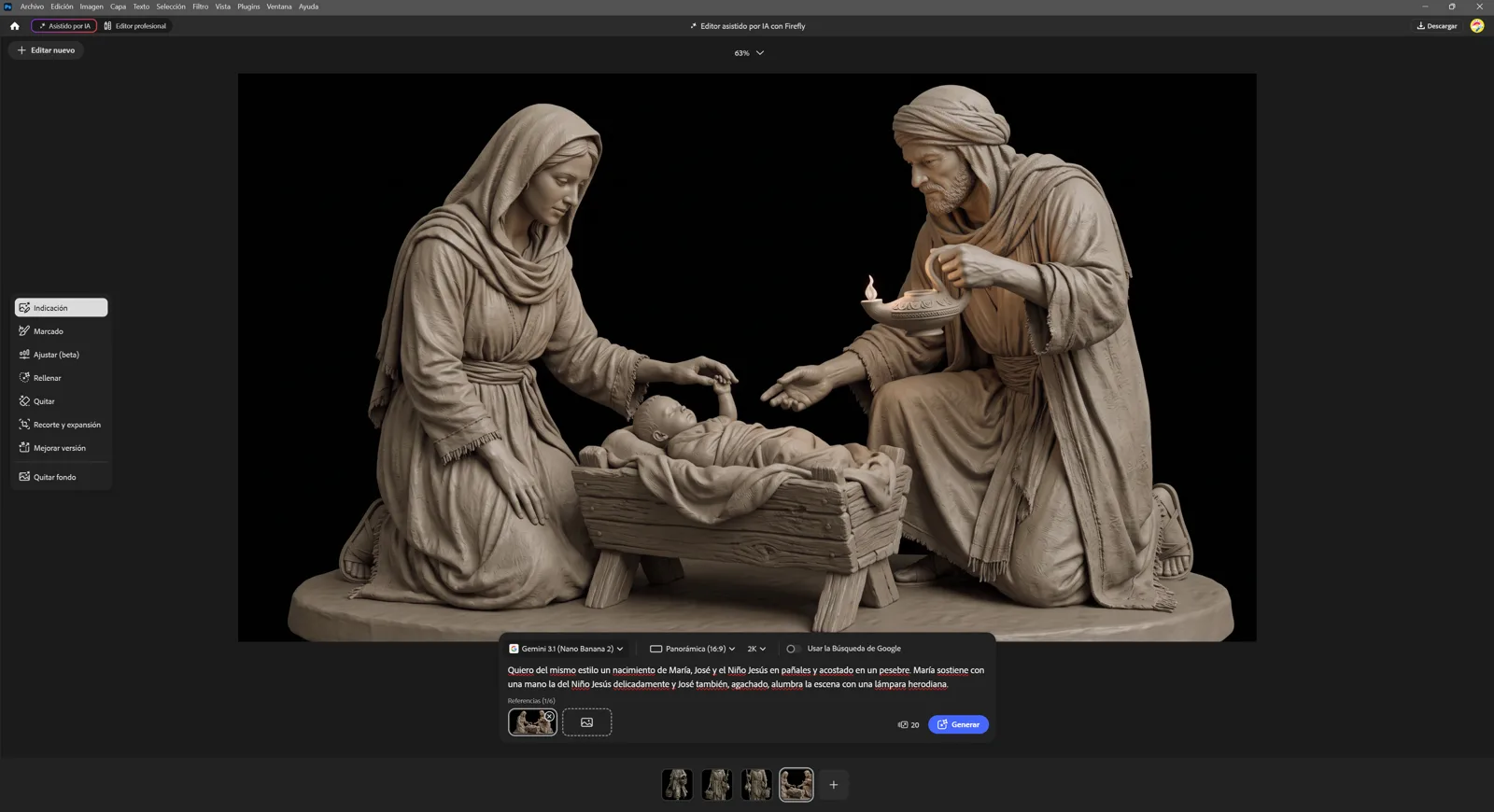
An example makes it visible, and it comes from the person who writes this. On 13 October 2026, Emili Solé asked Photoshop, with one of the generated figures of section 9 as a reference, for «del mismo estilo un nacimiento de María, José y el Niño Jesús en pañales y acostado en un pesebre. María sostiene con una mano la del Niño Jesús delicadamente y José también, agachado, alumbra la escena con una lámpara herodiana» — in the same style, a Nativity of Mary, Joseph and the Child Jesus in swaddling clothes and lying in a manger; Mary gently holds the Child Jesus’s hand in one of hers, and Joseph, also crouching, lights the scene with a Herodian lamp—. 20 seconds later he had the image: three figures in a triangle, the three gestures linked, coherent folds, a lit lamp. For anyone who has not gone to look it will do, and that is the point. The lamp that Joseph holds has a ring handle, a long nozzle and the size of a jug; the Herodian lamp that the record sheets of this Manual include measures 8 to 11 centimetres, is of terracotta, with a rounded body and a short nozzle for the wick: the system received the word and returned the lamp that an ancient lamp usually looks like. The manger is a joiner’s cradle with turned legs; of its material the Manual states nothing — stone, masonry or wood are all possible—, but it does state that it must first of all look like a feeding trough, and this looks like a piece of furniture. And the clothing is that of all this year’s generated figures: tunic, cloak, turban, fringes; it is not wrong, it is undecided. None of this is seen without having read first; all of it is seen afterwards. That is the exact distance between the average and the looking, and the only way for the reader to know it is for someone who went to look to point it out.21
What this chapter calls the average has also been stated by someone who is neither a sculptor, nor a jurist, nor a seller of figures, and it is worth bringing it in here because it reaches the same distinction from a place where nobody expected it: the Church speaking to artists. There are two texts, of two different kinds, and they must be read in order.
The first is an encyclical. An encyclical is a letter from the Pope to the whole Church on a fundamental question, and it is the weightiest document a Pope signs. Leo XIV’s is titled Magnifica humanitas, is dated 15 May 2026 and deals, according to its own subtitle, with «la custodia de la persona humana en el tiempo de la inteligencia artificial» — the safeguarding of the human person in the time of artificial intelligence—. It does not speak of generated art; it speaks of what artificial intelligence does to whoever uses it. In its paragraph 100 it describes three risks of personal use, and the first is the one this chapter has seen in the workshop: «la facilidad para lograr el resultado» — the ease of obtaining the result—. The speed and simplicity with which «elaboraciones complejas, contenidos mediáticos» are obtained — complex elaborations, media content; and a nativity figure is both— «pueden acostumbrarnos a delegar demasiado y a buscar respuestas rápidas, debilitando el juicio personal y la creatividad» — can accustom us to delegating too much and to seeking quick answers, weakening personal judgement and creativity—.25 It adds something that explains why the average is an average: the answers of these systems give an «impresión de objetividad» — impression of objectivity—, and that impression makes one forget that they «reflejan los parámetros culturales de quienes las han proyectado y adiestrado» — reflect the cultural parameters of those who designed and trained them—. Put in this chapter’s terms: whoever writes «ancient lamp» and accepts what comes back has not decided the lamp, and has moreover stopped exercising what would allow them to decide it. The encyclical looks at the one who asks; it says nothing of the object that comes out.
The second text is a speech, 5 months later. On 2 October 2026 the same Leo XIV received at the Vatican a group of artists and exhibition curators brought together by the Dicastery for Culture and Education, and spoke to them about art. A speech to a group does not carry the weight of an encyclical, but here it says what the encyclical did not say, and it says it of the object. First, that the Church needs artists «in modo particolare in quest'era dell'intelligenza artificiale, nel quale diventa urgente distinguere l'arte umana da ciò che viene prodotto dalle macchine» — particularly in this era of artificial intelligence, in which it becomes urgent to distinguish human art from what is produced by machines—. And then, where the difference lies: «C'è una differenza ontologica, prima ancora che estetica, tra l'arte e ciò che una macchina può generare per calcolo statistico a partire da milioni di immagini altrui» — there is an ontological difference, even before an aesthetic one, between art and what a machine can generate by statistical calculation from millions of other people’s images—.26 Those two words deserve a slow reading. Aesthetic is what is seen: whether the figure is well or badly resolved, whether it pleases. Ontological is what the thing is, before one looks at it. The Pope does not say that what is generated is ugly, nor that it is not art, nor that it is forbidden: he says that it is another kind of thing, and that it is so because of how it was produced, «by statistical calculation from millions of other people’s images». That is, word for word, what this chapter has called the average: the system looks at nothing, it returns what such a figure usually looks like in the images that others made before. And the consequence the speech draws is the same one that section 7 will draw: that one must distinguish, not condemn, because to the eye the two things can no longer be told apart.
The two sources are cited with their date and as a contrast, not as an authority. Neither an encyclical nor a speech decides what a nativity figure is or who its author is: that is decided by the form and the proof, as this whole block holds. What they contribute is something else, and it is no small thing: that the distinction between decided form and generated form is neither a workshop matter nor a sculptors’ complaint. The Pope neither models nor sells figures, and he has arrived at it on his own: he has given it a name — ontological, before aesthetic— and has also described the two ends of the chain that this chapter goes through: the one who asks and delegates, in the May encyclical; what comes out and where it comes from, in the October speech.
7. What a figure no longer lets one see of its origin
The reader of this Manual finds themselves, at a fair, at an exhibition or on a screen, before someone else’s figure, and wonders whether anyone decided it. 2 or 3 years ago the object usually answered: the systems resolved hands, ears and feet badly, clothing fell well without coming from any garment, objects did not serve for what they were, detail covered equally what mattered and what did not. Anyone with the trade saw it. That is over, and it must be said with the same clarity with which the opposite used to be said.
The figure that a page of nativity figures published on 21 December 2025 — an old man seated, with a bowl in one hand and the other outstretched, begging— has five fingers on each hand and five toes on each foot, the tendons on the back of the hand marked, a bowl that holds up and could be filled, a cloak knotted at the chest with the knot resolved, folds that come from a garment and fall by their own weight, and a pose that does something.13 There is nothing that a sculptor can point to. And what that system did badly 2 years ago and does well today, it will do better within a month: those who sell it promise as much on their pages, and they deliver. That is why this section does not give a list of signs, which would be out of date before being published. It gives the fact: today there is nothing in the form that says who decided it.
And it gives what can be seen, which is not in the figure but around it.
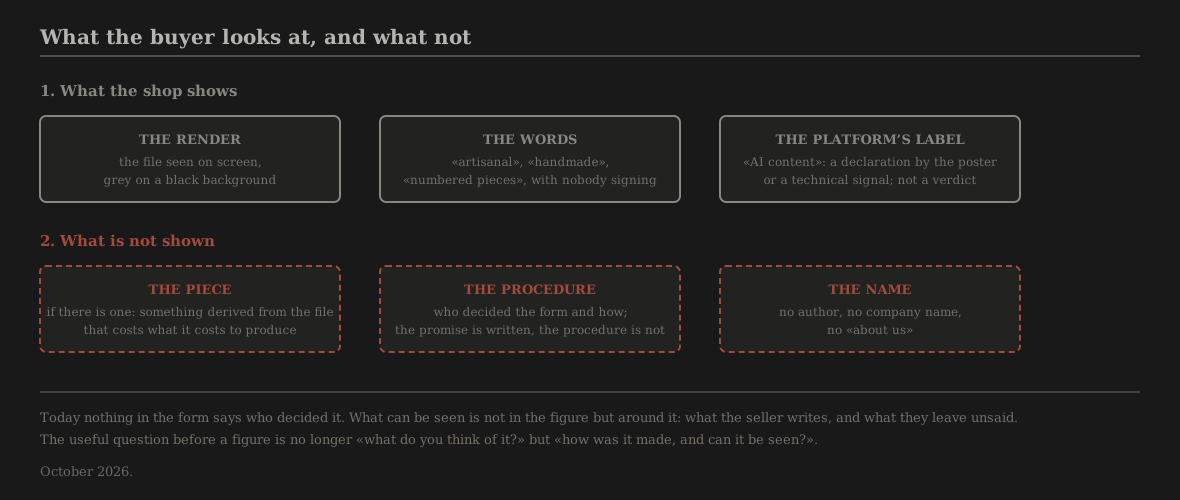
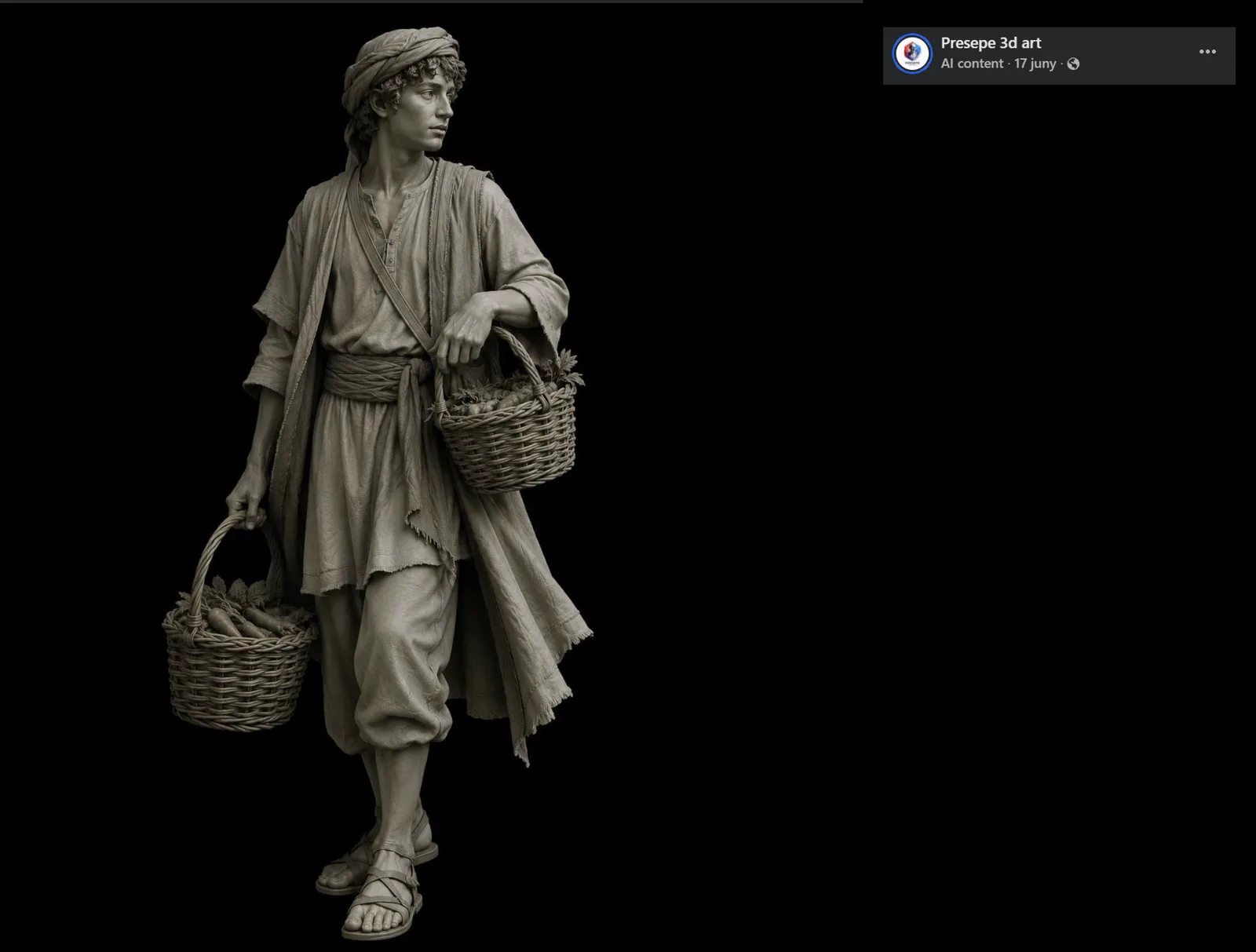
The render is the image of the product. In the Laual shop, which sells nativity figures «artesanals en 3D», the catalogue had 68 figures on 13 October 2026, and all 68 were shown with the same kind of image: a grey volume on a neutral background, the file seen on screen; on the server those images are called, one by one, «Arxiu producte». The text of the page speaks of «un meticulós procés de pintura», of «cada pinzellada» and of «petites obres d'art»; on the catalogue and price pages there is not a single photograph of a painted piece.14 The same at Presepe3DArt, which advertises itself as «statuine presepe iper realistiche, stampate in resina + dipinte a mano»: what it publishes are grey renders on black.13 The buyer is not looking at an object; they are looking at the file. The object, if there is one, is a derivative that costs what it costs to produce.
«Artisanal», «handmade», «numbered pieces», with nobody signing. Neither of the two shops gives an author’s name, nor a company name, nor an «about us»; Presepe3DArt offers «Edición Artesanal: piezas numeradas, pintadas a mano» — artisanal edition: numbered pieces, painted by hand—; Laual signs with a plural, «estem especialitzades».1314 A numbered edition without an author is a contradiction in terms: numbering is counting the copies of someone’s work. And «handmade» applied to what is printed is, exactly, the vocabulary that the chapter on the sculptor took apart (The sculptor: «One trade, two names»). Here the criterion that the chapter on author and law formulated — ask for the procedure, not the promise (Author and law: «What the law recognises, and to whom»)— has its case: the promise is written; the procedure is not shown.
The platform’s label. Since 2024, Facebook and Instagram have put an artificial intelligence content label on some posts. Meta explains that the label is applied when «people disclose that they're uploading AI-generated content» or when the system detects «industry standard indicators that other companies include in content created using their tools», and that its purpose is to give «more information about the content so they can better assess it».15 A Presepe3DArt post of 17 June 2026, the one that announced «más de 140 modelos diferentes disponibles» — more than 140 different models available—, carries that label.13 It is a fact of the platform — a declaration by whoever posts or a technical signal in the file—, not a verdict on the figure or on anyone: a labelled post may be a retouched photograph of a modelled terracotta; an unlabelled one, a render of a generated file. It is cited as what it is: what the platform was showing that day. YouTube does the same: it requires whoever posts to declare generated or altered content «that seems realistic», shows the label in the expanded description or, for photorealistic content, in the player itself, and «may automatically apply an AI label» when the file carries provenance indicators or was made with its tools.24 The labels of the two platforms appear in several of the cases this chapter cites, and in all of them they are worth the same: what the platform was showing that day.
With that, what can be known by looking comes to an end: nothing from the object, and, from whoever publishes it, what they themselves write. Whoever has conceived a form can show how they conceived it — the states, the sketches, the decisions—; whoever has written a description can only show what the system returned to them. The useful question before a figure is no longer «what do you think of it?» but «how was it made, and can it be seen?».
The useful question before a figure is no longer «what do you think of it?» but «how was it made, and can it be seen?».
8. What proves it: the chain
If neither the material, nor the style, nor the object, nor the marks of the hand, nor the photograph of the workshop prove that someone decided the form, what does? It is worth first saying why those five things do not prove it, because the nativity-scene world takes them for proof.
The material. A terracotta or a wood carving can come from a file that nobody conceived: an original is printed from the file, a mould is taken from that original and the clay is fired; or the same file is milled in wood and the carving comes out of the machine. A printed resin exists physically just as a terracotta does. The material says what the piece is made of, not who decided its form. The style. Style does not prove authorship even among humans: two painters of the same school and the same year are confused at a glance, and art history lives on disputed attributions; the hyperrealistic proves even less, because it seeks to erase the hand. The object on the table. That there is a piece one can touch does not say where the form came from. The marks of the hand. There are sculptors who erase them on purpose with a brush, a sponge or a rag, and there are moulds that reproduce them: a mould taken from an original with marks returns copies with marks. A mark proves that a hand once touched an original; it does not prove that the piece before one is that original. The photograph of the piece in the workshop. The finished figure on the table, among paint pots, brushes, gouges and shavings, is what a scenographer posts on finishing a scene, and it is today what a system generates as easily as the figure: an account of dioramas was posting entire scenes in September 2026, photographed like that, with the artificial intelligence content label put on by the platform; there is neither piece nor tools.23 The shops’ render showed the file and hid the object; this shows an object that does not exist and surrounds it with the signs of work. It is the promise dressed up as procedure.
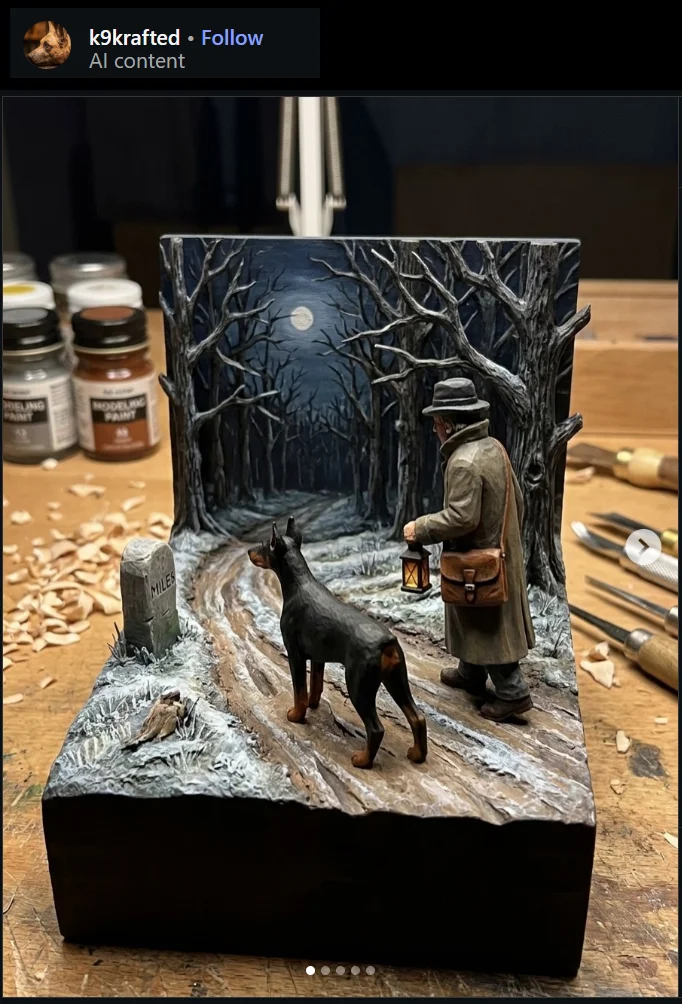
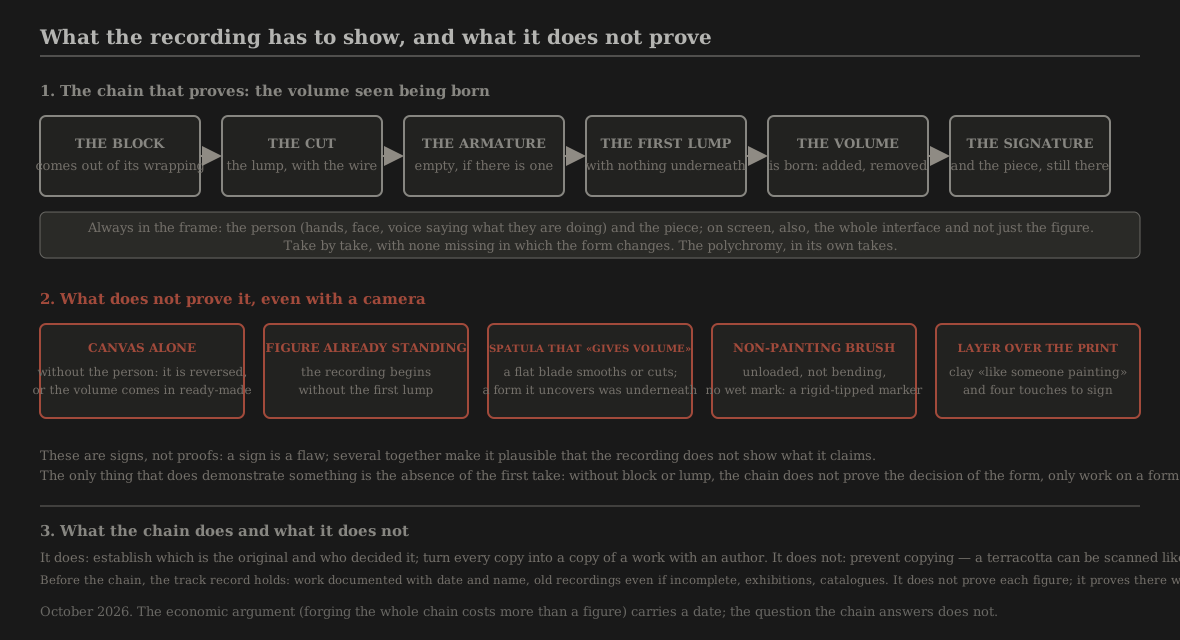
What proves it is one thing only, and it is not an object but a chain. The chain has two links, and both are needed. The process seen: the modelling recorded, from the first lump of clay to the signature, in all its takes, without any missing in which the form changes; and the polychromy, likewise, in its own. The object that appears in those takes and goes on existing: the same piece, with its accidents, its marks and its signature, which can be placed alongside the recording. With that, which one is the original is established. That it is reproduced afterwards breaks nothing: an authorised copy is a copy of that original, and declares it; an unauthorised copy is what it has always been in the history of art — a forgery or a plagiarism, as the case may be—, an offence with a name, which the chapter on author and law dealt with when saying what each person can do with the figure (Author and law: «What the law recognises, and to whom»), and which the recording of the original makes easier to prove, not harder.
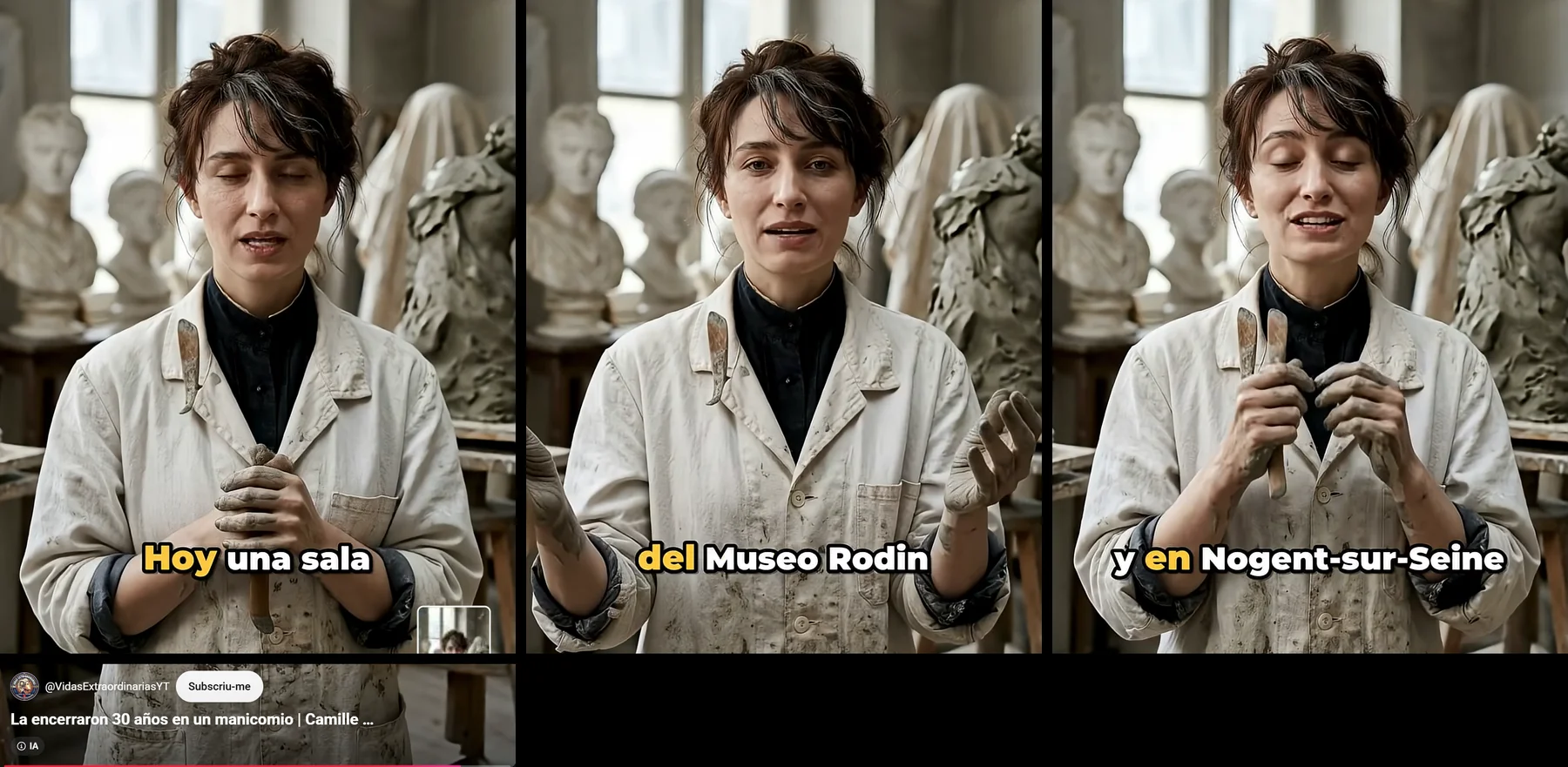
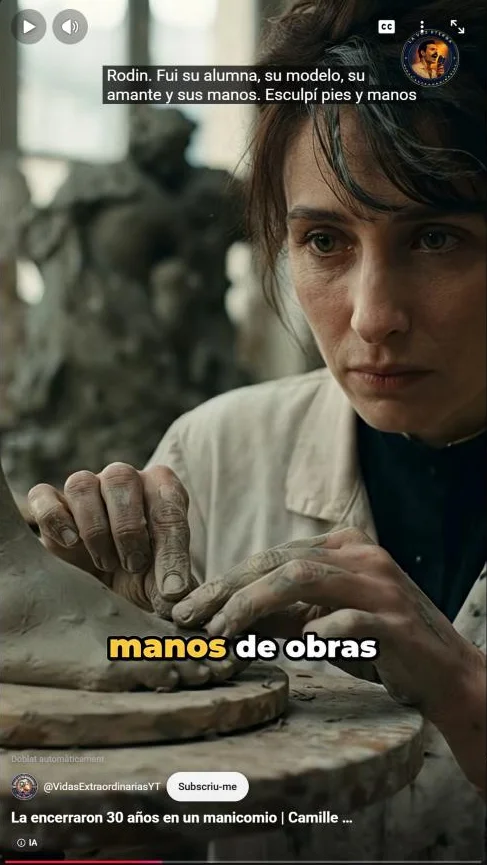
It is worth saying exactly what «the process seen» is, because not every recording is one. A recording of the canvas of a digital sculpture program, with nothing else, proves nothing: one opens the figure — one’s own or a generated one—, gradually strips it of form and resolution until it is brought back to the sphere the program starts from, records only the canvas and edits the video in reverse; what is seen is a sphere turning into a figure, and nothing gives it away, because a stroke that removes, seen in reverse, is a stroke that adds. And there is not even any need to go backwards: the volume can enter the program ready-made, from a generator that sends it with a button — section 9 shows this—, and the recording of the canvas will show someone spending an hour retouching a figure they did not decide. What proves it is the person working: the hands on the clay or on the tablet, with the monitor in the same plane; the face or the body of whoever models; and their voice saying what they are doing at that moment, not afterwards. That recording cannot be reversed, because a hand that adds or removes clay with the fingers or with a modelling tool, seen in reverse, gives itself away like someone walking backwards; and on screen, with the hand and the monitor in the frame, the same happens. And it is also what an artificial intelligence does not fabricate today. It already fabricates, in shots of a few seconds, hands smeared with clay, a plausible face and a plausible workshop; what it does not fabricate is a form that changes under those hands, from the lump to the figure, in long takes without cuts, with the voice tied to the gesture. An example, with a date: a short popular-history video about Camille Claudel, labelled by the platform as artificial intelligence content, strings together some 20 shots of 2 to 4 seconds; in the only one in which the sculptor «models», the hands rest on a cylinder of clay that does not change between the beginning and the end of the shot, and in one and the same frame, within a few seconds, the tools change in number and place: one in the pocket and another between the hands, then only the one in the pocket, then two between the hands and none in the pocket.22 What the machine produces is seconds; what it does not produce is continuity. A long take of a form being born is worth more as proof than hours of recorded canvas and than any montage of short shots, however plausible each of them may be; that is why the unit of this chain is the take, what the camera records in one go. That is why in this Manual «recording the modelling» means recording whoever models, not only what is modelled.
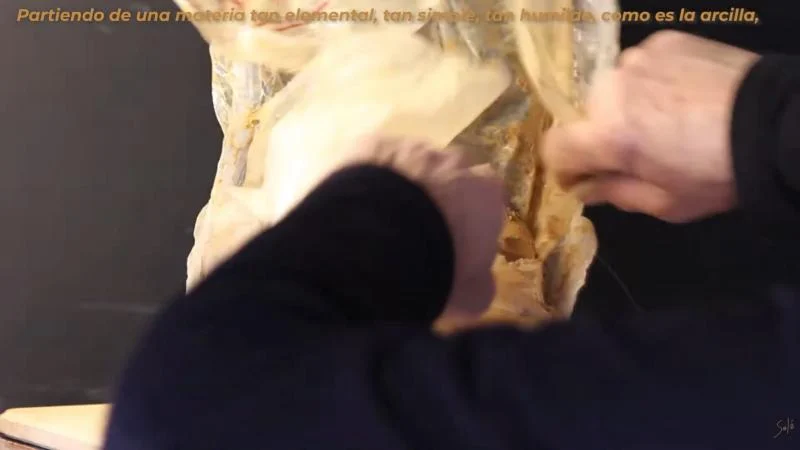
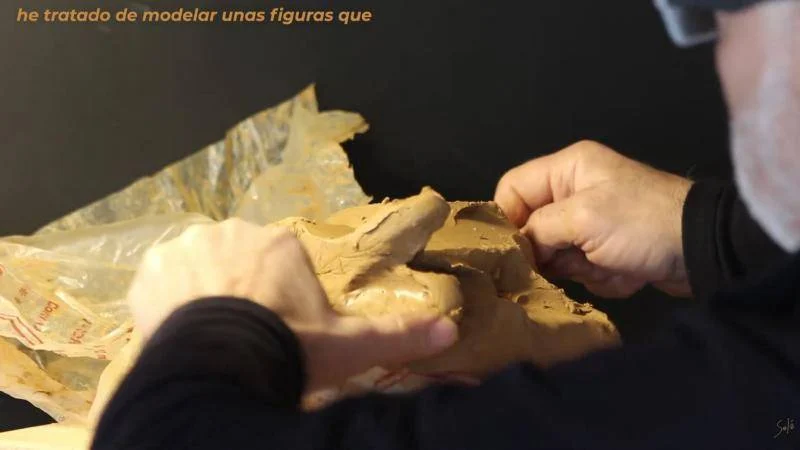
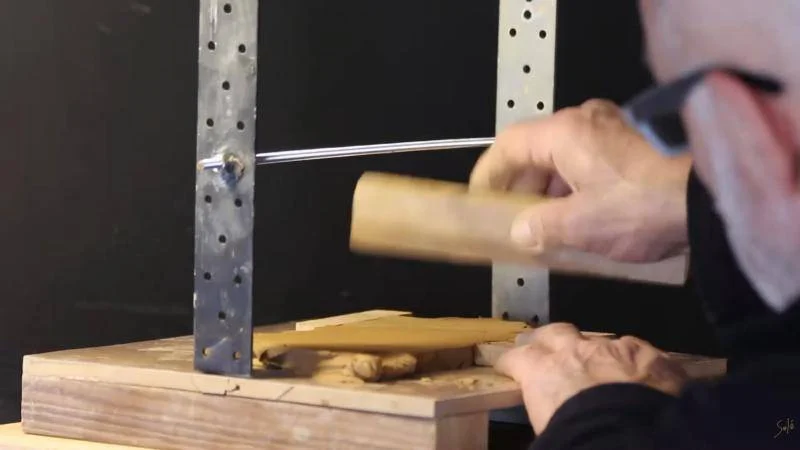
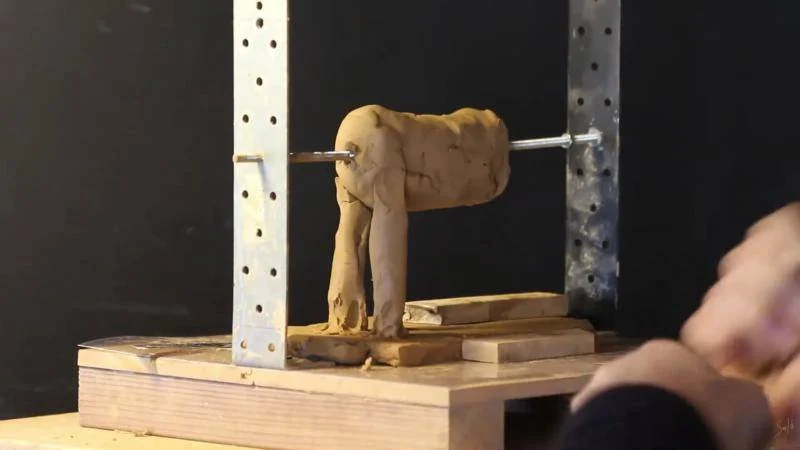
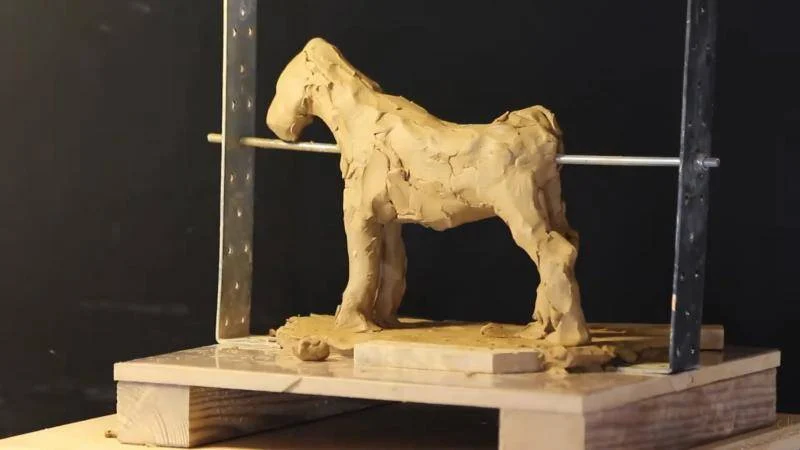
And it must also be said what has to be seen in those takes, because hands on clay, with face and voice, prove that someone was working on that piece, and that is not yet what is being sought. A figure printed from a file can be covered with a layer of clay and then one can record how that layer is «modelled», with everything the previous paragraph asks for in the frame; the form, in that case, was decided before the first take, under the clay, and what the camera sees growing is the layer, not the figure. What the chain has to show is the volume being born, and that begins before there is a figure: the block of clay as it comes out of its wrapping, the cutting of the lump with the wire, the empty armature if the figure needs one, and the first lump on it, with nothing else. From there on, the volume grows as it grows in modelling: by the addition of lumps that the fingers press and spread, or by subtraction with the modelling tool, and each of those gestures shows that underneath there was nothing. In direct carving the chain is the same, in reverse: the whole block before the first blow, and the form emerging from it by subtraction, blow by blow, with nothing being added. What proves nothing there is the block that arrives already roughed out by a milling machine from a file and is «finished» with the gouge: it is the clay-covered print, in wood. The opposite can also be seen, and it is worth knowing how to look for it. A spatula is flat, and that is why what it does is apply or remove material on the surface: it smooths, cuts, goes over; it does not create volume. A recording in which the passing of a spatula leaves behind it a volume already made — an arm, a fold, a face that was not there and appears when the blade is withdrawn— shows a surface being uncovered, not a form being born. The same happens with polychromy: a brush loaded with paint deposits it, its bristles bend against the piece and leave a wet mark that can be seen; a brush that runs over the figure without being loaded, without bending and without leaving anything, as if it were a rigid-tipped marker, is not painting. These are signs, not proofs: a sign is a flaw; several together make it plausible that the recording does not show what it claims; none on its own demonstrates how the piece was made. What does demonstrate something is the absence of the first take: a chain that begins with the figure already standing, however much clay one sees being put on it, does not prove the decision of the form, but only someone’s work on a form that already existed.
Each loose link can be forged. A video is cut; an object is substituted. The whole chain, today, is not worth forging: fabricating hours of recording of hands deciding a form that in the end matches an existing piece costs more than a nativity figure is worth. The argument is economic and carries a date, like everything in this chapter: when technology makes that forgery cheaper, the argument will have to be revised. What does not carry a date is the question that the chain answers — did anyone decide this?— and the observation that, of all possible proofs, it is the only one that is not in the object but outside it.
It is also worth saying what the chain does not do. It does not prevent copying: a terracotta can be scanned like anything else, and from its file copies will come out in whatever material one wishes. What the chain does is make clear whose the copied thing is: there will be an original whose birth has been seen, with the author the law recognises and the rights that this brings, and any copy that comes from it will be a reproduction of someone else’s work, authorised or not. The sculptor who decides and lets it be seen does not prevent being copied; they prevent what is copied from passing as nobody’s.
The sculptor who decides and lets it be seen does not prevent being copied; they prevent what is copied from passing as nobody’s.
And it is worth saying what holds before the chain. Recordings begin one day; what came before was not recorded. For that time the usual proofs hold, those the previous chapter called the track record (Who conceives the form): the work documented with its date and its name, old recordings even if they are not complete, exhibitions, catalogues, publications. A track record does not prove each figure; it proves that there was someone who decided forms before it was necessary to demonstrate it.
9. The market for the component, with prices in plain view
There is a point that the nativity-scene world does not usually say out loud and that this chapter needs to say, because understanding where the form without an author strikes, and where it does not, depends on it.
For many scenographers — above all in the associations, where new scenes have to be built every year on a fixed budget— the figure is a component of the scene. It has to fulfil its role, it has to please and it has to cost little; the purchase is decided on those three criteria, and it is reasonable that it should be: what the scenographer signs is the scene, and the scene does not care where the shepherd at the back came from so long as it looks like a shepherd. It is not a new attitude; it is the position of the client in a chain that this block describes in full.
What is new is that, on those three criteria, the form without an author always wins, and the prices are published. Laual’s table, on 13 October 2026: a printed figure, unpainted, from €25 to €43 according to size, from 10 to 24 centimetres; painted, from €54 to €72; «Arxiu STL», €4; «Disseny de figura personalitzada», €99; shipping, €5; monumental size of 1 metre, on request.14 The line for the file deserves a slow reading. Four euros pay for no work: they pay for the act of downloading. A file costs the same to produce once as a thousand times, so any price above zero is profit and the seller can lower it as far as they like; whoever sells physical figures cannot follow, because each of their units costs material, hours and shipping. The file, moreover, has no size: the buyer prints it at whatever size they like, as many times as they like. With €4 an association prints the shepherds it needs and paints them itself; a single sale covers a demand that used to be 10 or 20 figures bought. How much that shop sells nobody outside it knows, and the argument does not need it: if it sells 10,000 files a year, that is €40,000 for figures whose form no sculptor decided, and the market is broken by volume; if it sells none, what remains in the buyer’s head is that a nativity figure costs €4, and from then on the price of a unique terracotta cannot be understood as anything but an absurdity.
Four euros pay for no work: they pay for the act of downloading.
The other blow is that of quantity. Presepe3DArt, an Italian page without an author’s name, announced on 17 June 2026 «más de 140 modelos diferentes disponibles, incluyendo personajes populares, oficios antiguos, figuras históricas y creaciones personalizadas» — more than 140 different models available, including popular characters, old trades, historical figures and custom creations—, in sizes from 10 to 30 centimetres, with shipping «a toda España y al resto del mundo» — to the whole of Spain and to the rest of the world—; on 5 October it was «più di 230 personaggi diversi».13 That is 90 new characters in 4 months. A sculptor who decides every form produces, in the experience of the person who writes this, a few dozen in a good year. And the demand is there, and can be read in the comments on its videos, which ask about the till, not about the author: «¿Qué medidas tiene? ¿Cuál es el precio?» — what size is it? what is the price?—; «pertenezco a una falla en la cual hacemos el belén de dicha falla y me gustaría saber precios de las figuras y modelos» — I belong to a falla in which we make the nativity scene of that falla and I would like to know prices of the figures and models—; «vivo en California, dime en dónde yo consigo pastores así» — I live in California, tell me where I can get shepherds like these—.13 The 13,000 followers of that page are 13,000 people who have gone to look there, and every purchase made there is one that will not be made from anyone else. Whoever asks the price does not ask who modelled it, and does not ask because it has ceased to be a purchasing criterion.
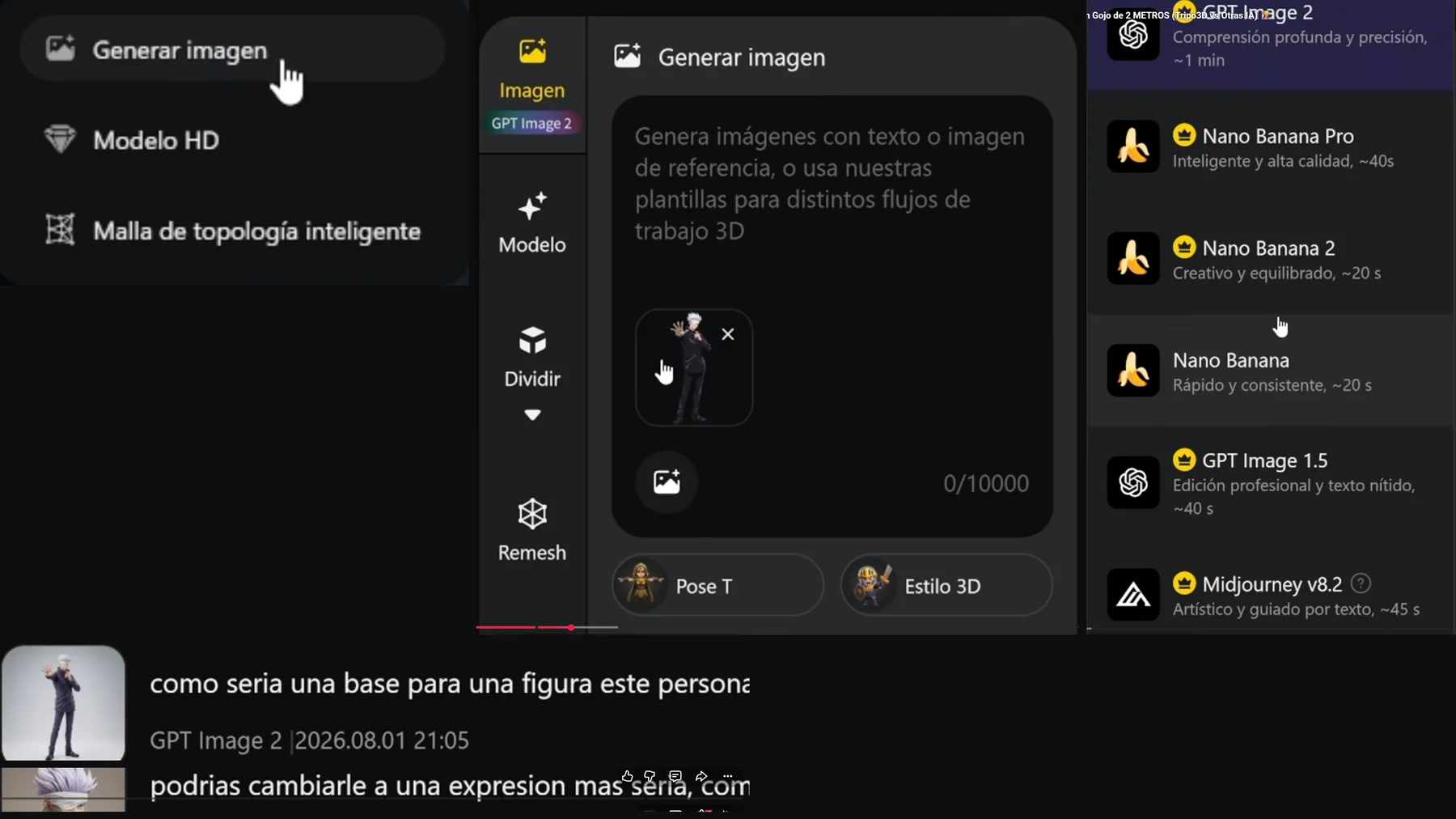
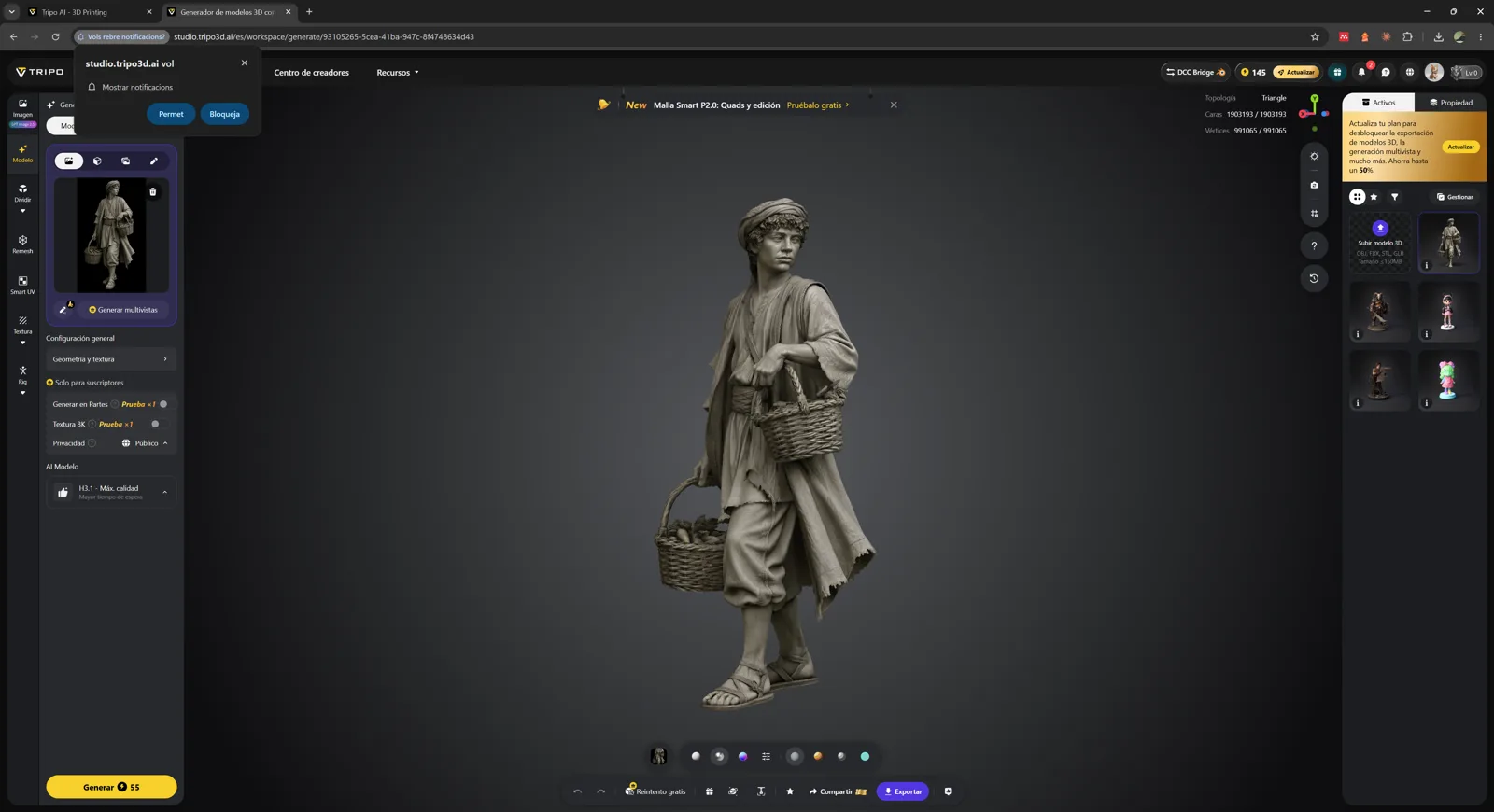
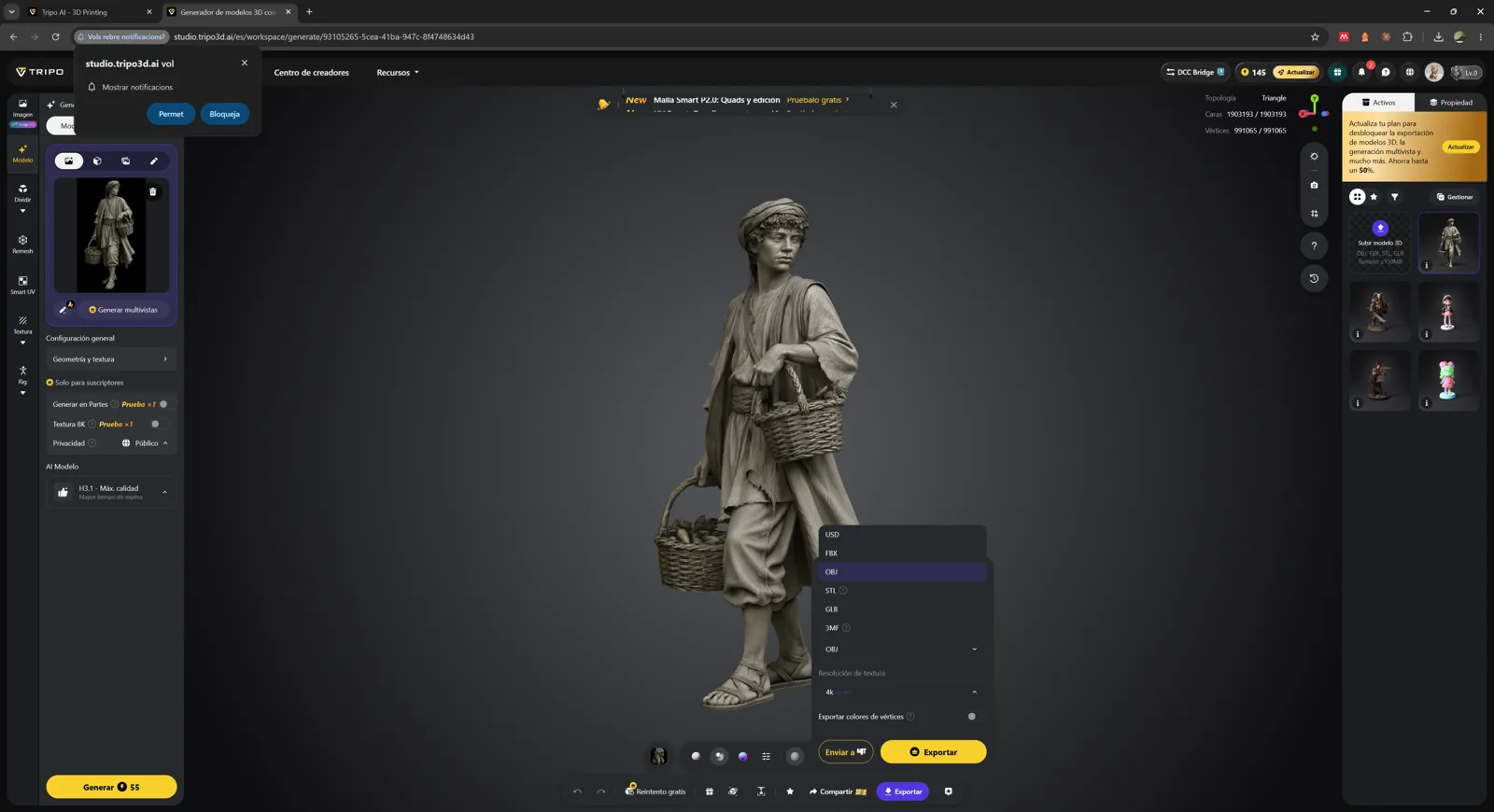
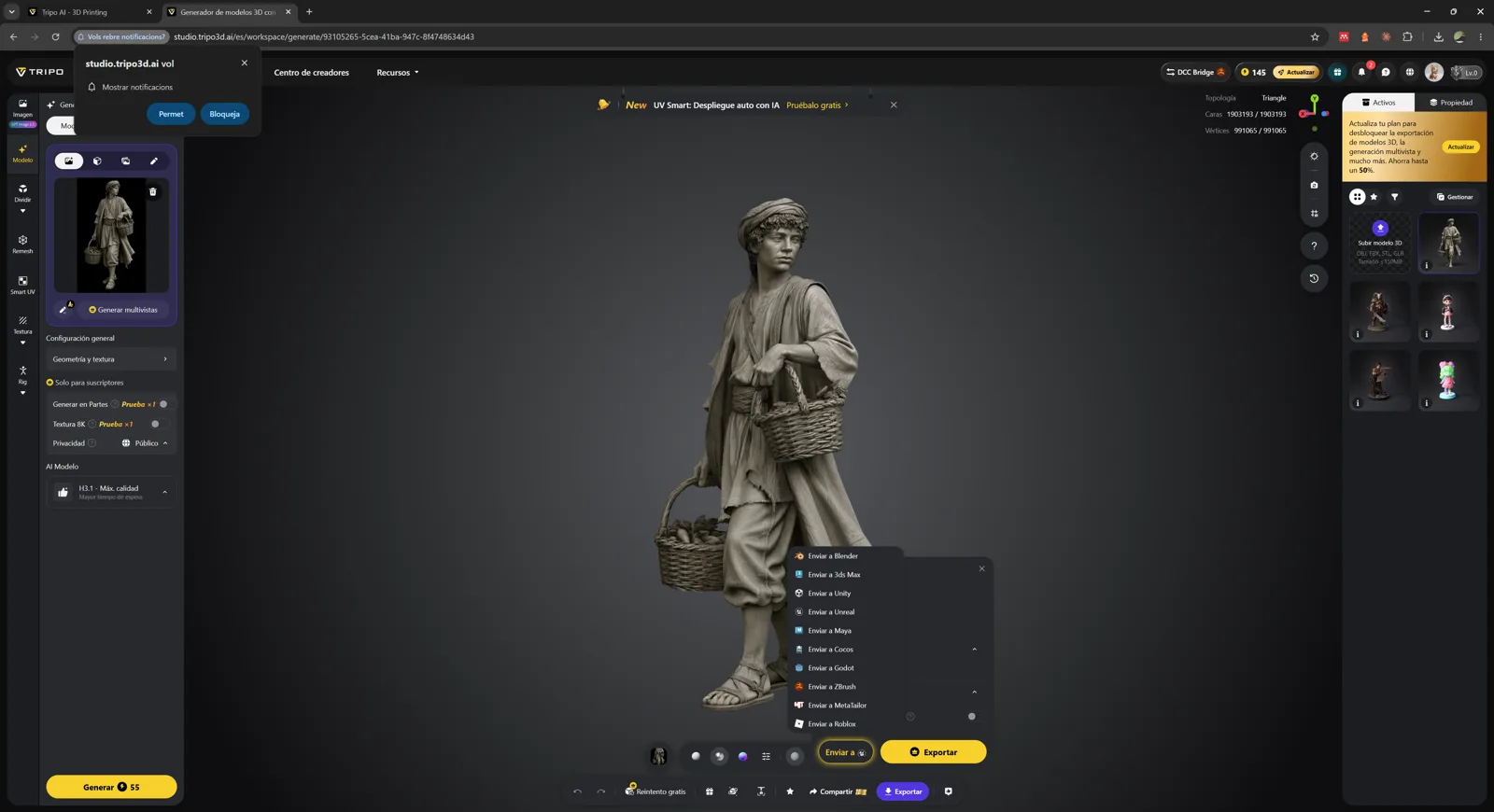
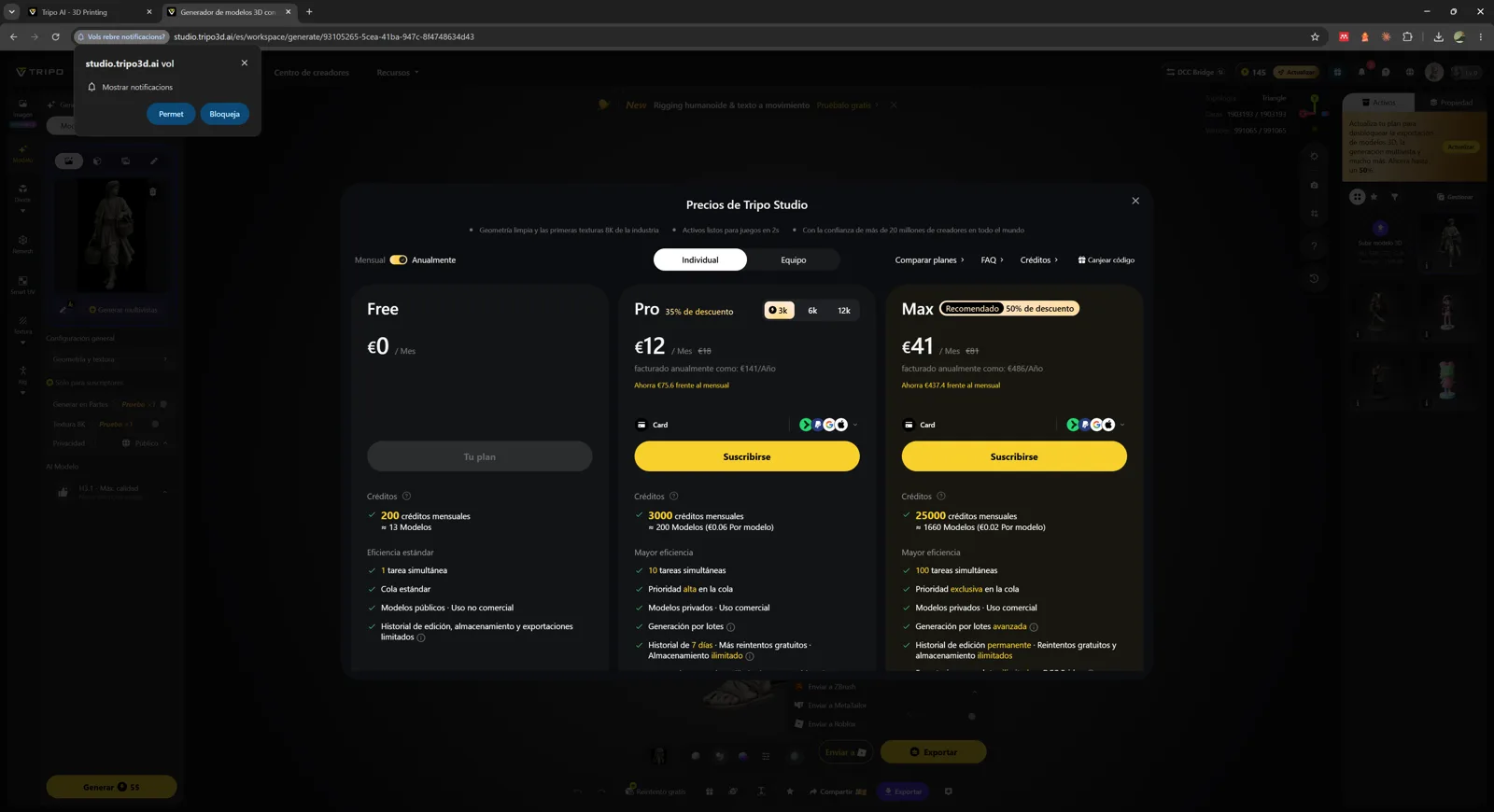
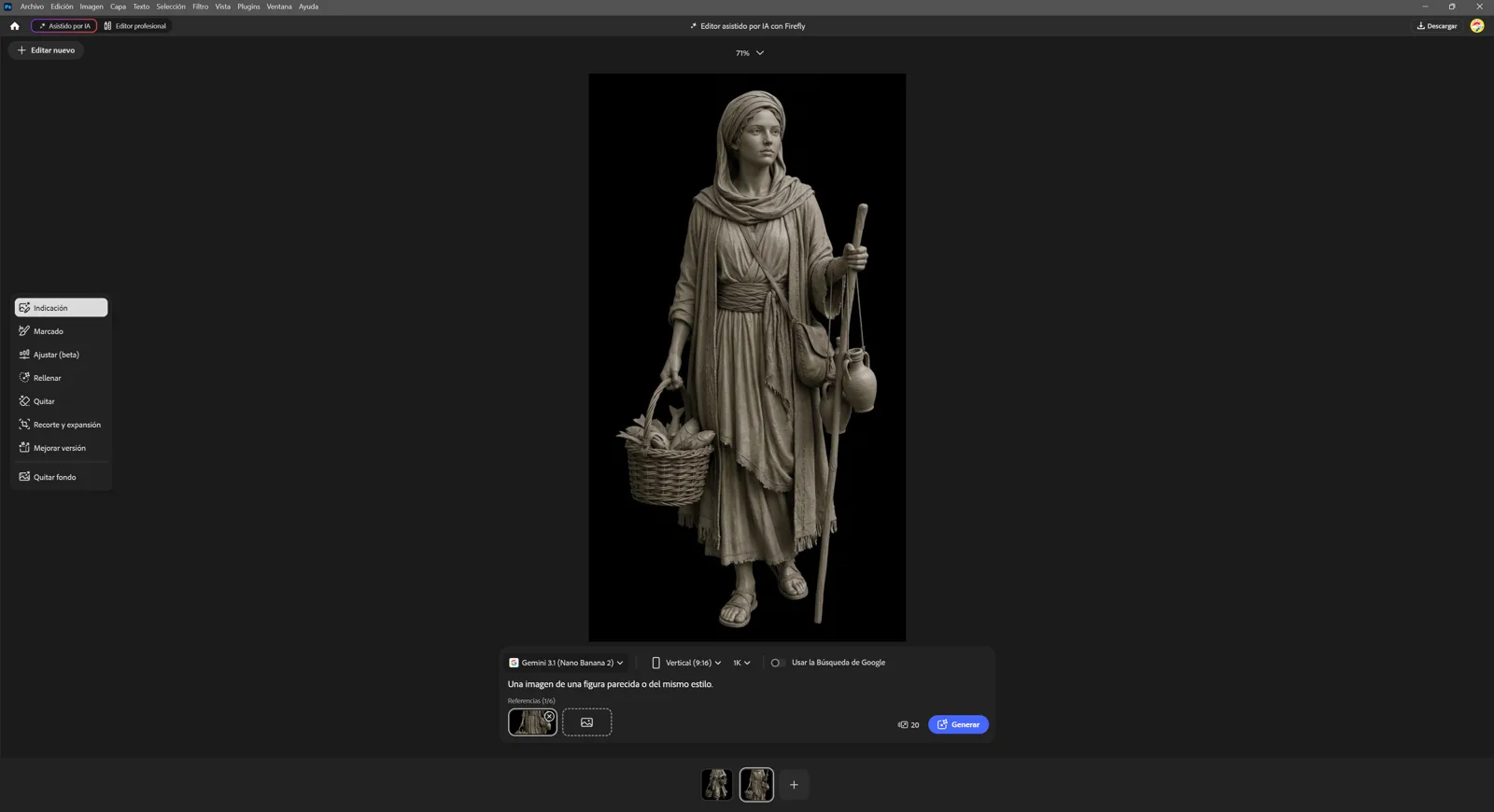
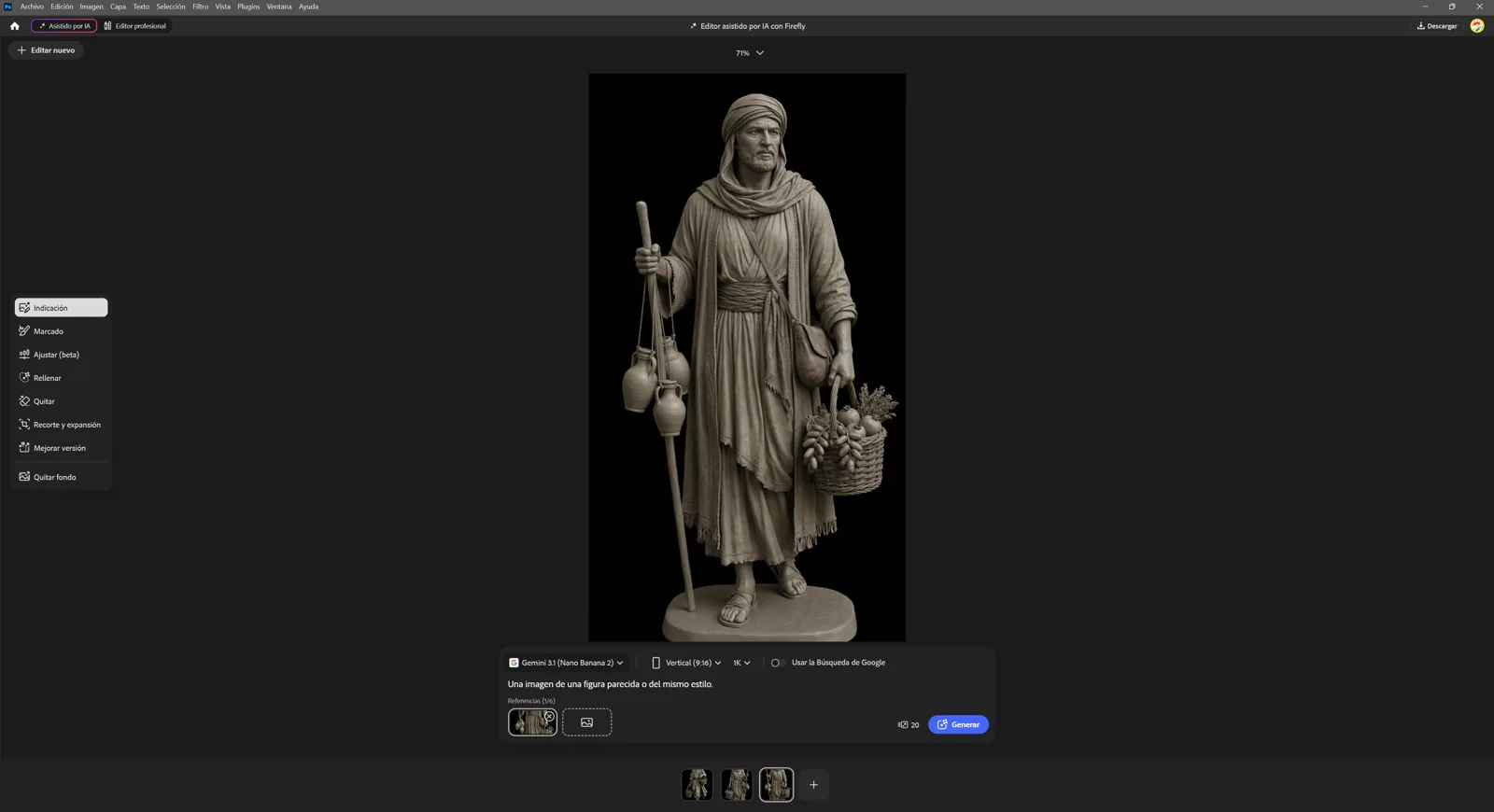
And whoever sells today is not safe either, for the same reason that the chapter gave in section 6: whoever sells forms that nobody decided has no author to invoke. There is no need even to buy: the advertisement is enough. Emili Solé verified this on the afternoon of 13 October 2026, in less than half an hour, discovering the chain as he went along it. He took the image with which Presepe3DArt advertises one of its figures on Facebook — a boy with two baskets, posted on 17 June with the platform’s «AI content» label— and uploaded it to Tripo, a generator of volumes from images, in its free mode. Within minutes it returned a figure of 1,903,193 faces, that is, print resolution, with the back, the soles of the sandals and the bottoms of the baskets resolved coherently even though the photograph did not show them. The export button offers USD, FBX, OBJ, STL, GLB and 3MF, with 4K texture — STL and 3MF are the printer formats—, and the «Enviar a» button — send to— sends the volume to Blender, 3ds Max, Maya or ZBrush, where anyone can change its face, turn its head and sign it. And neither someone else’s image nor the program afterwards is needed any longer: the same platform generates the starting image from a sentence, with other companies’ image engines in its menu, accepts corrections by conversation — «podrias cambiarle a una expresion mas seria», could you change it to a more serious expression—, turns the image into volume and divides it into pieces the size of the printer bed, «print-ready […] no repairs needed». Free means 200 credits a month, about 13 models, «uso no comercial» — non-commercial use—; for €12 a month, about 200 models at €0.06 each, «uso comercial» — commercial use—; for €41, 1,660 at €0.02.20 There is not even any need to copy. The same image, given to Photoshop with the sentence «Una imagen de una figura parecida o del mismo estilo» — an image of a similar figure or one in the same style—, returned in less than a minute a fisherwoman with a crook, a pitcher and a basket of fish, with the same grey, the same black background and the same light, which goes into Tripo by the same door and comes out as one more figure, belonging to nobody; a careless click on the same button returned, in less than 30 seconds, a third character, a man with pitchers and a crook.20 A catalogue of 230 characters can be regenerated «similar» at one a minute, and whoever does so will not have copied anyone. A shop like that dismantles another in a short time, and the next one after that. Whoever wins in that chain is none of those who sell figures: it is whoever sells printers, whoever prints to order and, if commissioned, whoever paints.
The two blows add up: one multiplies the supply of forms, the other makes copying infinite. When supply has no limit and demand is what it is, the price falls to the cost of producing one more unit, and that of a file is zero. And the cost of producing a new form does not hold anything back either: Hyper3D advertises in its price list about 60 models for $24 a month and about 416 for $96, that is, between $0.40 and $0.23 per model;7 a single sale at €4 pays for 10 generations. Whoever sells like this does not have a business that lasts — their own buyers are their competition, because each of them can resell what they bought—, but it does not need to last for the reference price to be set. Anyone can do the sums, and the person who writes this Manual did them before there were generators, with the prices of his own workshop as an example: an original figure in polychromed terracotta, about 17 centimetres tall, around €350; an edition of 8, €300 per copy; a silicone mould and 200 resins, €125 each; the file alone, €25, sold 1,000 times. The most profitable line was already the one that needed the least original work, and Laual has corrected it to €4. The limit of that column is not the price: it is the number of buyers, which in the nativity scene nobody has measured.
From this comes a distinction that puts everything in order: under the same name, «nativity figure», there are two markets. That of the figure-as-component, decided by fulfilling its role, pleasing and costing little, which the form without an author sinks, because nothing can compete with a cost of zero. And that of the figure-as-sculpture: a unique piece, with an author and with a process, which was never a volume market and whose value depends not on how many are sold but on someone having decided it and on that being visible. The flood reaches where reproduction was — the mould, the series, the resin, and with them whoever prints to order, whoever paints, the mould-maker—, not where the unique piece goes. Whoever lived from the series has a problem that this chapter does not solve; whoever made unique pieces has today, paradoxically, the only dry ground.
Whoever made unique pieces has today, paradoxically, the only dry ground.
| What is sold | Who | Price | Date consulted |
|---|---|---|---|
| Printed figure, unpainted, 10-24 cm | Laual | €25-43 | 13-X-2026 |
| Printed and painted figure, 10-24 cm | Laual | €54-72 | 13-X-2026 |
| STL file of a figure | Laual | €4 | 13-X-2026 |
| Custom figure design | Laual | €99 | 13-X-2026 |
| Generation of forms, Creator plan | Hyper3D | $24 a month, «approx. 60 models» ($0.40 per form) | 13-X-2026 |
| Generation of forms, Business plan | Hyper3D | $96 a month, «approx. 416 models» ($0.23 per form) | 13-X-2026 |
| Volume from an image, free plan | Tripo Studio | €0, 200 credits, «≈ 13 models», non-commercial use | 13-X-2026 |
| Volume from an image, Pro plan | Tripo Studio | €12 a month, «≈ 200 models (€0.06 per model)», commercial use | 13-X-2026 |
| Volume from an image, Max plan | Tripo Studio | €41 a month, «≈ 1,660 models (€0.02 per model)» | 13-X-2026 |
The prices are those of the days indicated and they change; the table adds nothing to the notes, it only puts them side by side.
10. What nativity-scene art and practice loses: first the figure, then the scene
There remains a consequence that the scenographer who buys components has no reason to see, and which it is worth setting before them, because it affects them more than anyone.
The previous block described the nativity scene as a chain of authors: the sculptor decides the form of the figure, the scenographer decides the scene, and between the two — with those who make the props, those who paint, those who dress the figures— the work has more than one name. If the figures cease to have an author, that chain loses a link, and not just any link. What remains is a single author, the scenographer, composing with pieces that belong to nobody. Nativity-scene art is then reduced to composition: scenes built with a material that nobody decided.
But the chain does not stop at the figure, and it is honest to follow it. The same systems that turn a photograph into a printable figure turn anything they are given into volume — «sube una foto… y lo convierte en un modelo 3D que puedes imprimir», upload a photo… and it turns it into a 3D model you can print—.8 A photograph of a courtyard, of a house, of an entire diorama, goes in by the same door and comes out as a file, and a file can be broken down into planes and printed, cut and engraved on a laser cutter, or milled on a machine that reads the file; the nativity-scene maker is left with the moss and cork they buy, and the odd sprig of thyme. What reaches them is not a material to compose with: it is a kit, whether a diorama or an open nativity scene of the scale-model kind. And here the word that this Manual forbids for the nativity scene — montar, to put together— becomes the exact one, because a kit really is put together: one follows the instructions and fits the pieces. Whoever receives it does not compose a scene; they assemble it. Their merit, which was that of whoever decides where each thing goes and why, has been kept by the file, and what is left to them is the merit of someone who puts together a piece of furniture.
Whoever receives it does not compose a scene; they assemble it.
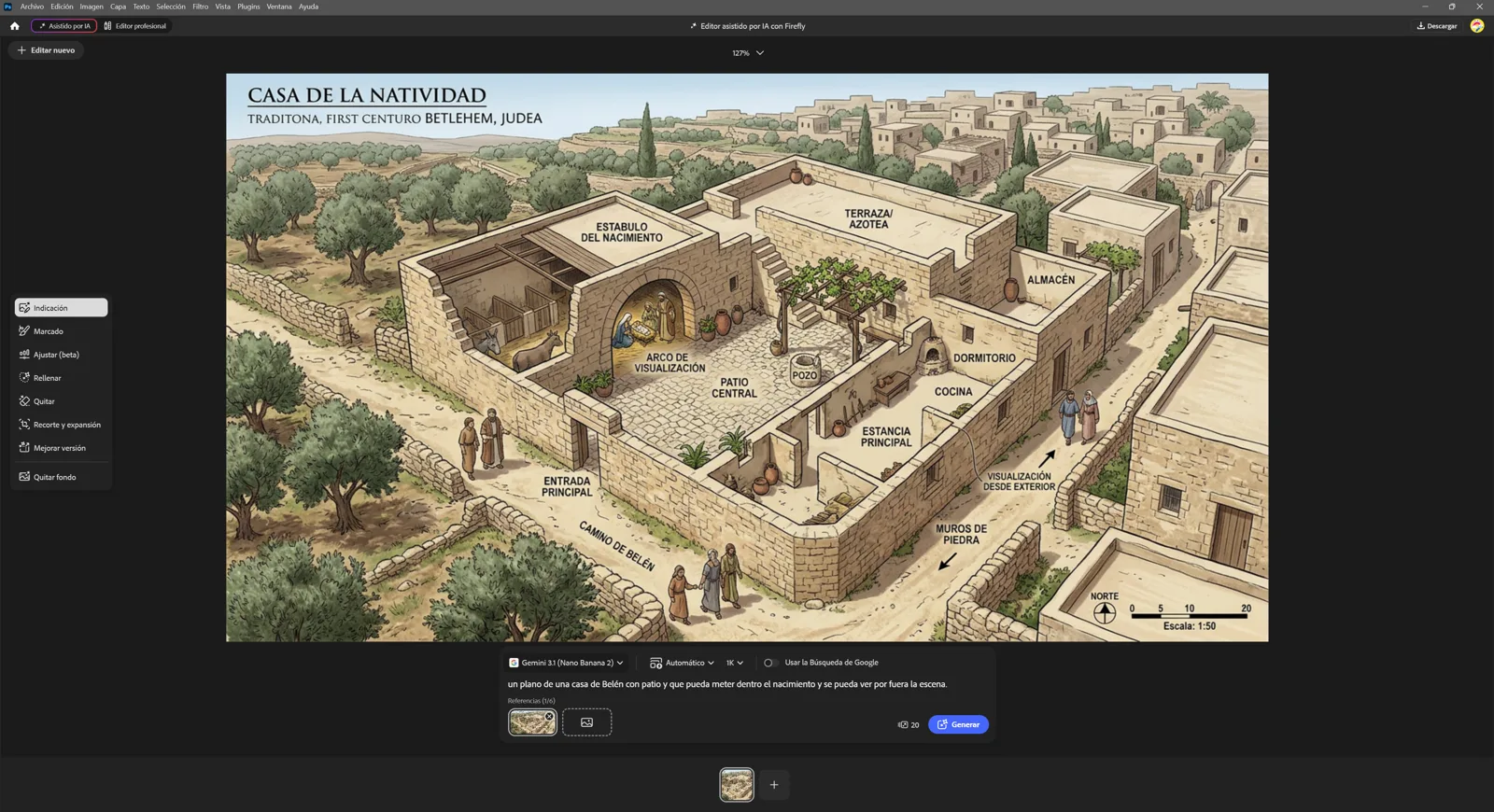
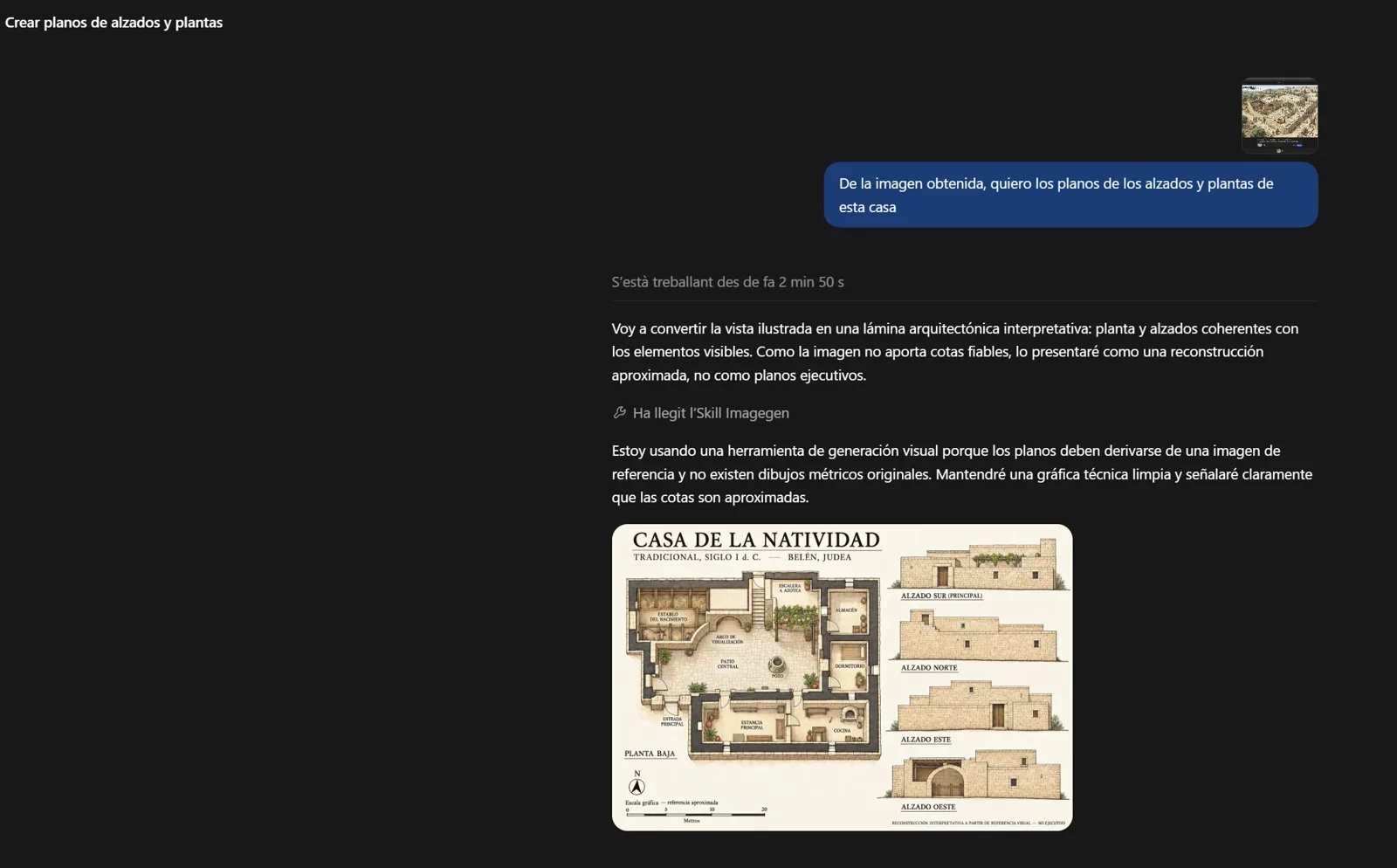
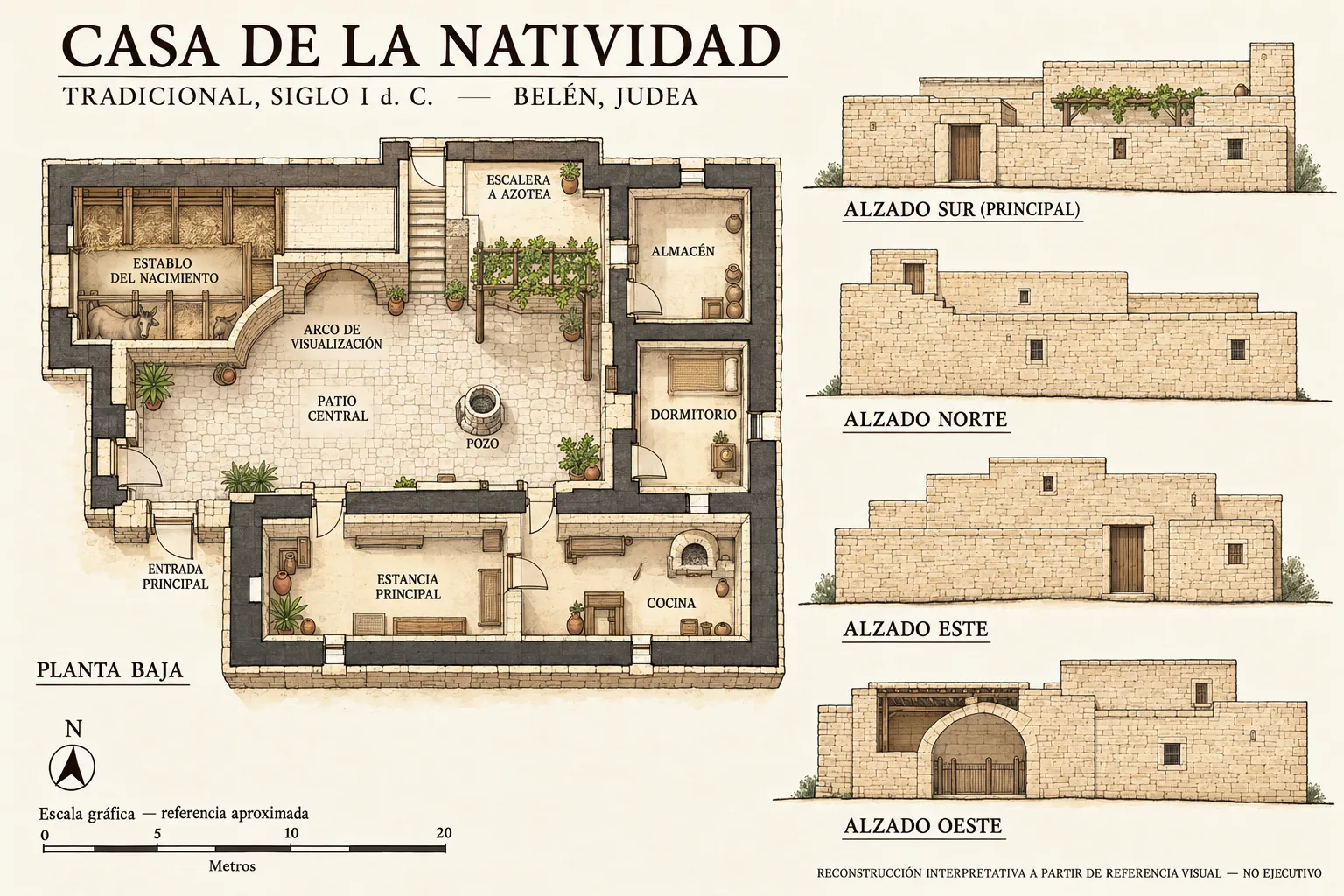
That this chain is not a forecast was verified by Emili Solé on 13 October 2026, in minutes and without first looking for what there was on the internet. In Photoshop, with the image generator that the program incorporates, a single sentence — «un plano de una casa de Belén con patio y que pueda meter dentro el nacimiento y se pueda ver por fuera la escena», a plan of a house in Bethlehem with a courtyard, into which the Nativity can be put and where the scene can be seen from outside— returned a house in Bethlehem opened up to show its interior: courtyard, stable with the Nativity, well, kitchen, storeroom, flat roof, each room labelled, north arrow and scale. That image, handed to ChatGPT with another single sentence — «De la imagen obtenida, quiero los planos de los alzados y plantas de esta casa», from the image obtained, I want the elevation drawings and floor plans of this house—, returned in less than 3 minutes a sheet with the ground floor and the four elevations, with a graphic scale from 0 to 20 metres. Two sentences, no correction, not even a photograph: the view came out of the sentence. The label of the first image had two misspelt words; the sheet corrected them on its own. At the foot, the sheet warns that it is a «reconstrucción interpretativa a partir de referencia visual — no ejecutivo» — interpretative reconstruction from a visual reference, not for construction—. The warning changes nothing: one measures on that plan, and what is measured is taken to whatever scale one wishes. What comes out is the scale model waiting to be broken down into pieces.19
When that happens at both ends — nobody’s figure and nobody’s scene—, the nativity scene will no longer have an author in any link: nobody will have decided anything, and nobody will have made anything with their hands either; it will be seasonal decoration, an industrial object. The chapter on the heritage dossier examined a decree that called craft what was art, and showed that it was mistaken (The dossier: «The Real Decreto 481/2022: the declaration that demotes what it declares»); it is worth seeing that the generated kit nativity scene would prove it right, not because the decree had understood nativity-scene art and practice, but because nativity-scene art and practice would have sunk to its definition. And since that decree does not distinguish whoever decides from whoever assembles, it could not see that this has happened either.
That is not a moral catastrophe; it is a loss of rank, and an exact one. A nativity scene composed with figures without an author is still a work — the scenographer’s— and can be good; a kit nativity scene is a decoration, and can also be pretty. What neither of them is any longer is what this Manual holds nativity-scene art and practice to be: a sculpture that a scenographer puts on stage, two arts that meet. Whoever buys good, pretty and cheap makes, without knowing it, the nativity scene a smaller thing than it was. They already have what they wanted; what they do not know is what they have just bought with it. And that is exactly why this block’s question — who decided the form?— is not a sculptor’s curiosity, but the one that decides what a nativity scene is.
11. The whole scene without an author
What precedes has announced the kit; the step before it has already been taken, and it is worth recording it with a date, because it affects another chapter of this Manual: the one that asks what makes a biblical nativity scene authentic.
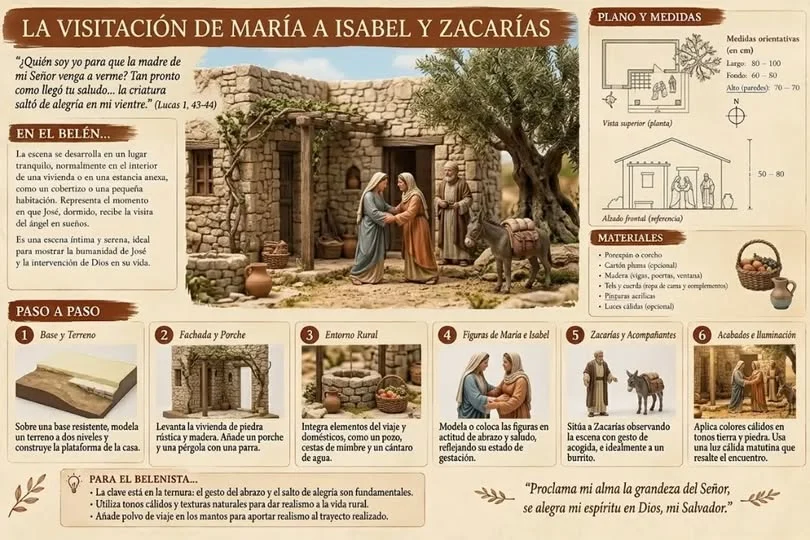
In October 2026 sheets in the format of workshop record cards are circulating on social media: an image of the scene — a caravan courtyard, a king’s fortress, women washing by the water—, a list of materials and tools, a numbered step-by-step guide, «consejos del taller» — workshop tips—, a section on «continuidad en el belén» — continuity in the nativity scene— and a historical text without a single source. In the fortress step 10 is missing and step 11 has its title with the letters jumbled; the caravan courtyard takes for granted «pesebres o ataderos» — mangers or tethering posts—, a «pozo o aljibe central» — central well or cistern— and «estancias para guardar mercancías» — rooms for storing goods— without anyone saying where from; the washerwomen use «jabón natural (o sosa)» — natural soap (or soda)—, ash and pumice stone, with no reference whatsoever. The errors show that nobody read them before publishing them, and they are delivered as authentically historical. The platforms label them as artificial intelligence content, with the scope that section 7 has given to that label; whoever publishes them presents themselves as a master nativity-scene maker and adviser to an association.16
What this adds to the form without an author is scenography without an author: no longer a figure whose form nobody decided, but an entire scene — with its figures, its architecture, its props and its «history»— that nobody decided or checked, presented as a manual. The reader who follows it will build a caravan courtyard that did not exist, with washerwomen who did not wash like that, and will take it for historical. This chapter goes no further; what this does to the biblical nativity scene belongs to the chapter that deals with its authenticity (What makes a biblical nativity scene authentic?). Here the observation is enough: the absence of decision does not stop at the figure, and neither does the absence of checking. And it is worth saying so without attributing bad faith to anyone, because there is no need: whoever publishes what they have not researched is not teaching, they are handing out what the system gave them, and the system knows nothing, it only repeats what is frequent. The good will of whoever publishes it does not change the lamp. One rule is enough for the reader: the figure or the sheet that does not say how it knows, does not know; and the one that does say, gets checked.
The figure or the sheet that does not say how it knows, does not know; and the one that does say, gets checked.
12. A way out, with its measure
This Manual gives no recipes, but it must say what the person who writes it does with what has just been set out, because otherwise the chapter would be a complaint. And it must say it with its exact measure, so that nobody takes it for more than it is.
Since October 2026, Emili Solé models every new figure directly in clay, a unique piece fired as terracotta, polychromed or not, and records all the modelling, take by take, from the first lump to the signature, and the polychromy in its own takes: the chain of section 8, complete. And he does not offer figures for sale: no catalogue, no price, no series. What he closes with that is his participation in the chain as a seller — his sales chain, not the creative chain of this block, of which he remains the first link—. The unique piece can be sold, as sculpture has always been sold: after a dialogue with whoever wants it, with a document certifying it as an original work and with rights reserved; and commissions continue. What there will not be is a shop window with figures at a price, because that shop window is the market of section 9, and in it there is no longer anything to decide. Put another way: he does what cannot be bought for four euros. It is also the only thing that the chain of section 9 does not produce: a person in front of a camera with their hands in the clay.
What that way out does not do, and it is worth saying with the same clarity: it solves nothing for the sculptors who live from selling figures. It is one way out among several, and not the only one possible. The next chapter, «The ways out», examines them one by one — this one included, with its measure— and says of each what holds up against a cost of zero and what does not.
13. Closing, with a date
The two categories that this chapter proposes — the form taken from reality and the composed figure— were written in October 2026 by analogy with what photography won and with what a registration office has written about what is generated; no judicial decision on scanned or composed figures supports them yet, and the day there is one they will have to be read against it. The economic argument of the chain — that forging it whole costs more than a figure is worth— carries a date, and it is the first that technology may leave behind. The pages, the price lists and the labels the chapter cites are those of the days their notes carry; they will change, and the chapter with them. The question does not change; the answers are dated.
The question does not change; the answers are dated.
References
Ley de Propiedad Intelectual (Real Decreto Legislativo 1/1996), art. 6.2 and art. 27.1. Consolidated BOE text (BOE-A-1996-8930), latest update published on 30-III-2022; checked on 15-X-2026. ↩
Two examples, read on 1-X-2026: Labs3D (Barcelona), labs3d.com («realizamos escaneo 3D de personas, objetos y piezas para reproducción, impresión 3D»); MIO3D (Seville), mio3d.com («te hacemos tu propia réplica mediante el escaneo y la impresión tridimensional»). They are cited as evidence that the service exists, not as a recommendation. ↩
Laual, «Figures personalitzades», laual.art/figures-personalitzades/, consulted on 13-X-2026: a figure from a photograph, from an idea, or by 3D scanning «vestit amb roba d'època», with «faldilles, armilles, casaques, mocadors, calçat» that the shop provides and «una bota, un porró, un cistell, una forca, eines de treball» that can be held during the scan. The page gives no author’s name or company name. ↩
Musée Rodin, dossier documentaire Rodin, le laboratoire de la création, p. 7 (musee-rodin.fr, PDF), and «Rodin and photography», musee-rodin.fr/en/resources/rodin-and-arts/rodin-and-photography; date of Brussels (January 1877) in MuMa Le Havre, record «Rodin, L'Âge d'airain». Consulted on 1-X-2026; the Manual’s translation. ↩
Supreme Court of the United States, Burrow-Giles Lithographic Co. v. Sarony, 111 U.S. 53 (1884): third finding of fact recorded by the Supreme Court, and conclusion. Cornell Law School, Legal Information Institute, law.cornell.edu/supremecourt/text/111/53. Consulted on 1-X-2026. ↩
Court of Justice of the European Union, judgment of 1-XII-2011, case C-145/10, Painer, paragraphs 91 and 94. EUR-Lex (CELEX 62010CJ0145). Consulted on 1-X-2026. ↩
Hyper3D (Deemos Corporation), hyper3d.ai/es, version «Gen-2.5» in the page’s selector, and hyper3d.ai/es/use-cases/character-design («Generador de personajes 3D con IA»: «Rodin genera recursos 3D prácticamente listos para producción a partir de texto o imágenes, con una topología limpia y materiales PBR»). Price list (hyper3d.ai/es/pricing): «Creator» plan, $24 a month, «aprox. 60 modelos»; «Business» plan, $96 a month, «aprox. 416 modelos». The page publishes no version date; the date is that of consultation, 13-X-2026. Systems and their price lists change: what is stated holds for that version and that day. ↩ ↩
Meshy, meshy.ai/es, consulted on 13-X-2026: «Imagen 2D a 3D de alta fidelidad. Sube una foto, un boceto o una pieza de concept art, y Meshy lo convierte en un modelo 3D que puedes imprimir, usar en un juego o refinar aún más»; «La única IA 3D entrenada para imprimir. Los modelos 3D de Meshy se generan pensando en la impresión: watertight, manifold y listos para cortar». The same caution as in the previous note. ↩ ↩
Daz 3D, End User License Agreement, sections 1.0 and 5.0, daz3d.com/eula; MakeHuman, «License explanation», section C, makehumancommunity.org/content/license.html; Reallusion, Software EULA, version of 25-V-2026, sections 2.2, 5.2 and 5.3, reallusion.com/Content/EULA/AP/EULA_AP.htm. Consulted on 1-X-2026. Licences change: what is stated holds for that date. ↩ ↩ ↩
U.S. Copyright Office, Copyright and Artificial Intelligence, Part 2: Copyrightability, Report of the Register of Copyrights, January 2025, Executive Summary, copyright.gov. Consulted on 1-X-2026 and reread on 13-X-2026. In the same summary: «The use of AI tools to assist rather than stand in for human creativity does not affect the availability of copyright protection for the output»; «Based on the functioning of current generally available technology, prompts do not alone provide sufficient control»; authorship «must be analyzed on a case-by-case basis». It is cited with a date and as a contrast, not as an authority: it is the criterion of an administrative office of one country. ↩
TurboSquid, turbosquid.com, consulted on 6-X-2026: «Jesus Christ Rigged Real Model», $149; «Jesus Christ PACK», $199; models in an arms-outstretched pose («T-pose»), prepared for animation. Catalogue prices change: they hold for that date. ↩
Ley de Propiedad Intelectual (Real Decreto Legislativo 1/1996), art. 5.1 and art. 1. Consolidated BOE text (BOE-A-1996-8930), latest update published on 30-III-2022; checked on 13-X-2026. ↩
Presepe3DArt. Website presepe3dart.com (Spanish version), consulted on 13-X-2026: «Línea Clásica», «Edición Artesanal: piezas numeradas, pintadas a mano», «Personalizados»; «Impresión 3D de alta definición · Acabado y pintura a mano · Materiales resistentes y duraderos · Envío seguro en toda Italia»; no author’s name or company name. Facebook page «Presepe 3d art» (category «Artesanía», created on 21-XII-2025), consulted on 13-X-2026: 13,000 followers; presentation «Statuine presepe iper realistiche · Stampate in resina + dipinte a mano · Realizziamo anche il TUO volto · Spedizioni in tutto il mondo»; figure of the old man with a bowl posted on 21-XII-2025; post of 17-VI-2026, with the platform’s «AI content» label: «Realizo figuras y escenas para belenes impresas en 3D y acabadas a mano, con más de 140 modelos diferentes disponibles, incluyendo personajes populares, oficios antiguos, figuras históricas y creaciones personalizadas. Disponibles en varios tamaños: 10 cm - 12 cm - 15 cm - 20 cm - 30 cm. Envíos a toda España y al resto del mundo»; «più di 230 personaggi diversi» on 5-X-2026. The comments quoted, from three different users, are on two of the page’s videos (reels 1678461246608276 and 912050358361705), read on 13-X-2026; they are cited without names. The images in the posts consulted are grey renders on a black background; in one of the videos a printed piece in grey appears on a workshop table, and in another a painted figure with a hand painting it: this chapter does not state whether that video is a recording or a generation. ↩ ↩ ↩ ↩ ↩ ↩
Laual, laual.art, consulted on 13-X-2026. Catalogue «Figures de pessebre artesanals en 3D»: 68 figures at €25 (a Nativity at €50, a group at €63); all the product images are grey renders on a neutral background, with the file name «Arxiu producte»; text: «Un cop impresa, cada figura passa per un meticulós procés de pintura […] Cada pinzellada està pensada per ressaltar el caràcter i expressivitat de la figura»; «cadascuna d'aquestes petites obres d'art». «Preus» page: table from 10 to 24 cm, unpainted €25-43, painted €54-72; «Arxiu STL 4 €»; «Disseny de figura personalitzada 99 €»; «Enviament a Espanya 5 €»; «Mida monumental – 1 metre: consulteu»; «Estem especialitzades en figures de pessebre de gran format (100 cm)». «Emilia» product page: €25 VAT included, size from 10 to 20 cm, finish «Sense Pintar / Pintat (+29,00 €) / Fitxer STL (−21,00 €)». No author’s name, legal notice or company name; footer «WordPress». Prices change: they hold for that date. ↩ ↩ ↩
Meta, «Our Approach to Labeling AI-Generated Content and Manipulated Media», about.fb.com, 5-IV-2024, with updates of 10-V-2024 (extension to organic content), 1-VII-2024 (the «Made with AI» label is renamed «AI info») and 12-IX-2024 (content only edited with AI: the label moves to the post’s menu); page modified on 23-X-2025. Consulted on 13-X-2026. Platform policies change: what is stated holds for that date. ↩
Sheets examined on 8-X-2026 on Facebook and Instagram, without signing in, in posts that both platforms labelled «AI content»; whoever publishes them presents themselves on their page as «Maestro Belenista y Asesor Artístico» of an association. What it allows one to state: that they are published in that format and with that label, and that their historical text carries no source. What it does not allow one to state: what tool generated them, whether the association knows of it or endorses it, or anything about the person, who is therefore not named. ↩
Decret 182/2014, de 30 de desembre, sobre l'activitat artesanal (DOGC núm. 6786, 12-I-2015), art. 3, art. 6.1 and annex, «Família 14, Artesà/ana interdisciplinari/ària», trades 14.5, 14.6, 14.10 and 14.11. Consolidated text from the Portal Jurídic de Catalunya (portaljuridic.gencat.cat/eli/es-ct/d/2014/12/30/182), in force, with the consolidated wording in force since 24-IX-2015; checked on 15-X-2026. The Portal warns that its consolidated texts have no official status. ↩ ↩
Real Decreto Legislativo 1175/1990, de 28 de septiembre, tariffs of the Impuesto sobre Actividades Económicas, second section, grouping 86 («Profesiones liberales, artísticas, literarias y culturales»), group 861. Consolidated BOE text (BOE-A-1990-23930), latest update published on 21-III-2026; the wording of group 861 is the one given by art. 70.3 of Ley 31/2022, de 23 de diciembre, in force since 1-I-2023 (the amendment made by Real Decreto-ley 9/2024 was rendered void by the Resolución of 22-I-2025). Checked on 15-X-2026. ↩
Test carried out by Emili Solé on 13-X-2026, documented with screenshots. First step: Adobe Photoshop, «Editor asistido por IA con Firefly», model Gemini 3.1 (Nano Banana 2), 1K resolution, with the text quoted as the sole instruction. Second step: ChatGPT, with the previous image attached and the text quoted; the program itself announced that, as there were no «cotas fiables», it would present «una reconstrucción aproximada, no planos ejecutivos», and it took 2 min 50 s. Two more screenshots from the same day, from banks of generated images (media.io, magnific.com) that offer «maquetas de ciudad 3D» and the prompts to obtain them. What it allows one to state: that from a sentence one obtains a view and from the view a set of plans, with two sentences and without correcting anything. What it does not allow one to state: that the measurements on the sheet are consistent between floor plan and elevations, because nobody checked them; for the argument it makes no difference, because whoever wants to build it measures on the image and sets the scale themselves. ↩
Test carried out by Emili Solé on 13-X-2026, documented with screenshots. Starting image: post by the page «Presepe 3d art» on Facebook, 17-VI-2026, labelled «AI content» by the platform. Generator: Tripo Studio (studio.tripo3d.ai), free plan, model «H3.1 – Máx. calidad»; result of 1,903,193 faces and 991,065 vertices, in front, profile, back, top and bottom views, and as an untextured mesh. Export formats and «Enviar a» destinations as the screen showed them that day; prices from the Tripo Studio plans page, annual billing: Free €0, 200 credits, «≈ 13 modelos»; Pro €12/month, 3,000 credits, «≈ 200 modelos (0,06 € por modelo)»; Max €41/month, 25,000 credits, «≈ 1.660 modelos (0,02 € por modelo)». «Similar» images: Adobe Photoshop, AI-assisted editor, model Gemini 3.1 (Nano Banana 2), with the previous image as reference and the sentence quoted; Emili Solé has an Adobe subscription. Two generations: the fisherwoman, requested; the man with the pitchers, through an involuntary click, in less than 30 seconds. What it allows one to state: that from someone else’s advertisement a printable volume comes out, and from that volume another figure, without anyone modelling. What it does not allow one to state: that the volume is faithful to the file that shop sells, or that the shop produces its figures this way; all that is on record about it is what note 13 says. Home page of tripo3d.ai consulted on 17-X-2026: «Simply type a prompt or upload a photo, and our AI generates a fully textured 3D model you can download and use immediately»; «Turn any image or concept into a detailed, print-ready 3D model — no repairs needed»; «Smart segmentation automatically splits larger models into parts sized for your print bed»; «Export as STL, 3MF, or OBJ — ready to slice, no cleanup required»; the home page gives no version or date. The Tripo Studio interface — «Espacio 3D» menu with «Generar imagen», «Modelo HD» and «Malla de topología inteligente»; column Imagen → Modelo → Dividir → Remesh → Textura; selector of image engines GPT Image 2, Nano Banana Pro, Nano Banana 2, Nano Banana, GPT Image 1.5 and Midjourney v8.2; a generation dated on screen «2026.08.01 21:05»; the instruction «podrias cambiarle a una expresion mas seria»— can be seen in a video by a user published on YouTube on 1-IX-2026 (youtu.be/eKaAN6aLc84), whose description carries an affiliate link and a discount code for the platform: it is cited only as proof that that screen existed that day, not for any of its author’s opinions. Emili Solé has no account on the platform. ↩ ↩
Generation carried out by Emili Solé on 13-X-2026 in Adobe Photoshop, AI-assisted editor, model Gemini 3.1 (Nano Banana 2), 16:9 panoramic format at 2K, with the figure of the man with the pitchers (note 20) as reference and the text quoted as the sole instruction; 20 seconds between the command and the image. What this Manual holds about each thing is in its place: the manger, in the chapter «The birth of Jesus» (block c_4, section «The manger»); the lamp, in the record sheet «Herodian oil lamp» in the domestic props; the clothing, in block c_3, «Research on 1st-century clothing». Here they are used only as contrast. ↩
YouTube, channel @VidasExtraordinariasYT, short video «La encerraron 30 años en un manicomio | Camille Claudel», youtube.com/shorts/i0Yca1ob7Po, viewed on 17-X-2026, with the platform’s «IA» label under the title, automatically dubbed voice-over and 3,300 likes that day. What it allows one to state: that it is published as generated content; that it is made of shots of 2 to 4 seconds; that in the shot at the modelling stand, used twice, the clay does not change between the beginning and the end; and that at around 1:22, in one and the same frame and within a few seconds, the tools change in number and place (one in the pocket and another between the hands; only the one in the pocket; two between the hands and none in the pocket). What it does not allow one to state: what tool generated it, or anything about whoever publishes it. It is a video of historical popularisation, not about nativity-scene art and practice: it is cited as proof that the scene of the sculptor at work is already being generated. ↩
Instagram, account k9krafted, post instagram.com/p/DdmgzNvAdfo, of 22-IX-2026, with the platform’s «AI content» label, viewed on 17-X-2026 without signing in: a snow diorama with a man with a lantern and a dog, photographed on a workshop table with paint pots, brushes, gouges and shavings; the text tells the character’s story, not how it was made; the account’s other posts repeat the same framing. An account of dog dioramas, in English, unrelated to nativity-scene art and practice: it is cited as the same procedure applied to another subject. ↩
YouTube Help, «Disclosing use of GenAI content», support.google.com/youtube/answer/14328491, consulted on 17-X-2026: «We require creators to disclose AI-generated or altered content that seems realistic»; the label appears «in the expanded description» or, for photorealistic content, «a label in the video player may also appear»; «YouTube may automatically apply an AI label on the video player or in the expanded description» for content made with its tools or with provenance metadata (C2PA). The page publishes no version date. Platform policies change: what is stated holds for that date. ↩
Leo XIV, encyclical letter Magnifica humanitas on the safeguarding of the human person in the time of artificial intelligence, Rome, 15-V-2026, paragraph 100. Official Spanish version at vatican.va,
content/leo-xiv/es/encyclicals/documents/20260515-magnifica-humanitas.html. Checked on 20-X-2026. Paragraph 146, on education, repeats the risk in other words: that «el flujo incesante de información sustituya al ejercicio de la investigación, la reflexión y el discernimiento». ↩Leo XIV, Discorso ad artisti e curatori nell'ambito dell'incontro «L'arte della possibilità: tessere insieme», promosso dal Dicastero per la Cultura e l'Educazione, Sala del Concistoro, 2-X-2026. Original Italian text at vatican.va,
content/leo-xiv/it/speeches/2026/october/documents/20261002-artisti-dce.html; official Spanish version at the same address replacingitwithes. Checked on 20-X-2026. The phrases quoted in the body, in the official Spanish version: «de manera particular en esta era de la inteligencia artificial, en la que se vuelve urgente distinguir el arte humano de aquello que producen las máquinas»; «existe una diferencia ontológica, incluso antes que estética, entre el arte y aquello que una máquina puede generar mediante un cálculo estadístico a partir de millones de imágenes ajenas». The speech continues with «Agli algoritmi manca la scintilla dell'umano» and refers to the encyclical, paragraph 122; there the «chispa» — spark— that culture and art safeguard is the capacity to recognise injustice as a scandal, not a difference from machines. What is said of algorithms comes from the speech, not from the encyclical. ↩