
 ≈ 56 min
The previous chapter ended with a reckoning and with a way out. The reckoning: the form of a nativity figure today costs zero, or almost, because it comes from a generator, from a library of bodies or from a file shop without any sculptor deciding it, and a file can be copied without limit. The way out: that of the person who writes this Manual, a unique piece in clay with the whole modelling recorded and no figures for sale, declared with its exact measure, which is that it solves nothing for whoever lives from selling figures. To leave it there would be to leave the sculptor reader with a diagnosis and no alternatives, and that is not a position this Manual can take: if there are other ways out, they have to be studied and explained, and if any cannot be seen from here, it has to be said that it has not been seen. To keep silent about what one knows of a trade shared with others is not prudence.
It is worth warning from the outset what this chapter deals with, because it is going to speak of prices, of sales and of ways of living from a trade, and a reader may think they have left nativity-scene art and practice to enter a business. That is not so. To the scenes and to the figures, the zero-cost form does nothing: a nativity scene is still composed in the same way and a figure is still what it is. What it does affect is the continuity of people: the sculptors who live from deciding forms, the stallholders at fairs who live from selling them, and, with them, the very history of nativity-scene art and practice, which is written with the names of authors and which, without sculptors, will have nobody to cite. Talking about money is tedious; but what is measured here in money is not a profit but a survival. And it is the survival of the Manual itself: everything this book holds — that nativity-scene art and practice is a branch of art, that the figure has an author, that the scene is composed and not put together— loses its object if the nativity scene becomes seasonal decoration made with forms that belong to nobody. That is why this chapter is not an economic appendix: it is the one that holds up the others.
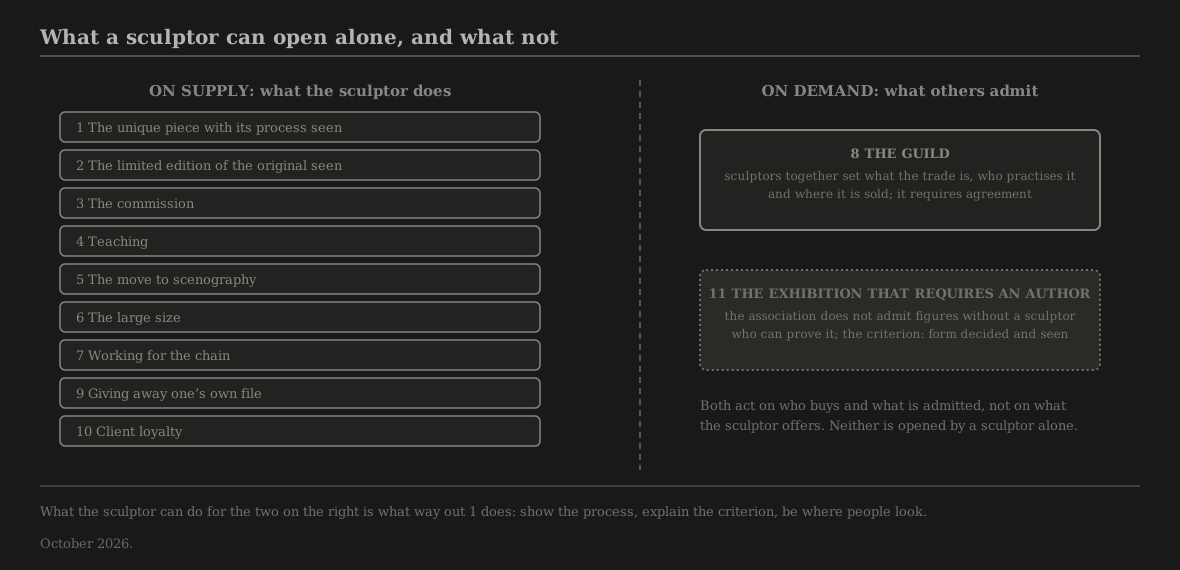
This chapter examines, then, the ways out that a sculptor of nativity figures has before them when form ceases to be scarce. There are eleven, and they are gone through one by one, in an order that runs from the one that depends least on others to the one that depends most on them: the unique piece with its process seen; the limited edition of that original; the commission; teaching; the move to scenography; the large size; working for the chain that prints and paints what is generated; the guild, in the manner of the santonniers of Provence; giving away one’s own file; client loyalty; and the last, which is not in the sculptor’s hands but in those of the associations: the exhibition that requires an author. It is not a closed list: it is the one that the person who writes this has been able to gather with what he knows in October 2026, and if there is another, its place is this chapter.
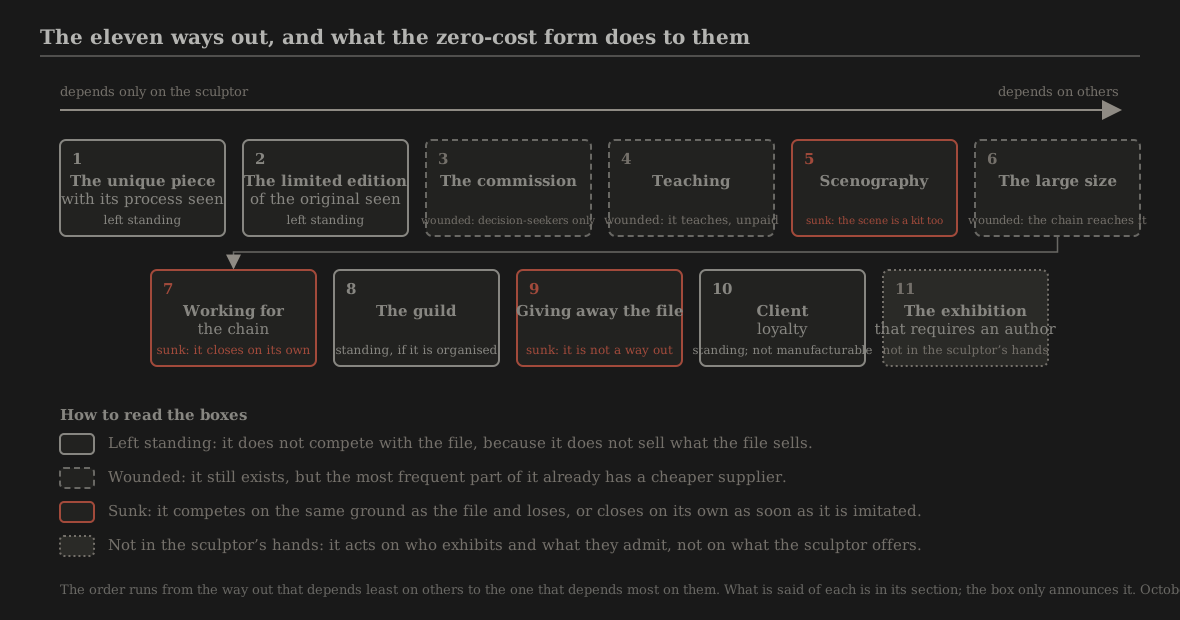
It is worth saying from the start how each one is looked at, because the question is not «which one is good?» but a narrower one. Of each way out it is said what it is, what it has in its favour today and what the zero-cost form does to it: whether it leaves it standing, wounds it or sinks it, and why. The criterion is that of the previous chapter, and it is not repeated here: what holds up is what a machine does not produce — a form decided by someone and seen being decided—, and what does not hold up is what competes on price with a file. The reasons given are those of someone who has practised several of these ways out, and they are declared as such where they appear; they are not a survey of the trade nor a statistic, which does not exist. And one warning that holds for all eleven: none of them is advice. The Manual does not know what each workshop lives from or in which city, and a way out that one sculptor can do without another one lacks.
What this chapter does not do must also be said. It gives no figures for income or prices beyond those the previous chapter already put in plain view, because those of one workshop are no good for another. It does not examine the technique of any way out — how a modelling is recorded, how a mould is made, how one teaches—, which is the matter of other blocks. And it does not discuss whether technical progress is good or bad: it is what there is, and whoever stays in complaint is in none of the eleven ways out.
1. The unique piece with its process seen
It is the way out with which the previous chapter ended: a figure modelled in clay or carved in wood from which no copy is taken, with its whole process recorded, and which is offered in no catalogue. It can be sold, if its author wishes and to whomever he wishes, with a document certifying it as an original work; it may never be sold, and the figure is the same (The form without an author). It is taken up here first because it is the one that depends least on anyone — neither on a client who commissions, nor on an association that admits, nor on a chain that prints—, and because the other ten are measured against it.
What it has in its favour today is that it is the only thing that a generator, a library of bodies or a file shop do not produce: a person deciding a form in front of a camera, with their face and their name. The author shows their face, in the literal sense of the expression: they do not sign at the end, they are in every take. And that is also the only proof that holds today that someone decided that form, because neither the material, nor the style, nor the marks of the hand prove it; what proves it is the whole recording together with the piece that goes on existing (The form without an author).
The author shows their face, in the literal sense of the expression: they do not sign at the end, they are in every take.
What the zero-cost form does to it: nothing, because they are not in the same place. The zero-cost figure is a component, and it is bought as a component: it must fulfil its role, please and cost little (The form without an author). The unique piece is what a work of art with an author has always been: a thing that exists once, with a name behind it and the rights that the law recognises to that name, which may please more or less and which is neither a series product nor of unknown origin. Whether someone wants to buy it or not is indifferent to what it is, and when it is sold, it is sold as art has always been sold: to whoever wants it for what it is, and not as an object within reach of anyone who picks it from a catalogue. Its measure, therefore, is not that of the market for the component, but that of art: one does not live from it because it sells a lot; it is made because it is what a sculptor does, and if it is sold, it is sold as art is sold. Whoever chooses it gives up the shop window, the series and the figure that sells without speaking to anyone; what is left to them is the work, and, if there is one, way out 10: a client who comes back.
Two things are not this way out. The unique piece without a recording: a work with an author as it has always been, but one that today, in front of a buyer who does not know the sculptor, cannot be told apart from a carefully painted resin, because there is no longer anything in the form that says who decided it (The form without an author). And the recording without a unique piece: a recorded modelling from which copies are then taken, which is the next way out and has its own measure.
2. The limited edition of the original seen
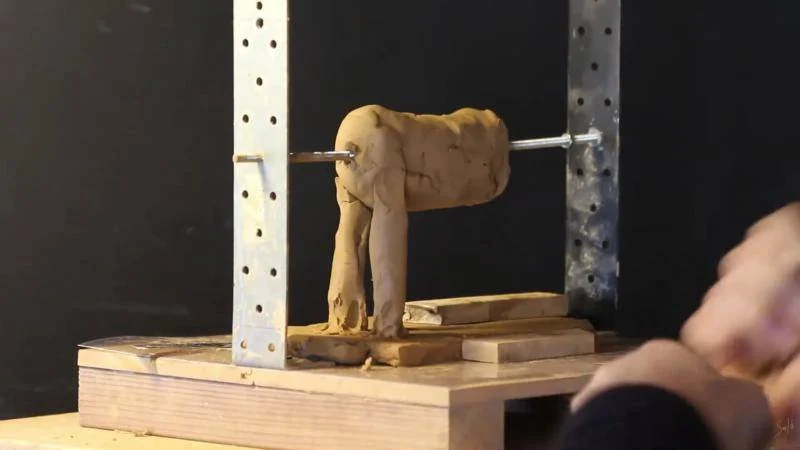
It is the previous way out with one step more: from the original modelled in clay or carved in wood, and recorded in full, copies are taken — from a mould, by milling or by printing, the procedure does not matter—, numbered and in a number that the sculptor decides, which does not exceed 8. The original goes on existing and goes on being the one that is seen being born in the recording; the copies come from it and declare it. It is the way in which sculpture has always reproduced its work, and the chapter on author and law explained where the figure of 8 comes from and what it means in each country (Author and law: «What the law recognises, and to whom»): a custom of the foundry that European tax law turned into a boundary.
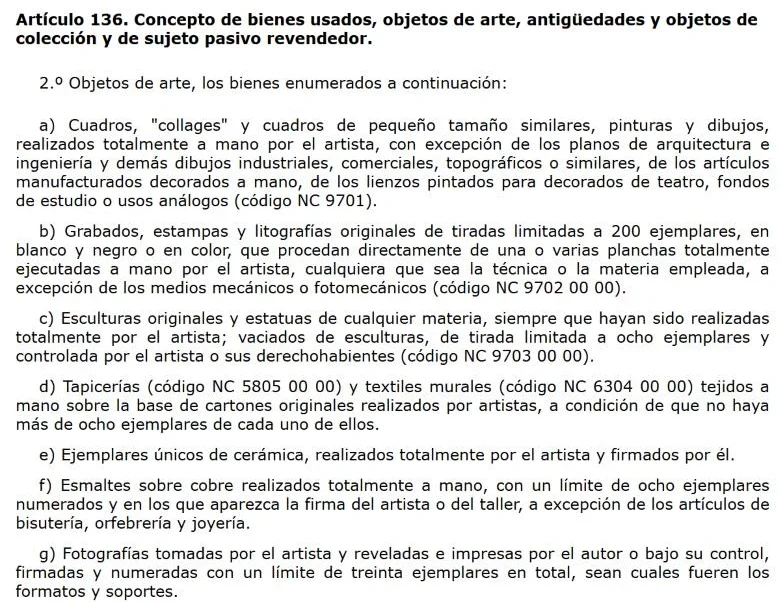
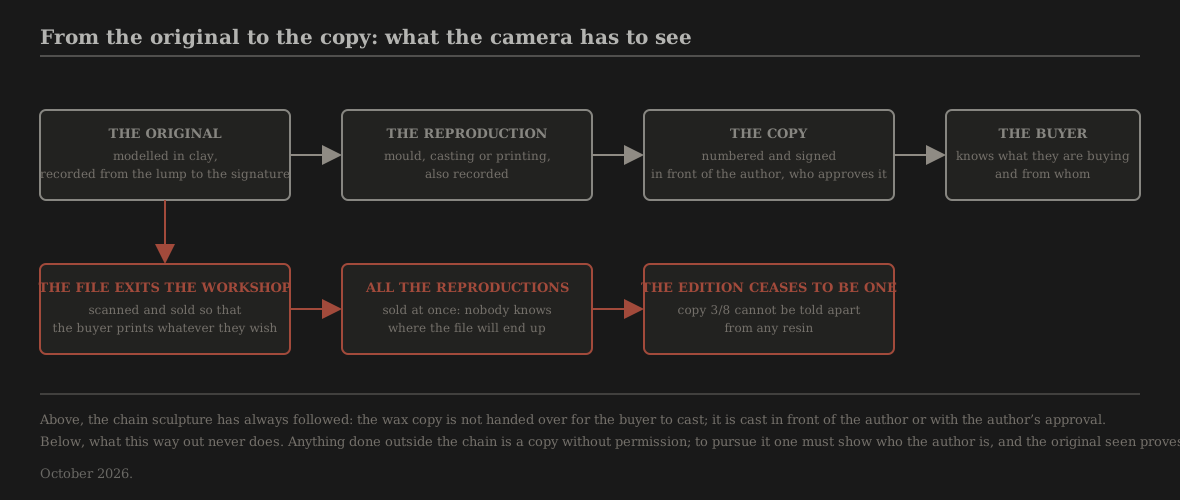
What it has in its favour today is that the law treats it as what it is, an original work of its author, and that it does so in two different places. In copyright, each copy is a work of the sculptor with all its rights, like the original it came from (Author and law: «What the law recognises, and to whom»). In tax, the Ley del IVA — the Spanish value added tax law— counts among works of art the «esculturas originales y estatuas de cualquier materia, siempre que hayan sido realizadas totalmente por el artista; vaciados de esculturas, de tirada limitada a ocho ejemplares y controlada por el artista o sus derechohabientes» — original sculptures and statues in any material, provided that they have been made entirely by the artist; casts of sculptures, in a run limited to eight copies and controlled by the artist or his successors in title—,1 and to supplies of those objects made «por sus autores o derechohabientes» — by their authors or successors in title— it applies the reduced rate of 10 per cent,2 as against the general 21 per cent.3 It is worth reading the letter of the law with the figure in front of one: it speaks of vaciados, casts, which is reproduction from a mould; a figure printed from the scanned original is not named, and whether or not it falls within that letter is something the law does not say and this Manual does not decide. And there is one thing this way out never does, and it is worth saying because the market has made it seem normal: the sculptor does not sell the file. Scanning the original and selling the file so that the buyer prints it is the same as handing over a wax copy for the buyer to cast in bronze himself, and that has never been accepted in sculpture, neither as practical nor as safe: a foundry does not reproduce a work without the signed authorisation of its author, and the piece is cast in front of him or with his approval of each copy. Selling the file is selling all subsequent reproductions at once, because nobody knows where that file will end up or how many times it will be printed; the limited edition ceases to be one the moment the file leaves the workshop. The figure, if it is reproduced, is reproduced with the reproduction in front of the author, who is the one who approves each copy; whatever is done outside that is what it has always been, a copy without permission, and it is pursued as such (Author and law: «What the law recognises, and to whom»). And to be able to pursue it, one has to be able to demonstrate who the author is, and the only proof that demonstrates it today is that of the previous way out: the whole process, from the lump to the signature, seen.
The limited edition ceases to be one the moment the file leaves the workshop.
What the zero-cost form does to it: little, and for a precise reason. The buyer of copy 3/8 is not buying a figure that fulfils its role, pleases and costs little; they are buying a work with an author, in a run that the author controls and that the recording of the original makes demonstrable. A file at €4 cannot offer that, because what it sells is the opposite: the run without limit. Nor does copying a copy take it away: copying it to sell it is what it has always been in the history of art, an offence with a name (Author and law: «What the law recognises, and to whom»); copying it for private use is permitted by law as a limit on the author’s right, and it is worth saying how far that limit reaches: the copy that a person makes by himself, without the help of third parties, for his home and his private life, and which is neither sold nor used collectively.4 A copy placed in a nativity scene shown to the public — in an exhibition, in a shop window, in a square— is no longer private use but collective use, and falls outside that limit; it is a reproduction that needs the author’s permission, like any other. Neither the private copy nor the public one takes from the sculptor the authorship or the run. That is why the person who writes this holds that this way out survives as it is: what the zero-cost form sinks is reproduction without an author and without limit; reproduction with an author, limited and seen, is not in that market.
Its measure is twofold. The first is that of the previous way out: it is not a volume market, and 8 copies of each figure do not change that. The second is its own: the chain of proof has to reach the copy. If the original is recorded but the mould, the casting or the printing are not, the copy 3/8 that someone holds in their hand cannot, by itself, be told apart from any resin; what distinguishes it is that one can follow it from the copy to the original seen, and that requires recording the reproduction as well, and numbering and signing each copy with the original in front of one. Whoever reproduces without letting it be seen how they reproduce goes back to the position of the figure whose origin cannot be seen (The form without an author).
| Under the Ley del IVA | Under copyright | What this chapter holds | |
|---|---|---|---|
| The original modelled in clay or carved in wood, and recorded | Original sculpture «realizada totalmente por el artista» — made entirely by the artist—: a work of art; supply by its author at 10% | A work of the sculptor, with all its rights (Author and law: «What the law recognises, and to whom») | Way out 1: the only thing the chain does not produce |
| The cast, up to 8 copies, controlled by the artist | A work of art; supply by its author at 10% | Each copy is a work of the same author (Author and law: «What the law recognises, and to whom») | Way out 2, if the reproduction is recorded too |
| The print made from the scanned original | Not named: the law speaks of «vaciados» — casts—; whether it falls within it or not, the law does not say | The same as the cast: reproduction of a work with an author | The same way out 2, with the same condition: the file does not leave the workshop |
| The file sold for the buyer to print | It is not the figure: it is not a supply of goods | It sells all subsequent reproductions at once | It is not a way out for the sculptor: it is the chain of the previous chapter |
Sources: notes 1 to 3 of this chapter (Ley 37/1992, arts. 136, 91 and 90) and the chapter on author and law.
There remains the case of the sculptor who models on screen, because this way out is also theirs and does not serve them in the same way. Their authorship is not in doubt: the previous chapter established that the line is not clay against screen but decided form against generated form, and a shepherd modelled point by point in a digital sculpture program has a sculptor (The form without an author). What serves them differently is the proof. Digital modelling can be recorded in full, just like clay modelling, and at first sight more easily, because the screen records itself; but that recording has a problem that the clay one does not have: if it does not capture all the tools used during the modelling — the whole interface, with its menus, its panels and the list of what enters and leaves the canvas—, the process can be falsified without anything giving it away. A generated volume can enter the program outside the frame and appear on the recorded screen as if it were being modelled; a tool can project onto the mesh a form that was not decided; a hidden panel can be doing what the hand seems to do. The previous chapter described how a recording of the canvas is reversed and how the volume enters ready-made; here the consequence is enough: the recording that does not show the tools proves nothing, and the sculptor who trusted it is left without proof of authorship the moment they need it. The requirement is therefore greater than in clay: the person and the monitor in the same plane, and on the monitor, the whole interface and not only the figure. And there is a second difference, which is not one of proof but of risk: the digital sculptor’s original is a file, that is, exactly the thing that this way out says is not sold and that, once outside the workshop, is reproduced without limit. Their limited edition depends on that file never leaving, and a file is easier to lose than a terracotta.
The recording that does not show the tools proves nothing.
3. The commission
Someone wants a figure that does not exist — a character, an attitude, a size— and asks a sculptor for it. It is the oldest way out in sculpture, older than the catalogue and the shop: for centuries there was no other. In the nativity scene it is commissioned by a private individual for their scene, by a collector for a figure they are missing, or by an association for a year’s new nativity scene. The sculptor conceives it and models it, and is its author; whoever commissioned it chose the subject and paid, and that makes them the author of nothing (Who conceives the form). What rights each of them has over the commissioned figure is the matter of the chapter on the client and the commission, later in this block; here all that matters is whether the commission holds up as a way of living.
What it has in its favour today is that the commission is, from the beginning, what way out 1 has to look for afterwards: a specific buyer who wants a specific figure and speaks with the sculptor before it exists. A commission can be recorded just like a piece of one’s own, and whoever receives it then has the same as the buyer of the unique piece: a form decided by someone, seen being decided, and with a name behind it. And they have in addition what no shop gives: the figure they asked for, not the one that was there.
What the zero-cost form does to it: it wounds it where it is most frequent. Most commissions ask not for a decision but for a result: «I want a shepherd with a lamb on his shoulder, 12 centimetres tall», and whoever asks for it does not care who decides the form so long as the shepherd is that one. That commission can already be carried out without a sculptor: the description is written, generated, printed and painted, in days and for a fraction of the price, and the previous chapter showed the whole chain, with its price lists (The form without an author). The associations are the clearest case, because they are the client that needs the most figures at once and with the tightest budget: their statutes usually say that they promote nativity-scene art and practice as art, but whoever composes this year’s scene needs 12 figures for November, and between a sculptor who takes time and charges and a chain that takes no time and hardly charges, the statutes do not decide the purchase. What remains of the commission is the one that asks for a decision and not a result: the one that wants this sculptor and not just any shepherd, and for that reason does not go to the chain. That client exists, but it is not the commission: it is loyalty, which is way out 10.
Its measure is given by what the commission has always been, before any generator: occasional. Nobody commissions figures every year; a collector completes a collection and stops; an association makes a new nativity scene every few years and composes the rest with what it has. In the experience of the person who writes this, commissions for nativity figures in clay have always been scarce, and have never been enough to live from on their own; what has changed is not their frequency but that the most frequent part of that scarcity — the commission that only asks for a result— now has a cheaper supplier. Because of how infrequent it is and how little it is sustained over time, the commission is not a way out in itself: it is an occasion that sometimes comes, and that, when it comes, is treated as way out 1.
4. Teaching
If selling figures ceases to be enough to live on, what remains is selling what the sculptor knows: teaching how to model. It is a way out with three different forms, and it is worth separating them because they do not hold up equally. Formal teaching, in an art school or a faculty, with years ahead. Short courses and workshops, of a weekend or of 3 or 4 days, organised above all by the associations. And videos: a channel where the sculptor models and explains, open or paid.
What it has in its favour today is that teaching how to decide a form is the only thing a generator cannot do, for the same reason it cannot decide it: there is nobody looking (The form without an author). Whoever wants to learn to model a figure needs to see someone decide and hear them say why, and to correct their own work with someone in front of them. That is still worth what it was worth. And the sculptor who records their whole process, as way out 1 requires, already has ready, without setting out to, the raw material of a course of teaching: each take is a lesson in how a volume is born.
What the zero-cost form does to it: it does not touch it directly, but it takes the ground from under it on both sides. On the side of demand, whoever might have wanted to learn to model figures for their nativity scene today has the figure without learning anything, and some of those who used to sign up for a course no longer do. On the side of supply, video teaching already had its price at zero before any generator: on the platforms there are excellent sculptors, many of them and from all over the world, modelling and explaining to camera for free, and whoever wants to charge for the same competes with them. And there remains what is not of today but of always: learning to model a realistic figure requires artistic anatomy, composition and a technique, and that takes years; a weekend course with 2 hours of class does not teach how to model, and a sculptor modelling in front of some students is a demonstration, not teaching. The associations organise them with good will and the students come away happy, but no sculptor comes out of them, and whoever gives them lives from their being repeated, not from their working.
Its measure is, therefore, narrow: formal teaching is a job, not a way out from the workshop, and there are few such jobs; the short course does not teach what it promises; and the video cannot be charged for. The person who writes this knows all three: he was a sculpture teacher at an art school in Andorra, and from now on he will teach on his channels what he knows, without charging for it, because it is what is already done for free everywhere and because he expects no income from teaching. That is exactly the reason why his case is no model for anyone: a way out that only works when it does not need to work is not a way out for whoever needs it. And that is why it is not recommended to any sculptor who lives from figures; it is left described, with what holds up — teaching how to decide— and with what does not — charging for it—.
A way out that only works when it does not need to work is not a way out for whoever needs it.
5. The move to scenography
If the figure no longer sells, the sculptor can move up a link in the chain and sell the scene: compose nativity scenes and dioramas to commission, for private individuals, for associations that do not want to or cannot compose their own, for exhibitions and for whoever needs a whole nativity scene and not 12 figures. The sculptor who takes that step changes role — from author of the figure to author of the scene, which is the other author the nativity scene has (Author and law: «What the law recognises, and to whom»)— and brings an advantage that the scenographer who does not model lacks: they know what a figure can do and what it cannot, because they have decided figures.
What it has in its favour today is that the scene is where the figure takes on meaning, and that composing it is deciding: where each thing goes, what is seen from where, what the light tells. That is a work, with an author, and the chapter on author and law established it. While the form of the figures was what was scarce, composition seemed what was plentiful; with the zero-cost figure, composition could seem the refuge: what one still has to know how to do.
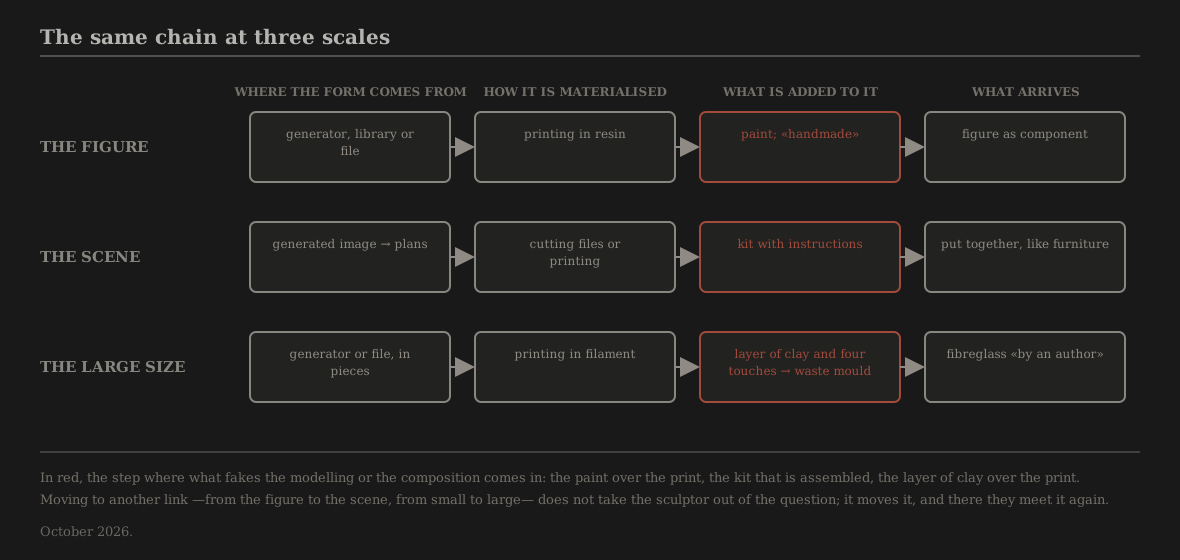
What the zero-cost form does to it: it does not save it, and it is worth saying so plainly, because it is the way out in which it is easiest to deceive oneself. The same chain that produces the figure produces the scene. The previous chapter verified it in minutes and recorded it: one sentence gives an image of a house in Bethlehem opened up to show its interior, with courtyard, stable and flat roof; another sentence gives the plans, floor plan and elevations, with a scale; and from plans come cutting files for a laser machine or printing files for a printer, and from the files, a kit with instructions (The form without an author). What reaches whoever buys it is not a material to compose with: it is a scale model to be put together, and the word that this Manual does not use for the nativity scene — montar, to put together— is there the exact one, because a kit is put together like a piece of furniture that arrives in a box. The scenographer who sells scenes then competes with the same thing as the sculptor who sells figures: a file that costs zero, that is printed or cut at whatever size one wishes, and that brings the scene already decided by nobody. And demand does not wait for them either: in association nativity-scene practice the scene is composed by the members themselves, and there is no commission to pay for there; the private individual who wants a whole nativity scene without making it himself is the same one who buys the kit.
Its measure is, therefore, that of the figure: the scene composed by someone who decides, for a real place and a real public, is still a work and still has its place, but not in a market where nobody’s scene costs what it costs to cut a few boards. Moving from the figure to the scene does not take the sculptor out of this chapter’s question; it moves it one link higher, and there it finds it again. What it does do, and it is no small thing, is make clear that the loss the previous chapter described — the nativity scene without an author in any link— is not avoided by changing link.
Moving from the figure to the scene does not take the sculptor out of this chapter’s question; it moves it one link higher, and there it finds it again.
6. The large size
If the small figure no longer sells, there remains the large one: figures life-size or close to it, which the monumental nativity scenes of squares, churches and town halls call for, and which until recently only someone with a sculptor’s trade and a workshop for it could make. At first sight it is the most protected way out: a figure 1 metre tall requires a structure, proportion at that scale, a modelling that holds up close and from afar, and a reproduction procedure — mould, cast, materials that withstand the open air— that cannot be improvised. There, it would seem, the machine does not reach.
What it has in its favour today is real: at a large size, the decision of the form can be seen from afar and up close, mistakes do not hide, and the sculptor who knows how to compose a group at that scale has a knowledge that few have. And the client for the large figure — an institution, almost always— can require that it be seen how it was made, because it pays enough to ask for it.
What the zero-cost form does to it: it reaches it, and by a route that is worth describing in full because it is the same one that the previous chapter took apart at a small size (The form without an author). The form comes from where they all come from: a generator, a library or a bought file, and it is printed in filament, in pieces if need be, at whatever size one wishes, and it does not matter that the printing takes days. Over that print a layer of liquid clay, or of almost melted plasticine, is spread, like someone painting; a few touches of modelling are given to the face, the hands, a fold, enough for there to be «marks» and to be able to say «author»; from that a waste mould is taken, and from the mould, the definitive figure in fibreglass or resin, which is what a nativity scene in a square needs. The result is a large, resistant figure, with a surface that looks modelled, signed, and whose form nobody decided. It is exactly the print covered in clay that the previous chapter gave as an example of what a recording has to rule out; at a large size it is, if anything, easier, because the layer that covers it is thicker and the client is further away.
Its measure has two parts. The first is that of proof: against that chain only the same thing holds as against the small one, the volume seen being born from the lump, and the sculptor who works at a large size will have to record it in the same way, even if the modelling lasts weeks. The second is that of the market, and it is the one the person who writes this considers decisive: a city commissions a monumental nativity scene once, and brings it out every year for decades. Whoever makes large figures lives from there being new cities, not from their own, and sustaining oneself for years with that way out in the same place is not possible. It is a way out that exists, that requires what is most difficult in the trade, and that does not feed you twice in the same square.
It is a way out that exists, that requires what is most difficult in the trade, and that does not feed you twice in the same square.
7. Working for the chain
If the form is no longer paid for, what remains is charging for what comes after the form: printing, sanding, painting and selling figures whose form came from a generator, from a library or from a bought file. It is the way out of whoever says: «since the form is free, I’ll supply the rest». The sculptor who takes it ceases to be the author of what they sell and becomes, with respect to the form, what the previous chapter called a craftsman — whoever reproduces a form that belongs to nobody— and, with respect to the object, a printer, finisher and painter (The form without an author). Whether what they put into the polychromy gives them any right over the figure is a matter for the chapter on polychromy and dress, later in this block; here it is enough that the form is not theirs.
What it has in its favour today is that it works, and it is the only one of the eleven of which that can be said without reservations. It is the way out that has begun to make money: a shop based in Italy, with no author’s name, which the previous chapter examined with its figures, went from 140 to 230 characters in 4 months and has thousands of followers who ask about the price and the box (The form without an author). The buyer who wants a figure that fulfils its role, pleases and costs little finds it there, and finds it painted, which is what the file alone does not give them. There is demand, and today there are few who serve it.
What the zero-cost form does to it: it is its very business, and that is why it will sweep it away as soon as it grows. What that shop sells is not scarce: it is a subscription to a generator, a resin printer and a few hours of painting, and anyone has that. When instead of one shop there are hundreds, the price of the printed and painted figure will fall to what the resin and the hours cost, and the shops that opened first will close as they opened. And there is a worse competitor than the other shops: the client himself. An association with 2 subscriptions and a resin printer has the three things it was looking for — good, pretty and cheap— without going through anyone, and it paints them itself, because painting is what its members already did. The previous chapter said it another way: in that chain none of those who sell figures wins; whoever sells printers wins. And the first one the chain leaves without a place is the fair stallholder, who sells what he does not make: when the form is free and the shop sells direct, there is nothing left between the file and the buyer that he can supply.
In that chain none of those who sell figures wins; whoever sells printers wins.
Its measure is that of a way out that works today and is not a way out, because it lasts as long as it takes to be imitated, and that takes no time at all. The person who writes this would not take it, and says so with his reason: not because of what is lost of the trade — which is lost entirely: the form ceases to be one’s own—, but because it is the only one of the eleven that can be closed from outside, by others doing the same, without the sculptor being able to do anything to prevent it.
8. The guild
If each sculptor on their own cannot sustain the price of a decided form against a free form, they can try together: a guild, in the old sense of the word, which is an association of those who practise the same trade to settle among themselves what that trade is, who practises it, how it is named and where it is sold. The model usually held up is that of the santonniers of Provence, the sculptors of santons, whom the nativity-scene world cites as an example of a trade that presents itself to the buyer as a trade and not as a sum of workshops; how they are really organised is not examined here, because associations and guilds have their own block in this Manual. A guild of sculptors of nativity figures would do the same: a common name, some conditions for bearing it — that the form be decided by whoever signs, and that this can be seen—, a fair or a section of a fair where only those who meet them get in, and a way of telling the buyer.
What it has in its favour today is that it solves what none of the previous ways out solves on its own: information. Today’s buyer cannot tell a decided form from a generated one, and the previous chapter said why (The form without an author); a guild that guarantees that difference with its name spares the buyer the check they do not know how to make. And it shares among many the cost of explaining what this block explains: what an author is, what a unique piece is, why it is worth what it is worth. The person who writes this considers it, of the eleven, perhaps the best solution.
What the zero-cost form does to it: it does not sink it, but it puts before it a reckoning that the guild has to win every day. A new santon today costs zero: the form comes out of a generator for a few cents, at the rates the previous chapter put in plain view, and the plaster mould that reproduces it costs the clay and the kiln. A santon decided by a sculptor costs their hours. The guild has to convince a buyer to pay for the second when they could buy the first, and good, pretty and cheap coming from a file that costs less than half a dollar is, in the market for the component, unbeatable; the guild does not win there, it wins only where the buyer wants to know who decided. And it has the problems of every guild: who decides who gets in, what is done with whoever breaks the rules, how to prevent the common name from ending up protecting what it should not, and who pays for the time spent organising it, which is time not spent modelling.
Its measure is that it is not easy and guarantees nothing. It is not easy because it requires sculptors who compete with one another to agree on what their trade is, and this block has shown how far the nativity-scene world is from agreeing even on the word. And it guarantees nothing because the guild can fix the name and the conditions, but it cannot fix the buyer: if the buyer wants a component, they will buy a component, with a guild or without one. What the guild does guarantee is that, when there is a buyer who wants an author, they know where to find one.
9. Giving away one’s own file
There is a way out that is often proposed and that is worth examining, if only to rule it out: if the form is going to be free anyway, let mine be free, with my name. The sculptor models, scans or models on screen, and publishes the file under an open licence, so that anyone can print it; in return they expect the name to travel with the file, that they will become known, and that commissions, classes or sales of what they do not give away will come of it.
What it has in its favour is only what it promises: that the file bear the author’s name and that, in the letter of the open licences that require attribution, whoever uses it has to name them. The previous chapter showed what those licences come with and what they permit (The form without an author).
What the zero-cost form does to it: it makes it absurd. Nobody reads who the author of a free file is; it is downloaded, printed and painted, and the name, if it was there, stays on a line of a download site that whoever prints never opens again. The file given away enters the same stream as the generated ones and is confused with them: from the printer, a decided form and a form that belongs to nobody are the same, and the previous chapter established it. And what is given away does not come back: the sculptor has given the only thing they had that was scarce — a decided form— in exchange for a visibility that the file does not produce, and has fed with their own work the chain that replaces them. If the name reaches anyone, it reaches them as that of someone who gives forms away, and no commissions come of that: requests for more files do.
Its measure: none. The person who writes this considers it preposterous, and leaves it written only because it is proposed and it has to be said why not. If a sculptor wants their work to be known, what they have to show is the process, not the file: the former cannot be printed.
What they have to show is the process, not the file: the former cannot be printed.
10. Client loyalty
There remains the way out that is neither a technique nor a product, and that is why it is on no list: the client who comes back. It is the person — a private individual, a collector, sometimes an association— who bought a figure from a sculptor, then another, and who over the years buys not nativity figures but figures by that sculptor. They are not looking for a shepherd; they are looking for that sculptor’s shepherd. And when they are offered one at €4, or one for free, they do not compare it with what they have, because what they have is not a shepherd but a relationship with whoever decided it.
What it has in its favour today is that it is the only one of the eleven that the zero-cost form does not touch at all. All the others compete with the file in something — in price, in delivery time, in quantity, in information—; this one competes in nothing, because the loyal client is not buying what the file sells. That client will go on buying from their sculptor however many zero-priced figures are put before them, and will do so for the reason that way out 1 gave: because what they are buying is a work with a name, not a component. And it is the way out that holds up the other two that hold up: the unique piece and the limited edition are sold to someone, and that someone is almost always this client.
What the zero-cost form does to it: nothing. What wounds it is something else, and it lies in its own nature: loyalty cannot be manufactured. It is built with years of work and of dealings, and it needs a first sale to have come before, and a second, in a market that today makes the first harder than ever. The sculptor who is starting out has no loyal clients; they have to win them one by one, selling against zero cost, and that is where zero cost does reach them. And loyalty has the size it has: a sculptor knows their loyal clients by name, and they can be counted on the fingers of the hands.
Loyalty cannot be manufactured.
Its measure is, therefore, that of a way out that lasts unchanged but cannot be chosen: one has it or one does not, and if one has it, it is because one worked before it was needed. For whoever has it, it is the one left standing when everything else moves; for whoever does not, it is not a way out but a destination, and the road to it passes through ways out 1 and 2, which are the ones that make clients like that.
11. The exhibition that requires an author
The last way out is not in the sculptor’s hands. It is in the hands of whoever exhibits: the associations, with their annual exhibitions, their competitions and their shows, which are the place where nativity-scene art and practice shows itself and the public what it is. If an association decided not to admit to its exhibition nativity scenes composed with figures whose form cannot be attributed to a sculptor — to someone who decided it and can demonstrate it—, the market for the component would lose, within that exhibition, its reason for being: the scenographer who wants to exhibit would have to ask, before buying, who decided the form, and that question is the one the previous chapter took to have disappeared (The form without an author). It is the only way out that acts on demand and not on supply, and the only one that would give back to the figure, in the place where it is looked at, the standing it loses when nobody decides it.
What it has in its favour is that it requires nothing new. Fairs already set conditions for admitting exhibitors — a tax registration, photographs of what one makes— and nobody disputes them; an association’s exhibition can set its own. And wherever the statutes of an association say that it promotes nativity-scene art and practice as art, this way out only asks it to live up to that at the door of its exhibition.
What the zero-cost form does to it: it puts it to the test through the criterion, and here one has to be exact. The criterion cannot be the sculptor’s track record, because it would leave out whoever is starting out and did decide their form, and because nobody certifies who is a sculptor: this block has said that titles and classifications are applied for by each person and that the work is the only thing that demonstrates it. The criterion can only be that of the previous chapter: a decided form, and one that can be seen being decided. That requires the association to know what to look at — to tell a recording of a volume being born from one of a surface being covered—, and to be willing to say no to a member who bought good, pretty and cheap. The first can be learnt; the second is what decides whether the way out exists.
The first can be learnt; the second is what decides whether the way out exists.
Its measure is that it depends entirely on others, and on the others who have most to lose from it in the short term: an exhibition that requires an author has fewer nativity scenes in its first year. That is why it comes last, and why this Manual can do no more than leave it described: it is not the sculptor who can take it. What the sculptor can do is what the associations would need in order to take it — show the process, explain the criterion, be where the looking is done—, which is, once again, way out 1.
12. Closing, with a date
Eleven ways out, and of each it has been said what the zero-cost form does to it. What remains open is what this chapter cannot close. There is no statistic of the trade: how many sculptors of nativity figures live from it, how many have stopped living from it since form has cost zero, and which way out each of them has taken; the reasons in this chapter are those of one person, declared, and if someone gathers those of many, this chapter will be corrected with them. No way out has been seen that escapes the question — who decided the form, and can it be seen?—, and if one exists, its place is here. And the two that act on demand, the guild and the exhibition that requires an author, cannot be opened by a sculptor alone; when and whether they open will be said by whoever can open them. The price lists, the shops and the figures the chapter gathers are those of the previous chapter and carry its date; the reasons given here are from October 2026, and if in a few years any of the ways out that are sinking today floats again, or any of those that hold up sinks, it will have to be said with the same clarity.
References
Ley 37/1992, de 28 de diciembre, del Impuesto sobre el Valor Añadido, art. 136.Uno.2.º c). Consolidated BOE text (BOE-A-1992-28740), latest update 7-X-2026; checked on 15-X-2026 in the BOE PDF. ↩
Ley 37/1992, art. 91.Uno.4.1.º: «Las importaciones de objetos de arte, antigüedades y objetos de colección, cualquiera que sea el importador de los mismos, y las entregas de objetos de arte realizadas por las siguientes personas: 1.º Por sus autores o derechohabientes». Same consolidated text. ↩
Ley 37/1992, art. 90.Uno: «El Impuesto se exigirá al tipo del 21 por ciento, salvo lo dispuesto en el artículo siguiente». Same consolidated text. ↩
Ley de Propiedad Intelectual (Real Decreto Legislativo 1/1996), art. 31.2: authorisation from the author is not needed for the reproduction «en cualquier soporte, sin asistencia de terceros, de obras ya divulgadas», when it is made «por una persona física exclusivamente para su uso privado, no profesional ni empresarial, y sin fines directa ni indirectamente comerciales», «a partir de una fuente lícita» and without it being the case that the copy «sea objeto de una utilización colectiva ni lucrativa, ni de distribución mediante precio». Consolidated BOE text (BOE-A-1996-8930), wording in force since 1-VIII-2017; checked on 15-X-2026. ↩