
 ≈ 14 min

This chapter does not add a new material to the Manual. It visually orders operations that have already appeared, scattered across the previous chapters: how shorn wool or pulled flax comes to be turned into thread, cloth and garment.
Its function is not to reconstruct a complete workshop or to fix a single sequence for every case. It serves the nativity-scene maker: it makes it possible to decide which textile tasks can become figures, working groups or secondary scenes without confusing different processes.
A finished garment does not appear all at once on the body. Before that it has been animal or plant, a hand that separates, water that cleans or macerates, fibre that is put in order, thread that is twisted, a skein that waits, colour that may be fixed, a loom that crosses and an edge that is finished off. To represent one of those tasks is to show the material world that makes the garment possible.
The complete chain, with its two entries and its common stretch, can be seen at a glance before going through it part by part:
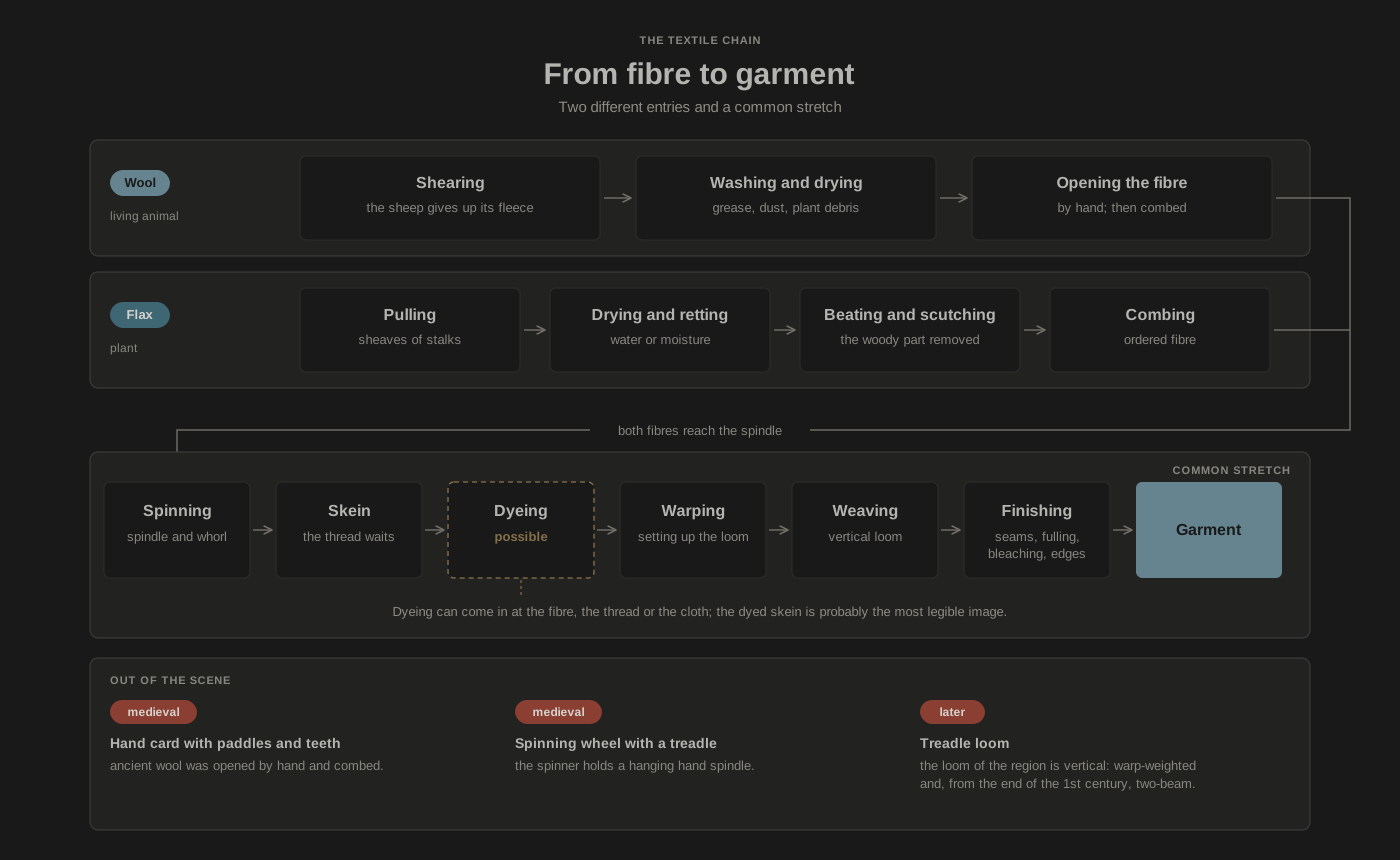
Two chains, not one
Wool and linen do not start in the same place.
Wool comes from a living animal. First there is a sheep, then a fleece, then prepared fibre, thread, cloth and garment. Its visible chain begins with shearing, already dealt with in The gesture before the fibre, and continues in the separated fleece that Wool as a separated fibre develops.
Linen comes from a plant. First there is a stem, then fibre freed from the stem, then thread, cloth and garment. Its visible chain begins with pulling the plants and demands water, drying, beating and combing before it reaches the spindle. That difference was already pointed out in The gesture before the fibre, but here it is worth making it legible for the scene.
That is why wool and linen should not be presented as two equivalent columns. They share the final stretch —spinning, skein, loom, weaving and finishing—, but they reach it from different operations. Wool is opened out from the fleece; linen is freed from the stem.
For the biblical nativity scene, this separation avoids two errors. The first would be to imagine that every fibre is prepared in the same way. The second, much more visual, would be to place a linen task where only a wool task makes sense, or the reverse, and turn textile work into a generic scene.
The visual chain of wool
For wool, the clearest sequence for a representation in the nativity scene can be ordered like this:
sheep -> shearing -> fleece -> washing -> drying -> opening the fibre -> spinning -> skein -> possible dyeing -> loom -> weaving -> finishing -> garment
Not every step had to happen always in this exact order. The sheep could be washed before shearing if there was water; if not, the fleece was washed afterwards. Dyeing could be done on the fibre, on the thread or on cloth already woven. But for an understandable scene, the dyed skein is probably the most legible image: the viewer understands that this colour is not yet a garment, but material on its way to becoming one.
The chain begins with a seasonal gesture: shearing. It is not a decorative shepherd’s action, but the annual moment at which the sheep gives up its fleece. That fleece is not yet fibre ready for spinning. It keeps its grease, dust, plant debris, differences of quality and areas of different colour. It may be washed, dried, sorted and opened out before it reaches the spindle.
The preparation of the fibre is less spectacular than shearing, but perhaps more important for a domestic scene. A woman who picks out debris, opens locks, shakes out impurities or forms tufts is not making a secondary gesture: she is making the thread possible. There is no need to reconstruct a particular carding tool if the tool is not determined; it is even worth avoiding it, because the hand card with paddles and teeth is medieval, and ancient wool was opened by hand and combed. The figure can show the material operation without asserting a specific instrument.
Spinning is the first moment at which wool begins to become thread. The spindle and the whorl are archaeologically recognisable tools, and the textual sources know the action of spinning with the hands. For the nativity-scene maker, the spinner is a strong figure because she brings together material, gesture, time and domestic scale. It is advisable, however, that she hold a hanging hand spindle: the spinning wheel with a treadle is medieval, and a figure turning one takes the scene out of its century.
Excerpt 6:08-6:55 of El hilado de la lana: spinning standing up with a hanging spindle. Hosted on YouTube. To watch it, allow audiovisual content.
After spinning, the skein makes it possible to order visually a point of waiting. The thread already exists, but it is not yet cloth. It may be stored, carried, dyed or prepared for the loom. In a composition, skeins hung up, grouped together or plunged into a bath convey the passage between domestic craft and colour.
The loom completes the step from thread to cloth. It is not enough to say «weaving»: first the warp has to be prepared, the threads tensioned and crossed with the weft. At small scale the structure will not always be seen, but the gesture can be: a weaver, a vertical loom, tensioned threads, a piece that grows. The loom documented in the region is vertical: the warp-weighted loom and, from the end of the 1st century, the two-beam loom (From thread to cloth: loom, width and stripes); the treadle loom is later and is best kept out of the scene.
At the end come the finishes: edges, fringes, hems, seams, repairs, cords, bands or other finishing work. Two things that the word «finish» brings together should be distinguished here. One is the technical closing of the garment —seams, hems, fulling, bleaching: the work of the fuller in the chapter on white (White in the biblical nativity scene)—, which is what allows a woven cloth to be worn. The other is the decorative finish —bands, trims, fringes as a visible sign—, which is studied in Decorative finishes: from the end of the chain to the visible sign. The garment is not ready simply because it has come off the loom: it has to be finished, first so that it can be worn and, where applicable, afterwards so that it can signify.
The visual chain of linen
For linen, the sequence has to be separated from the outset:
plant -> pulling -> sheaves -> drying -> retting -> second drying -> beating -> scutching or cleaning -> combing -> spinning -> skein -> loom -> weaving -> possible washing or bleaching -> finishing -> garment
Flax is not shorn or gathered as a fleece. It is pulled up. The useful fibre is inside the stem, and that is why the first image is not an animal held by a shearer, but a plant gathered into sheaves. The future quality depends on the moment of harvest: young flax intended for fine fibre is not the same as a mature stem destined for coarser textiles or ropes.
Then comes a chain that is slower and less domestic than that of wool. Retting demands water or controlled moisture to separate the fibre from the woody part of the stem. This operation should not be placed in just any village without thinking about the place. Bethlehem, Nazareth or Jerusalem could use linen without that obliging us to imagine it being grown and retted next to the house. Linen could arrive already well advanced along the chain: as fibre, thread, cloth or garment.
Beating, scutching and combing are necessary operations for freeing the fibre and putting it in order. Visually they are more difficult than shearing or spinning, because they can be confused with generic farm work. If they are represented, they must show the material clearly: sheaves of stems, fibre coming apart, combs, woody debris, a hand that cleans.
The final stretch comes close to that of wool: spinning, skein, loom, weaving, possible washing or bleaching, finishing and garment. But the behaviour of the material is not the same. Linen produces a different surface, cooler, smoother, with creases and falls that should not be confused with fine wool. That is why the technical chain ends up affecting the sculptural volume.
Where dyeing can come in
Dyeing does not occupy a single fixed place in the chain. It can be applied to the fibre, to the thread or to cloth already woven. Each position produces a different scene.
Dyeing fibre makes it possible to show colour before spinning, but it may be less legible for the viewer if the material appears as a loose mass. Dyeing thread or skeins is visually clearer: skeins hung up, rinsed or plunged into a bath explain at once that colour comes in before the cloth. Dyeing cloth already woven shows colour as an intervention on a piece that is almost finished.
For the biblical nativity scene, the scene of dyed skeins has an advantage: it sums up the process without exhausting it. It does not say that everything was always done in this way, but it makes it possible to represent a real and understandable phase. It also links naturally with the block on colour: colour does not appear as paint on a figure, but as a material operation before the garment.
The principal caution of Colours and dyes: the colour palette of biblical figures must nevertheless be kept: a dyestuff is not equivalent to a fixed sample, and a possible colour is not equivalent to a particular garment. The task of dyeing shows technical possibility; the decision to dress a figure in that colour still depends on scene, character, cost, function and composition.
Which tasks are worth representing
Not all operations have the same visual force.
Especially clear are:
- shearing a sheep;
- washing or drying fleece;
- opening wool by hand;
- spinning with a spindle;
- gathering skeins together;
- dyeing skeins or cloth;
- weaving on a loom;
- sewing, finishing or repairing a garment.
Possible, but requiring more care:
- pulling flax;
- retting;
- beating and scutching;
- combing flax;
- fulling or specialised bleaching.
Hardly legible at small scale:
- fine sorting of qualities;
- direction of twist of the thread;
- internal differences of warp and weft;
- technical treatments that do not clearly change the posture or the visible object.
This classification does not decide what existed. It decides what can be seen. An operation may be documented and, even so, not work as a nativity-scene figure if the viewer does not recognise it or if it requires too long an explanation. The representation must choose gestures that sustain the scene without turning it into a technical catalogue.
Where each task is developed
This page orders; it does not set things out again. Each task is dealt with in depth elsewhere in the Manual, and it is worth knowing where:
| Task | Where it is dealt with |
|---|---|
| Shearing | The gesture before the fibre (and The material before the figure) |
| Preparation of flax | The gesture before the fibre, recalled in White in the biblical nativity scene |
| Sorting the fleece by colour | Brown in the biblical nativity scene |
| Washing and drying the fleece | Wool as a separated fibre |
| Opening and combing the fibre | Wool as a separated fibre |
| Spinning (spindle, whorl) | Wool as a separated fibre; evidence in The material evidence |
| Skein | here, as a phase in its own right |
| Dyeing | Colour as a manufactured appearance, Colours and dyes: the colour palette of biblical figures, chapters by colour (White in the biblical nativity scene–Black in the biblical nativity scene) |
| Warping / setting up the loom | here, as a phase in its own right |
| Weaving / loom | From thread to cloth: loom, width and stripes; evidence in The material evidence |
| Technical finish (closing the garment) | material on the fuller in White in the biblical nativity scene |
| Decorative finish | Decorative finishes: from the end of the chain to the visible sign |
Criterion for the nativity scene
These tasks should not be added as genre-scene decoration. Each one says something: season, trade, available water, household economy, women’s or collective work, the value of the garment and accumulated time.
A shearing places the spring and the flock. A washed fleece speaks of water and preparation. A spinner shows domestic time. A loom speaks of production. A dyed skein joins textile technique to colour. A woman mending reminds us that an ancient garment was too valuable to be thrown away without a second thought.
The aim is not to fill the nativity scene with trades. It is to choose those gestures that help the scene breathe truth: a spinner, a weaver, a shearer, some skeins hung up, a fleece drying, a woman finishing off an edge, a garment being repaired.
The finished garment is only the visible end of a long chain. When the sculptor remembers this, clothing stops being surface and recovers weight: it has season, water, hand, fibre, colour, use and memory.