
 ≈ 57 min

Luke names no one beside Mary.
Nor does he say that she was alone.
The one who helps and the one who certifies
The midwives are the character of the Nativity whom Luke does not name and whom art kept for centuries at the foot of the manger. Two opposite conclusions are drawn from this, and both fall short. One takes them for granted: they were there because the ancient image brings them. The other takes them for invented: they are not in the Gospel, so they are superfluous. Neither stops to look at which midwife it is talking about, and the distinction is worth making, because under the same name there are two figures that rest on evidence of different kinds.
The first is the one who helps at the birth: the woman, a midwife by trade or not, who receives the child, sees to the cord and stays with the mother. This is a matter of material life, and it is examined with the narratives of the Bible, the rabbinic rules, the studies on childbirth in antiquity and what medicine knows about an unassisted birth.
The second is the midwife who certifies: Zelomi and Salome, the two women of the apocryphal narratives, who help no one to give birth and are in the story to bear witness to a prodigy. From them come the two midwives of art, and their path can be followed text by text until the West removes them.
The page examines the first and then the others, and ends with the figure: what is modelled and which decisions remain in the hands of whoever models. One thing it will not be able to affirm at the end, and it is said now: who was beside Mary that night. Luke does not say.
This manual is read as a series: the historical window, the census, the routes and the sequence of scenes are fixed in In search of the biblical nativity scene (c_1). The rules are the same as for Mary, Joseph, Jesus, the ass and the ox: Matthew and Luke as the script; archaeology as confirmation; apocrypha and iconography, outside the corpus and studied in their place. Each statement is presented as proven, inferred from context or unknown.
What Luke leaves unsaid
Luke names no midwife, no women of the house, no neighbours and no relatives. That silence has to be measured within the scale of the narrative: the evangelist reduces the birth to two verses and also omits the place, the postures, the cord, the placenta, the water, the light and almost every movement. This is not an obstetric chronicle that lists those present and leaves out only the helpers. That is why their absence from the sentence prevents calling them characters Proven by the text, but does not show that Joseph and Mary faced the birth alone. Who could have been beside Mary, and on what grounds it can be said, is what this page examines.
The midwives of the corpus
Before asking about Bethlehem it is worth looking at what the Bible knows about the one who helps at a birth. The passages are few, and they are read here in the Spanish Reina-Valera of 1909, as in the rest of the Manual; they are given in translation from that version.1 They are not contemporary with the Nativity: they are the narratives through which a Jew of the first century had learnt how a birth is told.
The starting point is Ezekiel 16:4, which describes an abandoned newborn girl by listing, in the negative, the care she did not receive: cutting the cord, washing, rubbing with salt and swaddling. The passage is some six centuries earlier and cannot simply be carried over to Bethlehem, but it shows that the biblical tradition conceived birth as a sequence of tasks that follow the delivery of the child. The other passages tell who performs them.
Rachel. It is the birth closest to Bethlehem that the Bible has, and it happens on the road: «there was still about half a league of land to come to Ephrath, when Rachel gave birth, and she had hard labour. And it came to pass, as she was in hard labour, that the midwife said to her: Fear not, for you shall have this son also» (Gen 35:16-17). Rachel dies, «and was buried on the way to Ephrath, which is Bethlehem» (35:19). The midwife travels with Jacob’s caravan; her work, in the text, is done in words: she calms the mother and tells her that it is a son.
Tamar. She bears twins, and the midwife solves a problem that is not medical but one of inheritance: «one put out his hand, and the midwife took and tied a scarlet thread on his hand, saying: This one came out first» (Gen 38:28). She is the one who certifies the order of birth.
Shiphrah and Puah. They are the only ones with a name: «the midwives of the Hebrew women, one of whom was called Shiphrah, and the other Puah» (Ex 1:15). Pharaoh orders them to kill the males at birth; they disobey, and when called to account they answer: «the Hebrew women are not like the Egyptian women: for they are vigorous, and give birth before the midwife comes to them» (1:19). The narrative treats them as an ordinary figure of a people, and ends with them rewarded: «he made them houses» (1:21).
Eli’s daughter-in-law. Here there is no midwife named, but women present: «at the time she was dying, those who stood by her said to her: Do not be afraid, for you have borne a son» (1 Sam 4:20). The sentence is almost that of Rachel’s midwife, and so is the ending: the mother dies.
Ruth. Nothing is told of the birth; the women appear afterwards: «the women neighbours, saying, A son has been born to Naomi, gave him a name» (Ruth 4:17).
Rebekah. This is the case with no help named: «the first came out red, and all of him hairy like a fur cloak; and they called his name Esau» (Gen 25:25). No one assists in the text, and yet the verb is in the plural: someone, besides the mother, gives the name.
Four things come out of these passages. The first, that the midwife is in the corpus an ordinary character: she appears without introduction, as someone the reader already knows. The second, that the one who helps is not always a midwife by trade: beside Eli’s daughter-in-law are «those who stood by her», and beside Naomi, «the women neighbours». A distinction should therefore be made between the midwife and the women who help; the corpus knows both. The third, that what the text has them do is little and precise: saying «fear not», announcing the sex of the child, marking the firstborn; the rest —the cord, the washing, the salt, the swaddling bands— is given by Ezekiel 16:4 in the negative. And the fourth, that help guarantees nothing: of the three births narrated with someone at hand, in two the mother dies.
The Jewish source closest in time is the Mishnah, the compilation of rabbinic rules that the Sefaria library dates between the years 190 and 230, some two centuries after the Nativity. Its tractate on the Sabbath says that on that day the woman giving birth is assisted, a midwife is called for her —the Hebrew says ḥakhamá, «wise woman»— «from place to place», the Sabbath is profaned for her and the child’s cord is tied (Shabbat 18:3).2 The rule is later and does not describe Bethlehem; what it shows is that for those legislators help at a birth weighed more than the Sabbath rest, and that the midwife had to be fetched: she was not in every house.
Tal Ilan, the historian of ancient Judaism already introduced on the page on Mary, devotes to childbirth a few pages of her study on Jewish women in Greco-Roman Palestine, made with rabbinic literature, Josephus and funerary inscriptions.3 Five points come out of them. The name: in those sources the midwife is the «wise woman» (ḥakhamá), and the trade belonged to women only, not necessarily Jewish, because the Mishnah allows recourse to a gentile midwife. The rule: helping a woman in labour is treated as equal to saving a life, and so it comes before the Sabbath. A scene: the Jerusalem Talmud tells that Bar Qappara’s maidservant went on the Sabbath to help a Jewish woman in labour and asked Rabbi whether she could cut the cord; he sent her to ask a midwife, and she answered: «The midwife is out». The reply was that she should do according to the custom of the place. It is the case this page was deducing: a woman who is not a midwife helps at a birth because the midwife is not there. The posture: a rabbinic saying speaks of the woman who kneels to give birth. And the risk: Ilan counts the ossuaries in which a woman is buried with her child —6 of the 130 that bear a woman’s name— and estimates that around 5 % of women died in childbirth, a figure she herself considers high; among them is that of Salome daughter of Saul, from Giv‘at ha-Mivtar, where the mother’s bones were found with those of the child still in the birth canal. The rabbinic sources she uses are later than the Nativity, like the Mishnah, and Ilan does not say how many births had help nor does she deal with giving birth alone.
Soranus of Ephesus, a Greco-Roman physician of the second century, divides the care between a midwife and several assistants: some support and accompany the woman; the midwife receives the newborn, checks its condition, sees to the cord, cleans it and swaddles it, while the expulsion of the placenta must also be watched. His treatise is later, ideal and foreign to any particular Jewish house; it serves as an ancient analogy, not as an inventory of the Nativity. Its value lies in showing the material burden of a birth and the need to attend to two bodies at once.4
On the midwife in that Greco-Roman world, Valerie French, of American University, published in 1986 the study «Midwives and Maternity Care in the Roman World».5 It brings together what Pliny the Elder, Soranus, Celsus and Galen say about childbirth, and the epitaphs of midwives from the city of Rome. Three of its conclusions bear on this page. The first, that according to the literary sources «midwives normally attend childbirth», and that the woman giving birth had with her her female relatives and the midwife. The second, that the midwife was paid, and not a little: of poor women French says that it is not known what they did, and supposes that they turned to knowledgeable women or to their female relatives. The third, that it is not known whether with a competent midwife fewer mothers and fewer children died. French does not deal with Judaea nor use Jewish sources: her study holds as a frame for the Roman Mediterranean, not as a datum for Bethlehem.
What is told of a birth
The passages above have something in common that is not in what they say, but in when they say it. It is worth seeing it first in something close at hand. Whoever today tells in two lines of the birth of a child does not write which hospital it was in, nor the midwife’s name, nor who was in the room: it is taken for granted. They would write it if the child had been born in a taxi, or if the mother had given birth alone, because that is not what usually happens. What is necessary and what is extraordinary gets told; the usual is left unsaid, and it is left unsaid precisely because it is usual. The comparison is of today and proves nothing about an ancient text; it serves to know what to look for in it.
And the corpus bears it out. The ordinary birth is told in three words and with no one around: in the same chapter as Tamar, three times in a row, «she conceived, and bore a son» (Gen 38:3-5). The midwife appears only when something happens that has to be told: with Rachel, because the birth goes wrong and the mother dies; with Tamar, because they are twins and it has to be known who is the firstborn; with Eli’s daughter-in-law, because she dies; with Shiphrah and Puah, because a king has ordered the children to be killed. In none of those narratives is the midwife the news: she is in the sentence because the news passes through her hands. Tal Ilan observes the same in the rabbinic sources: they do not tell particular cases of pain or death in childbirth because these were too common a thing.
Luke writes in this way. Of everything that surrounds the birth he names a single thing, the manger, and it is exactly what was not normal: a newborn in a feeding trough. The rest —the place, the light, the water, who was there— he leaves unsaid as Genesis leaves unsaid the birth of Judah’s first three sons.
There is a counter-proof. The texts that want Mary alone, which this page reads further on, say so in so many words: the Pseudo-Matthew tells that Joseph had gone to look for midwives and she gave birth in the meantime; Bridget has Joseph go out so that he is not present; Jerome states that there was no midwife. Whoever had a solitary birth to tell, told it, because it was the extraordinary thing. Luke does not tell it.
Something follows from this about the silence, and it should be measured. It does not prove that anyone helped Mary: a silence does not prove presences. What it does is change the side on which it falls. If help was the usual thing, leaving it unsaid is what one would expect; if Mary had given birth alone, that would have been the thing worth telling. Luke’s silence, which is usually read as a sign of solitude, weighs rather on the other side.
«Before the midwife comes»
No more can be drawn from the passages above than what they say. To affirm that in the ancient world no woman gave birth alone would be a universal, and the corpus does not support it. There is no proof that all the women of the first-century Levant gave birth with help, just as there is none that they gave birth alone. What there is are the narratives of the Bible, the rules of the Mishnah, a scene from the Jerusalem Talmud and the ossuary inscriptions gathered by Tal Ilan; and the narratives themselves allow for the opposite case.
The text that prevents it is that of Shiphrah and Puah: the Hebrew women «give birth before the midwife comes to them» (Ex 1:19). It is an excuse before Pharaoh, not a statistic, and nothing obliges us to believe it was true. But an excuse only works if the one who hears it can believe it: the narrator takes for granted that a birth which outruns the midwife is something that happens. The Mishnah points in the same direction when it provides for her to be called «from place to place»: whoever has to come from another place may arrive late.
It follows that the question, properly put, is not whether a woman could give birth alone —she could—, but what was ordinary when there were people nearby, and what was risked when there were not.
Giving birth without help: what is risked
That an unassisted birth should go well is possible, and it is moreover the most frequent outcome. The most direct measurement that has been found is modern. In 1983 the health department of the state of Indiana, with the Centers for Disease Control of the United States (CDC), investigated the deaths that occurred between 1975 and 1982 in a religious group that rejected all medical care: its women had no pregnancy care and gave birth at home «without medical assistance». The result was published in 1984 twice: in the weekly bulletin of the CDC and, signed by 5 authors, in the medical journal American Journal of Obstetrics and Gynecology.6 Out of 344 live births in two counties, the mortality of the mothers was 872 per 100,000 births —3 deaths—, and that of the children around the time of birth, 48 per 1,000 according to the bulletin and 45 according to the abstract of the article. Read the right way round, the figures say that more than 99 of every 100 mothers and some 95 of every 100 children came through.
The same study measures what it costs. In the rest of the state, with medical care, maternal mortality was 9 per 100,000 and perinatal mortality 18 per 1,000: the death of the mother was in the group almost 100 times more frequent, and that of the child almost 3 times. The 6 mothers of the group who died in the whole state died of the same things that the World Health Organization points to as the main causes of maternal death in the world: 4 of haemorrhage and 2 of infection. Of haemorrhage after childbirth the WHO says that it can kill a healthy woman within hours «if she is unattended».7 The children died above all of asphyxia or trauma at birth, often from problems with the cord, and of respiratory problems.
Put together, with today’s figures given by the WHO and with the only estimate that has been read for ancient Judaea, that of Tal Ilan on the ossuaries:
| Situation | Mothers who die per 100,000 births | The same, put another way | Children who die around the time of birth, per 1,000 | The woman’s risk over her lifetime |
|---|---|---|---|---|
| Indiana, group without medical care, 1975-19826 | 872 | 1 in every 115 births | 48 (bulletin) / 45 (article) | no data |
| Indiana, rest of the state, same years6 | 9 | 1 in every 11,000 | 18 | no data |
| Low-income countries, 20237 | 346 | 1 in every 290 | no data | 1 in every 66 women |
| The world, 20237 | 197 | 1 in every 500 | no data | no data |
| High-income countries, 20237 | 10 | 1 in every 10,000 | no data | 1 in every 7,933 women |
| Ancient Judaea, Ilan’s estimate from the ossuaries3 | no data | no data | no data | around 1 in every 20 women (5 %) |
The table mixes two measures, and they should not be confused. The first three columns count per birth: of each birth, how many mothers or how many children die. The last counts per woman: of all women, how many end up dying in childbirth over a life with several children. That is why Ilan’s 5 % does not contradict Indiana’s 0.9 %: a woman who runs a risk of 1 in 115 at each birth, and gives birth 6 times, reaches a risk of around 1 in 20 in her life. The calculation is only a check that the two figures are compatible; the number of children is an assumption, not a datum.
The limit of these figures has to be stated in full. They compare unassisted birth with the obstetrics of the twentieth century, which has drugs against haemorrhage, antibiotics and surgery. A midwife of the first century had none of that, so the study does not measure how much an ancient midwife protected compared with giving birth alone: that datum is Unknown. Nor are the women of Indiana, well fed and housed, those of a village in Judaea; nor does «without medical assistance» mean with no one: the report counts the births that no doctor attended and does not say who was in the room. And the figure for the mothers rests on 3 deaths, a small number.
What can be said, as an inference, is what a second person does that the woman giving birth cannot do for herself. The causes of death of the children of Indiana —asphyxia, the cord, breathing— are those of the moment when someone has to receive the newborn; those of the mothers —haemorrhage, infection—, those of the hours and days that follow, when someone has to watch over her while another holds the child. They are the same tasks that Ezekiel lists and that the Mishnah authorises on the Sabbath. Ancient help does not cure a haemorrhage; it shares out the work of attending to two bodies at once, and places beside the mother someone who has already seen other births.
The opposite reading
There is an ancient reading that draws the opposite conclusion from the same verse of Luke, and it has to be put on the table. Jerome, the translator of the Bible into Latin, wrote around the year 383, in Rome, a treatise in defence of the perpetual virginity of Mary against an author called Helvidius. In it he states: «Nulla ibi obstetrix: nulla muliercularum sedulitas intercessit. Ipsa pannis involvit infantem, ipsa et mater et obstetrix fuit» —no midwife was there, nor did the bustling of a few womenfolk intervene; she herself wrapped the child in swaddling clothes, she was both mother and midwife—. And from this he deduces that Luke’s sentence refutes «apocryphorum deliramenta», the ravings of the apocrypha.8
The argument has a firm part and another that is not. The firm one: in Luke the verbs are Mary’s —«brought forth», «wrapped him», «laid him» (Lk 2:7)—, and swaddling is precisely one of the tasks that Ezekiel places in the hands of whoever assists. That weighs more than mere silence: the text not only leaves the midwife unsaid, it gives the mother a gesture that could have been another’s. The part that is not firm: Jerome does not write as a historian of childbirth, but to defend a doctrine, almost four centuries after the event, and his conclusion goes further than the verse. That Mary swaddled the Child does not say who received him, who tied the cord or who supported her; Luke names none of those acts, neither to give them to her nor to take them from her.
The firm part remains to be weighed, and it weighs less than it seems, for three reasons. The first is Luke’s own. When he tells of the burial of Jesus he uses the same construction, with a single subject: Joseph of Arimathea «wrapped it in a linen sheet, and laid him in a tomb» (Lk 23:53). John tells the same act in the plural and with another man present, Nicodemus: «They took therefore the body of Jesus, and wrapped it in linen cloths» (Jn 19:40). The likeness is not in the verb: in Greek Luke says of the Child espargánōsen, «swaddled», and of the body of Jesus enetýlixen, and it is the translation that puts «wrapped» in both places. It is in the number: Luke writes the burial in the singular —enetýlixen, éthēken— and John in the plural —élabon, édēsan, éthēkan—. Matthew and Mark also tell it in the singular (Mt 27:59-60; Mk 15:46); only John names Nicodemus.9 They are different evangelists, and the parallel proves nothing about Bethlehem; it shows that a narrator can give to a single person, the one who matters in his account, a gesture in which another puts more hands. The second is that Luke does not say when Mary swaddled the Child: between «brought forth» and «wrapped him» there is no measure of time, and the swaddling could have come after others had done what was urgent. The third concerns the body. The World Health Organization recommends today that the mother have the newborn on her and breastfeed within the first hour; it follows that a woman able to hold and nurse her child within that hour can also wrap him, with help or without it. What is left of the clue is something else: in Soranus’s protocol swaddling is the midwife’s task, and in Luke the mother does it. That does not speak against help; it leans, slightly, towards a help that was not that of a midwife by trade, or that arrived afterwards.
His sentence against the apocrypha will return in the inherited image, when studying what became of the midwives in Western art.
The scales
The question of the page remains: was there a midwife, or some woman who helped, at the birth of Jesus? There is no proof that settles it either way. What there is are clues, and they weigh differently.
In favour of there having been help:
- Mary and Joseph do not give birth on the road. «While they were there, the days were fulfilled in which she was to give birth» (Lk 2:6): they were already in Bethlehem when the birth came.10 How long they had been there is unknown —it may have been the same day or a longer stay (→ There was no room for them)—; what the text rules out is a birth on the road, far from any house.
- They were among people. «There was no room for them in the inn» (Lk 2:7) does not say that the lodging was full, but it does say that there was one. In the three reconstructions that the Manual studies —Bailey’s village house, Carlson’s chamber attached to the family house and Fitzmyer’s caravanserai (→ There was no room for them)— the katályma is an inhabited place: a family or a group of travellers. Whatever the form of the place, all three put people a few steps away.
- In the narratives through which that world told of a birth, the midwife and the women around are ordinary figures, and the later rabbinic rule orders her to be called even on the Sabbath.
- A birth leaves two bodies to attend to at once, and Joseph, to whom Luke attributes no experience at all, would have had to attend to both.
- The corpus leaves unsaid the one who helps at an ordinary birth and names her only when something happens; and the texts that want Mary alone say so expressly. Luke does not say it.
Against:
- Luke names no one. It weighs little, because he does not name the place, the light or the cord either, and because the usual is exactly what a brief narrative leaves unsaid.
- The verbs are Mary’s, swaddling included. It is the only thing the text says about who did anything, and it is Jerome’s argument. It weighs less than it seems: it does not exclude other hands nor say when she swaddled him. It leans, if anything, against the midwife by trade, not against help.
- The corpus itself admits that a birth may outrun the midwife (Ex 1:19).
- Joseph and Mary come from Nazareth (Lk 2:4); how many people they knew in Bethlehem is unknown.
And one clue that is left off the table. The midwives of art do not count in favour. They come from apocryphal narratives, not from a memory of the event, and this page studies them further on as an inherited image.
Can a figure be put on it? No, and it is worth saying why. To give a percentage one would need to know how many births in a village of Judaea had someone at hand and how many did not, and no one counted. Any number would be invented.
But it is not a tie either, and the difference lies in what each hypothesis costs. To affirm that someone helped contradicts no word of Luke and leaves nothing unexplained. To deny it does have a cost: it obliges one to explain why, in a place where there were people, no one came or was called for what that world considered so urgent that it came before the Sabbath. It is the same scale that the Manual applies to the ass of the journey (→ The ass): it is harder to deny the help than to affirm it. And it is different from that of the ox (→ The ox), where neither of the two ways out costs anything.
The place chosen for the scene changes that cost. If the scene happens in a house, a shared lodging, a courtyard or an outbuilding close to neighbours, there are people to call and a birth hardly goes unnoticed. If, on the other hand, a cave or an isolated shed is chosen, the absence of help becomes more understandable, but it obliges Joseph to take on the receiving of the Child, the cord, the placenta, the water, the cloths, the warmth and the care of Mary without Luke attributing any obstetric experience to him.
The result, with the labels of the Manual:
- That Mary had some help, during the birth or immediately afterwards: Inferred from context, and with more weight in favour than against.
- That this help was a midwife by trade and not a woman of the house or an experienced neighbour: Unknown. The corpus knows both figures.
- That she arrived before the Child was born or just afterwards: Unknown. The swaddling in Mary’s hands and the sentence from Exodus leave a late arrival open.
- How many they were, what they were called and where they came from: Unknown.
- That there was no one: not refuted. It is the most costly hypothesis, not an impossible one.
The midwives therefore enter the Nativity that this Manual reconstructs, and they enter as the ass of the road enters: not because a text names them, but because removing them demands more assumptions than including them. What cannot be done is to present them as a datum of the Gospel.
The inherited image
The two midwives of art do not come from Luke nor from the reconstruction above. They come from two apocryphal narratives, and these should be read in full, because what they tell is not what is usually supposed: in neither of the two does anyone help with the birth.
The older is the Protoevangelium of James, a Christian infancy narrative composed in the second century. Mary asks to get down from the ass halfway along the road; Joseph leaves her in a cave and goes out to look for «an Hebrew midwife». He finds a woman coming down from the mountain, and the text no longer calls her anything but «the midwife» —hē maîa in the Greek—; she has no name. When they reach the cave a luminous cloud covers it, then a light that the eyes cannot bear, and when the light withdraws the child is already there and takes his mother’s breast. The midwife has touched no one: she has seen. On leaving she meets Salome, whom the text does not call a midwife, and tells her that a virgin has given birth. Salome does not believe it, demands to check it with her hand, and her hand is burnt; an angel orders her to take the child in her arms, and she is healed. They are two women, and neither assists: one is the witness and the other the unbeliever.11
The second is the Gospel of Pseudo-Matthew, a much later Latin narrative, whose oldest manuscripts are from about 800-820. Here Mary gives birth alone in the cave, surrounded by angels, while Joseph has gone «ad quaerendas obstetrices», to look for midwives, in the plural. When he returns, the child has been born, and he says: «Ego tibi Zelomi et Salomen obstetrices adduxi» —I have brought you Zelomi and Salome, midwives—. The two wait outside because of the brightness. Zelomi goes in, examines Mary and proclaims that she is a virgin; Salome, «alia obstetrix», the other midwife, wants to check it, and her hand withers until she touches the child’s swaddling clothes. It is the same episode with two changes: both are now midwives, and the first has a name.12
Three things come out of the reading. The first, that the number two comes from here, and that it grows from one text to the other: a midwife and a woman in the second century, two named midwives centuries later. The second, that these midwives are not in the narrative to help, but to certify: they bear witness to the virginity, with the same function of witness that Tamar’s midwife had over the firstborn. The third, that the bathing of the Child, which is what the midwives do in Byzantine Nativities, is in neither of the two texts. Where the image takes it from is seen further on.
With those two narratives, Byzantine art composed a Nativity in which the birth can be seen. Mary is reclining beside the manger, with the swaddled Child; Joseph, seated apart; and below, in the foreground, two women bathe the newborn, who thus appears twice in the same image. Three works from three moments show it. In a tenth-century ivory from Constantinople, now in the Walters Art Museum in Baltimore, «the infant receives his first bath while the seated Joseph watches the scene»; the museum’s record adds that the bath is characteristic of Byzantine Nativities and rare in the art of Western Europe. In an icon of about 1310-1320 in the British Museum, two women bathe the Child in a hexagonal basin, with a jug whose spout is shaped like a bird’s head; the museum’s description calls them midwives, and its commentary calls the one who pours the water a serving girl, and points to the same arrangement in the mosaic of the Chora monastery, in Constantinople, of 1316-1321. And in a Post-Byzantine icon of about 1500 in the Menil Collection in Houston, one pours the water and the other tests with her hand whether it is warm.13
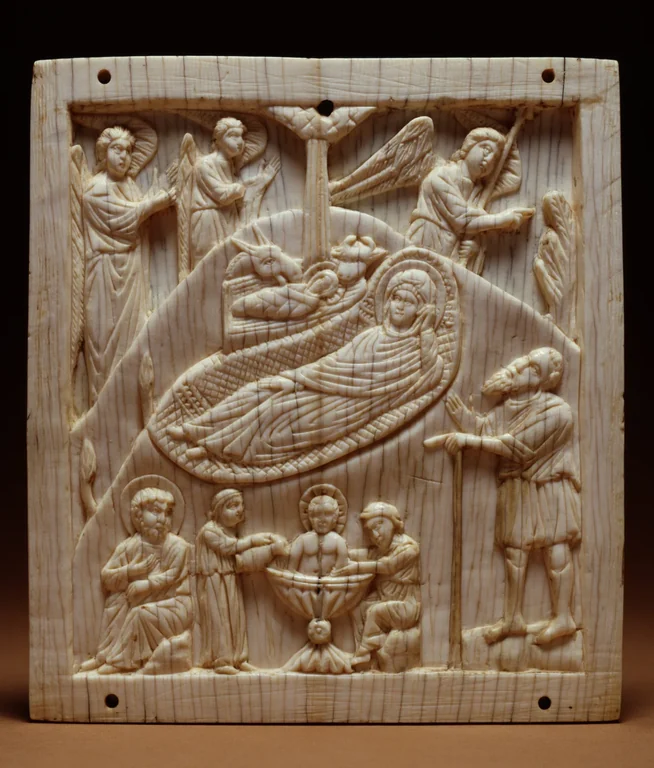
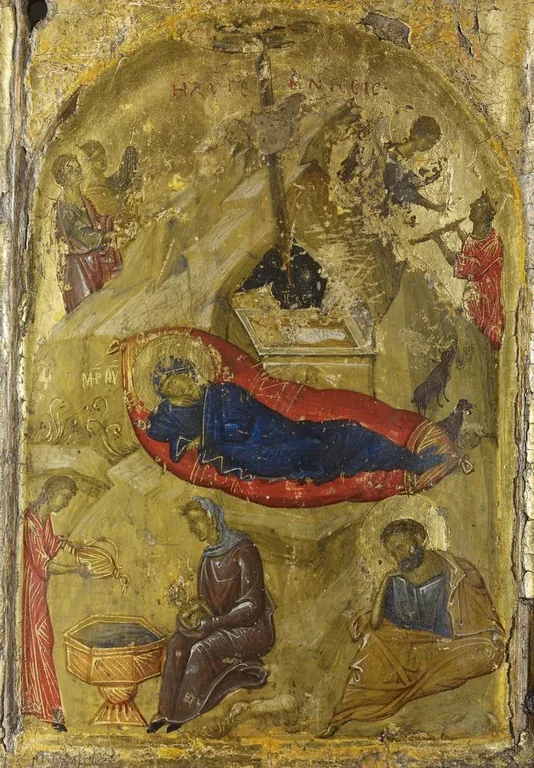
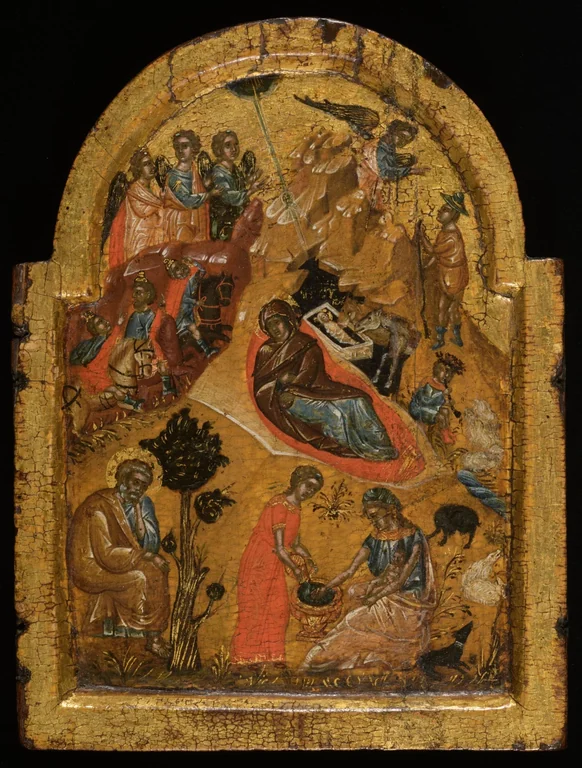
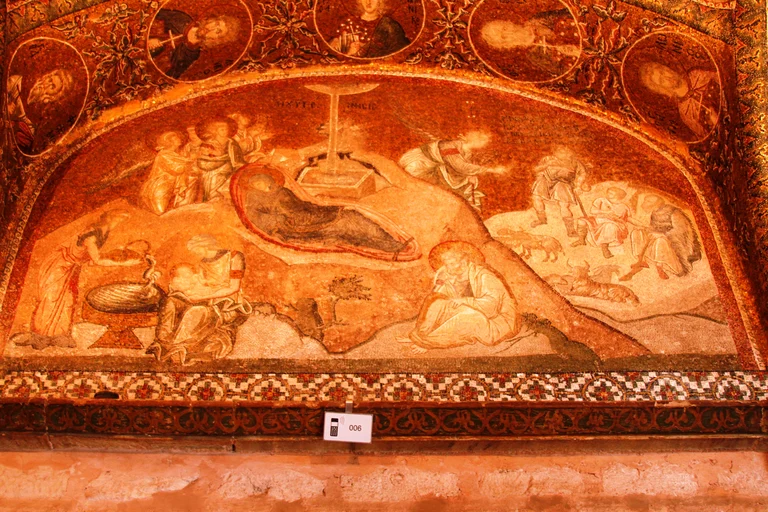
It is worth distinguishing what this image takes from the apocrypha and what it does not. It takes the two women. It does not take what they do: in the texts they certify, and here they wash. The bath comes from none of the narratives read on this page, and it is, on the other hand, one of the acts of care that Ezekiel lists for every newborn: «nor were you washed with water». It follows that the Byzantine image gives back to the midwives a task that the apocrypha do not give them. It is the version that takes seriously that there was a birth. Where the bath comes from is not settled, and the two reference works consulted do not agree. Louis Réau, a French art historian, writes in 1957 that it is in neither the Gospels nor the apocrypha, and believes it was taken from pagan sarcophagi, where it was carved in the birth of Bacchus.14 Gertrud Schiller, a German historian of Christian iconography, says instead that it is mentioned by an apocryphal text that this page has not read, the Arabic Infancy Gospel; she finds it already in a Syrian relief of the fifth century and believes that its origin may lie in Egypt, where a Coptic relief of the fourth century shows it on its own.15 Where they do agree is on its meaning: the bath says that the Child is of flesh.
In the West the midwives were there and were lost. Réau finds them in a ninth-century fresco at Castelseprio, on the eleventh-century bronze doors of Hildesheim, on capitals at Chartres and Lyon and in stained glass at Laon and Le Mans of the twelfth and thirteenth centuries; and still in the fifteenth in Italy, in Flanders and in Germany. In the Nativity of the Dijon museum, painted about 1430, the two carry their words written on a scroll: Zelomi proclaims the virginity and Salome doubts. The names change with the border: Byzantine art calls them Salome and Maia, which is simply «the midwife» in Greek; Western art, Zelomi and Salome. And Réau says what they were there for: to prove a supernatural birth with the testimony of two expert women. It is what is read in the apocrypha.14 Schiller adds the order in which they came in: at first only Salome was represented, the one who doubts, showing her withered hand —as in an ivory of the Throne of Maximian, in Ravenna, of the sixth century—, and in time the bath took up more room in the East than she did. An inscription on a Roman fresco of the eighth century gives the name Salome to one of the women bathing the Child, and from this Schiller concludes that the bath was regarded as a variation on the theme of the midwife, which was felt to be offensive.15
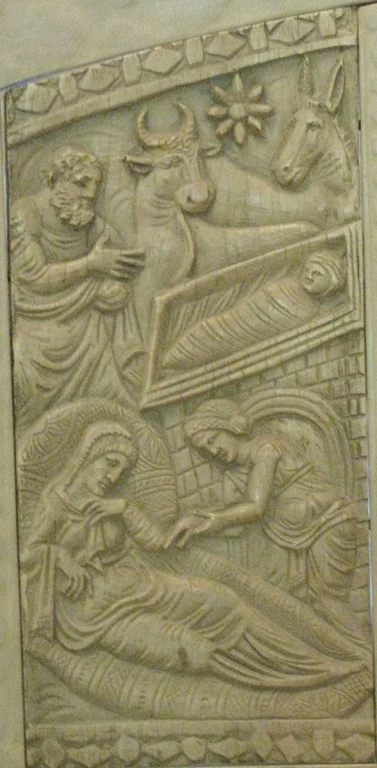
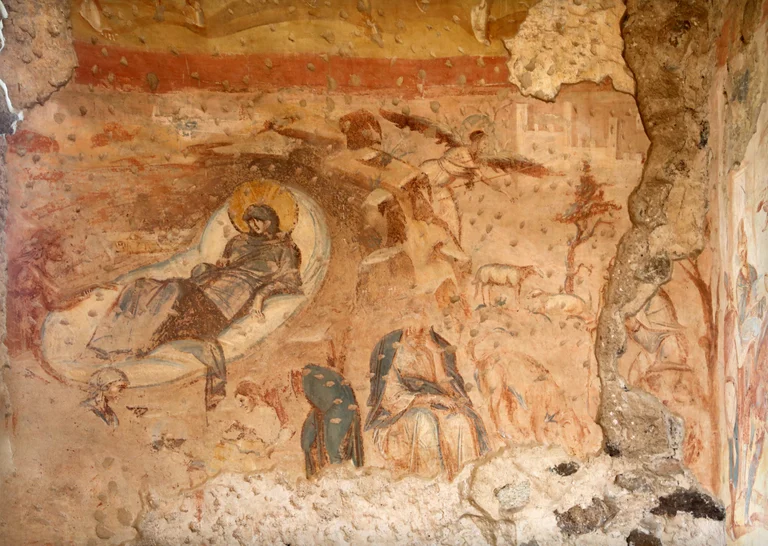
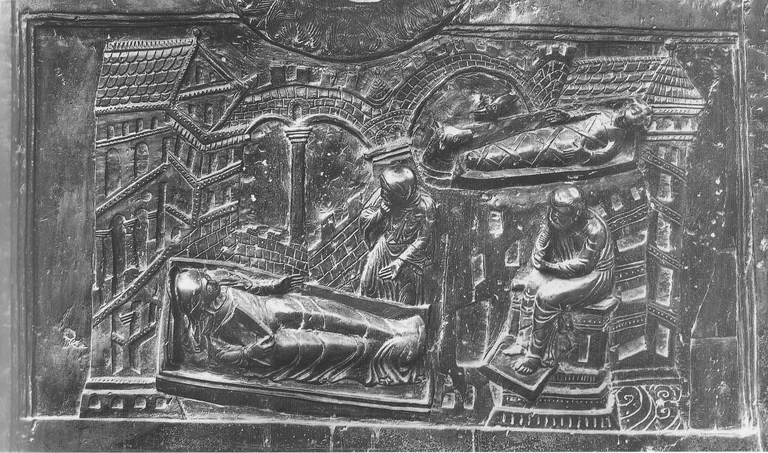
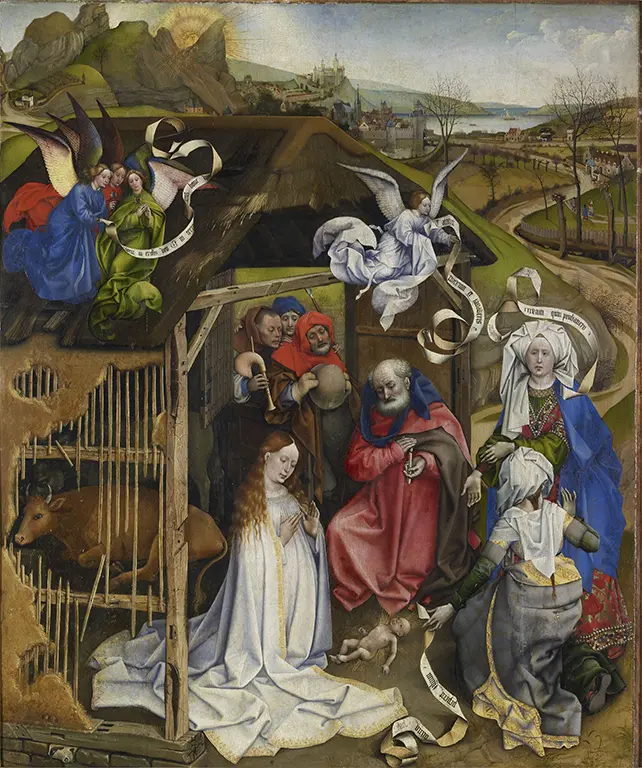
Their disappearance can be followed in four texts. The first has already been read: around 383 Jerome denies that there was a midwife. His sentence lived alongside the images for centuries and did not remove them.
The second and the third are from the end of the Middle Ages. In the Meditations on the Life of Christ, the work of an Italian Franciscan of the fourteenth century, it is the Virgin who washes the Son, with her own milk; there begins, according to Angela Maria La Delfa, who studies these texts in an article of 2021, the move away from the motif of the midwives. And Bridget of Sweden, the mystic who described a vision of the Nativity received in Bethlehem, leaves it no room. In her text Joseph ties up the ox and the ass, brings a candle and goes out «ne partui personaliter interesset», so as not to be present at the birth; the Virgin is left alone, with the cloths she herself has brought, and the Child is born clean. La Delfa sums it up thus: «Brigida rifiuta del tutto questo motivo» —Bridget rejects this motif entirely—. If the Child is born clean there is nothing to wash, and the two women of the bath have nothing to do in the image.16
The fourth now says it as a rule. In December 1563 the Council of Trent approved a decree on images. It names neither the Nativity nor the midwives: it orders in general that no images of false doctrine be set up and that no unusual image be placed without the bishop’s approval.17 The one who brought it down to particular cases was Johannes Molanus, a theologian of Leuven, in a treatise on sacred images. One of its chapters is entitled that the childbed of the Virgin, lying down and ill, should not be painted. He describes the image he rejects —«Pallet e doloribus Virgo, sorbitiunculam puerperae parant obstetrices»: the Virgin pale with pains, the midwives preparing a broth for the woman in childbed— and asks: «Ad quid ista?», what is this for? Of the midwives he says that they are taken from an apocryphal book, and against them he quotes Jerome’s sentence. He approves, on the other hand, the paintings in which the Virgin is on her knees with her hands joined before the Child already born, and tells that in more than one place the parish priests had removed from the altars the image of the childbed to put another in its place. In another chapter he records the complaint of an earlier author, Petrus Richardus: there are painters who, against historical truth, paint the Virgin’s midwife with her hands lost, «cum non habuerit obstetricem», when she had no midwife.18
Réau dates the end: the motif disappears altogether only from the sixteenth century onwards, and he counts it among the victims of the purging of images that followed Trent. What that means should be made precise. The decree does not forbid them by name; Molanus forbids them when applying it, with an argument 1,200 years older.
The order of events matters. The midwives do not leave Western art because someone showed that there was no help at the birth. They leave because the image of the birth stopped serving what was meant to be taught: a birth without pain and without stain needs no one to assist and no one to wash. The argument of Jerome, of Bridget and of Molanus is doctrinal, not historical, and for that reason it carries no weight on the scales of this page. What it does show is where the Nativity with no one else, which the nativity scene has inherited, comes from: not from Luke, who is silent, but from this decision.
In their scenes
The midwives do not travel through the cycle. They enter a single house on a single night.
In the Nativity (11 Lk), whoever helps comes in during the birth or in the immediate care. What each figure does at each of the moments the work can hold still —the birth, the care, the gesture of laying the Child down, the afterwards— is developed on the page of the scene (→ The birth of Jesus and The birth of Jesus (2): the material world).
In the adoration of the shepherds (13 Lk), which happens in the same place and on the same night, Luke says that the shepherds «found Mary, and Joseph, and the child lying in the manger» (Lk 2:16) and names no one else. Whether the one who helped is still there, tidying up, or has already withdrawn, is a decision of composition (→ The Adoration of the shepherds).
The scene of Salome and the withered hand belongs to the apocrypha and not to Luke: it can be represented as a conscious quotation of the tradition.
From the character to the figure
How many they were, how old they were, how they dressed and what each one did is unknown. There is no figure of a midwife to copy nor a pose to respect: there will be as many as there are sculptors to represent them. What follows are not guidelines. They are the few data that this page has gathered and from which whoever models can start.
The number. No text gives it. The two of the tradition is that of the apocrypha.
Midwife or woman of the house. The corpus knows both, and which of them helped Mary is unknown. The midwife by trade was paid, and of women without means French supposes that they turned to their female relatives or to knowledgeable women.5
The age. No text gives it. The epitaphs from Rome gathered by French commemorate midwives who died at 21 and in their early thirties, and the trade could be practised into old age.5
What they do and what they say. Receiving the child and, with Ezekiel and the Mishnah, tying and cutting the cord, washing, salting. The swaddling, in Luke, is Mary’s. And the only thing the corpus has the helper say is «Fear not», both times to the mother.
Two analogies, with their distance. Soranus asks of the midwife soft hands and short nails, and that she wrap them in a cloth so that the newborn does not slip; he seats her in front of the mother and lower, with an assistant who supports the mother from behind.5 A rabbinic saying speaks of the woman who kneels to give birth.3 Both sources are later and from different worlds; they do not describe Bethlehem.
The light. Whoever arrives at a house by night arrives with her lamp: it is one of the functional reconstructions of the scene (→ The birth of Jesus, decision 6, «the lamps that arrive with each woman»).
The dress. Unknown. There is no source on a dress peculiar to the midwife. Whoever models her has the whole block on clothing (Research on first-century clothing, c_3) to dress her as a woman of the place, in the way they find most coherent.
What must not be presented as a datum: the names of Zelomi and Salome; the withered hand; the bathing of the Child as if it came from Luke; the midwife who swaddles in Mary’s place; and the midwife present because the ancient image brings her, or absent because Luke leaves her unsaid, either of the two presented as the rigorous reading.
References
Ezek 16:4-5; Gen 25:24-26; Gen 35:16-19; Gen 38:3-5.27-30; Ex 1:15-21; 1 Sam 4:19-22; Ruth 4:13-17, Reina-Valera Antigua (1909), es.wikisource.org. Ezek 16:4 checked on 7-7-2026; Gen 35:17 and Ex 1:15, on 14-7-2026; all the passages, read in full on 17-11-2026. The English versions are our own, made from that Spanish text. Ezekiel is from the sixth century BC; it is used as cultural background, not as a protocol demonstrated for Bethlehem. ↩
Mishnah, Shabbat 18:3, Hebrew text and Koren-Steinsaltz English translation on Sefaria: «call a midwife for her to travel from place to place», sefaria.org; date of composition («c.190 – c.230 CE») in the record of the tractate, sefaria.org. Read on 17-11-2026. The wording of the passage given here is our own, made from the Hebrew and the English translation; «wise woman» is also Ilan’s rendering (p. 189). ↩
Ilan, Tal, Jewish Women in Greco-Roman Palestine: An Inquiry into Image and Status, Mohr Siebeck, Tübingen, 1995, pp. 116-119 («Childbirth») and 189 (the midwife among the trades). Read on 17-11-2026 in the copy of the 1996 edition lent by archive.org, archive.org. Rabbinic passages cited by Ilan and not consulted directly here: Mishnah, Avodah Zarah 2:1 (gentile midwife); Jerusalem Talmud, Shabbat 18:3, 16c (Bar Qappara’s maidservant); Babylonian Talmud, Niddah 31b (the woman who kneels). ↩↩↩
Soranus of Ephesus, Gynaecia II, in particular the sections on the preparation and course of the birth, care of the newborn, cord, cleaning, swaddling and feeding; Owsei Temkin (trans.), Soranus' Gynecology, Johns Hopkins University Press, 1956/1991, pp. 69-90. For the bands, II, IX, §14, ed. Ilberg, Sorani Gynaeciorum libri IV, CMG IV, Leipzig-Berlin, 1927, p. 61; Greek text checked by Emili Solé against the facsimile on 7-7-2026. Soranus presupposes a midwife and assistants and divides the tasks among them. It is a Greco-Roman medical analogy of the second century, not direct proof for Judaea nor an inventory of the Nativity. ↩
French, Valerie, «Midwives and Maternity Care in the Roman World», Helios, n. s., 13/2 (1986), pp. 69-84. Read in full on 17-11-2026 in the reproduction at neonatology.net, which says it took it from a page of Indiana University of 2001; the journal has not been consulted directly. ↩↩↩↩
Centers for Disease Control, «Perinatal and Maternal Mortality in a Religious Group — Indiana», Morbidity and Mortality Weekly Report 33/21 (1-6-1984), pp. 297-298, cdc.gov, read in full on 17-11-2026. Kaunitz, A. M.; Spence, C.; Danielson, T. S.; Rochat, R. W.; Grimes, D. A., «Perinatal and maternal mortality in a religious group avoiding obstetric care», American Journal of Obstetrics and Gynecology 150/7 (1984), pp. 826-831, DOI 10.1016/0002-9378(84)90457-5: the abstract and the extended extract on PubMed read on the same day, pubmed.ncbi.nlm.nih.gov, from which come the figure of 45 per 1,000 and the causes of death; the full article, behind a paywall, has not been consulted. ↩↩↩
World Health Organization, «Maternal mortality», fact sheet of 7-4-2025, who.int. Read on 17-11-2026. ↩↩↩↩
Jerome, Adversus Helvidium de perpetua virginitate beatae Mariae, 8 (10 in the numbering of the English translation). Latin text read on 17-11-2026 in the Bibliothek der Kirchenväter of the University of Fribourg, bkv.unifr.ch; the printed edition from which it comes has not been checked. English translation by W. H. Fremantle, G. Lewis and W. G. Martley, Nicene and Post-Nicene Fathers, 2nd series, vol. 6, 1893, newadvent.org; the date and place («about a.d. 383», Rome), in the introduction to that edition, ccel.org. The translation given here is our own, made from the Latin and compared with that English one. ↩
Lk 2:7.12; 23:53; Jn 19:38-42; Mt 27:59-60; Mk 15:46, Greek text of the SBLGNT, read on 17-11-2026 in its publisher’s repository, github.com; Lk 23:50-56 and Jn 19:38-42, Reina-Valera Antigua (1909), read on the same day on Wikisource. The meaning of enetýlixen and édēsan has not been checked in a lexicon. For the first hour: World Health Organization, «Early initiation of breastfeeding to promote exclusive breastfeeding», updated on 9-8-2023, who.int, read on 17-11-2026. ↩
Lk 2:4-7, Reina-Valera Antigua (1909), read on 17-11-2026 on Wikisource, es.wikisource.org. The study of the passage, in The birth of Jesus. ↩
Protoevangelium of James 17-20, read in full on 17-11-2026 in the English translation by A. Walker, Ante-Nicene Fathers, vol. 8, 1886, newadvent.org. Greek text of chapters 19 and 20 checked on the same day in C. von Tischendorf, Evangelia apocrypha, 2nd ed., Leipzig, 1876, pp. 36-37, archive.org; the beginning of chapter 19, on p. 35, has not been looked at in Greek. ↩
Gospel of Pseudo-Matthew 13, Latin text in Tischendorf, Evangelia apocrypha, 2nd ed., 1876, pp. 77-78, archive.org, and English translation in Ante-Nicene Fathers, vol. 8, newadvent.org; read on 17-11-2026. Oldest manuscripts, from about 800-820: B. W. Hawk, «Gospel of Pseudo-Matthew», e-Clavis: Christian Apocrypha, cited in The ox; it has not been consulted again. ↩
Walters Art Museum (Baltimore), Nativity, ivory, 10th century, no. 71.305: «the Virgin rests beside the manger with the swaddled Christ Child»; «the infant receives his first bath while the seated Joseph watches the scene», art.thewalters.org. British Museum, icon with four feasts, about 1310-1320, no. 1852,0102.1: «Mary reclines beneath the infant Christ in the manger»; «the scene of the two midwives bathing the Child», britishmuseum.org. The Menil Collection (Houston), Nativity, Post-Byzantine icon, about 1500, no. 1985-057.13 DJ: «Joseph sits alone, appearing contemplative beneath a tree», menil.org. Online records of the three museums. Records of the Walters and the British Museum reread in full on 17-11-2026; that of the Menil, read on 13-11-2026. On the origin of the bath, not consulted: P. J. Nordhagen, «The Origin of the Washing of the Child in the Nativity Scene», Byzantinische Zeitschrift 54 (1961), pp. 333-337, and E. Kitzinger, «The Hellenistic Heritage in Byzantine Art», Dumbarton Oaks Papers 17 (1963); both references, taken from an article that cites them, ojs.tnkul.pl, without checking in the journals. ↩
Réau, Louis, Iconographie de l'art chrétien, vol. II, Iconographie de la Bible, part 2, Nouveau Testament, 1957, pp. 220-223 («Les deux sages-femmes et la Punition de l'incrédule» and «Le Bain du Nouveau-né») and 225. Read on 17-11-2026 in the page images of the archive.org copy, archive.org; p. 224 is missing from that copy. The dates and attributions of the works are those given by Réau. ↩↩
Schiller, Gertrud, Iconography of Christian Art, vol. 1, English trans. by Janet Seligman, New York Graphic Society, Greenwich (Connecticut), 1971, pp. 63-65 («The Nativity: motif of the midwife and the bathing of the Child»). Read on 17-11-2026 in the lending copy on archive.org, archive.org; the German edition has not been consulted. Nor has the Arabic Infancy Gospel, which Schiller gives as the text of the bath. ↩↩
La Delfa, Angela Maria, «Il significato della visione del Natale di santa Brigida di Svezia nel contesto della cultura tardo medievale», De Medio Aevo 10/2 (2021), pp. 319-338, doi.org; read on 17-11-2026 in the journal’s PDF: p. 324 (the Child needs no bath) and p. 326 (the Meditations and Bridget’s rejection). The Latin of Revelations VII,21 is quoted through La Delfa, n. 15. That the Meditations are by an Italian Franciscan of the fourteenth century, Giovanni de Caulibus, is stated by Réau, p. 225, following É. Mâle. For the motif of the midwives La Delfa refers to Réau and to Schiller, both cited on this page. ↩
Council of Trent, session XXV, December 1563, decree on the invocation and relics of the saints and on sacred images. Read in full on 17-11-2026 in the English translation by J. Waterworth, London, 1848, history.hanover.edu; the Latin text has not been consulted. ↩
Molanus, Johannes, De historia SS. imaginum et picturarum pro vero earum usu contra abusus, Leuven ed., 1771, bk. II, ch. 27, pp. 78-79, and bk. III, ch. 57, p. 396; checked on 17-11-2026 in the page images at archive.org. Chapter 27 is also in the Leuven edition of 1594, archive.org, read in automatic transcription. The first edition, of 1570, has not been located. The translations from the Latin are our own. ↩