
 ≈ 39 min

Each age drew space as it understood the world. The history of perspective is the history of those ways of looking.
What knowing history gives us
Before speaking of perspective it is worth pausing over a wider question, because the reader has every right to ask it: what does knowing history give us, in general? The answer has to do not only with art or with nativity-scene making, but with our own way of being human.
History offers, above all, collective memory. Thanks to it we know where we come from and do not have to start from scratch in every generation: it remembers successes and mistakes, and allows us to learn from both. At the same time it gives critical awareness: it does not let us think that the present is natural or inevitable — it shows it as the fruit of decisions, struggles and contexts that could have been different — and knowing that background helps us to look at our own time more lucidly. It also provides identity and belonging: in the traces of the past we recognise our own customs, languages and beliefs, and discover that we are part of something larger than ourselves — while learning to value other cultures and to converse with them. It is, moreover, a horizon for the future: not only memory but compass — knowing how others faced changes and crises offers paths and spares us naivety. And it adds, finally, depth of gaze: it lets us perceive that today’s problems have already been lived through in another form, and that solutions are not born out of nothing but out of a thread of continuity. That awareness gives substance to the decisions of every day.
It was summed up in a famous sentence by a philosopher who deserves to be introduced, because the sentence is quoted far more often than its author. George Santayana (Madrid, 1863 – Rome, 1952) was a philosopher and writer of Spanish origin who wrote in English, a professor of philosophy at Harvard University and one of the major voices of American thought in his time — a member of the American Academy of Arts and Letters and of the Phi Beta Kappa Society, the most prestigious honour society for the arts and sciences in the United States.1 In his work The Life of Reason (1905) he wrote the passage of which everyone remembers only the end; in full it says more:
«Progress, far from consisting in change, depends on retentiveness. […] when experience is not retained […] infancy is perpetual. Those who cannot remember the past are condemned to repeat it.»2
In this craft, repeating the past without remembering it takes a very concrete form: applying inherited conventions — the scale that shrinks towards the background, the colour that fades in the distance — without knowing where they come from or what problem they solved. They half work, like everything that is imitated without being understood.
«El Realismo Crítico de George Santayana - Filosofía del siglo XIX (y XX)», La Travesía channel, in Spanish. Hosted on YouTube. To watch it, open the cookie settings and allow audiovisual content.
What knowing the history of perspective gives us
Let us now come down from the general to our own concern, because the reader may be thinking it: «All I want is to build a nativity scene for Christmas… what use will it be to me to know the history of perspective?». The doubt is legitimate, and it should be answered before setting out.
Perspective was not born as a mere optical trick: it is the trace of how each age has understood the world. From medieval frescoes to the Renaissance, by way of the modern avant-gardes, every change in the way of representing space reflects a cultural and aesthetic transformation. Knowing that road places the nativity-scene maker within an artistic tradition larger than their own: the point is not to repeat formulas, but to understand that, in composing a nativity scene, one takes part in a history that has shaped our way of looking.
Because seeing is never a neutral act: every representation implies an interpretation of the world — this Manual established as much when speaking of composition (The why and the what for). Every nativity scene that is created, even in the dining room at home, proposes a visual order: a way of placing the figures and of narrating the mystery. Perspective is, in that sense, a language — it speaks of our relationship with reality and with what transcends it.
And in practice, what the nativity-scene maker seeks is emotion and coherence. Whoever does not know how perspective was born and evolved runs the risk of applying it superficially; whoever knows its history understands why certain devices work, why others feel forced, and how to give the scene depth and life. Perspective does not only organise space: it helps to persuade the eye — and, through the eye, the heart.
An example from another art: classical music
A parallel from another art makes it clear. What sense would there be in performing Beethoven without knowing that he lived in a time of transition between Classicism and Romanticism — that in his music inherited order and the emotion that overflows it live side by side? Or in listening to Bach without understanding that his work crowns a whole Baroque tradition of counterpoint and polyphony? Each composition is not an isolated sound: it is the voice of an age, a chapter within a larger evolution.
Johann Sebastian Bach, chorale «Jesus bleibet meine Freude» from Cantata BWV 147, by the Netherlands Bach Society. Hosted on YouTube. To watch it, open the cookie settings and allow audiovisual content.
That is why whoever studies classical music does not confine themselves to learning notes and scales: they need to know the history of that art. Only then do they understand why some works sound solemn and others seek intense emotion; why some follow strict rules and others break them boldly. The same happens with the nativity scene. Figures and houses can be set down as notes can be played on a piano; but when the history of perspective is understood — just as the musician understands the history of music — a language with roots, evolution and meaning is discovered. And then the nativity scene ceases to be merely an ornament and becomes a creation with cultural and artistic depth.
A note on method, so that the reader knows what kind of history they are about to read. This is not a history of art — there are excellent ones — but a history told with the eyes of a nativity-scene maker, and its criterion of selection is declared: each episode earns its place if it leaves something on the worktable — a device, a warning, an idea that can be put to use. That is why every stage of the journey ends in the same way: by asking what it leaves to whoever composes nativity scenes. What does not lead to the table is named and passed over.
One more point before setting out, and it is only fair to make it: not every nativity scene needs perspective. A nativity scene can be composed with nothing more than a Holy Family, a little moss and a piece of cork — and it can be a complete work: there the whole scenographic weight is carried by the sculpture, and the scene lives on what the figures say. But when the aim is to design a more complex scenography — a village receding, a road losing itself, a sky that breathes — things change completely: then what the nativity-scene maker has internalised and reflected on artistically comes into play. And what has been internalised does not fall from the sky: it is built — by looking, comparing, knowing. The history that begins here is material for that construction.
Prehistory: the first gestures of depth
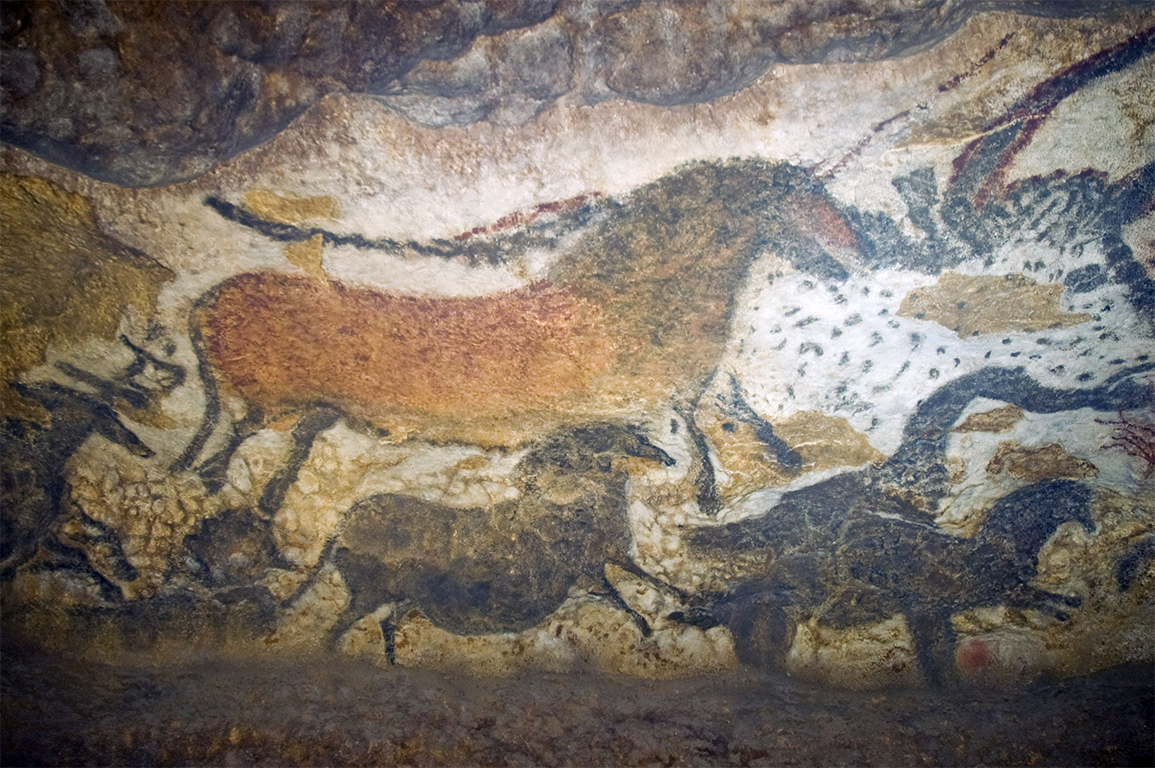
The desire to represent space and give visible form to what is perceived was not born with the historical civilisations. Already in prehistory there are attempts to suggest depth. In the cave paintings of Lascaux or Altamira, the animals are represented with overlaps — some bodies partly covering others — and with variations in size: the largest appear in the foreground and the smallest behind. In some cases, legs and horns are painted at an angle, like a timid foreshortening — the name given to the apparent deformation of whatever points towards the eye: the leg coming towards us looks shorter than it is. This is not yet a system of perspective, but an intuitive device for evoking three dimensions on a wall.3
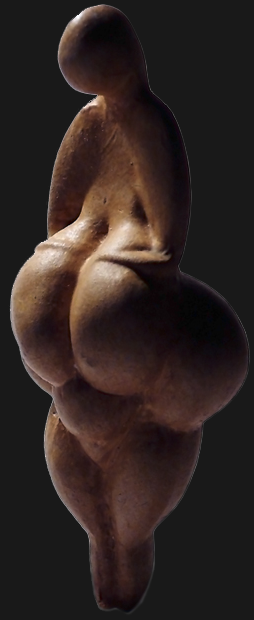
In Palaeolithic sculpture, such as the famous Venuses, the approach was a different one: symbolic. Certain features — the organs of fertility — were exaggerated, while others, such as the face, were omitted. The aim was not optical imitation but the expression of vital and religious values. These works recall something worth keeping in mind: long before any theory of perspective, human beings were already seeking to represent the invisible and to give meaning to the world through the image.
What this leaves on the nativity-scene maker’s table. More than it seems: overlapping and variation in size — the two gestures of Lascaux — are still, thirty thousand years later, the two most elementary devices of depth in any nativity scene. Whoever places one figure in front of another, or makes the house in the background smaller, is using exactly what those painters discovered: the human eye reads those two signs without anyone teaching it. Before any rule, depth already had a grammar.
Egypt: clarity above realism
Egyptian art disconcerts anyone who looks at it with modern eyes — why those «flat» figures, with the head in profile and the eye seen from the front? — and the answer is the first great lesson of this journey: it did not seek to reproduce visual reality, but to express a religious and symbolic order. Each apparent oddity is a coherent decision within that purpose.
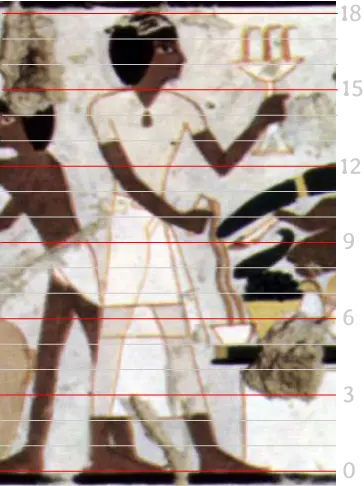
It was governed, first, by a canon of proportions: a grid 18 squares high, in use from the Middle Kingdom, in which each key point of the body — elbows, knees, navel, shoulders — corresponded to a line of the grid. What for? To guarantee that all figures kept «ideal», standardised proportions, considered correct from the cultural and spiritual point of view. That system explains the astonishing uniformity of Egyptian art over millennia. It was not, however, a prison: the finds show slight variations — the grid worked more as a guide than as an inflexible norm.
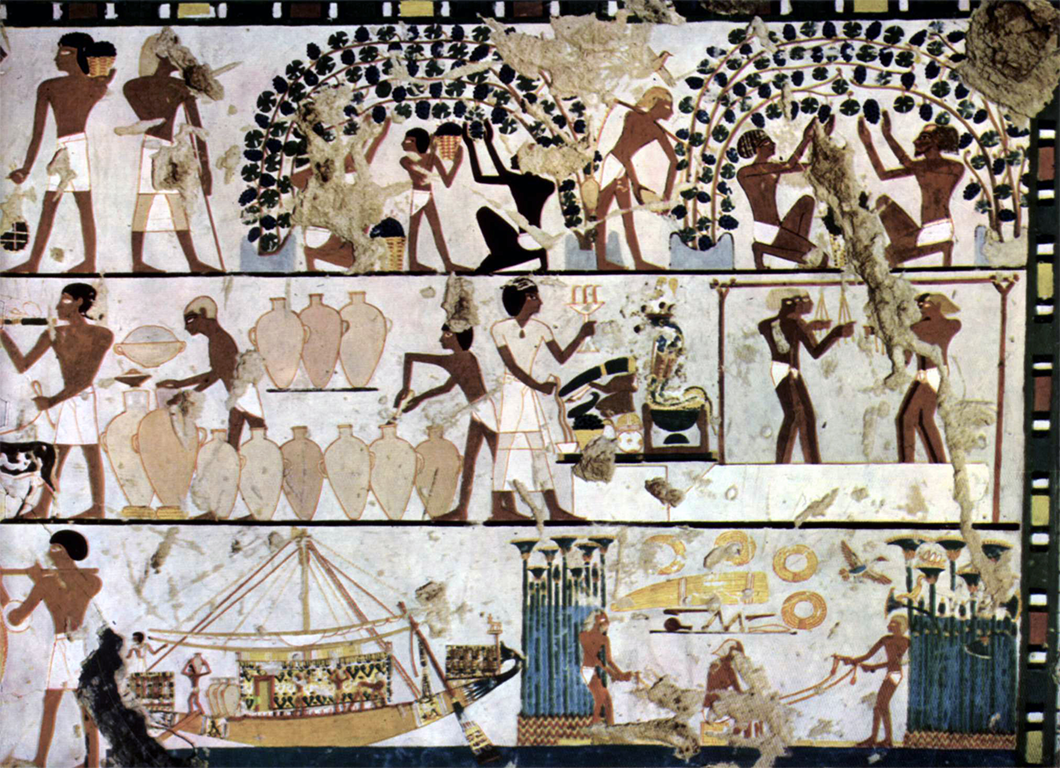
There also prevailed the law of frontality: combining the profile view and the frontal view to show what is clearest of each part of the body — head and legs from the side, eyes and torso from the front. The reason matters: the point was not to imitate what the eye sees from one place, but to offer a complete and eternal image of the person or divinity represented — their true form, not their momentary appearance. For the same reason foreshortening was avoided: a foot in profile was more «true» than a foot shortened by vision, which would have deformed the perfect form.
The representation of time and movement followed that logic too. A figure could gather into a single gesture several phases of an action: a peasant ploughing appeared with his arms in positions that suggested at once the beginning and the end of the task — not an instant, but the whole work.
Colour was likewise symbolic, not descriptive: red meant life and strength; white, purity; black, the fertility of the Nile silt — and death; yellow, the sun and eternity. Men’s skin was painted reddish and women’s lighter, following social conventions rather than natural observation.
And hierarchy was expressed in size and position: the most important characters, larger or higher up in the composition — what some call vertical or hierarchical perspective: size according to importance, not according to distance. To reinforce it, overlapping was used, placing some figures in front of others. This convention — the perspective of status — will reappear centuries later in European Romanesque and Gothic art; this series names it here and will not develop it, because its logic is not spatial but social: it measures dignities, not distances.
What Egypt leaves on the table. The proof, sustained for three thousand years, that every convention is a choice in the service of something. The Egyptian system is not «failed perspective»: it is clarity chosen above realism, with an impeccable inner coherence — a conscious system in the service of a world view that preferred the eternal to the apparent. The nativity-scene maker who understands this makes a leap in maturity: they stop asking «which is the correct representation?» and begin to ask «in the service of what do I place mine?». Everything that comes afterwards in this history — scientific perspective included — consists of different answers to that same question.
Greece: the stage, cradle of illusion
In the Greek world perspective did not arise as a unified, scientific system — that will happen centuries later, in the Renaissance — but as an experimental practice bound up with observation and the workshop. And above all — the fact changes the whole genealogy of the craft — bound up with the theatre.
The Greek term closest to our idea of perspective is skenographia: literally, «scene painting» — from skene, the structure at the back of the Greek stage. It named the painted sets that simulated architecture and gave the spectator the illusion of depth. It was no minor ornament of the performance: Aristotle counted it among the constituent elements of tragic performance — although for him the power of tragedy lay in the plot and the characters, not in visual effects: the spectacle was necessary, but secondary.4
The founding report was preserved by Vitruvius — a Roman architect and engineer of the 1st century BC, author of De architectura, the only architectural treatise of Antiquity to have come down to us complete: he tells that Agatharchus, in Athens, painted the scene for a tragedy by Aeschylus and left a commentarius about it — a written account; and that this account led two philosophers, Democritus and Anaxagoras, to treat the same subject: how, given a centre fixed in a definite place, the lines should correspond to the spectator’s point of sight and to the divergence of the visual rays.5 Some regard that lost commentary as the first text on perspective in history; what is on record is what Vitruvius says — and that is already a great deal: a stage practice that set the philosophers thinking.
The nativity-scene maker should pause here, because this fact concerns them like a certificate of origin: Western perspective was not born on a painter’s easel — it was born on a stage. The problem that begot it is exactly theirs: to make a limited space, seen from the front, look like a world.
Skenographia was related to skiagraphia, the art of painting shadows: grading the tone — darker where the light does not reach, lighter where it falls — so that a flat surface appears to have volume. It is one of the first documented steps of flat painting towards visual depth: before making lines recede, painters learned to model with shadow.6
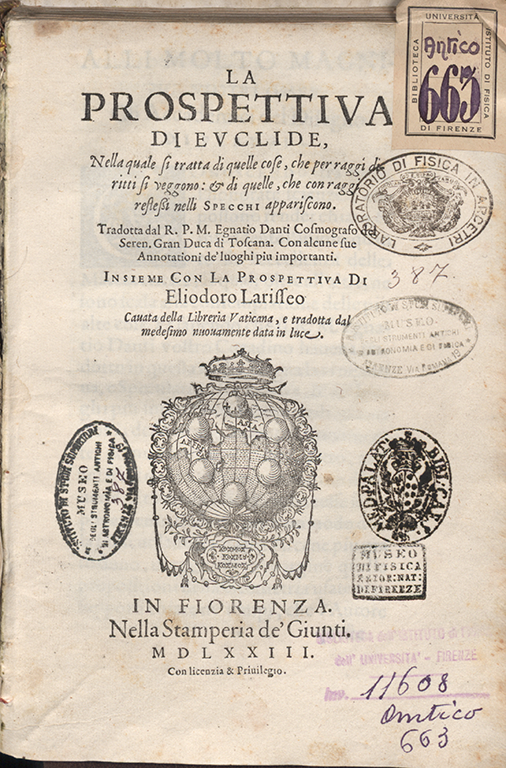
And reflection soon leapt from the stage to science. Around 300 BC, Euclid — the mathematician of the Elements, the most influential book of geometry ever written — analysed in his treatise Optics how the size at which we perceive an object depends on its distance from the eye. He did not formulate a system of central perspective; but he laid the foundations for relating vision and geometry — the step without which nothing of what comes afterwards would have been possible.7
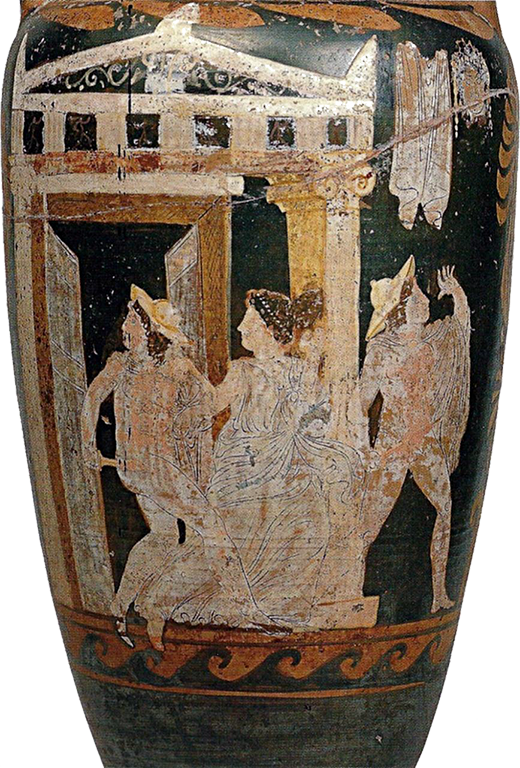
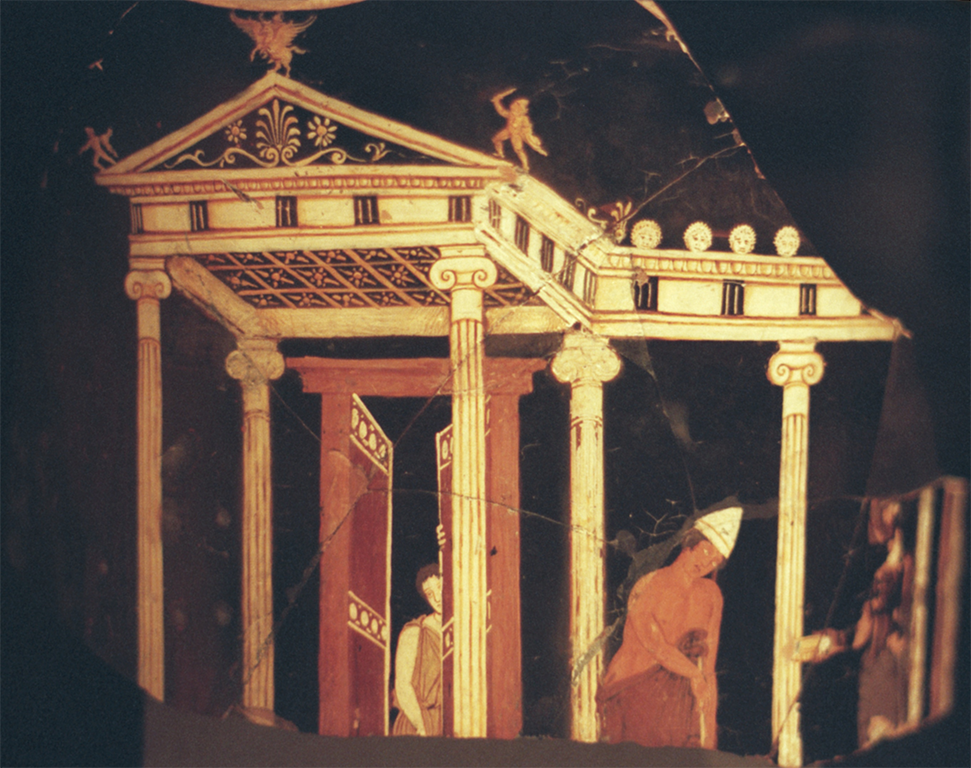
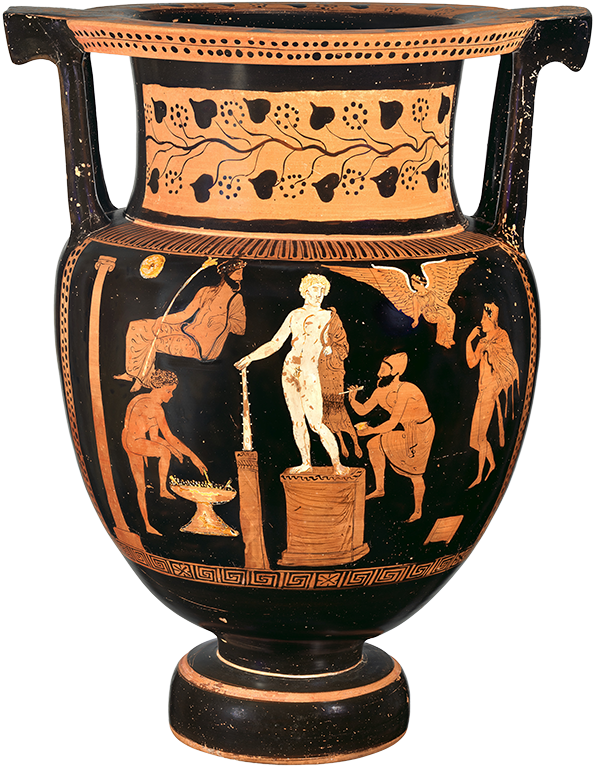
Greek pottery — and later the Italiote pottery of the 5th and 4th centuries BC — shows that search under way: temples, altars and columns appear receding with strong lines of depth, living in the same scene alongside characters represented frontally or in tiers. Perspectival and non-perspectival devices together, without the mixture troubling anyone: the interest lay in illusion, not in geometric coherence. With Hellenism the spaces gained in verisimilitude and homogeneity, without ever coming to form a unified central system — but preparing the ground for Roman illusionism.
What Greece leaves on the table. A whole principle, and one of those that govern a craft: perspective was understood as a tool for moving and convincing, not as a mathematical construction. What was essential was not exactness but visual effectiveness before the spectator. That principle is still alive, intact, in the nativity scene: it does not matter that the space be perfect — it matters that it look true and move whoever contemplates it. And with it, the certificate of origin: the nativity-scene maker working on a diorama is not a distant cousin of the painters — they are a direct descendant of the scenographers who invented this.
Rome: illusionism at home
If Greece laid the theoretical and scenographic foundations, Rome carried the concern for illusionism into decorative practice: onto the walls of houses. There is no single, coherent system in Rome, but there is an increasingly sophisticated repertoire of devices for astonishing the spectator.
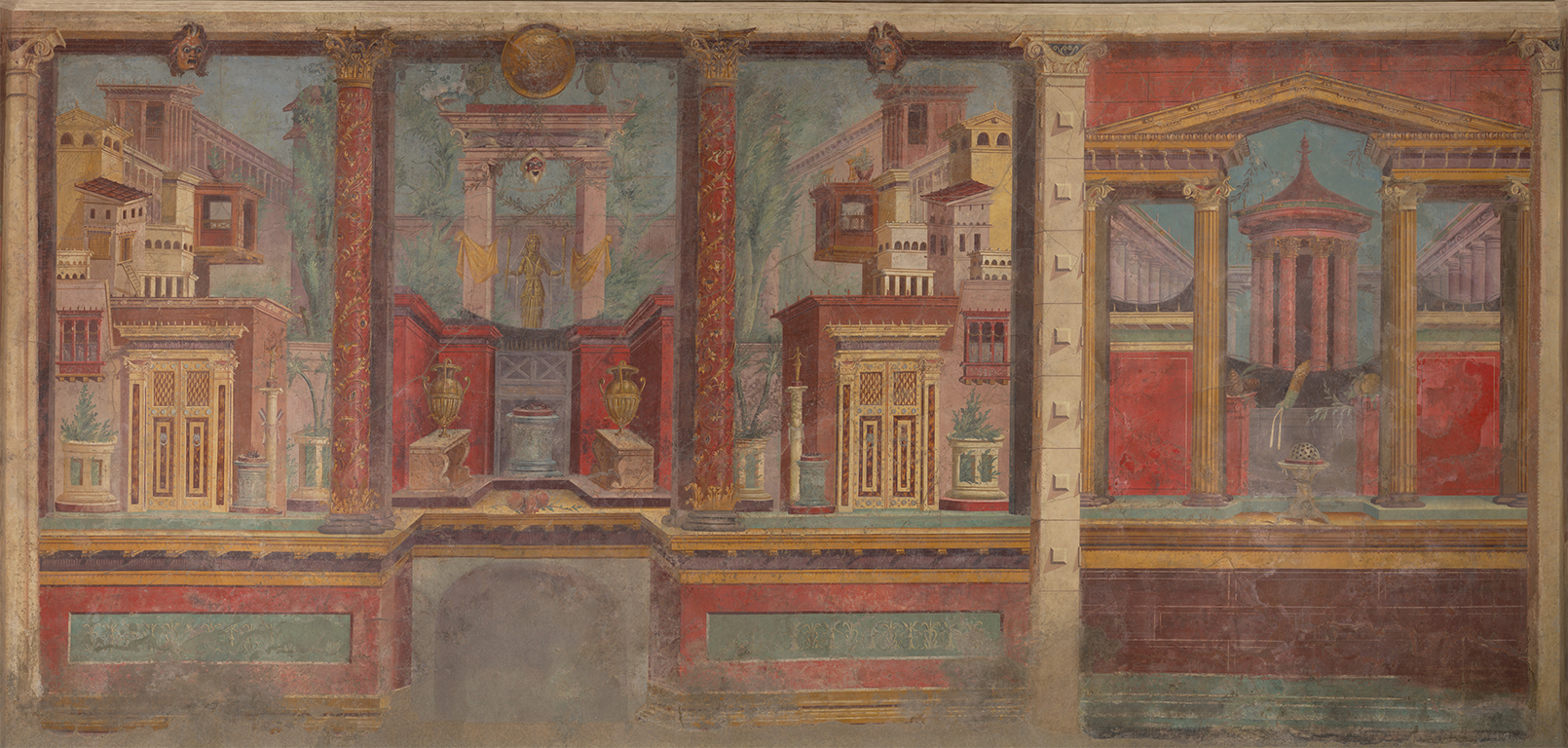
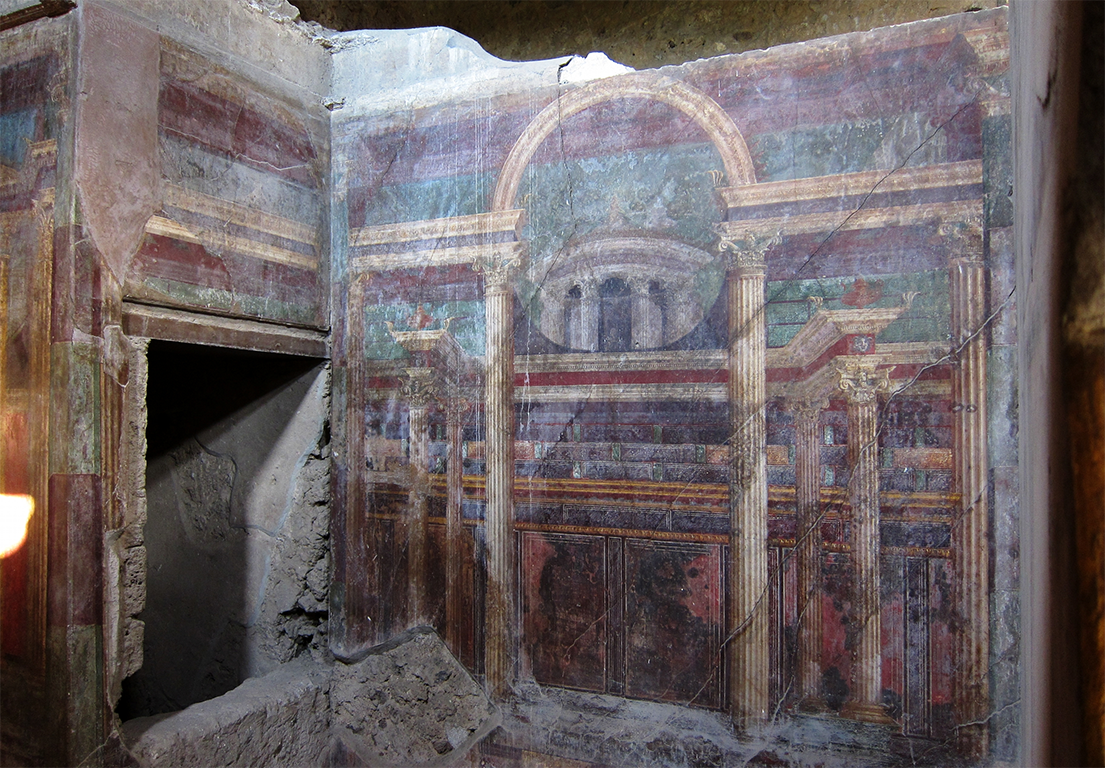
The Romans inherited Greek skenographia and took it further in wall painting. In the frescoes of Pompeii and Herculaneum — especially in the so-called Second Style, developed in the 1st century BC (the «Pompeian styles» are the modern classification of Roman wall painting into four successive manners; the second is the architectural and illusionistic one) — the walls open onto feigned architecture: porticoes, colonnades and landscapes that visually enlarge the rooms and, in passing, display the power and refinement of the owner.8 A major example is the frescoes of the Villa of P. Fannius Synistor at Boscoreale, where multiple vanishing points coexist to build the illusionistic space — not always coherent with one another from the geometric point of view, but with an unmistakable intention: that the wall should seem to extend beyond the wall.9
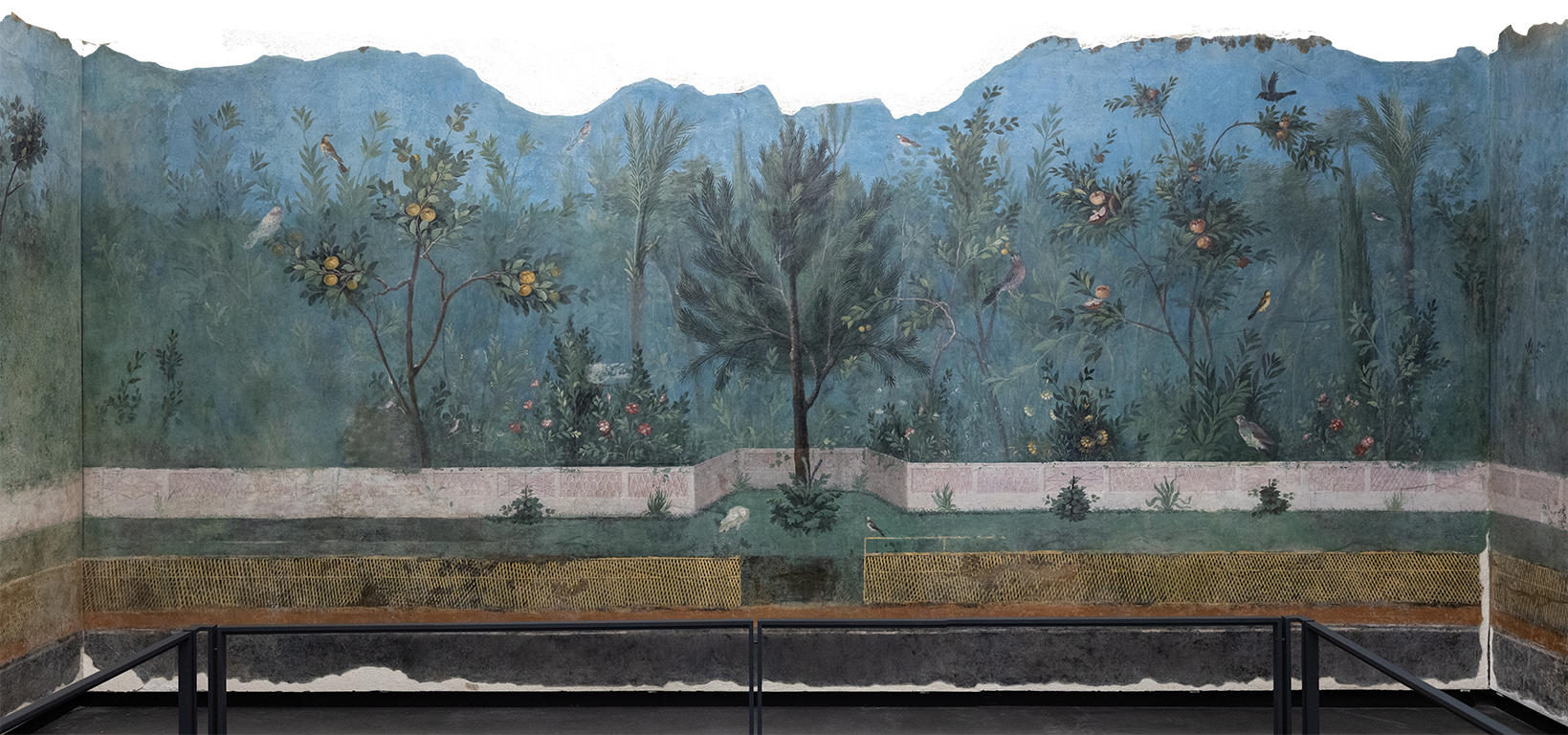
And the Romans sensed something more — something this Manual will treat in a chapter of its own, because it is one of the nativity-scene maker’s major tools. In the famous painted garden of the Villa of Livia at Prima Porta (c. 30 BC), the nearby vegetation is represented sharp and detailed, and the distant vegetation fades into bluish tones, with less contrast and less colour. It is what we now call atmospheric perspective: the air lying between the eye and things — with its particles, its moisture, its scattered light — veils what is far away and turns it blue, and the painter who reproduces that veil builds distance without drawing a single line.10 Centuries before Leonardo set it down in writing, an anonymous painter had practised it in the dining room of an empress.
They also applied perspective to vaults and ceilings — painted beams and coffers converging towards a point, to suggest height and monumentality. But Rome did not develop a mathematical theory of perspective: its interest was practical — the convincing effect in the villa, the temple or the theatre — and that is why in many frescoes areas of great illusionism live alongside flat traditional conventions. The priority was not absolute coherence but visual and narrative impact. That legacy was handed down for centuries through frescoes and mosaics, until the Renaissance reinterpreted it in mathematical language.
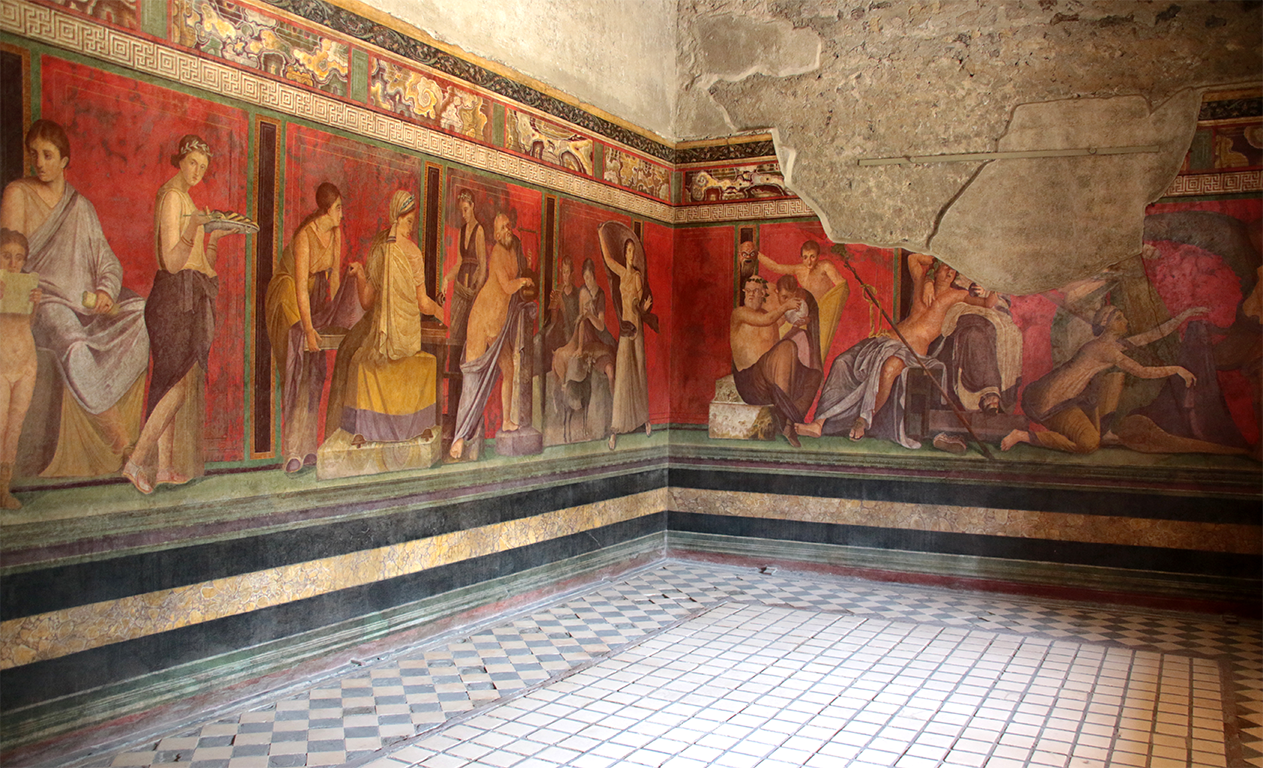
What Rome leaves on the table. Something any maker of diorama nativity scenes will recognise at once: opening a wall onto a world that does not exist is exactly what a well-painted background does. The Roman illusionistic fresco is the direct ancestor of the diorama background — the wall that pretends not to be there. And its inconsistencies teach as much as its successes: the spectator forgives a great deal, if the whole convinces. The second inheritance is a seed: that bluish air of the Villa of Livia is the first documented appearance of the device the nativity-scene maker will use every time they paint a sky backdrop — and it will have its chapter.
The Middle Ages: many languages for one and the same space
After the splendour of Rome, the representation of space entered a new cultural framework. It should be said against the cliché of «obscurantism»: it was not a time of emptiness, but of diversity. To understand that diversity, the journey follows an order: first Byzantine art, the direct heir of the Roman tradition; then Islamic and Chinese art, which developed solutions of their own; and finally the European West, where the trials that anticipate the Renaissance will appear. All these traditions share one trait: none sought central linear perspective — each adapted the representation of space to its own cultural, religious or aesthetic values.
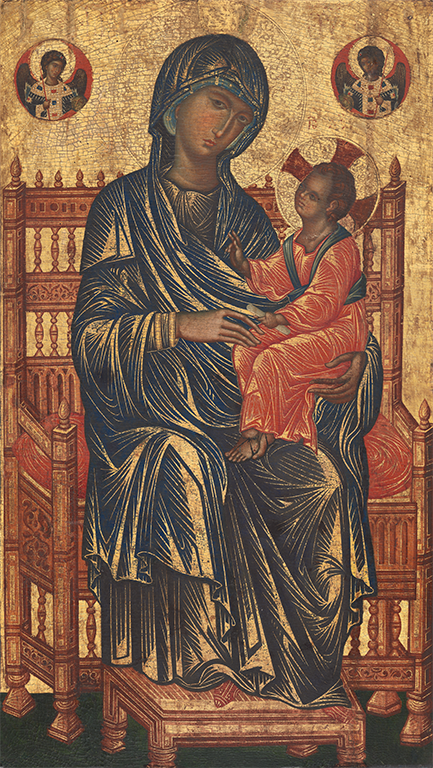
In Byzantium the so-called inverse perspective developed: the lines of thrones, footstools and aedicules do not converge towards the back of the picture, but open towards the spectator — as if the vanishing point were in front of the image, in the one who looks. The effect is strange to a modern eye, and it is deliberate: the scene seems to expand outwards and involves the believer in the sacred space — they are not looking through a window: they are reached by what the image contains. It is not technical clumsiness: it is theology made geometry — the divine does not obey the laws of human vision, and its image should not pretend to obey them either.11
In the Islamic world representation followed another logic: linear perspective was avoided and priority was given to geometry, symmetry and decoration. In the Persian miniatures and manuscripts of the Abbasid period (8th-13th centuries) a form of tiered oblique perspective was used: the most distant objects, placed higher up in the composition. Most of those early works were lost in the Mongol invasions — what is known comes mainly from chronicles — but their legacy passed into the later miniatures of Iran and Central Asia.
In China there developed from very early on oblique projection, a system different from all the previous ones: instead of a single vanishing point, space unfolds in successive layers — mountains, rivers and trees organised in oblique planes that suggest depth without a horizon or proportional reduction. The spectator is not pinned to one spot: their eye travels through the landscape, entering from below and rising from plane to plane, in the service of a contemplation more spiritual than optical.12
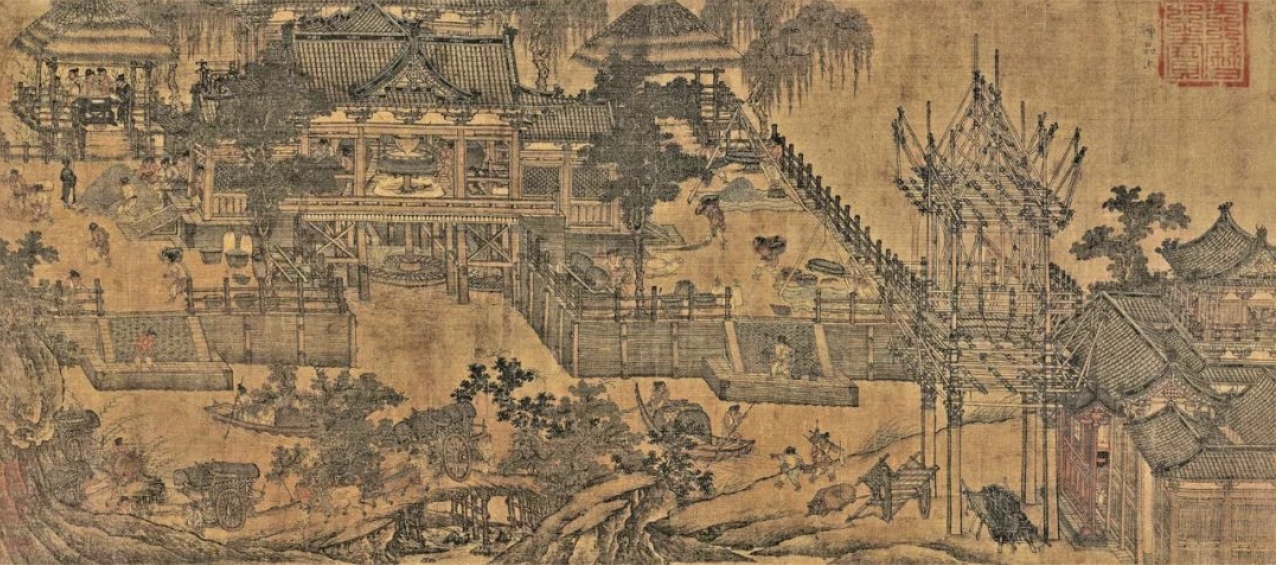
And here the reader of this Manual must pause, because they have just met an unexpected relative. A spatial system conceived for the moving viewpoint — the eye that strolls and goes on discovering, with no obligatory place from which to look — is, in its deep logic, the same thing the nativity scene of multiple framings does: the one that is walked round, the one each visitor looks at from wherever they wish (A question of framing). Chinese painting demonstrates with centuries of masterpieces that space without a single vanishing point is not a defect of system: it is another system — and whoever composes a table-top nativity scene will do well to know it: their tradition is not that of the picture, and need not measure itself against it.
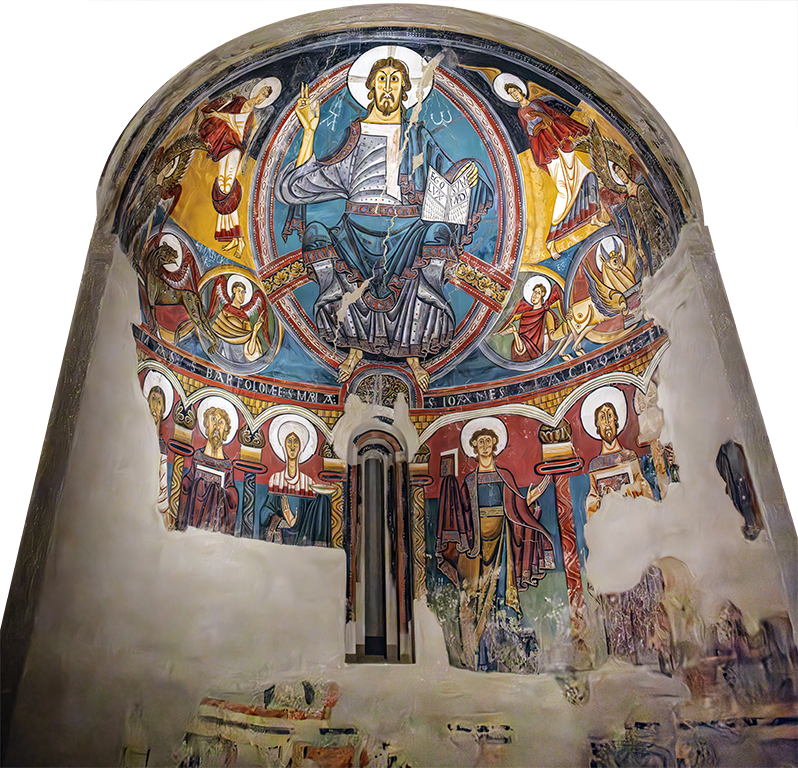
In Romanesque Western Europe, the frescoes of churches such as Sant Climent de Taüll (c. 1123) show the symbolic logic in its fullness: the Pantocrator dominates the composition by his monumental size — which underlines his divinity, not his nearness; the apostles, much smaller although they are on the same plane; the architecture, schematic and symbolic, with no intention of building an inhabitable space.13 It is the perspective of status that already appeared in Egypt — size according to dignity: it stands named, and with it the warning that the Romanesque did not «not know» perspective: it did not need it for what it wanted to say.
Giotto: the stage recovers the scene
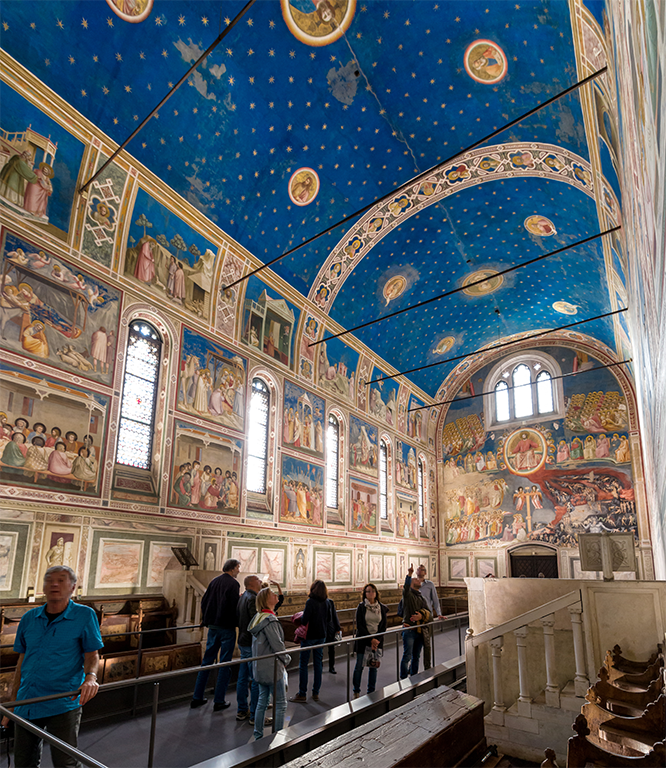
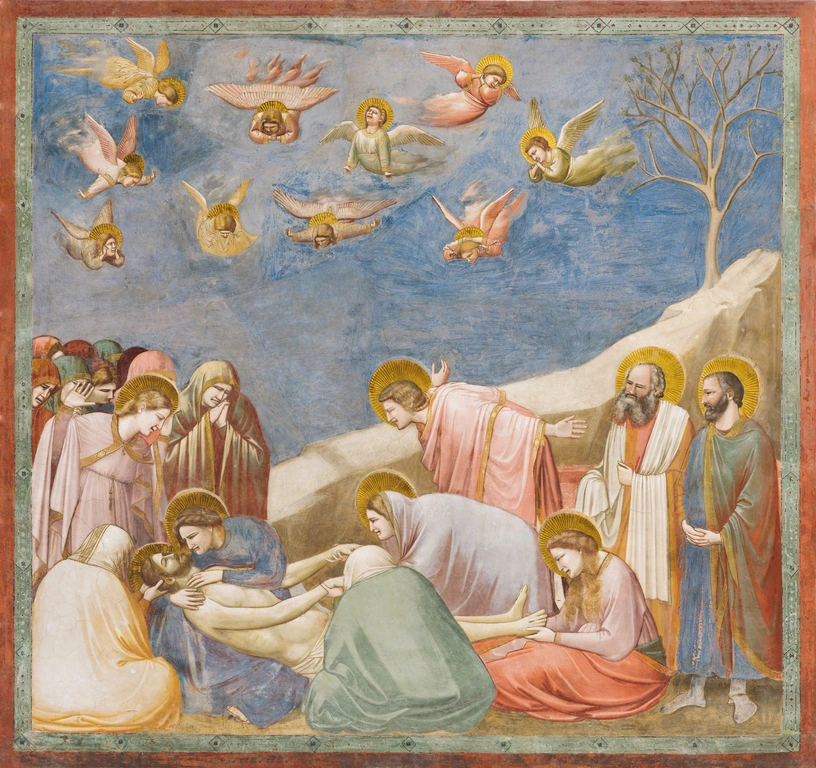
Until the end of the 13th century, Western painting had been above all a symbolic art: flat figures, gold or abstract backgrounds, absence of depth. With the Gothic, more naturalistic solutions began to be tried; but the real transformation came with Giotto di Bondone (1267-1337) — a Florentine painter whom the history of art marks as the threshold of modern painting, and whom this Manual already met when speaking of the theme of the Nativity (Is nativity-scene making an art?). His fresco cycle in the Scrovegni Chapel in Padua (c. 1303-1305)14 gave painting a new purpose: to imitate human life and emotion.
His revolution had three fronts, and each should be understood, because all three will matter in the nativity scene:
The first, the volume and weight of the figures. Giotto was the first to give his characters a solidity that anchors them in space, and he achieved it through chiaroscuro: modelling the forms with lights and shadows — lit where they project, darkened where they recede — so that they looked like sculptures painted on the wall. In a way he was taking up the old Greek skiagraphia — the art of shadows; but what in Antiquity was an experiment becomes in Giotto a structural principle: his figures are there, with physical and dramatic presence.
The second, the pictorial stage. His scenes do not float on gold backgrounds: they take place in architectural settings and landscapes that work as a unified, credible stage, where the characters act as in a play and the composition directs the spectator’s gaze — a coherent and persuasive visual narrative.
And the third, the one that gives him his place in history at large: the birth of psychodrama. His characters are no longer rigid symbols but human beings with recognisable emotions — faces and gestures that express pain, astonishment, compassion, despair — and that brought the religious scenes close to the spectator with unprecedented force. Giotto did not only paint stories: he painted feelings.
And perspective? Giotto formulated no system — but he experimented, and his experiments teach. In Christ before Caiaphas (Scrovegni) he built the interior with a linear perspective done «by eye» which analysis reveals to be double: the ceiling beams converge coherently towards one point — a vanishing point: the place in the picture where receding parallels seem to meet; the term will have its chapter, here the idea is enough — but the edges where the walls meet the ceiling converge towards another, different point. That double convergence creates a slight torsion of the space — the ceiling pushes towards a centre, the walls open the box towards the sides: it is not a geometric system, it is an empirical construction to achieve verisimilitude and direct the gaze. Read historically, it is a proto-perspective: enough to anchor the characters in a credible place and concentrate attention on Christ, without the mathematical homogeneity that Brunelleschi and Masaccio will establish a century later.15
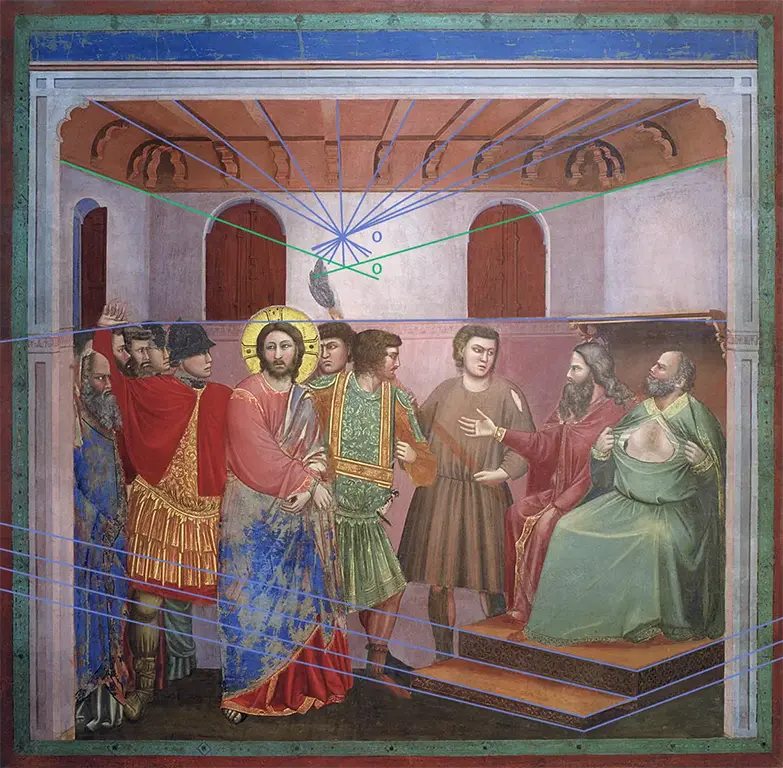
And from there, a workshop guideline that the first edition of this Manual formulated and that deserves to be kept as it stands: if an interior is designed with central perspective, align beams, cornices and floor towards a single vanishing point; if two are to be used, treat them as two boxes with different axes and disguise the transition with arches, columns or hangings — to avoid the sensation of «broken space». Giotto did it by eye seven centuries ago; the nativity-scene maker can do it knowingly.
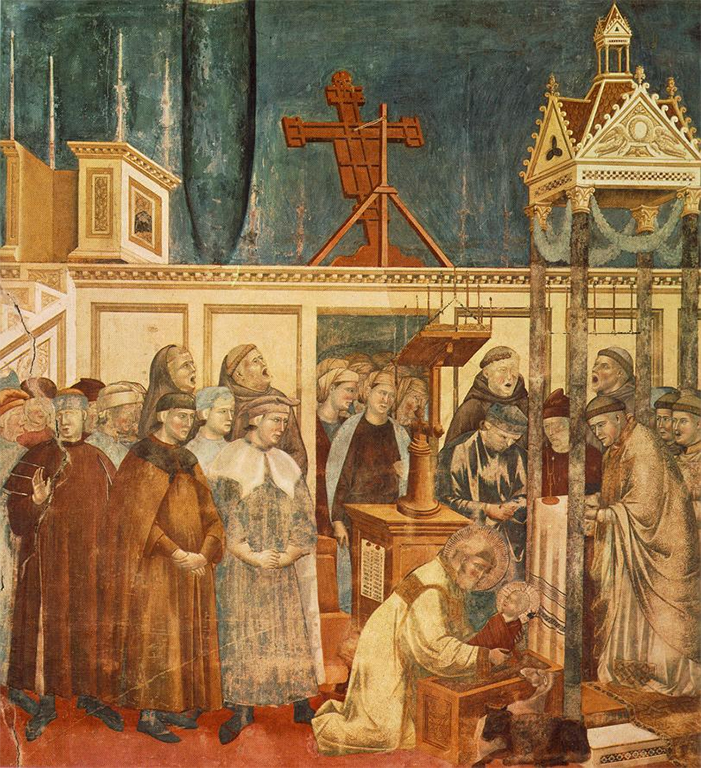
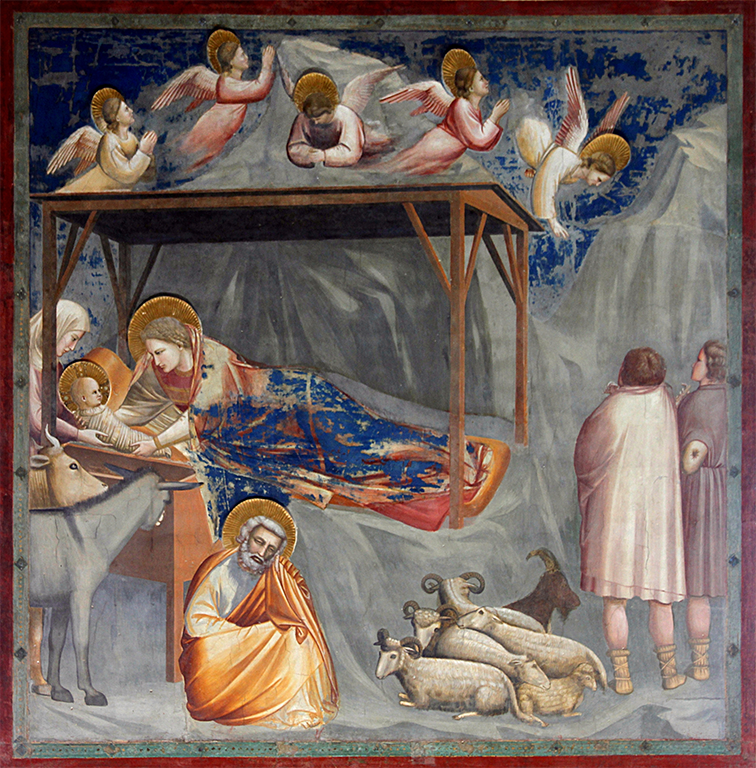
And what has all this to do with the nativity scene? Everything — and not because of perspective. Giotto’s great revolution was not technical but one of mentality: he humanised the divine, bringing the sacred figures close to the spectator through emotion and real space. A figurative artistic nativity scene — the kind this series serves — needs exactly the three things Giotto brought: figures that feel — a mother and a father who look tenderly at their son, shepherds who express astonishment and devotion: persons, not icons; a believable space — a cave, a stable, a landscape that the spectator recognises as real and can inhabit with the gaze; and a composition that narrates — that guides the eye so that the story of the Nativity comes to life. That plastic humanisation runs parallel to the one Saint Francis had sought at Greccio by way of devotion — the case of Greccio, with its exact documentary size and its nuances, is judged in its own chapter: Making the memory present with the eyes of the body; to Giotto, incidentally, the fresco of that scene in Assisi is traditionally attributed. Of that double impulse — the devotional and the plastic — figurative nativity art is the direct heir.
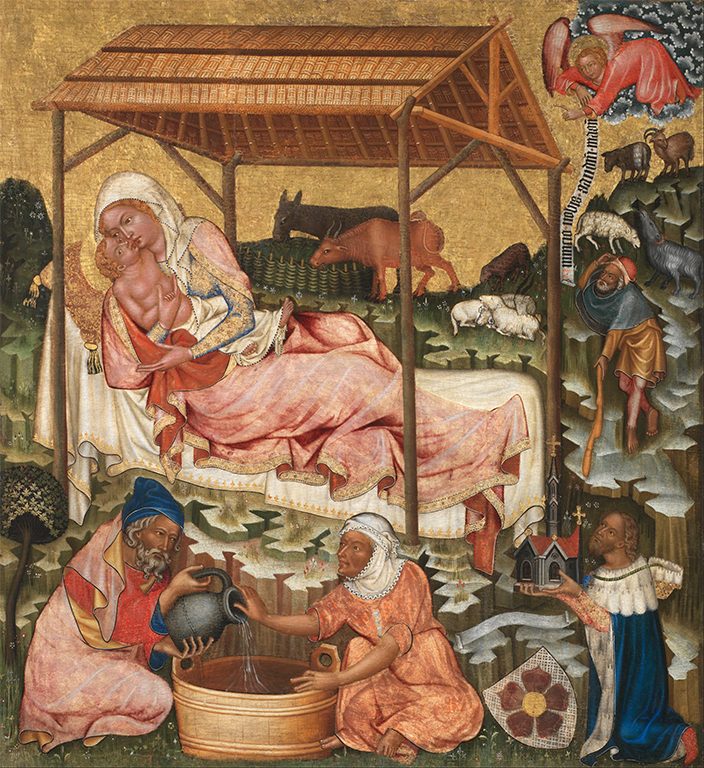
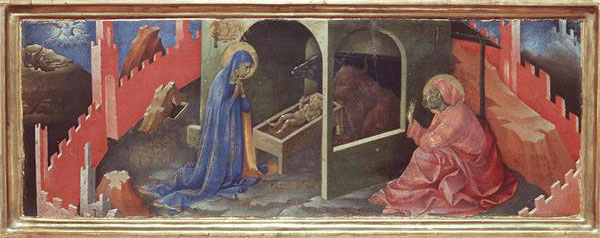
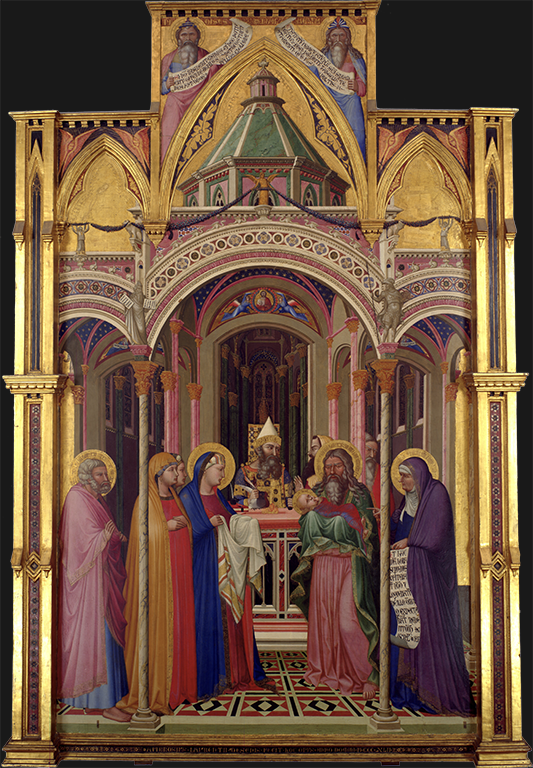
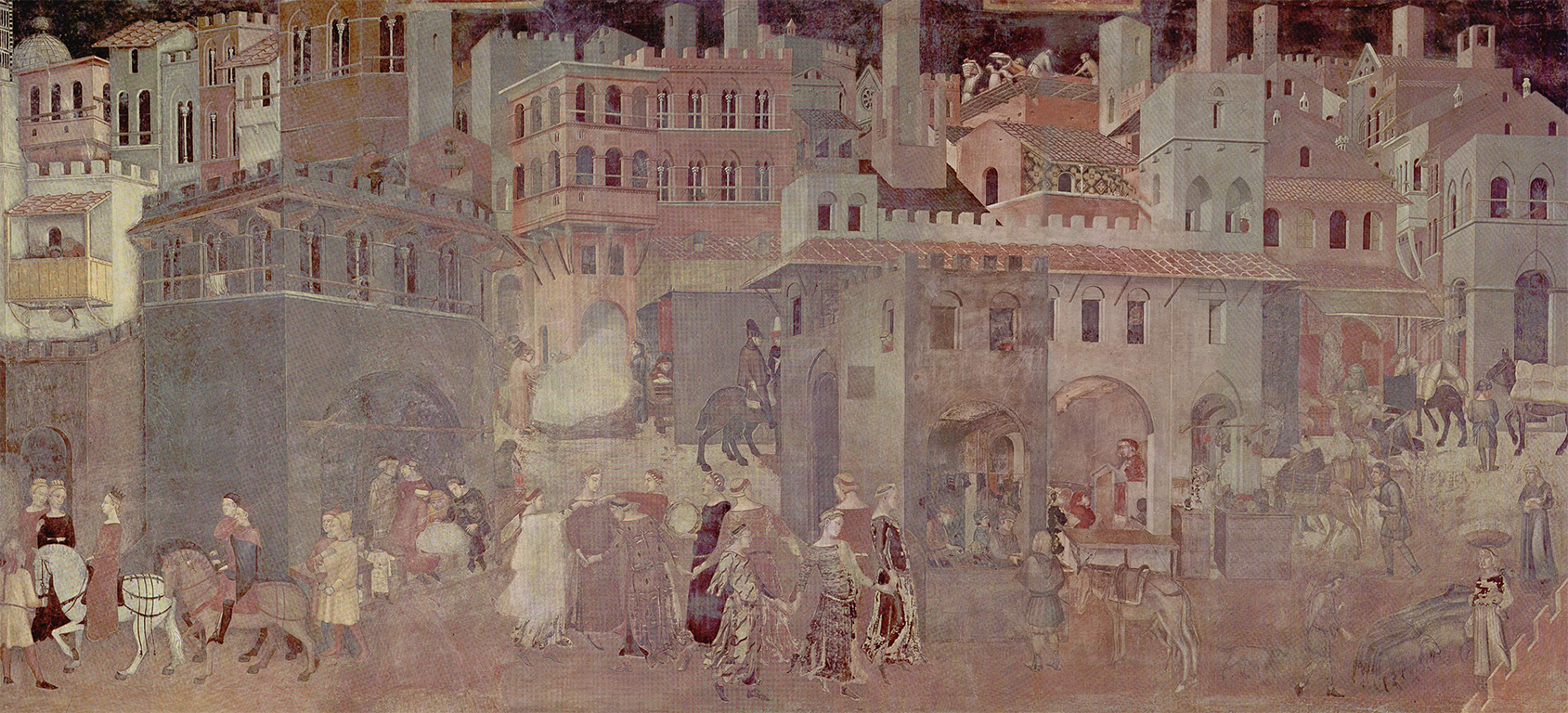
After Giotto, others continued the search and prepared the leap. The Master of Vyšší Brod (Bohemia, c. 1350) showed in his Nativity a space still hierarchical but more integrated. Lorenzo Monaco (c. 1390) tried out architecture that suggested depth and a new sensitivity to light. And Ambrogio Lorenzetti, in The Presentation in the Temple (1342), made the lines of the marble pavement and the bases of the columns converge towards a central point — the lines do not align perfectly, but the experiment is conscious: to unify the scene in a single architectural setting. One step away by now, although nobody knew it, from the revolution.16
Closing: the problem had been posed
Thirty thousand years of solutions, and still no system. Prehistory gave the elementary gestures — overlapping, diminishing; Egypt, chosen clarity — and the proof that every convention serves something; Greece, the stage and its principle — convincing before measuring; Rome, domestic illusionism and the first painted air; the Middle Ages, the demonstration on three continents that there are many possible spaces; and Giotto, the need — painted worlds so credible that they were already crying out for a geometry to hold them up. That geometry arrived. It has first names, surnames and even an experiment with a mirror in a square in Florence; it changed painting, architecture and — with five centuries of patience — the nativity scene too. It is the next chapter: the Quattrocento, or perspective made science.
References
The footnotes locate; they do not argue.
SANTAYANA, George (Madrid, 1863 – Rome, 1952). The Life of Reason: or, The Phases of Human Progress, vol. I: Reason in Common Sense, New York, Charles Scribner’s Sons, 1905. — Philosopher and writer; professor at Harvard; member of the American Academy of Arts and Letters and of the Phi Beta Kappa Society. He enters for the quotation on retentiveness, restored to its context. Wording and page (284) according to the Santayana Edition (Indiana University). Supporting source.
VITRUVIUS (1st c. BC). De architectura, VII, preface, 11. — Roman architect and engineer; the only ancient architectural treatise preserved complete. Primary source for Agatharchus, Aeschylus and the commentarius, and for Democritus and Anaxagoras. Read in Morgan’s English translation (Lexundria), accessed 10 August 2026. Central source of the Greek section.
EUCLID (fl. c. 300 BC). Optics. — The mathematician of the Elements; perceived size as a function of distance. Definition 4 and proposition 8, according to Heath’s summary (1921); English translation by Burton (1945). Supporting source.
Flamm, M. C., «George Santayana (1863-1952)», Internet Encyclopedia of Philosophy (iep.utm.edu/santayan), accessed 28 November 2026: born in Madrid on 16 December 1863, died in Rome in September 1952, and taught philosophy at Harvard from 1889 to 1912. ↩
Santayana, G., The Life of Reason, vol. I, Reason in Common Sense, Charles Scribner’s Sons, New York, 1905, p. 284. ↩
Ministère de la Culture (France), «Datation des figures de Lascaux» (archeologie.culture.gouv.fr/lascaux), accessed 28 November 2026: the first radiocarbon datings gave 17,190 ± 140 BP; the conclusion the page now gives places the frequentation of the cave between 21,500 and 21,000 years before present. ↩
Aristotle, Poetics, 1450a (the six parts of tragedy: plot, characters, diction, thought, spectacle and song) and 1450b (spectacle, the part most foreign to the art of poetry); trans. W. H. Fyfe, Perseus Digital Library, accessed 28 November 2026. ↩
Vitruvius, De arch. VII, praef. 11 (trans. Morgan): «Agatharcus, in Athens, when Aeschylus was bringing out a tragedy, painted a scene, and left a commentary about it. This led Democritus and Anaxagoras to write on the same subject…»; Lexundria, accessed 10 August 2026. The status of the lost commentary as the «first text on perspective» is a modern reading and is presented as such. ↩
Ancient tradition links skiagraphia to Apollodorus of Athens, nicknamed «Skiagraphos». ↩
Euclid, Optics, definition 4 (what is seen under a larger angle appears larger) and proposition 8; summarised in Heath, T. L., A History of Greek Mathematics, vol. I, Clarendon Press, Oxford, 1921, p. 442. English translation: Burton, H. E., «The Optics of Euclid», Journal of the Optical Society of America, 35 (1945), pp. 357-372. ↩
The classification of Roman wall painting into four styles comes from August Mau. ↩
The Metropolitan Museum of Art, New York, Cubiculum (bedroom) from the Villa of P. Fannius Synistor at Boscoreale, c. 50-40 BC, fresco, inv. 03.14.13a–g (Rogers Fund, 1903); metmuseum.org, accessed 28 November 2026. ↩
Ministero della Cultura (Italy), «Villa di Livia» (cultura.gov.it/luogo/villa-di-livia), accessed 28 November 2026: the garden paintings were detached in 1951 and are exhibited in the Palazzo Massimo alle Terme (Museo Nazionale Romano). The development of atmospheric perspective belongs to a later chapter of this series. ↩
Classic study of the question: Pavel Florensky, Reverse Perspective. ↩
Water Mill, by Wei Xian (Five Dynasties, 907-960), Shanghai Museum; 53.2 × 119.3 cm. ↩
Museu Nacional d’Art de Catalunya, Barcelona, Master of Taüll, Absis de Sant Climent de Taüll, c. 1123, 620 × 360 × 180 cm, inv. 015966-000; museunacional.cat, accessed 28 November 2026. ↩
The dating of the Scrovegni cycle (c. 1303-1305) is the standard one and has already been checked in this Manual: Is nativity-scene making an art?, note 6. ↩
The analysis of the two sets of receding lines in Christ before Caiaphas is the Manual’s own, with its diagram of lines over the fresco; the reading as proto-perspective is presented as visual analysis, not as a quotation of authority. ↩
Master of Vyšší Brod (National Gallery, Prague), Lorenzo Monaco (Museo di San Marco, Florence), Ambrogio Lorenzetti (Presentation in the Temple, 1342; Allegory of Good Government, Palazzo Pubblico, Siena). ↩