
 ≈ 48 min

In a square in Florence, an architect painted a panel, bored a hole in it and looked at it against a mirror. That day perspective ceased to be a workshop secret.
Two roads to the same illusion
At the beginning of the 15th century, European artists had to solve one and the same problem: how to create the illusion of three dimensions on a flat surface. The answer was not a single one. Two ways of looking arose, born in different cultural contexts but with a shared aim: to turn painting into a believable window onto reality — a challenge that, centuries later, those of us who build coherent worlds in miniature still face.
In Italy — and in Florence in particular — perspective was conceived as a form of science and reason: in the hands of Brunelleschi, Masolino, Masaccio and Alberti, geometry and mathematics became the basis of a linear system that organised space around a vanishing point. In Flanders — the Low Countries and present-day Belgium — the road was another: painters such as Jan van Eyck did not start from geometry but from observation: an optical and atmospheric perspective, based on light, reflections and minute detail — closer to the eye than to the ruler.
These two processes should not be understood as successive stages — first Italy, then Flanders — but as simultaneous and complementary answers to the same visual challenge.
The scenographic synthesis: reason and sensibility for the nativity-scene maker
In the end, what we nativity-scene makers seek is to create a nativity scene that conveys depth and visual truth, capable of moving through its scenography. That is why it is so valuable to know both traditions: the geometric precision of Italy and the optical sensibility of Flanders. Fused, they offer the nativity-scene maker a complete visual language, in which the ruler — or the thread that traces the receding lines — and the eye join forces to give life to the sacred space of the nativity scene. Whoever has only the ruler builds models that are exact and cold; whoever has only the eye, warm scenes that go askew. The craft asks for both hands.
Let us begin, then, with Italy. It was there, in the heart of the Florentine Renaissance, that perspective ceased to be a workshop secret and became a science, and the cornerstone of every scenography that aspires to combine emotion, order and depth. The second road — Flanders, and everything that came after 1435 — is travelled in the next chapter.
The criterion of chronology
This chapter concentrates on the first works made before 1435 — the year in which Leon Battista Alberti published his treatise De pictura and turned the workshop secret into written theory. Until then, linear perspective was handed on orally and in practice, circulating among the architects, sculptors and painters of the Florentine milieu.
The order followed will not be biographical, but that of the works in which one-point linear perspective appears clearly — so that it can be observed, step by step, how the new science of space takes hold.
Florence: perspective as science — and the artist as thinker
In 15th-century Florence, the Renaissance opened a new horizon. Linear perspective ceased to be an isolated device, based on practice and intuition, and began to be understood as a scientific language grounded in optics, geometry and mathematics. The process was gradual — there were pioneers, there was resistance, and for decades the new vision lived alongside the forms inherited from the medieval world. It was not only a technical discovery: it was a change in the way of looking — space ordered according to precise, rational and verifiable rules.
And it brought a social consequence that this Manual already knows from another chapter: by being founded on measurable and demonstrable principles, painting, sculpture and architecture ceased to be regarded as mere manual trades and claimed to be applied sciences — and the artist ceased to be only an «artisan» executor and presented himself as a thinker capable of conceiving and demonstrating visual ideas. It is the same movement in the status of the trades that was told when the pigeonhole of the «popular» and the «artistic» was taken apart (The story of a half-finished reading): the frontier between art and craft is a convention with a history, and here it can be seen moving in real time — with perspective as the lever.
The consolidation was the work of a chain of names that this chapter and the next will introduce one by one: Brunelleschi, who discovered the principle empirically; Masolino and Donatello, pioneers in applying it to painting and sculpture; Masaccio, who took it to an unprecedented narrative force; and afterwards — in the next chapter — Alberti, who set it down in writing, Piero della Francesca, Leonardo and the others, up to the synthesis of Raphael.
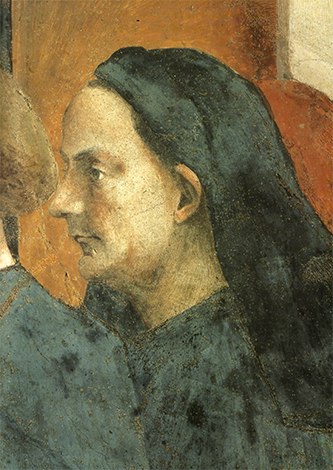
Filippo Brunelleschi and the discovery
Filippo Brunelleschi (Florence, 1377-1446) had trained as a goldsmith before becoming an architect, engineer and sculptor — a workshop profile, not a university one. At the beginning of the 15th century he carried out the experiments that established him as the discoverer of linear perspective: until that moment, painters such as Giotto, Duccio or Lorenzetti had tried out spatial approximations — the previous chapter went through them — but without a scientific basis or systematic use of the vanishing point.
The scientific roots: from Alhazen to Brunelleschi
The discovery did not come out of nothing, and its genealogy deserves to be told because it is one of the great journeys of knowledge. Centuries earlier, the Arab scientist Ibn al-Haytham — known in the West as Alhazen (c. 965 - c. 1040) — had formulated in his Book of Optics (1011-1021) a revolutionary theory: vision occurs because light enters the eye in straight lines — not, as was believed, because the eye emits rays towards things. Translated into Latin as De aspectibus, that book legitimised something enormous: if light travels in straight lines to the eye, the visible world can be represented geometrically.1
Alhazen’s ideas reached Europe through medieval thinkers such as Roger Bacon (c. 1220-1292) — the Oxford Franciscan who defended experimental science — and Witelo (c. 1230 - 1280/1314?), author of an influential Perspectiva that not only systematised Alhazen’s optics, but added reflections on the psychology of vision — association of ideas, perception, memory — and on light as divine emanation, in tune with medieval Platonism.2
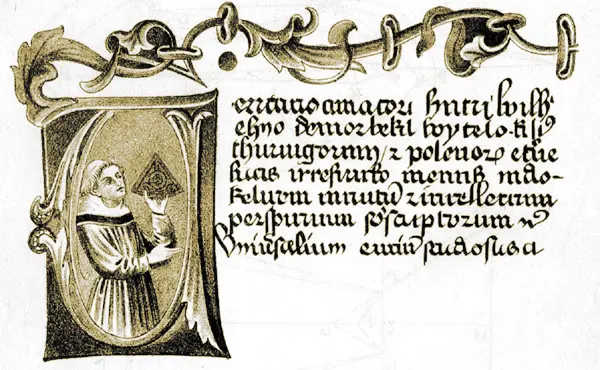
How do we know that these ideas circulated in Brunelleschi’s milieu, if he left no writings? Through an exceptional witness: Lorenzo Ghiberti — the sculptor of the Baptistery doors, Brunelleschi’s rival and contemporary — who in his Commentario terzo (1452-1455) expressly cites Alhazen, Ptolemy and Bacon when giving visual art a theoretical foundation. The scientific background was present and active in the Florentine workshop.4
The experiments with the small panels
Around 1415 — the date is the conventional one among historians — Brunelleschi painted two small panels that have been lost. We know them through a single testimony: that of Antonio Manetti (Florence, 1423-1497), a mathematician, architect and writer who knew Brunelleschi in life and devoted to him the biography Vita di Filippo Brunelleschi. As it is a single source — and that of an admirer — historiography reads it with caution; so does this Manual.5 The first showed the Baptistery of San Giovanni seen from the door of the cathedral. And here comes the genius of the experiment: Brunelleschi bored a hole in the panel, exactly at the point of sight from which he had painted it; the spectator had to look through the hole, from behind the panel, towards a mirror held opposite — and what was seen reflected, the painting, coincided exactly with the real view of the building if the mirror was moved away. The demonstration was irrefutable: all receding parallel lines converge towards a single point — the vanishing point — and a painting built on that law takes the place of reality for an eye set in the right spot. The second panel showed the square of the Palazzo della Signoria, with the outline of the buildings cut out so as to compare them directly against reality.
«La prospettiva - Brunelleschi e la prospettiva centrale», Raffaella Arpiani - Arte essenziale channel, in Italian. Hosted on YouTube. To watch it, open the cookie settings and allow audiovisual content.
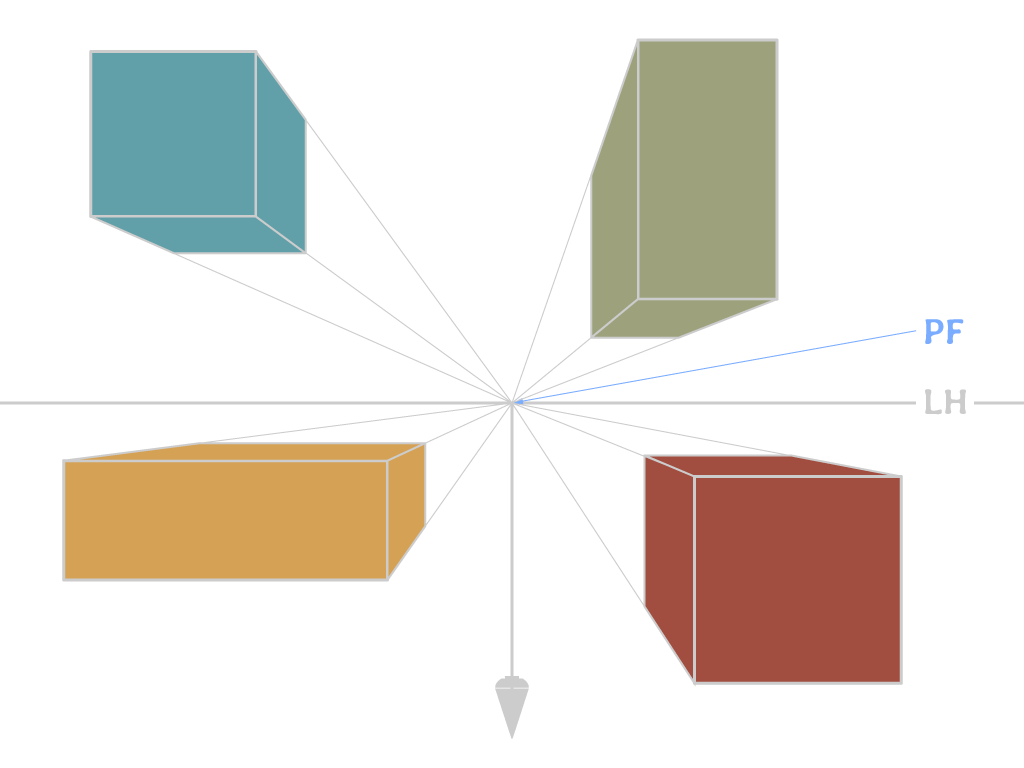
What this leaves on the nativity-scene maker’s table. More than it seems at first sight, because Brunelleschi’s panel is — look at it closely — a demonstration diorama: a single viewpoint, physically fixed by a hole; an image built for that eye and for that eye alone; and even a sheet of glass in front — the mirror — between the observer and the illusion. The viewing aperture of the proscenium opening, the scene composed for a single place, the glass of the diorama: everything is already in that experiment of 1415. The maker of single-framing nativity scenes does not descend from easel painting — they descend from this small panel.
Architecture as laboratory
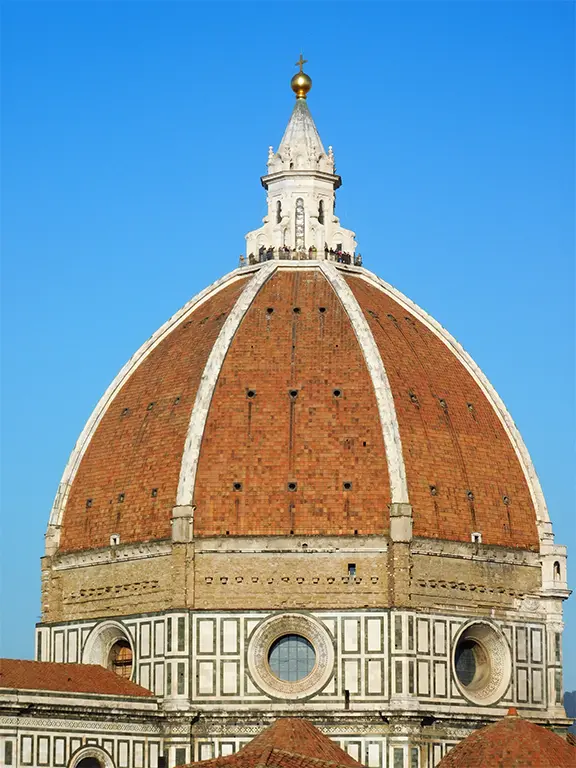
Brunelleschi applied the same rules of proportion in his built work: for him, the building had to be conceived from the spectator’s vision. His dome of Santa Maria del Fiore — the technical marvel that crowns Florence — is also a visual manifesto of harmony and proportion: architecture turned into a laboratory of perspective, where the laws of drawing were translated into real construction.
Before 1435: the workshop as school
The Florence of the early Quattrocento was a laboratory of ideas. Architects, sculptors and painters shared spaces, workshops and commissions, and Brunelleschi’s discovery spread by word of mouth, with no need of treatises. Masaccio — a personal friend of Brunelleschi — was part of that milieu later described by Giorgio Vasari (1511-1574), painter and first great historian of art, in his Lives (Le Vite, 1550 and 1568) — a period source rather than an exact chronicle: a portrait of the atmosphere, and it is used as such here; Masolino, Donatello and other artists linked to the church of the Carmine and to the district of San Niccolò Oltrarno also worked in it.6
Perspective had not yet been codified, but it was already the subject of conversation, experiment and informal transmission among colleagues. It was not learned in books: it was learned in the workshop, with hands and eyes. A knowledge shared in the doing, proper to a community that, without fully knowing it, was inventing a new way of seeing.
What this leaves on the table. A mirror of the craft itself: for twenty years perspective was handed on exactly as nativity-scene knowledge is handed on today — in the workshop and in the association, by word of mouth, watching someone else work. The treatises came afterwards; shared practice came first. Whoever has learned to fit a sky backdrop by watching it done already knows how Florence felt before 1435.
Masolino da Panicale: the transition towards the new way of looking
Masolino da Panicale (1383-1447) represents the moment of transition in person. Older than Masaccio, trained in the elegance of the International Gothic — the courtly style of graceful figures and gold — he was nevertheless one of the first to apply the principles of linear perspective clearly. His work lives at a crossroads: medieval decorative sensibility and the new science of space, together in the same pictures. The reference monograph on the painter is that of Perri Lee Roberts, Masolino da Panicale (Oxford, Clarendon Press, 1993) — the study and catalogue of his complete work — and the biographical data of this chapter are anchored to it.8
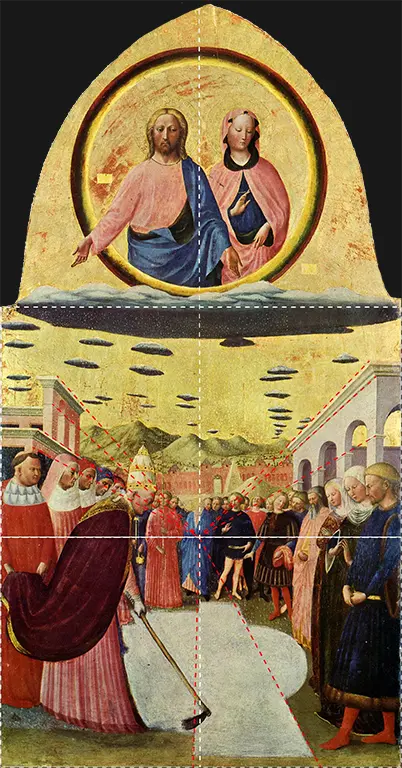
The Founding of Santa Maria Maggiore (c. 1423-1425 or c. 1428-1429)
This panel, painted for the Roman basilica of Santa Maria Maggiore, represents Pope Liberius tracing the plan of the church during the miraculous snowfall that, according to tradition, marked the site in the middle of August in the 4th century. The work was commissioned within the framework of the urban restoration of Pope Martin V, after the end of the Schism. Its date is not settled. Masolino was in Hungary between September 1425 and the summer of 1427, so that the panel is either earlier than that journey or later than it: Joannides and Roberts place it in Florence around 1423-1425; the catalogue of the National Gallery in London, which holds other panels from the same altarpiece, around 1428-1429.
Masolino composes the scene by making the architectural lines converge towards a central vanishing point with remarkable precision — if the early date is the right one, it would be one of the first conscious applications of the principle in Italian painting; if the late one is, it comes after Masaccio’s Trinity. And at the same time he keeps the Gothic devices: stylised figures, ornament. The organisation of the space already obeys the new logic; the skin is still the old one.9
The Goldman Annunciation (1424): the painted proscenium opening
The so-called Goldman Annunciation, kept in the National Gallery of Art in Washington, is one of the most sophisticated experiments in architectural perspective of the early Quattrocento — the first edition of this Manual gave it as signed and dated on the original frame; that point remains to be checked against the NGA’s record.10
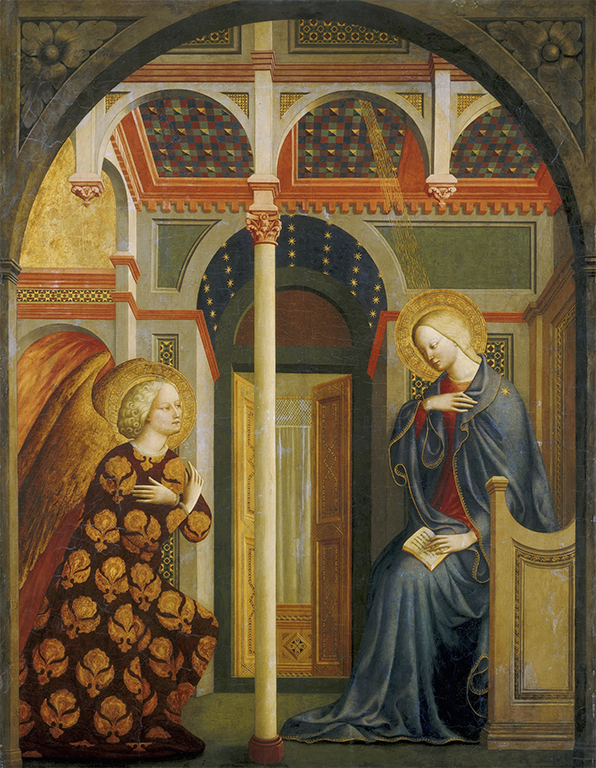
Masolino places the vanishing point very low, obliging the spectator to look at the scene as if it were on a higher plane. The architecture is presented open at the front — it is seen from the other side of the arch, as through a theatrical proscenium opening: the scene is not contemplated as a picture, but as an intimate, raised enclosure into which the eye looks. The reader of this Manual will recognise the operation at once: it is the logic of the diorama — the box closed on three sides that opens on the fourth (A question of framing) — painted five hundred years before nativity-scene making built it in cork.
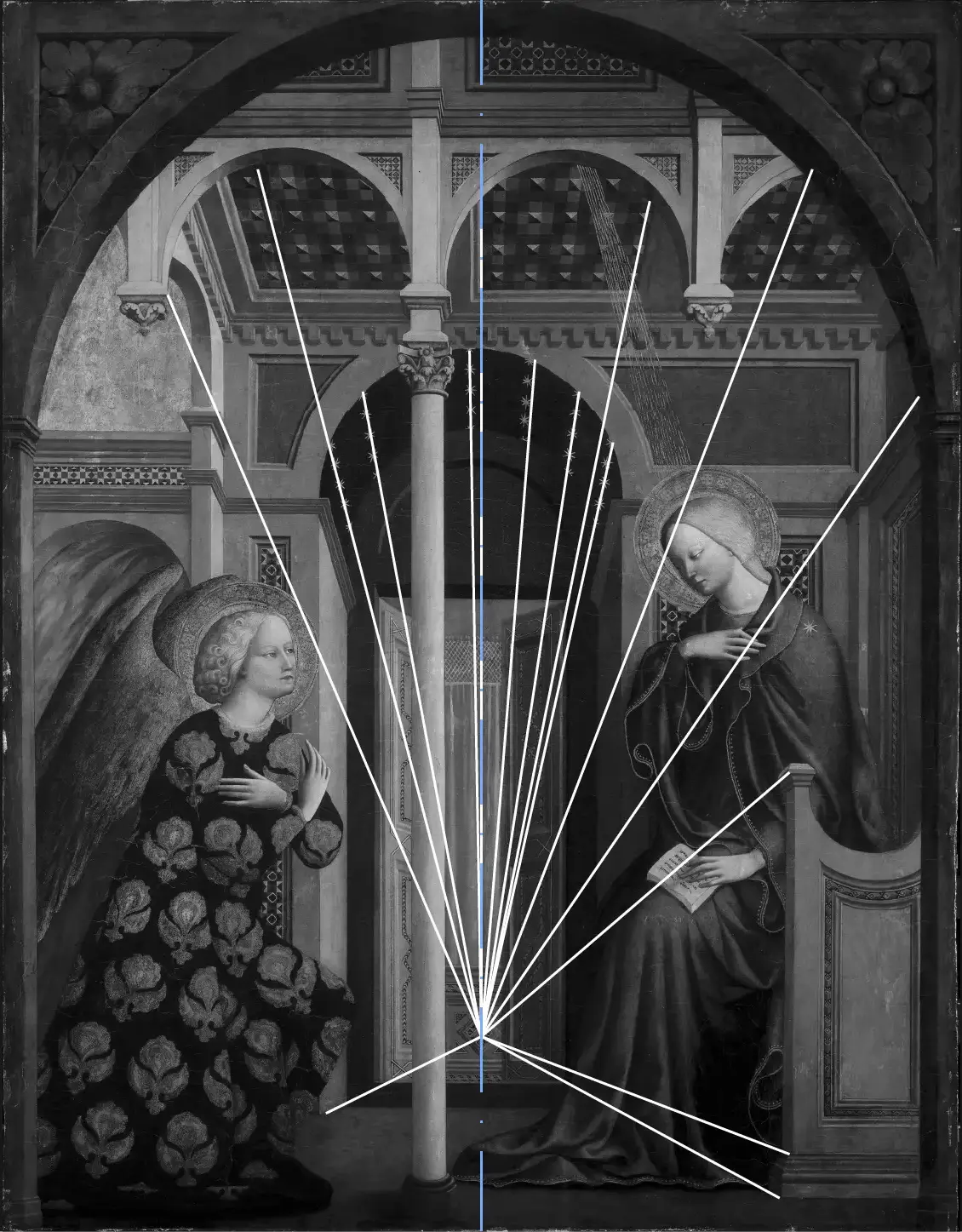
And there is a technical decision that teaches how to compose: from so low a horizon, including a receding paved floor would have forced the composition or made the ground incoherent. Masolino, instead of fighting with it, dispenses with the floor as the leading surface and turns the coffered ceiling into the support of the spatial demonstration — the gaze does not fall towards a lower recession: it rises towards the architecture that shelters the scene. Where the system got in the way, he chose; and his choice served the meaning.
The Solomon’s knot at the vanishing point
In the visual depth of the picture — at its exact geometric centre — Masolino painted something more. In the Quattrocento, the vanishing point was not a mere technical device: it was the invisible nucleus that organised the whole space. By placing there a Solomon’s knot — a motif of two interlaced loops without beginning or end, an ancient symbol of wisdom, prestige and geometric perfection — Masolino turns the mathematical solution into a visible emblem: he does not merely apply the technique — he states it. He marks the centre of the system with a sign that speaks of unity and eternity: faith, reason and beauty knotted at the point where all the lines converge.11
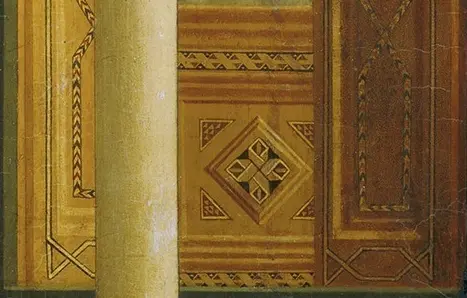
The first edition of this Manual considered it an exceptional case — no other painter of the Quattrocento would place an allegorical motif so clearly right at the vanishing point; the statement is kept here as an observation of the Manual, pending comparison with the specialist literature on Masolino — the first candidate for that comparison is C. Tyler’s studies of Masolino’s perspective, kept in the archive of this Manual.11
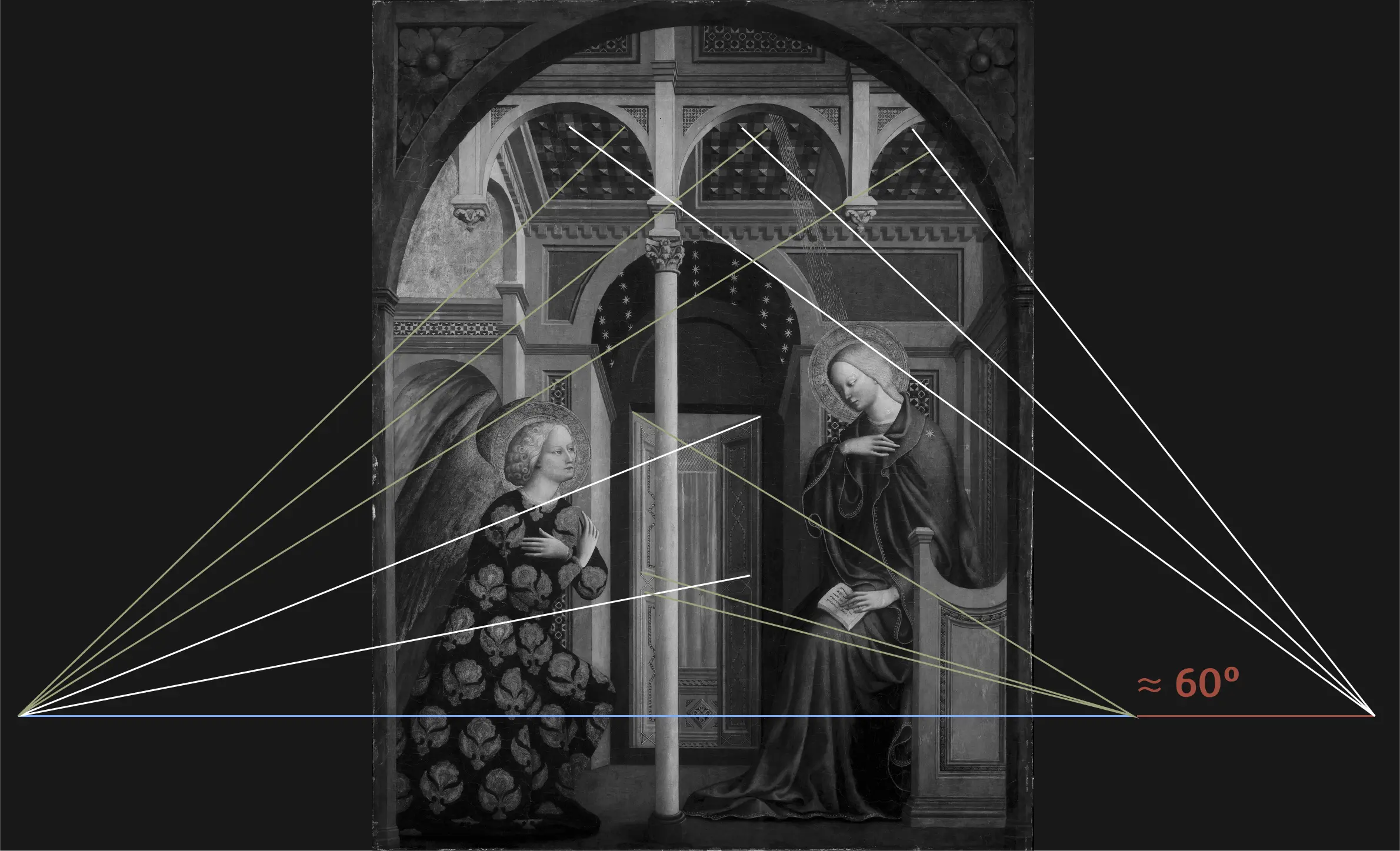
The precision is surprising in a painter trained in the Gothic: the obliques rigorously fulfil the logic of central perspective, and even the doors opened at different angles obey a geometric coherence uncommon in his time. Brunelleschi had conceived scientific demonstrations — exact panels that were not works of art; Masolino takes that theory and turns it into emotional experience: the spectator does not analyse the perspective — they feel it, as if they could enter the space. It is the dimension of trompe-l’œil — painting that deceives the eye by creating an illusion of reality — placed at the service of a sacred narrative. And there is one condition for the effect to burst forth, which the nativity-scene maker should underline: contemplating the panel with the horizon line at the level of one’s own eyes. That principle — making the horizon of the work coincide with that of the observer — will reappear as a cornerstone when this series reaches the practice of the diorama.
Masolino and Masaccio: a dialogue in the Brancacci Chapel
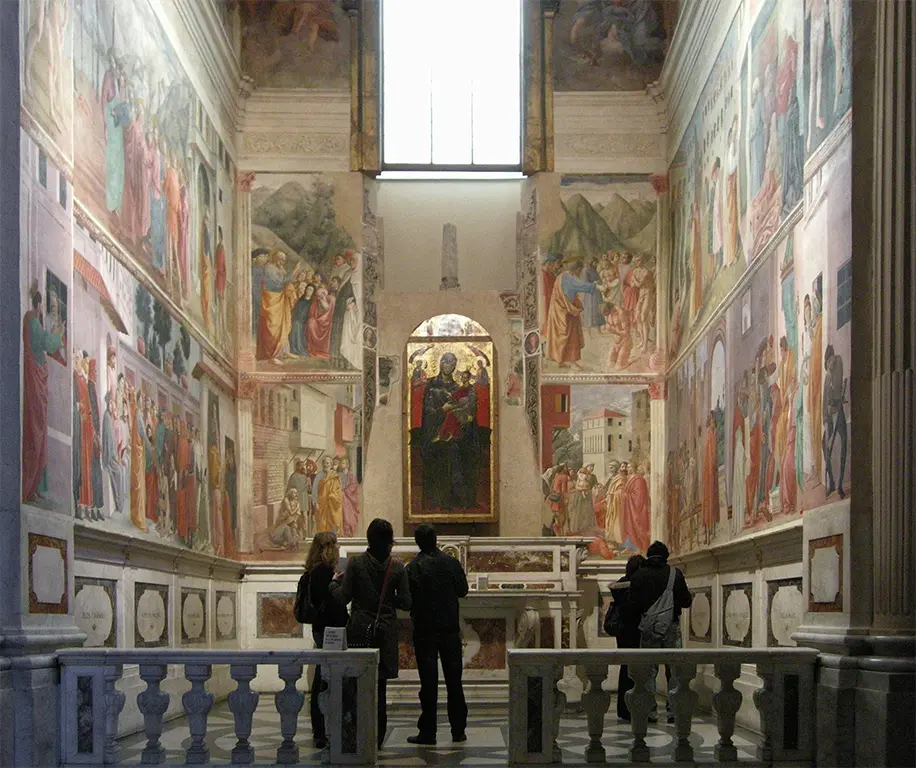
The patron of the decoration was Felice Brancacci, a prosperous silk merchant and diplomat in Cairo, who on his return in 1423 decided to adorn his family chapel in the Carmine. In 1424 he engaged Masolino, who was then collaborating with the young Masaccio, eighteen years his junior. The data on the patronage come from the classic study by Anthony Molho, «The Brancacci Chapel: Studies in Its Iconography and History», Journal of the Warburg and Courtauld Institutes, 40 (1977); the comprehensive monograph on the chapel — with the restoration of 1984-1990 that recovered its colours — is that of Umberto Baldini and Ornella Casazza, La Cappella Brancacci (1990; English edition: The Brancacci Chapel, New York, Abrams).12
For a long time it was believed that Masaccio was Masolino’s pupil; today it is known that this was not so. From 1422, Masaccio was registered as an independent master in the painters' guild — the Arte de' Medici e Speziali — and received commissions on his own account; the studies suggest that around 1423 the two shared a common bottega, as partners rather than as master and apprentice — the documentation and the relationship between the two painters are set out in the catalogue by Paul Joannides, Masaccio and Masolino: A Complete Catalogue (London, Phaidon, 1993), this Manual’s reference for the pair.13 From that collaboration came the Sant’Anna Metterza and the Brancacci cycle. Their artistic dialogue has one trait essential to this chapter: both applied frontal linear perspective — and each made it say different things. In spite of the difference in styles — Masolino still with a Gothic air; Masaccio with an unprecedented monumentality and drama — what follows concentrates exclusively on the use of perspective.
Masolino in the Brancacci: a convincing but scattered space
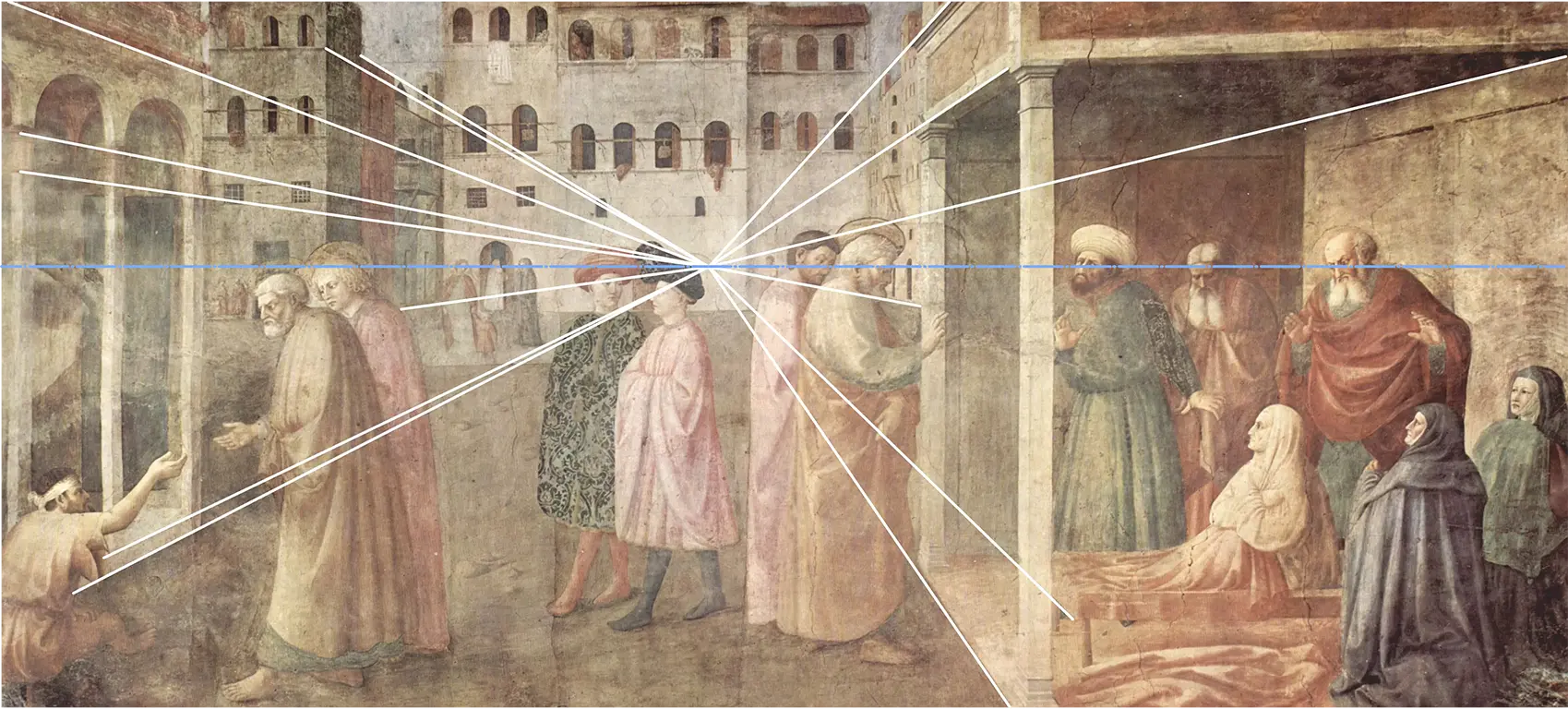
In the Healing of the Cripple and Raising of Tabitha, Masolino adopts the rules of frontal linear perspective and builds one of the most coherent urban spaces of his time: the square, the façades and the side street obey a well-defined geometric structure. But the scene is presented fragmented: several actions live together in the same frame, and a multitude of details — hanging objects, animals, passers-by — enrich the whole and at the same time divert attention. Perspective works here as a credible stage; not yet as a narrative language.
Masaccio: the vanishing point as narrative key
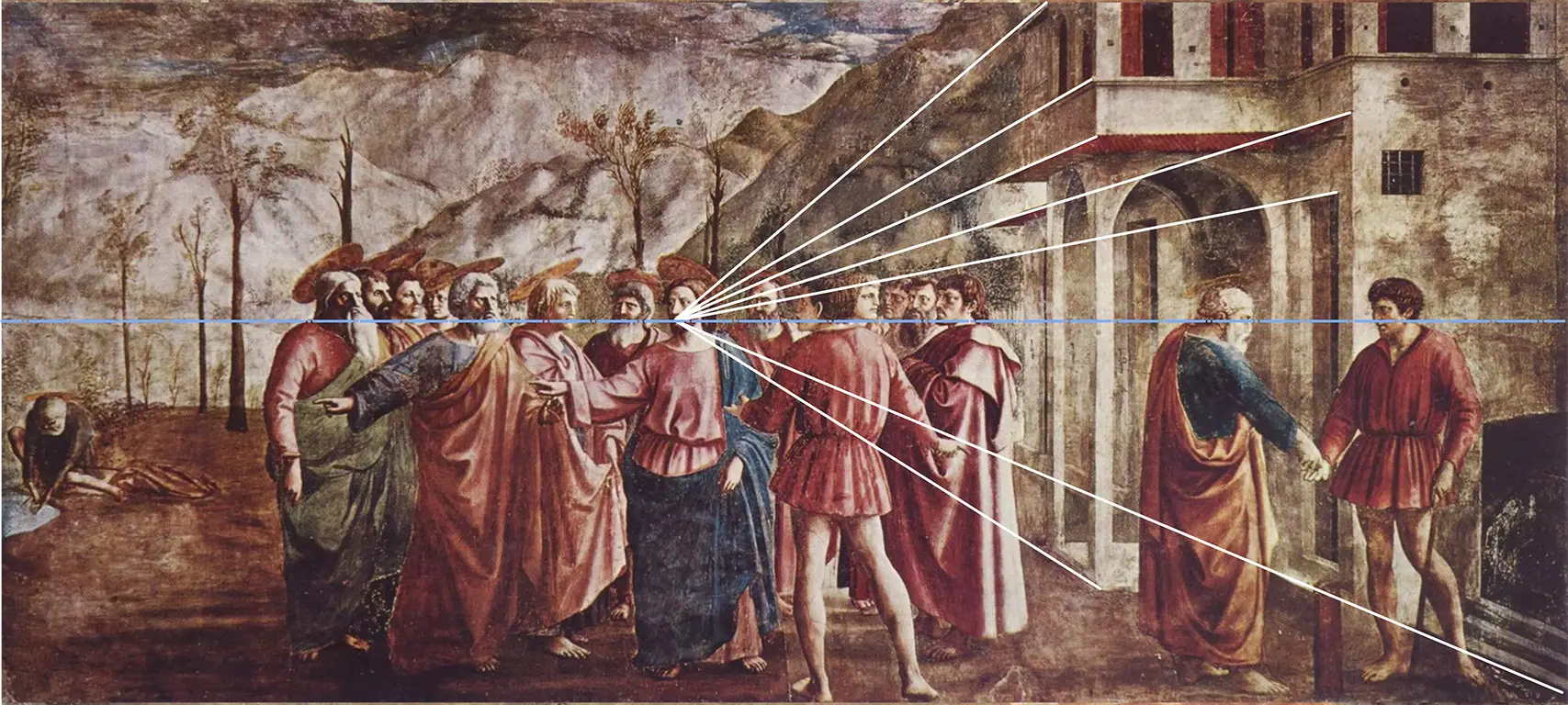
Masaccio takes the step that was missing. In his famous Tribute Money, the vanishing point becomes the structural axis of the scene — and he places it nowhere less than on the mouth of Christ, from which the Word issues. The location comes from this Manual’s own construction lines: over the fresco, the fine receding lines — drawn with the skill of technical drawing — converge on the mouth, on the horizon line that passes through the faces; the image above shows it. The popularising analysis of Smarthistory — the art historians Beth Harris and Steven Zucker — agrees on the essential: «Christ is the vanishing point». But it puts it generically at the head, with arrows too thick to locate anything — and this is not a matter of refining a detail. In a work that is pure composition, the vanishing point is the principal point — the whole system converges on it — and that point is the mouth: the place of the Word, which is the subject of the work. To overlook it is no minor oversight: it is to describe the picture while skipping what it was composed for. Where the fine construction and the popularising description differ, this Manual keeps to its construction.14 The geometric centre coincides with the theological centre: the whole space — and with it the entire narrative — turns around the teaching of Christ. Perspective ceases to be a technical support and becomes dramatic language and theological sign.
The evolution can be understood on three complementary levels, and it is worth having them in view because they are the three uses this series will go on teaching:
- Perspective as a technical tool: representing three-dimensional space rigorously. - Perspective as a compositional device: structuring the scene, ranking its elements, directing the gaze. - Perspective as symbolic language: concentrating meaning on a precise point — as Masaccio does on the mouth of Christ, as Masolino does on the Solomon’s knot.
Brunelleschi had demonstrated the laws with rigorous method — but his experiment was visual science, not art. The transformation happened when Masaccio and Masolino took the system into the territory of narrative: for them perspective was not a cold calculation, but a way of signifying. Geometry became language, and the vanishing point passed from construction tool to visual centre of thought.
What this leaves on the nativity-scene maker’s table. A question that no technical handbook asks and this one does: where do you put your vanishing point — and what does that place say? If the whole space of the diorama converges towards one point, that point carries weight: it may fall on the manger, on a lit doorway, on the emptiness of a road. Masaccio taught that the choice is not technical but one of meaning — the vanishing point says what matters. It is perspective as a compositional and symbolic device: the two layers that separate a correct model from a scene that says something.
Donatello and the Feast of Herod: perspective enters sculpture
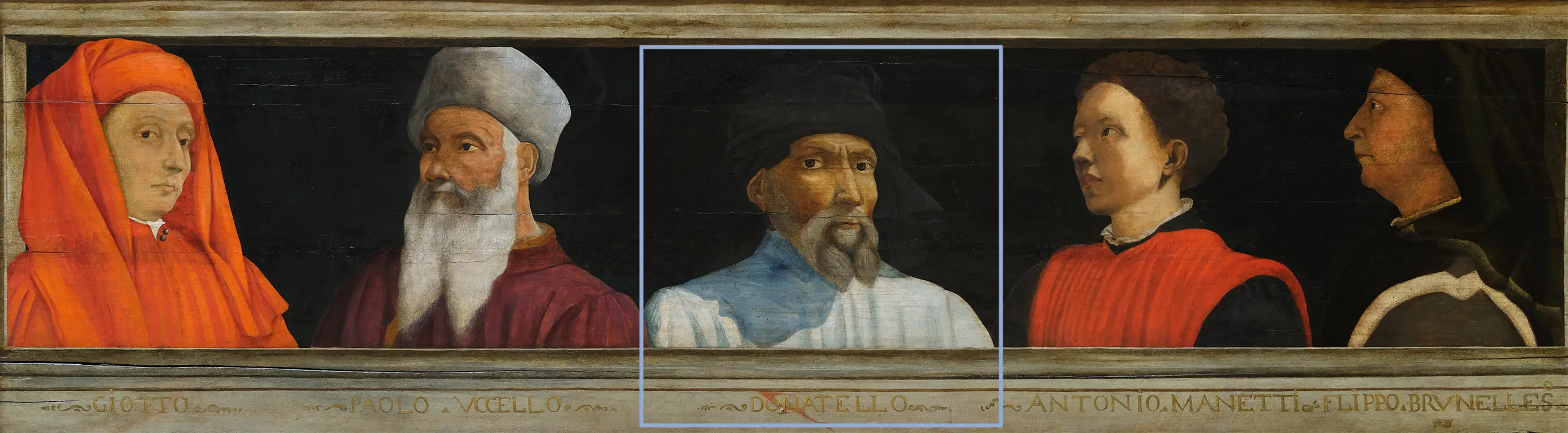
Donatello — Donato di Niccolò di Betto Bardi (c. 1386-1466), the great sculptor of the early Renaissance and a friend of Brunelleschi — made for the baptismal font of the Siena Baptistery his first bronze relief: the Feast of Herod (c. 1423-1427), within a programme initially commissioned from Jacopo della Quercia — the advance payment is of 1423; the delivery, of 1427. It is a key work twice over: for the history of sculpture and for that of perspective — because it shows that the new system was not a matter for painters alone. The data on the Sienese programme come from the monograph by the art historian Rolf C. Wirtz, Donatello, 1386-1466 (Könemann, 2000).15
The geometric system
In barely 60 × 61 cm, Donatello built a convincing three-dimensional space by rigorously applying one-point perspective — transferring to sculpture the principles his friend had formulated.
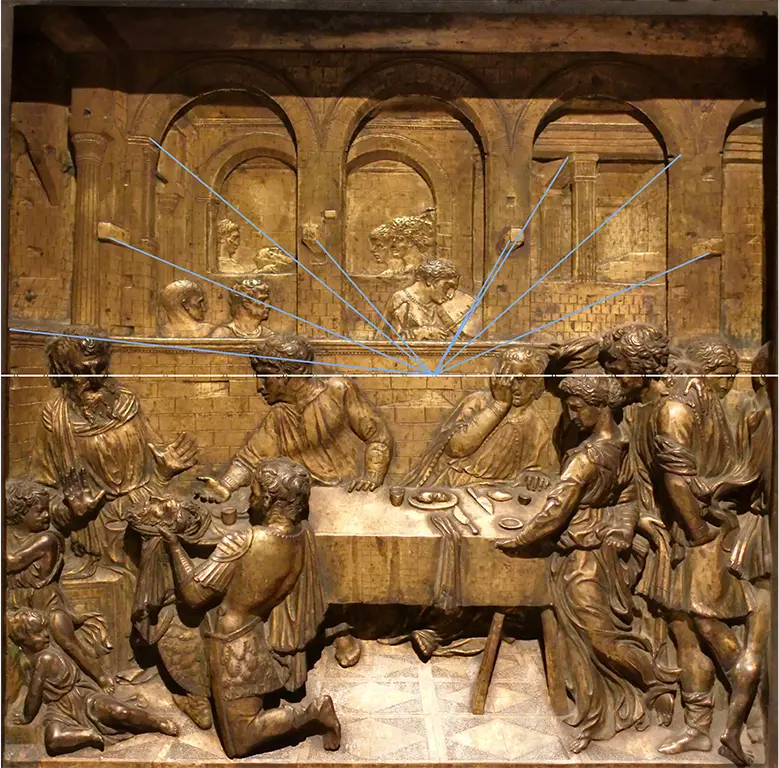
The chequered pavement contracts towards that point, acting as the demonstrative surface of the new system — the gridded floor will be, throughout the century, perspective’s favourite test bench. And fine analysis reveals a nuance that teaches: the vanishing point of the pavement is slightly displaced from that of the arcades — about 3.9 cm along the horizon line, as the first edition of this Manual measured on the diagram. It is not an error: it is a decision to balance the composition and harmonise vision with narrative.
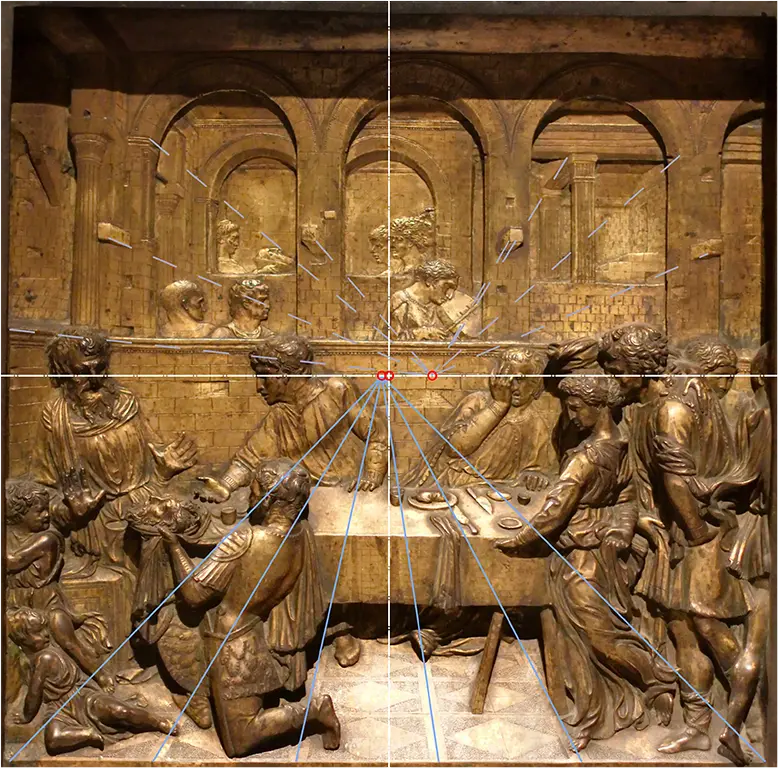
The architecture — round arches, columns, axial arrangement — evokes a Roman interior and modulates depth through the proportional reduction of the elements.
Stiacciato: perspective made relief
Donatello’s genius lies in combining a structure conceived for flat surfaces — linear perspective — with a medium that has real volume: relief. The fusion takes shape in stiacciato — «flattened» — the technique that models the volumes in decreasing levels of depth: in the foreground, figures in high relief — Herod, the guests, the servant with the head of the Baptist; in the middle ground, musicians and witnesses in lower relief, articulating the transition; at the back, architecture and episodes barely hinted at, like a vision fading away.16
And here the first edition of this Manual made the observation that justifies the whole chapter, and it is kept in its full force: does this not follow, in essence, the same principle as a single-viewpoint nativity diorama? A succession of planes — a volumetric foreground, modulated middle planes, an almost evanescent background. Only that in Donatello it is not three-dimensional scenography, but compressed relief with astonishing visual depth. The diorama and stiacciato are the same idea travelled in opposite directions: relief compresses the world towards the plane; the diorama expands the plane towards the world. Whoever understands one understands the other.
Perspective in the service of the story
Donatello does not merely represent space: he uses it as a dramatic tool. The central void — the table top and the cleared grid — draws the eye towards the back, contrasting geometric calm with the tension of the foreground. And in one and the same frame two episodes follow one another: at the back, the execution of John; in front, the presentation of the head and Herod’s horror — the continuous narrative of medieval origin that this Manual already knows (A question of framing), adapted here to the rational order of Renaissance space.
«Donatello’s Feast of Herod», Smarthistory channel. Hosted on YouTube. To watch it, open the cookie settings and allow audiovisual content.
The Feast of Herod shows that perspective, far from being a mathematical formula, is a visual and narrative tool: first it gives depth, then it structures space, finally it directs meaning. Donatello does not apply a system — he transforms it into art.
Masaccio and The Trinity: the first total application
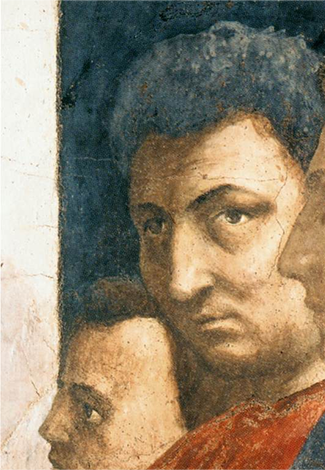
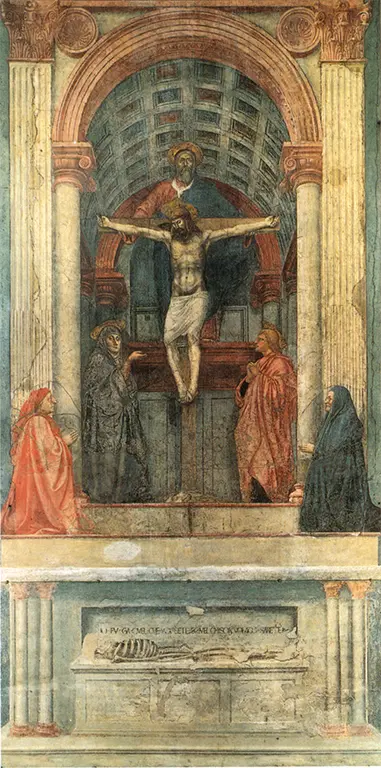
Masaccio was the first painter to transfer Brunelleschi’s laws to the wall with full coherence. A personal friend of the architect — it is believed he consulted him for this work — he painted in Santa Maria Novella in Florence the fresco that historiography regards as the first painting built with complete perspectival exactness: The Trinity (c. 1427). The reference study is the volume edited by Rona Goffen, Masaccio’s ‘Trinity’ (Cambridge University Press, 1998, «Masterpieces of Western Painting» series), which brings together the fundamental analyses of the fresco.17
The system and the illusion
The fundamental achievement is an architectural trompe-l’œil: the illusion of a chapel hollowed out of the wall — a coffered barrel vault, Corinthian columns, Ionic pilasters — where there is only flat wall. Masaccio incised a grid directly into the plaster and applied the laws exactly — even the nails of the cross are drawn with mathematical precision.
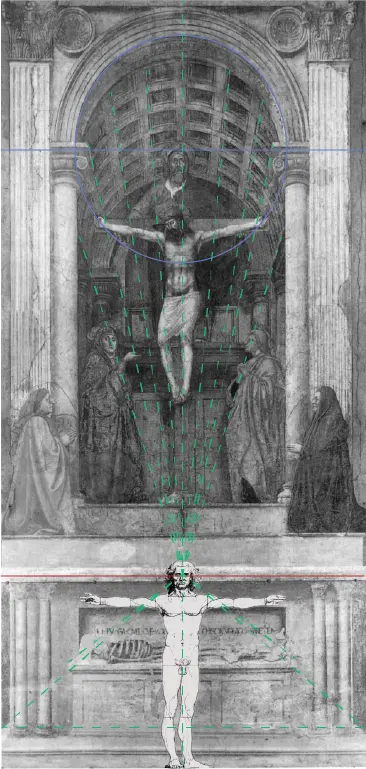
And the key to the effect lies in a decision the nativity-scene maker should look at twice: the vanishing point is placed at the eye level of an adult spectator standing in the nave — on the painted lower step. That is why the wall «disappears»: the geometry of the feigned chapel coincides exactly with what a real eye would see if placed where the visitor’s eye really is. It is the principle of Brunelleschi’s panel installed in a church — and it is, to anticipate, the principle that will govern the horizon line in the diorama: the illusion is at its greatest when the horizon of the work and that of the observer coincide.
Hierarchy as theology
Masaccio also turns perspective into theological language, organising the sacred space in a vertical hierarchy of four levels: below, the earthly — a skeleton in its sarcophagus, with the memento mori: «I was what you are; what I am, you will be»; above it, imploring humanity — the kneeling donors, on the spectator’s plane; then, mediation — the Virgin and Saint John beside the cross, already inside the feigned architecture; and at the deepest point, the divine — God the Father holding the crucified Christ, with the Spirit between them. The invisible pyramid generated by the perspective system underlines the solidity of the dogma: the mathematical order of space as a reflection of the order of faith. The spectator’s gaze rises from the tomb towards the divinity — death not as an end, but as the beginning of an ascent: perspective turned into a path of meaning.
With The Trinity, painting could no longer go back. Others — Fra Angelico, Paolo Uccello, Piero della Francesca — would take it further still, each in his own way: they are the matter of the next chapter.
Masolino in Rome and in Lombardy: the maturity of a pioneer
The story returns to Masolino to close the chapter, because his last works teach two more uses of perspective — the devotional and the scenographic. For both cycles, the reference is once again Roberts’s monograph (1993), which catalogues the painter’s complete work.18
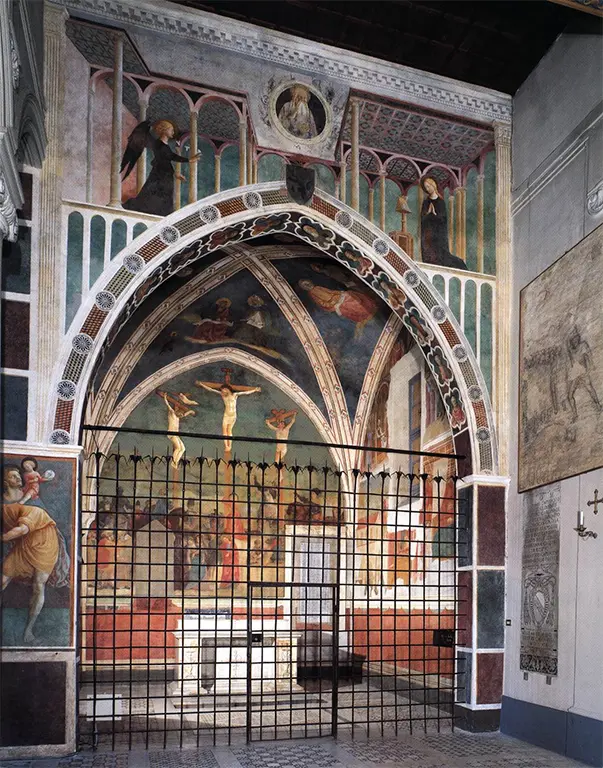
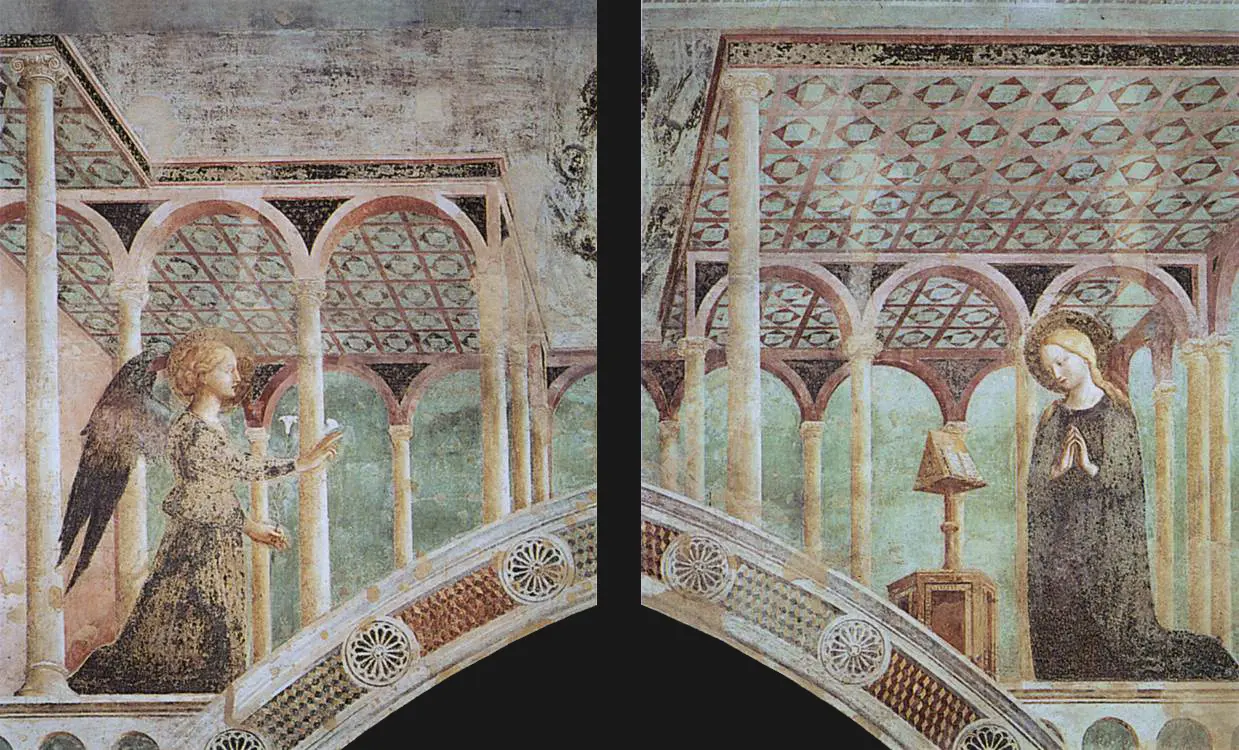
In the basilica of San Clemente (Rome), Cardinal Branda Castiglioni commissioned him to decorate the Chapel of Saint Catherine (c. 1427-1430) — a cycle with the Annunciation on the entrance pediment, the Crucifixion at the back, scenes of Saint Ambrose and Saint Catherine on the walls, and the Evangelists and Doctors in the vault; attributed to Masolino with no documented participation by Masaccio.18 The Annunciation on the pediment works as a symbolic threshold: the faithful enter the chapel passing beneath the announcement of the Incarnation — the scene does not decorate: it is a theological door. Technically, Masolino organises the space with a system of receding lines converging in frames, cornices and openings — the structure tried out in the Goldman placed at the service of the liturgy: a perspective that seeks not to surprise, but to accompany.
And around 1435, in the Baptistery of Castiglione Olona (Lombardy), he painted the Banquet of Herod — a true scenographic demonstration of the Brunelleschian system. A porticoed gallery advances with geometric rigour towards the back; the vanishing point, on the central axis, unifies the space and draws the gaze as far as the horizon. The architecture is not a backdrop: it is the visual protagonist — its mathematical precision and the rhythm of its arches organise depth and also the time of the story. Over that severe stage move the graceful figures of the International Gothic: the scene is Gothic in its forms and Renaissance in its spatial language — the old and the new, living together on the same wall.
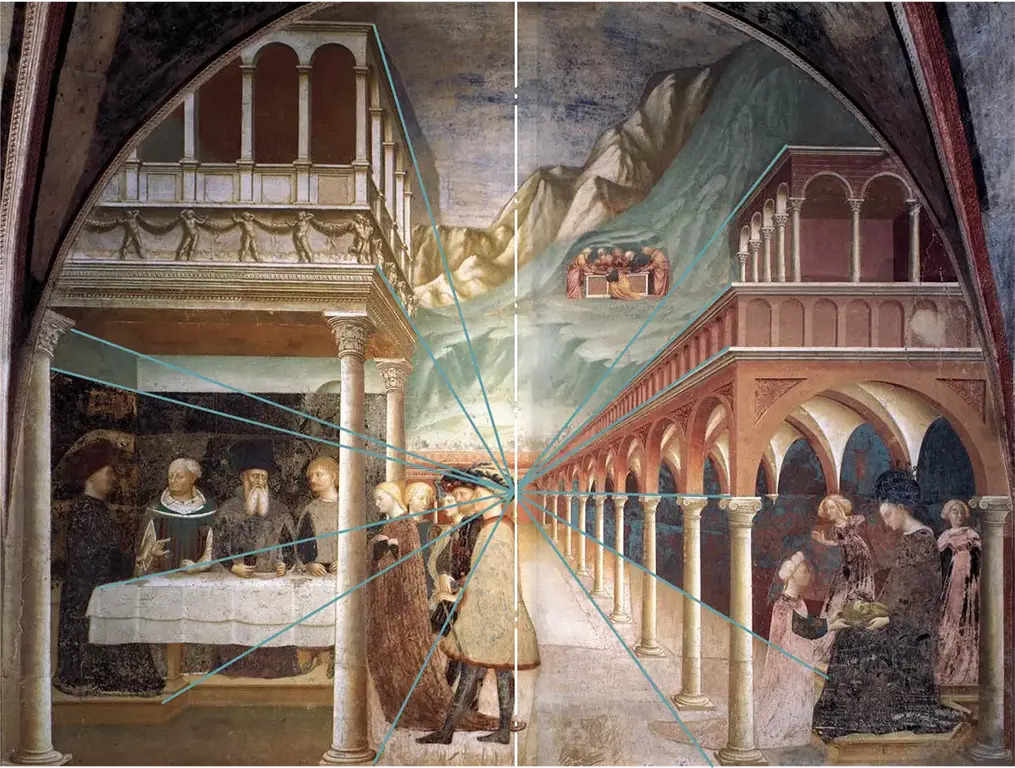
The scene also combines three moments in a single image — on the left, the banquet with Salome’s dance; on the right, the presentation of the head to Herodias; at the back, on the mountain, the burial of the Baptist by his disciples: medieval continuous narrative reinterpreted with new tools. And here perspective does something that deserves a name of its own: it becomes a temporal structure — the sequence of episodes is aligned with the architectural recession, from the dramatic present of the foreground to the final destiny on the horizon. The spectator’s gaze becomes a journey: from the courtly feast to the silence of the tomb.
What this leaves on the nativity-scene maker’s table. Two things. The first: recession can be a narrative path — what the nativity scene tells can be ordered along the depth: the immediate in front, the destination at the back; it is the same principle that the series of dioramas unfolds in successive boxes (A question of framing), compressed here within a single scene. The second: the contrast of Castiglione Olona — figures from one world, space from another — is a warning about coherence that the nativity-scene maker knows from experience: the figures and the stage must speak the same language, or the spectator notices the seam.
Three echoes to close
Five centuries later, we go on stretching threads, marking receding lines and building spaces where the visible points towards the invisible. Like Masaccio, like Donatello, like the masters of the Quattrocento, the nativity-scene maker too seeks that the gaze should not stop at the form, but discover a deeper meaning behind each plane, each light and each figure.
The nativity scene is not just a model or a Christmas decoration: it is a narrative architecture in which perspective, just as in the Renaissance, organises emotion, guides the gaze and gives depth to the mystery represented. From the vanishing point to the last light of the background, everything speaks, everything counts.
Brunelleschi had his panels; Donatello, his reliefs; Masaccio, his painted chapel. We have cork or plaster, moss or paint, and a worktable that is, at bottom, their heir. The materials change, but the gaze seeks the same thing: to give form to the invisible.
The map of the section — and what comes next
The course of the Quattrocento can be summed up in two stages separated by one date. Before 1435, perspective was a workshop secret: Brunelleschi’s experimental panels, Masolino’s Goldman Annunciation, Donatello’s Feast of Herod, Masaccio’s Trinity — works that apply a knowledge not yet written down anywhere. In 1435, Leon Battista Alberti publishes De pictura, the first theoretical treatise on painting and its perspective: the secret becomes public science. And after 1435 perspective unfolds as science and as language: the pictorial geometry of Piero della Francesca, the devotional space of Fra Angelico, the obsessive experimentation of Paolo Uccello, the mathematics of Pacioli, the aerial perspective of Leonardo, the classical synthesis of Raphael — and, in parallel, the Flemish road of light.
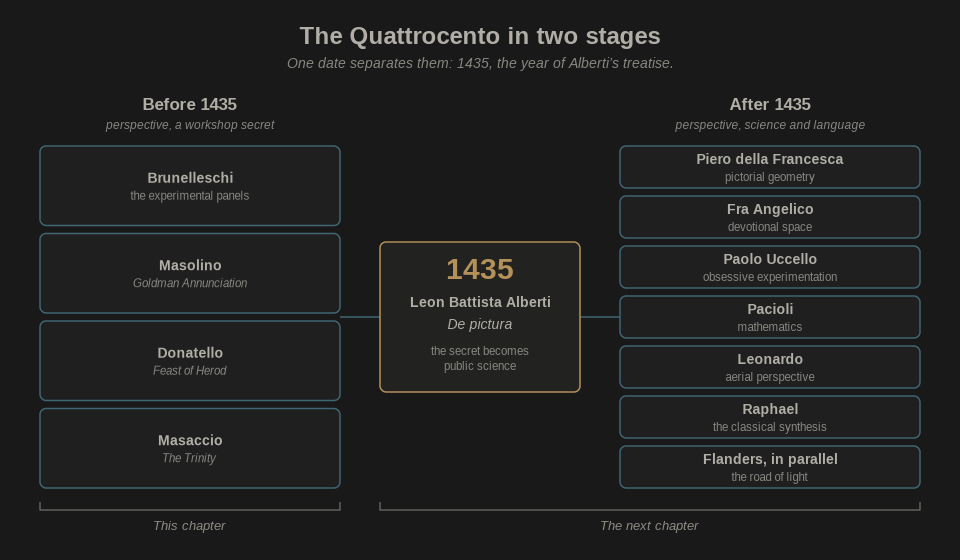
All of that — the treatise, those who came afterwards, Flanders, and the thread that comes down to the nativity-scene maker of 2026 — is the next chapter.
References
The sources of this chapter are presented in the body of the text, beside the passage they support — the reader should not have to come all the way here to know where what they read comes from. This section only recapitulates them for reference; the footnotes locate, and what has not been checked is declared in the text itself, where it is stated.
SMITH, A. Mark. Alhacen’s Theory of Visual Perception, «Transactions of the American Philosophical Society», 91 (5), 2001. — Historian of optics; critical edition and study of the De aspectibus. He enters for his judgement on the Ghiberti route («may well have been central» to Italian pictorial perspective). Central source for the scientific roots.
LINDBERG, David C. Roger Bacon and the Origins of «Perspectiva» in the Middle Ages, Clarendon Press, 1996. — Historian of medieval science. He enters for the transmission Alhazen→Bacon→Witelo. Supporting source.
GOLDTHWAITE, Richard A. The Building of Renaissance Florence: An Economic and Social History. — Economic and social history of Florentine building; the system of workshops and guilds. Supporting source.
BAXANDALL, Michael. Pintura y vida cotidiana en el Renacimiento (the Spanish edition of Painting and Experience in Fifteenth-Century Italy). — A classic on the «period eye» and the social conditions of the gaze. Supporting source.
MANETTI, Antonio (Florence, 1423-1497). Vita di Filippo Brunelleschi (15th c.). — Mathematician, architect and writer; the near-contemporary biography and only source for the panels. It is used as a period testimony, with the caution declared in the text.
VASARI, Giorgio. Le Vite (1550/1568). — Painter and historian; the portrait of the Florentine milieu. A period source, not a chronicle: it is used for atmosphere, not for fine detail.
WIRTZ, Rolf C. Donatello, 1386-1466 (Könemann, 2000). — Monograph. It enters for the data on the Siena programme.
ROBERTS, Perri Lee. Masolino da Panicale, Oxford, Clarendon Press («Clarendon Studies in the History of Art» series), 1993. — The monograph and catalogue of Masolino’s complete work. It anchors the biographical data and the cycles of San Clemente and Castiglione Olona.
JOANNIDES, Paul. Masaccio and Masolino: A Complete Catalogue, London, Phaidon, 1993. — Complete catalogue of both painters; documentation of Masaccio’s enrolment (1422) and of the collaboration in a shared bottega.
MOLHO, Anthony. «The Brancacci Chapel: Studies in Its Iconography and History», Journal of the Warburg and Courtauld Institutes, 40 (1977), DOI 10.2307/750991. — The classic study of Felice Brancacci’s patronage.
BALDINI, Umberto, and CASAZZA, Ornella. La Cappella Brancacci (1990; English ed.: The Brancacci Chapel, New York, Abrams). — Comprehensive monograph on the chapel, linked to the restoration of 1984-1990.
GOFFEN, Rona (ed.). Masaccio’s ‘Trinity’, Cambridge University Press («Masterpieces of Western Painting» series), 1998. — The reference volume on the fresco.
SMARTHISTORY. «Donatello’s Feast of Herod» and «Masaccio, The Tribute Money» (Beth Harris and Steven Zucker). — A popularising academic resource (video and text); the first inherited from the 1st ed., the second added in the check of 13 August 2026. It maintains that «Christ is the vanishing point»; the exact location — the mouth — comes from the Manual’s own construction lines, and is declared as such in the text.
THINKING 3D (University of St Andrews). «An important 13th-century book on optics», Thony Christie, 1 March 2019. — An annotated and illustrated entry on Witelo’s Perspectiva and its debt to Alhazen; inherited from the 1st ed. (which described it as an introduction to Alhazen’s Book of Optics; description made more precise after the check of 13 August 2026). Link in the chapter’s historical note.
Ibn al-Haytham (Alhazen, c. 965-c. 1040), Kitāb al-Manāẓir / De aspectibus (1011-1021): the intromission of light in straight lines. Via Smith 2001. ↩
Bacon and Witelo: via Lindberg 1996. ↩
The Italian translation De li aspecti (late 14th c.) and Smith’s judgement («may well have been central»): Smith 2001. ↩
Ghiberti, Commentario terzo (1452-1455): the citations of Alhazen, Ptolemy and Bacon. ↩
Manetti, Vita di Filippo Brunelleschi. ↩
San Niccolò Oltrarno and the milieu of the Carmine: Vasari (atmosphere); Goldthwaite and Baxandall (workshop system). ↩
Goldthwaite and Baxandall: entries in the list of sources of this chapter. ↩
Roberts 1993. ↩
Founding of Santa Maria Maggiore (Galleria Nazionale di Capodimonte, Naples; from the so-called Colonna polyptych). The two datings and Masolino’s journey to Hungary: Dillian Gordon, The Fifteenth Century Italian Paintings, vol. I, National Gallery Catalogues, London, 2003, entry on the Santa Maria Maggiore altarpiece, section «Attribution, Division of Labour and Date» (nationalgallery.org.uk/paintings/catalogues/gordon-2003/santa-maria-maggiore-altarpiece; accessed 24 November 2026), which sets out the positions of Joannides and of Roberts. ↩
Goldman Annunciation (National Gallery of Art, Washington, c. 1423/24): the dating is that of the museum’s record. ↩
Molho 1977 (DOI 10.2307/750991) and Baldini-Casazza. ↩
Joannides 1993. ↩
Smarthistory, «Masaccio, The Tribute Money», Beth Harris and Steven Zucker (accessed 13 August 2026): caption of the diagram, «Christ is the vanishing point»; in the video, «at the head of Christ». The fine location comes from the Manual’s construction lines. ↩
Wirtz 2000. ↩
Stiacciato: a documented technique of Donatello himself. ↩
Goffen (ed.) 1998. ↩
Roberts 1993: cycles of San Clemente and Castiglione Olona. ↩ ↩