
 ≈ 15 min
A work does not begin with form or with colour. It begins earlier: in whoever decides to make it.
Where a work begins
Where does every work of art begin? With form? With colour? With a well-thought-out composition? With none of these — or at least, not exactly. Before the first visible decision there are two invisible ones, and this chapter deals with both: the motivation — why this nativity scene is created — and the intention — what kind of work is sought. They are the two inner factors on the map of the section; the four material ones — budget, place, support, figures — wait in the next chapter.
The motivation: the engine
Every project that comes into being starts with an impulse, and in the nativity scene that impulse has many legitimate sources: the wish to convey a message, the emotion of recreating a scene, family tradition, the challenge of improving year after year. It does not matter which it is; what matters is keeping it in view, because without it there is no energy to create and no patience for the stumbles of the process — and with it confused, the other decisions wobble without anyone knowing why.

Something the manuals keep quiet about is worth saying: motivation weighs more than resources. A nativity scene of simple materials with a firm motivation and a clear message can hold together better than a technically impeccable one that does not know what it wanted to say. Technique is learned; the why is not improvised.
And the same holds for the other craft: whoever models a figure also needs their why — to know what that figure will have to be able to say on the day a scene receives it.
And the economic motivation? It exists, and not equally in the two crafts. In scenography money circulates, but hardly ever as the sale of the work: there are town councils that pay every year for the making of their nativity scene — these are public contracts, with their contractor and their amount in plain sight —1 and at fairs and in shops stables, caves and small constructions are sold. What is not known is the nativity-scene maker who devotes themselves solely to composing whole dioramas and putting them up for sale; the sculptor, by contrast, needs to sell in order to go on producing, and that need, with the marketing and the fashions it drags along, can condition the work — sometimes a great deal. This section is not going to deal with it. But saying that it is not dealt with does not excuse saying why, and the why is simple: the economic motivation does not enter into composition. One can compose perfectly well with an economic motivation, and also perfectly badly — it does not decide the quality of a scene, and what does not decide it is not taught in a section that teaches how to compose. Money as a condition is another matter: without money or funding there is no work, and that conditions things from the outset. An entry in Michelangelo’s own accounts shows it, dated 10 May 1508, the day he began the vault of the Sistine Chapel: he notes that he has received from Pope Julius II 500 ducats «per conto della pittura della vôlta della cappella di papa Sisto, per la quale comincio oggi a lavorare» — on account of the painting of the vault of Pope Sixtus’s chapel, «on which I begin work today».2 The first payment and the first day of work bear the same date. But then money is no longer a why, but a what with: the budget, the first of the material factors, which waits in the next chapter. What it does do — how it conditions the craft, what part each participant plays in that machinery — belongs to another territory of the Manual: that of who is who in the nativity scene. It is developed there (The ways out); here, it simply does not belong.
Three questions are enough to put it to the test, and they deserve an answer before a single bag of plaster is bought: why this nativity scene? What message or emotion is it meant to convey? What story is it meant to tell?
The script: knowing the story that is represented
A nativity scene is, in essence, the three-dimensional representation of a story: a visual narrative of the Nativity cycle. And here a distinction is in order that avoids misunderstandings: to enjoy a nativity scene it is enough to look at it; its beauty can move without the person looking knowing the story in detail. But to compose one, more is needed: whoever does not know the script — the biblical account and the tradition that surrounds it — runs the risk of building an empty scene, with errors of concept, unable to convey what gave it meaning.
There is also a rule that every nativity-scene maker knows without having formulated it: the more widely the code is shared — the characters, the episodes, the signs — the less text the scene needs; the more that code fades among the public, the more necessary it is for the script to be inside the composition itself, told by it.
An example from another art makes it clear. Whoever listens to the finale of Beethoven’s Ninth Symphony feels its force without needing anything more: the music is enough. But whoever also reads what the choir sings — Schiller’s Ode to Joy: universal brotherhood, joy as a bond — discovers another depth: what was only felt is now also understood. The nativity scene works the same way. It does not need a script to be beautiful; it needs one to say what it really had to say.
Finale of Beethoven’s Ninth Symphony, conducted by Herbert von Karajan, from minute 12:37. Hosted on YouTube. To watch it, open the cookie settings and allow audiovisual content.
That script, moreover, does not have to be sought far away: reconstructing it rigorously is exactly the work of the block «In search of the biblical nativity scene» — the map of the scenes of the cycle, the characters, the material world. This section takes that path for granted and refers to it; here it is enough to know that the script exists, that it is documented, and that composing without it is composing blind.
Every representation is an interpretation
The corpus that narrates the Nativity is silent about far more than it says: neither the day, nor the hour, nor the season is recorded — 25 December is an anchor of convention, declared as such in this Manual — and a good part of what the nativity scene shows fills silences in the text. The consequence is not a weakness: it is the nature of the craft. Every nativity scene, without exception, is an interpretation — the most traditional one too, even if its tradition hides this from it.
That is why there are many valid ways of representing the cycle: the orientalist style, the regional, the contemporary, even the abstract. All these ways of looking are legitimate and enrich the tradition. What must not be lost is the story itself: its core comes from the Gospels of Matthew and Luke, and when a nativity scene moves away from it unknowingly, it is left as a handsome piece of scenography — but without a reading, without a language, without what held it up. To interpret is not to move away from the story: it is to choose, knowingly, where to tell it from.
The intention: what kind of work is sought
With the why made clear, the what for remains: not every nativity-scene creation pursues the same thing, and naming what is sought saves years of confusion. Three intentions run through present-day practice:
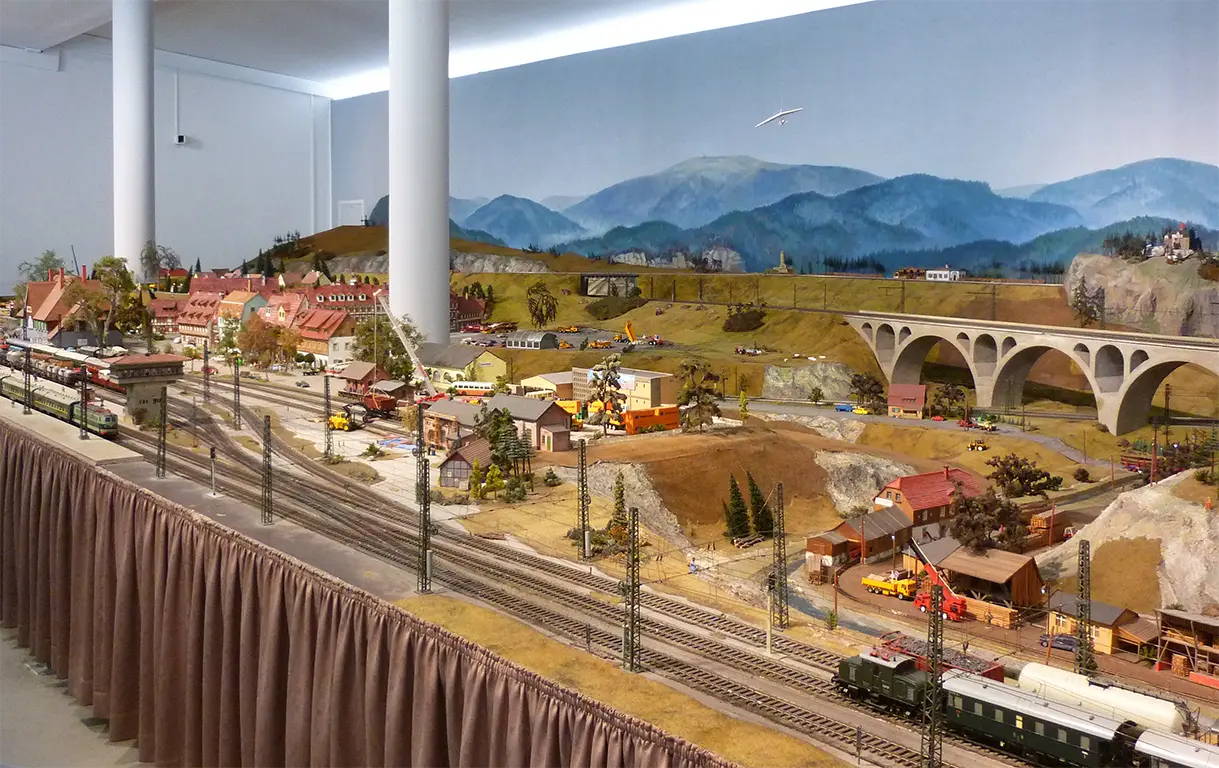
The model-type nativity scene. Its endeavour is exhaustive miniaturisation: like model railways or military dioramas, it accumulates elements, trades, corners — and its strength lies precisely there, in the meticulousness and the wonder of detail. Narration is not its priority; constructive skill is.
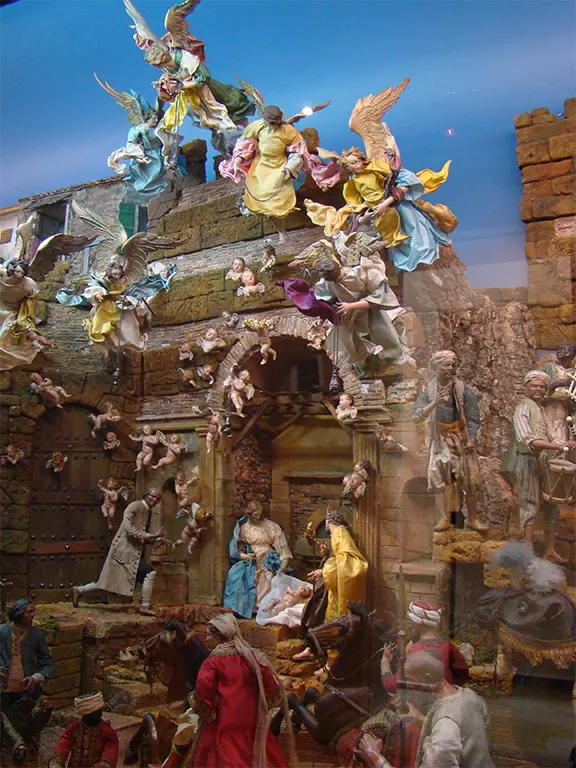
The figurative artistic nativity scene. Here every figure, every colour and every light is at the service of a story: everything is ordered so that the observer does not only look, but receives the scene and what it tells. Its centre is usually the Nativity, and its instrument, composition. It is the type on which this section will dwell longest, because it is where composition and story work together.
The conceptual or contemporary nativity scene. It places an idea above formal fidelity — a social, poetic or critical thesis — and may sacrifice recognisable form to symbolic impact. But it does not escape composition: rhythm, scale, light and colour remain its tools for making the idea understood.

Each intention, moreover, asks for different figures — in style, in gesture, in degree of detail: the sculptor too composes for an intention, and knowing it before modelling avoids figures that find no scene.
And one clarification that avoids the commonest error: there is concept in all three. The model revolves around the idea of the miniaturisation of the world; the figurative one, around that of the story of the cycle; the conceptual one, around a more abstract thesis. The difference is not the presence or absence of concept or of composition, but what is underlined and to what end.
Lastly, this division should be kept apart from another that this block has already withdrawn. The pigeonhole «popular or artistic» classified nativity scenes in order to rank them, and it was dismantled in its chapter (The story of a half-finished reading): the value of a nativity scene is judged work by work, not by pigeonholes. The division by intention is something else: it does not order from better to worse — it describes what each work seeks, so that each creator knows what they are choosing and this Manual knows whom it is addressing. An excellent model-type nativity scene is worth more than a failed artistic one; the intention is not a rank: it is a direction. A model of Venice is not the same thing as a veduta by Canaletto — a painted view of the city: the two may be worth the same as a work carried out for its purpose, and they are not the same as regards their final task.
When the path begins the other way round
The impulse is not always born within. Sometimes the motivation and the intention arrive from outside: one is a member of the local nativity-scene association and the annual exhibition comes round, or a commission arrives — from an institution, a church, a hospital, a school. In these cases the map is travelled in reverse: the four material factors are given beforehand — one knows what there is to work with: the space, the budget, the support, often the figures — and the inner decision consists in accepting or not. And here is what matters: if one agrees to carry it out knowing those conditions, the motivation already exists — and with it its intention. To accept a commission is to answer the questions of this chapter all at once, only in another order. The map does not change its pieces: it changes the direction of travel.
From the why to the what with
With the motivation in view and the intention chosen, the nativity-scene maker already knows two things that no technique can give: why they create and what kind of work they seek. What they do not yet know — unless the path began the other way round — is what they have to work with: how much they can invest, where the scene will be seen, what it will rest on, which figures will inhabit it. Those are the material conditions, and they are the next chapter: the limits within which every composition, the best one too, takes place.
References
Comunidad de Madrid, Portal de la Contratación Pública, file P/SER-023593/2025, «Belén, Navidad 2025/2026»: service contract awarded by the Consejería de Presidencia, Justicia y Administración Local to the Asociación de Belenistas de Madrid for 48,000.00 euros (contract of 3-X-2025). Toledo City Council, «Anuncio de apertura de recepción de proyectos» for four nativity scenes for Christmas 2021, open to «Asociaciones o empresas», total amount €8,000.01. Consulted on 22-XI-2026.
Michelangelo Buonarroti, note (ricordo) of 10 May 1508, in Le lettere di Michelangelo Buonarroti pubblicate coi ricordi ed i contratti artistici, ed. Gaetano Milanesi, Florence, 1875, p. 563. Read in the digital transcription of Project Gutenberg (no. 46599), consulted on 22-XI-2026. The translation is this Manual’s.