
 ≈ 20 min
Limits are not the enemy of the work. They are the ground on which it happens.
From the inner to the material
The previous chapter left the nativity-scene maker knowing why they create and what kind of work they seek. This one deals with what remains to be known: what they have to work with. Four material factors — the budget, the place, the support and the figures — mark the limits within which every composition takes place, and it is worth saying from the start how they should be looked at: they are not obstacles to lament, but facts to know. A composition does not begin in spite of its limits; it begins by knowing them — and more than once, thanks to them.
The strongest proof was already given in this block: the diorama box is pure limitation — six sides, a single window — and from that limitation comes its unique advantage: total control of the light (A question of framing). That is how well-known limits work: they do not only bound the work — they give it form.
The budget: the limits of what is possible
It tends to be taken as obvious, but it is basic — and a manual of nativity-scene making has to explain it, above all for those starting out. The budget conditions the whole creative process: from the selection of figures to the design of the support, everything depends on how much one is willing, or able, to invest. Far from being a brake, it is a tool for deciding: it obliges one to prioritise the essential, which is exactly what composition also asks.
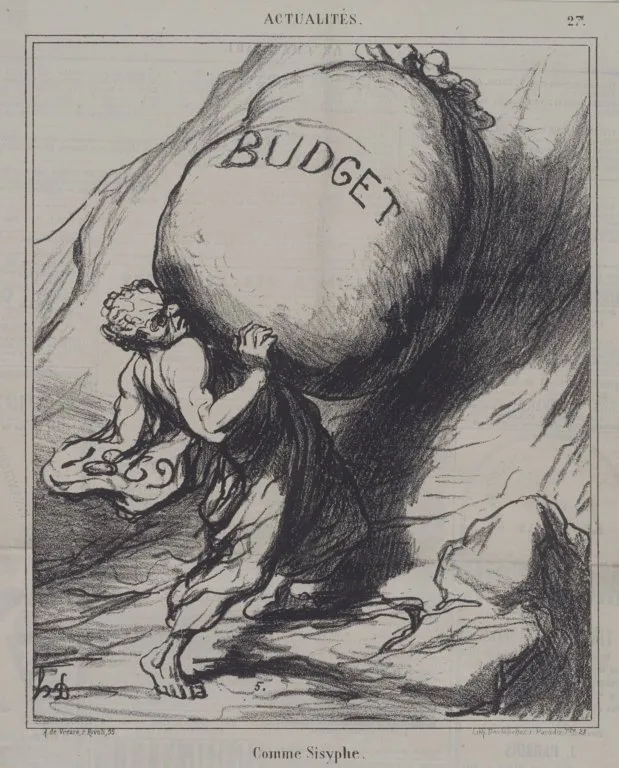
It does not matter whether it is large or small; what matters is knowing how it is distributed. The useful questions are about allocation: more on figures or on materials for the support? What can be used from home, from the countryside or from previous years — remembering that the gathering of moss, of certain plants such as holly or yew, and of volcanic stones is prohibited or regulated according to the rules of each territory —1? What can be reused or recycled? A tight budget does not prevent creating something that holds together: scarce resources tend to awaken ingenuity — inexpensive materials, figures modelled by oneself, recovered decoration. And it is worth remembering that the nativity scene is a project that grows over the years: it does not need to be complete in a single Christmas.
Managing and optimising the budget
For more effective control, three fronts:
1. The breakdown of costs:
- Fixed or initial costs: the basic tools (craft knife, glue, brushes, etc.), although many people already have them.
- Costs of building materials: cork, expanded polystyrene, plaster, paints, sawdust, glue, and so on.
- Costs of figures: the item that can vary most — by a nativity-figure sculptor, from a workshop, commercial, of different sizes, etc.
- Lighting costs: cables, bulbs, transformers, special effects (water, smoke).
- Decoration costs: artificial moss, trees, plants, animals, accessories.
- «Hidden» or transport costs: the trips to several specialist shops, the search for elements.
2. Saving strategies:
- Wish list versus list of needs: prioritising what is indispensable for this year’s vision of the nativity scene and what can wait.
- Price research: comparing in different shops — physical and online — street markets, craft shops.
- Staggered purchases and offers: acquiring materials outside the Christmas season, when discounts tend to appear; and keeping an eye on specialist auction sites, where figures can offer good opportunities.
- Exchange or loan: in an association or a group, sharing or lending elements among nativity-scene makers. Many associations have materials available: joining the local one is good advice — economically too.
- Self-production: modelling one’s own figures is not only an excellent way of reducing costs — it is also, as will be seen when the figures are discussed, the route of greatest creative freedom.
3. The investment of time, a resource that does not appear on the invoices:
- Looking for inexpensive materials, recycling or making elements does not cost money, but it costs hours, and those hours have value. If the nativity scene born of the motivation is impracticable in the time available, it is better to think it over before starting: either the project will be paid for in sleepless nights, or it will not be ready to open at Christmas.
- Two questions measure it: how much real time can be devoted to the project each week? What level of complexity is manageable within the deadlines?
The value of a nativity scene is not in its price. Nor are passion and dedication enough: there can be a great deal of both and the scene may still not move anyone. And the same happens with constructive technique: it can be excellent and, without composition, convey nothing. With the budget defined, the next factors can be approached clearly. Art also flowers in small pots: to move people, telling something does not depend on size or cost.
The place: the condition
The site where the nativity scene will be shown influences almost every creative decision: a corner at home, a room open to the public, the association’s diorama exhibition. And it is worth realising that the condition is not always imposed: often the place is chosen, and choosing it is already a decision of composition — whoever opts for the shelf is choosing intimacy and scale; whoever opts for the hall, public and distance. Each option brings its limits and its possibilities. When choosing the location, the following aspects should be considered:
- The size of the space: it defines the dimensions of the nativity scene — designing an intimate scene for a small shelf is not the same as a large nativity scene on several levels on a big table, or a diorama. Does the furniture need rearranging? Will the space be for the nativity scene alone or shared?
- The lighting: is it a space with good natural light, or will artificial lighting have to be added to bring out the details? The point also affects the budget and may condition the final idea: a night scene cannot be achieved with excessive ambient light. The availability of sockets and the electrical capacity also count; and if natural light enters, the direction it comes from matters — it can produce unwanted shadows or reveal imperfections.
- The visibility: the height and the angle from which it will be observed — a nativity scene at floor level has a different impact from one shown at eye level. The background and the immediate visual surroundings matter too: they should complement the scene and not distract from it. In public spaces, it is worth observing whether the architecture or the surroundings contribute or condition — a real background can help or distract.
- Accessibility: in a public place or where there are small children, the nativity scene has to be safe and stable, without fragile or unstable elements. To this are added protection against dust and, in prolonged outdoor exhibitions, the conditions of temperature and humidity for the conservation of the materials: a nativity scene exhibited only on Christmas Eve and Christmas Day is not the same as one installed from 8 December, the feast of the Immaculate Conception, to 2 February, Candlemas — a traditional period of up to 57 days. The materials and the structure are adjusted to the expected duration.
- The flow of people: in busy spaces, how will the movement of visitors be managed so as to allow good observation without compromising the integrity of the nativity scene?
- Assembly and dismantling: can the platform and the structure be assembled and dismantled without difficulty? Is there enough room to work around the diorama when installing it? If it is not built in situ, the doors it has to pass through should be measured first — to avoid surprises. And where are the transport boxes stored temporarily, if it has to be moved to be exhibited elsewhere?
- Noise and the sound environment: whether the surroundings favour the contemplation of the nativity scene or introduce noises and vibrations that may distract or affect the experience.
These recommendations will be refined when each type of nativity scene is dealt with: depending on the framing — multiple or single (A question of framing) — the decisions about the place call for different nuances. What does not change is the substance: the place does not only condition the size and the design; it conditions how the work will be perceived.
The support: the decision
In all the arts the work needs a support: something physical in which to be born, take form and be contemplated. The painter has the canvas, the panel or the wall; the photographer, the draughtsman and the printmaker, their papers; theatre, opera and ballet are performed on a stage; cinema lives on a data medium and a screen. The nativity scene needs one too, and there is no single one: depending on the intention and the type of framing it may be the floor itself, a shelf, a table, a frame, a raised structure, a box.
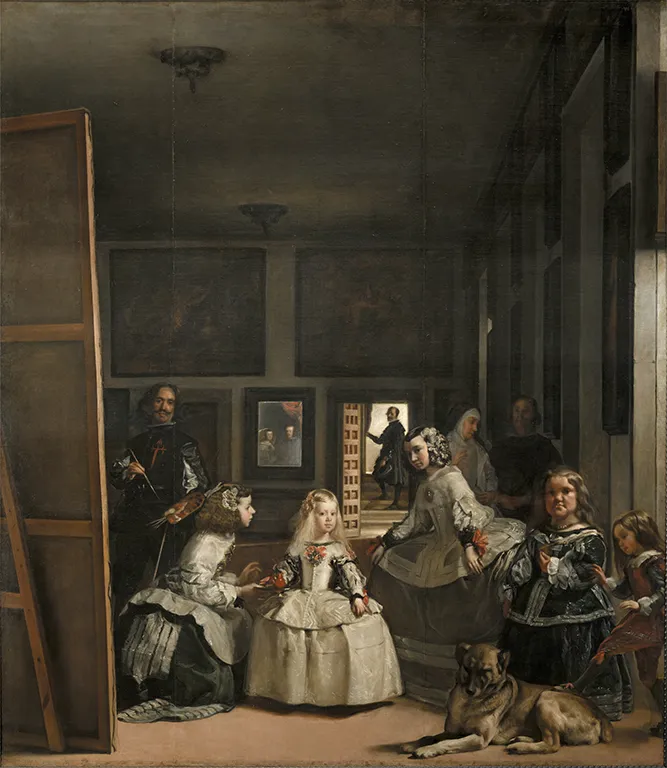
Is the support a limit or a possibility? Both, and that double condition is not a misfortune: it is what it shares with all the supports of art. The support conditions, yes — and it also offers. And it is worth saying plainly, because the easy way out would be to imagine that one can do without it: the support cannot be eliminated; it can only be replaced. A nativity scene without a support exists in only two places, and in both it ceases to be a nativity scene: in the imagination — where it is a project, not a work: the idea alone is not enough, the work demands tangible form (Is nativity-scene making an art?) — and in a written explanation — where it is already literature, and even there the support persists: the page has it. Digital or immersive forms do not eliminate it either: they change its material — the screen, the headset. And what holds for the whole holds for each piece: every figure needs a stable support. It could be hung from a fishing line, or float in an antigravity chamber; but the line is already a support, and the chamber is the extreme that measures how far one has to go to pretend it is not needed. Without a support there is no nativity scene.
The question, then, is never whether to use it, but how to use it consciously — and to use it consciously it helps to see it for what it is. Art is an act of communication: a sender — the artist — a message — the work — and a receiver — the observer. The support is the medium through which that message travels, and no medium is neutral; the richness lies not in an impossible neutrality, but in the awareness with which it is used and the freedom with which it is interpreted.
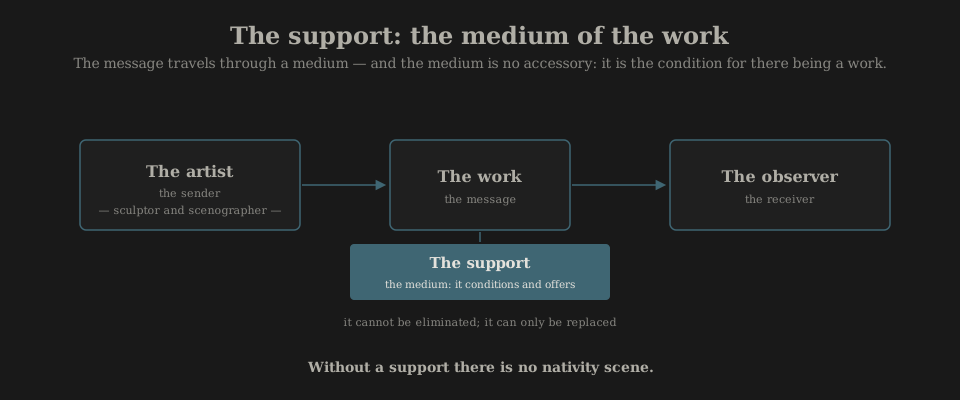
The underlying objection remains — that a support which fixes the gaze imposes it — and it was answered in this same block: to compose a gaze is not to impose it, and whoever receives a composed gaze receives a work, not an order (A question of framing). The specific supports — which one suits each type of nativity scene, with what technical, narrative and compositional needs — will be dealt with when each type is examined in depth.
The figures: the starting point
The figures are the heart of the nativity scene. Without them — even if they were abstract forms, voids or mere suggestions, like the angel, which in this Manual is not modelled and is represented by light — there would not properly be a nativity scene: there is landscape, there is scenography, but there is no story.
That the figures close this chapter does not make them last: here the factors are ordered by how they are obtained — and obtaining figures always passes first through the budget, wherever they come from, except by inheritance, loan or gift; in the order of composing, as will be seen shortly, the figures come first.
Which first, the scene or the figures? The question is one of those that spare disappointments, and it is worth answering precisely, because there are three ways of proceeding and they are not worth the same. The first is the safe one: the preliminary sketch — drawing the scene before building it, with the figures already decided inside it. In a sketch the possibilities are studied: one erases, draws again, examines the whole composition — and in making those sketches, the idea gradually takes shape in the mind. The second: improvising with the figures in front of one, keeping the idea in the imagination. It can be done, but it is worth knowing what is being taken on: erasing and correcting what has already been built — decorated scenes, landscapes, directions of rhythm, balances, contrasts: everything the world of composition comprises — is far more difficult than on a schematic sketch, and for that reason this route demands a good knowledge, or a good intuition, of composition — beforehand. And the third is the one that gives the worst results: building the scene first and fitting the figures in afterwards. The visual result will be just that, a fitting-in — like those albums with a background drawing onto which stickers are stuck to form the whole: when the background does not match the stickers, everything is left confused and incoherent.
In either of the two good routes, the figures come before the scene — in the sketch or in front of one’s hands, but before. Because the figures determine the scale of the setting; the arrangement — a leading role does not occupy the same place as a supporting one or an extra; the light — an intimate scene is not lit like a public one, nor an interior like an exterior; and the style — composing with figures of orientalist, popular or contemporary style is not the same thing.
And they determine something deeper, which the prologue stated: the figure arrives at the scene already composed. This is where the two crafts of the section touch. The sculptor decided a gesture, an attitude, a direction of the gaze, an age, a trade, a dress — all of them decisions of composition — and the scenographer composes with them: their first task with each figure is to read it — what it says and what it asks for: how much space, what company, what light, what ground. The river fisherman of the prologue asked for water; each figure brings, like him, its conditions written in its body.
There are several routes to having figures, each with its advantages and its limits:
- Modelling them oneself. Deciding to model one’s own figures gives total creative freedom: each piece reflects the vision of whoever makes it, with expressions, postures and attitudes perfectly aligned with the story and the atmosphere imagined. It is true that modelling requires time and learning, especially in aspects such as anatomy, proportions and formal coherence. There is no need to reach the level of a professional sculptor, but there is a need to seek harmony with the scenography: the aim is for the figures, even if they are simple, to be integrated coherently and in balance into the whole of the nativity scene. The satisfaction of seeing one’s own creations come to life in the nativity scene is immense: each figure bears the personal stamp of whoever modelled it and an incalculable value, because it also tells its own story. Many nativity-scene makers find in this process, beyond the practice and the time invested, their greatest reward: enjoying and learning at every step, without the pressure of competing with the professionals.
- Buying them ready-made — at Christmas fairs, in specialist shops or from the catalogues of nativity-figure sculptors and workshops. It is the practical option, and it also imposes limitations: the scene will have to be imagined from what is on the market, and one will have to adapt — sometimes the combination of scale, gesture and style that is needed does not exist.
- Commissioning them from a sculptor. The balance between freedom and quality: the idea is presented to the sculptor, who interprets it applying their style and artistic background — like the playwright and the actor, or the composer and the performer. It requires budget and availability, but it can give rise to unique works.
- The nativity-scene associations. They have figures, but they do not usually lend them: they are for the exhibitions the association itself holds. The member composes with them within those exhibitions, and is limited to what the association has.
- One’s own collection. Whoever already has a set of figures can start from them to define the composition. It saves time and cost, and it also obliges one to adapt to their characteristics: the scale, the style, the poses, the number of characters.
From the what with to the word
With the six factors of the map in hand — the why, the what for, and these four what-withs — the ground is prepared. There remains the word that gives the section its name: what exactly is composing? Where the term comes from, what those who thought about it before understood by it, and why it is a language that is learned — that is the next chapter, and with it begins what this section came to teach.
References
Two examples. The Community of Madrid prohibits gathering moss, yew and holly in its woodlands, as they are protected species (official note «La Comunidad de Madrid recuerda la prohibición de recoger musgo, tejo o acebo en el campo», 15-XII-2018, comunidad.madrid). In Catalonia, Law 2/1982, of 3 March, on the protection of the volcanic zone of La Garrotxa, art. 3.4: «Queda expressament prohibida per aquesta Llei tota classe d'extracció de gredes i de granulats lleugers de qualsevol mena» — every kind of extraction of volcanic gravel and lightweight aggregates of any sort is expressly prohibited by this Law — in the natural site and in its strict reserve. Consulted on 22-XI-2026.