
 ≈ 7 min
Nearly all nativity-scene makers compose. Hardly any of them call it that.
A practice without a name
Every Christmas a familiar ritual is repeated: the figures, the moss, the cork, the lights — and at the end, looking at the whole, the feeling often arises that something is missing. That something has a name, though it is hardly ever spoken: composition — the art of turning loose pieces into a scene that holds together and says what it meant to say.
It is worth looking closely at a very small gesture, because everything is in it: whoever places a figure, looks at it, turns it a little, moves it back a hand’s breadth «because it looks better that way», is taking visual decisions. They are composing. Most nativity-scene making is done like this — by an intuition trained through years of looking — and that way of working is not a defect: it is the spontaneous form of a craft practised without its name. This section of the Manual begins by giving it one. The point is not to teach a new skill, but to name, order and sharpen one that is already being exercised.
Two crafts compose
One clarification before the map, because it is easily forgotten and the forgetting is costly: two crafts work in nativity-scene composition, even if the same person sometimes exercises both. The sculptor composes the figure — the gesture, the attitude, the drapery: decisions of composition taken before any scene exists. The scenographer composes the scene: places those figures in space and light. The chain is closed by the observer, who receives without explanation what the two prepared. This section speaks to both crafts: whoever models their own figures exercises them at once; whoever acquires or commissions them works with decisions someone else took, and their craft begins by reading them — because the scene must take in what the figure already says. A figure of a river fisherman asks for water: placing it where there is none is not adapting to the figure, it is contradicting it.
Before the techniques, the conditions
The temptation of every manual of composition is to begin with the rules: the thirds, the rhythms, the centres of attention. It is worth resisting, because by the time the first figure touches the moss decisions have already been taken — nearly always without knowing they were being taken — and it is those prior decisions that the rules will come to serve.
Six factors prepare the ground for any nativity scene, and they are not of the same order. Two are inner: the motivation — why it is created: tradition, a message, the challenge of improving year after year — and the intention — what kind of work is sought: the exhaustive model does not pursue the same thing as the artistic scene or the conceptual piece, and the next chapter tells them apart. Four are material: the budget, which marks the limits of what is possible and is a tool for deciding before it is an obstacle; the place, the condition that is accepted or chosen — where it will be seen, in what light, at what height; the support, the decision that is taken and built — what the scene rests on; and the figures, the visual and narrative starting point — without figures there is landscape, there is scenography, but there is no story.
The inner factors orient; the material ones condition. And composition is not a seventh factor on the list: it is what brings them all into relation — the clearer the why, the what for and the what with, the more surely it will give visible form to what was meant to be told.
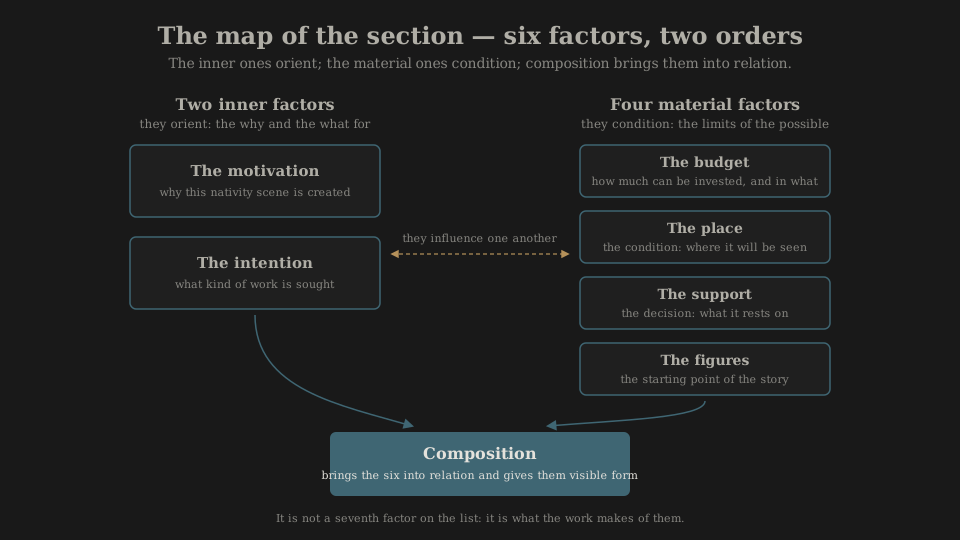
These six factors influence one another and are not travelled in a straight line: the budget corrects the intention, the figures available redefine the place, and more than one motivation has become clear halfway through. The map is a flexible guide, not a fixed recipe: it sets the starting point and orders the questions, nothing more — and nothing less.
Rules are learned in order to choose
The chapters on technique will speak of rules, and the word is more imposing than it should be. The rules of composition are not a rulebook: they are accumulated observation — centuries of people who stopped to look at why some scenes work and others do not, and left on record what they found. Knowing them does not oblige anyone to follow them: it gives the possibility of choosing — following them, adapting them or breaking them — knowing what is being chosen and at what price. Whoever does not know them also chooses, only blindly: they inherit, with each household’s way of doing things, decisions that others took for them.
The plan of the section
The order of the chapters reproduces the order of the work. The next one deals with the two inner factors — the motivation and the intention: what moves someone to create a nativity scene and what kind of work is sought. The third, with the four material ones — budget, place, support and figures: the limits within which every composition takes place. The fourth dwells on the word itself: what exactly composing is, where the term comes from, why it is a language that is learned. And from there, the techniques: the concrete instruments with which a scene is ordered for the gaze.
What a name changes
Composition does not begin when the first figure is placed: it begins earlier — in the why, in the what for, in the conditions that are accepted and those that are decided. That is why this section starts where it starts. And that is why the word mattered: putting a name to what is already being done does not change what is done — it changes what can be decided.